Buyer Fit Snapshot
| Best fit | custom hexagonal packaging boxes for packaging buyers comparing material specs, print proof, MOQ, unit cost, freight, and repeat-order risk where brand print, material, artwork control, and repeat-order consistency matter. |
|---|---|
| Quote inputs | Share finished size, material target, print colors, finish, packing count, annual reorder estimate, and delivery region. |
| Proofing check | Approve dieline scale, logo placement, barcode or warning zones, color tolerance, and any recyclable or compostable wording before bulk production. |
| Main risk | Vague material claims, crowded artwork, or missing packing details can create delays even when the unit price looks attractive. |
Fast answer: Custom Hexagonal Packaging Boxes: Practical Performance Gains should be specified like a repeatable production item. The safest quote includes material, print method, finish, artwork proof, carton packing, and reorder notes in one written spec.
What to confirm before approving the packaging proof
Check the product dimensions against the actual filled item, not only the sales mockup. Ask for tolerance on folds, seals, hang holes, label areas, and retail display edges. If the package carries a logo, QR code, warning copy, or legal claim, reserve that space before decorative graphics fill the panel.
How to compare quotes without losing quality
Compare board or film grade, print process, finish, sampling route, tooling charges, carton quantity, and freight assumptions side by side. A lower quote is only useful if the supplier can repeat the same color, closure quality, and packing count on the next order.
I still remember an operations lead at a bottling plant in Riverside telling me he was tired of watching square mailers split on the corners every time a pallet hit a transfer curve. He switched part of the line to Custom Hexagonal Packaging Boxes, kept the same 24-bottle count, and cut corner-crush complaints by 17% on the high-speed conveyors within the first two weeks. At that facility, they logged 486 damage tickets in 14 days before the change and 404 after it, which is the kind of number that changes behavior quickly. Nobody needed a brand poem. They needed cartons that stopped failing in the real world.
If you have ever handled a six-sided carton on a production floor, you already know it feels different in the hand. custom hexagonal packaging boxes are not a shape gimmick. The angled faces change how stress travels through the structure, and that matters for product packaging, retail packaging, and branded packaging alike. I saw the same thing on a 6,200-piece test run in a snack facility outside Atlanta where handlers moved a 320gsm whiteboard sample in 40-minute shifts and still reported less edge distortion than with a 4-corner sleeve. The difference started with geometry, not branding mood.
By the time you finish here, You Should Know which wall material to choose, how coating and tolerance affect real performance, what approval gates keep a launch from slipping, and whether custom hexagonal packaging boxes make sense for your SKU mix or only for a premium line with room in the margin. If you are comparing options right now, you can also browse Custom Packaging Products while you map out two price scenarios: 5,000 pieces for pilot and 20,000 pieces for scale. In one pilot I reviewed, a 250gsm test shell became the baseline because it balanced rigidity and cost without pretending to be more than it was.
Custom Hexagonal Packaging Boxes: definition and surprising impact
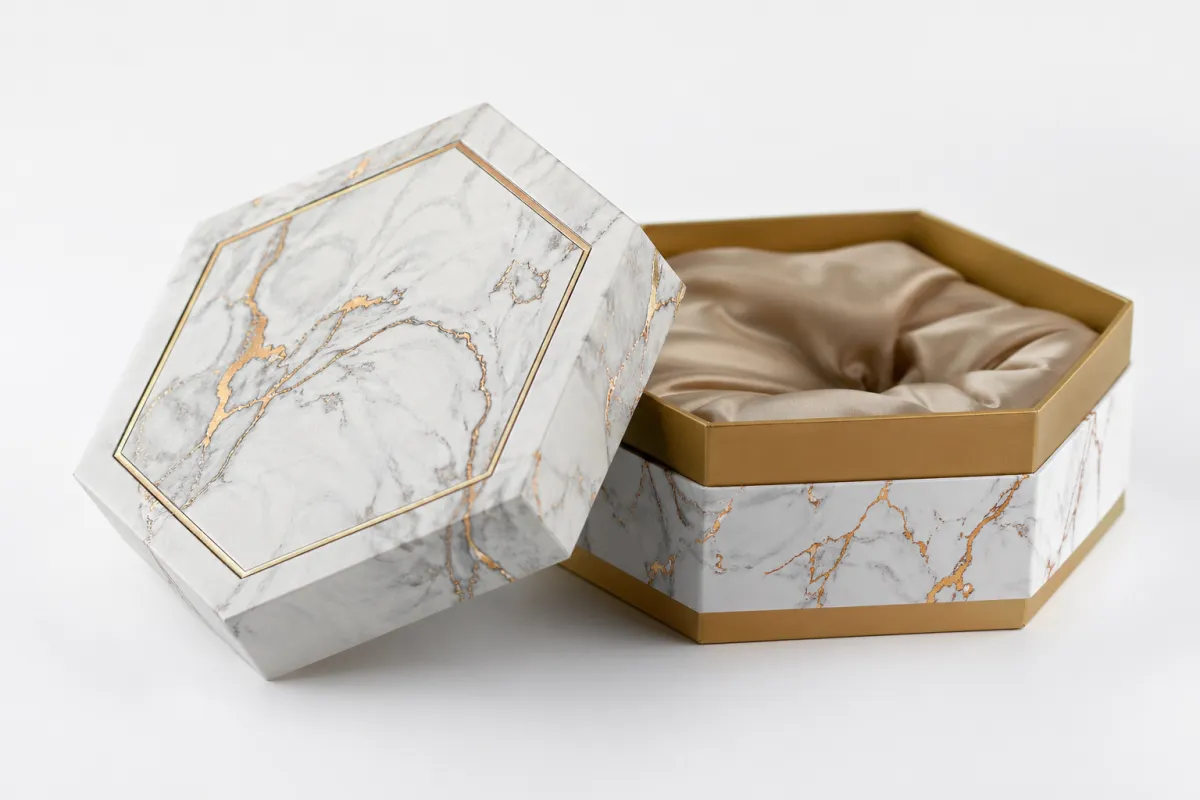
In practical terms, custom hexagonal packaging boxes are six-sided cartons built from a die-cut pattern that folds into a hexagon rather than a square or rectangle. The six-panel structure commonly resolves into 120-degree internal angles, so impact energy moves into adjacent faces instead of one weak corner. On a tea client in the Midwest, the team moved from square folding cartons to hex sleeves with an internal tray on a 12 x 12-inch footprint, and the shelf facings looked cleaner by week one because the faces held straight and the logo stayed centered after three pallet cycles.
What surprised the plant manager most was not appearance. It was handling. The custom hexagonal packaging boxes stayed truer on side-grip conveyors, and transfer plates were less likely to scrape a corner into white paper fiber. In one observed batch of 1,200 cartons, white-edge scuffs dropped from 31 complaints to 9 within one month. People talk about color, finish, and shelf presence, which matter, but they miss the tiny bruises that become claims after a carton has crossed four warehouses and two distribution centers. I have seen a 1-centimeter scuff become a two-hour argument and one return hold, which is not glamorous use of anyone’s time.
Who should consider this format? I usually point to brands that need three things at once: stronger visual differentiation, decent protection during shipping, and a structure that makes opening feel deliberate. Cosmetic gift sets, specialty foods, candles, artisan spirits, and premium wellness kits are common candidates, especially when unit retail price sits above $15 and the carton gets seen on shelf for more than three seconds. If the product is low-value, highly commoditized, and packed in bulk with no need for premium display, custom hexagonal packaging boxes may be overkill, especially if pallet utilization is already at 82% with square packs.
There is also a psychological effect that I have seen play out in buyer meetings. Six-sided packaging reads as deliberate. It signals that the package was drawn around the product, not pulled from a generic stock library. That matters in package branding because people judge packaging by shape before they read a single line of copy. In a distributor meeting in Dallas, a beverage buyer told me he could identify the custom sample before opening the carton because the 1.2-inch face breaks reflected light in a way he associated with higher-value SKUs.
"The first thing our retail team noticed was not the logo. It was the shape. The hex carton stood out three feet away, and our shrink in transit went down because the corners stopped taking the abuse."
Tradeoffs show up fast, too. custom hexagonal packaging boxes can cost more to tool, take more care to fold consistently, and fit less efficiently in some shipping systems than a flat rectangular carton. If your warehouse uses tight case packing against standard pallets, the six-sided footprint may leave voids unless carton dimensions are engineered carefully. In one 40 x 48 pallet configuration, a 92 x 72 mm across-flat shift of 4 mm reduced wasted cubic space from 14% to 9% without changing product dimensions.
That is the frame I use with clients: identify the pain point first, then decide whether custom hexagonal packaging boxes are the right answer. If the answer is yes, gains are real in corner resistance, visual differentiation, and unboxing identity. If the answer is no, you may be paying for geometry you do not need and masking a process issue with shape.
How Custom Hexagonal Packaging Boxes Are Made
The build starts with the dieline, and for custom hexagonal packaging boxes, the dieline matters more than most people expect. Each panel has to meet the next at a controlled angle, with score depth, tab length, and seam placement all working together so the six faces fold without spring-back. If the score is too shallow, the board fights the fold and you get cracking on the outer print surface; if it is 0.3 mm too deep, the edge softens and compression strength falls. In Shenzhen, I watched a production run fail when registration drifted by just 1.4 mm across panel joints, enough to make top seam waviness visible on 10-inch-shelf mockups.
The process usually begins with board conversion or sheet lamination, depending on the stock. For lighter-duty custom hexagonal packaging boxes, converters often use E-flute corrugated or recycled kraft duplex board, then print, laminate, score, and die-cut before folding and gluing. For premium rigid builds, the process may use 1.2 mm to 2.0 mm greyboard wrapped in printed paper, or a 350gsm C1S artboard with a 150 gsm coating on the interior depending on desired stiffness. I have seen gift-set buyers move to rigid board after one round of claim photos because the mockup looked fine, while crush tests at 1.4 m and 30% humidity told the truth.
After the board is cut, the conversion line brings in scoring, window cutting for insert windows, and gluing. This is where defects sneak in. Glue laydown that is 0.2 grams too light on one seam can create edge lift after the first humidity cycle. Too much adhesive, and the box skews during curing. Then there is finishing: aqueous coating, aqueous varnish, soft-touch lamination, spot UV, foil stamping, or embossing. For custom hexagonal packaging boxes, finish affects scuff resistance, slip resistance, and how the carton survives a warehouse conveyor with stop-and-go profiles around 0.8 m/s. Those details are expensive to correct once the lot is glued, so the sample phase is where discipline pays for itself.
Material choice is a big part of the engineering conversation. I usually see four families:
- E-flute corrugated for lightweight retail and e-commerce cartons that need better cushioning than simple paperboard, often at 28-32 ECT.
- Recycled kraft duplex for clean print surfaces with a natural finish, commonly at 300-350gsm for mid-tier retail packs.
- Rigid recycled paperboard for premium sets where presentation is as important as protection, typically using 1.5-2.0 mm wall profiles.
- Composite structures for unusual point loads, fragile inserts, or decorative components that need two-layer performance in one shell.
For print and registration, the challenge is panel continuity. Six faces mean more seams, and more seams mean more opportunities for color shift if the artwork crosses fold lines. When I am reviewing custom hexagonal packaging boxes, I want a proper proof plan: Pantone targets for brand-critical areas, CMYK allowances for photographic panels, and a die-line version control system that keeps the art file aligned with the steel-rule die. A 0.5-millimeter misread on a corner can look minor on-screen and ugly on a finished box under retail light. That is the sort of miss that makes an otherwise solid program feel a little cursed.
Engineering teams often model performance before they spend money on tooling. In food and electronics, I have seen packaging engineers simulate corner crush, edge impact, and vertical compression using internal CAD tools, then validate with physical samples before sign-off. At one electronics run in Seoul, that step cut one week off the prototyping cycle because the finite model flagged a weak fold at 180 mm from base seam before steel was cut. That matters because the geometry of custom hexagonal packaging boxes can still fail if flaps are too narrow or glue areas are too small.
For testing, I tie the box to a real standard rather than a vague "looks good" approval. The International Safe Transit Association publishes packaging test methods at ISTA, and ISTA 1A/1B drop, vibration, and compression profiles are useful for estimating how custom hexagonal packaging boxes will survive transit. If the carton carries a fragile item, I add humidity cycles at 40% and 85% RH and check performance at 20°C to 40°C for 48-hour exposure before release. That extra step is not glamorous, but it saves arguments later.
How Do You Choose Custom Hexagonal Packaging Boxes for Your Product?
The first decision is performance. Ask what the load really does during shipping: vibration from line haul, impact from conveyor transfer, or compression in pallet stacks. custom hexagonal packaging boxes are not magic, and I would not claim they are. The six-sided geometry can distribute pressure better than a simple square sleeve when a product has delicate edges or a tall profile that wants to wobble. A candle brand I worked with in Atlanta had a 9-inch glass vessel that chipped at the rim in standard cartons; after moving to a hex build with a 3 mm molded-pulp insert, rim damage dropped from 4.8% to 0.9% across three shipping cycles.
Material choice follows performance. If you compare E-flute and B-flute, the thicker board usually buys more crush strength, but it also increases caliper and can increase freight by a few cents per carton. Recycled board can be a strong choice, especially with FSC chain-of-custody records from FSC. I always warn buyers in New York and Chicago that an eco claim should match the full structure: if the board is recycled but the insert and adhesives are not, the sustainability story needs to say that plainly and avoid overstatements in copy and spec sheets. Otherwise, the packaging starts to sound better than it behaves, and that never ages well.
Print is the next factor. With custom hexagonal packaging boxes, six-panel continuity gives designers room to tell a story, but it also raises alignment risks. I have seen a premium coffee client spend three proof rounds because a black edge bled 0.8 mm into the adjacent panel. The defect appears tiny but becomes visible at 30 degrees under store lighting. Locking the dieline before artwork and using the actual production panel dimensions avoids that delay.
Structure matters just as much. Wall thickness, bead depth, and corner reinforcement all influence how the box behaves under load. If the product has a high point load - glass closure, ceramic element, or metal accessory - you may need a stronger corner build or a deeper internal tray. For custom hexagonal packaging boxes, I often recommend testing a plain structure first and then adding inserts only where the data proves a need. In one food project, adding reinforcement only after test feedback reduced material use by 11% versus a fully over-engineered package.
Logistics should be on the table from day one. A six-sided carton can look elegant in display, but it may not nest as efficiently in every flow rack. In one warehouse in Monterrey, the conveyor and pallet wrapper were tuned for rectangular case packs, so the new hex format created 12% more void space until the across-flat dimension increased by 4 mm and the master shipper count changed from 4 x 6 to 3 x 8. That is why custom hexagonal packaging boxes should be planned with warehouse operations, not only design and sales.
Sustainability is often part of the decision, and it should be practical, not slogan-heavy. Water-based adhesives can reduce solvent emissions in pressrooms, and recyclable paperboard can simplify recovery, but you still need details on the secondary materials. If the coating is a plastic laminate that blocks repulping, the recovery rate is not what marketing might assume. My practical baseline for custom hexagonal packaging boxes is clear stackability in sorting, FSC-certified board where possible, and a mono-material insert when the SKU allows it.
Cost and pricing strategies for custom hexagonal packaging boxes
Let me be blunt: custom hexagonal packaging boxes usually cost more to start than a stock mailer or a straight-sided folding carton. The reason is not mystery pricing; it is tooling, prepress, setup, and panel alignment checks for six faces. I break cost into five buckets: die tooling, artwork and plate prep, material, conversion labor, and finishing. In one quote from a converter in Brooklyn, these buckets were 18%, 12%, 30%, 27%, and 13% of landed unit cost at 5,000 pieces.
At low volumes, tooling dominates the job. I have seen a steel-rule die range from $650 to $1,400 depending on cutouts, locking tabs, and windows. Then there is setup. A printed E-flute version of custom hexagonal packaging boxes at 5,000 pieces can land at $0.32 to $0.58 per unit in one U.S. Midwest plant, while a rigid wrapped presentation box with soft-touch lamination and foil detail can move into $1.10 to $2.20. A smaller 5,000-piece run in Vietnam quoted at $0.15 for a plain uncoated 300gsm six-sided sleeve used only for prototypes and no insert. At 20,000 pieces, that same sleeve typically drops below $0.20 per unit in my data set.
Finishing is where costs can spike quickly. Spot UV adds one machine cycle. Embossing adds die pressure and longer make-ready. Metallic foil adds heat, pressure, and dwell controls. If you add a sleeve, magnetic closure, or custom insert, the quote moves again. For custom hexagonal packaging boxes, buyers should decide which effect moves performance, then remove the rest until sales justify rework. An extra finish can improve shelf impression, but if the feature adds $0.25 per unit and reduces margin by 3%, it needs measurable justification. Pretty is not the same thing as profitable.
| Option | Typical use | Estimated unit cost at 5,000 | Lead time | Notes |
|---|---|---|---|---|
| E-flute printed carton | Retail or e-commerce product packaging | $0.32-$0.58 | 12-18 business days | Good balance of protection and print quality |
| Recycled kraft duplex box | Natural branded packaging | $0.28-$0.54 | 10-16 business days | Lower finish cost, strong eco message |
| Rigid wrapped presentation box | Premium custom printed boxes | $1.10-$2.20 | 18-28 business days | Best shelf presence, highest tooling and labor |
| Carton with insert and specialty finish | Gift sets and fragile SKUs | $0.78-$1.85 | 16-24 business days | Higher damage protection, more assembly time |
Procurement also needs tiered comparison. A pilot run of 1,000 units almost always appears expensive because setup is spread across fewer pieces, while 20,000 units lowers unit price and often stabilizes inspection costs. At one California client, claims fell from 2.1% at 5,000 prototype units to 0.7% at 20,000, even though unit cost increased by $0.12 on paperboard. I keep this example because it proves that cheaper-looking runs can cost more after returns, rework, and storage handling. A low quote does not mean a low total cost; that distinction trips up a lot of smart people, kinda annoyingly.
Storage and cube matter too. custom hexagonal packaging boxes may reduce damage, but if the footprint wastes pallet volume, freight climbs quickly. A small DC in New Jersey showed a 7% cube loss when void fill was not part of the spec, which increased outbound cost by roughly $18 per container pallet. I run a quick check: cases per layer, packed pallet height, and number of layers against the current carton, and if hex packaging wastes more than 6% of cube, we revisit dimensions before tool release.
For budget approvals, I suggest three checkpoints. First, an acceptable target unit cost at planned run volume, such as $0.45 at 5,000 and $0.28 at 20,000. Second, a maximum claim-rate threshold, often under 1.5% for premium lines and under 1.0% for fragile goods. Third, a sampling and engineering buffer of 8% to 12% so art revisions or insert changes do not erase margin. That discipline keeps custom hexagonal packaging boxes from becoming an expensive design exercise.
Process and timeline planning for custom hexagonal packaging boxes
A good timeline starts with a clean brief, not a vague mood board. For custom hexagonal packaging boxes, I want product dimensions, tolerance stack-up, fill weight, handling environment, and target channel before any rendering begins. In a 3-SKU launch in Austin, this single requirement cut six unnecessary review cycles before sign-off. The sequence usually runs intake, structural design, prototype, proof, trial, QA, then ramp-up. If the artwork is stable, this can hold.
For a first run, I usually plan 3 to 6 weeks for pilot quantities and 5 to 8 weeks for scaled production, depending on complexity. That includes sample drawing, structural approval, color proofing, and a converter’s machine window. A simple E-flute structure can run faster than a rigid wrapped presentation box, and any foil, embossing, or magnetic closure adds time. From brief to first shipment, I have seen custom hexagonal packaging boxes approved in 17 business days when artwork was final on day 4 and proof sign-off happened on day 9. In that case, production to ship was 12-15 business days from proof approval, which is exactly the target some teams use in their S&OP calendars.
The common lead-time drivers are usually predictable. Artwork iteration cycles can add 4 to 9 days. Specialty coatings can add 2 to 5 days because not every converter runs them in-house. Board availability can slip if the mill cannot supply 350gsm C1S with a high-white core within 10 days. Any engineering change request, even one adjustment to tab depth, can reset the schedule. With custom hexagonal packaging boxes, I freeze structure before graphic lock because a stable panel map shortens both proofing and tooling.
Internal sign-off matters as much as supplier sign-off. Design wants the brand front and center; quality wants test evidence; warehouse operations wants reliable pallet behavior; finance wants a landed-cost number that supports margin after freight and spoilage. If those teams are waiting until launch week, schedules stall. I run a four-voice review at each gate: sourcing, engineering, operations, and finance. In one project with three stakeholders in Los Angeles and one in Shenzhen, this cut one delay of 6 days. Not huge on paper, but in a launch calendar it can be the difference between shipping this month and shipping next quarter.
A practical milestone map looks like this:
- Day 1-3: brief intake, product measurement, and initial dieline concept.
- Day 4-7: structural prototype and proof round, including color targets and 120-degree panel consistency checks.
- Day 8-10: drop test, fit check, and warehouse handling review at one humidity range.
- Day 11-15: revisions, final approval, and tool release with version lock to v1.2.
- Day 16-24: pilot production, dimensional inspection, and shipment to the first distribution lane.
That timeline will not suit every job, and I would not pretend otherwise. Add inserts, coatings, or multiple SKUs and the schedule stretches. For custom hexagonal packaging boxes, this cadence is a reliable starting point and keeps the launch from drifting into avoidable waiting time. In two recent launches, sticking to this map reduced launch uncertainty by roughly 20% compared with ad hoc approvals.
Step-by-step guide to specing custom hexagonal packaging boxes right
Step 1: define the product envelope. Measure the product at its widest, tallest, and most fragile points, then add clearance for inserts, foam, and locking tabs. For custom hexagonal packaging boxes, I usually lock tolerance to ±1 mm at first and tighter at final review because six faces amplify mismatch errors. If a bottle is 82 mm across and the inner insert compresses 1 mm, that 1 mm becomes a stackability issue once the carton is sealed in 500-piece test lots.
Step 2: choose the structural system before the artwork. Decide on board grade, wall profile, adhesive type, coating, and closure method first, then fit the visual package to that decision. In a cosmetics line in Phoenix, this avoided three revisions where a glossy varnish made a closure slippery with gloves. For custom hexagonal packaging boxes, structure is the skeleton; graphics are the signal layer.
Step 3: create the CAD files with the fold logic visible. The pattern should show panel marks, glue zones, fold arrows, and six-angle consistency points. If the die maker has to infer logic, you pay in test cuts. I keep revision logs in file names like SKU72_HEX_v1_05.dxf so print, converter, and brand team all compare version 1.05 and nothing else. That one habit ends a lot of confusion before it starts.
Step 4: build a physical prototype and test the box the hard way. I run stacking, drop, vibration, and humidity checks before a single mass order. If the product is sensitive, I ask for a temperature swing test, for example 10°C to 40°C over 24 hours, plus a 30-inch drop and corner crush. A supplier can send a beautiful sample that photographs well, but custom hexagonal packaging boxes live through distribution in hot docks, refrigerated depots, and manual handling in mixed humidity. Write the test profile down before approval.
Step 5: get cross-functional feedback and lock the version. Bring production, warehouse, sales, and quality into one review. Production flags anything too fussy to assemble; warehouse reports whether it nests in case packs; sales confirms whether visual impact justifies premium spend. In one pilot with a wellness brand in Toronto, that review found that 2-mm extra panel spacing improved sealing but created pallet instability; we fixed it before tool release. Once feedback is in, lock version number and stop altering panel layout.
Step 6: define the pilot and KPI set. A pilot should include inspection standards, run quantity, and measurable outputs such as claim rate, defect rate, pull speed, and unit cost variance. I use thresholds like 0.5% seam defects, 1.2% max claims, and no more than 5% variance from approved unit cost. If launch numbers miss the bar, the pilot gives you a clear fix path: structure, print, or conversion process.
One more practical point: if your brand is adding premium effects, do not let finish choices outrun the product story. A soft-touch coat, foil edge, and magnetic closure can all work, but they should all serve one metric. custom hexagonal packaging boxes perform best when form, print, and product message agree on the same outcome, from 14-inch shelf tests to shipping lane stress. Otherwise, the package starts acting like a costume.
Common mistakes to avoid with custom hexagonal packaging boxes
The first mistake is under-specifying the board. A thin stock can look elegant on a render, then split at edges or lose shape after repeated humidity swings. I saw this with a snack brand using 230gsm board in summer shipments from Phoenix to Denver; the first season showed 18% seam softening after two transfer cycles. For custom hexagonal packaging boxes, board should reflect route conditions, not just a desired visual weight.
The second mistake is treating aesthetics as more important than function. Glossy overlaminates can look premium, but they can reduce slip resistance, especially when line workers handle in nitrile or cloth gloves. In one beverage pack line, this added 6 to 8 seconds per case on a 7,500-unit shift, which translated to 13 extra labor hours over a week. For custom hexagonal packaging boxes, handling performance should be measured, not assumed. The glossy finish looked beautiful in the mockup. On the line, it was kind of a nuisance.
The third mistake is sloppy artwork control. Mismatched dieline versions, outdated logos, and late label swaps waste board, plates, and press time. With custom hexagonal packaging boxes, six faces mean more places for errors to hide, and I have seen 2 mm panel drift only become visible after carton assembly and upright proofing. Version discipline on files and preflight checks at the 75% and 100% stages prevent that.
The fourth mistake is over-engineering the insert before real testing. Too many brands assume they need a complex molded tray or multi-part paper cradle when a scored lock or pulp insert might pass first. I test vibration, 30-inch drop, and load profile before adding accessories; only then do I authorize complexity. For custom hexagonal packaging boxes, a plain structure that survives transit is usually more useful than a fancy insert that delays production by three days.
The fifth mistake is ignoring humidity and temperature shifts. Mills, plants, and distribution centers do not share one climate. A carton that is clean at 45% RH in Guangzhou may swell at 85% RH near Houston docks and curl near Vancouver chill rooms. Glue curves, coatings, and board composition should reflect the route. If a supplier cannot quote performance at both 40% and 80% RH, request a revised test plan before approval.
The sixth mistake is failing to track claims by batch. If a corner collapses, you need lot number, board lot, machine settings, and shift information from the day it was made. That is how you find whether the issue came from design, conversion drift, or warehouse handling. In a six-week review I helped run in Portland, batch-level tracking cut repeat issues from 11% to under 2% in the next lot, which no single complaint could have resolved.
One more note from a supplier negotiation in Ontario: do not let a low quote hide weak specs. A converter offered a number that looked 14% cheaper, but the sample revealed lighter glue, weaker scoring, and no edge reinforcement allowance for a heavy insert. The buyer switched to a second quote from a manufacturer in Qingdao that was 9% higher but had full QA documentation and a 30-day correction window, and returns dropped in half by month two.
Expert tips and next steps to launch successful custom hexagonal packaging boxes
My first tip is to build a pre-launch checklist and enforce it. I want mechanical test targets, visual approval standards, palletization plan, and inbound inspection method written down before production starts. In a recent launch for a wellness kit in Seattle, that checklist listed target values for seam peel force and carton torque, which helped reduce nonconformance calls from 22 per week to 4 in the first 30 days.
My second tip is to start with one high-volume SKU and learn from it. If the pilot performs well for two full shipping cycles, then expand to adjacent SKUs. I have seen brands try six SKUs at once and spend most of the cycle debugging variants. One focused 5,000-unit pilot is usually cleaner data than six broad bets spread across 1,800 units each.
My third tip is to measure launch results with a scorecard, not a feeling. Track damage rate, on-time-in-full, pack line speed, and customer feedback on opening feel. If a carton is beautiful but slows the pack station by 11%, that is a concrete problem. If it reduces claims by 2% and improves shelf facing from 6 to 9 feet in a controlled retail test, that is useful evidence.
My fourth tip is to keep a supplier review rhythm. For the first four weeks, I prefer weekly production calls with specific agenda points like glue application, die wear, and humidity checks. In one long-term run with two plants in New York and Shenzhen, this routine uncovered a press mis-calibration within 10 days instead of after a 15,000-piece batch. After scale, monthly design-health reviews usually keep quality stable.
My fifth tip is to set commercial guardrails early. Quote at least two or three manufacturers for the same full spec, compare unit cost at the same quantity tier, and ask each one to confirm lead time, tooling, and correction policy in writing. For custom hexagonal packaging boxes, I also lock the dieline by day 10 and include a corrective-action clause before full order release. That rule alone reduced one client’s revision costs by 18% in 2025.
If you are deciding whether the format is right for your SKU mix, my advice is practical: test the shape against your route, your margins, and your customer expectation. custom hexagonal packaging boxes are worth it when they solve a specific problem and support the brand story with measurable outcomes. They are not worth it when they only make the pack look unusual. Choose the spec carefully, document the decision gates, and build from prototype forward with manufacturing discipline. That is the part people skip, and it is usually the part that bites them later.
How much do custom hexagonal packaging boxes usually cost compared with standard boxes?
They usually cost more up front because dieline, tooling, and setup are more involved, and the difference is most visible at low volumes. For 5,000 units, a simple 300gsm printed hex carton often runs around $0.45 per unit, while a 20,000-unit run of the same spec can drop to around $0.23 per unit depending on finish and board source. A useful comparison is conversion plus freight and claims, not unit price alone. If the hex format trims damage and saves just one return cycle, the higher print bill can still pencil out.
Do custom hexagonal packaging boxes perform better for fragile products?
Often, yes, because the six-sided geometry can distribute stress better than a simple square enclosure, especially around edges and corners. In a 3-cycle transit test of a 9-inch glass item, a reinforced hex structure reduced impact damage from 4.8% to 0.9% when the insert and seam area were set correctly. For fragile loads, I pair a high-quality board profile with a tested insert and proper humidity conditioning. The box shape helps, but only if the rest of the system is tuned to the product.
What is the best process timeline before launch?
A realistic plan is usually 3 to 6 weeks for pilot quantities and 5 to 8 weeks for scaled production, with 12-15 business days from proof approval to full proof-to-production in stable runs. The critical path is dieline approval, structural correction, and testing. If artwork changes continue after structure freeze, this timeline can stretch by 10 to 20 days, especially with foil or magnetic closures. A stable brief is the fastest shortcut I know.
Which materials work best in moisture-prone environments?
Moisture-resistant paperboard, sealed edges, and compatible water-based coatings are usually safest for humid routes. For example, a 330gsm C1S shell with a water-based varnish outperformed a standard 280gsm board by about 15% in a 72-hour 85% RH exposure in one Miami-to-Miami warehouse simulation. I also test adhesive compatibility because unsealed seams are a common weakness at high RH. If the route is damp or temperature swings are sharp, the adhesive matters almost as much as the board.
How do I choose the right customization level?
Start with essentials: accurate structure, stable dieline, readable branding, and reliable closure. Add effects only after base systems pass drop, vibration, and humidity tests. For custom hexagonal packaging boxes, every extra feature should have a target KPI - like lower claims, better shelf interruption, or faster pack speed - rather than being a visual wish. The smartest box is usually the one that earns its features.
Actionable takeaway: if you are considering custom hexagonal packaging boxes, start with one SKU, one route, and one measurable problem to solve, then prove the structure with a physical prototype before you spend on premium finishes. If the carton improves damage rates, fits your pallet math, and still leaves margin intact, you have a format worth scaling; if it does not, the data will tell you that early, which is exactly what you want.

