Buyer Fit Snapshot
| Best fit | Custom Kraft Paperboard Boxes projects where brand print, material claims, artwork control, MOQ, and repeat-order consistency need to be specified before quoting. |
|---|---|
| Quote inputs | Share finished size, material target, print colors, finish, packing count, annual reorder estimate, ship-to region, and any compliance wording. |
| Proofing check | Approve dieline scale, logo placement, barcode or warning zones, color tolerance, closure strength, and carton packing before bulk production. |
| Main risk | Vague material claims, crowded artwork, missing packing details, or unclear freight terms can make a low unit price expensive after revisions. |
Fast answer: Custom Kraft Paperboard Boxes: Board, Finish, Dieline, and Unit Cost should be specified like a repeatable production item. The safest quote records material, print method, finish, artwork proof, packing count, and reorder notes in one written spec.
Production checks before approval
Compare the actual filled-product size with the drawing, then confirm tolerance on folds, seals, hang holes, label areas, and retail display edges. Reserve space for logos, QR codes, warning copy, and material claims before decorative graphics fill the panel.
Quote comparison points
Review material grade, print process, finish, sampling route, tooling charges, carton quantity, and freight assumptions side by side. A quote is only useful when the supplier can repeat the same color, closure quality, and packing count on the next order.
Custom Kraft Paperboard Boxes: Sustainable Packaging Guide
Custom Kraft Paperboard boxes do a lot of work without making a speech about it. Clean lines. Natural texture. Enough structure to keep retail packs, subscription kits, and light shipping products in one piece from factory floor to customer door. A good kraft carton does not need a loud print treatment to earn attention. The material already says enough: practical, restrained, and more honest than glossy packaging pretending to be something else. For a lot of brands, that is exactly why custom kraft paperboard boxes keep showing up in packaging specs.
If you are sorting through branded packaging options, the real question is not whether kraft looks eco-friendly. It is whether the structure, print, and board choice fit the product, the shipping path, and the price point. That is where custom kraft paperboard boxes become useful. They can be simple folding cartons, mailer-style packs, or presentation boxes with inserts, closures, and finishes that support package branding without turning the spec into a circus.
A kraft box should earn its place by doing three jobs well: protect the product, present it clearly, and stay efficient to produce and ship.
For buyers comparing Custom Packaging Products, the advantage of kraft is not mystery. It is control. Size, board grade, artwork coverage, and finishing can all be tuned so the box behaves the way you want on shelf and in transit. That flexibility is why custom kraft paperboard boxes work across cosmetics, candles, apparel accessories, and small food items without pretending every product belongs in the same carton.
I have watched plenty of brands overcomplicate this part. They ask for a “premium” box, then discover they really wanted a box that looks clean, packs fast, and does not crush in shipment. Those are not the same thing. Kraft keeps the conversation grounded.
What Are Custom Kraft Paperboard Boxes?
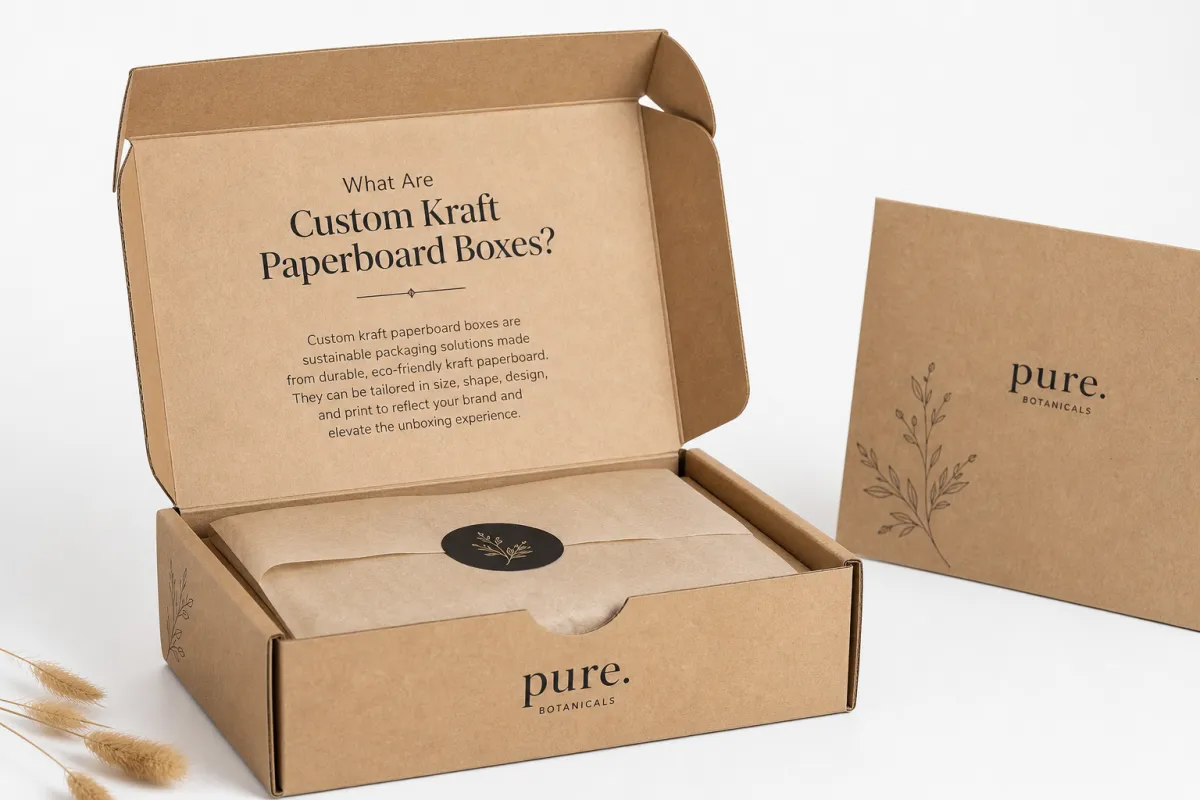
custom kraft paperboard boxes are cartons made from paperboard stock with a kraft-facing surface, usually a brown liner that gives the pack its natural look. Paperboard is the lighter, foldable sheet material used for cartons, sleeves, and presentation packs. Kraft refers to the fiber look and feel that gives the box its earthy, unbleached character. That is not the same thing as corrugated cardboard, which includes a fluted layer for shipping strength and is better suited to heavier transit loads than most retail cartons.
For a packaging buyer, the most useful distinction is structure. Folding cartons are common for shelf-facing product packaging and retail display. Mailer-style boxes focus more on shipping and quick assembly. Presentation-style packs sit in the middle, with tighter construction, a better opening experience, and room for inserts or closures. All three can be built as custom kraft paperboard boxes, but each solves a different problem.
The word custom matters more than people think. It covers size, board caliper, panel layout, print method, closure style, inside printing, inserts, coatings, and how the box opens or locks. A 2-ounce skincare jar and a folded apparel set do not need the same carton, and they should not share the same spec just because both can be made from kraft paper. Good packaging design starts with the product. Not with the prettiest render.
Brands usually choose custom kraft paperboard boxes for a few practical reasons. The natural brown surface already carries a sustainable look, so the package does not have to over-explain itself. Dark typography, line art, and simple logos tend to stand out beautifully against kraft paper. The material also supports a wide range of custom printed boxes without forcing the brand into a glossy finish that can feel too polished for the product story.
Kraft paperboard is not the right answer for everything. If the item is heavy, brittle, or expected to survive rough parcel handling, a heavier corrugated structure or a reinforced mailer may be smarter. custom kraft paperboard boxes do well in retail packaging, gift packaging, and lighter-to-moderate shipping applications. They are not a substitute for a true shipping shipper when transit gets ugly.
Short version: use custom kraft paperboard boxes when you want a natural appearance, solid shelf presence, efficient production, and a fiber-based pack That Feels Honest in the hand. Use something heavier when protection is the only job that matters.
How Custom Kraft Paperboard Boxes Are Made
The process behind custom kraft paperboard boxes usually starts with a paper fiber sheet that has been converted into board at a mill, then finished with a kraft-facing liner or a kraft-appearance stock. Once the board is selected, it moves into converting: printing, die-cutting, scoring, folding, and gluing. Every step changes the look and the performance of the finished carton, which is why two boxes that look similar on a screen can feel very different in the hand.
Printing is where kraft behaves differently from white paperboard. Offset printing can deliver sharp detail and strong color control, especially for longer runs. Digital printing works well for shorter runs, pilot launches, and seasonal tests. Flexo can be efficient on simpler graphics and certain packaging formats. On an unbleached brown surface, colors print more muted and earthy, so a bright pastel on a white carton may read as toned down on kraft. That is not a flaw. It is what the material does. Good packaging design respects that.
For custom kraft paperboard boxes, finishing needs a careful hand. Aqueous coating is a common option because it can improve scuff resistance without turning the box into a plastic-heavy pack. Matte varnish softens the overall appearance and helps the carton feel calm rather than glossy. Embossing and debossing work especially well on kraft because the natural fibers make tactile detail easy to feel. Special effects can look strong, but they should stay under control so the box still feels like kraft paper and not some confused hybrid chasing three identities at once.
Structure changes how the box behaves in real use. Tuck-end cartons are quick to fill and ideal for many retail packaging applications. Auto-lock bottoms offer better support for products with a little weight. Sleeves work well when the goal is simple branding over an inner tray or tray-like insert. Presentation boxes can use magnets, ribbon pulls, or friction-fit lids, though each one raises cost and can alter recycling outcomes. For custom kraft paperboard boxes, every extra feature should earn its spot.
Sustainability tradeoffs matter too. A fiber-based carton can be recyclable, but only if the materials stay compatible with common recovery streams. Heavy lamination, foil films, plastic windows, or mixed-material inserts make recovery more complicated. If the box is meant to communicate eco-conscious brand packaging, the build should support that message rather than weaken it. That is one reason many buyers keep the finish simple on custom kraft paperboard boxes and save the visual interest for the artwork itself.
If shipping performance is part of the brief, ask how the carton will behave under compression, vibration, and drop conditions. Industry groups such as ISTA publish testing methods that help teams think about handling risk in a structured way, and that matters even for lighter cartons. For recycling guidance, the EPA recycling guidance page is a useful public reference point for the basic fiber-versus-mixed-material discussion.
Custom Kraft Paperboard Boxes Cost, MOQ, and Lead Times
Price for custom kraft paperboard boxes comes down to a handful of predictable factors: board thickness, size, print coverage, finish selection, inserts, tooling, and order quantity. A small carton with a single-color logo on kraft will usually cost far less than a presentation box with an insert, soft-touch coating, and multiple printed panels. That sounds obvious. Still, quotes get compared badly all the time because the buyer is looking at unit price while the supplier is pricing a completely different spec.
For short runs, digital printing often makes the most sense. Setup stays lower, which helps with launches, test markets, or seasonal offers. A 250-unit or 500-unit order of custom kraft paperboard boxes may carry a higher per-box price, but it can save you from paying for plates or more complex press setup you do not need yet. Once volumes climb, offset or flexographic production may bring the unit cost down, especially if the box design stays stable and repeat orders are likely.
MOQ, or minimum order quantity, is not just a sales number. It reflects the economics of make-ready time, die-cut tooling, printing setup, and material waste allowances. Simple tuck cartons often have lower entry points than rigid-style presentation packs, and more complex structures can push the minimum higher. If a supplier offers custom kraft paperboard boxes at a very low MOQ, ask what changed to make that possible: digital print, stock dimensions, a standard die, or a reduced finish package. The answer makes the quote easier to trust.
Lead time usually breaks into four stages: artwork approval, sample or proof review, production, and shipping. A straightforward run of custom kraft paperboard boxes can often move through production in roughly 12 to 18 business days after final approval, though the actual window depends on the structure and finish. If you need samples, revisions, or freight coordination, add more time. Special closures, unusual board grades, and multi-step decoration stretch the schedule further.
A better way to compare options is to look at the structure and the tradeoff, not just the line item price. The table below is a practical buying lens for custom kraft paperboard boxes:
| Box Type | Typical Use | Relative Cost | Strength | Best For |
|---|---|---|---|---|
| Folding carton | Retail display, lightweight product packaging | Lower | Moderate | Cosmetics, supplements, accessories |
| Mailer-style kraft carton | Direct-to-consumer shipping, subscription kits | Medium | Moderate to strong | E-commerce brands that need fast assembly |
| Presentation box | Gift sets, premium unboxing, retail packaging | Higher | Strong for display, variable for transit | Brands focused on package branding and perception |
| Reinforced mailer with insert | Shipping plus product protection | Medium to higher | Stronger | Items that need more retention and less movement |
One detail that saves money more often than people expect is quote scope. Ask whether the price includes dies, plates, sample proofs, packaging for shipment, and delivery terms. A quote for custom kraft paperboard boxes that looks cheaper may leave out tooling or freight that another supplier already included. Compare on a true apples-to-apples basis and the picture gets clearer fast.
For brands with a launch calendar, build in buffer time. Revisions happen. Artwork gets adjusted. A die-line changes by a few millimeters. Freight gets delayed. None of that is unusual, and the smartest packaging programs leave room for it. A rushed run of custom kraft paperboard boxes is where corners get cut, and that almost always costs more than waiting a few extra days.
Key Factors That Determine Fit, Strength, and Sustainability
Fit is the first technical question. custom kraft paperboard boxes should not just hold the product; they should hold it with the right amount of control. A box that is too loose lets the item shift, which can scuff printed surfaces, break closures, or create a weak unboxing feel. A box that is too tight can slow packing labor and damage the product during insertion. The best spec leaves a little breathing room for the packer but not so much that the contents drift around.
Strength comes from the board grade, the shape of the structure, and the expected load. A small carton for a 50-gram item needs very different support than a box carrying glass jars or stacked accessories. For custom kraft paperboard boxes, pay attention to caliper, basis weight, and the way stress moves across fold lines and corners. If the box will be stacked in storage, placed in a shipper, or displayed on a shelf under pressure, that needs to be part of the brief from the start.
Print and branding deserve their own check. Kraft has a warm, natural tone, which means contrast matters. Bold typography, simple iconography, and clear logo placement usually perform better than delicate lines packed into a busy layout. If your package branding depends on tiny gradients or pale colors, test them on kraft before you commit. What looks elegant on a white comp may disappear on brown fiber once ink, varnish, and lighting all get involved. Packaging loves to humble people like that.
Product requirements can override aesthetic preferences very quickly. Food items may need grease resistance or compliant barrier materials. Cosmetics may need an interior finish that resists staining from oils or alcohol-based formulas. Moisture resistance matters if cartons will sit in humid warehouses or travel across wide temperature swings. custom kraft paperboard boxes can be adapted for these needs, but the adaptation should be deliberate, because every added layer or coating changes the sustainability profile and sometimes the price.
Sustainability is not a slogan. It is a material decision. Fiber sourcing, recyclability, transport distance, and box size all matter. FSC-certified fiber can be a useful signal if your buyers care about responsible forestry, and the claim is stronger when backed by the right documentation. The same goes for over-packaging. A box that is much larger than the product wastes board, increases freight volume, and sends the wrong message. In practice, the most sustainable custom kraft paperboard boxes are often the ones that use the least material while still protecting the product properly.
There is a hidden environmental cost in bad fit too. If the product needs extra void fill, rework, or replacement because the carton was wrong, the original “eco” choice becomes a weak argument. Smart buyers keep the whole system in view: materials, labor, transit, and end-of-life. That is a more honest way to specify custom kraft paperboard boxes than focusing on a single claim printed on the flap.
For a practical view, think in layers:
- Product protection: product weight, fragility, and movement inside the box.
- Brand presentation: shelf visibility, color contrast, and the feel of the opening.
- Operational fit: packing speed, storage space, and pallet efficiency.
- End-of-life: recyclability, material compatibility, and local recovery rules.
That framework keeps the conversation grounded. It also separates real performance from packaging language that sounds good in a meeting and falls apart during a production run. custom kraft paperboard boxes perform best when the spec respects all four layers at once.
Step-by-Step: Ordering Custom Kraft Paperboard Boxes
The cleanest way to order custom kraft paperboard boxes is to start with a product brief, not with a print file. List the item dimensions, weight, fragility, and whether the box will be shipped, shelved, gifted, or all three. Add the opening experience you want. A retail carton that opens fast for the store associate is not the same as a presentation pack meant to slow the reveal for the customer.
Next, choose the structure. Folding cartons suit lighter retail applications and straightforward assembly. Mailer-style cartons work well for e-commerce and subscription kits because they combine branding with shipping function. Sleeves, trays, and rigid-style packs create a more premium feel, but they also increase cost and may increase waste. If you are unsure, compare a couple of formats from Custom Packaging Products and think about how the package will be handled at each stage of the journey.
Then decide on print and finish. For custom kraft paperboard boxes, I would usually keep the artwork simple unless the brand has a strong reason to do more. One or two accent colors, a clear logo, and intentional white or negative space tend to work better than a crowded print. If the visual language needs texture, embossing or debossing can bring that in without making the carton feel overworked. The kraft surface already carries a lot of character; the design should use that instead of fighting it.
Samples matter. A paper proof can tell you the artwork is in the right place, but it will not tell you how the box performs with a real product inside. Ask for a sample or prototype and test a few simple things: how fast it assembles, whether the insert holds, whether the corners crush, and whether the box stacks cleanly. For custom kraft paperboard boxes, those checks catch problems that digital artwork reviews will never show.
After that, lock the details. Confirm board thickness, artwork position, print method, coating, quantity, pack-out method, and freight terms. A clear spec sheet prevents a lot of mistakes later, especially on reorders. If your team plans to use the box across several product sizes, make sure the tolerance range is wide enough to cover the smallest and largest unit without forcing a new run every time. That is one of the simpler ways to keep custom kraft paperboard boxes useful over a longer product cycle.
- Measure the product and define the pack method.
- Choose the carton style that matches the channel.
- Set board grade, finish, and print expectations.
- Review samples with the actual product inside.
- Approve final art, dieline, and production timing.
A buyer who follows that sequence usually avoids the classic mistakes: overspecifying the box, underestimating lead time, or finding out too late that the closure does not work with the pack-out flow. If you are ordering custom kraft paperboard boxes for a launch, the first run should teach you something useful, not just fill a warehouse shelf.
Common Mistakes With Custom Kraft Paperboard Boxes
One of the easiest mistakes is overdesigning for the material. Kraft does best with clear, direct graphics. If the artwork depends on tiny text, low-contrast shades, or dense image detail, the final result can look muddy. custom kraft paperboard boxes are not a bad canvas, but they are a different canvas. The brown tone becomes part of the print whether the designer planned for it or not.
Another common issue is choosing the wrong board strength. A carton that feels fine in the mockup may fail once the product is added, especially if the item has uneven weight or a hard edge. That shows up as bowed panels, corner crush, or lids that no longer close cleanly. For custom kraft paperboard boxes, strength should match the actual load, not a product category guess pulled out of thin air.
Print alignment can cause trouble too. If the dieline is not respected carefully, logos may land too close to folds, panels can shift during conversion, and closure lines may cut through important copy. This happens more often than brands like to admit, especially on boxes with wraparound graphics. A good production team will check fold tolerances early, because once the plates or files are locked, fixing alignment gets slower and more expensive.
Finishes can create hidden problems. A laminated look may photograph beautifully, but it can make recycling harder and push the carton away from the natural look buyers expect from kraft. I have seen brands add enough surface treatment that the box no longer reads as kraft at all. If the sustainability story is central, keep custom kraft paperboard boxes honest. The material should still look like material, not a disguise.
Packing labor is another blind spot. A box that looks simple in a design deck may take too long to fold, fill, and close on the line. If an insert is hard to place or the closure needs too much force, the real cost climbs fast. That matters more than people think, because labor often costs more over time than a small change in board or finish. The best custom kraft paperboard boxes make the pack-out process feel smooth without becoming fiddly.
Finally, some teams forget to think about shipping conditions. A box that will sit on a retail shelf has different requirements from one that will be handled by parcel networks. If you expect more transit abuse, pair the carton with a stronger shipper or ask whether the design should be tuned with better retention. If the pack is going to travel far, custom kraft paperboard boxes may need support from an outer corrugated cardboard shipper so the nice presentation carton survives the trip.
Expert Tips for Better Custom Kraft Paperboard Boxes
Keep the design bold and simple. That is the first rule I would give any brand working on custom kraft paperboard boxes. Use one or two accent colors, then let strong typography do the work. Kraft already brings warmth and texture, so the artwork does not need to force a luxury signal through decoration overload. A restrained layout often feels more premium because it looks more confident.
Use the brown stock as part of the story. Many brands waste time trying to hide the kraft tone, but that natural base is often the reason the package feels trustworthy. It signals paper fiber, simplicity, and a lower-intervention material choice. If the packaging design is honest about the substrate, custom kraft paperboard boxes can make the product feel grounded and intentional rather than cheap or unfinished.
Prototype early, especially for boxes with inserts, windows, or unusual closures. A nice render is useful, but a working sample tells the truth. It will show whether the product rattles, whether the insert slows pack-out, and whether the unboxing sequence feels right. For brands building package branding around detail, that early test is money well spent. It is far cheaper to fix custom kraft paperboard boxes before production than after the first shipment lands.
Think about the whole system, not just the carton. A box can be beautiful and still fail if warehouse handling is awkward, if the closure pops open in transit, or if the customer cannot recycle it easily. The smartest specs tie together product protection, shelf presentation, freight efficiency, and end-of-life behavior. That is why custom kraft paperboard boxes work best when they are designed as part of the broader product packaging system, not as an isolated shell.
Ask for a plain-language quote summary. A useful supplier response should tell you board grade, print method, finish, MOQ, lead time, and what is not included. If a quote skips those details, ask again. The clearer the quote, the easier it is to compare options and protect your margin. For many buyers, that simple discipline is the difference between a clean rollout and a painful round of revisions on custom kraft paperboard boxes.
One last practical point: if your brand expects repeat ordering, build the spec for repeatability. That means stable artwork placements, standard carton sizes where possible, and finishes that are not hard to match across runs. A box that can be reordered without drama saves far more time than a one-off novelty pack. In real production environments, the best custom kraft paperboard boxes are the ones that keep working long after the first approval cycle is over.
If you are comparing options right now, start with product dimensions, order quantity, and the way the box will be handled after production. That gives you the fastest route to a practical spec and a credible quote. From there, custom kraft paperboard boxes become less of a marketing idea and more of a useful packaging decision.
For brands that want sustainable presentation without giving up structure, custom kraft paperboard boxes remain one of the most versatile choices in modern packaging. They can be modest, premium, or somewhere between the two, and that flexibility is exactly why they continue to work so well across retail packaging, branded packaging, and direct-to-consumer product packaging.
The practical takeaway is simple: define the product, pick the right carton style, keep the finish honest, and test the sample with the real item inside. Do that, and custom kraft paperboard boxes stop being a branding guess and start being a packaging decision that actually holds up.
Are custom kraft paperboard boxes recyclable?
Usually yes, as long as the box is mostly fiber-based and does not rely on heavy laminations, plastic windows, or metalized films. Local recycling rules can vary, so the safest approach is to keep the build simple and confirm regional guidance. If sustainability is the priority, ask for coatings and inks that support recovery rather than fight it. That keeps custom kraft paperboard boxes aligned with the claim printed on the carton.
What is the difference between kraft paperboard and corrugated boxes?
Kraft paperboard is lighter and better suited to folding cartons, sleeves, retail packaging, and presentation packs. Corrugated cardboard adds a fluted layer that gives the shipper more strength and better impact protection. In practical terms, choose paperboard for shelf appeal and branding, and choose corrugated when the product needs tougher transit performance than custom kraft paperboard boxes can reasonably provide on their own.
How much do custom kraft paperboard boxes cost?
Price depends on box size, board thickness, print coverage, finish choices, inserts, and the total order quantity. Short runs usually carry a higher unit cost, while larger quantities lower the per-box price through setup efficiency. Ask for tiered quotes so you can see how quantity, structure, and finishing change the price of custom kraft paperboard boxes side by side.
How long does it take to produce custom kraft paperboard boxes?
Timeline usually starts with artwork and structural approval, then moves into sampling, production, and shipping. Special finishes, structural revisions, and freight coordination can add days or weeks to the schedule. If you have a launch date, retailer deadline, or seasonal shipment window, build in extra time for custom kraft paperboard boxes so the schedule does not get squeezed at the end.
What do I need to send for an accurate quote on custom kraft paperboard boxes?
Share product dimensions, weight, fragility, and the shipping or display environment the box will face. Include quantity, artwork expectations, finish preferences, and any insert or closure requirements. The clearer the brief, the easier it is to price custom kraft paperboard boxes accurately and avoid expensive spec changes later.

