Buyer Fit Snapshot
| Best fit | Custom Kraft Paper Bags with Logo projects where brand print, material claims, artwork control, MOQ, and repeat-order consistency need to be specified before quoting. |
|---|---|
| Quote inputs | Share finished size, material target, print colors, finish, packing count, annual reorder estimate, ship-to region, and any compliance wording. |
| Proofing check | Approve dieline scale, logo placement, barcode or warning zones, color tolerance, closure strength, and carton packing before bulk production. |
| Main risk | Vague material claims, crowded artwork, missing packing details, or unclear freight terms can make a low unit price expensive after revisions. |
Fast answer: Custom Kraft Paper Bags with Logo: Film, Print, MOQ, and Carton Packing should be specified like a repeatable production item. The safest quote records material, print method, finish, artwork proof, packing count, and reorder notes in one written spec.
Production checks before approval
Compare the actual filled-product size with the drawing, then confirm tolerance on folds, seals, hang holes, label areas, and retail display edges. Reserve space for logos, QR codes, warning copy, and material claims before decorative graphics fill the panel.
Quote comparison points
Review material grade, print process, finish, sampling route, tooling charges, carton quantity, and freight assumptions side by side. A quote is only useful when the supplier can repeat the same color, closure quality, and packing count on the next order.
Custom Kraft Paper Bags with Logo: A Practical Guide
Two Custom Kraft Paper bags with logo can look like they came from totally different brands, even if both started with the same kraft stock. One feels polished. The other feels like it was assembled five minutes before opening time. The gap usually comes from paper weight, print placement, and handle choice. Not magic. Just decisions.
A bag does more than hold stuff. In retail packaging and branded packaging, it is the handoff, the carryout, and sometimes the only thing a customer keeps after the purchase. A flimsy bag makes the brand feel flimsy. A well-made bag makes the whole order feel more considered. That is why custom Kraft Paper Bags with logo deserve more attention than they usually get.
For a boutique owner choosing between plain kraft and custom kraft paper bags with logo, the real question is not decoration. It is whether the bag can handle a candle, a folded sweater, or a pastry box without collapsing. It is whether the logo still reads from a few steps away. It is whether customers will reuse the bag or ditch it on the way to the car. Those details decide whether the packaging earns its keep.
I have seen buyers spend weeks obsessing over the font and then approve a bag that tears at the handle the first time it is loaded. That is the part nobody puts on the mood board. But it is usually the part customers remember.
What Are Custom Kraft Paper Bags with Logo?
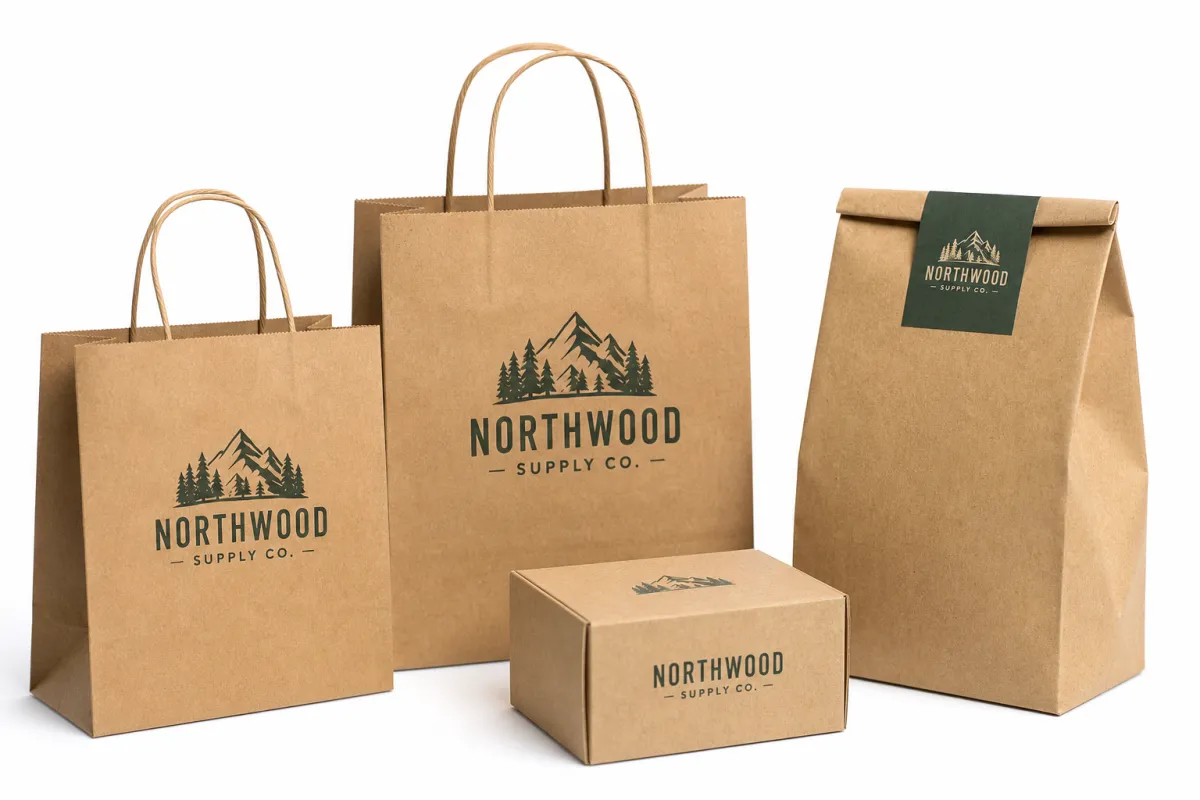
Custom kraft paper bags with logo are branded paper carriers made from kraft paper and printed with a company name, mark, or artwork. They show up in retail packaging, food service, gifting, trade shows, and event handoffs. The job is simple: carry the product safely. The larger job is brand recognition. Every time the bag changes hands, it says something about the business behind it.
Kraft paper has a useful personality. It looks natural, feels familiar, and holds up better than people expect. It gives a clean, grounded look without trying too hard. Still, not every kraft bag sends the same signal. A light 120gsm bag with a one-color logo feels very different from a 180gsm bag with reinforced handles and full coverage print. Same format. Different message.
That is the part people miss. Custom kraft paper bags with logo may be simple in shape, but buyers judge them fast. Paper weight, tone, finish, and handle style all shape perception. Brown kraft reads earthy and practical. White kraft reads cleaner and more formal. Matte feels quieter. Gloss feels louder. None of that is accidental.
From a packaging buyer’s point of view, the bag is a small piece of product packaging that does a lot of work. It protects items during the last stretch from counter to car. It supports the customer experience at the handoff. It keeps the brand visible after the sale. If the bag gets reused, custom kraft paper bags with logo keep advertising long after the transaction is over. That is a strong return for a low-cost item.
"A lot of buyers notice custom kraft paper bags with logo only after they see a bad one. Then the cheap bag suddenly looks very expensive."
Kraft bags are useful, but they are not a cure-all. A bottle set may need internal dividers. A heavy box may belong in custom printed boxes or a corrugated shipper. The smart move is usually a system, not a single format. A strong bag can work alongside Custom Packaging Products that protect the item inside.
For Brands That Sell in person, custom kraft paper bags with logo often do more than tissue or stickers ever will. They are visible outside the store, in transit, and in social settings. That makes them a quiet form of media. Ordinary surfaces get ignored until the branding is good enough to stick.
There is also a trust angle here. A bag that feels sturdy and prints cleanly tells customers the business pays attention to details. That sounds small. It is not. People read packaging fast, and they read it before they read your return policy.
How Custom Kraft Paper Bags with Logo Are Made
The production process for custom kraft paper bags with logo usually starts with a spec sheet and a dieline. The spec covers dimensions, paper weight, handle style, gusset depth, and reinforcement points. The dieline maps the flat bag before it gets folded and glued. If those two pieces are off, the bag may still exist, but it may not work the way the buyer expected.
Once the structure is set, the artwork gets prepared for print. Manufacturers check logo placement, ink colors, bleed, and safe zones. With custom kraft paper bags with logo, the logo should not just be dropped into the middle and called done. A real prepress review checks whether handle holes cut into the art, whether the side gussets need branding, and whether the print stays readable after folding.
Common print methods
Different print methods fit different order sizes and design styles. Flexographic printing works well for larger volumes and repeat artwork because it is efficient once the plates are made. Offset printing is better when sharp detail and tighter color control matter, especially on smoother kraft stock. Digital printing works for short runs, quick approvals, and jobs with more artwork variation. Screen printing shows up less often in mass bag production, but it can fit bold, high-contrast looks.
For custom kraft paper bags with logo, the best method depends on more than the file you send. A one-color logo on natural kraft may look excellent in flexo. A full-color illustration may call for digital or offset. Big ink coverage can also affect stiffness and fold behavior. That is why a proof on the real stock matters. A screenshot is not gonna tell you how the paper actually behaves.
Handles, gussets, and reinforcement
Handle choice changes both appearance and performance. Twisted paper handles are economical and familiar. Flat paper handles are common in food service and lighter retail loads. Rope handles usually feel more premium and show up on higher-end custom kraft paper bags with logo. Die-cut handles give a cleaner look and work well for lighter items. Some bags also use reinforcement patches near the top edge or inside the handle area so the paper does not tear under load.
Gussets matter just as much. A narrow gusset can make a bag look tall and neat, but it may pinch boxy products. A wider gusset gives more room for stacked items, garment boxes, or bakery packaging. When buyers compare custom kraft paper bags with logo, they often look only at front width and height. The side depth is what decides whether the bag is useful or annoying.
Approvals happen in stages. A quote is followed by a mockup or layout proof. Then the buyer checks size, color, logo position, and construction notes. Only after proof approval does production move forward. For custom kraft paper bags with logo, that approval window is where expensive mistakes get stopped. A logo placed too low, a handle hole that cuts into the artwork, or a stock choice that prints darker than expected can all be corrected before manufacturing. After production starts, every fix costs more.
If the order will carry heavier goods, ask whether the finished bag has been checked for transport stress, not just visual quality. For secondary packaging and distribution testing, the ISTA test protocols are a useful reference point. They are not a bag-specific rulebook, but they help buyers think about how the whole package behaves in transit.
Key Factors That Change Quality, Feel, and Use
The first variable is paper weight. Lighter kraft works for brochures, apparel, or small gifts. Heavier stock is better for wine, boxed goods, and premium retail packaging. Buyers usually talk about gsm or basis weight because a 120gsm bag behaves very differently from a 170gsm or 200gsm version. Custom kraft paper bags with logo feel more substantial as paper weight rises, but the bag also costs more and may need stronger handles or better reinforcement.
Finish changes the story too. Natural brown kraft has a dry, earthy texture. White kraft brightens the logo and makes colors look cleaner. A coated finish can improve print sharpness, but it can also affect recyclability and the hand feel. If the bag sits next to custom printed boxes or a premium product line, the finish should be part of the full packaging design, not a random afterthought. Customers read the set as one system.
Size and structure
Bag size is about more than fit. It changes how the customer carries the order, how the product sits inside, and how the bag looks at arm’s length. A bag that is too tall can fold awkwardly. A bag that is too short can expose the product or buckle at the top. With custom kraft paper bags with logo, the right dimensions let the logo stay visible without forcing the customer to wrestle the load into place.
Gusset depth deserves real attention. A 4-inch gusset may be enough for a single apparel item, while a bakery bundle or boxed skincare set may need more room. If the sides are too tight, the bag rounds out and distorts the logo. If the sides are too wide, the bag feels oversized and underfilled. That mismatch shows up a lot in early orders of custom kraft paper bags with logo because buyers estimate from the front and forget the depth.
Logo placement and ink coverage
Simple is not boring. A minimalist logo often performs better than full-wrap coverage because it reads cleanly and lets the kraft texture do part of the branding. One or two ink colors can keep costs in check, reduce prepress complexity, and improve consistency across production runs. Strong identity can still come from a bold typeface, a smart placement, or a spot varnish. The point is to make custom kraft paper bags with logo feel intentional, not cluttered.
Ink coverage also changes the physical behavior of the bag. Heavy solids on thin stock can curl at folds. Dark coverage on brown kraft can mute colors unless the design is adjusted for contrast. A logo that looks crisp on white stock may disappear on natural kraft unless the art is thickened or simplified. That is why a proof on the actual paper matters so much.
In practice, the best designs are often the ones that resist over-design. A clear mark, enough breathing room, and the right contrast beat a busy layout almost every time. Customers notice confidence. They also notice when a logo is fighting the material instead of working with it.
Sustainability and end use
Sustainability claims should be specific. Plain kraft paper is often recyclable, but coatings, plasticized laminations, or mixed-material handles can complicate the picture. If the bag needs moisture resistance or grease resistance, ask what that does to end-of-life handling. For general paper guidance, the EPA has useful recycling resources at epa.gov, and FSC certification is worth reviewing at fsc.org if chain-of-custody matters to your brand story.
The most useful sustainability question is not, "Is this bag green?" It is, "What is the simplest construction that still works?" That may mean FSC-certified kraft paper, water-based inks, and no extra coating. It may also mean accepting that custom kraft paper bags with logo fit dry retail handoffs better than greasy hot-food service. Honest fit-for-purpose choices beat vague environmental claims every time.
Brand effect matters too. A well-made kraft bag suggests restraint, but restraint is not the same as cheapness. That distinction matters. Custom kraft paper bags with logo should feel like part of the product packaging system, not a last-minute add-on. If they support the merchandise, they support the brand. If they fight it, customers notice that too.
Custom Kraft Paper Bags with Logo Pricing Explained
Pricing for custom kraft paper bags with logo usually comes down to five main variables: quantity, size, paper weight, print complexity, and handle style. Then there are the quieter costs that catch people off guard, such as plates, setup, sampling, freight, and artwork cleanup. A buyer who only looks at the per-unit quote can get blindsided when the total landed cost shows up.
Volume matters because setup gets spread across more bags. A 1,000-piece order usually costs far more per unit than a 10,000-piece order, even if the bag itself is not wildly different. That is simple arithmetic, not supplier drama. For custom kraft paper bags with logo, smaller runs absorb a bigger share of proofing and machine setup. Larger runs bring the unit price down, but they also raise inventory risk if the design changes later.
The table below gives broad planning ranges. These are not quotes. They are the kind of numbers that help a packaging buyer budget before sending artwork.
| Option | Typical Volume | Indicative Unit Price | Best Fit | Notes |
|---|---|---|---|---|
| Natural kraft, one-color flexo, twisted handles | 5,000-10,000 | $0.18-$0.32 | Retail giveaways, cafes, light apparel | Good value for straightforward custom kraft paper bags with logo |
| White kraft, two-color digital or offset, flat or rope handles | 2,000-5,000 | $0.35-$0.65 | Boutiques, cosmetics, gift sets | Cleaner print and stronger shelf presence for branded packaging |
| Heavy kraft, premium handle, larger print area | 5,000+ | $0.55-$1.10 | Luxury retail, wine, premium events | Higher perceived value; often closer to a brand statement than a carry bag |
Those ranges move fast if the order includes special finishes. Foil stamping, spot UV, embossed marks, or laminated surfaces can push costs upward. So can complex artwork cleanup or last-minute changes after proof approval. For custom kraft paper bags with logo, the cheapest quote is not always the best quote if the bag feels thin or if the logo prints badly. A few cents more per unit can improve resale value and reduce complaints.
Freight is another place where buyers get caught. Bags look light, but bulk cartons take space. If the bags are shipping overseas or across the country, dimensional weight can matter more than actual bag weight. Rush production can also move the price sharply. In many cases, the rush fee is not huge by itself; the real cost is the shorter review time. That is risky for custom kraft paper bags with logo, because a small artwork mistake can turn into a full production error.
Premium choices make sense when the bag is visible in front of house, likely to be reused, or tied to a higher-margin product. If the item inside is a $120 purchase, saving a fraction of a dollar on the carrier can be false economy. If the bag is for a short promotional run, standard kraft may be enough. The real trick is matching spend to brand exposure, not guessing.
For brands comparing options, Custom Packaging Products can help frame the decision against other formats, including boxes and paper carriers. Sometimes the better answer is not bigger bag spend, but a smarter combination of bag and insert, or a bag plus a smaller shipper for heavier items.
Step-by-Step Ordering and Timeline
The cleanest way to order custom kraft paper bags with logo is to start with use case, not artwork. Ask what the bag must carry, how it will be handed over, and whether it needs to survive a commute, a boutique shelf, or a food-service counter. Once that is clear, the rest gets easier. Size follows use. Print follows size. Price follows both.
A standard approval sequence looks like this:
- Request a quote with quantity, dimensions, paper weight, handle style, and logo file.
- Review a mockup or layout proof.
- Check color, placement, and structural notes on the proof.
- Approve prepress so production can begin.
- Move into printing, converting, packing, and shipment.
That sequence sounds ordinary, but the timing behind each step matters. For custom kraft paper bags with logo, the proof stage is where most delays happen. Sometimes the logo file needs cleanup. Sometimes the buyer wants to move the mark higher or widen the bag. Sometimes the paper sample shows the natural kraft tone is darker than expected. Each small revision protects the final order, but it also adds time.
Typical production timing often lands in the 12-15 business day range after proof approval for straightforward orders, though large quantities or special finishes can take longer. Shipping is separate. If the bags are needed for a launch or seasonal promotion, build in enough lead time to absorb both manufacturing and transit. A safe plan is to back-schedule from the event date and add an extra buffer for artwork revision. That buffer matters, because a logo tweak is easier on paper than in a factory queue.
Sampling is worth the trouble. A physical sample shows things a PDF cannot: handle feel, paper stiffness, color tone, fold memory, and the way the logo reads in actual light. It also helps you compare custom kraft paper bags with logo against other packaging choices, such as custom printed boxes or a mixed paper-and-box set for multi-item orders. A good sample often answers questions that three rounds of email never settle.
Scheduling advice is plain: order earlier than you think you need to. Seasonal programs compress the calendar. Trade show deadlines do too. If the artwork is not final, do not wait for perfection before asking for a mockup. A rough mockup can stop a bad size choice while the final art is still being refined. That is how experienced buyers keep custom kraft paper bags with logo on track without turning the process into a fire drill.
Common Mistakes When Ordering Custom Kraft Paper Bags with Logo
The most common mistake is choosing the wrong size. A bag that looks fine on paper may be useless once the real product is inside. Boxed goods need depth. Apparel needs width. Bottles need strength and a stable base. If the bag is too small, the handles strain. If it is too large, the product slides around and the logo looks tiny. Testing custom kraft paper bags with logo with actual merchandise is much better than guessing from a ruler.
Another frequent error is weak artwork. Low-resolution logos, thin lines, and poor contrast can make a good bag look generic. Natural kraft is especially unforgiving because the brown base mutes certain colors. A logo that technically exists but is hard to read does not help package branding. On custom kraft paper bags with logo, the simplest fix is often the right one: thicker type, fewer colors, stronger contrast.
Buyers also underestimate landed cost. Shipping, import duties, proof revisions, and rush changes can turn an attractive unit price into a much less attractive total. That is not a reason to avoid ordering. It is a reason to budget honestly. If the order is large, ask for pricing broken into setup, unit cost, and freight. For custom kraft paper bags with logo, transparency saves headaches later.
"The cheapest bag is expensive if it tears, and the prettiest bag is expensive if nobody can carry it comfortably."
Sustainability claims can get messy too. A buyer may want a recyclable bag, then add a plastic-coated finish, metallic foil, or mixed-material handles that complicate recycling. That does not mean those finishes are wrong. It means the claim should match the build. If the goal is a cleaner environmental story, ask for the simplest version that still performs well. That matters a lot for custom kraft paper bags with logo, because kraft already suggests simplicity even when the structure is not simple at all.
There is one more mistake I see often: treating the bag as an isolated item. A strong bag paired with weak internal packaging can still fail the customer experience. If the item needs stiffness, insulation, or shipping protection, the bag should work with the rest of the packaging system. That may include inserts, wraps, or outer shippers. In that sense, custom kraft paper bags with logo are part of a bigger product packaging strategy, not the whole strategy.
Finally, some buyers approve too quickly. They see a mockup, recognize the logo, and move on. The bag is not the mockup. It is the real object, with real folds, real handles, and real ink behavior. The proof deserves the same attention as a carton proof or a label proof. Small errors compound fast in custom kraft paper bags with logo, especially when the order quantity is high.
Expert Tips and Next Steps for Your First Order
Start with one use case. Not three. If the bag is mainly for apparel, design around folded garments and customer comfort. If it is for bakery items, think about grease resistance, handle strength, and counter handoff speed. If it is for event gifts, think about presentation and reuse. Custom kraft paper bags with logo work best when the brief is specific, because the manufacturer can optimize the structure instead of guessing.
Order a physical sample if you can. It is the fastest way to check the things that matter most: stiffness, print clarity, handle feel, and whether the bag stands up when filled. A sample can also show whether the logo is placed too low or whether the bottom fold steals visibility. For custom kraft paper bags with logo, a sample often saves more money than it costs.
A simple spec checklist keeps the process under control:
- Finished bag dimensions, including width, height, and gusset depth
- Paper weight and kraft color
- Print method and number of colors
- Handle style and reinforcement requirement
- Quantity and expected reorder volume
- Delivery date and shipping destination
That checklist looks basic, and that is the point. Basic is where most ordering problems live. Miss one line item and the quote changes, the schedule shifts, or the final appearance misses the mark. With custom kraft paper bags with logo, the best buyers are usually the most organized ones. They define the job up front instead of chasing features after the fact.
Here is the order of operations I would use for a first run: confirm the use case, shortlist two sizes, request quotes at two quantities, review a mockup, ask for a sample, then approve only after seeing the physical bag. That process is slower than clicking a stock product into a cart, but it is far safer for branded packaging. It also gives you a clearer view of where custom kraft paper bags with logo sit relative to other options like corrugated cardboard mailers or custom printed boxes.
If you want to make the decision easier for your team, write the goal in one sentence. Example: "We need a medium-weight kraft bag that carries one boxed item, one tote, and one receipt packet without sagging." A sentence like that does more work than a vague request for "nice branded bags." It helps the supplier recommend the right structure and keeps everyone focused on what custom kraft paper bags with logo actually need to do.
One last point: do not confuse a low-cost bag with a low-value bag. A well-specified order can be inexpensive and still feel premium. A poorly specified order can be expensive and still disappoint. If you treat custom kraft paper bags with logo as part of the brand system, not an afterthought, you usually get better durability, better presentation, and fewer surprises during production.
If you are ready to move, compare a few quotes, request mockups, confirm the timeline, and make sure the final spec matches how the bag will actually be used. That is the cleanest path to custom kraft paper bags with logo that look right, perform well, and hold up in the customer’s hand.
FAQ
How much do custom kraft paper bags with logo usually cost?
Price depends on size, paper weight, print colors, handle style, and total quantity. Small runs cost more per bag because setup and proofing are spread across fewer units. For custom kraft paper bags with logo, ask for quotes at two or three quantity levels so you can see where the unit price drops most sharply.
What size should I choose for custom kraft paper bags with logo?
Match the bag to the widest and tallest product you will carry, then leave room for easy loading. Check gusset depth for boxed items and bottle packs, not just the front face dimensions. Before approving production, test custom kraft paper bags with logo with actual merchandise rather than relying on a dimensional guess.
Are custom kraft paper bags with logo recyclable?
Plain kraft bags are often recyclable, but coatings, heavy inks, or plasticized finishes can change that. Handle material and local recycling rules also matter, so verify the full construction before making claims. If recyclability is important, ask for the least-coated version of custom kraft paper bags with logo that still performs well.
How long does it take to produce custom kraft paper bags with logo?
Timing depends on proof approval, print method, quantity, and current production capacity. Straightforward orders move faster when artwork is ready and no structural changes are needed. Rush jobs usually shorten the approval window more than they change the manufacturing realities of custom kraft paper bags with logo.
Which printing method is best for custom kraft paper bags with logo?
Digital printing is often best for smaller, full-color orders with quick turnaround. Flexographic printing works well for repeat designs and larger volumes. Offset can be ideal when sharp detail and consistent brand color matter most. The right choice for custom kraft paper bags with logo depends on the artwork, the paper, and the quantity.
What should I review before approving custom kraft paper bags with logo?
Check the proof against the real item use case, not just the artwork. Confirm size, handle strength, logo placement, contrast on the actual kraft shade, and any finish or coating that affects recyclability or feel. A careful review keeps custom kraft paper bags with logo from turning into a very avoidable problem later.

