Custom Label Making for Clothing: How to Order Smarter
Most people think the artwork is the hard part of custom label making. It usually is not. The real problems show up after the logo looks fine on screen and the sample turns out scratchy, too small, hard to read, or weak after a few wash cycles. That is where a label stops being decoration and starts affecting the garment itself.
For clothing brands, labels live in a few predictable places: the neck, side seam, hem, inner fold, hangtag stack, or care label panel. Each placement changes the spec. A neck label has to sit flat and feel soft. A side-seam label can carry a little more structure. Care labels need text clarity and wash durability above everything else. If you are building out broader Custom Packaging Products or expanding your line of Custom Labels & Tags, the same rule applies across the board: the format has to fit the product, not just the logo.
A good label survives handling, wear, and laundering without peeling, fraying, fading, or irritating the wearer. If it does that and still supports the brand look, the job is done properly. Nothing fancy. Just correct.
Why clothing labels fail before the garment does
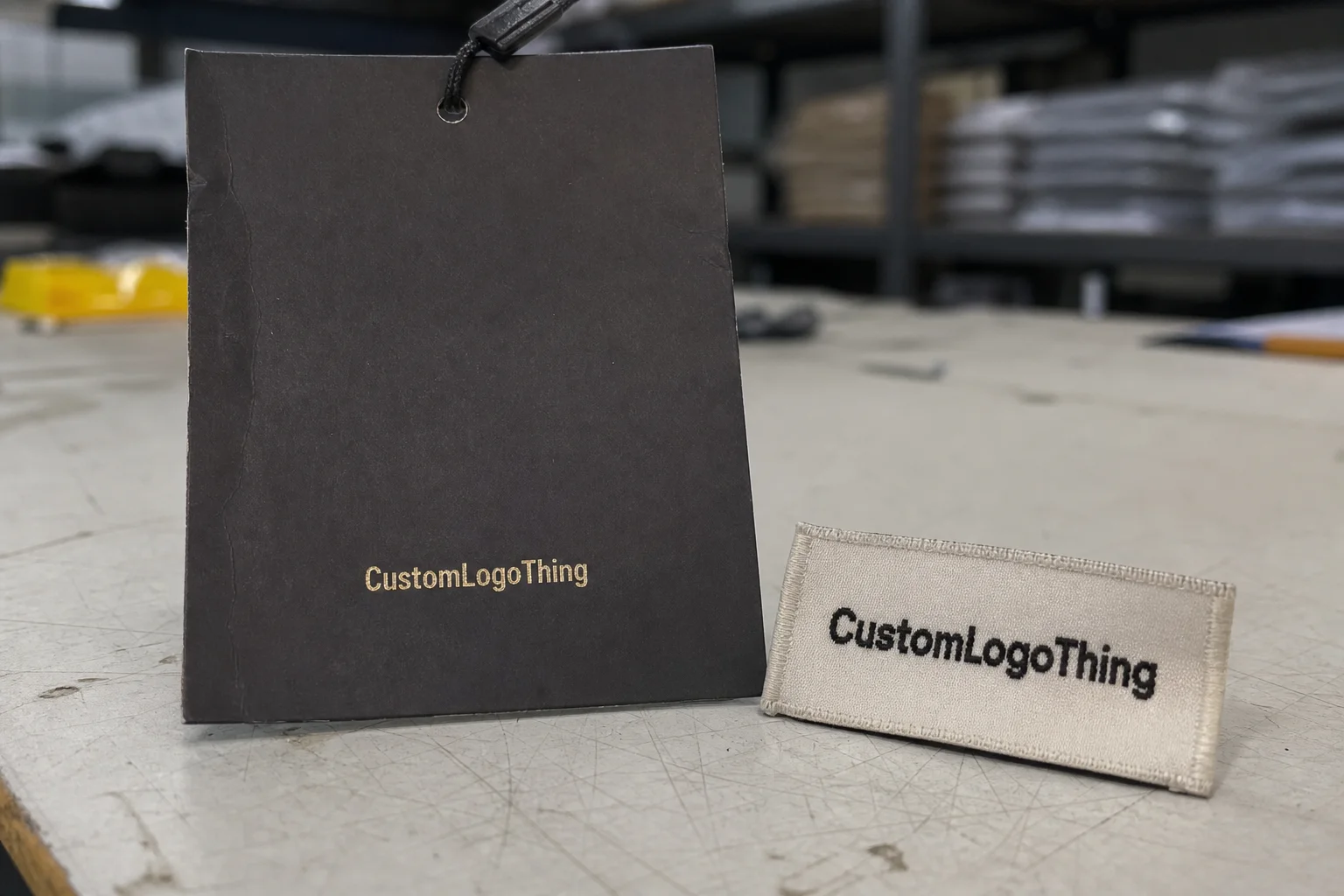
The most common label failures are ordinary, which is exactly why they get missed. A logo can be technically perfect and still fail because the contrast is too low, the type is too small, or the chosen construction does not suit the fabric. In practice, a label rarely fails visually first. It fails functionally.
Placement matters for that reason alone. Neck labels sit against skin, so hand feel and edge finish matter more than they would on a hangtag. Side-seam labels can be a little more utilitarian. Hem labels often need a lower-profile build to avoid bulk. Hangtag integration is a different job entirely because the label is helping sell the product, not just identify it. Care label stacks are the least forgiving because they need to stay legible through repeated laundering. If a buyer treats every label as the same spec, the order usually pays for that mistake later.
Custom label making is the process of matching substrate, construction, print method, finish, and attachment style to the garment and the brand position. That sounds simple. It is not. A soft baby tee, a heavyweight hoodie, and a technical activewear piece all want different solutions. Match the label to the product and the contact points, and the result feels intentional instead of improvised.
A label should never be the thing that makes the garment feel cheaper than it is.
How the production process actually works
The workflow is simple on paper: brief, artwork review, material selection, proofing, sampling, production, finishing, packing, shipping. The difference between a clean order and a messy one is how early the buyer makes decisions. Size, fold style, backing, color count, and wash-care language should be locked before the quote is finalized, not after the proof is already moving.
Suppliers need more than a logo file. They need vector artwork, Pantone targets, finished dimensions, the garment type, application method, quantity, and the real deadline. If you send a flat PNG and a vague note that says “make it premium,” you are asking for interpretation instead of manufacturing. That is how you get revisions, delays, and a surprise when the quote changes.
The proof stage is where many projects lose time. A first proof usually checks layout, dimensions, line weight, spelling, and color interpretation. If the buyer asks for changes after that, the schedule moves. Small changes are not always expensive, but they are almost always slower than people expect. The fastest orders are the ones where the brief is complete before anyone opens Illustrator.
For brands building out packaging across garments, inserts, and secondary packaging, the label spec should align with the rest of the product presentation. If the packaging is clean and minimal but the label is scratchy, loud, and badly folded, the whole delivery feels inconsistent. That mismatch is hard to ignore once the product is in hand.
Paper-based components often need their own sourcing standard. FSC certification is commonly used when a brand wants traceable fiber sourcing, while shipping-related testing may follow ISTA protocols depending on how the goods are packed and distributed. The standards are public: fsc.org and ista.org. A supplier does not need to be obsessed with acronyms, but they should know what those references mean and where they apply.
Materials, finishes, and construction choices that matter
The right material depends on how the garment is worn and how the brand wants to feel in hand. Woven labels are the classic choice for durability and a textile-forward look. Printed satin labels are softer against skin and often better for fashion basics. Cotton labels feel natural and casual, which works well for heritage, streetwear, and eco-positioned lines. Tyvek is common for temporary or utility-driven use cases. Faux leather sends a stronger fashion signal, though it is not right for every product. Heat-transfer labels reduce bulk, which is useful in performance wear and children’s apparel.
The finish matters as much as the substrate. Matte usually reads softer and more modern. Gloss can make colors pop, but it can also look harsher and show wear sooner. Fold style changes function too. End folds, center folds, Manhattan folds, and cut-and-sew tabs each behave differently on the garment. Adhesive backing is useful in some applications, but it is not a universal fix. It can simplify attachment and help with placement consistency, yet it does not replace a construction choice that fits the fabric.
There is always a tradeoff between premium appearance and irritation risk. A label that looks expensive but scratches the neck is a bad label. A label that feels invisible but breaks down after two washes is also a bad label. Brands serving activewear, uniforms, or baby apparel need to think harder about skin contact, seam thickness, and edge softness than brands making accessories or outerwear.
Here is a practical comparison of common options:
| Label type | Best use | Typical strengths | Main tradeoff | Rough unit range |
|---|---|---|---|---|
| Woven label | Premium apparel, outerwear, denim | Durable, clean detail, good brand perception | Can feel structured on skin | $0.08-$0.25+ |
| Printed satin label | Fashion basics, tees, soft goods | Softer hand feel, strong print flexibility | Less textured than woven | $0.06-$0.18+ |
| Cotton label | Heritage brands, casualwear | Natural look, good brand fit | Less crisp detail at small sizes | $0.07-$0.22+ |
| Heat-transfer label | Activewear, kids' apparel, minimal-bulk garments | No tag feel, low profile | Requires correct application process | $0.05-$0.20+ |
| Faux leather patch | Streetwear, denim, caps | Strong visual identity, premium texture | Not ideal for soft skin contact areas | $0.10-$0.40+ |
If the garment will be washed repeatedly, ask for wash-test guidance and confirm the construction against the application method. ASTM references can help when you are evaluating materials and environmental conditioning, and a decent supplier should be able to talk in plain language about durability instead of hiding behind buzzwords. That is usually a better sign than a flashy sales sheet.
Custom label making cost, MOQ, and unit pricing
Price is driven by a handful of variables: material, print complexity, size, finish, quantity, and whether the label needs special folding or backing. A simple one-color woven label at volume is a different job from a multi-color satin label with a center fold, custom sizing, and serialized care instructions. Buyers who compare only the unit price usually miss the real cost structure.
MOQ logic is not mysterious. Lower quantities almost always cost more per piece because setup, waste, and production time are spread across fewer units. If you need 300 pieces, you are paying for a lot of fixed work. If you need 10,000, the spread gets much better. The same thing happens across product packaging and retail packaging more broadly. Small runs are flexible. Big runs are efficient.
Hidden costs are where quote comparisons get messy. Color matching can add time. Multiple SKUs can create separate setup fees. Rush production compresses the schedule and often trims flexibility. Sampling is another line item buyers forget to budget. None of these are scams. They are normal costs of making something specific instead of generic.
Here is a useful buying range for a typical clothing label order:
- Simple repeat label: lowest cost, fastest production, best for reorders.
- Custom construction: higher unit price, better fit for brand positioning and garment use.
- Color-critical order: more proofing and tighter checks, usually slower.
- Rush order: possible, but only if files are clean and approvals do not stall.
From a packaging buyer’s point of view, it usually makes more sense to spend a little more on durability than to replace a cheap label after the first wash cycle. A label that survives the garment is cheaper in the long run, even if the purchase order looks slightly worse on day one. That is not glamorous. It is just math.
Process, timeline, and turnaround expectations
A realistic timeline usually follows this path: inquiry and quote, proof approval, sample or mockup confirmation, production, finishing, quality check, packing, and shipping. Simple repeat jobs can move quickly once the artwork is already locked. Custom builds take longer because every extra decision creates another checkpoint.
Fast steps are usually the ones with no uncertainty. Slow steps are the ones that depend on buyer feedback. If the file is complete and the spec is clear, the supplier can move. If the buyer is still deciding on font size, fold type, or compliance text, the schedule slips. That is not the factory being dramatic. That is just production.
Rush orders fail in predictable ways. Files are incomplete. Approvals take too long. The buyer asks for a material that is not in stock. Or the job is color-sensitive and nobody allowed enough time for proofing. A supplier can usually accelerate one or two parts of the process, but not all of them at once. Optimistic sales talk does not change the calendar.
Ask these questions before committing:
- What is the actual production window after proof approval?
- Do you have the exact material and backing in stock?
- How many proof rounds are included?
- What happens if I change the size after approval?
- Can you confirm the final shipping method and transit time?
For garments that will be distributed across multiple channels or folded into broader package branding, the label timeline should sync with the rest of the launch. There is no point getting the labels early if the hangtags, boxes, or inserts are still pending. That mismatch creates warehouse clutter and extra handling. Nobody needs that.
Step-by-step ordering checklist for a cleaner quote
Start with the garment itself. Is it a tee, hoodie, uniform, activewear piece, baby item, or outerwear? Where will the label live? How many wash cycles does it need to survive? What is the brand trying to communicate: minimal, premium, rugged, playful, or technical? Once those basics are fixed, the label spec gets easier.
Then collect the technical details in one place. Include size, material preference, color count, fold type, quantity, artwork format, and any compliance text. If the label needs care instructions, fiber content, country-of-origin text, or warning language, give that to the supplier at the start. The cleaner the brief, the cleaner the quote.
A simple proofing workflow keeps mistakes from spreading:
- Request a mockup with exact dimensions.
- Check spelling, alignment, and contrast.
- Confirm color targets against a Pantone reference where relevant.
- Approve the sample or pre-production proof.
- Release production only after the final version is signed off.
Compare suppliers on more than price. Response speed matters. Sample quality matters. Repeat-order consistency matters even more. The cheapest quote can become the most expensive choice if the labels arrive inconsistent or the supplier cannot reproduce the same result on the next run. That is especially true for branded packaging systems where the label has to match the rest of the line.
One more point: if you are also choosing Custom Printed Boxes or coordinating broader retail packaging, keep the same brand rules across all components. Paper stock, ink behavior, and finishing should not feel like separate projects from different planets. They should feel like one system.
Common mistakes that make labels look cheap
The fastest way to make a premium garment look bargain-bin is to cram too much into a tiny label. Tiny text, low-contrast colors, three typefaces, a logo with too much detail, and a long care block all on one strip? That is not design. That is a warning sign.
Another common mistake is choosing a material that fights the job. A stiff label on a soft tee feels wrong. A delicate printed surface on a rugged product gets abused. A fashion-forward faux leather patch on a baby garment is usually the wrong call. The material should match the use case and the wear conditions, not just the mood board.
People also underestimate wash durability and attachment method. If the stitching is poor, the label twists. If the adhesive is wrong, it lifts. If the print is weak, it fades. If the edge finish is rough, customers feel it immediately. You do not get a second chance to impress someone with a label they touch every time they wear the product.
Bad file prep creates avoidable damage too. Low-resolution art gives blurry edges. Poorly centered files lead to off-center layouts. Broken vector paths can slow proofing. These are not glamorous errors, but they are the ones that cost time and money. A clean file package is one of the cheapest improvements a buyer can make.
Next steps for a better label order
Audit the garment first: product category, placement, expected wash cycles, and how you want the brand to feel in hand. Then write one clean spec sheet and send the same version to every supplier. If each vendor is pricing a different version of the job, the quote comparison is meaningless.
Order a sample or pilot run before you commit to volume. That matters even more for anything color-sensitive, skin-contact heavy, or part of a larger packaging rollout. A small test run catches sizing issues, print problems, and comfort complaints before they become a production headache. It is cheap insurance.
Then compare three suppliers on material options, turnaround, proof quality, and communication. The one worth choosing is usually the one that asks the right questions about custom label making instead of just racing to the lowest number. A smart label order is not about buying the cheapest thing that fits. It is about making sure the label supports the garment, the brand, and the customer experience at the same time.
What is custom label making for clothing in practical terms?
It is the process of choosing the right label material, construction, size, print method, and attachment style for a garment. The goal is to make the brand look intentional while surviving wear, washing, and handling.
How do I choose the best label material for apparel?
Match the material to the garment: woven for premium durability, printed satin for a softer hand feel, heat transfer for minimal bulk, and faux leather for fashion positioning. If the garment touches skin directly, comfort matters as much as appearance.
What affects clothing label pricing the most?
Quantity, material, print complexity, finish, and folding or backing options drive most of the cost. Rush timing, multiple color matches, and sample revisions can raise the total quickly.
How long does clothing label production usually take?
Simple repeat orders can move quickly once artwork is approved. Custom jobs take longer because proofing, sampling, and production all add time before shipping.
What should I send when requesting a quote for label making?
Send artwork, label dimensions, quantity, garment type, placement, preferred material, and any wash-care or compliance text. The cleaner the brief, the faster and more accurate the quote will be.

