Buyer Fit Snapshot
| Best fit | Custom Label Sheets Wholesale for Brands That Scale projects where brand print, material claims, artwork control, MOQ, and repeat-order consistency need to be specified before quoting. |
|---|---|
| Quote inputs | Share finished size, material target, print colors, finish, packing count, annual reorder estimate, ship-to region, and any compliance wording. |
| Proofing check | Approve dieline scale, logo placement, barcode or warning zones, color tolerance, closure strength, and carton packing before bulk production. |
| Main risk | Vague material claims, crowded artwork, missing packing details, or unclear freight terms can make a low unit price expensive after revisions. |
Fast answer: Custom Label Sheets Wholesale for Brands That Scale should be specified like a repeatable production item. The safest quote records material, print method, finish, artwork proof, packing count, and reorder notes in one written spec.
Production checks before approval
Compare the actual filled-product size with the drawing, then confirm tolerance on folds, seals, hang holes, label areas, and retail display edges. Reserve space for logos, QR codes, warning copy, and material claims before decorative graphics fill the panel.
Quote comparison points
Review material grade, print process, finish, sampling route, tooling charges, carton quantity, and freight assumptions side by side. A quote is only useful when the supplier can repeat the same color, closure quality, and packing count on the next order.
Custom Label Sheets Wholesale for Brands That Scale
A brand relabeling 14 SKUs for a retail reset does not need a roll-versus-sheet seminar. It needs labels that show up on time, match the packaging spec, and keep the line moving. That is the practical case for custom label sheets wholesale: one planned format can cover multiple variants, cut down hand-off friction, and keep a launch from stalling because somebody is waiting on a reprint.
From a packaging buyer’s angle, control is the real prize. Sheet labels slot into branded packaging programs that change often, whether the line includes jars, mailers, cartons, or seasonal gift sets. They also fit neatly beside Custom Labels & Tags, Custom Packaging Products, and Wholesale Programs when one supplier needs to handle repeat packaging work across several categories. That kind of coordination matters when package branding, retail packaging, and production timing all pull in different directions.
What makes custom label sheets wholesale a smart fit for growing brands?
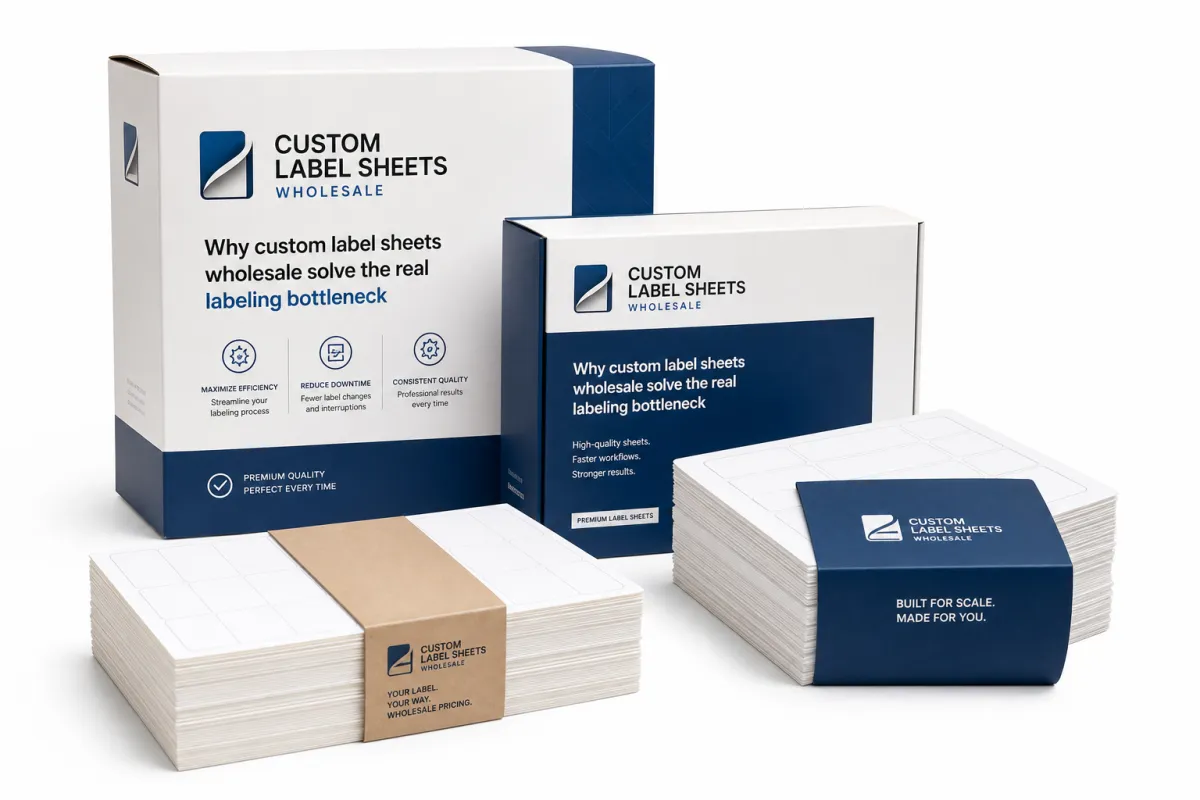
Most labeling problems are not design problems. They are throughput problems. A company can have the artwork approved, the brand standards written down, and the packaging dielines locked. The slowdown often shows up later, when different SKUs need different labels, fulfillment teams need labels yesterday, and the packaging calendar leaves no room for another delay. Custom label sheets wholesale addresses that bottleneck by turning labels into a planned inventory item instead of a one-off scramble.
Picture a product line with four jar sizes, two limited editions, and a retailer-specific sticker. Roll labels can work in that environment, but they are not always the cleanest fit when the order mixes short runs, multiple artwork versions, and hand application. Sheets are easier to count, easier to store, and easier to split across teams. One sheet layout can serve several product lines, and that is the part many buyers miss. A single sheet spec can carry a main SKU, a seasonal flavor, a promo mark, and a compliance label without forcing a new print setup every time.
That matters because labels usually sit inside a broader packaging system. If a brand is buying custom printed boxes, printed cartons, and product labels at the same time, the label format has to keep pace with the rest of the components. Wholesale buying changes the economics in a practical way. It trims reorder friction, keeps label stock tied to production runs, and lowers the odds that a small shortage slows a much larger launch. A delay on 2,000 labels can hold up 20,000 units if the schedule is tight enough.
The cost story is bigger than unit price. Buyers often compare labels by the sheet and stop there. That misses the labor around them: fulfillment time, changeover time, and the cost of carrying dead stock that never gets used. Custom label sheets wholesale often wins because it supports repeat demand without forcing constant spec changes. The sheet becomes a stable part of the program, and stability is what growing brands need when volumes rise, dip, and rise again.
A good wholesale label program is not just cheaper. It is easier to operate. The value shows up when the same sheet spec can be reordered, stored, and applied without rework.
For packaging teams working across retail packaging, e-commerce, and kitting, that predictability is the difference between a controlled prep schedule and a last-minute scramble. When custom label sheets wholesale sits on a reorder rhythm, the label function stops behaving like a fire drill and starts behaving like a planned input.
I have watched this play out on a holiday launch where the labels were technically ready, but the warehouse had nowhere to park the oddball inventory. The sheets sat in three places, nobody was fully sure which version belonged on which carton, and the team burned half a day sorting it out. The file was fine. The process was not. That is kinda the pattern with label work: the spec is usually less dramatic than the workflow around it.
Product details: what custom label sheets wholesale include
Sheet labels come in more formats than many buyers expect. A standard request may be a full sheet with one large label, yet wholesale programs often use a much more efficient layout. A sheet can include 2, 4, 8, 10, 12, or more labels per page depending on size, spacing, and application method. Custom label sheets wholesale can also be built for one product or for a mixed-SKU set, as long as the margins, cut lines, and bleed are planned with care. In practice, that makes them a strong fit for pressure-sensitive labels used across bottles, cartons, and mailers.
Shape is usually the first choice. Rectangles are the simplest. Circles and ovals show up often in cosmetics, candles, food jars, and promotional packaging. Specialty die cuts make sense when the label shape needs to echo a logo or wrap around a bottle contour. Finish changes the feel fast. Gloss brings up color and tends to pop on shelf. Matte reads quieter, photographs well, and fits premium retail packaging with a more restrained look. Clear film, textured stocks, and tactile finishes can strengthen package branding when the surface itself is part of the story.
Adhesive choice is equally practical. Permanent adhesive fits most bottles, boxes, and mailers. Removable adhesive works for temporary promo labels, sample packs, and short-term warehouse use. Freezer-safe adhesive matters for cold-chain packaging or products that move from room temperature into refrigeration. Some buyers need stronger tack for textured cartons, while others need an adhesive that releases cleanly from a coated surface. Those details influence how the label performs far more than the artwork does.
Print workflow deserves attention too. Digital printing is often the better fit for shorter wholesale runs because setup is faster and variable data is easier to handle. Offset can make sense for larger, stable orders with strict color expectations. Variable-data jobs are common when each label must carry a batch code, serial number, barcode, or retailer-specific identifier. Custom label sheets wholesale can support that mix, but the printer needs to know early which elements stay fixed and which ones change from sheet to sheet.
Good vendors treat the sheet as a system, not a blank page. They look at how the labels will move through carton assembly, bottle filling, or kitting. That matters even more for brands buying across multiple product packaging categories. If the label has to match branded packaging standards, the stock and finish should support the full shelf presence, not just the art file on a monitor.
One useful way to think about custom label sheets wholesale is to compare the tradeoffs by use case. The table below is not a fixed price list; it is a practical buying map based on the kinds of orders most packaging teams place.
| Option | Best for | Typical strengths | Tradeoffs | Typical wholesale pricing direction |
|---|---|---|---|---|
| Standard paper sheet labels | Retail prep, mailers, kitting, internal use | Fast printing, easy handling, good unit economics | Less moisture resistance than film stocks | Usually the lowest cost tier for repeated runs |
| Gloss coated labels | Bright product packaging, shelf-facing brands | Sharp color, strong visual contrast | Fingerprints and glare can be a factor | Moderate uplift over plain paper |
| Matte labels | Premium, minimal, or natural-brand presentation | Readable, refined, easy to write on | Less shine for high-impact displays | Often similar to standard paper, depending on stock |
| Clear or specialty stock | Bottles, jars, cosmetic packaging, transparent surfaces | Distinctive appearance, strong package branding | Higher cost and tighter artwork requirements | Usually the highest tier due to material and setup |
If the goal is consistent retail packaging across several SKUs, the best choice is not always the flashiest one. It is the option that preserves color, applies cleanly, and survives handling. A solid wholesale label spec should make the application step easy enough that operations does not have to think about it twice. That quiet reliability is one reason custom label sheets wholesale keeps showing up in serious packaging programs.
Specifications to lock before ordering
Spec mistakes get expensive because they multiply. A label that is off by just a few millimeters may still print, but it can fail in the field. It may sit too close to the edge of the sheet, trim badly, or leave too little room for a logo, barcode, or legal text. Before placing custom label sheets wholesale orders, buyers should confirm exact label dimensions, sheet size, bleed, safe area, corner radius, and cutline placement. Those numbers are not paperwork. They decide whether the sheet is usable.
Material choice is the next variable that gets underestimated. Paper is fine for dry indoor handling. Coated paper holds color better. Film can improve resistance to scuffing and moisture. If a label will be touched often, stored in refrigeration, or exposed to condensation, the stock matters as much as the design. The same logic applies to coated cartons and jars. A label can look perfect in proofing and still fail after a day in a warehouse if the adhesive is wrong for the surface.
File preparation should be treated like prepress, not a casual upload. Vector logos should stay vector. Raster images should be high resolution at final size. Color mode should be set correctly before export. Barcodes need enough quiet space to scan. Any variable fields must be called out clearly so the production team can verify how the data sits on the sheet. For custom label sheets wholesale, clean artwork saves more time than almost anything else.
There are also standards and tests that help separate serious packaging suppliers from generic print shops. If labels will travel through distribution, buyers should ask about shipping durability, carton compression, and handling tests. The ISTA test framework is a useful reference point for distribution stress, while FSC-certified paper stocks can support sourcing goals for brands that want documented fiber stewardship. For buyers making sustainability claims, the documentation matters as much as the stock choice. See also the FSC site for certification details.
A practical checklist helps prevent surprises:
- Label dimensions: final size, corner radius, and layout count per sheet.
- Artwork rules: bleed, safe zone, vector logos, and barcode placement.
- Stock and finish: paper, gloss, matte, clear, or textured options.
- Adhesive: permanent, removable, freezer-safe, or surface-specific.
- Application method: hand-applied, semi-automated, or mixed use.
- Proofing: digital proof, sample sheet, and signoff owner.
Buyers who lock these details early usually get better results from custom label sheets wholesale. The reason is simple: the file, the stock, and the application method are all pointed in the same direction before production begins. That is the part teams often skip because it feels like admin work, but it is really the difference between a clean run and a messy one.
Custom label sheets wholesale pricing and MOQ explained
Pricing in label printing is not mysterious, but it is easy to misread. The main drivers are stock type, print complexity, sheet size, number of labels per sheet, die cutting, finishing, and total quantity. If the order includes variable data, multiple versions, or special adhesive requirements, the quote changes again. That is normal. For custom label sheets wholesale, the goal is not the cheapest number on paper. It is the best cost for the level of consistency the brand actually needs.
MOQ, or minimum order quantity, is part economics and part setup efficiency. A shop has to make plates, load stock, calibrate die lines, and confirm print accuracy. Minimums help cover that setup. In return, the buyer gets a better unit cost than a tiny one-off order would ever produce. For growing brands, that tradeoff usually makes sense because the labels are part of a recurring packaging program rather than a one-time promotion.
Many buyers make a false comparison here. They assume a low per-sheet quote will stay low after artwork changes, rush scheduling, or extra versions are added. It usually does not. A better way to think about custom label sheets wholesale is to compare the full landed cost: print, proofing, shipping, storage, and labor time in fulfillment. If a slightly higher spec saves ten minutes per carton line or prevents rework on a kitting table, it can be the smarter business move.
The difference between wholesale and one-off digital buying becomes obvious at scale. Smaller pilots are useful when a design is untested or a SKU is still being validated. Larger wholesale runs make more sense when demand is established, the artwork is stable, and the packaging calendar is predictable. In that case, a brand may pay a little more up front but gain lower reorder friction, fewer proof corrections, and more consistent output across batches.
For a practical view, consider the following range patterns. These are broad indicators, not promises, because stock and finishing drive the final number.
| Order profile | Typical use case | Price behavior | What to watch |
|---|---|---|---|
| Small pilot run | New SKU test, seasonal launch, proof of concept | Higher per-sheet cost | Setup fees and proof revisions |
| Mid-volume wholesale run | Recurring label demand, mixed-SKU programs | Better per-sheet efficiency | Consistency across versions and reorders |
| Large recurring run | Established product packaging system | Lowest unit economics | Storage planning and reorder thresholds |
Buyers often ask for a cheaper quote and then add more complexity later. That is the wrong order of operations. The better approach is to define the real need first, then price the spec that supports it. For custom label sheets wholesale, this is how brands keep the program financially sensible instead of turning every reorder into a surprise.
Process and timeline for custom label sheets wholesale orders
A good label order follows a clean sequence. It starts with a quote request, moves into a spec review, then into file checking and proofing, and only then reaches production. After printing comes cutting, finishing, packing, and shipment. That sounds simple, yet each stage can shift the timeline if details are missing. Custom label sheets wholesale orders move fastest when the first files are final and the buyer knows exactly what the labels will be applied to.
Most timeline issues happen at the proof stage. A buyer may discover that a barcode needs more quiet space, a logo sits too close to a die line, or a label dimension needs to shift for a different bottle diameter. Those fixes are not unusual, but they add days. If the project includes multiple versions, the proof cycle stretches further because each version has to be checked separately. Experienced packaging teams ask for a proof and a quote together for a reason.
Typical production windows depend on quantity and complexity, but a clean wholesale label run often takes around 12 to 15 business days from proof approval. Smaller digital jobs can move faster. Specialty stocks, unusual die lines, or multi-SKU sheets can take longer. If the order is tied to a product release, it is smarter to work backward from the in-hand date rather than forward from the purchase order. That keeps the schedule grounded in reality.
Planning habits make a noticeable difference. Brands with mature packaging operations usually set reorder thresholds before stock gets tight. They keep a production-ready spec sheet on file. They know who approves artwork internally. They avoid letting marketing and operations sign off separately with different edits. That kind of structure does not make for exciting meetings, but it prevents delays and rework.
When the label program is tied to a wider packaging rollout, timing has to align with carton production, retail display needs, and warehouse intake. A label can be finished, but if the rest of the supply chain is not ready, the job still stalls. That is why buyers looking at custom label sheets wholesale should evaluate the supplier’s communication style as carefully as the print quality.
For products that need handling resistance or transport validation, ask whether the supplier can align the order with shipping standards and distribution expectations. A supplier that thinks about the whole path from press to shelf usually manages the job better than one that only thinks about the print step. That matters most when labels are part of broader branded packaging or custom printed boxes programs.
Why choose us for custom label sheets wholesale
What do wholesale buyers really pay for? Not hype. Not glossy language. They pay for consistency. A repeat order should look like the last one. The color should hold. The cut should stay true. The sheets should arrive ready to use. That is the practical promise behind custom label sheets wholesale at Custom Logo Things.
Packaging teams need a supplier that understands how labels behave in the real world. A label for a jar is not the same as a label for a pouch, a carton, or a retail kit. Adhesion, finish, and sheet layout all change depending on the package surface and how the product is handled. When a supplier has packaging-specific experience, the order is less likely to fail during application or after shipping. That matters more than any generic print brochure.
Prepress discipline is another advantage. Clear file checks catch the avoidable errors: low-resolution images, missing bleed, bad barcode placement, and die lines that do not match the sheet size. Good communication before production saves more time than any rush fee can recover. Strong vendors also understand that wholesale buyers often place repeat runs. That means the spec has to stay stable from reorder to reorder, not just look good once.
We also see the value in supporting labels as part of a broader packaging system. A brand may need labels alongside carton work, inserts, or other product packaging materials. The supplier should be able to talk about those pieces together, because the packaging calendar rarely runs in isolation. If a label must match custom printed boxes or support a retailer-facing launch kit, the specs should be aligned from the beginning.
A generic printer sees a file. A packaging partner sees a program. That distinction shapes everything from stock recommendations to reorder planning. It is the difference between a one-off job and a dependable supply path for custom label sheets wholesale.
Brands that want a steady source for labeling should also ask whether the supplier can support wider wholesale planning across multiple categories. That can include Wholesale Programs for larger buying needs and Custom Packaging Products for connected packaging components. The more the supplier understands the full packaging mix, the easier it is to keep specs aligned.
The best reason to choose a supplier is plain: fewer surprises. If a partner can keep the order clean, the color repeatable, and the cut accuracy consistent, the brand saves time on every cycle. That is what makes custom label sheets wholesale worth building into a long-term packaging plan.
Next steps to place your custom label sheets wholesale order
The fastest way to move forward is to gather the essentials before asking for pricing. You need the label size, quantity, stock preference, finish, artwork files, and target in-hand date. If the order will support multiple SKUs, list each version clearly. If the labels will be applied to a bottle, jar, mailer, or carton, say so. That one detail can change the stock recommendation for custom label sheets wholesale.
It also helps to request the quote and proof together. That gives the buyer a better view of what the spec really costs and whether the artwork is ready for production. If the quote looks attractive but the proof reveals a bad barcode, poor die placement, or a sizing issue, the project is not truly ready. Better to discover that early than after approval.
Inside the company, build a simple approval path. Packaging can review structure and fit. Marketing can approve color and branding. Operations can confirm handling and storage. That does not need to be a long committee process, but it should be clear who signs off first and who is the final decision maker. Repeated delays usually come from internal uncertainty, not from the printer.
For brands that already know they will reorder, create a threshold rule. Set a reorder trigger when inventory drops below a certain number of sheets or weeks of use. Keep the final approved artwork, sheet spec, and adhesive note in one place. That makes the next custom label sheets wholesale order faster and far less error-prone.
Keep the label spec tied to the rest of the packaging record too. If the brand updates a carton, refresh the label file at the same time. If the line expands into new retail packaging, check whether the label size still fits the new surface. That kind of maintenance prevents a small file drift from becoming a production issue later.
If the goal is a program that feels predictable rather than improvised, now is the time to set it up. Request a quote, confirm the proof, and build the reorder plan. That is how custom label sheets wholesale becomes a stable part of the packaging system instead of a recurring scramble.
FAQ
What sizes are common for custom label sheets wholesale orders?
Common sheet sizes include standard office-format sheets and larger custom sheets for higher label counts. The best size depends on the application method, how many labels you need per SKU, and whether the labels will be hand-applied or used in a semi-automated workflow. For custom label sheets wholesale, the sheet size should support both print efficiency and practical use on the packing line.
Can I put multiple designs on custom label sheets wholesale sheets?
Yes, mixed-SKU layouts are common when brands want one sheet to support several products or seasonal variants. Keep the margins, label dimensions, and cutlines consistent so the sheet remains easy to print, cut, and apply. That approach often works well for custom label sheets wholesale programs tied to retail packaging or kitting.
What is a typical MOQ for custom label sheets wholesale?
MOQ varies by material, print method, and finishing, but wholesale pricing usually becomes more efficient at higher quantities. If you are launching a new product, ask for a pilot run plus a reorder plan so you do not overbuy before demand is proven. That is often the smartest entry point for custom label sheets wholesale.
How long does production usually take for wholesale label sheets?
Timeline depends on proof approval, material availability, and order complexity, but the fastest jobs are usually the ones with clean, final artwork. Build extra time for revisions, especially if you need barcode checks, multiple versions, or specialty finishes. A straightforward custom label sheets wholesale order often moves much faster than a job with unresolved file issues.
What file format works best for custom label sheets wholesale artwork?
Vector files are best for logos, die lines, and type, while images should be high resolution and placed at the correct final size. Include bleed, safe area, and any variable text or barcode requirements so prepress can verify the file before production. The cleaner the file, the smoother the custom label sheets wholesale process tends to be.
For brands that want repeatable color, clean die cuts, and pricing that makes sense across reorder cycles, custom label sheets wholesale is a practical purchase, not a speculative one. It supports branded packaging, keeps retail packaging moving, and gives operations a label format they can actually manage. The most useful next move is simple: lock the dimensions, stock, adhesive, and approval path before the quote is finalized, then keep that spec as the baseline for every reorder.

