Buyer Fit Snapshot
| Best fit | Price of Custom Kraft Board Sleeves projects where brand print, material claims, artwork control, MOQ, and repeat-order consistency need to be specified before quoting. |
|---|---|
| Quote inputs | Share finished size, material target, print colors, finish, packing count, annual reorder estimate, ship-to region, and any compliance wording. |
| Proofing check | Approve dieline scale, logo placement, barcode or warning zones, color tolerance, closure strength, and carton packing before bulk production. |
| Main risk | Vague material claims, crowded artwork, missing packing details, or unclear freight terms can make a low unit price expensive after revisions. |
Fast answer: Price of Custom Kraft Board Sleeves: Artwork Proof, Packing Count, and Landed Cost should be specified like a repeatable production item. The safest quote records material, print method, finish, artwork proof, packing count, and reorder notes in one written spec.
Production checks before approval
Compare the actual filled-product size with the drawing, then confirm tolerance on folds, seals, hang holes, label areas, and retail display edges. Reserve space for logos, QR codes, warning copy, and material claims before decorative graphics fill the panel.
Quote comparison points
Review material grade, print process, finish, sampling route, tooling charges, carton quantity, and freight assumptions side by side. A quote is only useful when the supplier can repeat the same color, closure quality, and packing count on the next order.
One late spec change can wipe out 10% or more from a short-run packaging margin, which is why the Price of Custom kraft board sleeves has to be tested against the full order reality before artwork is approved. Buyers are not selecting between “cheap” and “expensive” in a vacuum; they are choosing between controlled landed cost and a cluster of weak points—reruns, correction charges, urgency fees, and late freight—that quietly inflate spend long after purchase orders are signed. Branded packaging is tactile psychology: the sleeve is often the first physical moment a shopper has with a product, so pricing should be judged against shelf impact, complaint rates, and inventory risk—not just the unit price line.
From a packaging buyer’s point of view, smart decisions start with specification discipline. A sleeve that fits snugly, prints consistently, and survives palletized transport can reduce damage claims and cut restock frequency far more than a few cents saved in unit price ever can. That is the business logic behind the Price of Custom kraft board sleeves: the highest quoted unit can still be the lowest total-cost option if it avoids rework and returns. In sustainable packaging, a Kraft Paper Sleeve can replace heavier outer structures while preserving shelf-ready graphics, but only if the material and finish decisions are realistic for actual handling and retail conditions.
The practical question is not “how cheap is this sleeve,” but “what happens to this sleeve after sign-off.” If a project hits two to three replenishment cycles, complaint data and reprint history usually reveal the true outcome better than pre-production promises. That is why the Price of Custom kraft board sleeves should be treated as a supply-chain variable, not merely a print quotation.
Value proposition: the price of custom kraft board sleeves starts before design is approved
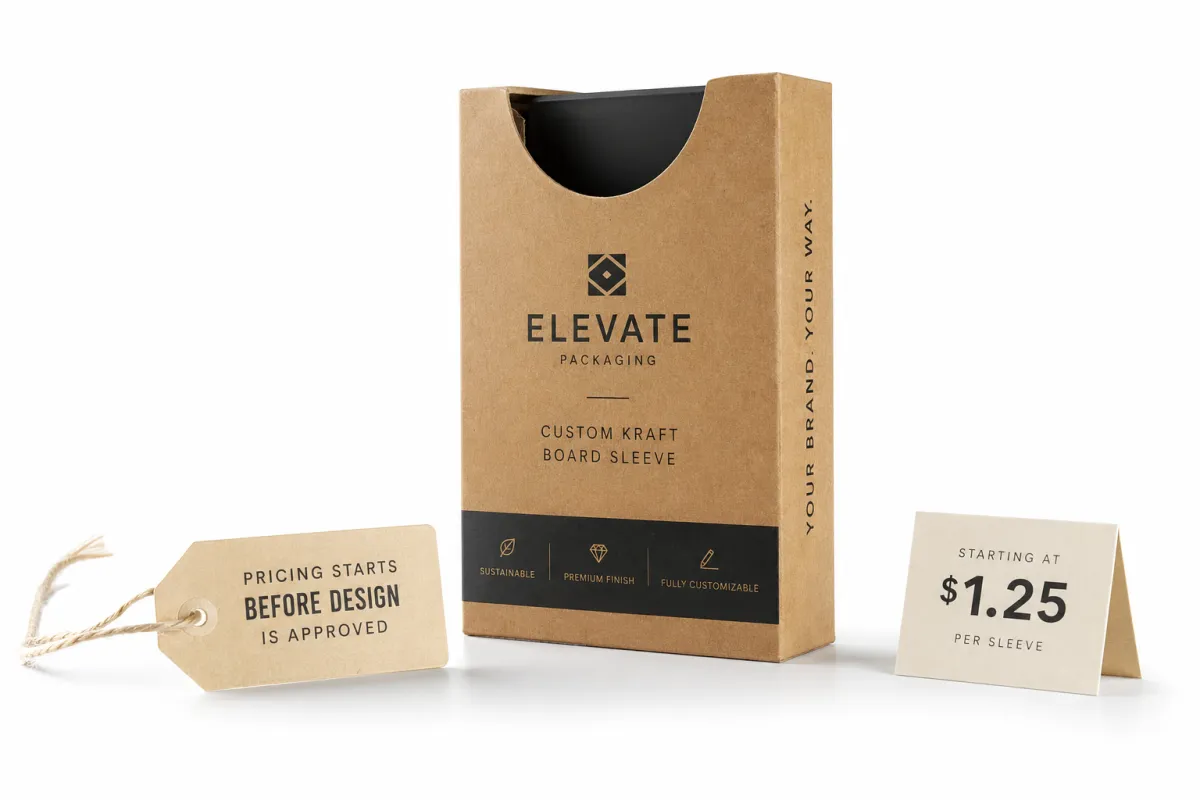
The first mistake I still see teams make is treating the price of custom kraft board sleeves as a late-stage procurement concern. It begins much earlier, during pack-out architecture. Sleeve format, board grade, print area, and closure style all influence material usage, finishing operations, and waste percentage before any press runs. A design that looks simple in a mockup can still be expensive if the dieline is too tight, fold logic is inefficient, or artwork triggers multiple setup corrections.
Many buyers assume a premium-look sleeve always commands a premium cost, but reality is messier. A slightly more expensive sleeve can be the better business choice if it lowers complaints, improves shelf performance, and prevents handling damage. The key is to compare what you pay upfront against what you avoid later. In one beauty launch I handled, a sleeve with a more controlled finish reduced scanner errors by half and saved enough returns to offset the initial difference in unit cost within six weeks.
What you can control, and where you can pull leverage, usually sits in your own hands: artwork density, print colors, coating type, and size variation strategy. What you cannot fully control is volatile raw board pricing, freight swings, and peak-season press availability. The strongest teams build their own decision quality around the controllable levers first. The next best teams then ask each supplier how the non-controllable costs are being managed and shared. That is how the price of custom kraft board sleeves moves from guesswork into negotiation.
Brand economics matter too. In many launches, sleeves act as a visual upgrade without forcing a full custom carton redesign. A well-engineered sleeve can carry most of the communication and still keep packaging spend in range, especially when the inner pack stays standard. For small brands testing channels, that can be the difference between a test that ships and one that never goes beyond sample stage.
If you are comparing format options, the Custom Packaging Products catalog is helpful for setting sleeve alternatives against other structures. The useful exercise is not ranking everything by aesthetics; it is assigning function first: protection, display, information clarity, and production repeatability. The price of custom kraft board sleeves is still the same unit phrase, but each function changes the cost behavior.
Some teams also benefit from an early discussion with production support before RFQ release. A practical next step is to confirm constraints and expected tolerances through Packaging Support before files are frozen.
Here is the procurement truth people often skip: pricing usually stabilizes only when the brief is stable. Instability appears when design, packaging, and operations departments each move in a different direction and no one owns one final truth. A locked dieline, clear structure, and realistic timeline are not admin overhead; they are practical cost controls.
“If the brief is loose, the price is loose. Production teams price certainty into disciplined inputs, not into creative hesitation.”
That sentence is blunt, and packaging teams respect it. A low initial price can still be expensive if it leads to hidden delays, complaint spikes, or dead stock. For most programs, the right sleeve spec is the one that reduces expensive surprises, not the one with the smallest first number. The objective with the price of custom kraft board sleeves is a clean system, not a cleaner-looking paragraph.
Product details: what exactly is included in custom kraft board sleeves production
Not all sleeves are built equally, which is why prices differ widely across vendors. In production terms, there are at least four frequent structures: pressure-sensitive wrap sleeves, tuck sleeves, collar sleeves, and high-resistance structural sleeves. Each one shifts assembly complexity, labor intensity, and cost. For example, pressure-sensitive wraps usually move faster for simple presentation jobs, while structural sleeves behave more like a protective shell and often need stricter setup and handling controls.
Board texture is more than visual style, especially on kraft substrates. I have seen natural fiber variation create visible inconsistency when designers push saturated colors to the edge of print tolerance. A raw appearance can look premium, but if ink density, registration, and color consistency are mission-critical, the production cost rises. The price of custom kraft board sleeves increases when a manufacturer has to compensate for natural variation while still meeting strict brand standards, and buyers must understand that this is a real trade-off, not an excuse.
Common practical board setups for kraft sleeves tend to sit in a 250–380 gsm range for light-to-standard retail duty, with 380–450 gsm often used where extra puncture resistance and stacking stress are expected. These ranges are not strict rules—they vary by substrate profile, moisture exposure, and carton architecture.
Customization layers can be broken down this way:
- Substrate — board weight, caliper, recycled content, and stiffness.
- Ink profile — CMYK, PMS, spot colors, white base, or reduced-color strategy.
- Coating and finish — matte, gloss, aqueous, UV, or soft-touch options.
- Die-cut profile — cut complexity, windows, score points, and fold reliability.
- Assembly method — flat packs, pre-glued delivery, hand-assembly support, or mixed workflows.
That breakdown matters because bids often diverge not on the base material, but on what is bundled. One supplier may show a low per-unit and recover cost through separate finishing charges. Another may fold multiple steps into one line, which looks higher on paper but is simpler to predict once approved. If quote formatting is unclear, the price of custom kraft board sleeves is easy to misread and harder to defend.
Use cases amplify the differences. A small-batch luxury campaign often needs tighter visual control and richer handling, so higher pre-press attention is reasonable. A fast-moving daily-store program usually values barcode reliability, repeatable fit, and steady replenishment efficiency. In that case, a straightforward sleeve can outperform a flashy one because it holds up under repeated handling and faster cycle planning.
For technical teams, the artwork brief is where risk enters the workflow. The file should lock final dimensions, bleed, barcode quiet zones, and scanner-safe margins. It should also state acceptable tolerance for sleeve fit: too tight increases assembly friction; too loose increases transit damage and complaints. Those are not aesthetic concerns—they directly affect the price of custom kraft board sleeves and final inspection pass rates.
When buyers ask for sourcing clarity, the FSC site is a useful industry reference for chain-of-custody context: FSC. In many retailer audits, this matters as much as board color or finish. A sleeve can be beautiful and still fail expectations if traceability documentation does not match brand policy.
Across projects, teams ask for three things from sleeves: deliberate design, reliable handling, and repeatability at scale. The price of custom kraft board sleeves should always be checked against those three. If consistency is weak, the cost model is fiction, no matter how premium the sample looks.
Specifications: board, finish, print, and tolerances that impact cost
Specifications are where the price of custom kraft board sleeves turns from opinion into calculation. Board thickness, caliper, and stiffness set the baseline: low caliper can cut material cost but may increase puncture risk, edge crush, and humidity warp. Higher caliper usually improves performance and perceived quality, yet it slows some finishing steps and can affect sheet handling. As a rule, the right board is not automatically the cheapest board; it is the lowest-cost board that survives your route and handling profile.
Most teams make good progress with practical bands:
- Light-duty sleeves — lower caliper, lower protection, best for controlled shelf display.
- Mid-weight sleeves — balanced stiffness, common for mixed-rotation retail and multipacks.
- Heavy-duty sleeves — higher crush resistance, better for transport stress and storage movement.
In many facilities, a sleeve production pass may use ±0.5 mm to ±1.0 mm tolerances on fold accuracy and a 1.0–2.0 mm trim tolerance depending on dieline complexity. If your supplier runs these in a tighter band, you often get better consistency, but the cost can rise through slower changeovers and more rechecks.
Print selection is another strong cost lever. CMYK is usually stable and easier to repeat than designs requiring multiple PMS colors, white ink on natural board, or special metallic effects. Those looks can be impressive, and they can also increase pre-press validation and the chance of variance rejection. If color accuracy is contractual, expect to pay for process control. There is no magical low-cost path to strict color fidelity on a natural substrate.
Finishes influence visual quality and process load at the same time. Matte and aqueous workflows often sit in standard production paths. UV and foil can improve pop and contrast, but they add setup, equipment, and sometimes slower turnaround. Soft-touch is premium on hand-feel and can be great for gifting contexts, yet it usually carries higher consumption and labor. These are cost-significant decisions because each may shift the project into a specialist flow rather than a standard line.
Packaging professionals are right to align material, format, and process together. That guidance appears in the broader industry literature, including Packaging.org, which supports treating design, test, and material in one loop. In practice, isolating these factors creates the kind of variation you later pay for: unexpected setup changes, rejections, and extra sample rounds.
Tolerance detail is often under-specified and undercharged. Width tolerance, score depth, closure force, and fold memory are each measurable, but each can create waste and handling friction if over-tight or under-defined. A 1 mm mismatch in fit tolerance can increase trim losses and manual adjustment in ways that are hard to reverse without rework. This is one of the clearest reasons the price of custom kraft board sleeves changes after approval.
Quality checks that help in the first pass:
- Gram-per-sleeve variance for board consistency and run predictability.
- Barcode legibility testing at realistic scanner angles and distances.
- Peel, friction, or draw resistance where sleeves include insert or closure interactions.
- Edge integrity checks for weak die-cut behavior under transport stress.
- Registration tolerances around windows, folds, and printed hit zones.
Precision is expensive if the commercial upside is weak. A cosmetics sleeve may justify tighter control because shelf presentation drives conversion, while a seasonal insert sleeve may not. Segmenting tolerances by value category is often the most underrated way to keep the price of custom kraft board sleeves competitive.
For transit behavior, teams frequently use ISTA methods as a common language for stress assumptions. The International Safe Transit Association publishes useful frameworks at ISTA. A sleeve does not have to carry a laboratory label to be production-ready, but it should be designed as if it will be handled, stacked, and unwrapped more than once before landing on shelf.
The practical reality is this: tight specs help quality, but over-tight specs without business justification hurt economics. The good buyers I see aim for enough control to protect brand performance while avoiding unnecessary precision overhead. That keeps the price of custom kraft board sleeves in a realistic range.
What affects the price of custom kraft board sleeves?
Quotation behavior is where confusion starts. The price of custom kraft board sleeves is typically a bundle of components: one-time startup, tooling, pre-press, unit manufacturing, finishing, freight, and occasionally insurance or storage handling. If a supplier gives only a unit figure with no structure behind it, you do not have a quote; you have a partial estimate. What you want is a clean map of fixed versus variable cost and what triggers a change order.
Use this baseline:
Total Project Cost = one-time startup + (unit run size × unit manufacturing cost) + materials + finishing + shipping + change-order impact
That formula is simple on purpose. It prevents teams from over-focusing on unit price and ignoring startup behavior. In short runs, startup dominates. In larger runs, freight and yield can dominate. In many brands, the first version of a formula is still the hardest part, because teams do not know where they will spend money once revisions start.
MOQ behavior still catches teams out, especially in the first three cycles:
| MOQ band | Typical use | What happens to the price of custom kraft board sleeves | Buyer takeaway |
|---|---|---|---|
| Micro | Prototype, sample, or test launch (roughly 250–1,000 units) | Setup and tooling costs sit across fewer units, so per-unit price is higher | Good for validation, not always ideal for cost efficiency |
| Pilot | Small campaign, regional release, limited edition (roughly 1,000–3,000 units) | Per-unit can remain elevated but with lower inventory risk | Useful when demand confidence is limited |
| Standard | Repeatable production for steady demand (roughly 3,000–12,000 units) | Startup is absorbed more evenly across the run | Often best balance of control and spend |
| Scale | National rollout or sustained retail program (roughly 12,000+ units) | Volume discounts can help, while schedule discipline becomes critical | Best when demand and replenishment are predictable |
The trade-off is not merely price versus volume. A higher MOQ can drop per-unit rates, but it can also trap working capital in shelves and depots. The cheapest headline price of custom kraft board sleeves is still a bad buy when half the stock turns slowly. If design edits are likely, I usually advise a lower MOQ with planned re-pricing checkpoints, rather than a single oversized order.
Common surcharge patterns show up in three places: rush requests, color-change approvals, and SKU complexity. Priority scheduling often adds line-priority or overtime costs. Multiple SKUs can trigger multiple plates or setup cycles even when the structure is the same. Shared materials across sizes helps only when the art and finishing assumptions are truly aligned. Ask each supplier where those surcharges sit: included, excluded, or conditional.
Samples are another place assumptions go sideways. Some vendors credit sample fees, some do not. Some include one revision loop; others charge per pass. The total cost of the price of custom kraft board sleeves can jump fast if that policy is not explicit. The best quotes include an unambiguous statement of what “sample included” actually means.
For fair comparisons, normalize everything. Same format, same file status, same size, same board, same finish. If one quote is based on preliminary artwork and another on approved CAD/dieline, they are not comparable. If one includes revised proofing and another leaves it out, the gap can look larger than it should—or hide real savings.
My preferred rule is to freeze pricing at design freeze, and only then revisit if approved changes appear. Once the quote is locked to approved files, both teams can protect themselves: buyers avoid silent drift, and suppliers can hold capacity without carrying unnecessary risk. That is what reliable procurement looks like in this space.
Process and timeline: timeline stages that control the price of custom kraft board sleeves
Timeline is often the single biggest multiplier of cost after design. The price of custom kraft board sleeves goes up when approvals drift because machine time shifts, capacity is held, and revisions consume real labor. Typical flow stages are RFQ, data check, prototyping, sampling, pre-production sign-off, bulk run, QA inspection, finishing, and dispatch. Delays become expensive after artwork lock, because they now displace real press time.
In one food supplement run I reviewed, we lost almost two weeks because two departments treated final file ownership as shared by default. At the end of day, nobody was wrong on intention, but everyone was wrong on accountability. The sleeve design was good; the process was the problem. Set a single approval owner early and define change rights in writing.
Timeline decisions affect material availability too. Specific recycled content or niche finishes can have lead-time constraints, especially before major trade windows. Shared press schedules increase this sensitivity. A minor change can move a run out of the planned slot and force overtime to recover, which feeds directly into the price of custom kraft board sleeves. Buyers who track only unit cost and not capacity risk frequently understate total spend.
A practical gate sequence:
- Gate 1 — RFQ submitted with final dimensions, target board, and chosen finish.
- Gate 2 — dieline approval, artwork validation, barcode position confirmation.
- Gate 3 — sample review, revision cap, and production file locked.
- Gate 4 — bulk authorisation issued, no design changes without change order.
- Gate 5 — final QA approval and shipment release.
That sequence has one strength: it separates manageable edits from expensive edits. Minor copy fixes before Gate 3 are usually acceptable. Structural shifts after tooling release are usually no longer “small edits.” They are production events, and they carry consequences.
Seasonality and logistics can wreck even a clean schedule. If your launch sits in a peak quarter, build contingency time into your production window and your pricing logic. A two-day internal delay at proof can become a one-week external delay when everyone is queueing for shared presses. So yes, revision caps and contingency windows feel like bureaucracy, but they are often the cheapest budget protection you get.
As a rough internal benchmark, many standard sleeve programs move from proof approval to dispatch in around 12 to 15 business days, but print complexity, finish type, and QA requirements can push that out to 3 to 5 weeks. Compression of that timeline generally costs more because supplier flexibility becomes part of the fee you did not explicitly see in the base line. If your program is time-sensitive, bake that into your procurement conversation up front.
The recurring pattern is clear: uncertainty left in design becomes cost in production, and cost in production is what pushes up the price of custom kraft board sleeves. Remove uncertainty early, and you usually improve both quality and spend.
Why choose us: operational proof points buyers can verify before purchasing
In this category, buyers should not buy narrative, they should buy proof. The price of custom kraft board sleeves is easiest to defend when a supplier shows clear repeatability and documented control. Ask for two things first: how close batch two is to approved sample, and how defects are handled when a deviation appears. If that cannot be shown, any low quote is simply a starting number, not a guarantee.
Transparency is the strongest filter. A good vendor quote includes line-item costs, proof logs, revision history, and a file version trail. Good communication includes who approved what and when. If board substitutions are made and not documented, quality and timing risk jump immediately because decisions are no longer traceable.
Operational proof points to verify before purchase:
- Sample-to-batch consistency from a previous SKU category with measurable inspection criteria.
- Documented defect escalation process and clear replacement terms for recurring issues.
- On-time shipment reports tied to gate milestones, not general monthly claims.
- Proof records showing reviewer identity, version number, and approval date.
- Response SLA for pre-press questions and change-order requests.
These checks do more than avoid arguments; they reduce management friction and prevent late-cycle rework. In real projects, packaging teams are rewarded for process stability as much as visual quality. A reliable workflow also protects against the pricing volatility that often follows rushed approvals.
Two engagement models are common. A design-to-order partner is useful when teams need co-engineering on structure, board selection, and pack-out logic. A self-serve file model usually works better when internal Brand and Production gates are already stable. Neither is inherently better. The right one depends on internal capability, risk tolerance, and how often your launch plans change.
Communication discipline is the most underrated part of the price of custom kraft board sleeves. A controlled review cadence, shared file naming, and documented sign-off paths reduce ambiguity. That is especially critical when sleeves sit inside a broader system that includes labels, inserts, or coordinated cartons.
For sourcing conversations, traceability documentation and fiber claims should be treated as part of quality. The right paper can support brand and retailer requirements, but it should not be mistaken for a cost reducer by itself. If your channel relies on transparency, include certification depth in the quote scoring, not as a side note.
At Custom Logo Things, the practical standard is straightforward: make the price of custom kraft board sleeves easy to verify before and during production. Keep quotes readable, keep version paths stable, and keep expectations visible. No buzzwords, no performance theater—just predictable outcomes and less revision chaos.
Conclusion and next steps: lock the price of custom kraft board sleeves with 5 actions
The core lesson is simple and repeatable. The price of custom kraft board sleeves is won or lost on spec clarity, timeline control, and approval discipline more than on board choice alone. Teams that lock purpose, structure, and finish early usually save both time and money because they avoid the expensive penalties of ambiguity. That applies equally to pilots, regional programs, and large-scale replenishment.
Use these five actions in order:
- Define sleeve purpose — prioritize protection, presentation, and information, then rank those priorities.
- Set a budget band before RFQs — then reject quotes outside that practical range until assumptions are corrected.
- Freeze final dieline and artwork — no guesswork on fit, bleed, and barcode position.
- Request matched sample sets — compare sample, approval proof, and intended bulk behavior side by side.
- Confirm staged timeline ownership — define approval owners, revision caps, and change-order triggers.
That list works because packaging cost is not only a materials problem; it is a process problem too. Top-performing teams assign approval roles clearly, use one source of truth for revision history, and compare three normalized quotes before selecting a supplier. That approach makes negotiation cleaner and much less emotional.
If this sleeve sits inside a larger packaging architecture, compare it against carton, insert, and label options before committing final budget. In some programs, the sleeve is exactly right. In others, a more integrated pack does better at the same cost. The right answer depends on margin profile, SKU velocity, and launch urgency, not on any generic market benchmark.
Actionable takeaway: treat the price of custom kraft board sleeves as a controlled system, not a fixed figure, and tie every decision to measurable production outcomes. Do it that way and you reduce two biggest costs at once: over-ordering low-value options and paying for preventable redesigns when shipping gets near. It sounds less glamorous than it is, but it is the part that keeps branding strong, schedules intact, and buyers on budget. If you want to discuss a practical starting scope, request guidance from Packaging Support.
FAQ: fast answers to the price of custom kraft board sleeves questions
What is the real price of custom kraft board sleeves for a first run?
Ask for a breakdown of startup/setup, unit manufacturing, finishing, and freight before discussing only the unit price. For first runs and pilots, startup often dominates and can make the quote seem heavy even when quantity is small. A useful comparison is a three-step spread: pilot, short production, and scale scenario. Also confirm whether die-cut revisions, color approvals, and proof edits are in the base quote or billed separately, because that is where first-run pricing usually drifts.
How does artwork complexity affect the price of custom kraft board sleeves?
Multiple inks, dense gradients, spot colors, and strict registration requirements increase pre-press workload and approval friction. That usually raises print and setup time, which can increase total cost more than unit price suggests. Simplified color and cleaner type hierarchy often reduce proof cycles and speed release. If strict brand color is mandatory, specify managed color controls and acceptance tolerance from day one; it avoids expensive late corrections. In real production, the price of custom kraft board sleeves rises the fastest when a design is visually strong but file-wise incomplete.
Can I order samples before committing to MOQ on custom kraft board sleeves?
Yes. Best practice is to request pre-production samples tied to the exact production file version and final dieline. Ask whether the sample is full-cost or subsidized, and whether accepted sample costs are credited to the first order. Use the same inspection checklist for sample and production so standards do not drift. This is one of the most effective ways to protect the price of custom kraft board sleeves from revision shocks later.
How should MOQ be used to control budget on the price of custom kraft board sleeves?
Choose the smallest MOQ that still covers setup and pre-press in a predictable way. A larger MOQ can reduce per-unit cost but increases cash tied up in inventory and storage risk. If demand forecasting is unstable, ask for split shipments or phased replenishment terms while preserving some price certainty. Also lock final artwork and approval before full tooling release; late structure expansion can trigger new pre-production costs. In practice, this is the difference between a controllable rollout and a capital sink.
What causes price spikes during the process and timeline phase for custom kraft board sleeves?
Late dieline edits after tooling, repeated proof rounds, and unscheduled stock substitutions are the most common direct spike drivers. Rush scheduling adds overtime, expedited freight, and priority press costs, and those charges should be separately visible from day one. The safest control is a version gate: every file change gets an explicit change order and timeline impact. If that process is not available, expect the price of custom kraft board sleeves to become a moving target.
The teams that win here are not those with the fanciest briefs; they are those with the cleanest controls. A tight brief, short approval chain, and transparent change policy usually protect the price of custom kraft board sleeves across first launch, repeat production, and multi-SKU programs. If your sleeve design has to do both brand work and logistics work, the process has to be just as deliberate.

