custom made labels do more than carry a logo. They change how a garment feels, how it wears, and whether the brand looks deliberate or improvised. A shirt can be cut well and sewn cleanly, then lose credibility the moment the neck label scratches, the size mark is unreadable, or the care instructions look like they were added at the last minute. Customers rarely diagnose the problem in technical terms. They just know something feels off.
For buyers, labels sit in the same decision bucket as Custom Packaging Products and other branded presentation pieces. They shape first impressions, carry practical information, and either reinforce or weaken the price point. If a clothing line is meant to live inside a wider packaging system, the label has to match the same level of care. One weak detail can make the rest of the package feel inflated.
The biggest misunderstanding is treating labels like artwork alone. They are a production spec. Material, fold, stitch, backing, size, and wash behavior all affect the final result. If the request is “send logo, get labels,” expect revisions. If the request includes the garment type, placement, and usage conditions, the quote is usually more accurate and the label is more likely to survive real wear.
What Custom Made Labels Actually Change on a Garment
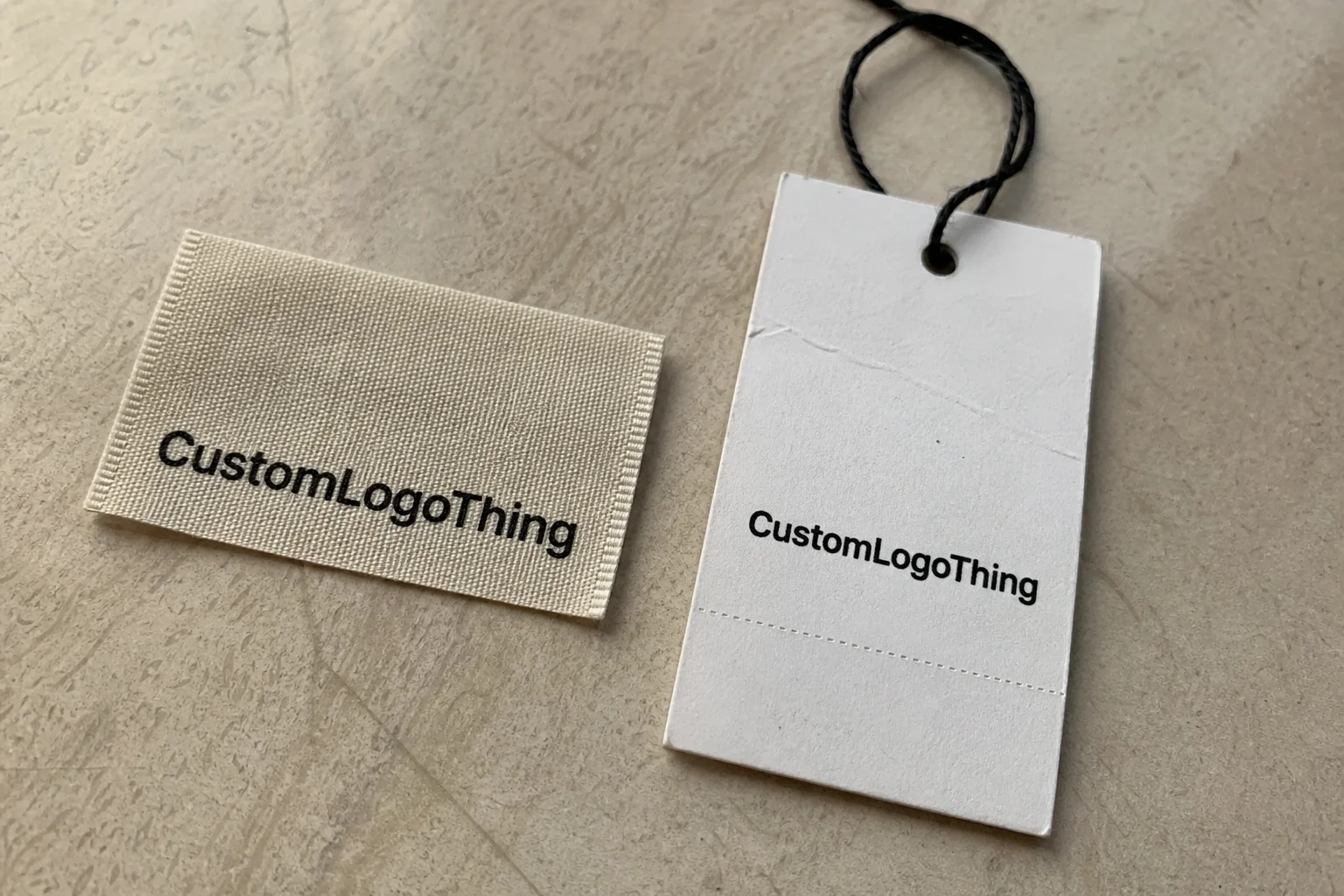
Most buyers mean one of four things when they ask for custom made labels: neck labels, size labels, care labels, and sewn-in brand identity labels. Some also mean exterior patches or hang tags, but those are different jobs. They sit differently on the product, use different materials, and carry different durability expectations. A woven neck label is not interchangeable with a hang tag, even if both carry the same logo.
The right label changes the garment in two directions at once. It affects the tactile experience, and it affects the credibility of the brand. Soft printed satin or printed nylon can disappear into the fabric. A stiff woven edge on a lightweight tee can feel distracting every time the shirt moves. On simple basics, that matters more than people expect because the label becomes one of the few premium cues the buyer can physically feel.
There is also a compliance layer that cannot be treated as optional decoration. Many apparel items need fiber content, care instructions, country of origin, and size information. If those details are missing or illegible, the label fails its job even if the logo looks polished. Brand styling comes after the required information is squared away, not before.
“A label that looks premium but scratches the neck is still a bad label. Pretty doesn’t fix comfort.”
For brands building package branding across apparel, inserts, and outer cartons, the label should feel like part of the same system. If your packaging design uses restrained typography and a clean palette, the label should not suddenly jump into a different tone or finish. Consistency is not flashy. It is what makes the product line feel intentional instead of assembled from separate purchases.
In practice, the labels that perform best are matched to garment weight, use case, and wash cycle. A baby tee, a heavyweight hoodie, and a technical knit do not want the same construction. That sounds obvious until someone asks for one label style to cover every SKU. The result is usually compromise, and compromise shows up in the hand feel long before it shows up in the mockup.
How the Process and Lead Time Usually Unfold
The ordering sequence is usually predictable: inquiry, quote, artwork review, proof approval, sample check, production, finishing, and shipping. The disruption usually appears in the proof stage, where vague artwork or missing specifications force back-and-forth. If the supplier has to guess at fold position, font size, or care text, the schedule starts slipping immediately.
For custom made labels, a normal timeline often looks like 2 to 4 business days for quoting and proof preparation, then 1 to 3 weeks for production after approval, plus shipping on top. Rush work can move faster, but only if the spec is simple and the buyer answers quickly. Specialty finishes, unusual colors, tighter tolerances, or multiple revisions add time. That is not a delay story. That is manufacturing.
A proof is not the finished label. It confirms layout, text, and general design intent. A sample is the first real chance to judge touch, size, and fold behavior. Production is the actual run. Sign off too quickly and any issue becomes your problem, not the proofing team’s. A label that looks balanced on a screen can land differently once stitched into fabric.
Lead time also changes with label construction. Printed labels and standard satin labels often move faster than woven labels with intricate detail. Tagless heat-transfer labels can be quick if the artwork is clean and the application method is defined. Embroidered or patch-style constructions usually need more time because more steps are involved and more quality checks are required.
If timing matters, ask for three separate numbers rather than one broad estimate:
- Proof time — how long before artwork or a digital mockup is ready to review
- Production time — how long after approval until the order is complete
- Shipping time — the transit window from the production point to delivery
If a supplier gives only one vague lead time, ask for the split. It usually reveals whether the schedule is realistic or simply optimistic.
Materials, Backings, and Finish Choices That Hold Up
Material choice matters more than most first-time buyers expect. Woven labels hold detail well and often feel premium, especially for logos with fine lines or small typography. Printed satin feels softer and is common for neck labels and skin-contact areas. Printed nylon tends to be durable and practical for everyday garments. Cotton can fit natural or lower-gloss brand positioning, though it is not always the best choice for heavy laundering. TPU and similar substrates can work well for modern or tagless applications, but they solve specific problems rather than automatically improving the result.
Feel matters as much as appearance. A label on kidswear or underwear should be soft enough that nobody wants to cut it out. A heavyweight hoodie can handle a thicker woven label better than a featherweight tee. On a luxury knit or delicate woven fabric, the wrong backing or edge finish can look and feel out of place. Good retail packaging and good labels share the same rule: the closer the touchpoint is to the customer’s hand or skin, the more the finish matters.
Finish style changes comfort, appearance, and cost. Common choices include end fold, center fold, loop fold, straight cut, and tagless heat-transfer application. End fold and center fold are common for sewn-in labels. Loop fold can give a cleaner presentation on larger labels. Straight cut is flexible, but it depends more on accurate sewing. Heat-transfer removes the physical label feel entirely, which is why it often appears in athleisure and children’s basics.
Durability is not just a property of the base material. Stitch quality, ink resistance, and edge treatment all affect how the label ages. For apparel that will be washed repeatedly, ask how the label is expected to behave after multiple laundry cycles. A supplier should be able to explain wash resistance in plain language. If the answer is only “it should be fine,” keep asking.
For brands building a full visual system, labels should align with other touchpoints such as custom printed boxes, hang tags, and inserts. The label does not live on its own. It sits inside the same branding structure as the outer package. If the label signals premium and the rest of the product presentation signals bargain, the customer notices the mismatch even if they cannot name the exact source.
| Label option | Best use | Comfort | Typical tradeoff |
|---|---|---|---|
| Woven label | Fashion basics, premium branding | Medium | Excellent detail, but can feel firmer than print |
| Printed satin | Neck labels, soft apparel | High | Very soft, but may feel less structured |
| Printed nylon | Durable everyday garments | High | Good wash performance, less texture than woven |
| Cotton label | Natural or eco-positioned brands | Medium to high | Natural look, but not always the best for harsh laundering |
| Heat-transfer tagless | Activewear, kidswear, underwear | Very high | No physical label feel, but application has to be accurate |
For sustainability-minded buyers, ask what the substrate is made from and whether related components in the packaging system can be specified more responsibly. Labels themselves are not always part of the FSC conversation, but the wider brand system often includes printed collateral and packaging materials that can be reviewed for responsible sourcing. Packaging industry references and certification bodies are useful when the label sits alongside cartons, inserts, or other paper-based components.
Useful references: Packaging industry resources, FSC certification standards.
Cost, Pricing, and MOQ: What Moves the Quote
Label pricing is driven by quantity, size, material, color count, fold style, finishing, and packaging. Add sampling, shipping, and rush charges, and the quote stops looking simple. That is normal. A cheap headline number can become an expensive order once the real variables are added.
For custom made labels, lower quantities usually mean a higher unit price. Setup and production overhead are spread across fewer pieces. At larger runs, the per-piece cost falls, sometimes sharply. A 500-piece woven label order can carry a noticeably higher unit cost than a 5,000-piece run, even if the total spend is smaller on the first order. Buyers often focus on total dollars and ignore the unit economics, which is fine until a product starts selling and the next reorder has to be priced under pressure.
A practical way to think about it:
- Low MOQ helps test a concept, but the unit price is usually higher.
- Mid-volume orders often balance flexibility and cost.
- Large runs improve unit price, but they tie up cash and storage space.
If a quote seems unusually low, ask what is missing. Is sampling included? Are proofs included? Is shipping included? Is there a setup fee? Do extra colors, tighter folds, or specialty packaging cost more? A realistic quote should spell out the full spec rather than hide behind a teaser number.
Pricing also changes with construction complexity. A basic satin neck label with one-color text will not price the same as a full-color woven label with a custom fold and sewn finishing. Specialty finishes and premium substrates push cost upward, and so do small text details that require more precise production. If a supplier quotes without asking garment type, placement, or intended use, the number is probably too thin to trust.
When comparing suppliers, compare spec to spec. Same material. Same size. Same fold. Same finish. Same quantity. Same shipping terms. Otherwise the comparison is meaningless. It is easy to call one offer cheaper until the details are lined up and the price difference disappears.
Step-by-Step Ordering for a First Run
Start with the garment, not the logo. Where will the label sit? Will it touch bare skin? Will it be seen immediately? Is the product a lightweight tee, a hoodie, a jacket lining, or a children’s garment? Those answers narrow the options quickly.
Then build the spec sheet. Include size, material, fold style, colors, text, stitch method, and any compliance wording. If the same label is used across multiple SKUs, note which parts are fixed and which can change. A clean spec sheet reduces back-and-forth and makes reorders much easier later.
Artwork needs to be usable, not just attractive. Vector files are usually the safest starting point. Keep fonts outlined or embedded, and check that the smallest text remains readable at final size. If care symbols or fiber content are included, make sure they do not collapse into visual noise once the label is folded or sewn. Tiny text can look fine on a monitor and become hard to read in production.
Then review the proof line by line. Check spelling. Check size names. Check fiber content. Check placement. Check spacing. If there is a barcode, SKU, or country-of-origin text, confirm it now. Correcting a mistake before production is inexpensive. Correcting it after production usually means rework, waste, or a delayed launch.
If the label touches skin, gets washed often, or sits on a high-volume style, order a sample or short run first. That small test can reveal comfort problems, color issues, or stitch problems that were invisible on screen. For brands balancing custom printed boxes, hang tags, and clothing labels, a sample run also helps keep the entire product packaging system aligned before a larger commitment.
Useful internal resources: Custom Labels & Tags and Custom Packaging Products.
Common Mistakes That Create Rework and Delays
The most common mistake is text that is too small. Care instructions or fiber content that look fine in a mockup can become unreadable after folding and stitching. Size the text for the actual object, not the screen. A mockup does not need to pass a wash test.
Another mistake is choosing a material because it photographs well. A woven label can look polished in a render and still feel scratchy on an actual garment. A soft printed satin label can be ideal for a tee and weak for a jacket lining. The garment should drive the label choice, not the other way around.
Wash performance gets overlooked constantly. Buyers see a clean proof and assume the label will age nicely. Then the print fades, the edge frays, or the color shifts after repeated laundering. If the product is supposed to last, ask how the label behaves after multiple washes. Claims about quality only matter if the finishing can support them.
Skipping proof review is another frequent self-inflicted problem. Teams approve too fast because they are busy. Later they discover a typo, a spacing issue, or a wrong size callout after production has already started. Proofs exist for a reason. Use the time before approval.
Reorder planning is the last mistake that causes avoidable stress. If one style starts moving quickly, the next batch should already be under review. Lead time, shipping time, and revision time all need room. If you are ordering custom made labels for a fast-selling line, set the reorder threshold before inventory gets thin. Waiting until stock is gone is how brands end up paying rush fees they could have avoided.
Next Steps: Test the Spec Before You Scale
Ask for a sample pack or a short-run proof and test it on the actual garment. Wear it. Wash it. Look at it under normal lighting, not just studio light. Screen colors, polished photos, and mood-board references are useful, but they are not the same as a shirt in a warehouse, in transit, or on a customer after three washes.
Once the sample works, lock the spec sheet. Save the material, size, fold, text, and quantity in one file so future reorders are straightforward. That small amount of discipline pays off quickly when a line expands or when multiple SKUs need to stay visually consistent across product packaging and apparel trims.
Set a reorder threshold before stock gets low. If production takes two weeks and shipping takes another week, the buffer has to be generous enough to absorb normal delays. That is basic inventory control, not a special process.
Strong labels support stronger branding. Weak labels make a good garment feel unfinished. If the goal is to have custom made labels that hold up in the real world, the smarter move is to test the spec first and scale after the details are proven.
For more authority on material, durability, and packaging standards, see ISTA testing resources for transport and handling considerations, especially if labels ship with finished apparel or boxed retail sets.
How long do custom made clothing labels usually take to produce?
Standard jobs often take a few business days for proofing and about 1 to 3 weeks for production, depending on complexity and quantity. Rush options exist, but they usually require simpler specs, faster proof approval, and fewer special finishes. If timing matters, ask for the timeline in writing and separate proof time, production time, and shipping time.
What is the usual minimum order quantity for custom made labels?
MOQ depends on the material and construction, but printed labels often allow lower starting quantities than woven or specialty options. Lower MOQs are useful for testing a new garment line, but the per-unit cost is usually higher. If you are between sizes, ask whether the supplier can quote a test run and a full run side by side.
Which material is best for soft, wearable custom made labels?
Soft satin, printed nylon, and other smooth substrates usually work best for skin-contact areas like neck labels. Heavy woven labels can feel premium, but they are not always the most comfortable choice for lightweight apparel. Always test the label on the actual garment, because fabric weight changes how a label feels in the hand and on the body.
Can custom made labels include care instructions and sizing?
Yes, most clothing label orders can combine brand name, size, care symbols or text, and country-of-origin details. The challenge is space, so the layout needs to stay readable after folding and sewing. If the garment has compliance requirements, confirm the exact wording before the proof gets approved.
How do I compare quotes for custom made labels without missing hidden costs?
Compare the full spec, not just the headline price: size, material, color count, quantity, folds, and finish. Ask whether sampling, setup, shipping, and rush fees are included or billed separately. A lower quote is not a better quote if the label fails wash tests, feels wrong, or forces a reprint.