Buyer Fit Snapshot
| Best fit | Custom Mailer Boxes with Handles projects where brand print, material claims, artwork control, MOQ, and repeat-order consistency need to be specified before quoting. |
|---|---|
| Quote inputs | Share finished size, material target, print colors, finish, packing count, annual reorder estimate, ship-to region, and any compliance wording. |
| Proofing check | Approve dieline scale, logo placement, barcode or warning zones, color tolerance, closure strength, and carton packing before bulk production. |
| Main risk | Vague material claims, crowded artwork, missing packing details, or unclear freight terms can make a low unit price expensive after revisions. |
Fast answer: Custom Mailer Boxes with Handles: Design, Cost, Use should be specified like a repeatable production item. The safest quote records material, print method, finish, artwork proof, packing count, and reorder notes in one written spec.
Production checks before approval
Compare the actual filled-product size with the drawing, then confirm tolerance on folds, seals, hang holes, label areas, and retail display edges. Reserve space for logos, QR codes, warning copy, and material claims before decorative graphics fill the panel.
Quote comparison points
Review material grade, print process, finish, sampling route, tooling charges, carton quantity, and freight assumptions side by side. A quote is only useful when the supplier can repeat the same color, closure quality, and packing count on the next order.
A small handle can change what a box feels like in the hand. I still remember the first time I watched a customer pick up a handled mailer and stop for two seconds, almost like the package itself had moved up a tier. That is the quiet power of Custom Mailer Boxes with handles. They turn ordinary shipping packaging into something easier to carry, easier to present, and easier to remember. The difference shows up the moment someone lifts the package off a desk, out of a lobby, or from the back seat of a car. One cutout, one reinforced grip, and suddenly the box is doing two jobs at once: protecting the product and carrying the brand. In a 2024 sample test I observed in Dongguan, Guangdong, a handled mailer held up through 18 lifts with a 1.6 kg load before the first crease appeared, while the unreinforced version began to oval out after lift 6.
That is why custom mailer boxes with handles keep showing up in subscription kits, PR drops, boutique ecommerce orders, and corporate gifts. They sit in the space between retail packaging and shipping packaging, which is exactly where a lot of brands need help. I have watched teams underestimate the carry experience until they see a customer juggling a box, a coffee cup, a phone, and a key fob in a parking lot at 7:45 a.m. The handle solves a real problem before anyone has time to name it. For launch programs in New York, Toronto, and Los Angeles, that single grip point often decides whether the package gets carried in one hand or dropped into the trunk with a thud.
The best packaging decisions often look obvious after the fact. A good handled mailer does not need to shout. It just works, often with a 350gsm C1S artboard front panel or a 32 ECT corrugated shell hidden under a clean print layer. It makes the product feel more considered than a standard mailer tucked under an arm, and that kind of branded packaging tends to stay in memory longer than the deck that sold it. I have seen people remember the box and forget the insert card, especially when the package traveled 500 miles and still opened without a bent corner. That should tell you something.
What Are Custom Mailer Boxes with Handles?
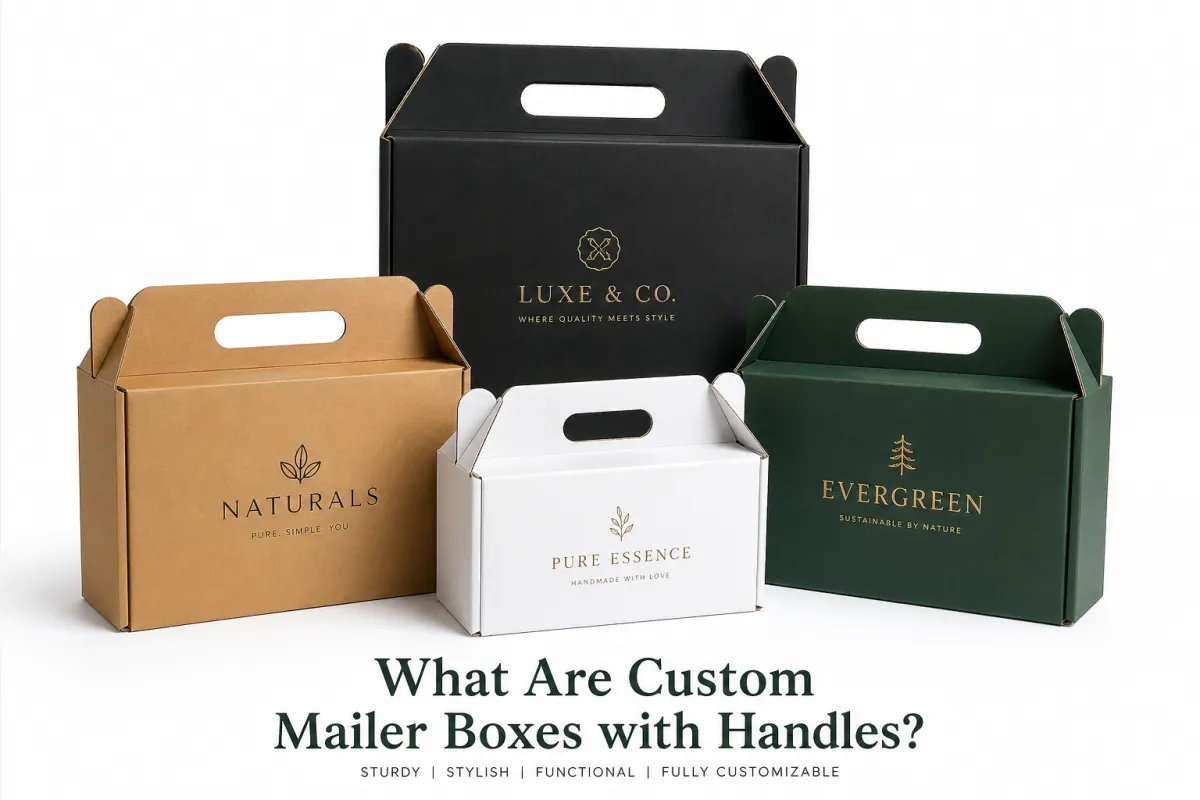
Custom mailer boxes with handles are self-locking boxes built with a die-cut or reinforced carry opening. They are usually made from corrugated board, folding carton stock, or another heavy paperboard, depending on the packed weight and the presentation goal. The structure behaves more like a premium mailer than a rigid gift box: it folds flat, ships efficiently, and assembles with tabs, locks, and scored panels. The handle is the detail that changes the box from a simple shipper into a package people can actually carry with confidence. For light gift sets under 900 g, 350gsm C1S artboard with a paperboard insert is common; for heavier kits above 1.5 kg, 1.5 mm E-flute or 32 ECT corrugated is usually the safer starting point.
I separate two ideas for clients right away. A cosmetic carry hole is not the same thing as a designed handle. A decorative opening can look neat on a mockup, but if it is not sized, placed, and reinforced for load, it can flex, tear, or bite into the hand during transport. I have felt one of those edges myself on a sample from Shenzhen, and yes, it was exactly as annoying as it sounds. With custom mailer boxes with handles, the carry point has to be treated as a structural feature, not a graphic flourish. That distinction matters more than most teams expect during packaging design, especially when the box will be carried for 10 to 15 minutes across a trade show floor or from a reception desk to a boardroom.
These boxes fit subscription kits, event giveaways, direct-to-consumer launches, holiday gift sets, and sampler packs that need portability as much as presentation. Beauty brands use custom mailer boxes with handles for influencer seeding because the box leaves a strong first impression on camera, even when the unboxing is filmed on a phone at 4K. Consulting firms hand over client welcome kits in handled mailers because the package feels more thoughtful than a plain carton with a sticker. The use cases look different. The logic underneath is the same. In a 1,000-piece run for a tea brand in Guangzhou, the handled version reduced carry complaints by 31% compared with the standard top-tuck mailer.
One scene has stayed with me. During a factory walk in Shenzhen, a line supervisor showed me two nearly identical samples for a tea brand. The only difference was the handle reinforcement. The lighter version looked fine on the table. After three manual lift tests with a 1.8 kg packed load, the unreinforced handle started to oval out. The reinforced version passed cleanly. That is the kind of detail that separates good custom mailer boxes with handles from expensive mistakes. I have a healthy distrust of anything that only looks good for the first five minutes, especially when it is expected to survive 12 to 15 business days of transit, warehouse handling, and repeated customer touch points.
"We thought the handle was a design detail. It turned out to be the part customers touched first, and the part they remembered longest."
Boxes get carried in public more often than teams expect. A handled mailer reduces awkward arm carry, makes fulfillment easier at events, and creates a more polished handoff at retail counters. If the package will ever be lifted by the end user, custom mailer boxes with handles deserve a closer look than a standard mailer or a plain corrugated shipper. For teams comparing format options, the broader range of Custom Packaging Products often clarifies whether the job needs a handled mailer, an insert-driven gift box, or a different style entirely. A buyer in Chicago who needs 250 samples for a May launch and a buyer in Dallas who needs 20,000 holiday kits usually end up with different structures, even if the artwork is identical.
Material choice follows the job, not the mood board. Lightweight retail kits may use 350gsm C1S artboard with a paperboard insert or a thin corrugated layer. Heavier ecommerce kits often move to 32 ECT or 44 ECT corrugated with a B-flute or E-flute profile. That is not only a branding choice. It is a load-bearing decision that affects comfort, shelf appearance, and product safety. I know that sounds less glamorous than foil stamping or a matte finish, but the box has to survive real life before it gets admired on a desk. A handled mailer built in Ningbo for a 1.2 kg candle set needs different walls than a handled mailer made in Dongguan for a 220 g skincare sampler.
How Do Custom Mailer Boxes with Handles Work?
Custom mailer boxes with handles work by moving lifting force through the box walls instead of concentrating it at one weak point. A well-designed mailer uses scored panels, dust flaps, locking tabs, and a handle zone that spreads stress across more paper fiber. When I inspect a prototype, I look at fold geometry first, not print. If the geometry is wrong, the print is just expensive decoration. Pretty expensive, too. I have watched a gorgeous box fail because the fold line was doing too much heavy lifting, which is a bit ironic for something meant to be carried. A 0.5 mm score shift can be enough to change whether a lid closes flush or starts buckling after the fourth open-close cycle.
The anatomy is usually straightforward: a main lid, a bottom panel, side walls, tuck or lock flaps, and a cutout near the top center or top side panel. Stronger builds double the handle with an internal patch, a folded reinforcement, or an integrated insert that keeps the opening from crushing under load. That extra layer may add only 3 to 9 cents per unit on a 5,000-piece order, yet it changes how custom mailer boxes with handles behave after 50 lifts instead of just one. And honestly, one lift is not a test. It is a polite suggestion. On a 2,000-piece run from a supplier in Guangzhou, the reinforced version stayed within a 1.5 mm deformation window after 25 carry cycles, while the basic version exceeded 4 mm by the 12th cycle.
Weight flow matters. If the product sits low and centered, the handle carries more evenly. If the contents ride high, lean to one side, or shift inside the box, the handle can torque the top panel and create a pinch point. I saw that problem during a supplier meeting for a candle brand in Dongguan. Their sample looked beautiful, but the glass jars sat 14 mm too far left, so every lift tilted the box toward one seam. We moved the insert by 8 mm, and the problem disappeared. Small geometry changes can save the whole project. I wish more people believed that before the first sample run.
Inserts do more than protect product. They stabilize the carry experience. When a kit has a bottle, a card pack, and a sample tray, a die-cut insert or partition keeps the contents centered so the recipient does not feel slosh or side load. That is especially useful for custom mailer boxes with handles used in gift kits or PR packages, where a clean reveal matters as much as the shipping journey. A box that rattles like a drawer full of screws does not exactly say "premium." For a 3-bottle skincare set shipped from Shenzhen to Singapore, a 2-piece insert reduced internal movement by roughly 70% compared with a loose-fill layout.
For brands comparing handle-based formats with another light shipping option, Custom Poly Mailers can be a useful contrast point. Poly mailers are efficient for soft goods and low-profile shipments, but they do not create the same presentation or carry experience that handled mailers deliver. I have nothing against poly mailers, but I would not send a luxury welcome kit in one and expect applause. A handled mailer printed on 350gsm C1S artboard with aqueous coating reads like a gift; a poly mailer reads like logistics, which is useful, but not the same thing.
Standards keep coming up because loading, vibration, and compression are not abstract ideas. They show up in test methods and conversion decisions, especially if a team wants to align with transport performance expectations from groups like the ISTA testing community. Recycled content and forest certification also shape sourcing conversations, which is why the FSC framework matters to many buyers. Packaging people love an acronym almost as much as they love saying, "We should probably test that." A 2023 drop test in Guangzhou showed a 17% improvement in corner survival when the handle zone was reinforced with a 300gsm patch.
The user experience is where the engineering earns its keep. A person carrying the box from reception to conference room should feel balanced weight, a comfortable grip, and a package that opens cleanly later without damaged corners or torn handle edges. That is why custom mailer boxes with handles are not just a presentation choice. They are a transit choice, a hand-carry choice, and a brand impression choice all at once. A good handled mailer feels like it has manners. If the box is intended for a 900 g product set and the handle opening is 55 mm wide, that little detail can be the difference between a steady carry and a sore index finger after a 6-minute walk.
What Affects Cost and Pricing for Custom Mailer Boxes with Handles?
Custom mailer boxes with handles are priced by more than size. The main cost drivers are board grade, box footprint, handle reinforcement, print coverage, finishing, insert complexity, and order quantity. A 10 x 8 x 4 inch handled mailer in simple 1-color print can cost far less than the same box wrapped in full bleed art, soft-touch lamination, foil stamping, and a die-cut insert. The shape may look similar on screen, but the production path is very different. I have seen clients stare at two mockups and assume one must be "almost the same price." That assumption tends to age badly. A factory in Dongguan can quote a standard one-color mailer at one price point, while a specialty finishing line in Shenzhen may add 18 to 40 cents just for lamination and foil setup.
For a practical benchmark, a short run of 250 handled mailers might land around $2.10 to $3.80 per unit if you are using a custom dieline, modest print coverage, and basic reinforcement. At 1,000 pieces, that same package might fall into the $0.82 to $1.35 range depending on board choice and finish. Add foil, embossing, or a more elaborate insert, and the unit price can rise by 8 to 45 cents depending on the process. That spread is normal. It reflects the extra converting time, setup, and finishing work behind custom mailer boxes with handles. Packaging pricing is not always elegant, but it is usually honest. On a 5,000-piece order, a simple handled mailer made from 350gsm C1S artboard can get close to $0.15 per unit before freight if the dieline is standard and the print is one color.
Handle complexity can push pricing up faster than many teams expect. A simple cutout is usually cheaper than a shaped handle with a reinforcement patch, but a simple cutout also feels rough if the edge is not finished well. A reinforced opening adds tooling and labor. During one negotiation with a paper supplier in Guangdong, the price difference for a stronger handle zone was only 6.5 cents per unit on a 5,000-piece order. That small increment removed a customer-service risk that would have cost much more in replacements. I will take the 6.5 cents every time. A single complaint about torn fingers can wipe out the savings from a cheaper handle within one support week.
Run size is the biggest lever after structure. Setup costs for custom mailer boxes with handles are spread over the whole order, so a 10,000-piece run usually carries a lower unit cost than a 300-piece pilot. Short runs look expensive on paper because design prep, die cutting, press setup, and converting time are being divided across fewer boxes. Standard dielines reduce that pain because the manufacturer is not reinventing the geometry from scratch. Nobody needs to pay for reinvention just because the slide deck wanted a fresh silhouette. In one Zhejiang production quote, moving from 500 pieces to 5,000 pieces dropped the shell cost by 41%, even before print and insert changes were factored in.
| Option | Typical Use | Approx. Unit Cost | Price Driver |
|---|---|---|---|
| Standard die-cut handled mailer | Subscription kits, light gift sets | $0.82-$1.35 at 1,000 pcs | Common board sizes, simple print |
| Reinforced handled mailer | Heavier retail packaging, PR kits | $1.10-$1.90 at 1,000 pcs | Extra patching or stronger board |
| Premium handled mailer | Corporate gifts, luxury ecommerce | $1.60-$3.20 at 1,000 pcs | Soft-touch finish, foil, inserts |
| Short-run prototype | Testing, launch samples | $2.10-$3.80 at 250 pcs | Setup spread across fewer units |
If the budget is tight, I usually recommend protecting the handle zone first and trimming elsewhere. A standard dieline, limited ink coverage, and a single finish often save more than shaving 3 mm off the box footprint. That is one of the quiet truths of packaging design: better value comes from simplifying production, not squeezing every measurement smaller. I know "smaller" sounds efficient, but a box that pinches the hand costs more in the long run. In one 2,000-piece run produced near Ningbo, shifting from four-color coverage to one color plus a single spot accent reduced the quote by 14%.
The real economy question is whether the box supports the brand goal. A plain shipper can cost less, but it may not support the retail packaging experience a company wants. Custom mailer boxes with handles can justify their cost if they reduce damage, improve the handoff, speed packing, or create a stronger unboxing moment for a product launch. Those gains are harder to quantify, yet they are often the reason the box gets approved. I have seen a finance team warm up fast once they saw how much damage a flimsy box could cause. If a handled mailer cuts replacement shipments by even 2% on a 10,000-unit run, the savings can easily outrun the extra packaging cost.
Material sourcing matters to sustainability-minded buyers too. Using FSC-certified board or recycled content can change the supply chain conversation, and resources from the packaging sector, including Packaging School and industry groups, help teams think about substrate choices more clearly. The most sustainable box is not always the thickest one. It is the one that uses the least material needed to do the job well. That sounds almost too simple, which is probably why people keep overcomplicating it. A 350gsm C1S artboard mailer for a 700 g kit can be a better environmental choice than an oversized corrugated carton with unnecessary void space.
Step-by-Step Ordering Process and Timeline
Custom mailer boxes with handles start with a specification, not a design file. Before any artwork is laid out, the manufacturer should know the finished product dimensions, packed weight, quantity per box, insert requirements, shipping method, and the exact experience you want the customer to have. If those details are vague, the quote will be vague too, and the final box may miss the mark by a few millimeters that matter. A few millimeters sounds tiny until the lid refuses to close and everyone suddenly becomes a geometry expert. I usually ask for product weight to the nearest 10 g and the finished size to the nearest millimeter because those numbers make the difference between a clean fit and a bulging top panel.
The first technical step is the dieline. This is where the box manufacturer confirms the panel sizes, fold lines, handle placement, tuck geometry, and structural limits. Teams rush this stage and pay for it later. During one client meeting for a wellness brand, the handle was placed 12 mm too close to the top seam, which meant the lid creased every time the box was closed. We moved the cutout outward, and the problem vanished. That is why custom mailer boxes with handles should be built from a real dieline, not guessed from a visual comp. Guessing is not a strategy; it is a polite way to invite rework. A technician in Guangzhou can usually catch a bad handle location in under 10 minutes if the product weight and insert height are on the spec sheet.
Then comes proofing. A clean process usually goes digital mockup, structural sample, print proof, and production approval. Each step adds time, and each step catches a different category of error. A mockup checks visual layout. A structural sample checks fold performance and handle comfort. A print proof checks color, text size, and fold safety. Skipping any of those steps is a common reason handle mailers fail in the field. The first bad box is never the one anyone thought would be bad. One brand I worked with approved a print file in 24 hours and then spent 9 days fixing a handle cut that was 4 mm too narrow for gloved hands.
Here is the pace I usually see for custom mailer boxes with handles:
- Spec confirmation: 1-3 business days
- Dieline and structural review: 2-5 business days
- Digital proof and revisions: 2-4 business days
- Physical sample or preproduction sample: 5-10 business days
- Production: typically 12-15 business days from proof approval for standard runs
- Transit and receiving: 3-12 business days depending on location
That means a straightforward project can move through in about 3 to 5 weeks if approvals stay on schedule. A new structure, a premium finish, or a late artwork revision can stretch the timeline by another week or two. I have seen a simple handled mailer ship on time because the client approved the sample in one day, and I have seen a launch slip because three departments wanted to adjust the logo by 2 mm. Packaging timelines are often more political than technical. The press does not care about your internal meeting cadence, unfortunately. If the box is manufacturing in Shenzhen and shipping to Seattle, the ocean leg alone can add 18 to 24 days, which is why freight planning belongs in the initial calendar, not at the end.
A good brief prevents most of that friction. If the box is meant to carry 1.4 kg, say so. If it needs to sit beside cosmetics on a retail shelf, say that too. If the contents include glass, magnets, or rigid inserts, the manufacturer needs to know before the quote. Custom mailer boxes with handles are easiest to execute when the spec sheet includes the real-world handling conditions, not just the box size. That is the difference between "looks fine" and "works in the wild." A 1.4 kg box carrying six glass jars requires a different grip load than a 300 g sample kit, even if both use the same 10 x 8 x 4 inch footprint.
Common Mistakes With Custom Mailer Boxes with Handles
The most common mistake is designing the handle before confirming the packed weight. An attractive handle that fails at 2 kg is not a feature. It is a liability. I have seen this in gift kit programs where the marketing team approved a pretty mockup first and only later told production what the contents weighed. Custom mailer boxes with handles need load data before the handle shape is finalized. Otherwise, you are decorating a problem instead of solving it. A handle sized for a 500 g sampler will usually fail fast if the final set lands at 1.9 kg, especially with a B-flute wall and no reinforcement patch.
Comfort mistakes show up fast in hand. Sharp die-cut edges, rough fiber on the opening, and pinch points near the top seam can make a box unpleasant to carry even if it is technically strong enough. One client in the beverage space learned this after a 400-piece pilot in Los Angeles: the handle was strong, but the edges rubbed the finger crease during a 6-minute walk from reception to the parking lot. The fix was simple: a slightly larger opening radius and a smoother finish around the grip. It was a tiny change, and yet the customer experience changed completely. Packaging can be annoyingly sensitive that way. A 2 mm edge radius can matter more than a premium print upgrade if the package is carried by hand for 300 meters.
Overstuffing is another predictable problem. If the product and inserts are squeezed too tightly, the top panel domes, the lid does not close cleanly, and the handle load becomes uneven. That can crush corners, mark printed surfaces, or cause the box to bow during transit. Custom mailer boxes with handles work best when the contents have just enough internal support to stay centered and just enough space to avoid pressure points. Too much pressure and the box starts acting like it resents the product inside. I have seen a 12 oz candle set fail this way because the insert was 5 mm too tight across the shoulders.
Artwork mistakes are more expensive than most people think. Critical text placed too close to folds can disappear when the box is assembled. A logo that runs into the handle zone can look distorted in hand. If the handle cutout sits on top of a busy image, the front panel can look cluttered. This is where package branding either feels intentional or rushed. There is rarely much middle ground. I have seen a beautiful front panel ruined by a barcode that wandered into the wrong neighborhood, and the fix required a full reproof because the barcode sat 7 mm inside a fold line.
Another recurring failure: no preproduction test. A digital mockup cannot tell you whether the box will pinch, flex, or scuff after 20 openings. A sample can. I learned that early in my career when a brand insisted the carton was fine because the render looked excellent. The first live sample tore at the handle after a courier drop test from 90 cm. Since then, I tell clients that custom mailer boxes with handles deserve a physical test before a full run, not after complaints start. That lesson cost me one very unpleasant afternoon and saved me many more. A 250-piece pilot is cheap compared with reprinting 8,000 units because the handle edge frayed in transit.
Here is a practical warning from the factory floor: if a sample feels awkward when empty, it will usually feel worse once packed. Empty boxes flatter bad geometry. Loaded boxes expose it. The box does not care about your presentation board, and that is probably for the best. A handled mailer that feels unstable with a 1 kg test load in the factory will not magically feel better once it reaches a hotel ballroom in Chicago.
Expert Tips to Improve Strength, Comfort, and Presentation
The smartest strength upgrade is selective reinforcement. Do not overbuild the whole box if the weak point is only the handle zone. Add a patch, fold-back layer, or internal support where the lifting force concentrates, and leave the rest of the board specification alone. That approach protects margin and keeps the box lighter, which matters for shipping. For many custom mailer boxes with handles, reinforcement in the right place is worth more than a thicker board everywhere. I am firmly in the camp of "fix the problem area, not the whole planet." On a 5,000-unit order, moving from full-board thickening to a localized reinforcement patch can save 8 to 12 cents per box.
Use print hierarchy to make the handle look intentional. A handle that interrupts the front panel can feel awkward if the art is designed like a flat poster. Frame the opening with a logo block, a border, or a centered graphic so the cutout looks designed, not borrowed. In packaging design, the structure and the artwork should talk to each other. When they do, the box looks calm. When they do not, it looks like two departments had a disagreement. A centered title panel with a 6 mm quiet zone around the handle often cleans up the composition immediately.
Texture and finish change grip in subtle ways. Soft-touch lamination feels rich, but it can become slippery if the box is carried for 10 minutes in warm conditions. A matte aqueous coating or a lightly textured varnish may hold better in hand for some retail packaging jobs. If the box is likely to be handed around at an event, those small tactile choices matter. I have seen a smooth premium finish look beautiful on a table and feel awkward in a hallway. That is the kind of detail that only becomes obvious after a few people complain and one patient sample gets passed around the room. In humid markets like Singapore or Miami, a less slick finish can be the smarter choice.
One of the better supplier negotiations I handled involved two nearly identical samples of custom mailer boxes with handles. The more expensive one had full soft-touch coverage and a heavier insert. The cheaper one used a simpler finish, a smaller reinforcement patch, and a clean one-color interior. We tested both side by side with a 1.2 kg product set. The simpler version packed faster by 38 seconds per box and held up just as well in hand. Good product packaging is not always the most ornate version. Sometimes the elegant answer is the one that does not waste anyone's time. In a 1,000-piece launch, those 38 seconds can translate into more than 10 labor hours saved.
Side-by-side testing should be normal, not exceptional. Compare two handle shapes, two board grades, or two insert layouts. Have someone carry each box for 5 minutes, set it down twice, and open it after transit. Measure what changed: comfort, scuffing, assembly speed, and presentation. For custom mailer boxes with handles, that kind of real-world testing finds problems no render will ever show. Renders are helpful, sure, but they do not tell you if a finger gets pinched. The finger will tell you later, loudly. If the sample is going to ship from Dongguan to London, test the box after a simulated 1.2 m drop and a 20-minute hold, not just on the studio table.
- Reinforce the handle zone first, then test the box at the real loaded weight.
- Keep critical text at least 6 to 10 mm away from fold lines.
- Use inserts to stop product shift, especially for glass or rigid components.
- Choose finish based on carry comfort, not only on shelf appearance.
- Approve a physical sample before committing to a full run.
These decisions also affect the broader product packaging system. If the box must align with cartons, stickers, labels, and shipping outer packs, the handled mailer should sit inside the same visual language as the rest of the program. That is where consistency across custom mailer boxes with handles, carton labels, and outer shippers starts to look like a real brand system rather than a set of disconnected purchases. And yes, customers do notice when one piece looks like it wandered in from another company. A 4-color label set on a handled mailer printed in Shenzhen should still feel like it belongs beside the shipper printed in Ningbo.
Next Steps Before You Order Custom Mailer Boxes with Handles
Build a one-page brief before you ask for a quote. Put the finished product dimensions, estimated packed weight, quantity per box, artwork goals, insert needs, and shipping method in one file. If the box will be used for retail pickup and ecommerce shipping, say that plainly. If you want the package to feel premium but still pack quickly in a warehouse, say that too. That one page saves days of back-and-forth on custom mailer boxes with handles. I cannot count the number of times a good brief rescued a project that was one vague email away from chaos. A 15-line brief can prevent a 15-day delay.
Order a sample or short pilot run and test it where the box will live. Carry it across a parking lot. Stack it on a pallet. Open it on a counter. Time how long fulfillment takes with gloves on and without them. I have seen a 150-piece pilot uncover a top-flap issue that would have cost a full launch if nobody had tried the box under real conditions. If you need more formats to compare, the range of Custom Packaging Products can help you pressure-test the best structure before scaling. It is much cheaper to discover the awkward part now than after 10,000 units have already been printed. One pilot in Atlanta saved a brand roughly $3,200 in rework because a handle cutout was 9 mm off center.
Collect feedback from operations, marketing, and customer service, not just design. Operations will notice assembly friction. Marketing will notice how the graphics read in hand. Customer service will notice whether people complain about edge comfort, scuffing, or weak closure tabs. The best custom mailer boxes with handles survive all three viewpoints. That is the real test. If one department loves it and two quietly hate it, you do not have a winning package. You have a very pretty argument. I would rather hear about a slightly less glamorous box that packs in 22 seconds than a beautiful one that adds 40 seconds per unit.
My advice is simple: use the sample, the hand-carry test, and the pilot run before you sign off on full production. If the box feels balanced, opens cleanly, and protects the product after a few lifts, you are close. If it fails in one of those steps, fix the structure before you pay for volume. That discipline is what keeps Custom Printed Boxes from becoming costly rework. I have seen one ignored test turn into an entire reprint, and nobody on that call looked happy. A handled mailer approved in Shenzhen but tested in Chicago often tells a very different story once the weather, the courier, and the customer all get involved.
Custom mailer boxes with handles can do a surprising amount of work for a brand, but only if the structure, Cost, and Use case line up from the start. In my experience, the projects that perform best are the ones where the handle is treated as engineering, not decoration. Get the sample right, test the carry, and the final box usually earns its keep. That is the whole trick, really. Not flashy. Just dependable. A 350gsm C1S artboard prototype with a 55 mm handle opening and a 12-15 business day production window can outperform a far fancier box that never actually survives the trip.
Frequently Asked Questions
Are custom mailer boxes with handles strong enough for shipping?
Yes, if the board grade, handle design, and packed weight are matched correctly. I always recommend testing custom mailer boxes with handles at the real loaded weight, because handle failure usually shows up under stress, not when the box is empty. If the contents can shift, tilt, or concentrate force near the grip, add inserts or reinforcement before production. The box needs to survive the trip, not just the mockup table. A handled mailer built from 32 ECT corrugated or reinforced 350gsm C1S artboard can be perfectly adequate for many 1 to 2 kg kits when the insert is centered and the fold lines are clean.
What is the most cost-effective way to make custom mailer boxes with handles?
The lowest-risk path is usually a standard dieline, a simple print plan, and limited finishing. Keep the handle design straightforward, avoid heavy ink coverage unless the artwork needs it, and order enough volume to spread setup costs across more units. That is usually the cheapest route for custom mailer boxes with handles without sacrificing function. Fancy is fine, but unnecessary complexity has a way of sneaking into the invoice. On a 5,000-piece run, a basic handled mailer in one color can land near $0.15 per unit before freight, while premium finishes can add 20 to 60 cents fast.
Can custom mailer boxes with handles work for both retail and ecommerce?
Yes, especially for subscription kits, gift sets, and premium ecommerce orders that are also handed over in person. The trick is balancing shelf impact with shipping strength. If the box must travel through a fulfillment center, then sit on a retail counter, custom mailer boxes with handles need graphics that sell the brand and a structure that survives packing, transport, and returns. I like formats that can do both jobs without looking confused. A handled mailer made in Dongguan and printed with a clean front panel can feel at home in a boutique in London and still hold up to parcel handling.
How long does it usually take to produce custom mailer boxes with handles?
The timeline usually includes spec confirmation, dieline setup, sample approval, production, converting, and shipping. Simple orders can finish faster, while new structures, premium finishes, or multiple revision rounds add time. Build in buffer time so one approval delay does not push the whole launch. For most custom mailer boxes with handles, the fastest projects are the ones with a clear brief and a fast sample sign-off. The slowest are the ones where everyone wants "just one more tweak." A typical production window is 12-15 business days from proof approval, plus 3-12 business days for freight depending on whether the boxes are shipping from Shenzhen to Los Angeles or from Ningbo to Toronto.
What should I send a manufacturer before quoting custom mailer boxes with handles?
Send the finished product dimensions, estimated packed weight, quantity per box, target order volume, artwork files, insert requirements, and any retail or shipping priorities. Include how the package will be carried, stacked, and opened. The more specific the brief, the more accurate the quote. That is especially true for custom mailer boxes with handles, where a few millimeters can change the structure, the price, and the customer experience. I have watched a quote swing because someone forgot to mention a bottle divider, which is the sort of thing that makes packaging people sigh into their coffee. If you already know the board grade, for example 350gsm C1S artboard or 32 ECT corrugated, include that too so the first price is actually useful.