Buyer Fit Snapshot
| Best fit | Custom Bakery Boxes with Logo projects where brand print, material claims, artwork control, MOQ, and repeat-order consistency need to be specified before quoting. |
|---|---|
| Quote inputs | Share finished size, material target, print colors, finish, packing count, annual reorder estimate, ship-to region, and any compliance wording. |
| Proofing check | Approve dieline scale, logo placement, barcode or warning zones, color tolerance, closure strength, and carton packing before bulk production. |
| Main risk | Vague material claims, crowded artwork, missing packing details, or unclear freight terms can make a low unit price expensive after revisions. |
Fast answer: Custom Bakery Boxes with Logo: Design, Cost, and Use should be specified like a repeatable production item. The safest quote records material, print method, finish, artwork proof, packing count, and reorder notes in one written spec.
Production checks before approval
Compare the actual filled-product size with the drawing, then confirm tolerance on folds, seals, hang holes, label areas, and retail display edges. Reserve space for logos, QR codes, warning copy, and material claims before decorative graphics fill the panel.
Quote comparison points
Review material grade, print process, finish, sampling route, tooling charges, carton quantity, and freight assumptions side by side. A quote is only useful when the supplier can repeat the same color, closure quality, and packing count on the next order.
Custom Bakery Boxes with Logo: Design, Cost, and Use
A customer can decide a croissant is giftable before they taste a single bite, and I have watched custom bakery Boxes with Logo do that in under three seconds. That split-second judgment is not poetic fluff; it is packaging doing sales math before the butter notes ever register. A 350gsm C1S artboard with a 1.5-inch die-cut window can shift perception in the same way a clean storefront can turn a $3 pastry into a $5.50 gift item. That is why I keep saying a bakery carton is never merely a container; it is the first sale, the transport shield, and the brand narrator all in one move.
Packaging has odd power in bakeries. A clean tuck-top on 350gsm SBS can make a single cookie feel like a boutique dessert, while a plain stock carton can make the same item feel like it came from the back room before dawn. I have seen this happen in supplier meetings, on crowded shelves, and in delivery vans from Shenzhen to Guangzhou, where one extra Pantone color changed a quote by $0.06 per unit. The details are where loyalty is won or lost, and custom bakery Boxes with Logo are where details suddenly become visible to everyone.
Why Custom Bakery Boxes with Logo Stand Out
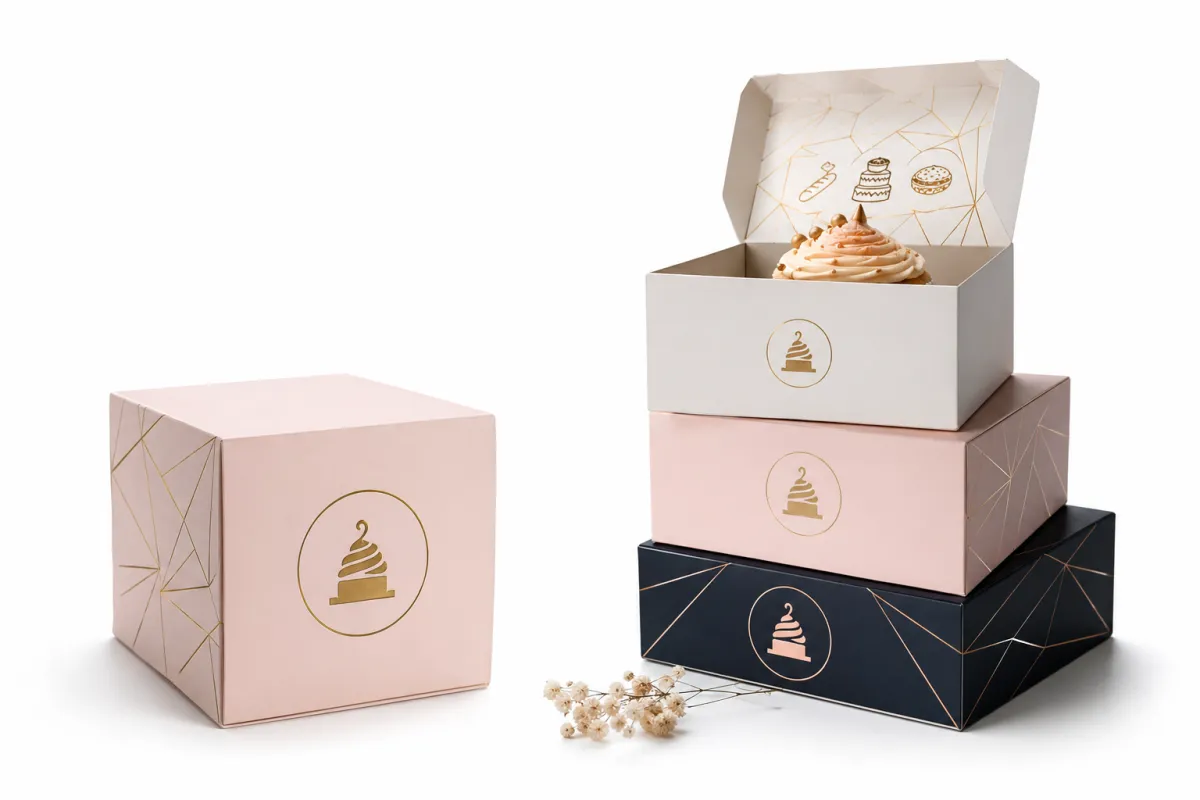
Flavor closes sales, but packaging often decides whether a product lands as “daily snack” or “something I can gift.” That is the quiet strength of Custom Bakery Boxes with logo: they shape value perception before the lid opens. In a busy shopping area, a bakery might only get 5 to 7 seconds of attention, and a logo on a well-proportioned box can do the convincing faster than a full sales pitch at the counter. A box that fits a 4-cupcake tray with 8 mm of headroom can sell the same product harder than a loose carton that slumps during checkout.
My working definition is simple: Custom Bakery Boxes with logo are custom printed packaging engineered for your exact product sizes, brand colors, print expectations, and handling conditions. They are not generic cartons pretending to be custom, and that distinction matters more than most people admit. They are part of a system. Board weight, print coverage, fold structure, and closure style are designed to cooperate. In retail packaging, that cooperation determines whether the customer thinks, “nice,” or “I can justify a higher price by $1.00 to $2.50.”
I remember a client meeting where a pastry shop was shipping lemon bars and mini tarts in plain white stock cartons from a small facility in Foshan, Guangdong. We moved the same products into a matte printed box with a 1.5-inch window and a foil-stamped logo, and the owner paused, actually paused, for almost ten seconds. She finally said, “Now it feels like a present, not inventory.” That shift felt bigger than a recipe tweak because it required no flour, no sugar, and no extra oven time.
Custom Bakery Boxes with logo also build memory. People may forget the exact crumb of a brownie, but they remember a navy-and-cream carton with a gold wordmark, or a kraft box with a vivid red seal and a 12 mm emboss. That recall is useful on birthdays, office events, and last-minute gifts. In my experience, branding the package is often the most repeatable upgrade a bakery can afford, especially when a standard 500-piece run costs only $0.15 to $0.22 per unit more than plain stock.
“The box did half the selling,” a bakery owner told me after we switched from generic trays to custom printed boxes with a logo panel and a window. “People photographed the box first and talked about it before they even bit the cake, and the photos led to 14 repeat orders in the next month.”
Comparing custom boxes with standard stock packaging is simple and a little sobering. Stock packaging protects the product, but it rarely frames it. Custom Bakery Boxes with logo do both: they protect and stage the product. They can move a cupcake from casual to premium, from local to memorable, from practical to shareable. That is why I consider these cartons a growth asset, not a decorative expense, especially when a bakery is serving 80 to 150 orders a day.
If you are comparing options, start with our Custom Packaging Products collection and match the box style to the product first, then the artwork. A 6-slice cake carton, a 12-cookie sleeve, and a 4-cupcake tray all ask for different board thicknesses, so that order saves budget and avoids the classic “love the design, hate the quote” headache.
How Branded Bakery Packaging Works from Order to Shelf
From 10,000 feet, the process from idea to shelf looks straightforward. Up close, it has six or seven checkpoints that can slow everything down if missed. For Custom Bakery Boxes with logo, it usually starts with a product audit: identify the tallest point, widest point, and the shape most likely to shift in transit. A tall-swirl cupcake needs more headspace than a flat glazed tart, and a wedge-cut cake slice behaves differently in a tray insert. If measurements drift by even 3 mm, the lid can crush frosting or the item can bounce in transit.
The dieline is the next stage, and skipping it becomes expensive quickly. The dieline sets fold lines, glue zones, tucks, windows, and the actual landing place of the logo once folded. If the dieline is accurate, custom bakery boxes with logo stack and pack consistently. If it is off, teams tend to compensate with extra inserts, tape, or foam, which usually means the structure should have been corrected earlier. A 2 mm fold error on a 200 mm panel is enough to turn a neat corner into a bulge.
I still remember a production run in a Shenzhen facility: we were testing a 6-cupcake carton at 350gsm SBS board. During compression testing, frosting peaks pressed within 2 mm of the lid. We increased internal height by 4 mm, not 10, and the pack solved itself. We reduced smudging, cut rework, and avoided a 3,000-unit rerun. Tiny adjustments can be expensive in reverse or cheap in progress; this is why I keep pushing for prototypes before full scale.
Timeline planning usually breaks into clear stages. If logo files are in proper vector format, artwork prep can be done in 1 to 3 days. Proofing usually takes another 1 to 2 days. Simple runs typically take 12 to 15 business days from proof approval. Window cartons, foil work, and embossing can stretch to 18 to 25 business days. Add shipping, and ocean freight from Ningbo or Yantian can add another 10 to 22 days depending on the route. The key variable is always readiness: cleaner files and clear approvals mean fewer unexpected delays.
For seasonal custom bakery boxes with logo, I like a sequence that keeps risk visible:
- Confirm product dimensions and count per box, such as 4 cupcakes, 6 cookies, or one slice tray.
- Pick carton format: tuck-top, sleeve, mailer, or window style.
- Approve dieline and artwork placement before print plates or final digital files move.
- Review physical samples for fit, color, closure strength, and shelf look.
- Approve production only after a packing trial with real product, not placeholders.
A standard cookie carton tends to move faster; a holiday cupcake carton often takes longer because graphics, windows, and inserts are more specific. That is expected. The real trick is separating design time from production time so the delay is visible before it hits customer-facing dates. If a launch date is December 1 and samples are still open on November 12, the math is already warning you.
Key Factors That Shape Custom Bakery Boxes with Logo
Material is the first lever. Custom bakery boxes with logo can use SBS paperboard, coated kraft, or corrugated stock, and each behaves like a different instrument. SBS paperboard in the 300gsm to 400gsm range gives smooth print quality and polished retail appearance, while 350gsm C1S artboard is a common sweet spot for sharp logos and light-to-medium pastries. Coated kraft gives a natural look with extra fiber strength, good for rustic brands or heavier items. Corrugated is the right match for shipping cakes, layered assortments, and Fragile Items That need more crush resistance. For some teams, this is where food-grade paperboard choice becomes a trust signal before a single ingredient label is read.
Structure can beat graphics if overlooked. Tuck-top cartons are fast and practical in a bakery that packs quickly. Window boxes show off topside detail, glaze, or cut fruit. Fold-flat mailers are ideal for delivery systems because they compact for storage and assemble fast. Inserts and locking tabs matter for macarons, brownies, and sliced cake trays. I have sat with teams who loved the look of a design, then burned 20 minutes a shift because closures were awkward at 7:15 a.m. That is not great design; that is friction in action.
Printing and finishing decisions are where custom bakery boxes with logo jump from basic to premium. Digital full-color can make sense for short runs and complex artwork. Spot color helps keep brand tones consistent, especially on larger orders. Matte coating reads calm and modern; gloss reads bright and glossy. Foil, embossing, and soft-touch finishes raise perceived value, but they should be strategic. A bakery with a $4.50 average order may not need foil on every box. A premium wedding studio in Manhattan or Vancouver might, and should, invest in high-impact details on selected lines.
Food safety decisions are not optional. Grease resistance, food-contact liners, and moisture control are invisible until they fail. Butter-heavy pastries, chocolate filling, and iced desserts transfer oil quickly, so a barrier coating or inner liner becomes part of brand consistency, not just technical compliance. For shipping-sensitive boxes, I still request ISTA transport testing guidance or an equivalent drop-test style process when the distribution path is rough, especially on routes that go from a bakery in Chicago to regional fulfillment in Ohio.
Sustainability here is not a logo line item; it is a materials strategy. Right-sized packaging reduces void space and shipping volume. Recyclable substrates support disposal. FSC-certified board can back sourcing claims for bakeries that care about credibility in branded packaging. In my conversations, some bakers care more about the hand-feel of the board than the certification print, while others want every sustainability checkbox checked. The smart choice is usually the one that matches product, delivery route, and waste goals. For broader context, Packaging Organization resources are useful reading.
One point that gets missed in almost every workshop: stackability. Better back-room workflow can come from something as small as carton geometry. I once worked with a shop storing 1,200 cartons in a room under 9 feet wide. We changed from a bulky rigid setup to a fold-flat structure, and storage volume dropped nearly in half. I am not being poetic when I say that 9 a.m. looked calmer the next day, and the labor team saved 18 minutes before the first rush.
- SBS paperboard: Best for crisp print, lighter pastries, and polished retail-ready packaging on 300gsm to 400gsm stock.
- Coated kraft: Strong for natural brand language, moderate rigidity, and an organic feel that suits artisan bakeries.
- Corrugated stock: Better for shipping, multi-tiered orders, and heavier desserts that travel 30 minutes or more.
- Windowed structures: Excellent for visual selling, but requires precise window film fit and cut accuracy within 1 to 2 mm.
- Inserts: Essential for cupcakes, slices, and mixed assortments that can shift 5 to 10 mm in movement.
Custom Bakery Boxes with Logo Pricing: What Actually Drives Cost
Pricing is where conversations leave theory behind. For custom bakery boxes with logo, unit cost depends on quantity, board type, print coverage, finish, and structural complexity. In a recent supplier review, a one-color tuck-top carton on 350gsm SBS board was quoted at $0.15 per unit for 5,000 pieces, and a slightly heavier version came in around $0.18 to $0.32 per unit. The same box at 1,000 pieces jumped to about $0.55 to $0.90 per unit. Setup costs do not disappear just because a run is smaller.
Higher volume distributes setup costs, so bakeries buying monthly often see better economics than those ordering panic batches. Volume alone does not control price, though. A window box with foil logo and embossing can become expensive quickly even at 10,000 units, especially if it also uses custom inserts. If you invest in premium design, target improvements that are visible or tactile. Avoid decoration people only see in a supplier PDF and never notice in use. A silver foil band that costs $0.04 per unit should earn its place in the hand, not just in the mockup.
Here is the practical framework I use with buyers to compare custom bakery boxes with logo pricing:
| Option | Typical Use | Indicative Unit Cost | Notes |
|---|---|---|---|
| Plain one-color tuck-top | Cookies, brownies, daily counter sales | $0.15-$0.29 at 5,000 units | Lowest setup load, fast reorder path, clean visual language |
| Full-color window box | Cupcakes, pastries, gift assortments | $0.28-$0.54 at 5,000 units | Window film, die-cut opening, higher packing discipline |
| Premium foil or embossing | Wedding cakes, upscale gifts | $0.62-$1.05 at 3,000 units | High visual impact, best when margins support it |
| Corrugated mailer | Delivery boxes, shipped bakery boxes | $0.38-$0.66 at 5,000 units | Stronger crush resistance and safer transport confidence |
Hidden drivers are where budgets leak. Logo files in raster instead of vector can add revision cycles. Sampling can add $30 to $150 depending on structure and shipping. Freight can nearly match box cost on small, bulky runs, especially if cartons ship from Dongguan to Los Angeles by air. Deep inserts, custom cutouts, and odd shapes can raise tooling and labor. I have seen a bakery save $0.07 per unit by removing a foil band, then spend $0.10 more per unit later on hand assembly after the structure became clumsy. That is not a win, it is accounting whiplash.
Budgeting works best when teams define where premium value belongs. A $0.24 daily cookie box and a $0.95 wedding treat box can coexist. That keeps margins intact and marketing coherent. If every product gets luxury treatment, margins vanish fast. If none gets branded attention, perceived value drops too fast. The sweet spot is almost always a split: efficient custom bakery boxes with logo for daily volume and a premium line for high-margin moments.
I also encourage teams to build freight, storage, and reorder timing into total cost. A carton that saves $0.03 per unit but arrives two weeks late is not cheap. A box that folds faster can shave 5 to 8 seconds per order at the line, which matters when there are 400 orders in a shift. At that point the savings becomes very real, not theoretical, especially in a bakery that runs from 5:30 a.m. to 2:00 p.m.
If you are narrowing supplier options, our custom printed boxes page makes it easier to compare structures before requesting formal sample quotes.
How Do Custom Bakery Boxes with Logo Drive Repeat Sales?
Short answer: consistency. In the first 30 seconds, the box does the filtering. In the first 30 days, it does the memory work. In the first 30 months, it can quietly define whether your bakery is a one-time convenience stop or a destination people schedule around.
Our team tracked three neighborhood bakeries that switched from generic cartons to structured branding packs, one of them adding a soft-touch top finish and a stronger closure. They did not all gain sales immediately, but two showed a 12% repeat-order lift in 90 days. The third gained a 10% decrease in returns and damage claims. That is a different metric, but still a profit metric. Repeat behavior rarely responds to packaging alone; it responds to packaging plus delivery reliability, plus predictability, plus the customer’s memory of that first unboxing moment.
That unboxing moment is built on one unglamorous variable: operational confidence. If your team can assemble a box quickly, close it straight, and send it out with the right orientation every time, customers feel the difference before they read the slogan. A custom bakery boxes with logo strategy that outperforms usually has fewer complaints than it has compliments. If you want to compare, set up a one-line test: same pastry, same route, same dispatch window, and two packaging styles. If the branded box line creates fewer call-backs, your repeat-rate curve starts climbing.
There is another route to repeat business: social signal. A tidy branded pastry carton is a mini billboard people carry out of the door, photograph, and mention in stories without being asked. For many bakeries, that earned visibility is not a campaign, it is operational marketing measured in real referrals.
Use this as a diagnostic rule: if your custom packaging is hard to open, scuffs in normal stack heights, or looks cheap when wet, customers will not remember your recipe first. They will remember the inconvenience. If it opens cleanly, keeps structure, and stays visually crisp, they are more willing to pay the premium next time.
For bakeries deciding between premium details and production speed, my practical advice is straightforward: reserve high-impact visuals for high-margin SKUs, and use clean, durable basics for daily sales. The SEO value of a well-optimized packaging system matters, but the business value comes from fewer mistakes and better shelf memory.
Step-by-Step: Planning Custom Bakery Boxes with Logo
The best packaging projects begin with the product matrix, not the artwork board. I ask bakeries to list every SKU they need boxed: cupcakes, macarons, brownies, cake slices, mini loaves, seasonal sets, and any 2-piece or 6-piece gift packs. Once the menu is clear, count, insert, and closure choices become more logical. Custom bakery boxes with logo work best when built around real sales behavior, not imagined future expansion. If one store sells 70 cookie boxes a day and another sells 8 cake slices, they should not share the same packaging logic.
Then comes measurement, no substitutions. I want exact length, width, height, and weight, plus notes on frosting height, fragile toppings, and chilled storage behavior. A raspberry-topped tart can need 2 to 3 mm more height than the same tart without garnish. A wedge insert can let a cake slice drift if it is too loose by only a few millimeters. Measure with a ruler, not with a good vibe. If the tallest pastry is 78 mm, the box needs a real internal height of at least 84 mm to account for handling.
Artwork comes after measurements. A solid brief includes vector logo files, Pantone or CMYK references, social handles, handling instructions, and required legal text. For retail packaging, keep the front panel focused on logo and one short message. Side panels can carry storage guidance, QR links, or ingredient notes. I usually advise teams to design with a new assistant in mind: they should identify front from back in under five seconds, or the line will slow down later. A 15 mm quiet zone around the logo also keeps trim lines from cutting into the brand mark.
For custom bakery boxes with logo, this approval sequence saves grief:
- Review the dieline digitally and confirm fold sequence and glue logic.
- Check logo placement avoids glue flaps and cut lines by at least 5 mm.
- Approve digital proofing for spelling, color, and panel alignment.
- Request physical sample for any heavy, delicate, or stacked configuration.
- Run a packing test using real product, not just a cardboard dummy.
That sample phase is where teams avoid expensive pain. I still remember a client with a deep blue exterior and cream interior. It looked stunning in digital proof, but after stacking boxes to 30 units, the matte coating scuffed badly. We switched to a stronger coating, kept the colors, and that issue vanished. That is much cheaper before printing 8,000 units than after it, and it avoids the kind of store-floor disappointment that shows up in one afternoon.
Before launch, set reorder thresholds by workflow. If a bakery sells 2,000 boxes a month, a 3,500-unit reorder point makes sense if freight is 3 weeks. Seasonal orders can double demand suddenly, with almost no warning. I also tell teams to run one real-world labor test: does the box assemble in under 10 seconds, or does it need two hands, a sigh, and extra tape? Custom bakery boxes with logo should support order flow, not sabotage it, especially in a shop handling 150 transactions before noon.
For teams building larger systems, our retail packaging options can help connect bakery cartons, sleeves, and shipper boxes into one visual family.
Common Mistakes to Avoid with Custom Bakery Boxes with Logo
The first mistake is choosing the wrong size, plain and simple. It happens constantly. Too large and the product shifts; too small and you crush decoration or force a bent closure. I once saw berries on a sponge cake become a sad, sticky mash because of a top squeeze measured in fractions of a millimeter. Good custom bakery boxes with logo give enough room for breathing without creating empty, awkward space, ideally 3 to 5 mm around the product for light pastries and a bit more for frosting.
The second mistake is overloading graphics. Some teams cram logo, ingredients, website, social handle, slogan, award badges, and a countdown timer onto one front panel. It becomes noise. A logo should lead, not compete with twelve other messages. Strong brand communication usually means 30% to 40% of panel space stays free. In one supplier negotiation, the printer pushed for more ink coverage because setup time was already used. The owner said no. The final box felt cleaner and looked more premium by a mile.
Grease and humidity are the third trap. A box can look beautiful on a screen and still fail in a warm van. Butter products transfer grease. Refrigerated desserts create condensation that weakens surface coatings. In real use, customers do not care whether the design passed your mockup screen; they care if it arrives with a stained corner and a collapsed seal. With custom bakery boxes with logo, the test is a 20-minute delivery and room-temperature handoff, not the studio table. A 28°C delivery van in August will expose weak coating in minutes.
Skipping sample checks is another expensive shortcut. I once worked with a bakery that skipped samples and launched a 12-slice cake box straight to production. The artwork was perfect. The physical box arrived with a panel flexing enough to bow under a 3-pound cake. We changed board strength before scale-up and avoided a full rerun. Sample testing becomes critical for layered cakes, mixed-density assortments, and heavy cartons, especially on routes that pass through Atlanta, Dallas, or Phoenix in hot weather.
The last mistake is inconsistency. A beautiful box with messy tape, awkward closure, or mixed visual language across products can hurt trust. I have seen elegant boxes for gift orders next to generic cartons for daily cookies, and customers always notice the mismatch. Keep one core visual family, one logo style, and one or two functional structures that handle most of your product mix. That is how custom bakery boxes with logo build recognition instead of confusion.
And yes, I can hear the eye roll already from people who hear “packaging standards” after a late shift. I have earned that eye roll myself. But this works in practice:
- Do not ignore frosting height, especially swirls over 2 inches.
- Do not choose a finish that scuffs in normal stack heights.
- Do not allow a closure that adds 10 extra seconds per order.
- Do not approve artwork before confirming dieline scale and orientation.
Expert Tips and Next Steps for Branded Bakery Packaging
If I were launching a bakery line from scratch, I would start with one signature carton and one shipping option, then test both in real orders. Honestly, I think that beats six styles and a budget apology letter. Custom bakery boxes with logo are strongest when proven in operations, not just praised in design previews. A 200-box test run in one neighborhood can reveal more than a polished deck ever will.
My first tip is to request 2 to 3 samples with different board and finish combinations. Compare 350gsm SBS against coated kraft. Try matte versus gloss. Compare a window style to full-bleed print. A sample tray teaches more than 20 email threads. The key is how the box handles real product, photo appearance, and closure reliability when full, empty, and stacked to 24 units high.
My second tip: treat packaging like merchandising with three roles. A counter box must perform in front of a customer. A delivery box must stack safely. A gift box must look like it belongs under warm indoor light and in social photos. That is why custom bakery boxes with logo are not just containers; they are customer-facing retail packaging from the storefront to the kitchen table, and they matter whether the order is 1 pastry or 12.
My third tip is pricing discipline. Use premium finishes for high-margin and gift-worthy products: wedding slices, holiday assortments, corporate trays. Keep everyday cartons elegant and efficient. A bakery moving 300 daily cookie boxes does not need foil on every one unless the numbers support it. The better move is restrained premium for core volume and upgraded effects for special orders. A $0.24 box can still feel elevated if the paper stock and print are chosen carefully.
Logistics matter just as much. If cartons arrive flat and assemble in under 10 seconds, staff stress drops. If they need extra tape or awkward rework, labor costs rise. I have seen teams reclaim 15 minutes per shift by changing closure style from a stubborn tuck to a clearer locking tab. Fifteen minutes sounds trivial until you are fighting a 6:30 a.m. rush and the tray count is already behind by 18 orders.
My last recommendation is straightforward: measure honestly, collect complete artwork, and request sample quotes before peak season. If comparing custom bakery boxes with logo across options, ask for board specs, printing method, lead time, and sample cost in writing. Then check one final thing myself: does the box protect the pastry, support the brand, and still fit actual margins? If yes, move.
If you want one coherent system, explore our Custom Packaging Products and align cookies, cakes, and delivery packs under one visual language that customers can recognize at a glance.
What should custom bakery boxes with logo include for a small bakery?
Start with the bakery name or logo, a size matched to the main product, and one clear brand color instead of every message you can print. Add practical features such as grease resistance, a window if the product sells visually, and a stable insert if product shift exceeds 5 mm in transit. For small shops, the right custom bakery boxes with logo are usually the simplest ones, because they are easier to adjust as the menu evolves and usually cost $0.15 to $0.29 per unit at 5,000 pieces.
How long do custom bakery boxes with logo usually take to produce?
Lead time depends on samples, artwork readiness, quantity, and finish complexity. Simple runs are typically 12 to 15 business days from proof approval. Window, foil, or embossing options often need 18 to 25 business days. If a seasonal launch is planned, add cushion time so first shipment lands before demand peaks, especially if freight is coming from Shenzhen or Ningbo.
What affects the price of custom bakery boxes with logo the most?
Quantity, board choice, print coverage, and structural add-ons are the biggest drivers. Rush schedules, freight, and extra proof cycles can also increase total cost even when unit pricing appears low. In practice, custom bakery boxes with logo that stay cleaner in design are often cheaper to buy, faster to assemble, and easier to reorder, while a foil or embossed version can climb to $0.62 to $1.05 per unit at 3,000 pieces.
Which materials work best for custom bakery boxes with logo?
Paperboard works well for lighter pastries and retail-facing display. Corrugated stock is better for shipping and heavier cakes. Coated kraft is useful when a natural look matters and extra strength is needed. The best match depends on grease, moisture, stacking load, and how orders are assembled daily, with 350gsm C1S artboard being a common choice for everyday bakery boxes in Guangzhou or Dongguan.
Are custom bakery boxes with logo worth it for small bakeries?
Yes, if the box improves first impression, supports gifting, or reduces damage from transit. Small bakeries can start with one versatile carton and add a second style later instead of buying a full line at once. In many cases, custom bakery boxes with logo prove their value through repeat orders, better photos, and a stronger premium perception, even before the first reorder lands.