Buyer Fit Snapshot
| Best fit | Custom Mailing Cartons Price projects where brand print, material claims, artwork control, MOQ, and repeat-order consistency need to be specified before quoting. |
|---|---|
| Quote inputs | Share finished size, material target, print colors, finish, packing count, annual reorder estimate, ship-to region, and any compliance wording. |
| Proofing check | Approve dieline scale, logo placement, barcode or warning zones, color tolerance, closure strength, and carton packing before bulk production. |
| Main risk | Vague material claims, crowded artwork, missing packing details, or unclear freight terms can make a low unit price expensive after revisions. |
Fast answer: Custom Mailing Cartons Price: What Drives the Cost should be specified like a repeatable production item. The safest quote records material, print method, finish, artwork proof, packing count, and reorder notes in one written spec.
Production checks before approval
Compare the actual filled-product size with the drawing, then confirm tolerance on folds, seals, hang holes, label areas, and retail display edges. Reserve space for logos, QR codes, warning copy, and material claims before decorative graphics fill the panel.
Quote comparison points
Review material grade, print process, finish, sampling route, tooling charges, carton quantity, and freight assumptions side by side. A quote is only useful when the supplier can repeat the same color, closure quality, and packing count on the next order.
Custom Mailing Cartons Price: Why the Cheapest Box Can Cost More
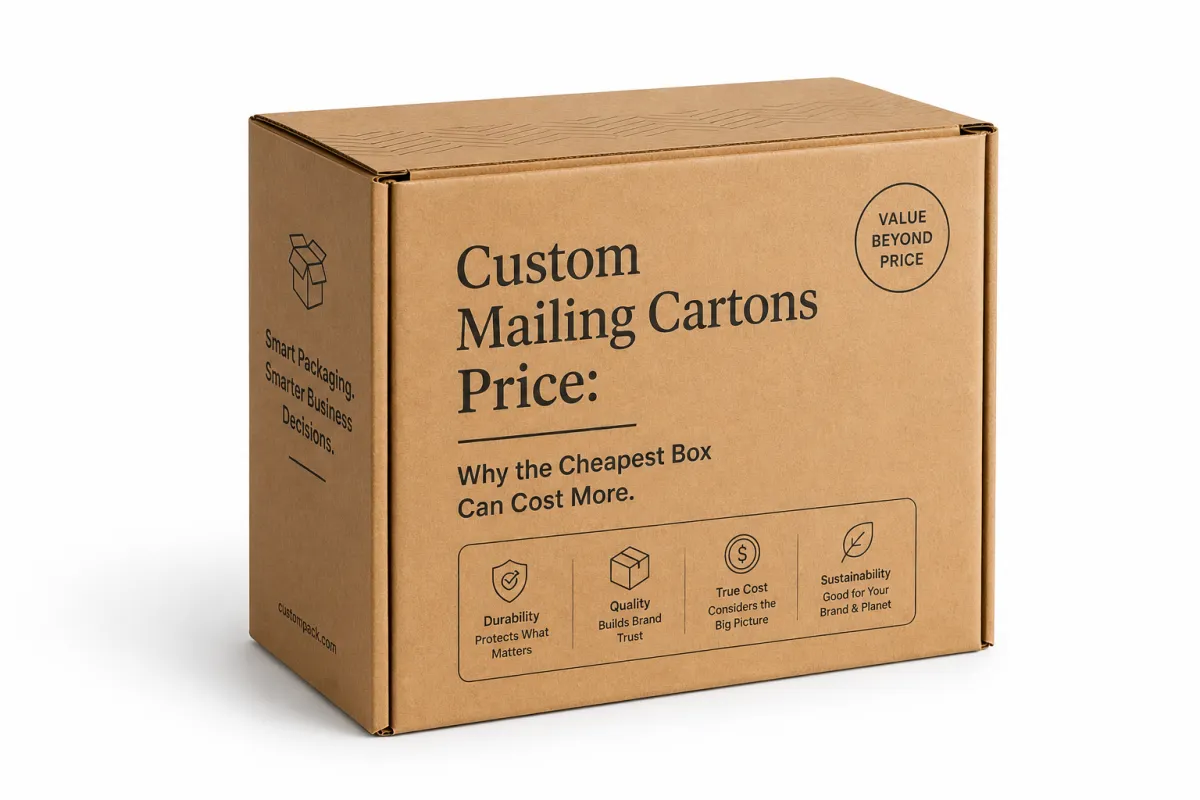
The first mistake many buyers make with custom mailing cartons price is treating the unit quote like the whole story. A carton can look inexpensive on paper and still end up being the pricier choice once it starts moving through real shipping conditions. If the box crushes too easily, leaves too much empty space around the product, or forces the packer to add extra void fill and tape, the "cheap" option starts to look a lot less cheap.
I have seen this happen more than once: a team trims a few cents from the box and then gives it back in freight charges, damage claims, replacement shipments, or labor that nobody budgeted for. That is why custom mailing cartons price should always be measured against the full landed cost, not just the number on the carton line.
The practical way to look at it is simple. Unit price matters. So does freight. Then there is packing labor, replacement cost, and the real-world mess of returns or customer complaints if the carton does not hold up. On smaller orders, those hidden costs can outweigh a small discount. On larger runs, a better fit can reduce corrugated use, cut filler, and speed up pack-out in ways that change the economics in a pretty meaningful way.
The pattern shows up across most packaging programs. The lowest number is not always the lowest total cost. The right carton is the one that protects the product, fits the packing process, and still looks like it belongs to the brand. That is the standard behind custom mailing cartons price.
A carton earns its keep twice: once in protection, once in presentation. If it only looks inexpensive, the savings may not survive the trip.
So the smarter comparison is not quote A versus quote B in a vacuum. Ask what shipping method the carton is built for. Ask whether the size is tight enough to reduce filler without slowing the line. Ask whether the finish supports brand presentation or shelf-ready use. The strongest custom mailing cartons price discussions begin with the outcome you need, not the number you hope to see.
Custom Mailing Cartons Price by Material, Size, and Print
The fastest way to understand custom mailing cartons price is to break it into the three variables that move it most: material, size, and print. Change one and the quote changes. Change all three and the gap can grow fast, even if the cartons seem similar at first glance.
Start with the structure. One-piece mailers are often the entry point because they are straightforward to manufacture and quick to assemble. Tuck-top cartons, crash-lock styles, and self-mailing designs all serve different product types, but each one changes die-cut complexity, locking behavior, and labor. Two cartons with nearly the same outside dimensions can still produce very different custom mailing cartons price results.
Board choice matters just as much. Lightweight paperboard can work well for apparel, inserts, small accessories, and certain cosmetics. Heavier corrugated structures are better when the shipment needs more protection, especially if the contents are fragile or the route includes rough parcel handling. Thin board may lower the quote, but if the shipment needs extra protection or fails transit testing, the savings disappear. In practice, custom mailing cartons price should match the actual shipping risk, not just the hoped-for budget.
Print is the next major factor. Plain kraft keeps costs lower. Single-color branding adds a moderate increase. Full-color exterior print, interior print, and special finishes such as soft-touch coating, foil, embossing, or spot UV can all move the quote upward. That is not a flaw; it is the cost of more detailed package branding and more involved production. Buyers often underestimate how much print coverage affects custom mailing cartons price.
Size drives both material use and shipping efficiency. A carton that is too large may cost more to make and more to ship because parcel carriers can bill by dimensional weight. A carton that is too small can create packing headaches or force a redesign. The best spec is usually the smallest practical internal dimension that still allows clean insertion and reliable closure. That is where custom mailing cartons price meets daily operations.
| Carton Option | Typical Use | Common Price Driver | Approximate Impact on Custom Mailing Cartons Price |
|---|---|---|---|
| Plain kraft one-piece mailer | Apparel, printed kits, lightweight accessories | Low print coverage, simple die line | Usually the lowest starting point; often the easiest way to keep custom mailing cartons price controlled on short runs |
| Tuck-top carton with single-color print | Beauty, subscription boxes, small retail sets | Additional closures and branding | Moderate increase; a practical middle ground for branded packaging |
| Crash-lock carton with full-color exterior | Heavier goods, e-commerce kits, retail packaging | Structural complexity and print coverage | Higher than basic mailers, but often better for speed and protection |
| Self-mailing corrugated carton with inserts | Fragile items, premium product packaging, multi-pack sets | Board grade, inserts, and assembly steps | Highest of the group, yet often justified by lower damage and better presentation |
Real quotes should reflect the combination of those variables, not a generic box category. A buyer comparing custom mailing cartons price across suppliers needs the same board grade, the same print coverage, the same internal dimensions, and the same delivery terms. Without that, the numbers are not truly comparable.
If your product line includes both mailers and other formats, it can help to compare cartons against related options in our Custom Packaging Products range. Some shipments benefit from a different structure that cuts waste or improves assembly speed. Other jobs still call for a mailer. That is why the best custom mailing cartons price discussion starts with use case, not artwork.
Specifications That Move the Quote Up or Down
The clearest way to control custom mailing cartons price is to define the specification before asking for a quote. Vague briefs create back-and-forth, and back-and-forth adds time. More than that, vague briefs often lead to the wrong structure, which means the buyer pays twice: once for the prototype that misses the mark and again for the corrected order. That part is never fun.
Every quote should start with internal dimensions, not just outer size. The carton has to fit the product, any protective component, and the closure style. Product weight matters too. A box for a light accessory is not the same as a box carrying glass, paper goods, or a dense assembled kit. Board grade, flute profile, closure type, and shipping method all feed into custom mailing cartons price.
Tolerance is another detail buyers miss. A carton built too tightly can slow packing and create assembly friction. A carton built too loosely may require filler, dividers, or inserts, which raises both material and labor costs. A difference of a few millimeters can change how smoothly the line runs. A tight spec sheet protects custom mailing cartons price better than a generic style name ever will.
Structural details matter just as much. Locking tabs add stability. Tear strips improve the opening experience. Dust flaps help control fit and shielding. Inserts and dividers keep multiple items from colliding. Custom windows can improve presentation, but they can also add tooling complexity and reduce board strength. Each feature pushes custom mailing cartons price in a different direction, and the effects stack up fast.
Shipping environment is the final filter. Parcel carriers subject cartons to drops, vibration, compression, and rough handling. Postal networks bring their own stress. Retail replenishment may be gentler, but it can ask more from shelf presentation. Technical specs should match the route, not just the product. For testing and transit simulation, standards from ISTA are widely used, and board or fiber sourcing can be evaluated against FSC requirements when sustainability matters in the brief.
Buyers sometimes ask whether a carton can be made cheaper by trimming features. The answer is yes, but only if the feature is not doing real work. Remove a decorative finish, and custom mailing cartons price may fall without affecting performance. Remove a critical support feature, and the apparent savings may come back as damage, complaints, or slower fulfillment.
Here is the practical checklist I would want before any serious quote review:
- Internal product dimensions, including any sleeve, insert, or divider.
- Product weight and any fragile or pressure-sensitive parts.
- Carton style, closure type, and board grade.
- Print plan, including one-color, multi-color, inside print, or special finish.
- Shipping method, destination, and whether the carton will face parcel, postal, or retail handling.
Once those points are defined, custom mailing cartons price becomes much easier to interpret because the quote reflects a real structure instead of a guess.
Pricing, MOQ, and What a Real Quote Should Include
A useful quote should separate the moving parts of custom mailing cartons price instead of blending everything into one number. If the supplier gives you only a final total, you cannot tell whether the cost is being driven by tooling, print setup, board grade, freight, sampling, or a complex closure. That lack of visibility makes comparison nearly impossible.
The MOQ conversation matters just as much. Lower runs usually carry a higher unit cost because setup expenses are spread over fewer cartons. That does not make a small order a bad choice. It means the buyer should expect custom mailing cartons price to improve as volume increases, especially after the structure is approved and the artwork has been finalized.
For short-run programs, digital production or simplified construction can keep the entry cost manageable. For larger runs, more efficient production methods usually lower the unit price. The break points vary by structure, board, and print coverage, but the pattern stays the same. Prototype quantities cost more per unit. Production quantities cost less per unit. Repeat orders often fall again because the supplier does not need to rebuild the whole process from scratch. That is a healthy sign in custom mailing cartons price planning.
Here is a practical comparison buyers can use to sanity-check a proposal:
| Order Tier | What It Usually Includes | Typical Unit Cost Trend | Buyer Takeaway |
|---|---|---|---|
| Prototype or sample run | One structure, limited quantity, proofing or dieline review | Highest unit cost | Good for fit checks; not a fair benchmark for full custom mailing cartons price |
| First production order | Approved structure, artwork, and standard production setup | Moderate unit cost | Best stage for balancing risk and price |
| Repeat replenishment order | Same spec, same print plan, fewer revisions | Lowest unit cost in most cases | Often the best reflection of stable custom mailing cartons price |
A real quote should also show what is not included. Ask whether tooling, plates, samples, freight, and taxes are separate. Ask whether the carton price changes if the artwork is revised after proof approval. Ask whether the quote assumes standard lead time or includes rush handling. If those items are not visible, the custom mailing cartons price comparison is incomplete.
That matters even more for buyers working across multiple formats. A mailer quote may look higher than a generic tray or sleeve, but if the mailer reduces packing labor and damage rates, the landed cost may still be better. The same logic applies across product packaging and retail packaging programs: the cheapest unit does not always create the cheapest shipment.
For teams comparing several packaging categories, our Custom Poly Mailers page can be a useful reference point for lighter-duty shipping programs. Some products need corrugated protection. Others do not. Choosing the wrong format is an easy way to distort custom mailing cartons price without realizing it.
Process and Timeline From Brief to Delivery
The order process usually follows a predictable sequence, and each step influences custom mailing cartons price a little differently. First comes the product brief. Then comes structural review. Artwork follows. After that come proof approval, sampling, production, and shipment. The cleaner the brief, the clearer the quote and the shorter the timeline.
Delays usually begin with missing measurements. If the supplier does not know the internal dimensions, carton style, or closure method, the quote has to be revised. Artwork can slow things down too, especially if the files are not print-ready or if the buyer has not confirmed the color target. Even a small change to the branding can move custom mailing cartons price because it may affect plates, setup, or finishing.
Sampling is worth the time. A physical sample or dieline often prevents much more expensive mistakes later. If the carton has to fit automated packing, a sample is not optional. If the carton carries fragile items, the sample is where fit, closure, and protection get tested before the production run. That extra step may raise the immediate custom mailing cartons price, but it often lowers total cost by avoiding reprints and returns.
Typical timing depends on complexity. A simple structural sample may take a few business days. Standard production can often move in about 10 to 20 business days after proof approval, depending on quantity, print coverage, and finishing. Rush work may shorten the calendar, but it usually raises the quote and narrows flexibility. Fast and inexpensive rarely sit in the same lane when discussing custom mailing cartons price.
Here is a realistic example timeline for a clean order:
- Day 1 to 2: submit dimensions, artwork goals, and quantity.
- Day 3 to 4: receive structural recommendation and preliminary quote.
- Day 5 to 7: review dieline or sample and confirm fit.
- Day 8 to 10: approve proof and finalize production details.
- Day 11 to 20: production, quality review, and shipment scheduling.
That schedule can compress if the buyer is organized and the design is straightforward. It can expand if the carton has inserts, special coatings, or multiple print passes. A practical buyer keeps one eye on the calendar and one eye on custom mailing cartons price, because speed, complexity, and cost are linked.
Good packaging design is not only visual. It also protects packing speed. A carton that folds in one motion may save labor every time it is used. A carton that needs extra handling may look elegant but cost more over the course of a season. That is the kind of comparison most teams should make before approving custom mailing cartons price.
Why Buyers Choose Our Custom Mailing Cartons
Buyers usually stay with a carton supplier for one of three reasons: consistency, clarity, or speed. Consistency means the carton arrives with the same dimensions and print quality every time. Clarity means the quote is broken out so custom mailing cartons price makes sense. Speed means the supplier can move from brief to proof to production without turning the process into a guessing game.
That is where a packaging partner earns trust. A clear spec check reduces revisions. A realistic sample prevents fit problems. A clean quote shows which elements are driving custom mailing cartons price instead of hiding them. Buyers do not need hype; they need fewer surprises.
There is also a waste angle. If the carton fits better, the team uses less filler. If the board grade matches the shipment, damage rates often fall. If the print is planned correctly, the packaging looks polished without adding unnecessary cost. The best custom mailing cartons price is not the lowest number in a spreadsheet. It is the number that causes the fewest problems downstream.
For many brands, that translates into better package branding and a more controlled opening experience. A clean mailer can feel premium without being expensive. A well-built box can support product packaging and retail packaging goals at the same time. That matters when the carton is part of the customer experience, not just the shipping process.
We also see a recurring mistake in branded packaging programs: teams spend heavily on artwork and forget the structure. Then they wonder why the box feels weak or oversized. The structure is not background noise. It is the foundation. That is why our approach to custom mailing cartons price starts with fit, then protection, then print, in that order.
Sometimes the smartest answer is not a carton at all. Some products ship better in a different format, especially when the item is lightweight and flexible. If that is the case, compare the carton against alternatives rather than forcing a one-size-fits-all approach. The right packaging category should support the shipment, not complicate it.
That is also why buyers often ask us to compare options across our wider catalog. If you need one program for cartons and another for flexible shipper formats, reviewing Custom Packaging Products alongside category-specific options can sharpen the decision. You may find that a mailer is ideal for one SKU and a lighter shipping format works better for another. That kind of comparison often improves custom mailing cartons price planning across the full line.
Next Steps: Get the Right Quote Fast
If you want a precise custom mailing cartons price, send the facts that affect the build. Internal dimensions. Product weight. Quantity. Print goals. Finish preference. Delivery date. If inserts or dividers are needed, say so up front. The more specific the brief, the less likely the quote will drift after the first review.
Request a sample or dieline before you commit to a large run, especially if the carton must fit automated packing, a premium unboxing experience, or a gift-ready presentation. A sample costs time, but it usually saves more than it costs by catching fit issues before production. That is one of the most dependable ways to protect custom mailing cartons price.
Compare at least two quotes using the same spec sheet, the same quantity, and the same delivery terms. If one quote looks much lower, check whether it excludes freight, tooling, or finishing. If one quote is much higher, ask what board grade, print process, or structure is driving the difference. Most of the time, the gap in custom mailing cartons price comes from a detail that can be identified and measured.
Useful buyer checklist:
- Confirm internal dimensions and product weight.
- Decide whether the carton needs inserts, dividers, or special closures.
- Choose the print level that matches the brand and the budget.
- Ask for a breakdown of setup, samples, freight, and unit pricing.
- Review sample fit before approving production.
From there, the conversation gets much easier. A supplier can recommend a carton style, estimate board usage, and explain how the shipment environment affects cost. That kind of clarity is exactly what buyers should expect before signing off on custom mailing cartons price.
The best orders usually start with a prepared buyer. A clear brief shortens the process, protects the budget, and leads to better packaging design decisions. If you are ready to move forward, submit your dimensions and artwork goals now, and ask for a quote that breaks down every element behind custom mailing cartons price.
What affects custom mailing cartons price the most?
Material grade, carton size, print coverage, and order quantity usually have the biggest impact. Add-ons like inserts, coatings, and special closures can raise the cost quickly. Freight and setup charges can matter as much as the carton itself on smaller runs, so the clearest custom mailing cartons price quotes separate those items instead of blending them together.
Is there a minimum order for custom mailing cartons?
Yes, most suppliers set an MOQ based on the production method and carton complexity. Digital or short-run jobs may allow lower quantities, while flexo and custom tooling often need larger runs. Higher quantities usually lower the unit price because setup costs are spread across more cartons, which is why custom mailing cartons price improves as volume rises.
How do I get an accurate custom mailing cartons price quote?
Send internal dimensions, product weight, desired quantity, and the shipping environment. Include artwork, print expectations, finish preferences, and whether you need inserts or dividers. Ask for the quote to separate setup, samples, freight, and unit pricing so comparisons stay fair and the custom mailing cartons price is easy to evaluate.
How long does it take to make custom mailing cartons?
Lead time depends on sampling, proof approval, production load, and shipping distance. A complete brief moves faster because fewer revisions are needed before manufacturing starts. Rush orders may be possible, but they often cost more and reduce flexibility on materials or finishes, which can move custom mailing cartons price upward.
Can I lower custom mailing cartons price without redesigning the box?
Often yes: simplify print coverage, reduce finish complexity, or standardize carton sizes across products. Increasing order volume can reduce the unit price without changing the structural design. You can also review whether inserts, coatings, or special closures are truly necessary for the shipment. In many programs, that is the easiest way to improve custom mailing cartons price without changing the core carton.

