Buyer Fit Snapshot
| Best fit | Custom Metallic Boxes Wholesale for Confident Buyers projects where brand print, material claims, artwork control, MOQ, and repeat-order consistency need to be specified before quoting. |
|---|---|
| Quote inputs | Share finished size, material target, print colors, finish, packing count, annual reorder estimate, ship-to region, and any compliance wording. |
| Proofing check | Approve dieline scale, logo placement, barcode or warning zones, color tolerance, closure strength, and carton packing before bulk production. |
| Main risk | Vague material claims, crowded artwork, missing packing details, or unclear freight terms can make a low unit price expensive after revisions. |
Fast answer: Custom Metallic Boxes Wholesale for Confident Buyers should be specified like a repeatable production item. The safest quote records material, print method, finish, artwork proof, packing count, and reorder notes in one written spec.
Production checks before approval
Compare the actual filled-product size with the drawing, then confirm tolerance on folds, seals, hang holes, label areas, and retail display edges. Reserve space for logos, QR codes, warning copy, and material claims before decorative graphics fill the panel.
Quote comparison points
Review material grade, print process, finish, sampling route, tooling charges, carton quantity, and freight assumptions side by side. A quote is only useful when the supplier can repeat the same color, closure quality, and packing count on the next order.
Custom Metallic Boxes Wholesale for Confident Buyers
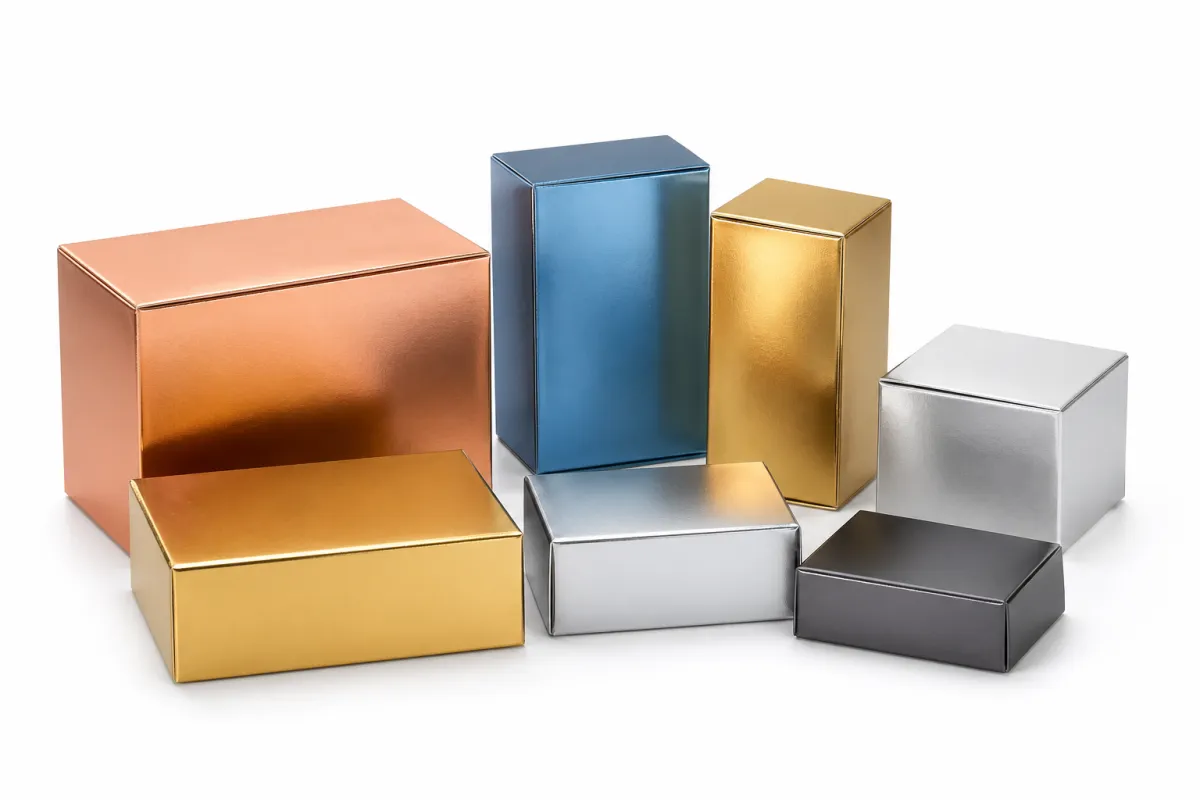
At the edge of a peak shipping day, nobody is judging marketing copy first; everyone is judging whether the right box reaches the right shelf fast. A warehouse that switched a high-mix SKU family from plain card stock to Custom Metallic Boxes Wholesale cut wrong-pick errors because the metallic stock gave each batch a weight, sheen, and recognition cue that operators could read in seconds, even under low light. That is the practical value: a strong pack can be a logistics tool as much as a brand tool, which is why serious sourcing teams should treat custom metallic boxes wholesale decisions as a commercial operation design decision, not decoration.
Custom logothing.com clients who are building a repeatable procurement and launch model benefit from a disciplined approach that connects design intent, technical Specs, and Order economics from day one.
Value of custom metallic boxes wholesale for stronger purchase decisions
A practical operations scenario
Picture a distribution center with hundreds of reference cards on a single pick face. The product mix includes gift accessories, electronics, and subscription replenishment kits. Before any finish changes, staff relied on labels and barcode scans only. The team had a rising reject count caused by line confusion at handoff. Once they moved those SKUs to Custom Metallic Boxes Wholesale with a controlled matte-metal finish and clearer front-edge cues, scan confirmation remained the control, but visual sorting improved fast. You can feel this in the floor report: fewer touches, fewer pauses, fewer “I have the wrong bin” moments.
In practice, this is why custom metallic boxes wholesale are often a higher leverage move than people assume. The finish changes the way operators handle packages. Matte foil appears less reflective than gloss but still reads premium. Brushed metallic adds directional light reflection so shelves are quickly segmented by color temperature, not just print color. Brushed-gold can create a premium cue for retail packaging where impulse comparison happens at close range. Soft-touch metallic films add a tactile confidence layer for unpacking and repacking cycles where handlers move boxes with bare hands.
custom metallic boxes wholesale sit at the intersection of perceived quality and repeatable handling. This is not mere branding theater. It is packaging design for real distribution behavior, especially when the line has mixed SKU families and tight turnover windows.
Cosmetics versus operational effect
People often split this decision into two buckets: style and cost. That framing misses the practical side. If your customer base pays more for premium presentation, then finish behavior affects how they compare products during the first 5 seconds. At the same time, a warehouse team or fulfillment app will treat high-contrast, well-defined packaging edges as a handling aid. In these environments, custom metallic boxes wholesale can increase acceptance and improve pull accuracy without touching product formula, SKU name, or insert size.
Buyers who choose custom metallic boxes wholesale from one supplier often get a useful side effect: specification consistency. Different cartons from different makers have subtle shifts in corner radius, board stiffness, and print density. That creates what I see frequently as a “lot-to-lot drift” problem. If you shift your program to a single program partner for branded packaging, custom metallic boxes wholesale can maintain a common tolerances language from SKU to SKU: same board family, same measurement standards, same registration checks. That matters when your brand portfolio grows and your receiving team expects predictable geometry.
Why this choice speeds acceptance rates
“Premium positioning is won in two places: the handoff shelf and the first close-up of the pack. If the box is stable, readable, and attractive, acceptance jumps even before the product is opened.”
That statement maps directly to launch reality. If your buyers expect a premium opening experience, stable dimensional specs, and clean unboxing behavior, then custom metallic boxes wholesale often become the fastest lever you can pull. You are not redesigning the product itself; you are redesigning how the market reads and handles it. In that sense, this is a transaction decision with direct shelf and operational returns, not just a taste decision in a mood board session.
Product details that matter before you place any custom metallic boxes wholesale order
Which format should go to production first?
For buyers moving quickly, these carton formats land most predictably in production:
- RSC (Regular Slotted Container): fastest to tool and easiest to scale for mixed fulfillment runs.
- Auto-lock: good for frequent handling and quick opening in repetitive operations where closure consistency matters.
- Telescope: stronger visual height stack, useful for retail launch packs and unboxing presentation.
- Rigid display: best where shelf impact and structural dignity matter more than pure shipping efficiency.
- Lift-lock: stronger reseal behavior for consumer repurchase cycles.
If your profile is gift-first, telescope or rigid display can improve brand perception, while auto-lock and RSC are safer for electronics-like handling where repeated opening and resealing are expected in operations. The right call is a function of what your product is asked to survive: gravity, motion, scanner contact, and customer touch.
Construction choices that survive transport and handling
Before any design work, lock your build language. Flute count is not decoration. A B-flute can be light and neat for short logistics loops. A C-flute adds cushioning and stiffness for medium-distance warehousing. BC hybrid board can offer better burst behavior and still keep panel weight manageable.
Board composition, surface coating stack, and closure type jointly influence collapse resistance and reseal behavior. If your route includes cross-dock points and mixed stacking, ask for stronger wall build on corners and consider reinforced locking tabs. For palletized orders, pay close attention to wall height-to-width ratio; unstable aspect ratios can create corner distortion in transit even when the graphics look perfect.
custom metallic boxes wholesale programs for hard movement products often target a compressive strength path that keeps edge crush and top crush within a realistic corridor. If the plan includes two to three pallet transfers and manual top-down handling, you should not treat paper weight as optional. It is a structural decision.
Customization levers that actually affect operations
Artwork repeat limits can save money if controlled, and cause expensive rework if ignored. If your repeat distance exceeds press capability or color density thresholds, the effect shows as banding and local registration drift. Inside color matching is not just for looks: it changes brand recognition when products are opened in retail packaging displays.
- Emboss/deboss depth should be tested at production scale; if depth is too shallow, the finish looks dead; if too deep, fold memory can weaken.
- Window placement should match pack opening patterns; a misaligned window can become a weak point in quality control.
- Matte-over-metallic topcoats protect against scuffs and clean edges on retail flooring; they also make handling safer for showroom demos where people touch repeatedly.
Ask your team to treat these as engineering choices, not art-direction preferences. In my view, custom metallic boxes wholesale that look bold but fail after a forklift loop are a false premium. Strong branded packaging is made at the fold line too.
Buyers’ pre-order checklist you should not skip
- Edge bleed allowance: usually 3 mm to 5 mm depending on die precision.
- Knock-out tolerances: define exact radius and clearance to prevent scoring splits.
- Die-line naming: avoid ambiguous layer names; use SKU-based naming and version control.
- Barcode and QR placement: keep scan zones outside likely scratch zones and within a consistent scanner path.
If these are unresolved before proof, your first run will feel like a design workshop instead of a production run.
Specifications and material specs for custom metallic boxes wholesale
Set technical parameters before file sign-off
Start with numbers that can be measured, then discuss visuals. Common baseline targets for custom metallic boxes wholesale teams:
- Outer dimensions: lock all length, width, and height tolerances before art is finalized.
- Fluting profile: select B, C, or BC based on drop tolerance and stacking pattern.
- Grammage: usually 300-450 gsm for standard SKUs; 500+ gsm for high-stress lines.
- Board compressive strength: align with expected pallet loads and lane distance.
- Corner strength target: if your freight route includes forklift-side transfer, build toward sturdier corner zones.
If we talk about ASTM practice, many teams use the logic behind ASTM D642-based concepts for compression expectations and then cross-check with package-level handling studies. For longer transit routes, matching that with realistic ISTA-oriented assumptions is wise; many teams use published handling profiles from ISTA as a planning baseline.
Substrate paths you should understand
Not all metallic looks come from foil. Typical paths include:
- Paper-based board + metallized paper film for lightweight, printable options.
- Metallic foil layer in a controlled laminate stack for high reflectivity.
- PVC-free films for cleaner compliance posture in sensitive categories.
- Water-based laminates for cleaner production and easier waste handling in some facilities.
For food adjacency or health-adjacent use, verify migration compatibility and print chemistry requirements early. I prefer suppliers who document approved materials up front and confirm any adhesive stack used under top coat. If there is any doubt, do not assume “food-safe” in the datasheet; require a clear zone classification and compatibility note.
Ask for the relevant certificates if sustainability claims are part of your commercial story. For responsibly sourced fiber, request chain-of-custody details and confirm labels from FSC where applicable.
Print and registration details with tolerances
For custom metallic boxes wholesale runs, set this clearly:
- Printing base: CMYK + up to 2 spot colors for accent control.
- Registration: keep tolerances tight for foil and fine script; 0.125 mm to 0.2 mm is often the practical corridor to avoid visible halos.
- Resolution: 300 dpi for standard branding marks; 600 dpi for very fine texture edges or micro type.
- White underprint: mandatory on metallic dark tones, especially where foil should read clean and solid.
Where metallic text is part of your package branding hierarchy, do not rely on one proof pass. The optical response of metallic ink under different light temperatures shifts fast in print houses. Ask for side-by-side print trials with agreed neutral and warm-white references to keep your brand color within acceptable delta limits.
Quality gates and file-ready control
From a QA perspective, practical checks should include edge crush, burst resistance, crease memory, and seal integrity where magnetic or tuck closures are used. For a lot of teams, a weak seam seam on the first pallets usually means they missed one pre-press control: trapping around metallic layers.
- Bleed: include 3 mm to 5 mm where the press can support and confirm in the dieline notes.
- Cut marks and fold marks: keep as separate layers from artwork content.
- Trapping for foil: include knockout and overlap sequence to prevent silver-edge lift.
- Color profiles: request native press profiles, then lock one profile per press family.
- Vector-safe line weight: avoid hairline under 0.2 pt for die lines unless the press has precision confirmation.
For true zero-pause pre-production, a locked naming format for files matters. A simple convention like SKU_FoldType_Version_Date_CAD can reduce back-and-forth and protect your timeline. In custom metallic boxes wholesale programs, file hygiene is often worth more than a visual tweak.
Pricing, cost drivers, and MOQ for custom metallic boxes wholesale
Where unit price really comes from
Pricing in this category is not a single number. It is a layered model. Standardized examples for custom metallic boxes wholesale orders typically come from the stack of:
- Artwork complexity: dense graphics and many reversals increase plate and color management time.
- Metallic ink coverage: high coverage increases ink lay and drying control cost.
- Coating stack: multiple top coatings increase pass time and reject risk.
- Board upgrade: heavier board and special folds can push unit economics materially.
- Die-cut complexity: extra slots, tabs, and internal nesting features increase tooling effort.
- Optional operations: inserts, magnetic fasteners, linings, and hand-insert features add labor and material passes.
As a practical range, many teams see simple 5,000-piece jobs landing in the roughly $0.18–$0.28 unit area for very basic runs, while heavy metallic effects with complex structures can move into $0.42–$0.65 or higher per unit. That is a real-world spread you only see if you build with data, not guesswork.
If your strategy includes premium unboxing, compare this to your downstream margin room. In many cases, controlled custom metallic boxes wholesale spend is still below the margin impact of returns from poor packaging acceptance.
MOQ logic by phase
MOQ is not one number. It changes by phase.
- Color proofing phase: lowest feasible batch to validate ink/laminate behavior.
- Tooling validation phase: enough units to confirm fold stability, seam behavior, and print consistency.
- First production batch: a larger run to spread setup and lock repeat rates.
- Replenishment: lower incremental cost if previous master files remain stable.
In many factories, a pilot plus full run approach is better than forcing a single huge first order where unknowns are still open. custom metallic boxes wholesale can work with that model if your commercial side understands that pilot is a process test, not a discount test.
Order structure comparison
| Program type | Typical MOQ | Setup profile | Indicative unit cost (5,000 units) | Lead window (business days) | Best fit |
|---|---|---|---|---|---|
| One-time launch batch | 5,000–8,000 | Higher setup, shorter planning discussion | $0.34 – $0.52 | 18–25 | Single campaign, first shelf entry |
| Staged ramp order | 3,000 pilot + 7,000+ replenishment | Moderate setup, controlled recheck | $0.39 – $0.56 | 14–24 | Demand uncertainty, cautious forecast |
| Locked-in volume contract | 12,000+ per season or rolling window | Lowest unit setup after approval | $0.24 – $0.44 | 18–35 | Continuous replenishment with stable art |
Note that this table compares structure impact, not absolute price. Actual quotes still vary by finish density, topcoat choice, board grade, and closure type. For custom metallic boxes wholesale teams with stable art and predictable SKUs, volume contracts usually unlock the best long-run cost behavior.
Shipping and packaging economics that are often ignored
Unit cost should never be reviewed alone. Shipping can move total landed cost by 8% to 20% depending on dimensions and class. Think like an operator: mixed-SKU carton optimization can erase a tiny unit gap. If one variant ships at $0.03 more per piece but packs better on pallets and lowers dimensional weight, your final cost may drop by much more than $0.03 after freight.
Freight breakpoints often sit at pallet and volumetric thresholds. A 1.0 m³ increase can shift class unexpectedly in certain corridors. Also verify whether your warehouse bills on gross or dimensional mass. In one route, a slightly thinner panel and better pack nesting reduced both shipping class and damage risk; in another, heavier board reduced fold failures and saved labor, and transit claims were lower. The right move is always route-specific.
Process and timeline for custom metallic boxes wholesale production
Realistic production flow
A good custom metallic boxes wholesale plan usually runs through this sequence:
- Brief: define goals, environments, and strict acceptance criteria.
- Artwork lock: lock dieline and color families before prepress begins.
- Proofing: physical and digital proof check with barcode, fold, and opening behavior.
- Prepress review: trap, trapping, and layer checks.
- Pilot run: a small controlled pull for fold, stack, and scan behavior.
- Production: full release once pilot is approved.
- QC release: sample every lot by batch and shift.
- Dispatch: packing, palletization, and logistics documentation.
In this cadence, most delays appear before full production start, not during press throughput.
Where most time disappears
- Design clarification loops: unclear fold intent and unclear finish descriptions cost days, not hours.
- Proof approval lag: if sign-off is delegated across too many people, turnaround can stretch.
- Late structural changes: a new die line after prepress is a direct hit to the schedule.
For custom metallic boxes wholesale buyers, the operational rule is simple. Freeze structure before color, then freeze color before coating. Every late change after prepress affects both cost and trust, especially if the print side is already calibrated.
Practical windows by complexity
- Standard (simple RSC, one finish, one size): from design lock to ship often 12 to 18 days for many teams.
- Moderate (custom die, one insert, mixed foil regions): 16 to 24 days.
- Premium (multi-layer coatings, multiple closure styles, advanced emboss/deboss): 22 to 35 days.
For each path, place explicit approval windows before major milestones: prepress release, pilot sign-off, and QC release are the three dates that protect your commercial calendar. With clean files and strict review cadence, many custom metallic boxes wholesale jobs still hold predictable dates.
Communication cadence and contingency planning
In transactional programs, I advise weekly production snapshots with milestone photos and a shared escalation channel. If a raw-material batch substitution happens, your supplier should notify you with a measured impact on color and feel before run start. A clear substitute protocol lowers emotional conflict and prevents silent compromises.
For speed: pre-approve a lighter backup substrate, parallelize internal approvals, and set one backup metal-look film equivalent list. If this is not in the contract, speed decisions become reactive and expensive.
Why choose us for custom metallic boxes wholesale programs
Operational strength that can be audited
Choosing a partner for custom metallic boxes wholesale is mostly about consistency. That means visible and traceable controls:
- Material traceability by batch and pallet, with lot-specific test logs.
- Calibrated press settings with routine verification logs across shifts.
- Standardized quality checklists from incoming board through final dispatch.
For buyers building packaged operations, this kind of discipline lowers variation between lots and avoids the “looks fine in sample, inconsistent in batch two” problem. It also protects your team from quality surprises at downstream assembly, shelving, or regional distribution nodes.
Customization at scale without surprises
custom metallic boxes wholesale programs become stable when three systems are in place:
- Separate color separation discipline for metallic and matte elements.
- Die maintenance scheduling that prevents drift after long runs.
- Laminate controls to keep sheen and gloss continuity across thousands of units.
If every shift uses the same tolerances and the same decision tree, long runs remain stable. When your packaging is tied to brand leadership, that is where trust is built.
Commercial certainty and service architecture
The strongest teams do not sell vague promises, they sell milestone clarity. We separate sales intent from delivery reality with transparent costing milestones and a written revision policy before dispatch. A buyer should know exactly what change can be done before lock and what change will trigger retool or delay.
Service architecture for wholesale buyers should include a dedicated production contact, engineering support for dielines, and pre-emptive issue resolution when warehouse fit or shelf issues appear. Many failures are not technical; they are communication failures.
“A supplier that answers technical questions within one business day and flags risks before they become rework is usually the one that protects launch dates best.”
In short, most buyers choose the partner that can keep packaging design predictable while protecting schedule reality. That is the same logic for custom metallic boxes wholesale and for any serious product packaging portfolio.
Action plan to execute your custom metallic boxes wholesale order
Step 1: Collect the technical packet
Do this first, before quote requests. A reliable packet should include:
- Exact dimensions and internal clearance envelope.
- Product weight and fragility class.
- Handling condition forecast: humidity, temperature, and vibration exposure.
- Machine compatibility and carton opening method.
- Barcode format and scanner position requirements.
- Topcoat, laminate, and metallic finish preference.
- Budget band and urgency tier.
This packet turns an opinionated quote into a realistic procurement decision for custom metallic boxes wholesale. It also prevents “we assumed” conversations and avoids hidden scope.
Step 2: Run the 5-step approval sequence
- Brief + sample reference: align expectations with real photos.
- Structural proof: validate die and fold behavior.
- Color approval: lock CMYK/spot setup and underprint behavior.
- Pilot run inspection: inspect edge strength, barcode legibility, and opening sequence.
- Final production release: issue clear non-negotiables and acceptance rules.
If your team handles large-scale branded packaging, this sequence protects both cost and schedule. If any stage is skipped, you pay for it later through repacking, claims, or reprints.
Step 3: Set commercial guardrails before PO
Write these into the order package so everyone is aligned:
- Accepted payment milestones: deposit, pre-production, release, and post-shipment options.
- Defect threshold: what is acceptable and what is reject-grade.
- Replacement SLA: timing for rework or remanufacture.
- Freight and destination terms: FOB, EXW, and risk transfer rules.
If your shipping terms are unclear at PO time, your margin and timeline both become vulnerable. For many teams, clear terms reduced friction more than any discount claim.
Step 4: Use forecast math, not MOQ fear
Set launch quantities using forecast math and service levels, not by minimum requirement alone. A disciplined formula helps:
- Forecast expected demand for the first cycle.
- Safety stock for damage and handling variation (often 3% to 7%).
- Refill cadence based on campaign calendar and reorder windows.
- Reorder lead buffer for high-demand SKUs.
In practical operations, the right first shipment often sits between pilot confidence and risk of expensive rerun cycles. custom metallic boxes wholesale are not a one-time procurement tactic; they are a process framework.
Step 5: Place a clean request and execute cleanly
Before sending your official request, review your technical and commercial packet once more. You are now close to action. The fastest teams submit a one-page production brief plus CAD/dieline pack and ask for a pre-quote that includes:
- Finish options (matte, brushed, brushed-gold, soft-touch).
- Delivery schedule with checkpoints.
- MOQ impact by each variant.
If you want to evaluate structure depth quickly, start with Custom Packaging Products references and compare contract behavior through Wholesale Programs for longer cadence alignment.
A disciplined first order in custom metallic boxes wholesale creates a repeatable packaging baseline you can scale without surprise cost or schedule shocks.
That is the practical edge. You get stronger product packaging control, better branded packaging recognition, and fewer operational surprises when volume grows.
FAQ
How do you control quality in custom metallic boxes wholesale production?
We standardize incoming board checks, print trials, and inline defect tracking by press and shift before full release. Each run includes visual and mechanical checkpoints for print consistency, edge strength, fold accuracy, and finish adhesion. Buyers receive checkpoint photos and inspection summaries so issues can be corrected before shipment rather than after goods are staged.
What is the MOQ for custom metallic boxes wholesale and can I start smaller?
MOQ is affected by print and die complexity, not only carton count. Detailed runs have higher setup impact than basic forms. Small pilots are possible when specs are stable. Many buyers do a short pilot plus full run; the pilot is still sized to test real process conditions, so it must be large enough for meaningful handling checks.
Can I order custom metallic boxes wholesale with short lead time?
Yes, when files are clean and structure is locked early. Standard-size jobs with no design revisions and simple color layers can move quickly. Lead compression usually needs fast proof turnaround, pre-agreed checkpoints, and limited sample rounds. If the first file arrives with unresolved fold or finish questions, every day of delay moves downstream into launch risk.
Which custom metallic boxes wholesale materials work for high-damage-prone products?
Use higher compression board and stronger liner combinations, with controlled fold scoring for repeated transport stress. For edge-crush-sensitive SKUs, specify reinforced corners, adequate wall height, and reliable closure security. Match inserts to product geometry first: a harder shell does not protect movement unless the internal support is aligned with the product shape.
How should I prepare artwork for custom metallic boxes wholesale artwork approval?
Submit print-ready files with clear bleed, cut marks, color standards, and front/mid/back orientation. Keep dark metallic tones and foil effects in separate proof layers when possible. Approve one master version and lock revision scope before tooling so late changes do not inflate cost and timeline unexpectedly.

