A motorcycle sticker has a harder life than most printed graphics. It sits under UV light, fuel vapor, engine heat, rain, grit, vibration, boot rub, glove contact, cleaning chemicals, and pressure washers that often get held too close.
That is why ordering custom moto stickers is not just a design choice. It is a materials and production choice. A sharp logo printed on the wrong film can lift at the edge, haze in sunlight, or scuff through after a few rides. A simpler graphic built with the right vinyl, adhesive, ink, laminate, and cut shape can stay cleaner for much longer, especially when the surface is measured and prepared correctly before installation.
What Custom Moto Stickers Need to Survive on a Real Bike
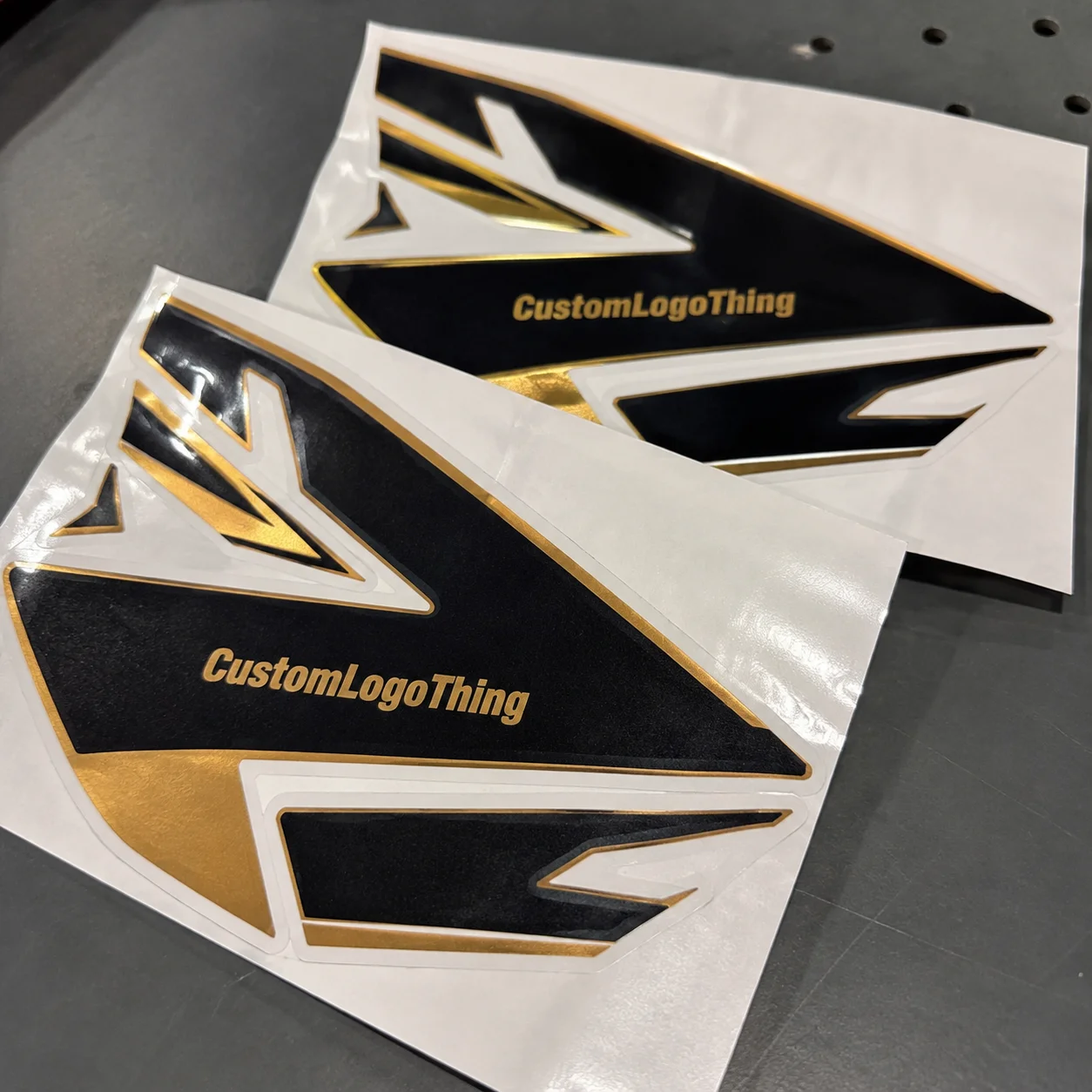
Custom moto stickers are printed, cut, and finished adhesive graphics made for motorcycle surfaces and related gear. They can be small helmet decals, tank badges, sponsor logos, side-case marks, swingarm graphics, windshield decals, race number plates, toolbox stickers, event handouts, or merch stickers packed into dealer kits. They may look like the same product category, but the best construction changes by placement.
Printing the image is usually the easy part. Modern digital presses can reproduce clean logos all day if the file is built properly. The more important question is whether the decal construction matches the bike. A flat aluminum pannier has different stress than a curved tank. A sponsor logo on a fairing sees different abuse than a decorative garage sticker. A small warning label near heat or fuel needs a different conversation than a giveaway sticker for a club ride.
Durability comes from the whole stack: face film, adhesive, ink system, laminate, cut shape, and application surface. One weak link can shorten the life of the decal. Outdoor vinyl without laminate may still scuff under knee contact. A heavy laminate cannot rescue a decal applied over wax, silicone detail spray, or oily residue. A beautiful contour cut with long needle-like points may lift sooner than a slightly simplified shape.
It helps to classify the job before asking for a quote. Decorative stickers are mostly about color, finish, and brand style. Sponsor decals need consistency across sets and quick installation. Warning labels need clear text, stable placement, and sometimes more conservative material choices. Race number plates need high contrast at speed. Partial-wrap graphics need more flexible film and more careful installation because they cover larger curves and panel transitions.
Practical rule: if the decal will live on a motorcycle outdoors, start with outdoor-grade vinyl, a suitable adhesive, and a protective laminate unless the supplier has a specific reason to recommend a different build.
How Motorcycle Decal Materials, Adhesives, and Laminates Work
The face film is the visible base material. White vinyl is the standard choice for strong printed color because it gives ink an opaque background. Clear vinyl lets paint, glass, or tinted plastic show through, but light colors often need white ink underneath so they do not disappear. Reflective vinyl adds visibility for safety-minded graphics or night-event branding. Specialty films, including chrome, brushed metal, holographic, and textured finishes, can make a decal feel more premium, though they raise cost and can limit fine-detail readability.
For curved motorcycle parts, film type matters. Cast vinyl is usually thinner and more conformable, often around 2 mil before laminate. It handles compound curves better than standard calendared vinyl and is a safer choice for tanks, helmets, curved fairings, and fenders. Calendared vinyl, often around 3 to 4 mil before laminate, can still be a good fit for flatter panels, toolboxes, temporary promos, merch stickers, or low-stress areas. It is not inferior by default. It is simply less forgiving on tight curves and stretched installations.
Adhesive choice deserves the same attention. Permanent adhesive is common for long-term outdoor motorcycle use. Removable adhesive can make sense for dealer promotions, seasonal events, or short-run graphics that need cleaner removal. Air-release adhesive has microscopic channels that let trapped air escape during application. It is helpful on larger decals, number plates, and partial-panel graphics. On a tiny 2-inch decal, air-release may add little value; on a large fairing graphic, it can reduce bubbles and installation time.
Laminate is the clear protective layer over the printed ink. It improves resistance to abrasion, UV fade, light chemical exposure, and cleaning friction. Gloss laminate makes colors look brighter and suits many sport bike graphics. Matte laminate reduces glare and can match understated paint. Satin sits between the two. Textured laminates can add grip or a specialty feel, but heavy texture may soften small type, thin lines, and detailed illustrations.
No sticker is indestructible. Gasoline soaking, harsh solvents, aggressive pressure washing at close range, repeated boot abrasion, or constant strap contact can damage even a well-built decal. The strongest specification is not always the most expensive one. It is the one that matches the surface, exposure, expected lifespan, and installation method.
| Material or Finish | Best Use | Typical Tradeoff |
|---|---|---|
| White outdoor vinyl with gloss laminate | Bold logos, fairing decals, club stickers, merch | Strong color, but less subtle on dark paint |
| Clear vinyl with white ink | Paint-show-through effects, windshield decals, layered looks | Needs artwork planning so colors stay visible |
| Cast vinyl with laminate | Tanks, helmets, curved fairings, compound surfaces | Higher cost than basic calendared vinyl |
| Reflective vinyl | Visibility graphics, safety decals, night events | Premium material cost and fewer finish choices |
| Chrome or holographic film | Premium branding, limited merch, show bikes | Can be hard to read with tiny text or low contrast |
Artwork Specs That Make Moto Graphics Print Cleanly
Good production starts with clean files. Vector artwork is the safest format for logos, sponsor marks, race numbers, simple illustrations, and die-cut shapes because it scales without jagged edges. AI, EPS, and properly built PDF files are common. Fonts should be outlined, linked images embedded, and cut paths clearly labeled so the production team knows what prints and what trims.
Raster artwork can work too, especially for photo-style graphics, weathered textures, airbrush-style designs, or digital illustrations. The file just needs enough pixel data at final size. A social media image stretched into a 10-inch tank decal will usually look soft. As a working target, many print teams prefer 300 dpi at final size for detailed raster graphics. Larger designs viewed from farther away may tolerate lower effective resolution, but small decals expose weak files quickly.
Bleed and safe margin prevent many production problems. Bleed means the artwork extends beyond the trim edge, commonly by 0.0625 to 0.125 inch, so normal cutting movement does not leave a white sliver. Safe margin keeps small text, borders, and key details inside the cut path. Vinyl cutters are accurate, but thin borders sitting exactly on the trim edge are still risky.
Color needs a reality check before production. Screens emit light; printed ink reflects it. A blue that looks electric on a phone may print deeper on vinyl, especially under matte laminate. If brand color matters, send Pantone references or ask whether a printed proof is available. A digital proof is useful for checking size, spelling, layout, version names, and cut shape. It cannot guarantee exact color on every monitor.
White ink is often the hidden detail that decides whether a design works. On clear, metallic, and transparent films, pale colors may vanish against black paint or tinted plastic without white ink underneath. White can be printed as a spot layer behind selected elements, as a full flood under the graphic, or as a visible part of the design. For custom moto stickers on dark bikes, that single production choice can separate crisp branding from a decal that looks muted from six feet away.
Cost and Pricing Factors for Motorcycle Sticker Orders
Motorcycle decal pricing depends on size, quantity, material, laminate, cut complexity, number of versions, print method, proofing requirements, and finishing format. A 2-inch round helmet sticker is not the same job as a 12-inch contour-cut tank graphic with cast vinyl, laminate, and individual packaging. Even if the art looks similar, material yield and finishing time can be very different.
Unit cost usually drops as quantity increases because file handling, press setup, color checks, lamination, cutting, inspection, and packing are spread across more pieces. Short runs are normal, especially for clubs, test launches, and limited merch. Still, very small batches carry a higher cost per piece because the same basic production steps still happen.
For basic outdoor vinyl decals, small quantities may land roughly around $1.50 to $5.00 per piece depending on size, finish, and shape. At higher quantities, simple decals may drop into the $0.20 to $0.85 range per piece. Larger laminated decals, cast films, reflective materials, specialty foils, individual cutting, and retail-ready packaging can move the price higher. A 5,000-piece merch sticker run and a 75-piece set of large bike panel decals may price very differently, even if the total square footage appears close.
Premium cost drivers include reflective vinyl, chrome effects, holographic film, complex contour cutting, kiss-cut sheets, individually cut decals, variable numbering, backing cards, labeled bundles, and heavy-duty laminates. Version count matters too. Ten designs at 50 pieces each usually require more file prep, proofing, sorting, and quality control than one design at 500 pieces.
Minimum order quantity is not only a sales rule. It often reflects production reality. Setup, proofing, press layout, cutting, and packing do not disappear because an order is small. If you need 25 decals, expect a higher unit price than an order of 500.
For an accurate quote, provide final size, quantity, material preference if known, intended surface, desired finish, artwork status, deadline, and packaging needs. If the decal belongs to a broader launch with retail cards, product packaging, Custom Printed Boxes, or branded inserts, mention that early. Matching finish and color across bike graphics and package branding is much easier before production starts.
Process and Timeline From File Check to Finished Decals
A typical order flow is simple: submit artwork and specifications, confirm size and material, receive a digital proof, approve production, print, laminate, cut, inspect, pack, and ship. The smoothest jobs have one clear contact, one approved file set, and written notes for finish, quantity, packaging, and due date.
Proofing is not paperwork. It catches spelling mistakes, scale problems, missing cut paths, color concerns, upside-down orientation, wrong version names, and layout issues before vinyl is printed. Many expensive reprints start with a rushed proof approval. The design may have looked right in a mockup, but a tiny typo, mirrored layout, or incorrect size can become painfully obvious once hundreds of decals are packed.
Timelines vary with artwork readiness, order quantity, material availability, specialty films, proof approval speed, finishing complexity, and shipping distance. A simple laminated outdoor vinyl order may often run about 5 to 10 business days after proof approval. More complex orders with specialty film, multiple versions, individual packing, or larger quantities may need 10 to 15 business days or longer. Those are planning ranges, not universal promises, because every production queue depends on open capacity and materials on hand.
Rush jobs are possible only under the right conditions. Clean vector files help. Firm decisions help more. Materials must be available, and the proof has to be approved quickly. Last-minute changes to size, color, finish, or quantity can reset the schedule because press layouts, material planning, and cut paths may need to be rebuilt.
Build in extra time for race events, dealer launches, merch drops, and club rides. Stickers often need to be sorted, kitted, labeled, handed out, or installed before the public date. If custom moto stickers are one part of a larger packaging project, such as matching labels, header cards, hang tags, or product boxes, align the production calendar so the pieces arrive in the right order.
For transit testing and packaging discipline, many companies reference standards from groups such as ISTA. For paperboard or mixed-material components used with sticker kits or merch bundles, buyers may also care about sourcing programs such as FSC certification. Stickers fall into a different material category, but the card, mailer, insert, or box around them may still need to meet those packaging requirements.
Step-by-Step Guide to Ordering Bike Decals Without Rework
Rework usually starts with missing details. The ordering process does not need to be complicated, but a few decisions should be made before quoting and proofing. Use this checklist before production starts.
- Decide where the stickers will go. A flat toolbox sticker and a curved tank decal may need different vinyl, adhesive, and laminate choices. If the surface gets fuel drips, knee rub, strap contact, or full sun, say so early.
- Measure the application area. Use a flexible tape and note ridges, seams, bolts, vents, badges, or compound curves. For a tank or helmet, a paper template can help confirm the real visual size before artwork is finalized.
- Choose the finish. Gloss gives strong color pop. Matte suits low-glare styling and muted paint. Satin balances both. Reflective film adds visibility, but it works best with bold shapes and enough contrast.
- Prepare the artwork. Outline fonts, embed images, include bleed, keep important details inside the safe margin, and label the cut line if contour cutting is required. If there are multiple versions, name them clearly.
- Review the proof at full size. Check spelling, color notes, orientation, quantity, cut shape, hole clearances, and version names. A proof viewed only on a phone can hide small type and scale problems.
- Confirm packaging needs. Decide whether the order should arrive as individual pieces, kiss-cut sheets, backing cards, roll labels, transfer-taped lettering, or labeled bundles for teams, dealers, clubs, or event kits.
Custom Logo Things also supports related printed components, so if your decal program connects to hang tags, retail cards, or other Custom Labels & Tags, share that upfront. If the moto sticker is part of a broader product launch, it can also be coordinated with Custom Packaging Products such as boxes, cards, inserts, and other branded materials.
Common Mistakes That Shorten Sticker Life on Bikes
The first mistake is choosing the cheapest indoor vinyl for outdoor motorcycle use. Indoor sticker stock may look fine on day one, but tanks, fairings, helmets, and saddlebags face sun, washdowns, and contact that basic materials were never built to handle. Low-cost material can be useful for event handouts. That does not mean every handout sticker belongs on a bike.
Surface prep causes just as many failures as poor material choice. Adhesive vinyl needs a clean, dry, compatible surface. Wax, silicone detail spray, oil residue, dust, and damp paint can all prevent a good bond. Many installers clean with isopropyl alcohol and a lint-free cloth, then let the surface dry fully. Fresh paint may need cure time before decals are applied; the safe window depends on the paint system.
Skipping laminate is another common shortcut. Printed graphics that get rubbed by knees, gloves, boots, straps, saddlebags, or cleaning towels need a protective layer. Laminate will not stop every scratch, but it gives the ink a sacrificial shield and usually extends outdoor life.
Design can shorten decal life too. Tiny text, hairline outlines, fragile cut shapes, low contrast, and overly complex edges may look good on screen but fail in production or installation. Long points can lift. Very narrow script lettering can tear during weeding. Low-contrast colors can disappear from 10 feet away, which matters for race numbers and sponsor marks.
Installation errors are the final category. Stretching vinyl too much can create memory that pulls edges back. Trapped air leaves bubbles. Cold application temperatures can reduce initial tack. Touching adhesive with fingers adds oils. Washing the bike too soon can interrupt bond development. Many pressure-sensitive adhesives need 24 to 72 hours to build stronger adhesion, depending on temperature and surface energy.
Next Steps Before You Request a Moto Sticker Quote
Before requesting a quote, gather the details that affect production. You do not need to know every material code. You should know the final size, quantity, application surface, indoor or outdoor use, desired finish, artwork status, deadline, and packaging or kitting needs. Those details turn a vague estimate into a quote that can actually guide a decision.
- Final size: width and height in inches, plus any shape notes.
- Quantity: total pieces and number of artwork versions.
- Surface: tank, fairing, helmet, windshield, toolbox, swingarm, package, or merch item.
- Exposure: sunlight, fuel contact, washing, abrasion, heat, or temporary use.
- Finish: gloss, matte, satin, reflective, clear, metallic, or specialty film.
- Format: individual die-cut pieces, kiss-cut sheets, roll labels, transfer tape, backing cards, or labeled bundles.
Send photos if the sticker must fit a tank, helmet, fairing panel, curved fender, windshield, or oddly shaped accessory. A photo with a ruler or tape in the frame is better than a clean beauty shot. It helps the production team judge scale, surface shape, nearby obstructions, and likely installation challenges.
Ask for material guidance instead of guessing. Fuel exposure, heavy sunlight, high abrasion, removability, and reflective visibility all change the recommendation. Good suppliers earn trust by matching the decal construction to the job, not by pushing the most expensive film on the list.
Also confirm how the order should arrive. Individual die-cut decals are easy to hand out. Kiss-cut sheets are efficient for sets. Roll labels may suit high-volume application. Transfer tape helps with cut vinyl lettering. Backing cards can turn stickers into retail-ready merchandise, especially when they coordinate with package branding, Custom Printed Boxes, or other retail packaging pieces.
The best custom moto stickers start with a clear use case, clean artwork, accurate measurements, and honest material choices. Get those pieces right, and the finished decals are more likely to arrive looking sharp, packed correctly, and ready to install on the bike or hand out without second-guessing the order.
FAQ
What material is best for custom motorcycle decals?
Outdoor-grade vinyl with a protective laminate is usually the safest choice for motorcycle use. Cast vinyl is better for curved tanks, helmets, and fairings, while calendared vinyl can work for flatter, lower-stress areas. Reflective, clear, metallic, and specialty films can also be used when visibility or a specific visual effect matters.
How long do custom moto decals last outdoors?
Lifespan depends on material, laminate, sun exposure, washing habits, fuel contact, abrasion, and placement. A laminated outdoor vinyl decal will usually last much longer than an unlaminated paper or indoor sticker. Areas with constant boot rub, knee contact, fuel drips, or pressure washing will wear faster.
Can custom moto stickers go on helmets?
They can be applied to many helmet shells if the surface is clean, smooth, and compatible with adhesive vinyl. Avoid covering vents, safety labels, visors, moving parts, or impact-damaged areas. For curved helmet surfaces, smaller decals or flexible cast vinyl are easier to apply cleanly.
What files do I need to order custom bike stickers?
Vector files such as AI, EPS, or PDF are preferred for logos, cut shapes, and crisp printed edges. High-resolution PNG, TIFF, or PSD files may work for photos or illustrations. Files should include outlined fonts, embedded images, bleed, safe margins, and a clear note about final size.
How much do custom moto stickers cost per piece?
Unit cost depends on size, quantity, vinyl type, laminate, cut shape, artwork setup, and finishing format. Larger quantities usually reduce unit cost because setup and production time are spread across more decals. The most accurate quote includes dimensions, quantity, material needs, finish, artwork status, and deadline.


