Custom nylon drawstring bags look more expensive than they usually are, which explains why they keep showing up in trade show kits, school programs, retail inserts, and fitness promotions. Nylon has a smoother hand than many low-cost woven alternatives, resists scuffing reasonably well, and tends to hold a printed logo in a cleaner way than rougher fabrics. The result is a bag that gets used again, sometimes long after the original handoff, which gives the artwork more life than a single event can.
For packaging buyers, that second life matters. A bag that goes home with apparel, gets tossed into a gym locker, or carries travel essentials becomes part of the product experience, not just a giveaway. If you already source Custom Packaging Products, the same logic applies here: the spec does more work than the logo alone.
The cheapest bag is rarely the best value. Fabric weight, stitching, and closure design decide whether the order feels premium or flimsy in the hand.
Why custom nylon drawstring bags Feel More Premium Than They Cost
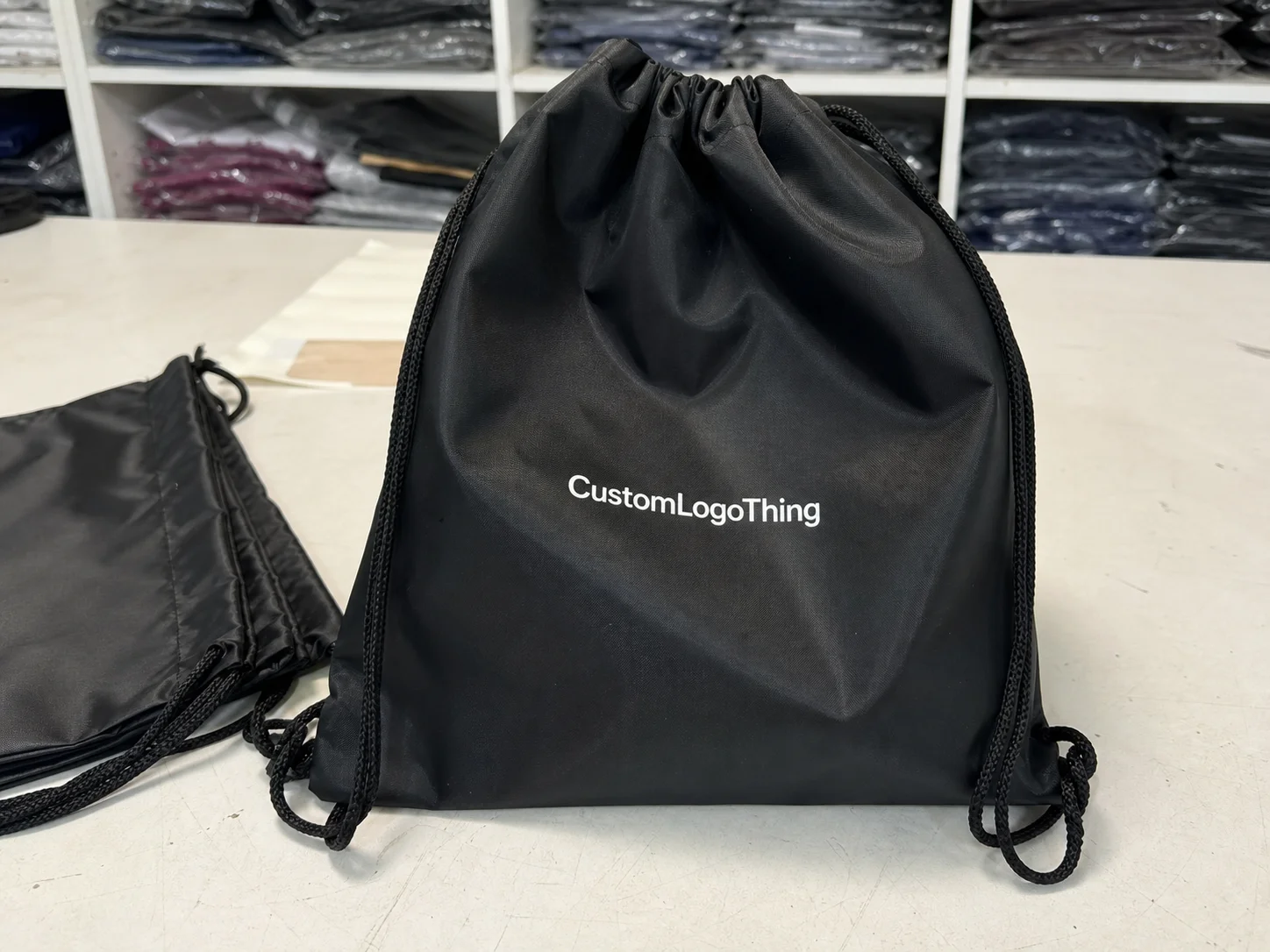
Nylon earns its place because it balances three practical qualities: low weight, decent abrasion resistance, and a cleaner surface for decoration. That combination is hard to beat at a modest price point. A buyer can get a bag that feels lighter than canvas, looks tidier than a rougher synthetic, and still survives regular handling without immediately looking tired.
Most versions use a woven nylon body with a drawcord closure, and the better ones add reinforcement where the cord exits the fabric or where the seams take load. Some include a gusset for extra volume, a front pocket for small items, or a lining if the contents need a slightly more finished presentation. None of that is complicated in isolation. The value comes from how well the parts are put together.
The best use cases are the ones that demand repeat handling. Event swag with apparel inside, welcome kits for schools, travel kits, and fitness giveaways are all practical fits. In those settings, the bag is not just packaging. It is a carrier, a display surface, and a small piece of brand memory all at once.
That is also why the low-cost option can be misleading. If a bag feels limp, opens awkwardly, or shows stitching problems at the top edge, the printed logo does not rescue it. People notice structure before they notice the artwork. That is especially true with reusable items, where the user touches the bag several times instead of once.
How the Bag Actually Works: Fabric, Cord, and Closure
Denier is the easiest way to describe nylon weight. It refers to yarn thickness, so higher numbers usually mean a heavier, firmer fabric. In practical terms, 210D nylon is light and flexible, while 420D feels sturdier and keeps its shape better. Heavier constructions can go beyond that if the bag needs more structure or more resistance to wear. There is no universal best choice. The right spec depends on what the bag has to carry.
For small handouts, 210D can be enough. For folded garments, water bottles, shoes, or mixed event kits, 420D usually gives a better hand feel and less distortion under load. If the bag is likely to be reused often, a heavier denier is worth considering because it buys a little more forgiveness at the seams and corners. Fabric weight matters, but it is only part of the story.
Where strength is won or lost
Seam construction often decides whether the bag feels solid or cheap. Clean stitch density, secure side seams, and reinforcement where the cord enters the body matter more than most buyers expect. A bag can look fine on a flat mockup and still fail the real-world test if the top edge twists, the cord tears through, or the seam starts to open after repeated use.
Closure style changes how the bag behaves in the hand. A single-cord design is simple and quick, but it does not always distribute load evenly. Dual-cord versions usually cinch more symmetrically and sit better on the shoulders. They cost a bit more and take more assembly, but they often feel more complete on bags meant to be carried beyond a single event.
Size and shape should be chosen around the contents, not around an arbitrary standard. A 12 x 15 inch bag and an 18 x 20 inch bag can both be called “standard” by a supplier, yet they behave very differently in use. Gussets increase usable volume. A wider opening makes packing faster. A flatter front panel gives the printer a more reliable surface and helps the logo stay readable. Those are not small details. They change how the bag performs after production is over.
Spec Choices That Change Performance and Print Quality
The biggest decisions are usually the least glamorous: size, fabric weight, color, cord style, and print area. Those choices matter more than a polished mockup. A bag can look excellent on screen and still feel wrong if the opening is too tight, the body is too soft, or the material is too thin for the contents.
Decoration method is the other major fork. Screen print is usually the most economical option for simple artwork, especially one-color or two-color logos with strong outlines. Heat transfer helps when the design has gradients, fine detail, or a higher color count. Embroidery gives a more elevated look, but it adds cost and works best when the artwork is simple enough to stitch cleanly. A complex logo does not automatically look better because it is embroidered; sometimes it just looks smaller and more crowded.
Color contrast and placement
Dark nylon bodies can look polished, but they make print contrast harder to manage. White, silver, or bright ink usually reads best on black, navy, or deep green. Light nylon gives more flexibility for print, but it can show dirt sooner and sometimes feels less substantial depending on the program. The bag color should support the brand, not compete with it.
Placement deserves real attention. Put artwork too close to a seam and it may distort during stitching or after the bag is filled. Shrink the logo too much and it disappears once the fabric wrinkles. If the bag has gussets or a curved upper edge, ask for a proof that shows the actual print area, not just a perfect flat rectangle. That step catches proportion problems before the bulk run starts.
One practical check saves a surprising amount of pain later: confirm whether the quote includes one-sided print or both sides. A second print location can change the price more than buyers expect because it affects setup, alignment, and inspection time. Small details become line items quickly once production starts.
For buyers who also Order Custom Printed boxes for retail kits, the lesson is the same. Packaging works best when fit, finish, and repeatability are planned together. Ask for a mockup with measurements called out. If the supplier cannot show where the logo lands relative to seams and cord exits, the order is still too vague.
Cost, Pricing, and MOQ Drivers
Pricing for custom nylon drawstring bags is driven by quantity, fabric weight, decoration complexity, and finishing details. The base shape matters, but not nearly as much as the number of print colors, the number of print locations, whether the bag needs a lining, and how much hand work the order requires. Two quotes that sound similar can still land in very different price bands.
| Spec | Best For | Typical Unit Price Impact at 5,000 pcs | Quote Drivers |
|---|---|---|---|
| 210D nylon, one-color screen print | Light giveaway items and event handouts | $0.28-$0.45 | Lower material cost, simple setup, faster decoration |
| 420D nylon, one-color screen print | Apparel, travel kits, and reusable promo use | $0.42-$0.68 | Heavier fabric, better hand feel, more durable seams |
| 420D nylon with two-color print | Retail packaging and stronger package branding | $0.55-$0.90 | Extra screens, more setup time, tighter color control |
| Embroidery or specialty finishing | Premium kits and higher-value promotions | $0.85-$1.40+ | Stitch time, backing, cleanup, and slower production |
MOQ shifts the economics fast. At 500 pieces, the unit price is usually higher because setup costs are spread across fewer bags. At 1,000 to 3,000 pieces, the numbers often start to make more sense. By 5,000 pieces and above, the per-unit price can improve noticeably, but the buyer also carries more inventory risk. That is a real tradeoff, especially for seasonal programs or one-time events.
Hidden costs are where many orders get misread:
- Artwork cleanup for low-resolution files or poorly separated colors
- Sample charges for swatches or pre-production samples
- Rush fees when the schedule compresses
- Split shipment fees when the order ships to multiple locations
- Color-match revisions when the brand wants a tighter shade target
- Polybagging or retail packing if the bags need shelf-ready presentation
That last point matters for retail packaging buyers. A bag that ships loose in cartons is not the same as one that needs individual packing, barcode labeling, or display-ready presentation. Labor is labor, and it shows up somewhere in the quote.
The cheapest quote is often the one that leaves out the most detail. A fair comparison starts with the same spec sheet and a landed-cost view.
Production Process, Timeline, and Lead Time
A clean order usually follows the same path: spec gathering, quote, artwork proof, sample or mockup review, bulk production, quality check, packing, and shipment. Buyers who approve each step quickly tend to protect their timeline. Buyers who treat proofing like a formality usually create avoidable delays.
Artwork approval is often the first bottleneck. If the logo file is not in vector format, someone has to rebuild or redraw parts of it. That slows things down. The same problem shows up when the buyer has not settled the dimensions, fabric color, or print placement. A vague brief creates a slow quote, and a slow quote creates a slow start.
For standard custom nylon drawstring bags, production often runs about 12 to 20 business days after proof approval, depending on quantity, decoration method, and current factory capacity. Shipping adds another layer. Air freight is faster and more expensive. Ocean freight is cheaper per unit, but it usually adds time and handling risk. If the bag is tied to an event date, the shipping method should be decided before the order is approved, not after.
If the bag will be packed with hard goods or shipped as part of a retail kit, treat it like a packaged product, not just a promo item. For sensitive contents, it helps to think in terms of transit testing, including standards such as ISTA distribution methods. That discipline is common in packaging work for a reason: vibration, compression, and edge wear do not care how good the mockup looked.
Peak season adds pressure. Trade show months, back-to-school runs, and year-end promotions all pull capacity in the same direction. Color matching can extend timelines if the brand wants a specific shade or if the fabric reacts differently under print. Customs clearance can also add uncertainty if the goods are imported. A safer schedule includes room for proof edits, sample review, and freight booking.
Buyers should lock four things early: dimensions, fabric choice, logo files, and delivery date. Quantity comes right after that. If those pieces are stable, the rest of the process becomes easier to manage and easier to price.
Common Mistakes That Create Weak Bags or Wasted Spend
The most common mistake is choosing a fabric weight that looks fine on paper but fails once the bag is filled with real items. A bag that carries a folded T-shirt might not handle a bottle, shoes, or a bundled kit without stressing the seams. If the contents have weight, shape, or sharp edges, the spec needs to reflect that reality.
Another recurring problem is ignoring the stress points. A weak cord attachment, a sloppy seam finish, or a closure that digs into the hand can make a bag feel cheap even if the print is good. The logo does not rescue a bag with poor structure. Structure protects the logo.
Artwork mistakes are just as expensive. Logos placed too close to a seam can twist during stitching. Fine text can disappear on wrinkled nylon. Light ink on a dark body can look weak if the proof gets approved too quickly. If the design depends on subtle gradients or tiny details, the buyer should ask whether the decoration method can actually hold them at production scale.
Skipping a sample is another expensive habit. A proof shows layout. A sample shows behavior. Those are not the same thing. On a real bag, the cord may sit differently, the fabric may fold differently, and the print may read differently under light. For larger orders or customer-facing retail packaging programs, a sample is cheap insurance.
The logo rarely saves a weak bag. The bag structure saves the logo.
There is also a planning mistake that happens often: buyers approve artwork before they approve use case. The design looks good, so the order gets greenlit, but the bag is too small, too soft, or too shallow for the contents. That is backwards. Start with the item size, then build the bag around it. That rule prevents wasted spend better than any discount does.
If the program includes coordinated branded packaging, such as mailers, inserts, or custom printed boxes, make the bag part of that system rather than a separate decision. Consistency in color, material feel, and logo placement helps the whole package look intentional instead of assembled in pieces.
How to Order the Right Bag and Validate the Final Spec
The cleanest way to Request a Quote is to give the supplier a complete spec sheet. Include the intended contents, target dimensions, fabric weight, decoration method, color, quantity, delivery date, and shipping destination. If the bag must hold a certain bottle size or folded garment, say so. General language like “standard size” creates unnecessary back-and-forth.
Compare at least two or three quotes on the same spec. That sounds basic, but many buyers compare different specs and then wonder why the pricing does not line up. A fair comparison needs the same bag size, the same fabric denier, the same print count, and the same shipping assumptions. Otherwise the numbers are not meaningful.
Ask for a mockup every time. Ask for a physical sample if the order is large, the artwork is sensitive, or the bag will be used for a customer-facing program. Ask for a landed-cost quote that includes freight, setup, and any known fees before approval. The goal is not just to know the factory price. The goal is to know the delivered price.
- Confirm the actual contents the bag must hold.
- Set the minimum usable size and closure style.
- Choose the fabric denier based on load and reuse expectations.
- Approve the print method after checking artwork complexity.
- Request a mockup and, if needed, a sample before bulk production.
- Lock the delivery date before the order is released.
For buyers managing Custom Packaging Products across multiple items, the best outcome usually comes from treating the bag as one part of a larger packaging system. If the colors, materials, and presentation all point in the same direction, the final result feels more deliberate and more valuable.
Custom nylon drawstring bags work best when the spec is built around the real use case, not just the logo. Match the size, fabric weight, and decoration method to the contents, and the bag will carry better, print better, and last long enough to justify the spend. That is the difference between a giveaway and a branded item people keep.
What denier is best for custom nylon drawstring bags?
Use lighter nylon for low-load giveaway items and heavier denier when the bag needs to carry bottles, apparel, or thicker event kits. For most buyers, seam strength and cord quality matter as much as fabric weight, so the right choice is the one matched to the real contents.
How much do custom nylon drawstring bags cost?
Price changes with quantity, fabric weight, decoration method, print colors, and finishing options. Per-unit cost usually drops as volume increases, but setup, sample, and freight costs can change the real landed price.
How long does production usually take for custom nylon drawstring bags?
The timeline depends on artwork approval, sampling needs, factory capacity, and shipping method. Projects move faster when the logo files, quantity, and final specs are approved before quoting.
What artwork files work best for custom nylon drawstring bags?
Vector files such as AI, EPS, or print-ready PDF usually produce the cleanest result. Simple shapes, strong contrast, and clearly defined color references reduce proofing delays and print risk.
Are custom nylon drawstring bags reusable and washable?
Yes, they are typically reusable for repeated light-to-moderate use, which is part of their value. Spot cleaning or gentle washing is usually safest, with air drying preferred to avoid heat damage or warping. For buyers who want a promo item people actually keep, custom nylon drawstring bags usually beat cheaper giveaways on both utility and memory.

