Custom outdoor labels have one job: keep doing the job after the product leaves the shelf. Sun, rain, abrasion, repeated folding, dirt, and washing all expose weak construction fast. A label can look clean in artwork and still fail the moment it hits real use. That is not a design problem. It is a spec problem.
Buyers often focus on print quality first because that is the easy part to judge. Color looks right, logo is centered, mockup looks polished. Fine. None of that matters if the label peels, frays, cracks, or turns unreadable after a few weeks outside. For apparel, bags, soft cases, and field gear, construction matters more than the prettiest proof.
The same logic applies across branded packaging, package branding, and products paired with Custom Labels & Tags. Spec the label for the environment, not for the presentation file.
What Custom Outdoor Labels Need to Survive Outside
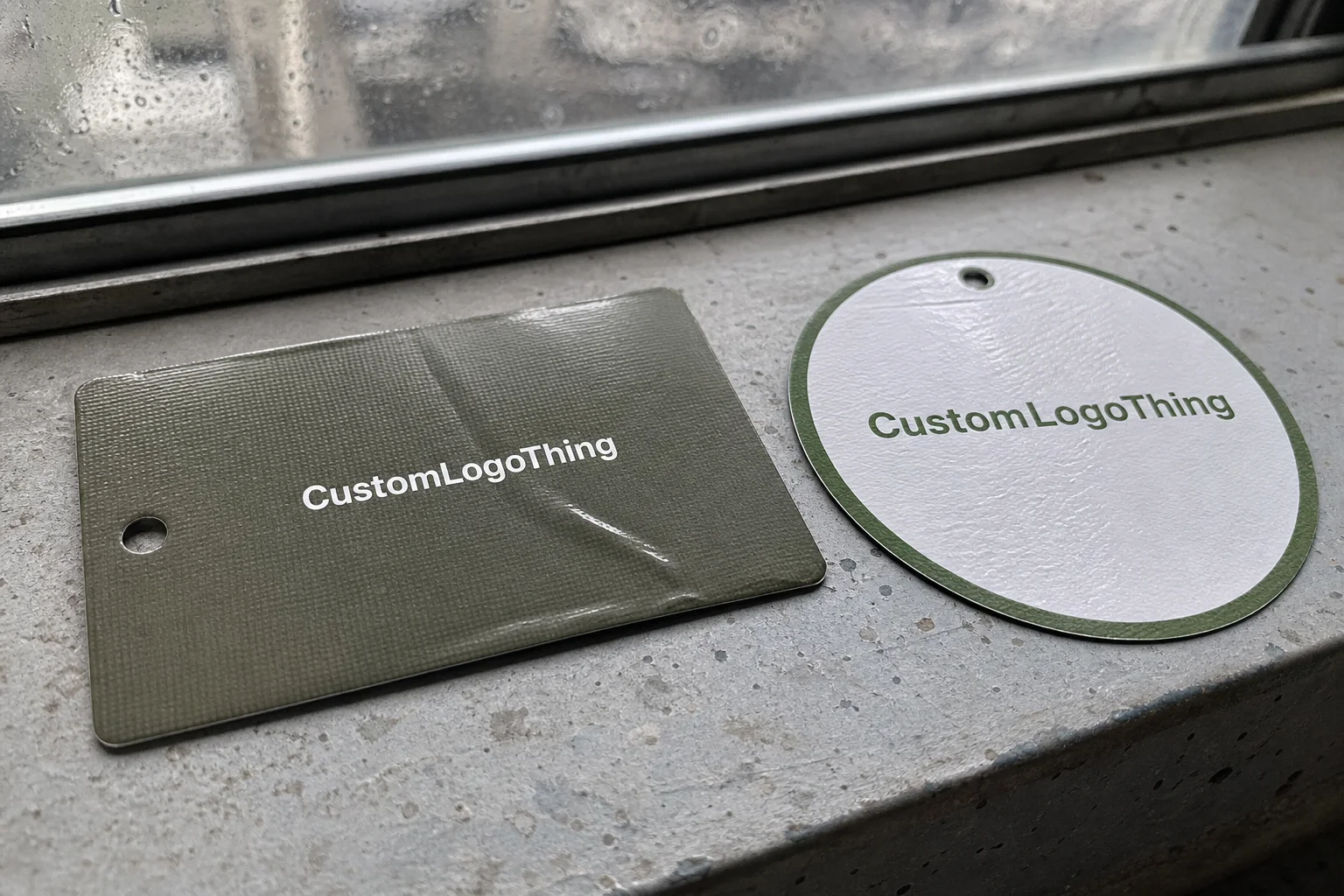
Outdoor labels fail for ordinary reasons. The adhesive is wrong. The edge finish is weak. The material was chosen for softness instead of weather resistance. Nobody needs a dramatic backstory for that. Two labels with the same artwork can perform very differently because the construction underneath is different.
For outdoor use, the label has to handle sunlight, moisture, abrasion, dirt, and repeated handling without losing legibility or attachment. That covers jackets, workwear, activewear, utility garments, backpacks, straps, tool rolls, soft cases, and similar items that get rubbed, bent, and washed more than once. A label on a rain shell faces a different stress profile than one on a tote bag. Same category. Different abuse.
Labels on retail packaging or sewn into products still need to survive the product lifecycle. A neck label in a jacket sees wash cycles and skin contact. A gear label might scrape against buckles and hardware. A bag label might stay in the sun for months. If the spec treats all of those as the same, the failure rate goes up. Predictably.
The cheapest-looking option is not always the cheapest label. If it fails early, you pay twice.
The right question is not whether the label can be printed. It is whether it can survive long enough to justify the order. For outdoor work, durability is not an upgrade. It is the baseline.
How the Label Construction Actually Works
Think of a label as three parts working together: the base material, the design layer, and the finish or attachment system. If one part is weak, the whole label underperforms. That sounds obvious, but a lot of orders still get built backwards. Artwork first. Survival later. Bad sequence.
Base material affects feel, print clarity, flex, and weather resistance. Design layer carries the brand mark, size information, care symbols, or product identifiers. Finish and attachment determine whether the label stays in place through washing, bending, UV exposure, and abrasion.
Woven labels remain common for apparel branding because they feel premium and hold up well in normal use. The tradeoff is detail. Very small text, thin strokes, and tight icons can blur if the weave count is too low. Printed labels give cleaner detail and more color flexibility. Synthetic constructions make more sense when the priority is weather resistance rather than a soft textile hand.
Edge treatment matters more than most buyers expect. Laser-cut synthetic labels avoid fraying. Folded or stitched edges can improve comfort and reduce curling. Backing choice matters too. Sew-in, heat-applied, and pressure-sensitive labels behave differently after laundering and bending. Pick the wrong attachment method and the corners start lifting, the label warps, or the edge starts looking tired long before the product does.
If the label needs to coordinate with Custom Packaging Products, the spec discipline should be the same. The buyer who checks coating, caliper, and print finish on Custom Printed Boxes should do the same here. Different item. Same problem. Hidden build quality is only invisible until it fails.
Materials, Adhesives, and Finishes That Change Performance
The core material options are usually polyester, nylon, vinyl, TPU, and coated synthetic textiles. Each one solves a different problem. Polyester is common because it is stable, cost-effective, and prints well. Nylon works well for apparel labels that need flexibility and a softer touch. Vinyl and TPU lean toward rugged outdoor use, especially where moisture and abrasion are constant.
Material choice should follow the use case, not the sample card. A soft woven nylon label may be ideal for a jacket neck label and a poor fit for a bag that gets rained on, stuffed, and dragged across rough surfaces. A matte polyester face stock with a UV-resistant coating often outperforms a decorative textile label that looks nicer in hand but ages badly outdoors.
Adhesive selection is where a lot of labels quietly fail. If the label is not sewn in, the adhesive must bond to the actual substrate, not the ideal one on the spec sheet. Textured fabrics, coatings, curved surfaces, and flexible materials all reduce bond strength. Repeated wet cycles can make things worse. Pressure-sensitive adhesives can work, but only if the surface prep, application pressure, and laundering conditions are compatible.
Finishes are not decoration in this category. Matte reduces glare and improves readability outside. Gloss can sharpen color, but it may show scuffs faster. Lamination adds protection. UV-resistant coatings slow fading. Abrasion resistance matters if the label will rub against straps, hardware, or rough fabric. If the label is going to live outdoors for long periods, cheaping out on the finish is a false economy.
| Material | Best For | Durability | Typical Unit Cost |
|---|---|---|---|
| Polyester | General apparel, branded packaging inserts, mixed-use labels | Good moisture and wash resistance | $0.12-$0.24 |
| Nylon | Soft apparel labels, flexible garments | Good flexibility, moderate outdoor resistance | $0.14-$0.28 |
| Vinyl | Rugged gear, utility products, high-abuse surfaces | Very good weather resistance | $0.18-$0.35 |
| TPU | Premium outdoor apparel, technical branding | Strong abrasion and water resistance | $0.20-$0.40 |
| Coated synthetic textile | Balanced look and durability | Good all-around performance | $0.15-$0.30 |
For outdoor programs, I also look for suppliers who can talk clearly about abrasion, wash performance, UV exposure, and adhesion testing. Vague claims are cheap. Test data is not. For broader packaging and material guidance, the ISTA test framework is useful, and the FSC system matters if the label program ties into paper-based packaging and sourcing claims.
One more practical point: the printed surface and the substrate should be chosen together. A rich black on a matte surface reads well outdoors. A fine-line logo with multiple thin strokes may not. If the artwork depends on tiny type or thin borders, the production method has to support it. Otherwise the proof looks tidy and the finished label looks tired.
The Process and Timeline From Proof to Production
The order flow is usually simple: send artwork and specs, review a digital proof, approve samples if needed, then move into production and final quality check. On paper, that sounds quick. In practice, most delays happen because the buyer skipped a detail early and the proof exposed it late.
Clean specs save time. Size, shape, attachment method, material, finish, quantity, and placement need to be clear before production starts. If the label uses custom cutting, specialty stitching, or a color match tied to existing product packaging or retail packaging, that needs to be stated up front. Every revision round adds time. Sometimes it adds money too. No mystery there.
Typical lead times depend on complexity. A straightforward run can often move in 10-15 business days after proof approval. If sampling is required, custom coatings are involved, or the label needs specialty cutting, it can extend to 15-20 business days or more. Rush production may be available, but rush work usually means less room for adjustment and a tighter QC window.
Pre-production samples are worth asking for when the label will face direct sun, hard abrasion, or frequent laundering. That extra step helps catch problems that a digital proof will never show. Readability, edge quality, curl, adhesive strength, and surface wear are easier to judge on a real sample than on a screen.
For brands aligning labels with a broader visual system, the proof stage is where the work either stays coherent or drifts. If the label, insert, carton, and hang tag are supposed to look like one family, review them together. Otherwise the package stack starts to look assembled by committee.
Production inspection should not stop at color. Check trim consistency, registration, stitch alignment, adhesive placement, and finish uniformity. A label can pass a quick visual glance and still have a corner that lifts, a misaligned edge, or a weak bond line. Small defects become expensive if the product launches before anyone catches them.
Cost, Pricing, and MOQ: What Drives the Quote
Pricing usually comes down to size, material, print method, attachment style, finish, and quantity. Larger labels use more material. More complex builds require more setup. Specialty finishes cost more. Higher detail can mean slower production or tighter tolerances. None of that is surprising, but it still gets forgotten during quote comparison.
MOQ matters because setup and proofing are fixed costs. On a small run, those costs are spread across fewer pieces, so the unit price climbs fast. A run of 250 labels can cost materially more per piece than a run of 5,000. The gap can be wider than buyers expect if the order also needs custom shapes, color matching, or durable finishing.
For budgeting, a practical range is:
- Simple printed synthetic labels: about $0.10-$0.18 each at moderate quantity.
- Woven or upgraded apparel labels: about $0.12-$0.25 each.
- Higher-durability outdoor constructions: about $0.18-$0.40 each, depending on finish and application method.
- Small runs with special setup: often land higher because fixed costs are compressed into fewer pieces.
The hidden cost is usually over-specification. Extra colors, decorative borders, tiny text, specialty ink, custom inserts, and unnecessary finishing all stack up quickly. If the label is going on a rugged jacket or field bag, a simpler construction with better adhesion often beats a prettier spec that only performs in the quote sheet.
If the label is part of a broader branded rollout, ask for the quote alongside the rest of your Custom Packaging Products. Related items sometimes share setup work, and the overall system stays cleaner if they are planned together.
One caution: comparing label prices without checking test requirements is a trap. A low quote that excludes sample approval, QC checks, or outdoor-grade material is not a bargain. It is a cheaper starting point with missing pieces. Those missing pieces tend to show up later.
Common Mistakes That Shorten Outdoor Label Life
The biggest mistake is trying to use an indoor apparel label outdoors and hoping it holds up. It happens all the time. The artwork looks fine, the unit price is attractive, and then the label starts failing in the field. That is a spec mismatch, not bad luck.
Other mistakes are more subtle:
- Using weak adhesive on textured or coated fabrics.
- Choosing very fine detail that disappears after wear and wash.
- Placing the label in a high-rub zone near seams, straps, or hardware.
- Skipping sample testing before committing to volume.
- Ignoring UV exposure and assuming water resistance is enough.
There is also a habit of treating more decoration as more value. Sometimes the strongest outdoor label is plain. Bigger type. Better contrast. Fewer elements. Cleaner edges. If the product lives outside, readability beats ornament. Every time.
Another common failure point is label placement. A great construction placed under a strap, near a zipper pull, or on a seam that folds constantly can still fail early. The label may be fine. The location is the problem. Buyers do themselves a favor by reviewing placement on an actual product, not just on a flat mockup.
For teams handling environmental claims or packaging compliance, documentation matters too. If your label program connects to recycled content, paper packaging, or chain-of-custody claims, verify the paperwork instead of leaning on vague supplier language. The EPA is a useful reference point for environmental standards and waste-related guidance. Claims need proof, not wishful thinking.
Expert Tips and Next Steps for Your First Order
Start with a short buyer checklist. Keep it concrete:
- What product is the label going on?
- Will it be washed, soaked, scraped, folded, or left in direct sun?
- How long does the label need to last?
- Will it be sewn, heat-applied, or adhesive-backed?
- What quantity are you ordering?
- What is the real budget per unit?
That list does more than organize the brief. It forces the spec to match the use case. If the answer is “this goes on a rain jacket and gets used hard,” you are not buying the same label as someone tagging a promotional tote. Different load, different build.
I recommend a small test batch if the label will face direct sun, heavy abrasion, or frequent laundering. Field testing beats guessing. A few dozen pieces on actual product will tell you more than a polished proof ever will. Check for lifting, curling, color shift, fraying, and legibility after handling.
Keep the label aligned with the rest of the product system too. Typography, contrast, finish, and placement should match the packaging stack instead of feeling borrowed from another brand. That includes any retail packaging or package branding elements tied to the product line.
If you want a clean first order, compare two or three material options, Request a Quote with exact dimensions, and approve a proof only after checking readability, attachment, and finish. If a supplier cannot explain why one spec should outperform another, that is a warning sign. A good label is not the one with the most features. It is the one matched to the actual abuse.
For custom outdoor labels, the best order balances durability, cost, and attachment without pretending all three can be maxed out at once. Pick the spec for the real environment, and the label will do its work quietly. That is the point.
FAQ
Are custom outdoor labels actually waterproof?
Some are water-resistant enough for repeated wet use, but the result depends on the material, print, and attachment method working together. A waterproof surface helps, but sewn construction or a stable adhesive often matters just as much as the face stock itself.
What materials work best for outdoor clothing labels?
Polyester, nylon, vinyl, TPU, and coated synthetic blends are the usual shortlist because they handle moisture and abrasion better than paper-like stocks. The best choice depends on whether you need a soft apparel feel, stronger detail, or maximum outdoor durability.
How much do custom outdoor labels cost per piece?
Unit cost depends on size, quantity, construction, and finish, but small runs cost more per piece because setup is spread across fewer labels. If the budget is tight, simplify the construction before cutting print quality or durability.
What is the usual turnaround for custom outdoor labels?
Turnaround depends on proof approval, sampling, quantity, and production complexity. A simple run may finish in 10-15 business days after proof approval, while more involved orders can take 15-20 business days or longer.
Should outdoor labels be sewn, heat-applied, or adhesive-backed?
Sewn labels are usually the safest choice for long-term durability. Heat-applied and adhesive-backed labels can work well, but only if the fabric, laundering, and abrasion conditions fit the construction.

