Buyer Fit Snapshot
| Best fit | Custom Packaging Box Dimensions Calculator projects where brand print, material claims, artwork control, MOQ, and repeat-order consistency need to be specified before quoting. |
|---|---|
| Quote inputs | Share finished size, material target, print colors, finish, packing count, annual reorder estimate, ship-to region, and any compliance wording. |
| Proofing check | Approve dieline scale, logo placement, barcode or warning zones, color tolerance, closure strength, and carton packing before bulk production. |
| Main risk | Vague material claims, crowded artwork, missing packing details, or unclear freight terms can make a low unit price expensive after revisions. |
Fast answer: Custom Packaging Box Dimensions Calculator: How It Works should be specified like a repeatable production item. The safest quote records material, print method, finish, artwork proof, packing count, and reorder notes in one written spec.
Production checks before approval
Compare the actual filled-product size with the drawing, then confirm tolerance on folds, seals, hang holes, label areas, and retail display edges. Reserve space for logos, QR codes, warning copy, and material claims before decorative graphics fill the panel.
Quote comparison points
Review material grade, print process, finish, sampling route, tooling charges, carton quantity, and freight assumptions side by side. A quote is only useful when the supplier can repeat the same color, closure quality, and packing count on the next order.
Custom Packaging Box Dimensions Calculator: How It Works
A custom packaging box dimensions calculator looks almost suspiciously simple until you have spent a few years around sample benches, die-cut forms, and pack-out headaches that turn 2 mm into a budget line. I remember standing over a carton sample in Dongguan, Guangdong with a ruler in one hand and a coffee going cold in the other, watching a 2 mm cushion save a candle line from crushed corners. I also remember the less glamorous version: a 1.5 mm error that turned into 18,000 cartons of rework because the insert sat proud and fought the closure flap like it had a personal grudge. On the plant floor, a difference that small can change scrap rates by 6% to 9%, which is why packaging people tend to trust calipers more than instincts. A custom packaging box dimensions calculator is the first place I go before anyone starts arguing about impressions, board grades, or freight cube.
For brands building product packaging, retail packaging, or branded packaging, the box size does far more than hold an item. It affects loading speed, closure behavior, artwork placement, shelf presence, warehouse cube, and freight math before the first carton even leaves the plant. A custom packaging box dimensions calculator gives the first working answer, but that answer still needs to line up with the dieline, the board caliper, and the production method that will actually run on press and on the line. I have seen elegant packaging concepts collapse because nobody asked the boring dimension question early enough. Boring questions save budgets, and a 3 mm mistake in a 5,000-piece order can wipe out the savings from a cheaper board spec. That is why the custom packaging box dimensions calculator is not a side tool; it is the starting point for a spec that has to survive both the spreadsheet and the sample room.
I remember a cosmetics buyer arriving with a rigid set-up box that looked flawless in CAD and still failed in the sample room because the inner tray compressed the bottle shoulders by 3 mm. Another client in Chicago, Illinois running a subscription program shaved 4 mm from the depth and gained almost a full second per pack. That sounds tiny until the line is pushing 4,500 units an hour, which means the change recovered roughly 75 minutes of labor across a 3-shift week. Small dimension changes have a habit of behaving like large business decisions, which is inconvenient, but also fascinating if you enjoy watching spreadsheets get humbled by real-world physics. A custom packaging box dimensions calculator helps expose those tiny shifts before they become expensive habits.
What a Custom Packaging Box Dimensions Calculator Does
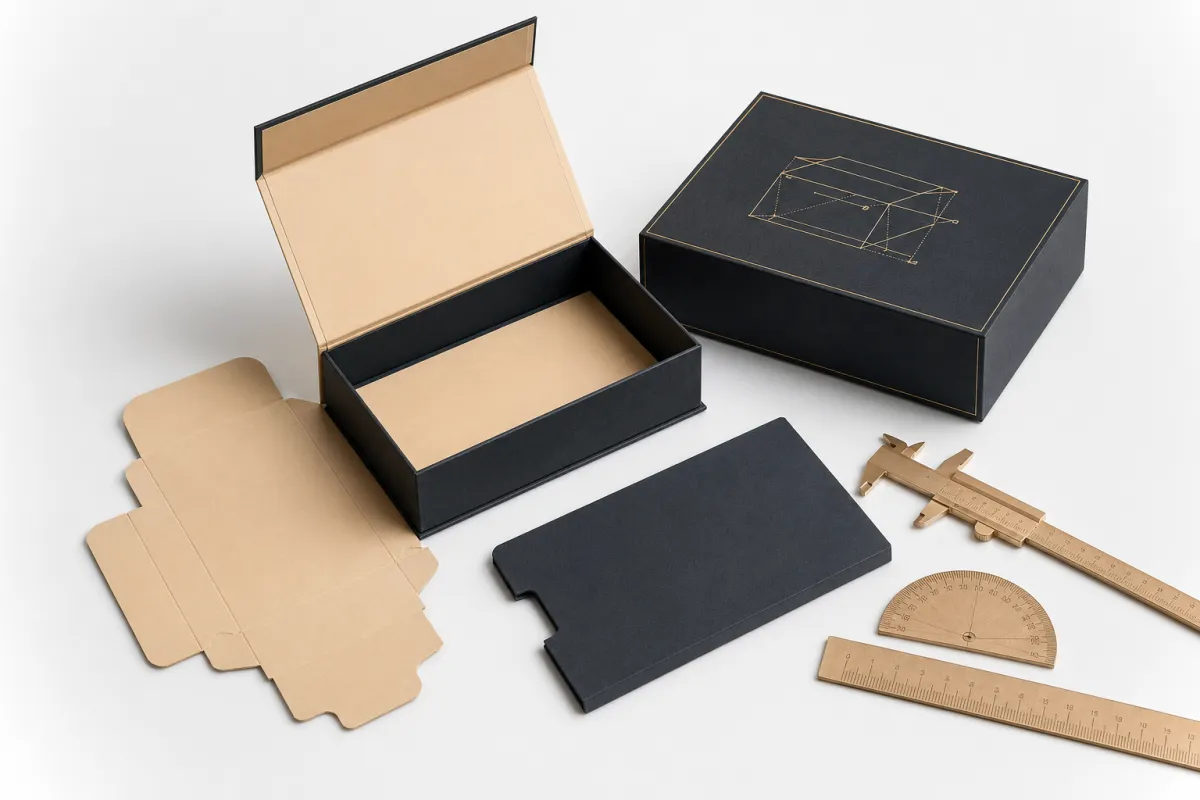
At its core, a custom packaging box dimensions calculator turns product measurements into a box specification a converter can build with confidence. The product comes first, then the calculator adds clearance, inserts, board thickness, score behavior, and the mechanics of how the carton locks, folds, and closes. On the shop floor, those mechanics matter more than the spreadsheet suggests. A flat drawing does not spring back, crush, or bow. Paperboard does, corrugated board does, and chipboard does too, especially when the humidity in Shenzhen is running above 75% in the finishing room. A custom packaging box dimensions calculator is really a translation layer between product intent and production reality.
That difference shows up fast when the intended use changes. An ecommerce shipper can allow a little more room so packing goes quickly and cushioning fits without a fight. A retail-ready carton wants tighter control because the shelf face has to look crisp and the logo has to land where the designer placed it. Display packaging may need headroom for visibility, especially for a 250 mL serum bottle or a 10 oz candle. A kit with accessories needs enough space for a cable, booklet, or sample vial without forcing the panels apart. I have seen a beautiful kit box ruined by one awkward 1.2 m charger cable. It was a cable, not a grand villain, but it acted like one. The custom packaging box dimensions calculator needs to know that detail before the spec locks.
The short version I give clients during early packaging design calls sounds like this:
- Internal dimensions tell you how much usable room sits inside the finished carton.
- External dimensions tell you how much space the box occupies in a shipper, on a shelf, or across a pallet.
- Finished dimensions tell the converter where the folded carton lands after scores, caliper, and closure geometry are counted.
- Clearance keeps the product from scraping, binding, or forcing the closure to bow upward.
A custom packaging box dimensions calculator earns its keep by keeping those measurements distinct instead of collapsing them into one vague number. Teams often confuse inside size with outside size, then wonder why a carton that “should fit” ends up tight after the board is wrapped, glued, and folded. That is more than a bookkeeping mistake. It can alter the quote, change the dieline, and push a launch back by 10 to 14 business days if the sample has to be rebuilt. If you have ever watched a launch schedule slide because somebody assumed “box size” meant the same thing to everyone in the room, you already know the feeling. It is not a pleasant one. A good custom packaging box dimensions calculator keeps that confusion from spreading across the project.
Box style changes the answer as well. A mailer box builds differently from a straight tuck end carton, and a rigid set-up box behaves differently again because chipboard, wrapped paper, and corner wraps all add thickness in layers. A custom packaging box dimensions calculator only helps when it understands structure, not just length, width, and height. I honestly think that is where a lot of calculators fall short: they do arithmetic well and packaging poorly. A mailer in Dallas, Texas and a rigid box in Toronto, Ontario should not be treated like identical structures, because their wall build and closure behavior are completely different. The custom packaging box dimensions calculator has to reflect that difference or the fit will drift.
How Does a Custom Packaging Box Dimensions Calculator Work?
The simplest version of a custom packaging box dimensions calculator asks for three basic inputs: length, width, and height. A better one asks for more. Insert space, loading clearance, rounded edges, handles, pumps, cables, and fragile surfaces all need to be part of the working footprint. A product with a taper or a cap is not a clean rectangle, no matter how tidy the spec sheet looks. Product spec sheets are often optimistic, while packaging engineers in a plant in Ningbo, Zhejiang tend to be less impressed by optimism than by actual measured dimensions. The custom packaging box dimensions calculator works best when it treats the product like it will be handled in the real world, not in a render.
Internal, external, and finished dimensions
Internal dimensions describe the usable room inside the box. External dimensions describe the footprint the warehouse, shipper, and pallet planner see from the outside. Finished dimensions sit between those two points, because they reflect what happens after board thickness, folds, glue, and score crush are accounted for. I have seen teams quote one and buy another, then discover the mismatch only after the insert design, freight estimate, and master case plan all started arguing with each other. That argument is always more expensive than it should be, especially when the carton count is 500 cases per pallet and the extra 4 mm changes the stack pattern. A custom packaging box dimensions calculator prevents that kind of mismatch from becoming the default.
Take a bottle measuring 92 mm long, 58 mm wide, and 146 mm tall. A calculator may recommend adding 2 to 4 mm of working clearance on each side, depending on the board, the finish, and how delicate the surface is. If the carton uses 1.6 mm E-flute corrugated board, the external footprint expands again by roughly twice the caliper plus fold allowance. That is why a custom packaging box dimensions calculator is not just arithmetic. It is a translator between product, structure, and production reality, and those three things do not always speak politely to each other. The Best Custom Packaging box dimensions calculator makes those relationships visible before the quote is final.
Why box style changes the result
A mailer box, a folding carton, a rigid box, and a shipping carton build out in different ways. A mailer often uses locking tabs and a one-piece wrap, which means the closure itself eats a little room. A straight tuck end carton has panels that need to close cleanly without forcing the flap against the product. A rigid box uses wrapped chipboard and often includes a tray, which can change usable depth by several millimeters. A custom packaging box dimensions calculator needs to know which structure is coming before it can produce a useful number. That is especially true on a 350gsm C1S artboard carton in Guangzhou, China versus a 1.5 mm grayboard rigid box in Dongguan, China. A custom packaging box dimensions calculator that ignores structure will miss the fit even if the math looks neat.
Special cases matter as well. Irregular shapes, overhangs, textured surfaces, soft-touch coatings, and stacked sets all change how the fit behaves once production starts. Foam may compress by 1 mm after repeated closures. Molded pulp trays may need extra room at the corners. I once watched a tray look perfect on the bench and then slowly betray us during repeated pack-outs because the foam relaxed just enough to let the product shift. That kind of problem is maddening, mostly because it is almost invisible until it starts costing time. That is why a custom packaging box dimensions calculator that flags those issues early saves time, money, and a long series of sample revisions, especially on Custom Printed Boxes where artwork panels and fold lines are already locked in. A custom packaging box dimensions calculator also helps the designer keep the print layout honest, because a tiny shift in panel width can move a logo or barcode out of its comfort zone.
I have found that the best calculators ask the awkward questions first: Does the item rattle? Does it carry a label seam? Will a sleeve slide over it? Does the shipper need to survive ISTA testing or distribution profiles similar to ISTA protocols? Does the paperboard need to come from an FSC-certified source because the sustainability team wants chain-of-custody documentation? A custom packaging box dimensions calculator is strongest before the quote, not after the sample fails. Waiting until after the sample fails is like discovering the roof leaks after you have already painted the ceiling, which happened to one beverage launch in Atlanta, Georgia and cost them 11 days of schedule recovery. A custom packaging box dimensions calculator should catch that risk while the order is still flexible.
Key Factors That Shape Box Dimensions and Fit
Product geometry comes first. Measure the true footprint, not the idealized one. Rounded corners, pull tabs, pumps, handles, and tapered walls change the usable space inside the box more than a quick glance suggests. I once worked with a small electronics brand in Austin, Texas that swore its device was 140 mm square, then the molded grip at the back added 6 mm in one direction and forced a complete insert resize. The team was not thrilled. I was not thrilled either. The ruler, however, was very confident. A custom packaging box dimensions calculator only works if the geometry is measured where it actually bulges, curves, or protrudes.
Material choice comes next. Corrugated board, SBS paperboard, and rigid chipboard each bring a different caliper, stiffness, and fold behavior. A 350gsm C1S artboard can perform beautifully for a presentation carton, while 1.5 mm grayboard wrapped in printed paper gives a luxury feel and also adds thickness to every wall. If the calculator ignores that material change, the fit will be off before the first sample leaves the table. On a 10,000-piece run in Dongguan, a 0.2 mm change in caliper can mean the difference between a clean tuck and a closure that fights back. A custom packaging box dimensions calculator should always account for the stock, not just the nominal size.
Protection and presentation change the answer too. Foam, molded pulp, paper inserts, and divider cards all consume space. So do embellishments such as soft-touch lamination, spot UV, embossing, or a deep foil panel that needs a clean flat area. For package branding, that visual space matters because a logo should not be pressed against a fold line, and a QR code should never land near a glue seam where scanners struggle. I have seen a barcode land in exactly the wrong place and turn a clean spec into a warehouse annoyance. Nothing says “efficient operation” like a scanner refusing to cooperate because someone centered artwork a few millimeters too aggressively. A custom packaging box dimensions calculator helps prevent that sort of conflict before print plates are made.
I still remember standing in a folding-carton plant outside Shenzhen while a technician checked a run of custom printed boxes for a tea brand. The board looked fine on the CAD file, but the humid finishing room had changed how the paper fiber behaved at the scores, and the tuck depth needed a 1 mm correction to keep the flap from buckling. That tiny adjustment saved the run. Experience often lives in corrections so small they look trivial until they prevent 40,000 boxes from becoming scrap. There is a special kind of humility that comes from watching humidity win an argument with a design team. A custom packaging box dimensions calculator is one of the few places where those corrections can be modeled before they become production facts.
Shipping and retail realities are the final piece. A box that is 6 mm too wide can cost more in freight because it may push a carton into a higher rate tier or reduce pallet efficiency by a full row. A box that is 8 mm too tall can cut shelf facings in a store or make a master case pack less efficient by just enough to matter. A smart custom packaging box dimensions calculator helps teams think beyond fit and look at the whole system: unit cost, pallet count, warehouse cube, and how the product moves from dock to shelf. A 48 x 32 inch pallet pattern in Memphis, Tennessee can lose an entire row if a carton grows by 5 mm, and that is the kind of detail procurement notices immediately. The custom packaging box dimensions calculator should therefore be read as a logistics tool as much as a design tool.
If you are comparing format options, our Custom Packaging Products page is a practical place to review structures before the spec is locked. I also tell buyers to keep a note on the end use beside every size decision: ecommerce, retail packaging, subscription, display, or transit. That one line prevents a surprising amount of expensive confusion later. It also keeps everyone honest, which can be surprisingly rare in packaging meetings once the coffee gets low and the sample count reaches four versions. A custom packaging box dimensions calculator works better when the use case is written down next to the numbers.
Some of the most common variables I review are these:
- Working clearance for loading, removal, and product protection.
- Insert thickness from foam, pulp, or paperboard trays.
- Board caliper and how the chosen stock folds under pressure.
- Graphics space for labels, barcodes, and printed legal copy.
- Transit stress if the carton needs to survive drops, vibration, or stacking.
That is why a custom packaging box dimensions calculator should be treated like a planning tool, not a final ruling. It narrows the choices quickly, but the real-world fit still has to be checked against the sample, the dieline, and the way the product behaves when a person is packing it at speed. Humans are part of the system, and humans pack with tiny variations that spreadsheets love to ignore. A 15-second loading motion in a plant outside Louisville, Kentucky is never exactly the same twice, which is why the sample has to tolerate variation. A custom packaging box dimensions calculator gets you close; the sample gets you honest.
Cost, Pricing, and Material Impacts You Should Expect
A custom packaging box dimensions calculator affects price in more ways than many buyers expect. Bigger dimensions use more board, but the ripple effect goes further than sheet area. Larger panels can reduce sheet yield on press, increase waste at the converting stage, and change how many cartons fit on a master sheet or in a shipping case. A small size change can alter the raw material bill, the number of impressions per run, and the amount of trim loss that ends up in the recycle bin. That is the unromantic part of packaging economics, and it matters a lot, especially on 20,000-piece programs where board savings of $0.03 per unit become $600 very quickly. A custom packaging box dimensions calculator makes those savings visible before the order is approved.
One point gets missed constantly: a tighter box can be cheaper in raw board and still cost more overall if it needs precise tooling, more complex inserts, or extra hand assembly. A rigid box with a snug tray may use less visible area than a loose shipper, yet the labor to wrap, assemble, and fit the tray can push the cost far above a simpler carton. The custom packaging box dimensions calculator helps expose those tradeoffs before anyone approves a structure that looks elegant and quietly eats margin. I have seen “premium” ideas become budget problems with impressive speed, including one $4.20-per-unit rigid set in Toronto that started life as a $2.80-per-unit concept on the estimate sheet. A custom packaging box dimensions calculator can stop that drift early.
Packaging cost gets oversimplified more often than it should. Buyers compare outer size and ignore what the structure is doing underneath. A 200# test corrugated shipper, a 1.6 mm E-flute mailer, and a 1.5 mm rigid chipboard box can look similar in a photo, yet pricing behaves very differently because of board usage, tooling, finishing, and pack-out speed. A custom packaging box dimensions calculator can surface those differences early enough to make the quote conversation honest. I prefer honest quotes, even when they are mildly annoying. Especially when they are mildly annoying, because a misleading quote in Guangdong becomes a production headache later. The right custom packaging box dimensions calculator keeps the economics grounded in the actual build.
Below is a practical comparison I use when helping a brand decide how much structure it really needs. The ranges are planning numbers, not formal quotes, but they show how size, material, and assembly change the budget. For a 5,000-piece straight tuck carton in Chicago, for example, a well-set spec can land near $0.15 per unit before freight, while a 1,000-piece rigid box in Los Angeles can exceed $3.50 per unit once wrapping and inserts are included.
| Box Style | Typical Material | Best Use | Planning Range per Unit | Common Timeline |
|---|---|---|---|---|
| Mailer Box | 1.6 mm E-flute corrugated | Ecommerce, kits, branded packaging | $0.22 to $0.48 at 3,000 pieces | 8 to 12 business days after proof approval |
| Straight Tuck End Carton | 350gsm C1S artboard | Retail packaging, lightweight items | $0.15 to $0.32 at 5,000 pieces | 10 to 15 business days after proof approval |
| Rigid Set-Up Box | 1.5 mm chipboard with wrapped paper | Luxury presentation, gift sets | $1.85 to $4.20 at 1,000 pieces | 18 to 25 business days after proof approval |
| Heavy-Duty Shipping Carton | 32 ECT to 44 ECT corrugated | Transit, warehousing, palletized shipping | $0.40 to $0.95 at 1,000 pieces | 7 to 10 business days after proof approval |
Those numbers explain why the custom packaging box dimensions calculator matters to procurement and product teams. A 3 mm change in depth may not sound dramatic, yet it can alter the die size, the number of cartons per sheet, the amount of printed waste, and the exact folding sequence on the line. For custom printed boxes, even the print layout changes can matter, because a logo centered on a 120 mm panel can look awkward once that panel stretches to 126 mm. I have watched a perfectly centered mark look oddly off-balance after a spec change that seemed too minor to worry about. Small changes love creating visual discomfort, and the custom packaging box dimensions calculator is often the only way to catch them before production.
Finish selection is another cost factor. AQ coating, matte varnish, spot UV, foil stamping, embossing, and soft-touch lamination all influence the final quote. A high-gloss retail carton can cost less than a rigid box, but if the size forces a larger sheet or a tighter ink registration window, the savings shrink fast. Add inserts and the budget climbs again. That is why I always tell buyers to treat the custom packaging box dimensions calculator as a cost-estimation tool as well as a fit tool. If the calculator is blind to finish, it is only doing half the job, and the missing half can be worth $0.08 to $0.25 per unit on a 10,000-piece order. The custom packaging box dimensions calculator should therefore sit in the same conversation as material grade and finishing choices.
The hidden cost of getting the size wrong is usually larger than people expect. A box that is too loose can cause product damage, rattling, or a poor first impression. A box that is too tight can slow packing speeds, increase rework, and crush corners before the shipment ever leaves the warehouse. Oversized cartons also raise storage costs because they consume more cube in the rack and more room on the pallet. I have watched a 12 mm size correction save a client from a freight problem that would have cost more than the paperboard itself, particularly on a West Coast shipment that was already close to the rate threshold. The custom packaging box dimensions calculator is often the first place that damage risk, labor time, and freight cube intersect.
Step-by-Step Process and Production Timeline
The workflow starts with gathering the product measurements in a consistent way. I always ask for length, width, and height at the widest points, plus notes on caps, handles, labels, and any fragile edge that needs extra room. If the product is a set, every component has to be measured together, because a bottle, a dropper, and a carton insert behave differently once they are packed as one unit. A custom packaging box dimensions calculator is only as reliable as the data going into it. Put another way: if the input is sloppy, the result will be politely wrong, usually by 2 to 5 mm. The custom packaging box dimensions calculator should be fed with the same care you would give the final dieline.
From there, the calculator produces a first-pass box size, and the packaging team builds a dieline around that spec. The sample comes next. That is where the real truth shows up. The sample gets checked for fit, closure strength, loading speed, shelf presence, and transit behavior. I have seen a perfectly rational drawing fail because a closure flap needed another 2 mm of relief to tuck without scuffing a coated surface. The numbers were right on screen, but the board still had a different opinion. Board opinion is not always rational, but it is always consequential, especially on a 1.5 mm chipboard structure wrapped in 157gsm art paper. A custom packaging box dimensions calculator can get the structure close, but the sample confirms whether the size works in practice.
“The box that looks one millimeter too small on CAD feels ten times too small when the line is moving at full speed.” That came from a veteran packer at a fulfillment center in Nashville, Tennessee, and I keep repeating it because he was right.
Timelines depend on structure. A simple straight tuck carton can move quickly, especially when the artwork is ready and the material is standard. A mailer or shipping box without inserts can also move at a steady pace. A rigid structure with wrapped edges, foam, or a multi-piece insert takes longer because there are more moving parts, more handwork, and more chances for revision. If the sample changes after the first review, the schedule stretches again. The custom packaging box dimensions calculator helps reduce those surprises, but it cannot erase them. On a straightforward order in Shenzhen, production might finish in 12 to 15 business days from proof approval, while a rigid gift box in Zhejiang can take 18 to 25 business days. A custom packaging box dimensions calculator helps the timeline stay realistic instead of optimistic.
As a practical guide, these are the checkpoints that slow projects the most:
- Missing product measurements, especially with irregular shapes or accessories.
- Late insert changes after the dieline has already been approved.
- Unclear artwork zones, barcode placement, or legal copy requirements.
- Switching board stock after sample approval because the fit feels too loose or too tight.
I remember a client in Chicago launching a two-bottle skincare set in a rigid box with a molded pulp tray. The first sample looked polished, but the tray compressed the pumps just enough to make the lid spring open 3 mm on one side. We adjusted the tray cavity and changed the product orientation, and the second sample passed. That kind of correction is normal in careful packaging design, and the custom packaging box dimensions calculator gives you the map so you can make those corrections before production locks in. I have yet to meet a packaging project that regretted one more sample review, especially when the order volume is 8,000 units or more. A custom packaging box dimensions calculator does not replace judgment, but it does reduce the number of surprises that judgment has to absorb.
For many programs, the timeline looks like this: one to two days to gather data and build the first spec, two to five days for a prototype or digital mockup, a review cycle for fit and artwork, and then production once the proof is approved. Add time when the box needs special finishing or an insert-heavy build. A calculator cannot replace the sample room, but it can shorten the back-and-forth by getting the box closer on the first try. And that, frankly, saves everyone from email chains that no one wants to reread at 6:40 p.m. on a Thursday. The custom packaging box dimensions calculator does its best work when it saves a revision cycle entirely.
Common Mistakes That Throw Off Box Sizing
The biggest mistake is measuring only the product and forgetting everything else that lives in the box. Labels, wraps, closures, foam, dividers, and even the slight rise of a sticker can affect fit. A custom packaging box dimensions calculator can only protect you from this if you feed it the full pack-out picture. I have seen teams measure a perfume bottle perfectly, then forget the sprayer cap and discover too late that the closure flap was colliding with a 5 mm protrusion. That is the sort of mistake that makes people stare at the sample in silence for a second too long, usually in a room with six people and one unhelpful camera phone. A custom packaging box dimensions calculator works best when nobody is guessing what belongs in the footprint.
The second mistake is borrowing outside dimensions from an old carton and assuming the new box will behave the same way. Board thickness changes. Score depth changes. A different supplier may use a slightly different flute or caliper. That means the same nominal box size can feel very different in the hand. On one plant visit in Guangzhou, I compared two mailers that looked nearly identical on a drawing, but one used a stiffer board and gained enough spring-back to change the fit by 2 mm at the corner locks. The drawing lied by omission. The board told the truth. A custom packaging box dimensions calculator should always be checked against the actual stock.
The third mistake is ignoring tolerance. Paper fiber moves with humidity. Scores crush differently after a long run. Glue and fold pressure affect final shape. A mathematically perfect specification can still fail if the material swells, the insert compresses, or the operator has to load the product at speed. A custom packaging box dimensions calculator should always leave room for real-world variation. Perfect on paper is not the same thing as perfect on the line. Paper is patient; production is not, particularly in July when the humidity in coastal China can sit near 80%. A custom packaging box dimensions calculator that assumes ideal conditions is usually the one that gets corrected first.
The fourth mistake is finalizing artwork before the dimensions are stable. Changing one dimension after design lock can shift panel proportions, barcode placement, warning text, and the visual balance of the whole package. That hurts especially on branded packaging, where the logo, foil panel, and product name are supposed to sit in a precise relationship. A small size change can force rework that costs more than the extra board ever would have. Designers hate this. Production hates it too. Procurement usually hates it last, but no less intensely, especially if the reprint adds 7 business days. A custom packaging box dimensions calculator should be part of the design lock, not a cleanup step after the artwork is finished.
Some teams also underestimate how much the product goal changes the spec. A carton meant for shelf display needs a different treatment than a carton meant for e-commerce. A sleeve for a luxury candle does not need the same clearance strategy as a shipping carton for glass jars. If you are not sure which format belongs where, a custom packaging box dimensions calculator is still useful, but it should be paired with a clear end-use brief and a sample check. Without that brief, the calculator can only guess, and guessing is a very expensive hobby, whether the order is 2,000 boxes or 20,000. The custom packaging box dimensions calculator is a guide, not a substitute for the use case.
- Do not size the box from the product alone.
- Do not reuse old outside dimensions without checking board caliper.
- Do not finalize artwork before the fit is stable.
- Do not ignore humidity, compression, and pack-out tolerances.
When those mistakes show up together, the result is usually the same: slower packing, higher damage risk, and a product packaging spec that has to be rebuilt under pressure. A custom packaging box dimensions calculator can prevent a great deal of that pain, but only if the team uses it as a planning step rather than a shortcut. I know that sounds obvious. It still gets ignored all the time, and the correction usually shows up in the form of a $1,200 rush sample charge or a delayed launch in November. A custom packaging box dimensions calculator is cheaper than that kind of repair.
Expert Tips and Next Steps for Better Box Specs
The best advice I can give is to measure the real product three times in three directions, then add the actual working clearance needed for loading, removal, and protection. That sounds plain, even boring, yet it prevents most of the ugly surprises I see in sample review. If the item has a label seam, a pump, a handle, or a rounded base, measure those features separately. A custom packaging box dimensions calculator is most accurate when it starts with honest measurements, not round numbers that feel convenient in a spreadsheet. On a 120 mm bottle with a 17 mm pump, the pump often matters more than the bottle body. A custom packaging box dimensions calculator should therefore reflect the full silhouette, not just the base footprint.
Decide the end use first. A box for ecommerce shipping should not be specified the same way as a display carton or a retail sleeve. The shipping version may need stronger corrugated board, more crush resistance, and room for void fill. The retail version may need tighter panel control, cleaner print registration, and a stronger front-face presentation. A custom packaging box dimensions calculator can serve both paths, but the goal has to be clear before the size is locked. I personally think this is where a lot of packaging trouble begins: a team chooses a structure before it agrees on what success actually looks like, and that is how a 350gsm C1S carton ends up trying to do a shipper's job. A custom packaging box dimensions calculator cannot fix a muddled brief, but it can expose it quickly.
I also recommend asking for a sample, a dieline review, and a manufacturing check before placing a volume order, especially if the product is fragile, expensive, or tightly packed. On a run I saw in Tennessee, a supplement brand wanted to switch from a loose folding carton to a snug tuck with an insert. The sample fit the bottle well, but the closure tab brushed the seal band and scratched the finish during pack-out. We added 2 mm of depth, changed the tab angle, and the problem disappeared. That is a tiny change on paper and a big change on the line. Tiny changes usually have the nerve to be the meaningful ones. A custom packaging box dimensions calculator is what gets those tiny changes onto the page before they get into production.
If the project includes sustainability goals, keep material sourcing in the conversation from the start. FSC-certified paperboard, recycled-content corrugated, and right-sized shipping cartons all affect the environmental footprint in different ways. The best packaging teams speak plainly about board use, recyclability, and transit performance instead of hiding behind jargon. A custom packaging box dimensions calculator helps here too, because smaller, better-fitted boxes often reduce wasted material and shipping cube at the same time. That combination is difficult to argue with, especially when a pallet save in Los Angeles, California cuts freight by 8% on a weekly shipment. The custom packaging box dimensions calculator can support both cost discipline and material discipline.
For teams comparing formats, our Custom Packaging Products page is a practical next stop before sampling begins. I would also keep a note next to every spec that says what the box must do: protect, present, ship, or all three. That note sounds simple, but it keeps everyone honest when the conversation turns to material grade, print finish, and price. I have learned that one sentence can spare a week of debate later, and a week is a long time when a launch date is already on the calendar. A custom packaging box dimensions calculator works best when the team agrees on the job before the numbers are finalized.
The strongest packaging programs treat the custom packaging box dimensions calculator as the first draft, not the final word. It gets the size into the right neighborhood, but the converter, the printer, and the pack-out team still have to confirm that the dieline, the board, and the loading method work together. Do that well and the box feels intentional instead of improvised, which is usually the difference between a project that drags and one that moves cleanly. And if you have ever tried to clean up an improvised packaging plan at 4:30 on a Friday in a warehouse outside Newark, New Jersey, you already know why that matters. A custom packaging box dimensions calculator can keep the project from getting that far off course.
Frequently Asked Questions
How do I use a custom packaging box dimensions calculator for a product with inserts?
Measure the product and every insert piece together, not just the item itself. Add clearance for loading, removal, and any compression from foam or molded pulp. Check that the insert does not push the product into the closure or print area. A custom packaging box dimensions calculator works best when the insert is treated as part of the structure, not an afterthought. I have seen too many “afterthought” inserts act like they were offended to be included late, especially on 1,000-piece luxury kits with foam cut to 3 mm tolerance. The custom packaging box dimensions calculator should reflect the full pack-out, not a simplified version of it.
Does a custom packaging box dimensions calculator include board thickness?
A good calculator should let you work from internal dimensions and account for material caliper. Board thickness changes the finished outside size, which matters for shipping, pallet planning, and warehouse fit. Always confirm whether the result is an internal size, external size, or dieline size before you approve the spec, because those three numbers can differ by several millimeters. That distinction sounds small until a pallet plan breaks for no good reason, such as a 48 x 40 inch pallet losing one more case row than expected. A custom packaging box dimensions calculator that shows the caliper assumption is much more useful than one that hides it.
Can a custom packaging box dimensions calculator help estimate pricing?
Yes, because dimensions affect board usage, sheet yield, tooling, and waste. It will not replace a formal quote, but it can show when a size is likely to be more expensive. Bigger boxes, unusual structures, and insert-heavy designs usually raise the price fastest. That is one reason I like to run a custom packaging box dimensions calculator early, before artwork and finishing choices lock the budget. Budget lock-in has a way of becoming emotionally loud, especially when a buyer sees the difference between $0.15 per unit and $0.32 per unit on a 5,000-piece order. A custom packaging box dimensions calculator gives the team a realistic range before the estimate hardens.
What measurements do I need before I start?
Collect the product's length, width, and height at its widest points. Note any handles, curved edges, closures, or fragile surfaces that need extra room. Also write down the packaging goal, such as retail display, shipping, or subscription fulfillment. A custom packaging box dimensions calculator is only useful if the input reflects the real item, not just a nominal product drawing. Real items are messy, and a 145 mm bottle with a 12 mm cap will never behave like a perfect rectangle. The custom packaging box dimensions calculator should be fed with those messy details from the start.
How accurate is a custom packaging box dimensions calculator for first-time orders?
It is accurate enough to create a strong starting specification for quoting and sampling. The first sample is still important because real board, folds, and inserts can change the fit. Use the calculator to narrow the range, then verify the final box with a prototype. For a first order, that combination is usually the safest way to keep the project on track. I would trust that process far more than any promise that claims to get everything right on the first guess, especially when the carton is shipping from Guangzhou to the U.S. in a 40-foot container. A custom packaging box dimensions calculator is strongest when it is followed by a sample check.
Before you release a production order, lock the product measurements, confirm the board caliper, check the dieline against the actual pack-out, and approve a sample that matches the way the box will be used. If any of those four pieces changes, run the numbers again before signing off. That habit is boring, sure, but it is gonna save you money, rework, and a very avoidable launch delay. A custom packaging box dimensions calculator should make the box feel inevitable, not improvised.

