A Custom PE Bags Factory custom logo order can look simple on paper: send artwork, approve a proof, receive bags. In practice, film choice, print method, bag construction, and handling requirements determine whether the result looks clean and performs well.
PE bags are popular because they are light, moisture resistant, easy to convert, and cost-effective for high-volume packaging. A printed PE bag can work for retail overwraps, fulfillment sleeves, liners, and promotional packs without adding much weight or cost.
The difference between a decent order and a frustrating one usually comes down to whether the supplier understands how the bag will be used, what abuse it will take, and what print quality the brand can support.
What a PE Bag with Custom Logo Really Does for Your Brand
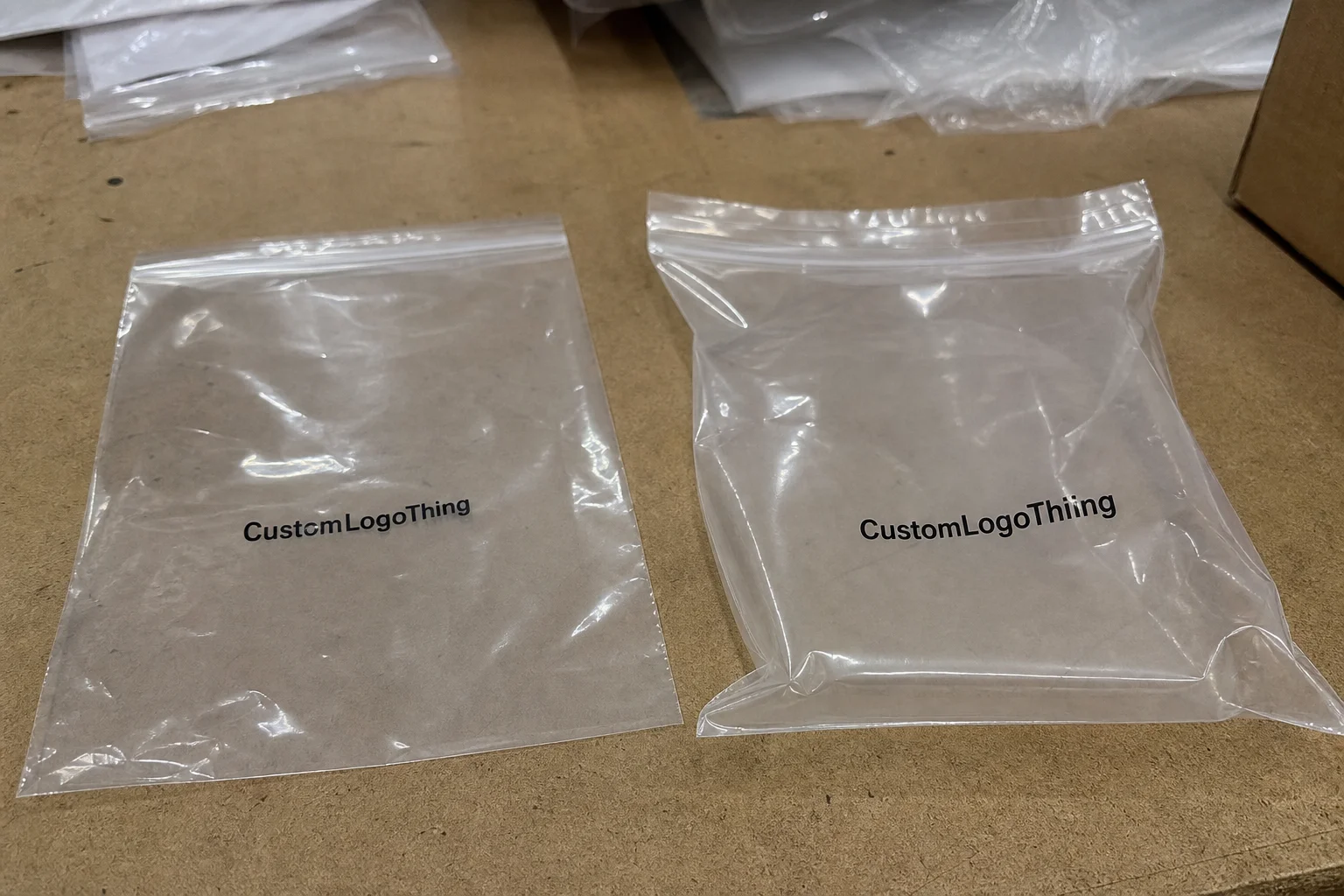
PE means polyethylene, a flexible plastic film used for sleeves, liners, garment bags, mailer-style packaging, and other common packaging formats. It is lightweight, moisture resistant, and adaptable, which is why many buyers choose it for practical packaging needs.
For branding, PE offers a large printable surface without much added weight. That makes it useful where presentation and protection both matter. A simple logo on clear or milky PE film can look sharp if the artwork is clean and the film thickness is appropriate.
PE is not one uniform material. A 30-micron sleeve for light apparel behaves differently from a 100-micron shipping liner. Glossy and matte films also affect how ink appears. Clear bags can make logos feel cleaner, while opaque films can make the print read more strongly. The right choice depends on the product, handling, and required appearance.
From a buyer’s point of view, the best PE bag disappears into the workflow while still carrying the brand. It opens properly, seals properly, prints cleanly, and survives the trip from warehouse to customer. If a bag tears, wrinkles badly, or makes the logo look off-center, people notice quickly.
A printed PE bag is often the least expensive branded surface in the packing flow, which is exactly why the specifications matter so much.
How a Custom PE Bags Factory Turns Artwork into Finished Bags
Most buyers start with the logo file, but a real production workflow goes through material selection, printing setup, conversion, sealing, inspection, packing, and shipment. Each step affects the finished bag.
The factory may extrude film in-house or buy finished roll stock. Resin blend, gauge control, and additives all matter. A film that is too soft can feel flimsy; one that is too stiff can wrinkle during sealing or stacking. Inconsistent resin can create haze, thickness variation, or weak seals.
Printing method also matters. Flexographic printing is common for medium to large runs with simple spot colors. It usually balances cost and speed well for logo-only packaging. Gravure printing is used more often for high-volume runs where fine detail and color control matter. Digital printing can work for small runs or fast samples, though not every factory offers it for PE film.
Buyers should ask how the factory checks print registration, ink adhesion, and color consistency. A logo can be printed and still look wrong if it shifts, stretches, or loses density when the bag is sealed or filled. Flat samples can hide problems that only show up in use.
Sealing and conversion matter just as much. If the bag is gusseted, wicketed, die-cut, resealable, or made for a specific fold, the conversion step needs to be controlled. Wrong seal temperature or pressure can create weak edges or bags that fail after delivery.
If the packaging program includes more than one format, some buyers compare the printed PE bag with other Custom Packaging Products to keep brand presentation consistent across sleeves, cartons, labels, and outer packs.
For quality and performance context, two references are useful. ISTA provides transit testing standards that help explain how packaging survives handling. EPA recycling guidance offers a practical framework for material and disposal questions.
Cost, Pricing, and MOQ Factors That Change Your Quote
PE bag pricing depends on size, thickness, print coverage, number of colors, order quantity, bag style, and whether plates or tooling are required. If a quote is much lower than the others, the first question should be what was left out.
MOQ matters because setup cost gets spread across the run. A 2-color logo on 5,000 bags will usually cost more per unit than the same design on 20,000 bags. A larger run lowers unit cost, but it also increases inventory risk, so the right quantity is a balance between savings and storage.
Here is a rough pricing reference used by many packaging teams:
| Order Type | Typical Unit Cost Range | What Usually Drives It | Best For |
|---|---|---|---|
| Small custom run | $0.20-$0.45 per unit | Setup spread across fewer bags, sample work, higher handling | Launches, pilot programs, seasonal promotions |
| Mid-volume order | $0.08-$0.18 per unit | Moderate volume, standard film, limited colors | Retail packaging, recurring fulfillment use |
| High-volume repeat run | $0.03-$0.10 per unit | Large quantity, established plates, optimized production | Stable SKUs, chain retail, ongoing shipping use |
These ranges are directional, not universal. A wider bag with full-coverage print will cost more than a narrow sleeve with a one-color logo. Film gauge, gusset depth, surface finish, and packing method also move the price.
Hidden costs are common. Sampling can add time and expense. Freight can change the total far more than expected. Plates, proofs, and rework are not always included in the first number. A quote is only useful if it is complete enough to compare with another complete quote.
Compare like with like: same thickness, same size, same print coverage, same packing standard, same delivery term. Otherwise the lowest number may simply be the least complete offer.
Process and Timeline: From Artwork Approval to Shipment
The order flow usually starts with an inquiry and ends with shipping, but the steps between matter most. A good factory will ask for dimensions, intended use, quantity, artwork files, color references, and any compliance expectations before confirming price or lead time.
A practical workflow looks like this: inquiry, spec review, artwork submission, proof approval, sample confirmation, production, inspection, packing, and shipment. Straightforward jobs move faster. New projects take longer because the factory has to set up printing, confirm the film, and verify output before full production starts.
For repeat orders, lead time can shorten because the tooling already exists and the print file has been approved. New custom jobs usually need more buffer, especially if the logo is detailed, the color is sensitive, or the bag structure is unusual. A common planning baseline is 12-15 business days from proof approval to production completion, plus freight time.
What causes delays? Blurry artwork, missing Pantone references, late proof approval, and last-minute changes after production starts. These problems are avoidable.
To move faster, send vector artwork in AI, EPS, or editable PDF format. Confirm dimensions early. Approve proofs promptly. State packing requirements up front. If the bags support a launch, build a buffer for customs, weather, or reprint delays.
Spec Checklist Before You Request a Quote
The fastest way to get an accurate quote from a Custom PE Bags Factory custom logo supplier is to send a complete spec sheet. Vague briefs create vague prices and more back-and-forth.
At minimum, define the bag style, width, length, gusset, thickness, print colors, logo placement, and intended use. A shipping liner, a retail carrier, and an apparel overwrap may all be PE bags, but they are not the same product in production terms.
What should be on the spec sheet?
- Bag style: flat, gusseted, wicketed, resealable, or sleeve
- Material thickness: for example, 30-120 microns depending on use
- Print method: flexo, gravure, or digital if available
- Logo placement: centered, corner, one side, or both sides
- Quantity: exact count or a realistic range
- Color references: Pantone codes or approved brand values
- Pack-out format: bulk, carton, poly-bundled, palletized
Usage matters. A bag that only needs to protect folded apparel can use a different thickness and clarity than a bag used for parcel shipping. If the bags must meet retailer packaging standards, say so early. Do not assume the factory will infer it from the logo file.
If sustainability is part of the brief, be specific. “Recycled content” can mean different things depending on source, percentage, and whether the content is pre-consumer or post-consumer. If the packaging program includes other materials, evaluate the PE bag as part of the full system. For broader paper-certification context, FSC guidance is the relevant reference.
Add a short use-case note, such as “used as an apparel overwrap,” “handed out in-store,” or “protects boxed goods during parcel shipment.” A sentence like that often improves the quote more than a page of brand language.
Common Mistakes When Ordering Custom PE Bags with Logo
Most PE bag problems are spec problems: wrong dimensions, weak seals, blurry printing, or color mismatch. These usually come from rushed approval or an incomplete brief.
The first mistake is treating all PE film as interchangeable. Resin quality, film gauge, additive package, and finish affect clarity, stiffness, feel, and durability. A cheap-looking bag can undermine the brand even if the logo is printed correctly.
The second mistake is using low-resolution artwork. Thin type and delicate lines can break down on film, especially if the logo is small or close to a fold. Vector artwork is the safer route.
The third mistake is assuming screen color equals print color. It rarely does. If color precision matters, use Pantone references, ask for a proof, and expect some variation between the digital mockup and the finished film.
The fourth mistake is buying by unit price alone. A low quote can hide lighter film, weaker seals, loose inspection standards, or extra freight charges. If the bags fail in transit or arrive with shifted logos, the cheap order becomes expensive quickly.
The fifth mistake is not specifying the actual use. A display bag and a shipping bag are not the same thing. If you want print quality and durability to hold up, the supplier needs the job description, not just the size.
Expert Tips for Better Print Results and Smoother Ordering
If the goal is clean print, simplify the artwork. High-contrast logos, fewer colors, and solid linework usually print more reliably on PE film than gradients, tiny text, or busy layouts.
Ask for a pre-production proof or sample, especially if the logo sits near a seal, fold, or handle. A design that looks centered on the flat proof can feel off once the bag is filled and handled.
Match thickness to the real load. If the bag will carry weight or travel through parcel sorting, be honest about the abuse it will take. Decorative film that works for an apparel insert may fail in warehouse handling.
For repeat purchases, keep one master spec and one approved artwork file. Many teams lose time because each reorder starts from a different email thread or an old PDF. Standardizing the final version reduces errors and helps keep batches consistent.
Document what worked: whether a wider seal improved strength, whether the logo read better with more negative space, and whether the film felt too slippery for stacking. Those notes become useful quickly if you reorder or expand into other branded packaging formats like custom printed boxes or coordinated retail kits.
The strongest suppliers behave like packaging problem-solvers, not order takers.
Next Steps: How to Move From Idea to Factory-Ready Order
If the project is moving toward a custom pe bags factory custom logo order, gather the facts before requesting quotes: dimensions, thickness target, logo files, quantity range, and actual use case.
Send the same brief to two or three suppliers and compare the answers, not just the prices. Ask for an itemized quote that separates material, printing, sampling, and freight. Ask whether the factory can provide a proof or sample. Ask how long production really takes and whether repeat orders can match the same spec.
Choose the factory that understands the application, not the one that makes the biggest promise. A supplier that asks about film gauge, print method, seal type, and end use is usually showing you where the risk sits.
Before paying, confirm the approved artwork, final measurements, packing method, and reorder spec. That one habit turns the first run into a template for later runs.
A printed PE bag protects the product, carries the brand, and shapes the customer’s first physical impression. If the order goes to a custom pe bags factory custom logo supplier, treat it like a production decision.
FAQ
What should I ask a custom PE bags factory custom logo supplier before ordering?
Ask about minimum order quantity, print method, thickness options, proofing, and whether the factory can provide a sample before mass production. Confirm turnaround time, shipping method, and exactly what is included in the quote. If possible, request examples of similar jobs to judge print quality and consistency.
How is pricing usually calculated for PE bags with a custom logo?
Pricing usually depends on size, thickness, print colors, artwork complexity, and order quantity. Tooling, plates, sampling, and freight can affect the final cost, so the lowest unit price is not always the best deal. Higher volumes generally reduce unit cost because setup expenses are spread across more bags.
What file format is best for a custom PE bag logo?
Vector files such as AI, EPS, or PDF are usually best because they stay sharp at any print size. High-resolution PNGs can work for proofs, but factories often need editable vector artwork for production. Include brand color references if exact color matching matters.
How long does it take to produce custom PE bags with logo printing?
Lead time depends on whether artwork is ready, whether tooling is needed, and how large the order is. Simple repeat runs can move faster, while new custom jobs usually take longer because of proofing and setup. Freight and customs may add extra time, so buyers should plan with a buffer.
What are the most common problems with custom PE bag orders?
Common issues include incorrect dimensions, weak seals, blurry printing, and color mismatch. These problems often come from unclear specifications, rushed approvals, or choosing the wrong film thickness for the application. A sample or proof helps catch issues before full production.

