Custom Plastic T Shirt bags remain one of the most practical retail packaging options because they do several jobs at once: they move quickly at checkout, protect purchases on the way out, and carry your branding into parking lots, apartments, offices, and cars. A bag that costs only a few cents can still generate repeated impressions long after the sale. That is a hard combination to beat for low-to-mid value retail.
They are not the fanciest packaging choice, and that is exactly why many stores keep using them. When the product is light, the pack line is busy, and staff need a simple carryout format, the bag’s value is in speed and consistency. Buy the wrong spec, though, and the savings disappear fast. Thin film that tears, awkward sizing, or poor print placement tends to create more complaints than branding benefit.
For store owners and buyers, the real decision is whether the bag fits the product mix, the sales environment, and the local rules. That sounds basic, but it is where many orders go sideways. The best-looking mockup in the world does not help if the bag is too small for folded apparel or too flimsy for boxed items.
What custom plastic t shirt bags are and why stores still use them
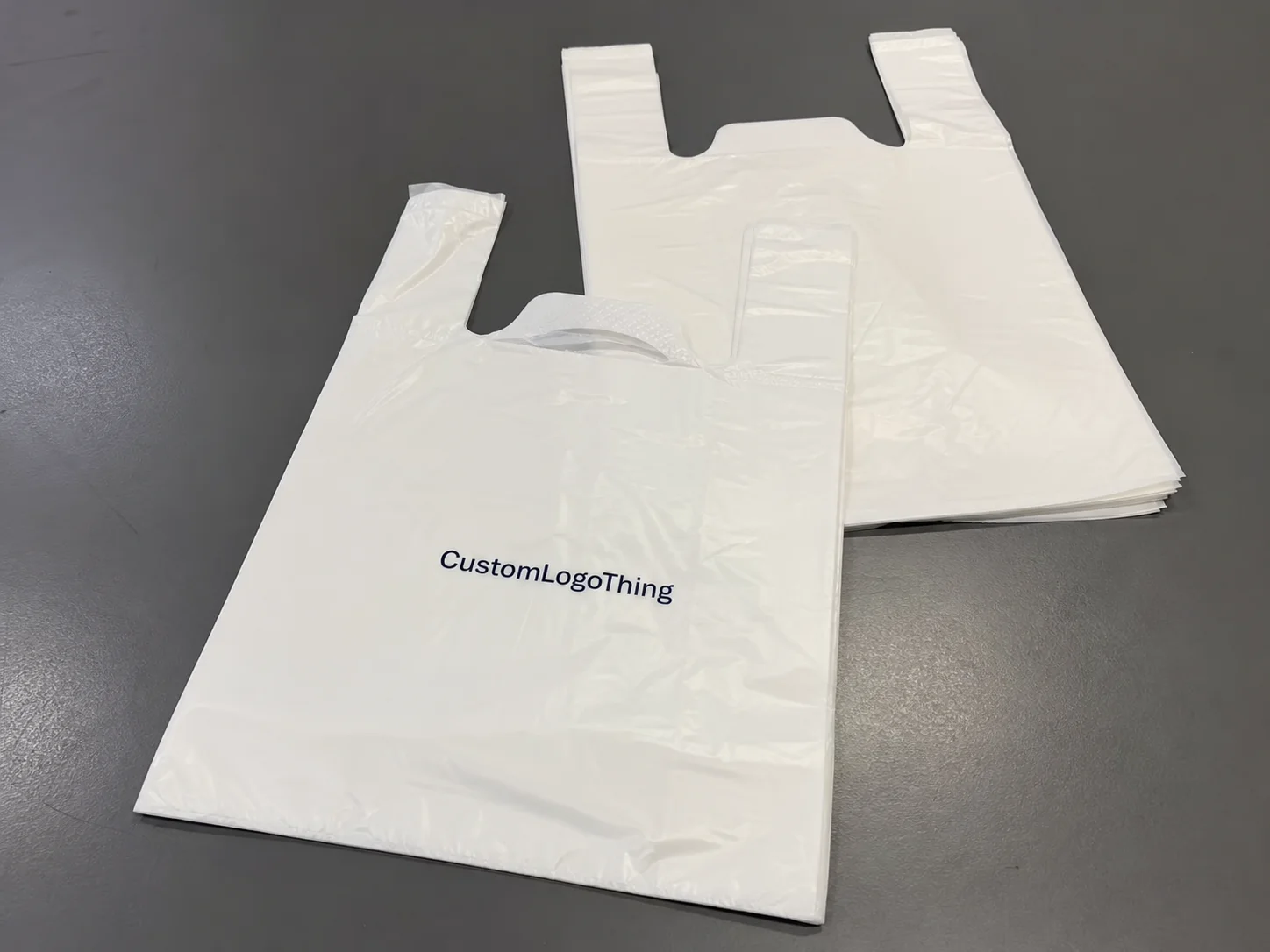
These bags are the familiar retail carryout style with side gussets, a bottom seal, and handle cutouts that make them easy to dispense and carry. Most custom plastic t shirt bags are made from either high-density polyethylene (HDPE) or low-density polyethylene (LDPE). The choice affects stiffness, stretch, and cost. HDPE is typically crisper and more economical; LDPE feels softer and can tolerate awkward loads a little better.
The name comes from the shape: the handles resemble a T-shirt’s sleeves on a simplified outline. It is a plain design, but that simplicity is why it works in retail. Bags need to stack neatly, open quickly, and pack without much training. Staff should not have to wrestle with a package every time a customer buys socks, snacks, or a folded shirt.
Stores still use them because checkout speed matters. Convenience stores, pharmacies, discount retailers, gift shops, apparel stores, and event vendors all rely on packaging that keeps lines moving. A bag that slows the register is a bad bag, even if it looks premium in a rendering. Speed is part of the product.
The branding effect is real too. A printed bag travels farther than most point-of-sale materials. It does not just sit by the counter; it leaves the store and gets seen again on the street, in transit, or at home. That makes bag printing one of the lowest-cost forms of package branding available to small and medium retailers.
“The best bag is usually the one customers barely think about during checkout, then remember later because the handle held and the print stayed readable.”
Common uses include apparel, pharmacy goods, boxed impulse items, takeaway packaging, and event giveaways. They are not ideal for every load. Heavy glass, sharp edges, and oversized items need stronger structures or a different carry format. But for light-to-moderate retail use, these bags remain efficient, familiar, and easy to reorder.
How the bag structure and print setup work
Bag performance depends on a handful of spec choices that buyers often underestimate: film gauge, bag width, gusset depth, handle style, and seal strength. Film gauge refers to the thickness of the plastic, usually measured in mils or microns depending on the supplier. A thinner film lowers the unit cost, but it also narrows the margin for error. Overload it, and the bag tells you immediately.
HDPE is commonly used where price and volume matter most. It is thin, light, and efficient for high-throughput checkout lanes. LDPE has more stretch and a softer hand feel, so it is often chosen when the products are boxy, the retail presentation matters more, or the customer is likely to carry multiple items in one bag. There is no universal “best” material; the better choice depends on the products inside.
Printing is usually done with flexographic presses on commercial runs. Artwork is separated into spot colors and transferred in layers. For most retail jobs, one to three spot colors are the sweet spot. They print cleanly, stay legible, and keep setup costs in check. Full-color artwork can be produced in certain workflows, but on a narrow bag face, restrained graphics often perform better than busy designs.
Layout matters more than buyers expect. The logo needs room around the handle cut and the bottom seal. If artwork sits too close to the edge, it can look cramped or distort once the bag is formed and packed. A good proof should show more than a centered logo on a blank rectangle. It should show actual placement on the finished bag shape.
Material claims and local regulations deserve real attention. Some regions restrict certain plastic bag constructions, recycled-content claims, or retail carryout use altogether. If a store operates across multiple jurisdictions, the spec should be checked against the target market before production begins. The EPA plastics guidance is a useful reference point, but it does not replace local compliance review.
Bundle format matters too. Ask how the bags are packed, stacked, perforated, and bundled for dispensing. A clean stack saves time at the register, reduces snags, and makes the bag easier for staff to grab one at a time. That kind of operational detail rarely shows up in a mockup, but it has a real impact at checkout.
Cost, pricing, MOQ, and what actually moves the quote
Pricing for custom plastic t shirt bags is driven by quantity, size, film thickness, print coverage, number of colors, and freight. The lowest quote usually comes from a standard size, a simple logo, a thin-to-moderate gauge, and a larger order quantity. There is no mystery here. It is a combination of setup economics and material usage.
MOQ, or minimum order quantity, has a big effect on unit price. A smaller run almost always costs more per bag because the fixed expenses are spread across fewer pieces. Those fixed costs include plate or plate-equivalent setup, press time, material waste, packing labor, and packaging for shipment. Buyers sometimes focus only on the piece price and miss the setup math behind it.
One practical way to compare options is to look at how each spec changes the final use, not just the quote. A bag that saves a fraction of a cent but tears during transport is not the cheaper option once complaints and replacements are included.
| Option | Typical use | Price impact | Buyer tradeoff |
|---|---|---|---|
| Thin HDPE, one-color print | Light retail, high volume | Lowest | Good unit economics, less forgiving under load |
| Standard HDPE, two-color print | General checkout packaging | Moderate | Balanced cost, cleaner branding, better durability |
| Thicker LDPE, two to three colors | Boutiques, heavier folded goods | Higher | Better strength and presentation, higher cost per unit |
| Custom size with heavy coverage | Specific product packaging needs | Highest | Best fit, but setup and print complexity rise quickly |
Print complexity is one of the easiest ways to overpay. Each added color increases setup and can raise the risk of registration issues. Tight type, gradients, and crowded artwork may look polished on screen, but on plastic film they often lose clarity. A strong logo in one or two colors is usually the smarter buy.
Thickness has to be matched to the load. Heavier gauges cost more, but they reduce handle breakage, seam failure, and customer frustration at the door. The savings from a cheaper film can disappear if the bag tears before the customer reaches the car. That is not just a customer service problem; it is a packaging failure that reflects on the store.
For rough budgeting, higher-volume custom orders often fall into low cents per bag, while smaller runs climb sharply once setup and freight are included. Exact pricing varies widely by supplier and specification. If a quote looks unusually low, ask about the gauge, print coverage, and pack count. One of those line items is usually doing the heavy lifting.
If your packaging program includes more than one format, it can help to compare a carryout bag against other Custom Packaging Products. In some cases, a branded carton, insert, or label system may better match the product mix than forcing every item into a single bag format.
Process and turnaround: from quote to delivery
The process usually follows a predictable sequence: inquiry, spec confirmation, artwork review, proof approval, production, packing, and shipment. The slow part is often not the press run itself. It is the exchange before production starts. Files need to be checked, dimensions confirmed, and color expectations aligned. A clean workflow saves more time than rushing a bad one.
Most delays come from missing vector artwork, unclear dimensions, low-resolution logos, or vague color direction. If a brand file only exists as a screenshot, the proof stage is going to drag. If the brand color matters, it helps to supply a Pantone reference or a clearly defined color target. “Make it brighter” is not production guidance.
Lead time usually breaks into three parts:
- Proof time — often 1 to 3 business days if the artwork is ready.
- Production time — often 10 to 20 business days for standard runs after approval.
- Transit time — depends on shipping mode, destination, and season.
That means a buyer asking for delivery in two weeks may be compressing several stages into one narrow window. It can happen, but only if the artwork is clean, the spec is straightforward, and the shipping lane cooperates. More often, the timeline slips because one stage is waiting on another.
Before approving an order, confirm the final size, gauge, ink colors, and pack count. Those are the details most likely to cause costly rework if they are wrong. If the bags are tied to a store opening, event launch, or seasonal promotion, build in buffer. Freight can slide, and production slots fill up faster than people expect during peak periods.
Compliance and sustainability questions should be handled before the proof is signed off. If recycled-content claims, recyclability language, or local bag restrictions apply, get the documentation sorted early. Chain-of-custody and certification language should be specific, not generic. If the packaging program also includes paper cartons or tags, the FSC framework is relevant for those paper-based components.
How to choose the right specs for your store
Start with what the bags will actually carry. A store selling folded apparel has different needs from a pharmacy packaging small boxed items, and both differ from an event vendor handing out lightweight merchandise. The most useful spec is the one that fits the average bundle, not the most extreme one. Oversizing to cover every possible purchase usually wastes money and storage space.
Bag width and gusset depth should be chosen around the most common transaction. A bag that is too small forces awkward packing and can stress the seams. A bag that is too large looks sloppy, takes more room behind the counter, and costs more than necessary. Good packaging should fit the product without excess.
Gauge and handle choice
Gauge determines how much abuse the bag can take. Thin bags are suitable for lower-load retail and high-volume checkout lanes where unit price matters most. Thicker bags make sense when customers often carry multiple items, heavier boxes, or awkwardly shaped goods. If bags are regularly doubled, that can be a sign the gauge is too light for the actual use case.
Handle style affects both feel and presentation. Standard T-shirt handles are the default for speed and storage efficiency. Die-cut handles can look cleaner in premium settings. Loop handles may fit certain gift, boutique, or promotional uses, but they can also add cost and complexity. The right choice depends on how the bag will be loaded, held, and seen.
Branding and layout decisions
Your logo should be readable from arm’s length and still make sense when the bag is partly full. High-contrast artwork tends to print better than busy graphics on plastic film. Negative space matters because the folds, seams, and handle cut all compete with the design. A simple mark that reproduces cleanly is often stronger than a crowded layout that looks clever in theory.
If your store already uses labeled cartons, inserts, or other packaging, align the bag design with that system. Consistent colors and typography make the whole retail packaging experience feel more intentional without requiring a larger budget. That kind of visual consistency often matters more than adding extra print effects.
Practical options like perforations, stack-friendly bundling, and recycled material content can also affect day-to-day use. None of those features are glamorous. They simply reduce friction for staff and may improve customer perception depending on market expectations and local requirements.
One simple test helps: does the spec make packing faster and carrying easier? If not, it may be a decorative choice rather than a useful one.
Common mistakes buyers make with custom plastic bags
The biggest mistake is choosing on price alone. A cheaper bag that tears, prints poorly, or fits badly can end up costing more than a slightly stronger version. Return visits, replacements, and customer frustration quickly erase the savings. Packaging has to survive real use, not just spreadsheet logic.
Another frequent error is ignoring local regulations until after production has started. Bag restrictions vary, and some markets limit certain plastic carryout formats or recycled-content claims. Ordering first and checking later is a costly way to discover you bought inventory that cannot be used where you planned.
Artwork problems are also common. A design that looks sharp on a screen can fail when scaled onto a narrow print zone. Fine lines, small text, and low-contrast taglines often disappear once the bag is formed. The printed area is not generous, so the artwork should be built for clarity first and decoration second.
Too many colors can inflate the quote without improving the result. Each added color adds setup and can complicate alignment. In most retail applications, a bold one-color logo or a restrained two-color layout is enough. Busy graphics tend to work against the bag’s main job, which is to carry and promote without slowing the checkout process.
Skipping the proof is the fastest route to preventable mistakes. A proof is not a formality; it is the chance to catch size errors, color issues, and placement problems before production begins. The few minutes spent checking it are cheaper than a full reprint.
Expert tips for better branding, fewer headaches, and smarter reorders
Use branding that survives real handling. Bags get folded, crumpled, stacked, and carried in poor lighting. If the logo only reads cleanly when the mockup is perfectly flat, the design needs simplification. Good package branding stays visible after contact, not just before it.
Keep the message short. A checkout bag is not the place for a long brand story or a wall of marketing text. One strong logo, a clean color choice, and a clear layout usually do more for recognition than a crowded composition. The bag should reinforce the brand, not compete with it.
Standardize dimensions across locations whenever possible. That makes reordering easier, simplifies storage, and reduces the chance that staff pull the wrong bundle during busy hours. For multi-store operations, standard specs also make quality control more predictable from one reorder to the next.
Ask for proofs that show exact placement relative to seams and handles. A polished mockup with soft shadows is fine for presentation, but it is not enough for production approval. The proof should answer the practical questions: where does the logo land, how much space sits above it, and how close is it to the fold?
Keep a reorder record with the final spec, approved artwork, Pantone references, pack count, and freight preference. That turns the next order into a routine transaction instead of another round of detective work. Buyers who track those details tend to reorder faster and make fewer mistakes.
If the bag is part of a broader retail packaging system, keep the look coordinated with labels, cartons, inserts, or other Custom Packaging Products. Consistency helps the store feel organized even when the product mix changes. That matters more than adding expensive embellishments that do not improve function.
Next steps: how to move from idea to order
Before asking for quotes, define the basics: product weight, typical bundle size, estimated monthly volume, and branding needs. If you cannot describe what the bag must carry on an ordinary day, you are not ready to spec the bag. The right starting point is the actual use case, not the imagined one.
Gather the essentials: logo file, preferred dimensions, number of print colors, and target quantity. If your packaging program includes matching cartons, inserts, or labels, that context can help the artwork stay consistent across the shelf and the checkout counter. The cleaner the input, the fewer proof edits you will need later.
Request at least two versions of the quote if possible: one lower-cost spec and one sturdier option. That gives you a real comparison between unit price and performance. It also makes the tradeoff visible. Sometimes the slightly better bag costs little enough that it is the more rational choice.
Confirm the proof, verify the lead time, and align delivery with your replenishment or launch schedule. If the bags are needed for a promotion or opening date, add buffer for freight and any artwork changes. Production can be predictable. Freight is less cooperative.
Custom plastic t shirt bags work best when the structure fits the product, the print is legible, and the reordering path is already documented. Choose the Right spec once, and the next order gets much easier.
What are custom plastic t shirt bags used for in retail?
They are used for checkout packaging, light product carry-out, and branded visibility after the sale. They work well for apparel, convenience goods, pharmacy items, and other lightweight retail purchases.
How do I choose the right size for custom plastic t shirt bags?
Match the width and height to the most common item bundle, not the largest item you occasionally sell. Leave enough gusset room for folded garments, boxes, or multiple products without stressing the seams.
What affects the price of custom plastic t shirt bags the most?
Quantity, material thickness, bag size, and print complexity usually have the biggest impact. Smaller order volumes and more colors generally increase the unit price.
How long does the process usually take for custom plastic t shirt bags?
Lead time depends on proof approval, production scheduling, and shipping method. Proofing and freight can add several days, so it is smart to build in buffer before a launch or event.
Can I print a logo on both sides of custom plastic t shirt bags?
Yes. Many orders can be printed on one or both sides, depending on the setup. Double-sided printing can raise the cost, but it improves visibility and brand recognition.


