Custom Printed Plastic t shirt bags still earn a place at checkout because they solve two problems at once: they move merchandise efficiently and they leave the customer with a branded object that keeps working after the sale. That matters more than many buyers expect. A bag is often the last physical item a shopper handles, so size, film, and print quality all feed into the impression the store leaves behind.
For retailers, the bag is not just a carrying device. It affects checkout speed, helps organize loose items, and carries the store name into the parking lot, the car, and sometimes all the way home. A clean, properly spec’d bag can make a modest operation feel deliberate. A flimsy one does the opposite very quickly.
Why Custom Printed Plastic T Shirt Bags Still Matter at Checkout
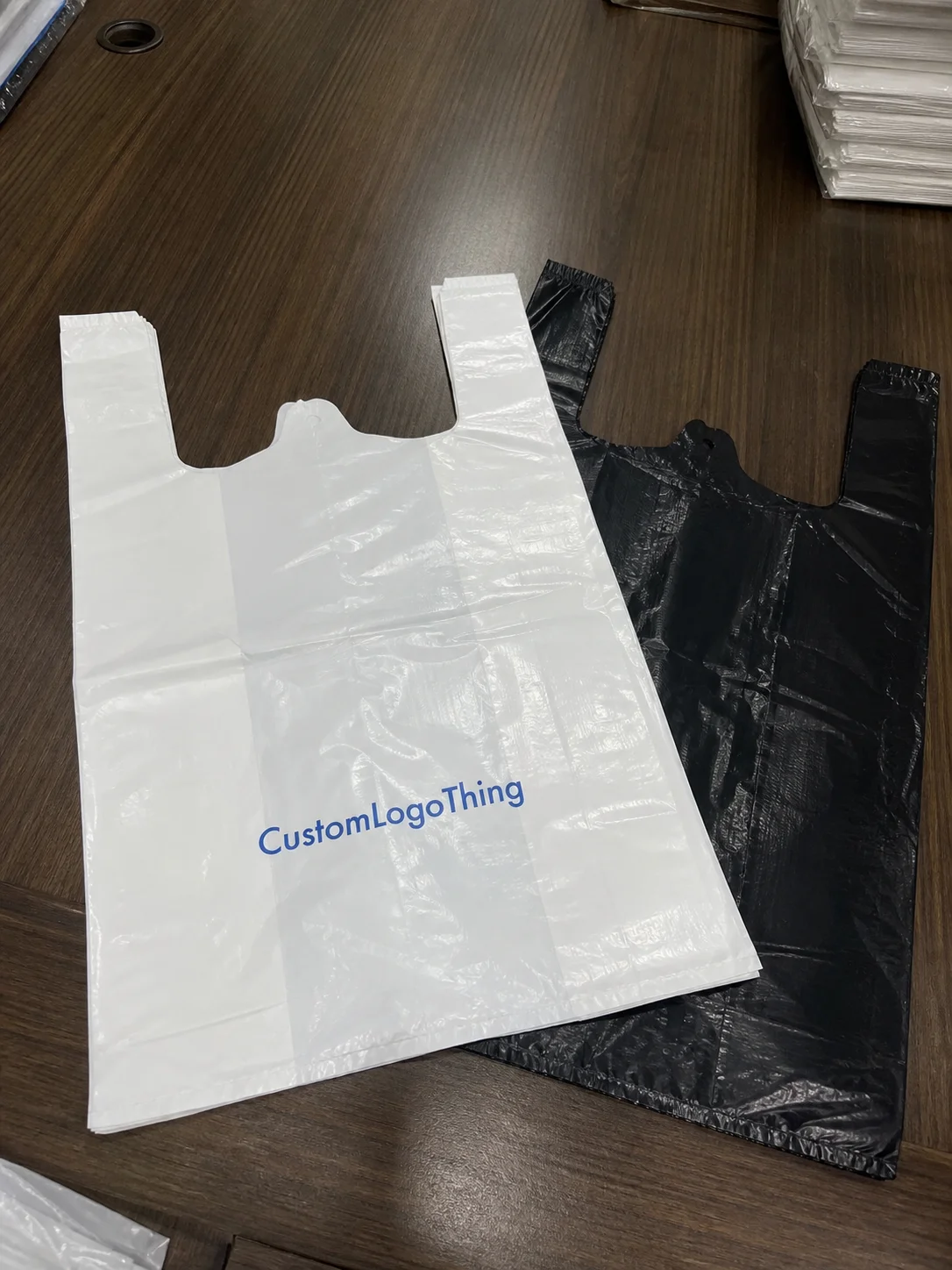
The shape explains part of the appeal. A t-shirt bag uses die-cut handles, side gussets, and a bottom seal that opens quickly when staff need to move fast. That structure has been around for a long time because it is efficient. It is easy to store behind the counter, easy to open, and easy to hand to a customer with one or two items inside.
In practical terms, Custom Printed Plastic t shirt bags are thin carry-out bags printed with a logo, store name, short message, or simple compliance text. Some jobs use a single color. Others add a second color for a cleaner retail look. The goal is not to turn the bag into a poster; the goal is to make the bag useful, dependable, and recognizable at a glance.
They show up in a wide range of settings for the same reason:
- Apparel stores that send out folded garments and accessories
- Convenience counters and foodservice outlets that need fast bagging
- Gift shops and small retailers that want a branded checkout finish
- Pop-up stalls and market booths where light carry-out matters
- Promotions and event programs that need affordable printed packaging
For many buyers, the main reason to keep using this format is cost control. The unit price can stay low, especially at volume, and the print area is large enough for branding without demanding a complicated layout. That makes the bag a practical part of the store’s packaging system rather than an expensive add-on.
A bag that rips before the customer reaches the car has failed twice: once as a carrier and once as brand support.
There is a simple reason restrained artwork often works better than crowded artwork. Thin films stretch, crease, and shift slightly during converting. A clear logo with enough breathing room usually prints cleaner than a busy layout packed with tiny type. If the rest of the packaging line uses custom printed boxes, labels, or tissue, it helps to keep the bag visually aligned with that system so the handoff feels consistent.
For buyers building a fuller retail packaging program, it helps to compare the bag spec against the other pieces in the line. A bag that looks good on its own can still feel out of place if the rest of the brand uses different proportions, colors, or print density. The best results usually come from treating the bag as one part of the whole package, not as a separate purchase.
How the Printing and Bag-Making Process Works
The basic production flow starts with resin selection, usually HDPE or LDPE, then moves into film extrusion. After that, the film is printed, slit, converted into bags, the handles are cut, and the finished bags are stacked or roll-packed depending on the order format. Each step influences the next one, which is why small changes in film or artwork can have a bigger effect than buyers expect.
Flexographic printing is the usual method for this category. The artwork is separated by color, plates are made, and the press transfers ink onto the film before converting. Printing before the bag is formed is standard because it keeps registration under control and avoids placing print too close to the handles or gusset folds.
The design itself matters. Fine lines, small copy, and highly detailed graphics can look soft once they move onto flexible film. Bold marks, solid type, and enough negative space tend to hold up better. That is not a creative limitation so much as a material one. Thin plastic behaves differently from paper or board, and the artwork has to respect that.
Material choice changes the feel and the print result:
- HDPE is crisp, lightweight, and common in grocery-style retail use.
- LDPE is softer and more flexible, with a smoother hand feel.
- Blends can balance strength, stretch, and print appearance when the spec calls for it.
In day-to-day use, HDPE is often selected for light retail loads because it opens quickly and gives a familiar rustling feel. LDPE can make sense when the bag needs a little more give or a less rigid hand feel. Neither one is automatically better. The right choice depends on what goes inside the bag and how the bag will be handled at the counter.
Ink adhesion and registration need real attention. On a thin carrier bag, a poorly tensioned press setup can let artwork wander toward folds or drift near the handle cut. Good converters keep the print centered, maintain consistent tension, and watch the bag edges closely during the run. That sort of control is what separates a tidy job from one that looks rushed once it is stacked.
Resources from packaging.org and ista.org can be useful if the bags are part of a broader packaging or distribution system. The standards there are more relevant when the bags travel with other goods or need to hold up through storage and transport.
Cost, Pricing, and MOQ Factors That Change Your Quote
Pricing usually comes down to a small set of variables: bag size, thickness, resin type, number of print colors, print coverage, and total quantity. Those are the real levers. If a buyer knows them before asking for a quote, the conversation is faster and the estimate is usually more accurate.
MOQ, or minimum order quantity, is where setup costs become visible. Plates, press setup, proofing, and waste all have to be absorbed somewhere. On a small run, those fixed costs make the unit price climb quickly. As volume increases, those same costs spread across more bags and the per-unit cost drops.
As a rough planning range, a simple one-color HDPE bag at 5,000 pieces may land around $0.05-$0.12 per unit before freight, depending on size and thickness. More customized jobs with heavier film, extra colors, or larger print coverage can move into the $0.12-$0.25 range or higher. Smaller quantities often sit above those numbers because the setup work has not changed much even though the order is lighter.
Here is a practical comparison that buyers can use while planning:
| Option | Typical MOQ | Example Unit Price | Best Use | Notes |
|---|---|---|---|---|
| Standard size, one-color print | 5,000-10,000 pcs | $0.05-$0.10 | Retail packaging, convenience counters, simple branded packaging | Lowest setup complexity and usually the easiest option for budget-conscious buyers |
| Custom size, one or two colors | 10,000+ pcs | $0.08-$0.16 | Stores with specific product dimensions or a stronger branding need | More control over fit, but artwork prep and registration need more attention |
| Heavier gauge or more complex print | 10,000-25,000 pcs | $0.12-$0.25+ | Higher-load carry-out, multi-location programs, more deliberate product packaging | More film, more setup, and usually a longer proofing and approval cycle |
Handle style, gusset depth, and packaging format also affect cost. A deeper gusset uses more film. A heavier gauge uses more resin. Roll-packed bags may fit some operations better than stacked bags, but the packing format can change labor time and freight efficiency. Those details often show up only after the first quote, which is why clear specs matter early.
Artwork has its own cost effect. A clean one-color logo with generous whitespace is usually faster to print than a design that uses gradients, tiny type, or multiple color changes. Thin film does not reward extra complexity. If the goal is a sharp retail presentation rather than decoration, simpler artwork usually produces the better result.
The lowest quote is not always the lowest landed cost. If a bag tears, prints poorly, or arrives late, the hidden cost shows up in reorders, staff frustration, and a weaker customer handoff. Buyers comparing custom printed boxes, bags, and other retail packaging should look at the whole job, not only the per-thousand price.
Choosing the Right Spec Sheet for Your Store or Brand
Start with the load. A folded T-shirt and a small accessory do not stress the same film thickness as a boxed candle or a heavier mixed purchase. If the bag is too light, it may stretch around the handle or split at the seam. If it is heavier than needed, the store may be paying for material that does not improve day-to-day use.
For apparel and light retail work, buyers often compare bags in the rough range of 0.5 to 0.9 mil, though the right answer depends on the resin and the construction. That range usually covers the balance between cost and enough strength for typical carry-out use. Heavier retail loads may justify thicker film, especially if customers often combine several items into one bag.
Print visibility is the next choice. A strong logo with a clear contrast color often performs better than a crowded layout. Side-gusset branding can work well if the bag is seen at an angle, but type placed too close to a fold may distort once the bag is converted. A one-color mark is often the safest starting point because it keeps the image clean and the cost under control.
Handling matters too. If the team bags quickly, the handles need to open without sticking and the film should not cling or tear during ordinary use. A bag that hangs up on itself slows the register. A bag that feels loose and thin can seem weaker than it really is. Perception is part of the spec, especially in a customer-facing setting.
Compliance and sustainability depend on the market. Some regions restrict certain bag types, and some buyers want recycled content or a particular disposal path. If recycled content is part of the order, ask for documentation and verify the actual percentage in the film. Do not assume all custom runs use the same resin blend. If you are comparing formats, it can help to review the broader set of custom packaging products so the bag fits the rest of the program instead of standing apart from it.
When a store uses custom printed boxes, labels, tissue, and bags together, the bag should carry the same visual discipline. That does not mean every piece has to match exactly. It means the line should feel intentional. A consistent system tends to look better and is easier to reorder without changing the brand voice every few months.
Production Timeline and Lead Time: What Happens After You Approve Art
After artwork approval, the order usually moves through file checks, plate making, press setup, proofing, printing, curing or drying, converting, inspection, and packing. The sequence is straightforward, but the schedule can slow down quickly if the spec is still moving or the file needs cleanup.
The usual delay points are predictable. Unconfirmed colors, missing dimensions, low-resolution artwork, and last-minute copy edits all create back-and-forth. A buyer who sends a vector file, confirms the size, and approves the proof quickly gives the production side a much cleaner path.
A practical lead time for many standard orders is often 12-15 business days from proof approval. Simpler jobs can move faster. Larger or more specialized orders can take longer. If the film has to be sourced specifically, or if the order waits on custom plates, the schedule can stretch. Rush jobs are sometimes possible, but only when the spec is locked and approvals move without delay.
It helps to think of the job in stages:
- Quote with size, gauge, print count, and quantity clearly defined
- Proof with artwork placement, copy, and color handling confirmed
- Production with printing, converting, and curing completed in sequence
- Inspection for print quality, gauge consistency, and bag count
- Shipment with freight timing added on top of production time
That breakdown matters because shipping is not the same thing as production lead time. An order can leave on time and still arrive late if freight was not planned correctly. Buyers ordering custom printed Plastic T Shirt bags for an opening, event, or seasonal run should count backward from the actual need date, not from the purchase order date.
A small buffer usually pays for itself. One proof correction and one freight delay are common enough to plan for, especially when the bags are tied to a launch or promotion. That margin does not solve every problem, but it keeps the schedule from turning brittle.
Common Mistakes When Ordering Custom Printed Plastic T Shirt Bags
The first mistake is sending artwork that looks fine on a screen but fails on film. Tiny text, thin lines, and low-resolution logos can blur or break once printed on flexible material. A bag is not flat board, and the visual tolerance is tighter than many first-time buyers expect.
The second mistake is sizing the bag for one item and ignoring the rest of the basket. Stores rarely sell only one product all day. A better spec fits the range of merchandise that actually moves through the checkout, including the awkward middle case where the customer has a folded shirt, a small box, and one extra item.
Too many colors can work against the final result. Every added color means more setup, more registration risk, and more room for the print to look busy rather than sharp. Strong branding often comes from contrast, placement, and restraint, not from filling every inch with graphics.
Another common miss is underestimating load. If the handles or seams are not matched to the real weight, the bag may split at the register or on the walk out. That failure is expensive because it is public. Customers remember a bag that breaks. Staff remember it too.
Some buyers focus only on the price per thousand and ignore the full landed cost. Freight, proof changes, lead time, and print quality all belong in the decision. A low number on paper is not useful if the bags arrive late or have to be reordered sooner than planned.
Expert Tips for Better Print Quality, Lower Waste, and Smoother Reorders
If the design needs to read from a distance, use bold shapes, strong type, and enough blank space for the logo to breathe. Thin film does not reward visual clutter. The most effective bags are often the simplest ones because the logo has room to stand out.
Keep a spec sheet that records the approved size, gauge, color count, artwork version, and proof reference. That one document prevents a lot of guesswork on future orders. It also makes reordering easier when the original buyer is not the same person placing the next PO.
Buy ahead of known peaks. Store openings, holiday periods, trade events, and seasonal promotions all create sharp spikes in demand for branded packaging. If the bags show up after the rush, the problem is not only inventory. It is the customer-facing consistency that was supposed to be there during the busiest week.
Ask for a sample or printed proof when color accuracy matters. Translucent films, tinted films, and heavier gauges can all change how ink appears. A small proof cost is easier to absorb than a full run that misses the intended look.
Standardization helps the floor as much as the office. Staff bag faster when the bag opens the same way every time, and customer complaints drop when the handles and seams behave predictably. That is one reason many operators keep the same approved spec for months or years before revising it.
If you manage multiple locations, keep the bag aligned with the rest of the retail packaging set. Bags, labels, cartons, and inserts do not need to match exactly, but they should belong to the same visual system. That kind of consistency usually makes purchasing simpler and the brand easier to recognize.
Next Steps to Order the Right Bag Without Guesswork
Start with three facts: approximate bag size, expected item weight, and preferred print style. Those basics allow a supplier to narrow the spec quickly and avoid quoting the wrong construction. If possible, add the type of merchandise the bag will carry, because that gives a better read on thickness and handle strength than size alone.
Then send clean artwork. A vector file is usually the safest starting point, and brand colors should be identified clearly if color matching matters. If old production samples exist, include those too. They often reveal practical details that a logo file cannot show, especially around print placement and color density.
Ask for a quote that separates unit cost, setup charges, plate charges, and freight. That breakdown makes comparison easier and keeps hidden cost from sneaking into the final number. It also shows whether a lower quote is actually better or only looks that way because one part of the job has been left out.
Before approving, confirm lead time, reproof policy, and what happens if dimensions or artwork need revision. A clean approval process keeps the schedule steady. If the first run performs well, lock that spec for reorders and use it as the baseline moving forward. That is usually the point where the bag stops being an item to source and becomes a reliable part of the store’s packaging routine.
What are custom printed plastic t shirt bags made of?
They are usually made from HDPE or LDPE film, or a blend chosen for strength, flexibility, and print performance. HDPE feels crisper and is common in light retail use, while LDPE is softer and more flexible. The material choice affects tear resistance, bag feel, and how sharply the logo prints.
How much do custom printed plastic t shirt bags cost?
Price depends on size, thickness, print colors, quantity, and how simple or complex the artwork is. Setup and plate costs weigh more heavily on small runs, so the unit price usually falls as the order gets larger. Shipping and special material requests can also change the final total.
What is the typical MOQ for custom printed plastic t shirt bags?
MOQ varies by manufacturer and specification, especially when multiple print colors or special films are involved. Standard sizes with one-color printing often have lower minimums than fully custom sizes. Smaller runs are possible, but the unit cost is usually higher because setup expenses are spread across fewer bags.
How long is the lead time for custom printed plastic t shirt bags?
Lead time usually includes proof approval, plate making, printing, converting, inspection, and shipping. Simple jobs move faster, while more complex artwork, larger orders, and material sourcing can extend the schedule. Final timing depends on how quickly the proof is approved and whether the spec is already locked.
What should I send before requesting a quote for custom printed plastic t shirt bags?
Send the bag size, estimated quantity, logo or artwork file, preferred print colors, and any thickness or handle preferences. If possible, include what the bag must carry so the supplier can recommend the right gauge and size. Clear information up front reduces revisions and usually produces a better quote and timeline.