Buyer Fit Snapshot
| Best fit | Custom PMS Color Matched Boxes Wholesale for Brands projects where brand print, material claims, artwork control, MOQ, and repeat-order consistency need to be specified before quoting. |
|---|---|
| Quote inputs | Share finished size, material target, print colors, finish, packing count, annual reorder estimate, ship-to region, and any compliance wording. |
| Proofing check | Approve dieline scale, logo placement, barcode or warning zones, color tolerance, closure strength, and carton packing before bulk production. |
| Main risk | Vague material claims, crowded artwork, missing packing details, or unclear freight terms can make a low unit price expensive after revisions. |
Fast answer: Custom PMS Color Matched Boxes Wholesale for Brands should be specified like a repeatable production item. The safest quote records material, print method, finish, artwork proof, packing count, and reorder notes in one written spec.
Production checks before approval
Compare the actual filled-product size with the drawing, then confirm tolerance on folds, seals, hang holes, label areas, and retail display edges. Reserve space for logos, QR codes, warning copy, and material claims before decorative graphics fill the panel.
Quote comparison points
Review material grade, print process, finish, sampling route, tooling charges, carton quantity, and freight assumptions side by side. A quote is only useful when the supplier can repeat the same color, closure quality, and packing count on the next order.
For brands shipping through retail shelves, fulfillment centers, subscription kits, and unboxing-heavy ecommerce channels, custom pms color matched boxes wholesale is not a decorative decision; it is a production control decision. A box can look excellent under one lamp, wash out under another, and appear entirely different once the customer looks at it on a phone camera. That is why this spec is tied to revenue, merchandising continuity, and repeatability. If packaging tells part of the product story, then color consistency has to hold from first print to final pallet. I see too many launches where design was right, but the production handoff was loose, and that looseness shows up on shelf.
The strongest teams do not treat color like branding garnish. They treat it like a controlled variable, alongside dimension, finish, and stock. One salmon-pink tone may look elegant in a studio render and still come out warm or flat in a warehouse with different lighting. A deep blue that drifts toward gray can cost a premium line its shelf authority before a single sale is scanned at POS. Custom pms color matched boxes wholesale exists for that exact reason: keeping the brand signal stable after the truck has rolled out, not just on paper before the print run.
Custom PMS Color Matched Boxes Wholesale: Why Color Drift Costs Sales
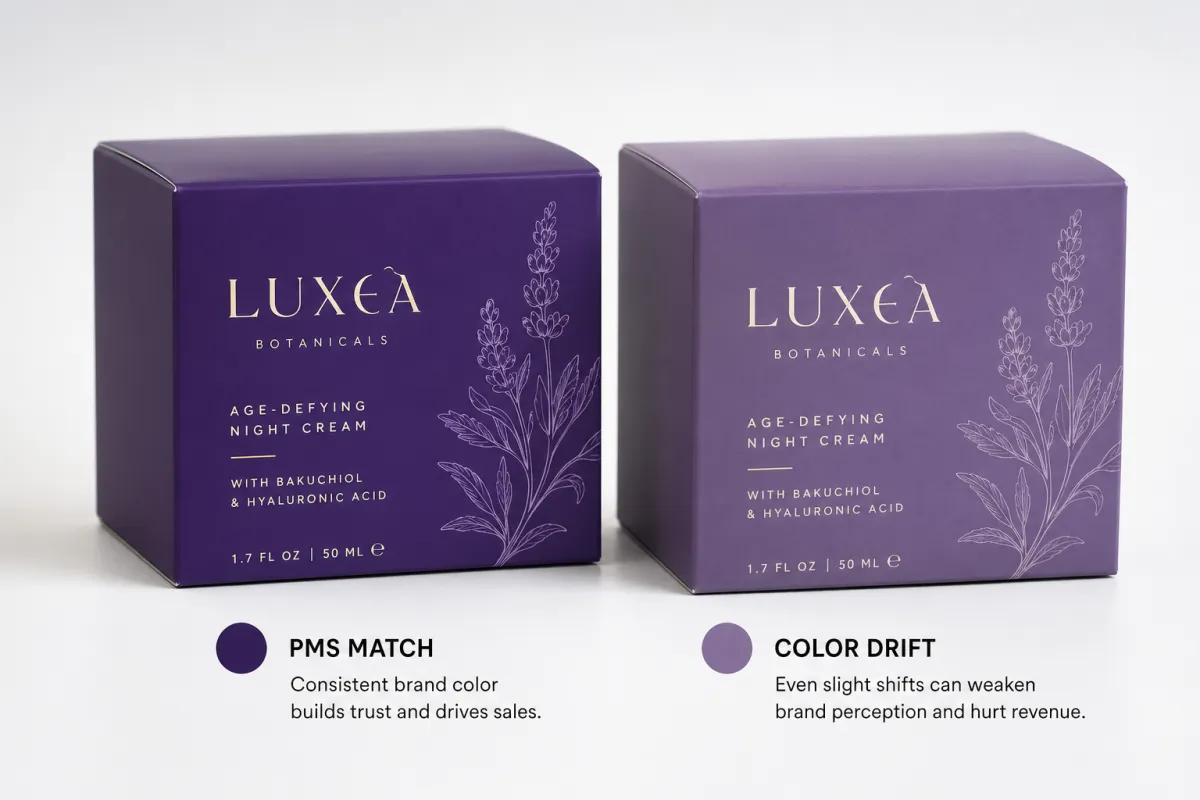
Color drift becomes expensive in the moments after approval. A missed target in print can force reprints, delay launches, or leave stores with mixed inventory that has to be manually reconciled. In wholesale packaging, this can become a silent margin leak: extra freight, extra handling, and extra coordination calls that nobody budgets for up front. The damage is often invisible to finance teams at first because the issue appears only when stock is already partly committed.
I once worked with a skincare brand that had three warehouse locations and one flagship retail partner. Their first run looked good at press, the second run looked off by a shade they could not easily describe, and the rep bought into the explanation that "it was within tolerance." It wasn't just a technical disagreement; it became a practical one when buyers started seeing mixed boxes on the same campaign stack. custom pms color matched boxes wholesale only worked for them once the visual spec was rewritten as a production document instead of a design note.
"A box color is not a decoration choice. It is a production specification. Treat it that way, and the brand keeps saying the same thing with every shipment."
The hidden cost is trust, not just aesthetics. Most customers cannot measure Delta E by name, but they instantly recognize when familiar packaging looks off. Inconsistent color lowers confidence, especially for repeat buyers who associate a product with a known visual signature. Multi-SKU lines suffer too: two tones from one SKU family can make the offer feel disjointed and less premium. PMS discipline protects a hard-won brand memory, and that memory is difficult to rebuild.
- Retail launches need a first lot that matches approved reference, because shelf photos and in-store plans are already committed.
- Subscription boxes need a consistent shade across monthly cycles so the unboxing ritual feels intentional, not accidental.
- Multi-SKU assortments need shared visual language so consumers can identify category relationships quickly.
- Reorders need exact PMS reference, stock, and finish to avoid a split in appearance between run dates.
How Do Custom PMS Color Matched Boxes Wholesale Protect Brand Consistency?
The short answer is still control, but the mechanics matter. Custom pms color matched boxes wholesale protects consistency only when a brand ties color to the same substrate, proof workflow, and finishing profile each time it repeats. A PMS swatch can be nailed, but if the coating, base stock, and press conditions move, appearance shifts. Teams who skip these dependencies usually run into reorders that technically "match" the job ticket and still fail visually.
Think of it like recording music. A note on paper can look exact, but a concert hall makes it sound different. Packaging works the same way: coating changes reflectivity, board texture shifts absorption, and ink density changes with press setup. So the strategy is not "matching one number"; it is matching a repeatable production state.
In real factory flow, repeatability comes from sequence: approved target swatch, clean artwork, stable prepress, proofing checkpoint, and retained master sample archived with production notes. Break one checkpoint and drift gets more likely. Keep all checkpoints and the next run can get close enough to pass quality audit, even months later. That is what custom pms color matched boxes wholesale should guarantee before a team puts a campaign on rails.
What has helped my clients most is a simple shift in language. Instead of asking “Can you match this color?”, they ask “Can this color be reproduced across 4,000 units, two reruns, and one alternate finish?” That change in question turns a design request into a sourcing strategy.
Custom PMS Color Matched Boxes Wholesale: Box Styles and Print Methods
Not every format reads color the same way. Folding cartons, rigid boxes, mailer boxes, sleeves, and related variants can all support custom pms color matched boxes wholesale, but each has a different geometry and ink interaction. Folding cartons often perform well for high-volume product lines because they print cleanly and can hold complex graphics. Rigid boxes can elevate perceived value, but their wrapped papers and board structure often alter tone more than teams expect. Mailer boxes in e-commerce use cases need visual continuity on both exterior and interior touchpoints, which increases the importance of material choice.
Substrate matters as much as artwork. SBS stock is usually a smoother, brighter surface and tends to preserve lighter detail better. Kraft introduces warmth and a natural texture, good for earthy or eco-facing brands, but it can mute saturation. CCNB can be practical for certain budgets, with the tradeoff that the coating and recycled content affect final optical behavior. Corrugated board adds strength and protection but its flute structure can soften small type and low-contrast tones if not managed with print settings. For PMS-matched wholesale packaging, selecting stock first and ink after can prevent a lot of avoidable disputes later.
Print methods have different strengths, and choosing poorly is where people lose color consistency. Offset is reliable for big runs with intricate visuals and fine tonal control. Flexographic works well in corrugated and mailer environments where speed and volume justify setup structure. Digital is useful for short or highly variable runs, especially where SKU count changes fast, though unit cost shifts upward as quantities shrink. So the smartest custom pms color matched boxes wholesale decision starts by ranking priorities: is volume stability, color precision, or delivery speed the true bottleneck? Teams often find they can trade speed for repeatability with cleaner results if they plan early.
Finish changes perception so dramatically it deserves separate review. Gloss can deepen contrast and make color appear richer; matte can soften and de-emphasize intensity. Soft-touch and texture reduce glare but can also alter apparent hue and brightness at first glance. Foil, embossing, debossing, aqueous, and UV coatings all alter light behavior. If anyone says the ink alone controls the look, they are leaving out half the job. Custom pms color matched boxes wholesale should be described as “ink plus substrate plus finish plus process.”
- Folding cartons work well for cosmetics, supplements, and mass-market goods with strong shelf competition.
- Rigid boxes are best for premium gifting, sets, and products with a brand story driven by unboxing value.
- Mailer boxes fit subscription and ecommerce flows that require both strength and recognizable branding at transit speed.
- Sleeves are useful when color continuity across a narrow printing area is more critical than full-surface coverage.
Specifications: How PMS Matching Is Controlled
For custom pms color matched boxes wholesale, the starting point is always a defined target: exact PMS reference, approved artwork, explicit color callouts, and clear production variables. The more concrete the input, the less interpretation pressure on production teams. If a previous sample is available, annotate it with stock code, coating type, ink build, and press conditions. That one step reduces guesswork and lowers revision frequency.
Proofing is where risk gets contained. A digital proof is still useful for typographic placement and preflight checks, but it cannot replace color confidence for all substrates. In most high-stakes packaging programs, teams request at least one physical or press-accurate proof before full approval. It can add lead time, yes, but one controlled proof is cheaper than two pallets of off-color cartons and a rushed rematch. Buyers who treat proofing as optional tend to spend more later.
Here is the industry reality: a PMS number is shared language, not absolute guarantee. Coated versus uncoated stock reflects light differently. Kraft has absorbency that warms darker pigments. Corrugated can dull edges if press pressure and drying profiles are not matched to design density. If the quote says “same PMS,” but stock and finish changed, the statement is incomplete.
A reliable supplier should speak tolerance, not absolutes. Variation exists in print, especially with recycled materials, heavy solids, and long-run drift. Good partners will share acceptance ranges and exactly how those ranges are checked during production. Ask for the method: spectrophotometer checks, hold points, retained sample workflow, and correction path if first sheets move outside tolerance. In custom pms color matched boxes wholesale, this level of conversation is the only way to keep reorders stable.
Special conditions need special planning. Metallic and very dark PMS selections often need modified build curves, white underprint, or specific foil behavior. Large flood surfaces can expose roller marks if press setup is rushed. Premium visuals with high contrast or glossy highlights may reveal tiny imperfections that a less demanding product never would. So teams should assume these are production design variables, not visual “quirks.”
For broader context, the Packaging School resources at Packaging.org provide reliable terminology and process context, while ISTA testing standards help define shipping resilience and handling expectations. A color-perfect box that fails during transit still fails the job, so durability and appearance must be managed together.
- Target reference: one PMS color or documented brand swatch, approved and versioned.
- Material choice: SBS, kraft, CCNB, corrugated, or rigid board selected before art finalization.
- Proof type: digital proof for layout and accuracy, physical or press proof for final color.
- Approval sample: master sample retained under controlled notes and used for reorder benchmarking.
- Finish: matte, gloss, soft-touch, foil, or coating decided before the print order locks.
Pricing and MOQ for Custom PMS Color Matched Boxes Wholesale
Pricing for custom pms color matched boxes wholesale looks complicated, but the drivers are understandable. Box format, stock grade, number of colors, special finishes, size, and quantity all move price. A simple one-color mailer may be straightforward; a rigid format with multiple spot colors and foil is a different cost profile. I often see buyers compare different quotes that are never equivalent because they ignore these production variables.
MOQ follows the same principle. Small batch jobs are possible, especially with digital workflows, but setup and proofing costs are distributed differently. For offset and complex premium formats, lower quantities usually increase risk and unit cost. A disciplined way to evaluate this is to ask for tiered quotes—at least 1,000, 3,000, and 5,000 unit scenarios—even if you do not think you need all three. That reveals the inflection point where the cost curve starts to flatten.
| Box Type | Typical MOQ | Common Unit Range | Best Use |
|---|---|---|---|
| Digital folding carton | 300-1,000 units | $0.85-$1.65 | Short runs, new launches, SKU testing |
| Offset folding carton | 3,000-10,000 units | $0.18-$0.42 | Retail packaging, steady replenishment |
| Mailer box | 500-5,000 units | $0.55-$1.45 | Ecommerce, subscription, shipping kits |
| Rigid box | 500-3,000 units | $1.10-$3.80 | Premium sets, gift packaging, luxury branding |
Those ranges are directional, not promises, because print economics shift by die complexity, color density, sheet utilization, and shipping lane. The practical takeaway is this: lower unit cost is only one variable. If your line is in test mode or branding is being rebalanced, a pricier digital run can still be the better operational move than waiting on the “cheapest” offset lot. This is the pricing paradox in custom pms color matched boxes wholesale: consistency has a value that is not always obvious on the first line of a quote.
Read quote breakdowns with a skeptical eye. Setup, plate charges, die cuts, proofs, freight, and overage terms can each swing total cost by a meaningful margin. A lower base price without transparent supporting fees is often a partial number, not a true landed cost. If you are building a procurement model, include lead-time risk and storage impact alongside unit economics.
One overlooked cost is delay. A color correction can trigger a timeline hit that affects campaign planning, promo windows, and retailer commitments. That timing risk often exceeds the direct reprint cost. In my experience, teams who pay a bit more up front for tighter control and fewer correction cycles usually save in total project stress and cash flow. custom pms color matched boxes wholesale is a total-cost decision, not a line-item decision only.
Process and Timeline: From Approval to Delivery
A straightforward order for custom pms color matched boxes wholesale generally moves through: request a quote, lock specs, deliver artwork, review proof, approve physical color sample, then start production and shipping. It sounds linear, but it works only if each stage is complete and time-boxed. A missing file, late material confirmation, or late finish decision can stall everything behind it, often for reasons nobody can fix in production speed alone.
Timeline is influenced by dieline build, stock lead time, finishing queue, and freight windows as much as by press hours. A simple carton run can move fast; a premium rigid build with custom wrapping can require extra scheduling and may need contingency. What matters most is not pressing faster at the wrong stage, it is deciding earlier at the right stage. Most overruns happen before press-up when assumptions collide.
- Lock the specs: dimensions, substrate, finish, and PMS reference are finalized before quoting.
- Submit clean files: dieline, logo set, bleed settings, and print-ready artwork.
- Review proofing: verify copy, registration, color callouts, and stock behavior.
- Approve production sample: retain one master reference with version notes.
- Coordinate logistics: align freight timing with marketing and replenishment windows.
A practical rule we use repeatedly: tighter input produces faster execution. If the team confirms board, finish, and PMS target before the quote phase, the job usually arrives at production without the churn that creates expensive rework. If those decisions happen after proof, the same project can stall for a week and nobody likes the panic that follows.
In real operations, add a buffer for the non-ideal moments. A few business days can absorb last-minute artwork fixes, stock substitutions, or customs-related freight disruptions. It is less glamorous than hitting every date with zero wiggle room, but it keeps launches from becoming emergency projects. The same goes for custom pms color matched boxes wholesale programs: schedule with margin and less drama.
Why Choose Us for Repeatable Brand Packaging
The biggest reason this category matters is repeatability. One launch cannot be treated as a one-off if your business expects replenishment or global scaling. Custom pms color matched boxes wholesale keeps packaging recognizable even when the print engine, shift, or run week changes. From the brand side, consistency protects visual equity. From operations, it reduces rework. From finance, it protects margin.
High-quality suppliers prove repeatability through process, not promises. Good teams typically run pre-production checks, validate materials on paper, monitor press adjustments, and keep retained samples for controlled reorder use. That makes it possible to compare current runs against historical approval in a meaningful way. Ask pointed questions: who checks the first sheets, what happens when first-pass color misses the target, and how is the correction documented? A supplier with clear answers is often more reliable than one with only polished imagery.
A lot of people underestimate communications quality. These jobs involve procurement, design, and logistics people; each role reads the order differently. If a partner explains tradeoffs plainly, updates status with specifics, and can map visual risk to practical cost, teams move faster and argue less. I have seen organizations save more from better cross-functional communication than from any single technical improvement. That is why mature buyers prefer packaging partners who can talk press and brand with equal confidence.
For teams running across multiple SKUs or channels, the question is not just “Does this one run look right?” It is “Can this same specification be recreated after six months?” That is where a controlled system across Custom Packaging Products and reorder cycles becomes genuinely strategic. If volume and channel complexity are increasing, the Wholesale Programs framework can help compare order tiers and production constraints before commitments lock in.
The best-looking option is not always the most elaborate. I often find a one- or two-color PMS application with the right substrate is more durable and more re-orderable than a complex mix of effects. Less ink can be better if execution is stable. Good packaging is less about “maximum wow” and more about “maximum reliability,” especially for repeat buyers and refill plans.
Next Steps for Custom PMS Color Matched Boxes Wholesale Orders
If you are placing a custom pms color matched boxes wholesale order, start by documenting six essentials: dimensions, target PMS, projected quantity band, substrate, finish, and required delivery date. Those fields remove most ambiguity and create a clean baseline for supplier review. If you already have a reference sample, include it in the same packet with physical observations like sheen, grain, and how the hue feels in hand.
Your files determine how clean your process will feel. Send logo master files, dieline source files, brand guidelines, and approved mockups in one version set. If comparing suppliers, request a split quote format: unit rate, setup, proof, freight, finishing, and any overruns or inspection terms. In custom pms color matched boxes wholesale programs, this is usually where false savings hide.
Before pressing start, ask for a proof plan in writing. A clear plan should specify sample stage, production note capture, tolerance threshold, and sign-off sequence. If this order is tied to launch optics or a refill cadence, that plan is non-negotiable. Once approved, archive the sample with date, board lot, finishing details, and any correction notes so future reorder teams are not guessing.
Before final sign-off, run your own quick control list: final artwork version, PMS reference code, quantity, stock, finish, ship-to details, and delivery cutoff date. It seems picky, but this is exactly the kind of detail that saves teams from reorder surprises. If your goal is the same color experience across cycles, the order should read like a production spec, not a creative mood board. That is the working discipline behind custom pms color matched boxes wholesale.
FAQ: Custom PMS Color Matched Boxes Wholesale
What does custom PMS color matched boxes wholesale mean in production?
In production, it means the final color is managed through a repeatable specification, not just an artistic preference. The buyer specifies a target PMS, and the supplier locks stock, finish, and proofing approach to that target. A code is useful, but the controlled combination of materials and process is what actually determines whether future runs truly match.
Can PMS matched packaging be done on kraft or corrugated board?
Yes, but appearance usually shifts with absorbent, textured substrates. Kraft and corrugated often read warmer or flatter than coated stocks, especially at higher ink coverage. For custom pms color matched boxes wholesale, teams may need white underprint, ink adjustment, or a finish-specific tweak to hold a tight match.
What is the usual MOQ for custom PMS color matched boxes wholesale?
MOQ depends on the process, shape complexity, and setup cost. Digital runs can work lower for quick starts, while offset and rigid builds usually justify higher thresholds. For custom pms color matched boxes wholesale, a better comparison is the quantity where unit cost drops enough to support your re-order frequency.
How long does it take to produce PMS matched wholesale boxes?
Timing depends on proof quality, stock availability, finishing demands, and freight distance. A complete spec usually matters more than press speed. In many custom pms color matched boxes wholesale jobs, production is straightforward once approval is locked; delays often happen earlier in preparation.
How do I make sure reorder color stays consistent?
Keep the same PMS reference, substrate, and coating for each rerun, then retain the approved sample as a master reference. Request supplier-level production notes so the same build conditions can be recreated with minimal drift. In practice, consistency comes from documentation habits as much as from color science.
Is there any risk I should assume even with color-matched specifications?
Yes. Batch variation, substrate substitutions, press condition shifts, and shipping stress can still create visible differences. Trustworthy suppliers should disclose these risks early and show how they monitor them. If someone cannot explain the correction path up front, you are accepting uncertainty you probably did not budget for.
Bottom line: If you document the target, lock the stock and finish, and require one approved master sample per reorder cycle, custom pms color matched boxes wholesale can stay stable across launches, regions, and replenishment waves. That discipline, not a single perfect print, is what keeps a brand looking coherent season after season.

