Custom Printed Garment Bags: Pricing, Materials, and Production Decisions That Matter
Press a suit, dress, or coat perfectly, then place it in the wrong cover and the result changes fast. A thin bag tears at the hanger slot. A short bag bunches at the hem. A sloppy closure lets dust, abrasion, and moisture do what they do best. That is the practical problem custom printed garment bags solve: they protect hanging apparel and carry brand identity across retail pickup, storage, and shipment.
The mistake many buyers make is treating the bag as a simple accessory. It is closer to transport equipment with branding attached. That distinction matters because the cheapest option on paper can become expensive once a returned item has to be re-steamed, repacked, or replaced. Packaging failures rarely show up as a neat line item; they show up as labor, complaints, and damaged presentation.
For apparel brands, dry cleaners, uniform programs, and retailers, the decision usually comes down to three questions: how much protection is needed, how visible should the branding be, and how much handling will the bag survive before it reaches the end user. A bag meant for one counter handoff is not the same spec as a bag moving through a courier network. If the bag is going to do both, the construction has to be more deliberate.
That is why the smartest buying process starts with use case, not graphics. Define the garment first. Then define the trip it has to survive. Only after that should the artwork and finish be fixed. The quote becomes more accurate, and the bag is more likely to work in practice.
A garment bag that looks premium but fails in handling is not premium packaging. It is a presentation problem with a shipping label on it.
Why custom printed garment bags need better protection than you think
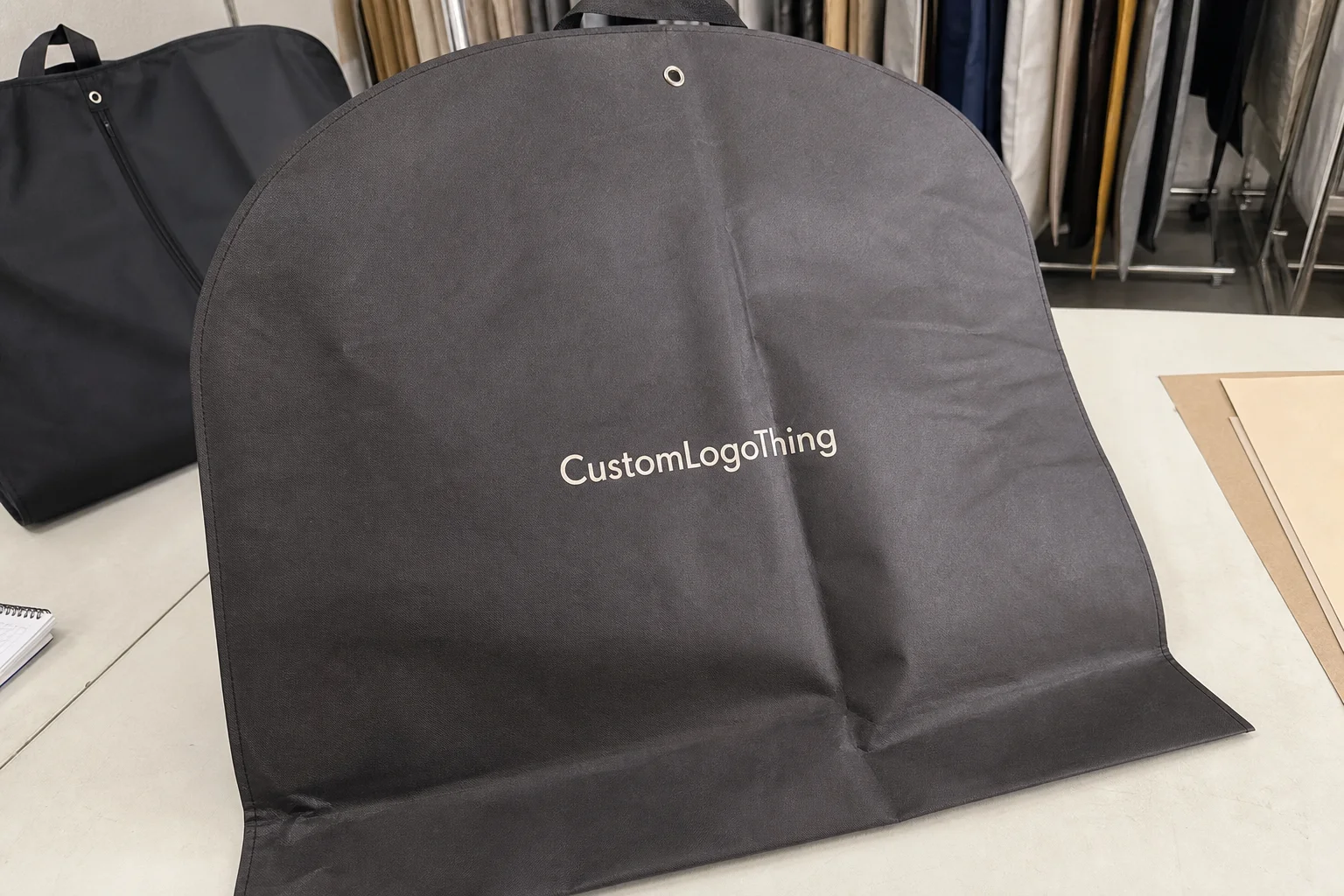
Garments are deceptively vulnerable. A jacket that sits neatly on a rack can arrive with creased shoulders if it shifts in transit. A gown can pick up scuffs from carton edges. Even a short trip can produce dust, snagging, or pressure marks if the cover is too thin or poorly sized. Buyers often assume the garment itself is the fragile item. In practice, the outer bag is what keeps the garment from being handled badly.
Custom printed garment bags do two jobs at once. First, they protect against dust, incidental moisture, and surface abrasion. Second, they make the item easier to identify and more deliberate in presentation. That is the same logic behind branded cartons, tissue, and inserts: the package tells the customer the item was meant to arrive as a finished experience, not a loose object in transit.
This is also where price comparisons can get distorted. A low-cost clear cover might seem adequate until the first batch of complaints arrives. A seam split, zipper failure, or weak hanger hole is not just a material issue. It can create repacking labor, extra freight handling, and return risk. One prevented damage event can pay for a noticeable upgrade in material weight or closure quality across many units.
Buyers should think about five variables early: size, thickness, closure style, print coverage, and order volume. Those levers drive cost more reliably than the logo itself. They also determine how the bag behaves in retail packaging, warehouse handling, or direct-to-consumer shipment. A bag built for showroom use can be lighter and simpler. A bag that ships across a carrier network usually needs more structure and a stronger closure.
Brand visibility is another practical issue. Some programs need the logo to read from several feet away on a retail floor. Others only need the branding to register at close range, where a quieter mark feels more premium. That decision affects ink coverage, contrast, and the amount of open surface left on the bag. More ink is not always better. In shipping contexts, a cleaner surface can actually hold up better to scuffing.
The best products in this category do not try to be decorative first. They solve a handling problem and still leave room for brand recognition. That order of priorities is what keeps the quote honest and the finished product useful.
How the bag construction and printing actually work
On the surface, a garment bag looks simple. The construction details tell a different story. The body may be made from polyethylene film, nonwoven fabric, or a coated substrate. The top usually has a hanger opening. The front may close with a zipper, flap, or fold-over panel. Some versions are flat. Others add a gusset so bulky garments can hang without being compressed at the sides. Handles, vents, and reinforced hems are optional, but each one changes the user experience.
Printing depends on the material. Film, nonwoven fabric, and coated materials do not take ink the same way. A logo that looks crisp on one substrate can blur or dull on another. Fine type, small marks, and thin lines demand better contrast than many buyers expect. If the bag surface is textured or slightly translucent, a white underlay or a simplified artwork version may be necessary to keep the print legible.
The most common decoration methods are flexographic printing, screen printing, and digital output. Flexo is often the practical choice for higher-volume film work because setup costs are spread across many units. Screen printing can deliver strong color on thicker materials and is often suitable for bold one- or two-color branding. Digital output helps with shorter runs or designs that change often, but large solid areas can become expensive quickly.
Printing is only part of the decision. The bag has to be built so the print survives normal handling. A logo placed on a high-rub area may look fine on approval but wear faster in stores or warehouses. Placement matters as much as color. Upper-panel branding is often safer than a large centered mark for bags that are repeatedly stacked, folded, or carried.
For buyers comparing packaging categories, the lesson is familiar. A layout that works on custom printed boxes does not automatically translate to soft goods. Soft substrates flex, stretch, and wrinkle. That changes registration tolerance, ink behavior, and how the brand appears under warehouse lighting or in a retail pickup area.
Sustainability discussions should be handled with the same specificity. If the overall program includes paper tags, inserts, or outer cartons, FSC-certified paper can be part of the broader packaging plan. For shipping performance, the more useful reference is ISTA-style testing rather than a hand-feel test. A bag that feels good in a sample box may still fail after compression, vibration, or repeated handling.
Material weight, closure style, and size choices that matter
Material weight influences almost everything: tear resistance, drape, opacity, appearance, and how the bag behaves after repeated use. A lighter film can be fine for short-term retail pickup or back-of-house storage. A heavier gauge becomes more appropriate when the bag is being moved often, stacked with other items, or reused by customers. The same is true for nonwoven bags, where gsm rating is a practical proxy for durability and body.
Opacity is worth checking separately. A bag can be thick enough to resist tears and still be too translucent for premium presentation. That may not matter for internal use, but it does matter if the customer can see labels, folds, or hanger hardware through the material. In some apparel categories, that defeats the purpose of branded packaging entirely.
Size is where many orders go wrong. Too short, and the hem bunches or drags. Too narrow, and the garment compresses. Too long, and material is wasted while shipping efficiency drops. The correct spec usually starts with the longest hanging item, then adds room for hanger height, shoulder volume, and garment drape. Coats, gowns, and layered outfits often need extra width or a gusseted build so the sides do not pinch the fabric.
Closure style is just as important. Zippers generally provide the most secure closure for apparel that will travel or be handled often. Fold-over flaps are simpler and can work well for storage or pickup. Drawstring tops are less common, but they can suit some lighter garments or lower-cost programs. Reinforced hems and sealed bottoms add durability where repeated use is expected. If the closure feels weak, the whole protection claim weakens with it.
Finish also shapes perception. Gloss can make logos stand out. Matte can feel more restrained and premium. Soft-touch surfaces can improve the tactile impression, but they need to be evaluated carefully because some finishes show scuffs faster than buyers expect. If the artwork includes fine details, contrast becomes critical. A beautiful logo that disappears against the substrate is not good branding; it is an approval mistake.
In a warehouse or fulfillment setting, speed matters. Staff need bags that open quickly, hang cleanly, and do not snag. A complicated closure can slow packing enough to matter at scale. That is why the right spec is usually the one that balances protection, handling speed, and appearance rather than the one with the flashiest feature list.
The difference between a passable bag and a good one is often small in cost and large in execution. A slightly heavier film, a better zipper track, or a better-sized gusset can keep the item looking right all the way through to the customer.
Pricing, MOQ, and what actually drives unit cost
The unit price for custom printed garment bags is driven by size, material, thickness, print colors, finish, and quantity. Printing affects cost, but it is only one lever. A larger bag with reinforced seams and two-sided branding will cost more than a smaller one-color cover, even if both carry the same logo.
Minimum order quantity changes the math quickly. Setup work, proofs, plates, and prepress costs are distributed over fewer units on small runs. As volume rises, those fixed costs become easier to absorb. That is why a 500-unit order can look expensive per bag while a 5,000-unit run drops sharply in unit price.
Indicative pricing for standard one-color work at a 5,000-unit level usually falls into these bands:
| Option | Typical Material | Typical Use | Indicative Unit Price |
|---|---|---|---|
| Basic clear cover | Lightweight PE film | Short-term retail pickup | $0.18-$0.28 |
| Printed film bag | Heavier PE film, one-color print | Retail branding and shipment | $0.24-$0.40 |
| Nonwoven garment bag | 80-120 gsm nonwoven | Reusable retail or storage | $0.45-$0.85 |
| Premium branded bag | Heavier nonwoven or coated material | Luxury apparel and repeated use | $0.75-$1.40 |
Those figures move with artwork complexity, material availability, and region. Two-sided print costs more than one-sided print. Standard dimensions cost less than custom dimensions. A reinforced top with a better zipper costs more than a basic hanger opening. Rush production can push the price up even if the design stays unchanged. A quote that comes in far below the rest is often missing something important: thickness, coverage, closure quality, or packing labor.
That is why every supplier should be quoted against the same spec sheet. If one vendor prices a 90 gsm bag and another prices 120 gsm, the comparison is not meaningful. The same problem appears if one quote assumes a single-color print while another includes a second side or a white underlay. Procurement only works if the inputs are aligned.
For teams comparing adjacent packaging formats, it can help to benchmark the bag against other retail packaging options. Sometimes a better outer carton or a different presentation method creates more value than forcing the garment bag to do every job at once.
Production steps and timeline for a smooth order
Clean orders follow a predictable sequence: request specs, submit artwork, review a proof, approve a sample if needed, produce, inspect, pack, and ship. Each stage has a failure mode. The most common one is late change. A buyer adjusts size or print details after proofing has already started, and the schedule slips immediately.
Artwork quality is another recurring delay. Low-resolution logos, missing bleed, unconverted spot colors, and vague file naming all slow down prepress. If the printer has to fix the file, that adds time. If the buyer needs multiple revision rounds, the timeline stretches again. A clean vector file and a confirmed color target save more time than most teams expect.
A realistic timeline usually breaks into three pieces. Proofing and artwork sign-off may take a few days if the files are clean. Sampling can take longer if the bag is custom sized or uses a special closure. Production often runs from one to three weeks depending on volume, substrate, and print complexity. Transit adds its own time, which may be minor for domestic freight and meaningful for international shipments.
Simple one-color jobs on standard materials move faster. Complex printing, special finishes, and high-volume orders move slower. That pattern holds across most branded packaging work. There is no mystery there; more steps mean more setup, more checks, and more opportunities for correction.
If the bags will move through distribution, ask whether the design should be tested against an ISTA packaging test profile. That matters more for shipping programs than for static retail display. A tabletop sample will not reveal what compression, vibration, or repeated handling will do to a weak seam or a loose closure.
Before requesting quotes, prepare these items:
- Final dimensions for the longest garment
- Quantity by SKU or size
- Material preference and target thickness or gsm
- Closure type
- Print colors and logo files
- Target delivery date and destination
That list looks basic because it is basic. It also prevents the most avoidable delays. More importantly, it forces the supplier to price the right configuration the first time.
Common ordering mistakes that cause reprints or damage
The first mistake is sizing the bag to the garment label instead of the actual garment. A 40-inch suit bag may sound correct until hanger height, shoulder volume, or a longer hem is added. Coats and gowns expose that error fast. The result is bunching at the bottom or stress at the top seam.
The second mistake is treating artwork as an afterthought. Raster logos, weak contrast, missing bleed, and unconverted colors can turn a clean mark into a muddy print. If the logo is part of the packaging system, that failure is visible the moment the bag hits a rack or is handed to a customer.
The third mistake is ignoring closure quality. A weak zipper, loose flap, or flimsy seal can undermine the whole product. Buyers often spend time on logo size and almost none on the closing mechanism, which is the wrong order. The closure is what keeps the garment protected after handling begins.
The fourth mistake is under-specifying durability. A bag that is fine for one-time pickup may fail if it is reused, stacked, or shipped with other items. Tears, abrasion, and moisture exposure usually cost more to fix than the price increase for a stronger material. This is especially true in retail programs where the same bag may be handled multiple times before it reaches the customer.
The fifth mistake is approving a proof too quickly. Check the dimensions, print placement, hanger opening, and pack-out method against the actual garment. If the bag is part of a larger mix of custom packaging products, make sure the system still works as a whole. A nice proof can still be wrong on the floor.
One more caution: if a supplier cannot explain how the bags will be nested, boxed, or palletized, that is a warning sign. Production does not end when the print run finishes. The packing method affects damage risk, warehouse efficiency, and freight cost.
Expert tips for specifying a better bag and next steps
Build a one-page spec sheet before asking for quotes. Keep it direct: size, material, closure, print colors, quantity, and delivery target. That gives every supplier the same brief and makes price comparisons meaningful. It also reduces the chance of hidden assumptions creeping into the order.
If the bag will carry premium apparel, request a sample or a short run. Photos do not reveal enough about opacity, feel, zipper quality, or how the surface behaves after handling. Buyers who skip sampling sometimes save a little time and then lose more time correcting a design that looked fine on screen but felt wrong in hand.
Start with the use case, not the artwork. A bag meant for showroom pickup may justify a softer surface and more visible branding. A bag meant for shipping may need stronger seams, more puncture resistance, and a simpler print layout. That is the same logic that separates retail packaging from transit packaging in other categories.
Compare suppliers on proof quality, response time, and consistency, not just on unit price. A vendor that catches a sizing issue early is often worth more than one that simply sends the lowest quote. Good communication is part of the product. So is the ability to explain tolerances, packing method, and expected failure points without hand-waving.
For teams handling multiple apparel programs, the most useful next step is to align the garment bag with the rest of the packaging system, including outer cartons, inserts, and retail touchpoints. That is where the experience starts to feel coherent instead of assembled piece by piece. The bag should fit the operation, not force the operation to adapt around the bag.
Seen that way, custom printed garment bags are not a disposable add-on. They are part protection system, part branding surface, and part operations decision. If those three pieces are aligned, the garment travels better, the quote becomes easier to defend, and the customer sees a cleaner finish.
FAQ
What sizes work best for custom printed garment bags?
Match the bag length to the longest hanging item, then add room for hanger height and garment drape so the hem does not bunch. If the bag will hold coats, gowns, or layered outfits, choose a wider cut or gusseted design so the sides do not compress the fabric.
How much do custom printed garment bags usually cost?
Price depends on material thickness, bag size, print coverage, closure style, and order volume, so the same concept can quote very differently across vendors. Small runs carry higher unit cost because setup and proofing are spread across fewer pieces, while larger runs usually lower the per-bag price.
How long does production usually take for custom garment bags?
Standard jobs often move faster than complex orders, but the timeline depends on artwork approval, sampling, material availability, and print method. Rush requests are possible in some cases, but they usually come with a trade-off in cost or flexibility.
Are printed garment bags better than plain ones for retail use?
Printed bags usually create a stronger brand impression at pickup, in storage, and during transit, especially for premium apparel. Plain bags can still work for back-of-house protection, but they do less to reinforce brand recognition or presentation.
What should I send when requesting a quote for custom printed garment bags?
Send final dimensions, quantity, material preference, closure type, print colors, logo files, and your target delivery date. If possible, include a sample image or an existing packaging reference so the supplier can quote the right construction the first time.


