Custom Logo Things
Custom Printed Mailing Labels: How to Buy the Right Fit Fast
For apparel shipping, custom printed mailing labels are judged less by the proof and more by how they behave on the actual package. A label that looks clean in an approval file can still peel from a soft poly mailer, smear in humidity, or lift when a carton sees heat, pressure, and rough handling in transit.
The practical order is simple: match the label to the surface first, then finalize the artwork. Buyers who get that sequence right avoid reprints, scan issues, and labels that fail after the shipment leaves the warehouse.
Why the right label matters for apparel shipping
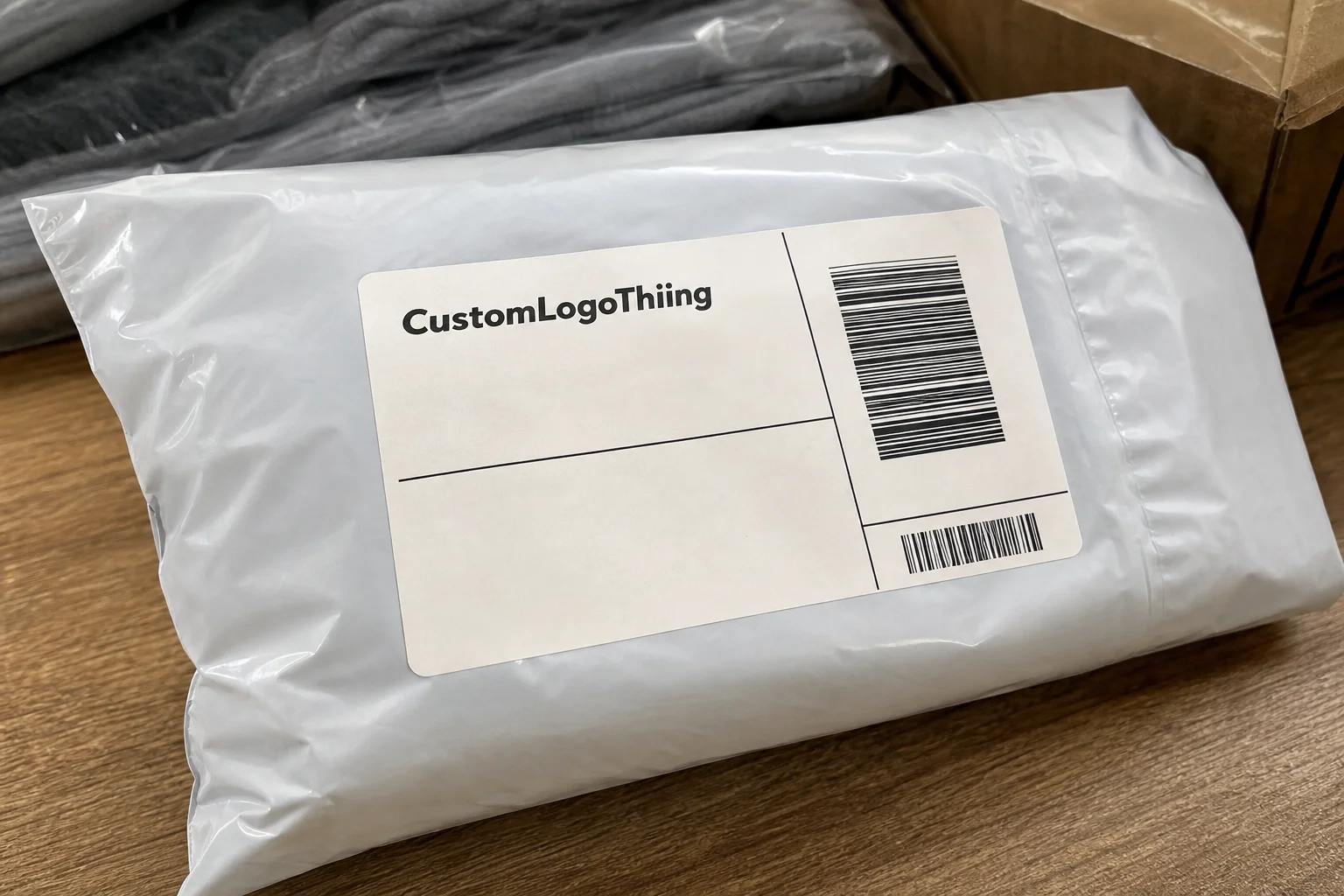
Most label failures start with the substrate, not the artwork. A label that looks fine on screen can still fail on a recycled sleeve, a textured mailer, or a carton that sees condensation during transit. For apparel brands and fulfillment teams, the real question is whether the label survives the package environment, not whether the mockup looks polished.
That matters because the label is usually the first printed touchpoint a customer sees during delivery. If it curls, stains, or scans poorly, it creates extra work for operations and a weaker first impression for the brand. In branded packaging, that is a functional problem as much as a visual one.
Custom printed mailing labels can carry a return address, logo, barcode, handling note, or a fully branded shipping frame. They are useful when you want cleaner presentation than stock labels and more control over how the shipping kit looks alongside Custom Labels & Tags, mailers, and cartons.
A label can pass design review and still fail in transit. If the adhesive and stock do not match the package surface, print quality will not save it.
Experienced buyers focus on a few concrete questions: Does it stay flat on a poly bag? Does it resist humidity? Does the barcode stay readable after handling and stacking? Those questions are more useful than asking only how the label looks in the proof.
Production process and timeline: from proof to shipment
The production flow is straightforward, but each step has a failure point. A standard order moves from artwork intake to spec confirmation, proofing, print production, finishing, quality control, and packing. If one piece is unclear, the job usually slows down later.
The biggest delay is often missing information. Low-resolution artwork, no dieline, unclear size, undecided finish, and late edits after proof approval are the most common reasons schedules slip. A simple layout with clear size, color count, and barcode requirements can move quickly. A custom shape, specialty adhesive, or variable-data run needs more lead time because there is more to verify before production starts.
For standard custom printed mailing labels, a realistic turnaround is often 7 to 12 business days after proof approval. Simpler jobs can finish sooner, while specialty orders or variable-data runs may need 10 to 15 business days. Rush service helps only if the spec is already complete.
A practical approval sequence looks like this:
- Artwork is checked for resolution, bleed, and size.
- Stock, adhesive, finish, and quantity are confirmed.
- A digital proof is sent for approval.
- Production starts after sign-off.
- Quality control checks print, cut, and adhesion details.
- The order ships with tracking details.
If the label is part of a broader branded kit, align it early with Custom Packaging Products or Custom Poly Mailers. That prevents a good-looking label from clashing with the rest of the shipping system.
Production also has practical limits. Metallic inks, heavy coverage, specialty laminates, and fine detail near cut edges can increase setup time or waste. Variable-data labels need extra proofing because one typo can affect an entire batch. These are manageable issues, but they should be built into the timeline up front.
Materials, adhesives, and finishes that affect performance
Material choice affects performance more than most buyers expect. Paper labels are cost-effective and work well on smooth cartons, but they are less forgiving when packages rub against other parcels or pick up moisture. Synthetic labels, usually polypropylene or polyester, hold up better against abrasion and humidity. Thermal options are useful for high-speed shipping lines, though the print method and desired lifespan have to match the job.
Adhesive is the hidden variable. For apparel mailers and cartons, a permanent adhesive is usually the default because it stays in place during handling. Stronger bonding formulas make sense on cold surfaces, in humid docks, or on recycled packaging with more texture. Removable adhesive is useful for temporary branding or returns, but it gives up holding power.
Finish affects both appearance and scan performance. Matte finishes reduce glare and tend to read well under scanners. Gloss can create a more polished presentation, but it may reflect light in warehouses or make contrast harder to read at some angles. If the label will be touched repeatedly, a smudge-resistant coating is worth considering.
Practical details that should be confirmed before quote approval:
- Temperature range during storage and transit.
- Whether the package surface is coated, recycled, or textured.
- How often the label will be handled before delivery.
- Whether the barcode must stay legible after scuffing.
- Any freezer, cold-chain, or humidity exposure.
For teams that care about sustainability, paper selection can matter. FSC-certified paper supports chain-of-custody expectations, and the FSC site explains the certification framework. If shipping durability testing is the concern, the ISTA methods are a useful reference for handling and distribution hazards. Neither standard chooses the label for you, but both help keep the spec discussion grounded.
In practice, most apparel brands do not need the most expensive stock. They need the label that stays flat, scans cleanly, and looks consistent with the rest of the package branding.
Custom printed mailing labels cost, pricing, and MOQ
Pricing is driven by a few inputs: size, stock, adhesive, finish, print method, quantity, and whether the artwork requires setup or version changes. Buyers often compare unit price first, but the total spend depends on the entire spec. A slightly higher-cost label can still be the better buy if it prevents reprints or packaging failures.
As volume increases, unit cost usually drops. That is normal. The tradeoff is that total spend rises with a larger minimum order quantity, so the buyer has to balance savings against storage, campaign changes, and the risk of holding obsolete stock. For seasonal launches or test runs, a lower MOQ often matters more than the lowest possible unit price.
For rough planning, simple paper labels at 5,000 pieces might land around $0.04 to $0.10 per unit, while synthetic stocks, specialty adhesives, or heavier print coverage can move that into the $0.08 to $0.18 range. Smaller runs usually cost more per label because setup is spread across fewer pieces. If a quote looks much lower, check what is excluded.
| Option | Typical use | Approx. unit cost at 5,000 pieces | Performance notes |
|---|---|---|---|
| Paper with permanent adhesive | Standard cartons, dry storage, basic branding | $0.04-$0.10 | Good value, less resistant to moisture and scuffing |
| Synthetic with permanent adhesive | Poly mailers, humid environments, repeated handling | $0.08-$0.18 | Better durability and shape stability |
| Removable adhesive label | Returns, temporary promotions, short-term branding | $0.07-$0.16 | Cleaner removal, weaker long-term hold |
| Thermal shipping label | High-volume fulfillment, fast line speed | $0.03-$0.08 | Efficient for shipping, limited aesthetic flexibility |
To compare quotes fairly, ask whether proofs, setup fees, shipping, and reorder support are included. A lower headline price can be misleading if the supplier charges for every revision or cannot match the approved spec later. The safest budgeting rule is to choose the label that performs on the package surface first, then optimize quantity once the spec is proven.
MOQ deserves attention because it changes both unit price and inventory risk. A lower MOQ helps a brand test new packaging without tying up cash, but a very small run may limit material choices and raise cost per piece. Larger orders lower unit price, but they also increase the chance of holding labels that no longer match a redesigned mailer or seasonal graphic update.
Step-by-step ordering checklist for better results
Start with the package, not the artwork. If the label will go on a poly mailer, recycled sleeve, or textured carton, that surface determines the adhesive and often the finish. A clean design printed on the wrong stock is still the wrong label.
Before requesting a quote, prepare these details:
- Label size and shape.
- Stock type and finish.
- Adhesive type and expected surface.
- Print colors and coverage.
- Quantity and reorder target.
- Barcode, QR code, or variable-data requirements.
- Any storage or transit constraints.
For apparel mailers, request a physical sample or a press proof if the label will sit on textured packaging. A digital proof can confirm layout, but it cannot reproduce tack, sheen, or the way a label curls under stress. If brand, operations, and fulfillment review the same spec sheet, approval is faster and the number of surprises drops.
Keep one version-controlled spec sheet for every approved run. Include the exact stock, adhesive, size, finish, and artwork file name, plus reorder notes so future buys do not drift. That matters for custom printed boxes and apparel inserts where consistency is part of the brand experience.
If you use custom printed mailing labels alongside branded mailers, sleeve wraps, or carton graphics, align the specs together. Otherwise the shipping kit can feel like it came from three different vendors even when it did not.
A practical ordering sequence is: confirm the package surface, choose the adhesive, narrow the stock, review a digital proof, request a sample if the order is high-risk, then approve production only after the spec matches the packing line. That order prevents most of the problems that show up later.
Common mistakes that cause peeling, smudging, or delays
The first mistake is choosing adhesive by habit. A label that works on corrugated cardboard may fail on a slick poly mailer or a recycled sleeve with more texture. Another common error is assuming all permanent adhesives behave the same. They do not. Temperature, application pressure, and substrate all change the result.
Artwork problems create a different kind of failure. Low-resolution files, thin barcode contrast, and cramped layouts can make labels hard to scan or hard to read. That tends to show up at the worst time, when orders are already packed and reprinting is expensive.
Design can also go too far. Heavy graphics, too many fonts, and dense copy can make a shipping label look branded but function poorly. The best decisions are often the quiet ones: enough white space for scanning, enough contrast for readability, and enough brand treatment to feel intentional.
Delays usually trace back to process, not capacity. Missed approvals, last-minute quantity changes, and late artwork swaps push a job out of its original queue. Once production starts, changes become expensive. If a batch fails, inspect storage conditions, application pressure, and the package surface before assuming the printer made the mistake.
Common failure signs include:
- Labels lifting at corners after the first day.
- Smudging when the package is rubbed or stacked.
- Barcodes that scan inconsistently.
- Gloss glare that hides key information.
- Peeling on recycled or textured packaging.
The best way to avoid these problems is to treat the label as a functional part of product packaging, not just a sticker. That shifts the quote conversation from appearance alone to behavior under heat, stacking pressure, and handling.
Next steps: sample, test, and lock the spec
Order a sample or a short test run on the exact apparel packaging the labels will touch. Test adhesion after packing, not just on a bench. Check whether the label stays flat on a poly mailer, whether the barcode scans without hesitation, and whether the finish holds up after handling. That is where the real performance shows up.
Then lock the spec in one place. A good internal record should include the approved size, stock, adhesive, finish, print file, and reorder threshold. That makes future purchasing faster and keeps the label consistent across campaigns. It also helps finance and operations compare landed cost, not just quoted price, because freight, rush fees, and waste from failed tests matter.
If the label is part of a broader packaging system, compare it with the rest of the shipper set. Custom Labels & Tags, Custom Poly Mailers, and the rest of your Custom Packaging Products should feel like one system rather than separate purchases made at different times.
What should I include in a custom mailing label spec sheet?
List size, shape, stock, adhesive, finish, print colors, quantity, and any barcode or variable-data needs. Add the package surface the label will stick to, because that determines whether the adhesive will hold. Include proofing contacts and reorder instructions so future jobs match the approved version.
Are printed mailing labels better than handwriting labels for apparel shipping?
Yes, if you need consistent branding, faster packing, and cleaner scan performance. Printed labels reduce readability issues and make a small brand look more established at the unboxing stage. They also cut rework, since handwritten labels are more likely to be damaged, smudged, or misread.
Which adhesive works best for clothing mailers and poly bags?
A permanent adhesive is usually the safest starting point for most apparel mailers and boxes. If the package surface is textured, recycled, cold, or humid, test adhesion on the exact material first. For temporary use or returns, ask about removable options, but expect weaker long-term bonding.
How long do custom printed mailing labels usually take to produce?
Timing depends on proof approval, quantity, and whether the job uses standard or specialty materials. Simple orders move faster; custom sizes, special finishes, or variable data add setup time. The fastest way to avoid delays is to send complete artwork and approve proofs promptly.
How can I lower unit cost without hurting label quality?
Keep the spec simple: standard size, standard stock, and a finish that matches the package surface. Order enough volume to reduce unit pricing, but avoid overbuying labels that may change with a new campaign. Compare quotes on the full landed cost, not just the per-label number.
Do I need a sample before placing a larger order?
If the label will go on a textured mailer, recycled carton, or a package that faces humidity or abrasion, yes. A sample or short run is often cheaper than correcting a bad adhesive choice after thousands of pieces are printed. For smooth cartons in a controlled environment, a strong proof process may be enough, but a physical test still removes a lot of guesswork.