Buyer Fit Snapshot
| Best fit | Custom Recyclable Candle Boxes for Safer, Greener Shipping projects where brand print, material claims, artwork control, MOQ, and repeat-order consistency need to be specified before quoting. |
|---|---|
| Quote inputs | Share finished size, material target, print colors, finish, packing count, annual reorder estimate, ship-to region, and any compliance wording. |
| Proofing check | Approve dieline scale, logo placement, barcode or warning zones, color tolerance, closure strength, and carton packing before bulk production. |
| Main risk | Vague material claims, crowded artwork, missing packing details, or unclear freight terms can make a low unit price expensive after revisions. |
Fast answer: Custom Recyclable Candle Boxes for Safer, Greener Shipping should be specified like a repeatable production item. The safest quote records material, print method, finish, artwork proof, packing count, and reorder notes in one written spec.
Production checks before approval
Compare the actual filled-product size with the drawing, then confirm tolerance on folds, seals, hang holes, label areas, and retail display edges. Reserve space for logos, QR codes, warning copy, and material claims before decorative graphics fill the panel.
Quote comparison points
Review material grade, print process, finish, sampling route, tooling charges, carton quantity, and freight assumptions side by side. A quote is only useful when the supplier can repeat the same color, closure quality, and packing count on the next order.
Custom Recyclable Candle Boxes for Safer, Greener Shipping
Custom recyclable candle boxes do a lot more than make a candle look polished on a shelf or inside a mailer. They hold fragile glass steady, reduce scuffing during transit, and help a brand tell a cleaner materials story without sounding vague or overblown. They also cut down on the hidden losses that eat into margin: cracked jars, dented lids, crushed corners, and returns that start with a box that was just a little too loose for the job.
That is why I usually talk about custom recyclable candle boxes as a packaging decision first and a branding decision second. A candle can look elegant in a render and still fail in a warehouse if the structure is wrong. The package has to manage weight, movement, and presentation at the same time, and that balance is where good packaging stops being decorative and starts doing real work.
Over the years, I have seen more breakage blamed on glass than on the carton around it, and that has always felt a bit backwards. A lot of the trouble starts with sizing, not with the candle itself. If the vessel is restrained properly, the outer box does not have to fight as hard to protect it. That is the real value of custom recyclable candle boxes: they set up the product to travel safely and still arrive looking like it belongs on a retail shelf.
What Custom Recyclable Candle Boxes Are and Why They Matter
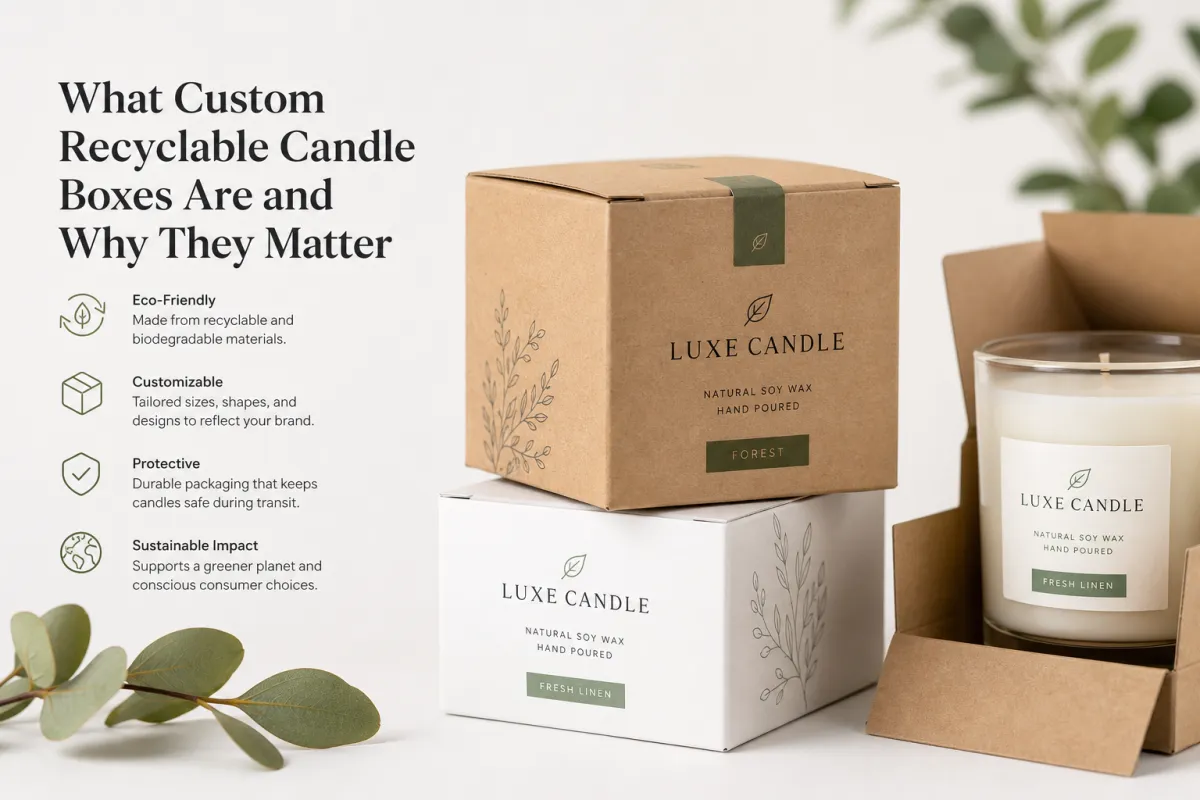
Custom recyclable candle boxes are fiber-based packaging structures built for a specific candle vessel, insert, and unboxing style. That usually means paperboard, corrugated board, or another recyclable paper-based format sized around the candle instead of forcing the candle into a generic carton. The difference sounds small, but it changes everything from fill speed to shipping performance to how the finished package feels in a customer’s hands.
A box built around the candle tends to use less void space, less filler, and less improvisation at packout. That is good for the warehouse and good for the customer. It also makes the packaging look more deliberate. A box that fits properly reads as planned, while a box stuffed with crinkle paper and hope reads as temporary. One feels like product packaging. The other feels like a workaround.
Think about what happens to a glass jar in parcel delivery. It gets vibration, drops, compression, and shifting pressure from neighboring packages. If the carton is oversized, the jar can move enough to strike the insert or the inner wall. If the insert is too soft, the first impact gets transferred right into the lid or shoulder. I have opened enough samples on a packing table to know that a few millimeters matter a lot more than most people expect.
Recyclable usually means the package is mostly fiber-based and does not rely on material layers that make recovery difficult. Paperboard cartons, corrugated mailers, and molded fiber inserts are common examples. Water-based inks, aqueous coatings, and low-tack adhesives often fit that goal well. Recyclable does not automatically mean compostable, plastic-free, or accepted everywhere in exactly the same way, and it is better to say that plainly than to make a claim that turns fuzzy the second a customer checks local rules.
That kind of honesty builds trust. Customers notice when a brand is careful with its language. They also notice when a package claims to be sustainable but hides a mixed-material build under a glossy finish. Custom recyclable candle boxes work best when the material story is simple enough to understand and solid enough to stand up to use.
From a business perspective, the biggest gains usually show up in four areas: fewer returns, cleaner presentation, lower packing waste, and a shipping footprint that is easier to control. If the box is sized well, the candle feels secure, the carton stacks better, and the team spends less time making up for a poor fit with extra tape or extra dunnage. That is not flashy, but it is the kind of discipline that keeps a packaging program healthy.
How Custom Recyclable Candle Boxes Protect the Product
Protection starts with fit, and fit starts with the vessel. A snug package keeps the candle from shifting during vibration, compression, and normal parcel handling. Custom recyclable candle boxes are built around the actual product dimensions rather than just the artwork size, which means the interior space can be controlled from the first round of design. That matters for glass jars, tins, wax melts, and gift sets, because each format needs a different amount of restraint.
The weak points are usually predictable. A jar rattles against the sidewall. A lid scuffs against the print. A tall candle leans inside a wide carton. A cheap insert collapses because the board is too light or the cut lines leave too much play. Those are the kinds of issues that show up again and again, and they are almost always easier to prevent than to fix after the fact.
Custom recyclable candle boxes address those problems by pairing the outer wall with a specific internal hold. That might be a paperboard cradle, a die-cut insert, a molded fiber support, or a locking-tab structure that centers the candle without foam or plastic filler. None of those solutions is magical. They just do the simple job of keeping the product where it belongs.
Closure style matters too. Tuck-end cartons are efficient and familiar for retail packaging, but they need the right board weight and clean scoring so the flaps do not spring back under pressure. Crash-lock bottoms can make filling faster and usually suit heavier candles better. Sleeve-style builds create a refined reveal, though they still need testing for slip resistance and abrasion. Structure is not just structure here; it is part of the protection system.
Finish choice also affects performance. An aqueous coating can help resist rub and light moisture while staying aligned with recyclable paper streams in many markets. Soft-touch finishes can feel refined, but they deserve a close look if recyclability is a priority. Heavy lamination, foil layers, and plastic windows add visual impact, but they also complicate recovery and can make the material story harder to explain. A good design does not need to pile on effects to feel premium.
Direct-to-consumer shipping asks more of the box than shelf packaging does. Parcel drops, conveyor impacts, and pressure from neighboring packages all come into play. Retail packaging shifts the priority a little toward display and ease of handling by store staff. Custom recyclable candle boxes can serve both channels, but the structure should match the route. A box that looks excellent in a boutique might fail in a mailer if the insert is too soft or the headspace is too generous. That is the kind of detail that gets missed when teams design only for the mockup instead of the journey.
Testing should always involve the real candle, not just the empty carton. A filled pack reveals problems that a flat sample hides. It shows whether the closure stays shut, whether the insert compresses correctly, and whether the vessel rubs against the print. If the sample survives desk handling but fails during packing or shipment simulation, the design still needs work. That is not a setback; it is the point of sampling.
Key Factors That Shape Custom Recyclable Candle Boxes Cost and Pricing
Pricing for custom recyclable candle boxes usually comes down to a handful of variables, and structure is the biggest one. A simple folding carton with one-color print costs far less than a multi-piece sleeve with a custom insert and full-coverage artwork. Board type, thickness, print coverage, coating choice, insert complexity, and order quantity all affect the final number. That sounds obvious, but plenty of buyers compare quotes as if every box were the same thing with a different logo on top.
As a rough working range, a basic recyclable paperboard candle box at 5,000 units may land around $0.18 to $0.32 per unit, depending on size, ink coverage, and finishing. A heavier corrugated mailer or a more complex carton with a molded fiber insert can move into the $0.35 to $0.85 range, again depending on the build. Those numbers are not guarantees. They are the sort of practical ballpark figures that help a team budget without guessing blind.
Smaller runs almost always carry a higher unit cost because setup costs are spread across fewer boxes. That includes prepress work, die cutting, press setup, and any special finishing. Once quantities rise, the unit cost usually drops in a noticeable way. A 1,000-unit order and a 5,000-unit order can use the same design, but they do not absorb the same fixed costs. If a brand is testing a scent or launching a seasonal line, a smaller run can still make sense. If the candle is established, scale usually helps.
Artwork complexity is another quiet cost driver. Full-bleed backgrounds, multiple spot colors, tight registration, and reverse type all take more attention on press. They are all possible, but they can slow production and nudge price upward. A lot of brands save money by standardizing a base structure and changing only the printed panel for each fragrance. That keeps custom recyclable candle boxes consistent while still giving the marketing team room to refresh the look from season to season.
| Option | Typical Material | Best For | Approx. Unit Cost at 5,000 | Notes |
|---|---|---|---|---|
| Folding carton | 16pt-24pt paperboard | Retail shelf presentation, light to medium jars | $0.18-$0.32 | Good for branded packaging with a clean, efficient footprint |
| Mailer box | E-flute corrugated | Direct-to-consumer shipping | $0.28-$0.55 | Better for parcel abuse and stack pressure |
| Rigid-style presentation box | Greyboard with wrapped paper | Gift sets and premium retail packaging | $0.75-$1.60 | Strong shelf presence, but higher cost and more material |
| Custom insert upgrade | Molded fiber or die-cut board | Heavy jars, multiple pieces, fragile lids | $0.06-$0.22 add-on | Often worth it when breakage is a real concern |
There is also a hidden cost benefit that buyers sometimes overlook. Better-fitting custom recyclable candle boxes can reduce dunnage, lower shipping weight, and cut down on damage-related returns. That means a slightly more expensive carton can still lower total packaging spend. A cheap box that needs extra void fill, additional tape, or frequent replacement after breakage is not actually cheap. The real cost is the whole system, not just the invoice line for the carton.
If sustainability is handled carefully, it can help cost rather than hurt it. A right-sized recyclable structure usually uses less corrugate, less filler, and fewer materials moving through the warehouse. That kind of disciplined packaging design is not loud, but it is smart. I would rather see a brand spend a few cents more on a better carton than lose money on damaged candles and disappointed customers.
Process and Timeline for Custom Recyclable Candle Boxes
The production path for custom recyclable candle boxes usually begins with a clean brief. Dimensions, weight, vessel material, closure style, print goals, shipping method, and target quantity should all be on the table before any dieline is drawn. Without that information, the design stage turns into guesswork, and guesswork is expensive. A good packaging team will ask for the actual candle, or at least precise measurements, because a box that is 2 mm too loose behaves very differently from one that is 2 mm too tight.
After the brief comes the structural concept. That may be a folding carton, a mailer, a sleeve, or a presentation box depending on the channel. The next step is usually a dieline, followed by artwork placement and technical review. Barcode placement, legal copy, recycling language, and finish notes get checked during that review. For custom recyclable candle boxes, that technical pass matters because the box has to do more than look good in a PDF. It has to fold, hold, ship, and open the way the brand expects.
Sampling is the stage that saves teams from expensive surprises. A structural sample or prototype can reveal lid interference, scuffing, weak tab locks, or insert compression problems long before a full print run begins. I always encourage clients to test with the real candle, not a stand-in. Some jars have a slightly wider shoulder, some lids sit higher than expected, and some wax finishes rub more easily than others. Those details show up fast in a sample.
Typical turnaround for custom recyclable candle boxes depends on the build, but a straightforward project often runs 12 to 15 business days after proof approval, with more complex jobs taking longer if inserts or multiple revisions are involved. Add sample time, transit time, and internal sign-off, and the calendar can move more than people expect. Rush orders can happen in some cases, though they often narrow the menu of options. If a candle launch has a fixed date, start the box schedule early so the packaging does not become the thing holding everything up.
Good production management also depends on handoff discipline. Design should know the final dimensions. Prepress should know the coating and board spec. Operations should know the carton count and pallet plan. When those pieces line up, custom recyclable candle boxes move through the system much faster. When they do not, the project starts slipping around the edges, and every small revision eats time.
For brands comparing structural options before they commit, it can help to review a broader range of Custom Packaging Products and map the candle box against other product lines. That exercise often makes it easier to see what can be standardized and what truly needs a unique structure. A simple comparison can save a lot of back-and-forth later.
How to Design Custom Recyclable Candle Boxes Step by Step
Start with the candle, not the artwork. Measure the jar or tin carefully: diameter, height, shoulder profile, lid height, and finished weight. If there is a wick protector, dust cover, or insert card, include that in the spec. The more exact the product data, the better the box will fit. Custom recyclable candle boxes are only as strong as the measurements behind them, and a sloppy dimension sheet almost always leads to a sloppy box.
Next, choose the structure based on the channel. A retail-ready carton may need a polished face panel and a hang-tab option. A direct-to-consumer mailer may need stronger corrugated board and a more secure locking design. A gift set may need a rigid feel with cleaner opening logic. The structural choice affects cost, protection, and the final impression of the package branding. Packaging design should be treated as a system, not as decoration placed on top of a generic box.
Then choose the recyclable substrate. For lighter candles, 16pt to 24pt paperboard can work well if the insert is designed correctly. For heavier jars or parcel shipping, E-flute corrugated or a stronger board construction may be the better fit. If the brand wants a premium look without moving away from fiber-based materials, a well-printed paperboard box with a clean aqueous coating can do a lot. Custom recyclable candle boxes do not need plastic windows or heavy lamination to feel refined.
Artwork should support both legibility and material honesty. Keep the brand name clear, the scent name readable, and the disposal language simple. If the box belongs to a larger product packaging system, make the typography carry the same tone across the line. That consistency helps the shelf look organized and helps the customer recognize the brand faster. A lot of custom printed boxes fail because the graphics fight the structure instead of working with it.
Before committing to a full run, ask for a proof or sample and test it in a real packing workflow. Fold it. Tape it. Fill it. Ship a few. Handle it the way a fulfillment team would handle it. A sample that looks beautiful on a desk may still fail under normal packing pressure. That kind of testing is not cautious for its own sake. It is basic insurance for custom recyclable candle boxes.
For brands that want support through the broader packaging process, a supplier like Custom Packaging Products can help align structure, print, and supply planning so the candle line stays consistent. The strongest programs are built on repeatable specs, not one-off improvisation.
As a quality check, I like to ask three simple questions: does the box protect, does it sell, and does it recycle cleanly in the broadest practical sense? If the answer is yes to all three, the design is usually in the right zone. If one answer is shaky, custom recyclable candle boxes need another round of review.
Common Mistakes to Avoid with Custom Recyclable Candle Boxes
The first mistake is choosing by appearance only. A carton can look polished on screen and still fail in transit if the jar has room to move. Custom recyclable candle boxes need structure first, aesthetics second. That sounds blunt, but it saves real money. A beautiful box that cracks lids or lets the candle scuff itself is not doing its job.
The second mistake is mixing too many materials. Foil lamination, plastic windows, magnetic closures, and liners that are hard to separate all add recovery problems. They can also make the package harder to explain to customers. If the sustainability story matters, keep the material stack simple enough that the buyer can understand it in a sentence or two. Fiber-based custom recyclable candle boxes tend to perform best when they stay fiber-based.
Oversizing is another common error. Some teams leave too much room inside the carton and plan to fill it with tissue or paper crinkle. That can work for gifting, but it is not a real substitute for fit. Extra void space increases shipping cost, weakens presentation, and can let the candle shift hard enough to cause breakage. Right-sized custom recyclable candle boxes are usually the safer and cleaner choice.
Another problem is assuming every coating is fine for recycling. That is not true. Aqueous coatings and certain low-impact print systems are commonly accepted, but heavier plastic films or specialty coatings may not be treated the same way everywhere. Brands should avoid broad claims unless they know how the box behaves in the intended recovery stream. Honesty beats overpromising.
A candle box should not just look sustainable. It should act sustainable in the real world: fewer materials, less movement, clearer disposal language, and a structure that protects the product all the way to the customer.
Finally, many teams rush approval without a physical sample. A PDF can hide weak scores, poor lid fit, and print-to-crease issues. Those problems show up when the box is folded, not when it is viewed on a monitor. If the order is for custom recyclable candle boxes, sample approval should be treated as a real checkpoint, not a formality.
For brands that sell through both ecommerce and retail packaging channels, it helps to review the box under both conditions. One design can behave beautifully in store and poorly in parcel delivery, or the reverse. The box has to succeed in the route it will actually travel, not just in a render.
Expert Tips for Better Custom Recyclable Candle Boxes
One of the best habits is to build a single structure that can serve multiple candle SKUs. Change the insert, adjust the height, or update the artwork, but keep the base platform stable if you can. That cuts tooling complexity, simplifies forecasting, and gives the operations team fewer cartons to manage. Custom recyclable candle boxes become much easier to replenish when the brand has a family of sizes built on the same logic.
Keep the opening experience clean. A customer does not need magnets, plastic trays, or decorative mixed-material layers to feel that a candle is premium. A crisp tuck, a precise fit, and a controlled reveal can feel more elegant than a box loaded with extra parts. In many cases, simple structure and thoughtful print do more for branded packaging than decorative complexity ever will.
Design for both shipping and shelf. That sounds basic, yet plenty of packages excel in only one of those roles. If the candle sells online, the outer carton should resist handling abuse. If it sits in retail, the face panel should read clearly under store lighting and should not depend on overly busy graphics. Strong custom recyclable candle boxes usually find a middle ground: durable enough for the warehouse, polished enough for the shelf.
It also helps to write the recycling guidance in plain language. Customers do not need a lecture. They need a quick note that tells them what the box is made from and how to dispose of it in a reasonable way. Simple copy can be a real part of package branding because it reduces friction and builds trust. The message should feel practical, not preachy.
On the graphic side, think of ink coverage as part of material strategy. A lighter overall print field can reduce visual clutter and sometimes lower production complexity. Strong contrast, disciplined typography, and well-placed white space often create a more premium feel than a full-bleed design packed with detail. Good custom recyclable candle boxes often look cleaner because the design team knows what to leave out.
I also recommend treating testing as part of design, not as the final hurdle. A few rounds of fit checks can prevent a lot of expensive rework. In packaging design, small corrections are cheap early and expensive late. That rule applies especially to custom recyclable candle boxes, where a millimeter of clearance can decide whether a candle arrives intact.
If you want to compare board, insert, and finish options before a launch, browse a matching range of Custom Packaging Products and use that comparison to refine the brief. A supplier conversation goes better when the goals are clear: protect the candle, keep the box recyclable, and maintain a premium look without overbuilding it.
For shipping validation, many teams think in terms similar to ISTA testing guidance, especially for drop, vibration, and compression expectations. On the material side, sourcing fiber responsibly can be supported by standards from FSC when that certification fits the brand's procurement goals. Those references help anchor the project in real-world performance and responsible sourcing.
Next Steps for Custom Recyclable Candle Boxes
If a candle brand is ready to move, the first step is to write a one-page packaging brief. Include candle dimensions, vessel weight, material type, target quantity, shipping method, and the preferred recyclable substrate. Add notes about print style, whether the box is for ecommerce or retail, and whether the insert must hold one unit or a set. That brief gives the supplier enough information to quote custom recyclable candle boxes accurately instead of filling in the blanks with assumptions.
Next, gather a few visual references. It helps to separate look-and-feel from structure. A team may want a matte white box, a natural kraft look, or a darker shelf presence, but that is different from choosing the board grade or insert type. The clearer those needs are split, the faster the packaging design process moves. It also makes quotes easier to compare because every supplier is answering the same question.
Ask for a sample plan before the order is placed. If the candle is heavy, unusually shaped, or part of a gift set, the prototype stage is not optional. It is where custom recyclable candle boxes prove whether the fit, closure, and print layout are actually right. A physical sample can save a launch, and it can also prevent the quiet costs that come from rework, returns, and damaged stock.
When comparing quotes, use one checklist across every proposal: board type, insert type, print method, coating, MOQ, lead time, and shipping terms. That keeps the conversation honest and avoids apples-to-oranges comparisons. A lower unit price can hide a weaker insert or a longer turnaround. A slightly higher quote can be the better deal if it lowers damage or reduces extra packing labor.
For many brands, a pilot run is the smartest move. Start with a manageable quantity, collect feedback from packing staff and customers, then tighten the spec if needed before a larger replenishment. That approach gives the team real data without locking the business into a weak design. It is a practical way to launch custom recyclable candle boxes with less risk.
Once the approved spec is set, save it as the standard for future orders. That matters more than people think. Reordering from a clear baseline keeps the program stable, simplifies seasonal updates, and makes future custom printed boxes easier to manage across the line. Good product packaging should become a repeatable system, not a one-time scramble.
The clearest next move is simple: measure the vessel carefully, choose the shipping route, and approve a real sample before placing the full order. If those three pieces are solid, custom recyclable candle boxes are much more likely to do exactly what they should do. They protect the candle, keep the sustainability story honest, and make the whole packing process a lot steadier.
Frequently Asked Questions
Are custom recyclable candle boxes strong enough for glass jars?
Yes, as long as the board thickness, insert style, and closure are matched to the jar weight and shipping route. A snug fit does more to prevent movement than decorative extras do, and heavier candles often do better in corrugated or rigid-style custom recyclable candle boxes than in light paperboard cartons.
What makes a candle box truly recyclable?
A truly recyclable box is usually made from fiber-based material with minimal mixed components that make recovery harder. Common choices include paperboard, corrugated board, and compatible aqueous coatings. Local recycling rules still vary, so custom recyclable candle boxes should be designed for broad practical recyclability rather than a narrow best-case assumption.
How much do custom recyclable candle boxes usually cost?
Cost depends on size, material, print coverage, finish, insert complexity, and quantity. Smaller runs usually carry a higher unit price because setup costs are spread across fewer boxes. If the budget is tight, simplifying the structure or standardizing one base across several custom recyclable candle boxes can reduce cost without weakening protection.
What is the typical turnaround for custom recyclable candle boxes?
Turnaround depends on sampling, revisions, and the complexity of the build. Simple orders can move faster once artwork is approved, while boxes with custom inserts or detailed finishes take longer. For launch planning, it is wise to build in time for proofing, transit, and final approval before the production order starts.
Can custom recyclable candle boxes support premium branding without plastic finishes?
Yes. Premium branding can come from clean structure, careful typography, precise fit, and disciplined print choices instead of plastic-heavy decoration. A refined paper feel, good proportions, and smart use of contrast often create a stronger impression than glossy add-ons, especially when the goal is elegant custom recyclable candle boxes that still stay practical.
Custom recyclable candle boxes work best when they are treated as a complete packaging decision, not a decorative afterthought. If the structure is right, the print is clear, and the material choice is honest, the box protects the candle, supports the brand story, and keeps the shipping process calmer. That is the real value of custom recyclable candle boxes: better product protection, cleaner presentation, and a recycling-friendly package that makes sense both for customers and for fulfillment teams.


