Buyer Fit Snapshot
| Best fit | Custom Recycled Cardstock Boxes projects where brand print, material claims, artwork control, MOQ, and repeat-order consistency need to be specified before quoting. |
|---|---|
| Quote inputs | Share finished size, material target, print colors, finish, packing count, annual reorder estimate, ship-to region, and any compliance wording. |
| Proofing check | Approve dieline scale, logo placement, barcode or warning zones, color tolerance, closure strength, and carton packing before bulk production. |
| Main risk | Vague material claims, crowded artwork, missing packing details, or unclear freight terms can make a low unit price expensive after revisions. |
Fast answer: Custom Recycled Cardstock Boxes: Board, Finish, Dieline, and Unit Cost should be specified like a repeatable production item. The safest quote records material, print method, finish, artwork proof, packing count, and reorder notes in one written spec.
Production checks before approval
Compare the actual filled-product size with the drawing, then confirm tolerance on folds, seals, hang holes, label areas, and retail display edges. Reserve space for logos, QR codes, warning copy, and material claims before decorative graphics fill the panel.
Quote comparison points
Review material grade, print process, finish, sampling route, tooling charges, carton quantity, and freight assumptions side by side. A quote is only useful when the supplier can repeat the same color, closure quality, and packing count on the next order.
Custom Recycled Cardstock Boxes: Materials, Costs & Tips
On a humid Thursday morning in a Shenzhen converting room, a stack of 350gsm recycled C1S artboard looked almost identical to virgin SBS until the score lines started revealing how the fiber had been built. That is the part most people kinda miss about custom recycled cardstock boxes: the sheet can look premium on a proof table and still run beautifully on a folder-gluer if the caliper, moisture content, and board density are kept within a tight window, usually when the room sits around 45% to 55% relative humidity. I have seen recycled cartons hold a clean fold at 48% RH in Dongguan, then curl at the edges an hour later when the warehouse climbed above 65% and the dock door stayed open. Paperboard remembers the room it lives in, which is a dramatic way of saying climate control matters more than most buyers expect.
If you are comparing Custom Packaging Products, it helps to separate the material story from the marketing story. custom recycled cardstock boxes are not simply "eco boxes" with a green label; they are folding cartons built to a specific size, with a specific board grade, finish, insert style, and print method chosen for one product rather than a generic stock carton. For a 120 mL face cream jar, a 100 g supplement bottle, or a boxed set of apparel accessories, that difference matters because the package has to look sharp under retail lighting, protect the item in transit, and survive a fulfillment line that may be packing 300 to 800 units per hour. I have watched beautiful cartons fail in a Shanghai distribution center because someone assumed "cardstock" meant one universal material, and the cartons told the truth the first time a pallet was stacked three high.
I also want to be direct about something that comes up in supplier meetings all the time: a buyer often asks for "the green option" without knowing whether they need recycled content, a recyclable structure, or FSC-certified fiber from a mill in Guangdong or Guangxi. Those are related decisions, but they are not the same. Once you understand the difference, custom recycled cardstock boxes become much easier to spec, quote, and scale, especially if you are buying for retail packaging, subscription kits, or branded cartons that have to stay visually consistent across 3,000, 12,000, or 30,000 units. That clarity saves everyone from a week of back-and-forth emails that could have been avoided with one accurate brief and a single dieline file.
What Makes Custom Recycled Cardstock Boxes Different?
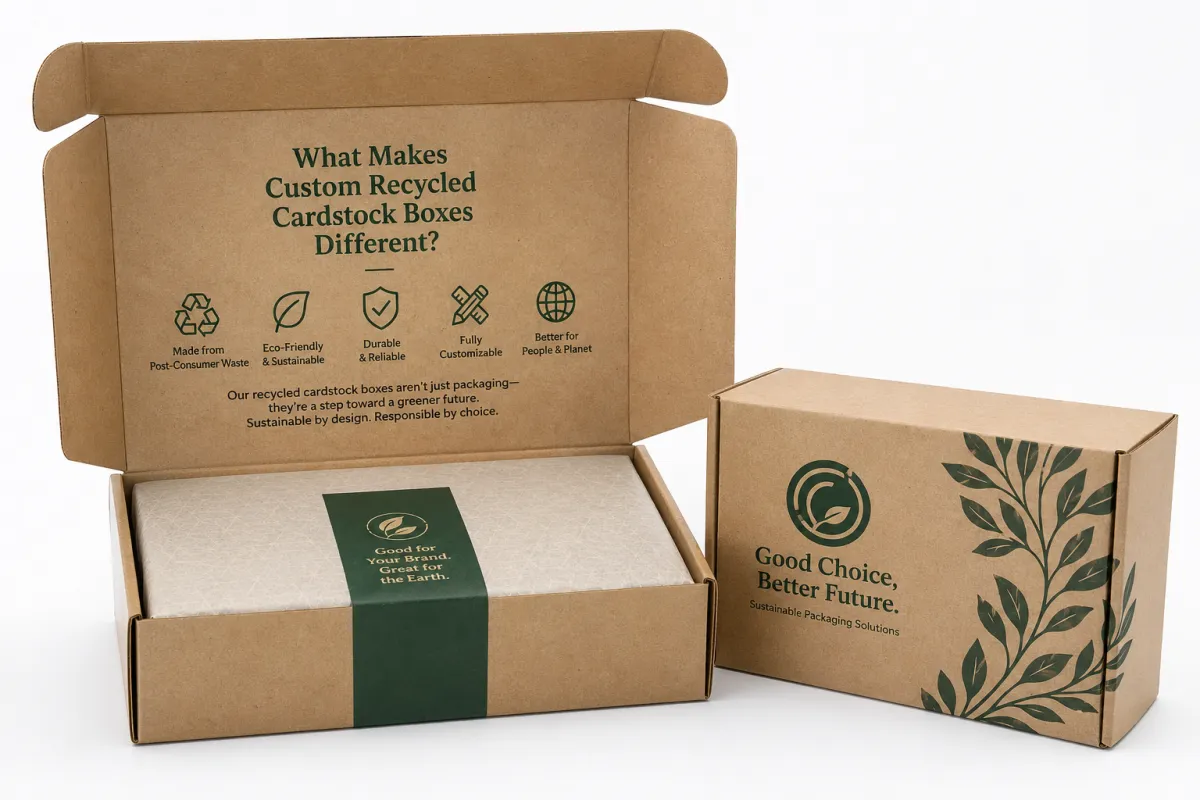
At the simplest level, custom recycled cardstock boxes are folding cartons made from paperboard that contains recovered fiber, usually post-consumer or post-industrial content blended into the sheet. The box is custom because the size, artwork, board grade, and closure style are chosen for one product instead of a generic stock carton, often with a tuck end, reverse tuck, auto-lock bottom, or sleeve structure. The recycled part matters because the fiber stream changes stiffness, brightness, and print response in measurable ways. A 300gsm recycled sheet may feel slightly less springy than a virgin sheet at the same caliper, yet it can still produce excellent Custom Printed Boxes if the furnish is well refined and the press room stays near 20 to 23 C.
What most people get wrong is assuming recycled means weak. That was not my experience standing beside a folding-carton line in Dongguan when a 400gsm recycled sheet ran on the same folder-gluer speed as a virgin run, about 180 to 220 boxes per minute, after we tightened the score depth by 0.2 mm and adjusted the backfold tension. The result looked clean on shelf and held a 420 gram candle jar without corner crushing during a 36-inch drop test. So yes, custom recycled cardstock boxes can perform very well, but only if the board density, fold geometry, and product weight are matched with the same care a good mill in Suzhou would use when setting the furnish ratio. I still remember one operator grinning at the inspection table like he had personally taught the carton a lesson.
There is also a big difference between recycled content and recyclable structure. A box can be made from recycled fiber and still be wrapped in a plastic film that complicates end-of-life recovery, while a paper-based board with a light aqueous coating may fit far better into common recycling streams. The choice affects both package branding and waste handling, so I usually tell clients to think in layers: board, ink, coating, inserts, glue, and any clear windows. That is where custom recycled cardstock boxes either stay simple or become a mixed-material headache. And yes, I have seen the headache part firsthand in a Guangzhou packaging audit, where a "green" box quietly contained three extra material layers that only showed up when the spec sheet was read line by line.
In practice, these boxes work especially well for cosmetics, supplements, candles, apparel accessories, and light consumer goods. A 120 mL face cream jar, a 60-capsule supplement bottle, a pair of leather gloves, or a compact charger all sit nicely in custom recycled cardstock boxes because the carton can feel premium without being overbuilt. For heavier products, like dense glass or multi-pack jars, I often recommend a stronger insert or a slightly higher caliper board, such as moving from 300gsm to 350gsm, rather than asking the outer carton to do every bit of the work. That advice has saved me from more than one awkward "why is the lid puffing up?" conversation during a packing trial in Ningbo.
On the retail side, the appeal is practical as much as visual. Clean folding cartons give you a large printable surface for brand messaging, ingredient panels, barcode placement, and compliance copy, often with a 4-color CMYK layout plus one spot color for the logo. If the artwork is handled well, custom recycled cardstock boxes can deliver the same shelf presence as more expensive stock options while still fitting the cost targets of a growing line. That is why so many brands use them for launch programs, seasonal sets, and limited runs where the packaging design needs to look intentional from day one, whether the boxes are shipping into Los Angeles, Toronto, or Berlin. I honestly think that combination of polish and restraint is what makes a carton feel modern, not a pile of shiny extras.
Here is the short version: the box is not trying to be fancy for its own sake. It is trying to protect the product, communicate the brand, and keep the line moving. When those three jobs are aligned, custom recycled cardstock boxes make sense for a very wide range of product packaging programs, from 500-piece test orders to 25,000-piece replenishment runs. If they do not align, you end up paying for pretty failures, and I have never met a buyer who enjoyed that surprise.
How Custom Recycled Cardstock Boxes Are Made
The material path starts long before the die line ever reaches a press. Recovered fiber is sorted, pulped, de-inked, refined, and formed into sheets, and each stage changes how custom recycled cardstock boxes will behave later in the plant. Longer fibers generally add tear resistance and stiffness, while over-refined stock can print cleanly but feel flatter in hand. I have watched mill technicians in Guangdong tweak slurry consistency by fractions of a percent because that small change affects brightness, porosity, and the way ink sits on the surface at 6 a.m. on a Monday shift. Those are the kinds of tiny numbers that make or break a large run, which is deeply unfair but also very real.
Once the board reaches the converting floor, the real work begins. The sheet is printed, typically on offset or digital equipment depending on quantity, then die-cut, scored, folded, glued, and packed. Standard folder-gluer machinery handles custom recycled cardstock boxes just fine as long as the score depth and board memory are right. I have seen a recycled 350gsm carton run without issue through a Bobst die cutter and a Jagenberg gluer in Dongguan because the scores were tuned to avoid fiber fracture and the glue line was kept at about 4 mm wide. In packaging design, the structure matters more than the label on the sheet, and the label is usually the least interesting part anyway.
That is also where the choice of finish comes in. Soft-touch lamination feels expensive, but on recycled board it can sometimes mute the fiber character and complicate recycling. Aqueous coating, matte varnish, or a light spot varnish often gives a cleaner balance between appearance and material honesty. For many custom recycled cardstock boxes, especially cosmetic cartons and branded packaging for supplements, I prefer a coating that protects against scuffing without hiding the board entirely. I know some people love a heavy film finish because it photographs well, but honestly, I think it can flatten the whole story if the brand is trying to signal material integrity.
Quality checks that keep cartons honest
In the factory, we do not trust appearances alone. We check crush strength, fold memory, glue adhesion, color consistency, and score recovery on every run of custom recycled cardstock boxes, because a carton that looks beautiful on a light table can still fail after 24 hours in a humid warehouse in Shenzhen or a hot truck ride through Texas. For heavier items, we may also run a small compression test based on ASTM D642 principles and a simple drop check modeled on ISTA handling expectations. A good converter keeps both the print and the mechanics honest, and a bad one will nod seriously while the cartons quietly disagree later on the shipping dock.
I remember a client meeting with a small candle brand in Atlanta where the sample looked perfect, but the side seam opened after a 30-inch drop test. The problem was not the recycled board; it was an over-aggressive glue line that had been set for a different carton style. We widened the glue area by 1.5 mm, changed the score, and the same custom recycled cardstock boxes passed the retest without changing the artwork or the 350gsm board spec. That is the kind of detail buyers rarely see, but it is what makes production cartons reliable. It is also the sort of thing that turns a calm production day into a small internal victory dance, usually performed in silence next to a pallet jack and a roll of shrink wrap.
Another useful checkpoint is fiber dust. Some recycled sheets shed more lint at the edges than a bright virgin board, especially if the supplier has blended in shorter recovered fibers. Good trim control, sharp knives, and clean press blankets solve most of that. If your custom recycled cardstock boxes are going to carry full-bleed graphics or tiny reverse type, that dust and edge cleanliness matter more than a designer may expect from a screen rendering. The monitor never shows the tiny fuzz that appears right where the brand name is supposed to look crisp, which is rude behavior from paper, but there we are.
For brands looking for environmental documentation, board origin and chain-of-custody can matter as much as the print spec. If you need certification, ask for FSC options and verify whether the supplier can document the material path from mill to converter. The FSC system is useful when your retail packaging needs a clear paper trail, especially for buyers that sell through large chains, hospital gift shops, or corporate procurement departments. custom recycled cardstock boxes are strongest when the sustainability story is as specific as the structure itself, and not just a slogan floating on a mockup.
One more floor-level detail deserves attention: humidity control. I have seen a reel-fed line lose an entire hour to curl because the stock sat near a dock door in monsoon weather. Paperboard that is fine at 45% RH may misbehave at 70% RH, and recycled fiber can be a little more sensitive than some virgin grades. If you plan to order custom recycled cardstock boxes in quantity, ask the converter how they store board and whether they condition the sheets before printing, usually for 12 to 24 hours in a climate-controlled room. That one question often separates experienced plants from careless ones. The careful plant answers immediately; the careless one starts talking about "weather conditions" like they are a surprise from outer space.
Custom Recycled Cardstock Boxes: Cost and Pricing Factors
Pricing for custom recycled cardstock boxes starts with board grade, and that one line item can swing the whole quote. A 300gsm recycled carton is not priced the same as a 400gsm recycled carton, even before you add coatings, embossing, or a window patch. Then there is recycled content percentage, which can affect both sheet cost and availability. Some mills are stable at 30% post-consumer content, while others can supply 60% or more, but the furnish needs to be consistent if you want the same print result across 10,000 units. I have seen buyers get a great quote, then act shocked when they ask for a different fiber blend and the numbers move. Well, yes, paper mills in Jiangsu or Guangdong are not magic.
Size matters too. A compact tuck-end carton for a lip balm uses less board and less press time than a rigid-looking mailer for a candle set, so the unit price falls quickly as the blank area shrinks. Print coverage is another major driver. A one-color kraft-style design on custom recycled cardstock boxes may be far less expensive than a full four-color flood with a rich black background, a soft-touch coat, and foil details. The press does not care about your mood board; it cares about ink laydown, drying time, and make-ready waste. I say that with love, because every packaging team I know has at least one designer who asks for "just a tiny gold detail" like it is free.
Short runs are where buyers usually feel the pain. If you order 500 boxes, the die line, plates, press setup, scoring tools, and gluer adjustments are spread across a tiny quantity. That is why a run of custom recycled cardstock boxes might land around $0.42 per unit at 500 pieces, while a 5,000-piece order with the same structure could come in around $0.15 per unit for 5,000 pieces if the artwork stays simple and the board is standard 350gsm recycled cardstock. Those are not universal numbers, but they are realistic enough to help a buyer understand the slope of the curve. Setup cost does not vanish; it just gets diluted, which is not glamorous but it is how manufacturing keeps score.
Special finishes can add more than people expect. Embossing, debossing, foil stamping, spot UV, or a complex window patch each adds labor and material. On a recent quote for custom recycled cardstock boxes in Ningbo, a switch from matte aqueous to soft-touch film raised cost by 9 to 14 percent, but the client still chose it because the box sat beside premium skin-care SKUs and needed a softer tactile feel. That is a brand decision, not just a cost decision, and both sides should be honest about the trade-off. I always tell clients: if the finish changes how the carton is handled by customers, it is not decoration anymore; it is part of the product experience.
| Order Profile | Typical Board | Approx. Unit Price | Lead Time After Proof Approval | Best Fit |
|---|---|---|---|---|
| 500 units | 300gsm recycled cardstock | $0.42-$0.68 | 15-20 business days | Sampling, launches, niche SKUs |
| 5,000 units | 350gsm recycled cardstock | $0.15-$0.22 | 12-15 business days | Growing retail lines, DTC bundles |
| 20,000 units | 400gsm recycled cardstock | $0.10-$0.15 | 18-25 business days | National retail, steady replenishment |
Freight, proofing, inserts, and storage can be the quiet budget killers. A buyer in California once quoted a carton at $0.19 per unit, then added a printed insert, a window patch, and split shipping across three pallets. The total landed cost jumped by 21 percent. That is why I tell people to price custom recycled cardstock boxes as a system, not as a shell. A carton is only one line in the final bill; the rest of the supply chain keeps adding inches, pounds, and dollars, especially if the shipment moves from Shenzhen to Long Beach and then by truck to Nevada. I have seen freight invoices that looked like they had been written by a mischievous accountant with a grudge.
Proofs also deserve attention. A hard proof, a sample carton, or a short-run preproduction sample may add $75 to $250 depending on complexity, but that is cheaper than correcting 5,000 boxes after the fact. If your artwork has tiny text, metallic elements, or a precise brand shade, it is far better to catch the issue before the full run of custom recycled cardstock boxes leaves the press. I have watched too many teams spend $1,200 fixing a $150 problem because they skipped the sample stage. That one still makes me sigh at the ceiling a little.
For buyers comparing custom recycled cardstock boxes against other Product Packaging Options, the cheapest line item is not always the lowest total cost. A slightly stronger board may reduce damage claims, and a cleaner structure may speed pack-out by 8 to 12 seconds per unit on the assembly table. That time adds up. In a 10,000-unit run, saving 10 seconds a box is nearly 28 labor hours. The box price is visible; the operational savings are hidden unless you look for them. Honestly, that hidden cost is where packaging either quietly helps the business or quietly bleeds it.
If you need a sustainability benchmark for your quote packet, the EPA has clear guidance on recycling common paper-based materials at EPA recycling resources. That does not replace local rules in California, Ontario, or the EU, but it helps brands ask smarter questions about coatings, liners, and material recovery. A little knowledge there can keep custom recycled cardstock boxes aligned with your waste goals instead of contradicting them. I have seen more than one good intention collapse under the weight of an incompatible finish.
Process and Timeline: From Quote to Shipment
The cleanest projects start with a spec sheet that has real numbers: product dimensions, target weight, carton style, board preference, print coverage, finish, and destination ZIP or port. With those details in hand, a supplier can usually quote custom recycled cardstock boxes with useful precision instead of guessing. I like to see the item weight to the gram, because a 180 gram jar and a 240 gram jar may need different crush performance even if the outer size looks close on a screen. Packaging rarely rewards vague math, especially when the cartons are being loaded into a 40-foot container or a regional distribution center in New Jersey.
After the quote, the dieline review comes next. Many delays begin here, especially if the buyer changes a 60 mm width to 64 mm after the first layout pass. The structure has to fit the product, the glue flaps, and the press sheet, so even small changes can ripple through the whole job. A good team locks the dieline early, which keeps custom recycled cardstock boxes from turning into a moving target. The more stable the dimensions, the smoother the rest of the work. I have seen one innocent 2 mm change create four hours of extra prepress work in Guangzhou, which is a very rude way for cardboard to behave.
Then comes artwork approval, and this is where the clock often slows down. Missing barcodes, vague Pantone targets, late copy edits, and coating changes all add days. A straightforward run of custom recycled cardstock boxes can move from proof approval to shipment in 12 to 15 business days, but only if the file is final and the sample is accepted quickly. If you need structural tweaks after sample review, add 3 to 7 more days, because the plant has to retool and recheck. The fastest projects are not lucky; they are simply disciplined about decisions and do not send a new logo version at 4:30 p.m. on proof day.
During production, the sequence usually looks like this: print, dry, die-cut, strip, score, fold, glue, inspect, pack, and palletize. That sounds simple, but each stage has a tolerance stack. A print shift of 0.5 mm, a die registration drift of 0.3 mm, or a score misalignment of 1 mm can show up as a crooked top flap in the finished carton. I have watched teams save a production run of custom recycled cardstock boxes by stopping after the first 300 sheets and correcting a tiny register issue instead of letting 30,000 pieces run wrong. That kind of pause is painful for about ten minutes and wonderful for the next three weeks.
Shipping is the last piece, and it is rarely glamorous. You want cartons packed in master cases that prevent edge crush, with pallet wrapping that keeps moisture out and corners intact. For export work, I prefer to label cartons with lot numbers, carton counts, and pallet IDs, because a clean receiving process matters when you are unloading at a warehouse with 1,200 other boxes on the dock. custom recycled cardstock boxes that are built well can still arrive damaged if the freight plan is sloppy. A strong carton does not deserve to be punished by bad wrapping, especially on a route that goes from Shenzhen to Port of Oakland and then by truck to a fulfillment center in Arizona.
I remember a supplier negotiation where the brand owner wanted a five-day shorter lead time but had approved the artwork in three separate email threads. We flattened the revision process into one PDF proof, one mark-up round, and one signoff call, and the job shipped two days earlier than the original estimate. The lesson was simple: custom recycled cardstock boxes move faster when one person owns approval and nobody is rewriting copy line by line after the press schedule is already set. It is not glamorous, but neither is running late and calling it a process.
Common Mistakes When Ordering Recycled Cardstock Packaging
The first mistake is judging the board by hand feel alone. I have handled recycled cartons that felt premium because of a smooth coating, then failed compression once the product weight reached the bottom panel. The reverse is also true: a slightly rougher sheet can outperform a glossy one if the caliper and board density are right. custom recycled cardstock boxes need to be specified by structure, not by the "this feels nice" test at the conference table. I know that sounds obvious, but I have watched experienced teams do exactly that and then act surprised when the carton behaves like, well, paper.
Sizing errors are the next trap. Too much empty space inside the carton makes the product shift during transit, which is bad for retail packaging and worse for fragile items like glass jars. Too little space creates tight folding pressure and can cause scuffing on print, especially near the tuck flap. I have seen custom recycled cardstock boxes come back from a warehouse because a 2 mm sizing mistake caused the closure flap to bow outward. A small measurement problem can look like a big quality problem once it is on shelf, and once a buyer sees a bowed flap, good luck explaining that the rest of the carton is technically fine.
Humidity is another hidden issue. Recycled fiber can absorb moisture differently from virgin board, and if the cartons are printed in one climate and filled in another, the score lines may behave unpredictably. In one plant visit in Xiamen, a batch of custom recycled cardstock boxes sat near a dock door for four hours, picked up water from the air, and lost enough stiffness to make the glued seam look weak. The cartons were fine. The storage conditions were not. It was one of those moments where the warehouse did nothing "wrong" exactly, but the cartons still paid the price for it.
Artwork mistakes are easy to overlook until the proof is already approved. Tiny reverse type on a dark background, thin serif fonts, and long legal copy can disappear once ink spread and paper texture enter the picture. The fix is simple: use a larger minimum type size, usually 6 pt or 7 pt depending on the layout, and test the design at actual scale. A lot of custom recycled cardstock boxes fail visually because someone designed for a monitor, not a press sheet. The screen forgives everything; paper is less generous.
Skipping a physical sample is probably the most expensive mistake of all. A flat mockup on a monitor cannot show corner crush, glue squeeze-out, or how the box behaves with the real product inside. For higher-value Custom Printed Boxes, I always push for a sample if the order is over 1,000 units or the product weighs more than 250 grams. The sample may add 3 to 5 business days, but it protects the whole production run of custom recycled cardstock boxes from preventable errors. I would rather be the person who annoys everyone with one more sample than the person explaining a pallet of rejects.
There is also a brand mistake that shows up often: treating sustainability like a separate visual layer instead of a material decision. If you want package branding to communicate recycled content, then the print, finish, and insert material need to support that message. Heavy plastic lamination on custom recycled cardstock boxes can send the wrong signal even if the carton itself contains recovered fiber. Buyers, retailers, and logistics teams all notice those contradictions faster than brands expect. People can smell a mismatch a mile away, even if the issue is only visible after they open the spec sheet.
"Give me the real sample, not the render, and I can tell you in five minutes whether the carton belongs on the shelf or back in the drawer, especially if the score line is off by 1 mm or the type is set below 6 pt."
That quote came from a packaging manager at a cosmetics client in Orange County, and I still think about it because it is true more often than not. Real samples reveal glue behavior, fold memory, and print clarity in a way no PDF ever can. For custom recycled cardstock boxes, the sample stage is where theory becomes manufacturing reality. It is also where everyone gets a little quieter, which usually means the work is getting serious in a good way.
Expert Tips for Better Performance and Print Quality
Start with the finish, not the decoration. If your brand wants a calm, natural look, a matte aqueous coat or a soft-touch coating on custom recycled cardstock boxes often works better than a heavy film wrap, because it keeps the paper character visible while still resisting scuff marks from carton-to-carton abrasion. If the carton will live in a humid stockroom, ask about coating performance at 55% to 70% RH, not just on a dry sample table in a Guangzhou showroom. The little environmental details make the difference between a good carton and a stubborn one. I think the obsession with "pretty first" has caused a lot of packaging pain that nobody needed.
Think about structure before you think about print effects. A 70 mm wide tuck-end carton with a paper insert may protect a skincare bottle better than a larger shell with no insert, even if the bigger box looks more luxurious on the screen. I have seen custom recycled cardstock boxes outperform more expensive packaging because the inside was designed with a 1.5 mm paperboard cradle and a tighter top flap. The best box is the one that fits the product, the transit path, and the shelf space all at once. That is not a glamorous design brief, but it is a smart one.
Test under real conditions, not just on a desk. Stack the cartons for 24 hours, shake them in transit simulation, and, if possible, run an ISTA-style drop sequence on a few filled samples. That matters especially for custom recycled cardstock boxes used in DTC shipping, where the box may ride through sortation belts, courier vans, and a warehouse floor before the customer ever opens it. A design that survives the mockup stage can still fail after a 36-inch drop onto a hard pallet deck. And yes, the box will always fail in the one direction nobody thought to test.
Ask for print targets in writing. If your brand color is Pantone 432 C, say so. If you need a specific black density, request a target, not a vague "rich black" note. Recycled board can absorb ink a little differently, so color consistency across a run of custom recycled cardstock boxes depends on press control and drying time. I have had suppliers hold a 0.8 delta E tolerance beautifully on one job, then drift badly on the next because the drying stack was too tight. Precision is not optional on branded packaging, and the press operator deserves your respect because they are the one standing next to the ink, not the mood board.
Do not over-specify the outside carton if a simple insert will solve the problem. A custom paperboard insert, a folded divider, or a small recycled pad often protects a product better than adding 40 gsm to the whole carton. That approach keeps custom recycled cardstock boxes lighter, cheaper, and easier to ship in bulk, which matters if you are building a line that will reorder every 6 to 8 weeks. I prefer this approach because it solves the actual problem without turning the carton into a heavyweight champion for no reason.
It also helps to compare finishes honestly. A foil stamp can look sharp, but if your audience wants sustainable cues, a restrained matte layout with embossed logo text may communicate better. I have seen retail teams sell more units with simple, well-registered custom recycled cardstock boxes than with flashy packaging that felt disconnected from the product story. Good packaging design is not about adding noise. It is about choosing the few signals that matter most. More glitter does not equal more trust, no matter how much a sales deck insists otherwise.
For buyers juggling multiple SKUs, one of the smartest moves is standardizing board grades across a family of cartons. You might keep the same 350gsm recycled sheet for three sizes and only adjust the dieline. That reduces quote complexity, speeds replenishment, and keeps inventory cleaner. In real factories, consistency often saves more money than chasing a slightly different carton for each product. That is especially true for custom recycled cardstock boxes in supplement and skincare lines where 2 or 3 sizes share the same visual system. I have seen brand teams breathe easier the moment they realize they can stop inventing a new carton every quarter.
Next Steps for Ordering Custom Recycled Cardstock Boxes
Before you request quotes, gather the essentials: product dimensions to the millimeter, target weight in grams, order quantity, print goals, finish preferences, and shipping destination. If you already have a dieline or a sample carton, send that too. Those details let a supplier price custom recycled cardstock boxes with far less guesswork, and they help you compare vendors on the same basis instead of sorting through apples, pears, and half-finished estimates. A clean brief is boring in the best possible way, which is usually what you want before a production run starts in Shenzhen or Ningbo.
Ask every supplier for a clear timeline, not just a promised ship date. You want to know how long artwork review takes, how many days the sample stage needs, and whether the factory holds board in-house or orders it after approval. If the answer is vague, expect the schedule to drift. Reliable custom recycled cardstock boxes programs usually have a structure sample, a proof approval checkpoint, and a shipment plan that names the pallet count and carton count by lot. If you cannot get those details early, you are probably buying hope instead of packaging.
Ask for a comparison of board options as well. A 300gsm recycled board may be fine for a 90 gram cosmetic item, while a 400gsm board may be better for a heavy candle or a dense glass bottle. If the supplier can explain why one board grade costs $0.03 more per unit but cuts damage claims, you are talking to someone who understands product packaging, not just printing. That is the kind of conversation that leads to better custom recycled cardstock boxes and fewer surprises later. I have a lot of patience for people who can explain trade-offs clearly; that alone is worth money.
Plan the box, the product, and the logistics together. The strongest results happen when packaging design, print, and freight are treated as one system instead of three separate jobs. That is how custom recycled cardstock boxes deliver on both shelf appeal and operational reality. If you want them to work well, do the boring planning first: measurements, samples, coatings, and shipping details. The prettier part of the job gets easier after that, which is one of the few comforting truths in packaging.
In my experience, the brands that do best are the ones that treat the carton like part of the product, not as an afterthought. A well-built recycled board carton can carry brand story, protect the item, and keep the production line moving with very little drama. If you want custom recycled cardstock boxes that hold up in the warehouse and still look sharp under retail lights, start with the structure, confirm the finish, and ask for proof before mass production. That sequence has saved me more than once, and it still holds up on the factory floor today.
The practical takeaway is simple: lock the board grade, finish, insert plan, and humidity handling before you approve a full run. Then request one filled sample and test it in the same packing and shipping conditions you actually use, not just on a desk in a quiet office. If that sample passes, you can move ahead with custom recycled cardstock boxes knowing the carton has already done the hardest part of the job.
What Are Custom Recycled Cardstock Boxes Best Used For?
Custom recycled cardstock boxes work best for products that need a polished retail presentation without the weight or cost of rigid packaging, especially cosmetics, supplements, candles, apparel accessories, and other light consumer goods. They are also a strong fit when you need printable surface area for barcodes, ingredients, compliance text, and brand storytelling, because the flat panels give designers room to work while the recycled board keeps the package grounded in material honesty. For heavier items, the structure can still work, but it usually needs stronger inserts, more careful scoring, or a higher caliper sheet. In practice, that makes custom recycled cardstock boxes a practical choice for launch programs, seasonal packaging, and steady replenishment runs where shelf appeal and production efficiency both matter.
FAQ
Are custom recycled cardstock boxes actually recyclable after printing?
Yes, in many cases they are recyclable if the board is paper-based and the finish stays light, such as a water-based coating or a thin matte varnish. Heavy lamination, plastic windows, or mixed-material wraps can change that answer, so brands should check the exact stackup with their recycler or waste handler. For custom recycled cardstock boxes, the safest rule is simple: the fewer incompatible layers you add, the easier the carton is to recover. I always tell clients to think like a sorter at the recycling facility, because that person is the one doing the real work later, usually on a fast line that sorts several tons an hour.
What affects the cost of custom recycled cardstock boxes the most?
The biggest cost drivers are board grade, box size, order quantity, print coverage, and any special finish or insert. Setup time matters a lot on small runs because die-cutting, plates, and press make-ready get spread across fewer cartons. Freight, proofing, and sampling can also move the total budget more than first-time buyers expect, especially on custom recycled cardstock boxes shipped by pallet instead of by parcel. Honestly, the quote can look pleasant right up until someone adds a window patch and shipping from Shenzhen to Chicago.
How long does it take to produce custom recycled cardstock boxes?
Simple folding cartons can move quickly, but approval speed often matters more than the machine schedule. A clean project can ship in 12 to 15 business days after proof approval, while artwork changes, sample revisions, or structural tweaks can add 3 to 7 more days. The fastest custom recycled cardstock boxes orders usually come from teams that lock the dieline early and answer proofs the same day. The press line does not wait kindly for inbox chaos, especially when a plant in Dongguan has already scheduled the next batch.
Can custom recycled cardstock boxes hold heavier products?
Yes, if the board caliper, structure, and scoring are matched to the item weight. For fragile or dense products, internal supports, inserts, or a stronger carton shape may be needed to prevent crushing during shipping. I always recommend testing real product samples before full production because custom recycled cardstock boxes that look strong on paper can still need tuning once a 300 gram or 500 gram item is inside. Paper is patient until gravity shows up, and gravity is never late.
What should I send for a quote on custom recycled cardstock boxes?
Send product dimensions, target weight, quantity, artwork details, finish preferences, and any insert or protection requirements. If you already have a dieline or a sample carton, include that too because it removes guesswork from the estimate. The more complete the brief, the easier it is to compare pricing, lead time, and material options accurately for custom recycled cardstock boxes. A good quote starts with a good request, and the best ones rarely arrive half-formed.

