Buyer Fit Snapshot
| Best fit | Custom Shipping Label Stickers projects where brand print, material claims, artwork control, MOQ, and repeat-order consistency need to be specified before quoting. |
|---|---|
| Quote inputs | Share finished size, material target, print colors, finish, packing count, annual reorder estimate, ship-to region, and any compliance wording. |
| Proofing check | Approve dieline scale, logo placement, barcode or warning zones, color tolerance, closure strength, and carton packing before bulk production. |
| Main risk | Vague material claims, crowded artwork, missing packing details, or unclear freight terms can make a low unit price expensive after revisions. |
Fast answer: Custom Shipping Label Stickers: Material, Adhesive, Artwork, and MOQ should be specified like a repeatable production item. The safest quote records material, print method, finish, artwork proof, packing count, and reorder notes in one written spec.
Production checks before approval
Compare the actual filled-product size with the drawing, then confirm tolerance on folds, seals, hang holes, label areas, and retail display edges. Reserve space for logos, QR codes, warning copy, and material claims before decorative graphics fill the panel.
Quote comparison points
Review material grade, print process, finish, sampling route, tooling charges, carton quantity, and freight assumptions side by side. A quote is only useful when the supplier can repeat the same color, closure quality, and packing count on the next order.
Custom Shipping Label Stickers: What to Know First
I still remember a Saturday morning on a contract packing line in Elizabeth, New Jersey, when a pallet of 12,000 cartons sat dead still because the custom shipping label stickers on the outer cases smeared under a warm dock fan, and one bad barcode turned into a 90-minute rework that cost the client two extra labor calls and one missed carrier pickup. That kind of failure is maddening because it usually starts small, maybe with a 2 x 4-inch label, a 60# glassine liner, or an adhesive that looked fine on a sample sheet from a shop in Newark, then grows into a stoppage that freezes order fulfillment harder than a jammed conveyor sensor. I have watched the same thing happen in refrigerated staging rooms at 38 F in Milwaukee and in dusty corrugate bays where recycled board keeps shedding fiber onto the glue line, and corrugate dust is rude in a very personal way.
At a plain-language level, custom shipping label stickers are pressure-sensitive labels made to identify cartons, mailers, pallets, or product shipments while holding up to handling, moisture, and temperature swings. They are not the same as office labels from a desktop laser printer bought for $12 at a warehouse club. The face stock is usually better suited to abrasion, the adhesive is chosen for a specific carton surface, and the print method is selected so barcodes, logos, and shipping data stay readable through the trip. In my experience, the difference shows up the second the box leaves the packing bench and starts moving through a warehouse in Atlanta, a 3PL in Chicago, or a carrier sortation belt in Memphis.
For an ecommerce shipper sending 300 orders a day from Phoenix, custom shipping label stickers can carry branding and operational data in one spot. For a 3PL handling eight client programs out of Ontario, California, they can reduce mis-sorts because the color, size, and barcode layout stay consistent from one lane to the next. For a retail distribution center in Dallas, they can support carton routing, lot identification, and internal QA checks without forcing the team to peel off separate stickers. I have watched a label spec save 15 minutes per skid on a busy packing floor, and I have also watched a weak spec create 15 minutes of confusion on every skid after that. That second outcome is the one people underestimate most, and it is gonna cost you every time if the lane is busy enough.
When a label has to survive a 45-minute parcel run, a 3-day cross-country transit, or a chilled warehouse at 34 F, custom shipping label stickers need to be designed for the actual lane, not for the easiest sample test in a conference room. That is the difference between packaging that looks polished in a mockup printed on 8.5 x 11 paper and packaging that behaves well in real shipping conditions. Mockups are charming. Shipping docks in Secaucus, Carson, or Louisville are not.
"The label was not the fancy part of the project, but it was the part that kept us from reopening 4,000 cartons after a Friday truck cut-off." - a 3PL supervisor I worked with after a peak-season audit in Indianapolis
What Are Custom Shipping Label Stickers and Why Do They Matter?
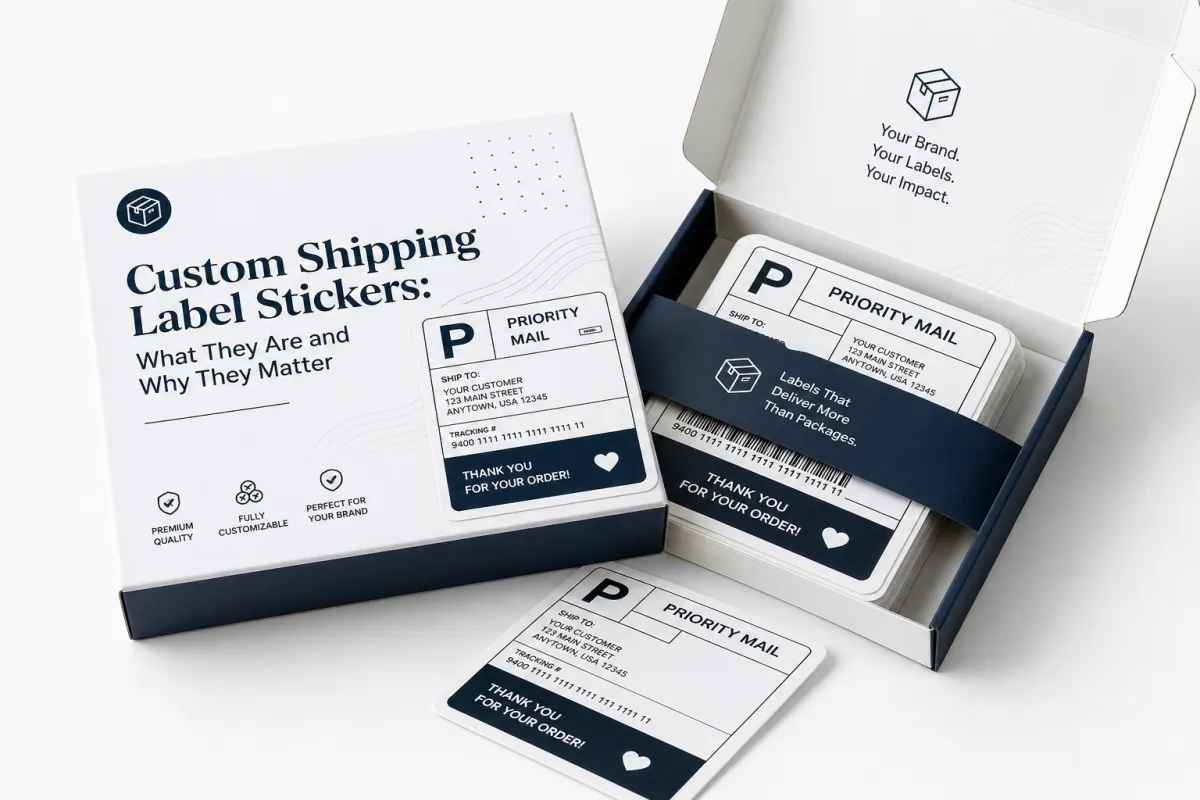
Custom shipping label stickers are pressure-sensitive labels built for logistics, not office filing. Most of the time, they are printed on paper or film face stock with a permanent, removable, or freezer-grade adhesive, then supplied in rolls, sheets, or fanfold stacks so a warehouse team can use them on a hand-apply bench or through a thermal printer. I define them this way because the label is doing three jobs at once: it identifies the shipment, it survives the environment, and it supports the brand. In strong branded packaging, those three jobs should never compete with each other.
People often compare a shipping label to a basic office sticker and assume the only difference is size. That is not how it works on a packing floor in Nashville or Reno. Standard office labels often use light adhesive and thin face stock, which is fine for folders and bins, but not for recycled corrugate with a rough Kraft surface or a poly mailer that flexes as soon as it is stuffed. Good custom shipping label stickers usually have a stronger bond, better ink or ribbon compatibility, and tighter manufacturing tolerances so the roll feeds cleanly on a Zebra, TSC, or Sato printer.
I saw this difference clearly in a Midwest 3PL outside Columbus that handled both retail packaging and direct-to-consumer shipping. Their office labels looked perfectly fine on a clipboard, but the same stock curled at the corners on boxes that sat near a dock door for 20 minutes in July heat. Once they switched to custom shipping label stickers with a 50# liner and a permanent acrylic adhesive, the edge lift dropped sharply and the packers stopped reprinting the same label twice. That one change saved them several cases of ribbon a week and a lot of waste on the floor.
These labels matter because shipping is a sequence of tiny decisions. A parcel might pass through an ecommerce shipping bench, a tape machine, a scale, a sorter, a trailer, and a delivery van before it reaches the customer in Seattle or Tampa. If the barcode smears or the adhesive fails at any one of those points, the entire chain slows down. Strong custom shipping label stickers reduce that risk while supporting package branding, internal QA, and carrier compliance. They also help if you are pairing the label with Custom Shipping Boxes or Custom Poly Mailers, because the whole pack feels intentional instead of patched together.
On the floor, I like to ask one simple question: what is the worst condition this package will face? If the answer is a humid porch drop in Miami, a freezer room in Minneapolis, or a pallet wrap lane with condensation in Portland, then the label spec needs to reflect that. If the answer is a dry, climate-controlled pick-and-pack room with same-day carrier handoff, then you can usually simplify the build. Custom shipping label stickers should match that reality, not a generic catalog assumption from a supplier brochure.
For readers who want the technical backdrop, packaging standards matter too. A good supplier should be able to explain testing under ISTA methods for shipment integrity, and for paper-based stocks I like to ask whether the mill documentation is compatible with FSC sourcing goals. That does not mean every label needs a lab report, but it does mean the conversation should be grounded in real production conditions, not just a glossy sample.
How Custom Shipping Label Stickers Are Made and Applied
The production flow for custom shipping label stickers usually starts with artwork setup and proofing, then moves into substrate selection, adhesive selection, print method, converting, inspection, and packing. I have sat through enough prepress calls in Chicago and Shenzhen to know that a 15-minute proof review can save a 15,000-unit mistake. The best shops will ask about barcode content, printer model, package surface, and storage conditions before they ever quote the job, because those details decide whether the label behaves well on corrugated cartons, poly mailers, or refrigerated packaging.
Substrate choice comes first because it determines how the label feels and how it survives. Paper stocks are still the most economical option for dry lanes, while polypropylene and other films are better for abrasion, moisture, and longer transit routes. Adhesive chemistry matters just as much. A carton with a recycled, slightly dusty surface usually needs more tack than a smooth coated box, and a freezer lane may need an adhesive that grabs in cold conditions rather than only after the package warms up. The finish is the final piece; matte stock can improve scannability, while a gloss or varnish may be chosen for a stronger visual on custom shipping label stickers used in retail packaging.
Print method depends on volume and data complexity. Digital printing works well for flexible runs, frequent artwork changes, and smaller lots because there is less setup. Flexographic printing makes more sense for high-volume programs where unit economics matter and the design will stay stable over time. Thermal transfer is common for variable data, especially when a warehouse needs batch codes, serial numbers, or shipping data printed in-house with a ribbon. In a plant where I helped spec custom shipping label stickers for 20,000 cartons a week in San Diego, the best answer was not one method for every line; it was a mix of digital for promotional runs and thermal transfer for daily order fulfillment.
Timeline expectations should be realistic. A simple digital job can often move in 5 to 8 business days after proof approval, while a custom die-cut or high-volume flexo order can sit at 12 to 15 business days before shipping, especially if plates or tooling are involved. Add 2 to 3 days for sample approval, and suddenly a "quick" order is actually a two-week project. That is normal. The faster you define the lane, the material, and the printer setup for custom shipping label stickers, the smoother the schedule usually goes.
Application also matters. Labels that are hand-applied on a pack bench behave differently from labels dispensed on an automatic machine in a facility outside Atlanta or New Jersey. Roll direction, unwind orientation, core size, and gap spacing all influence speed. If the label must run on a thermal printer, the roll should be specified with the correct core diameter, usually 1 inch or 3 inches, and the correct winding direction so the operator does not fight the machine. I have seen a line lose 20 minutes because a perfectly printed batch of custom shipping label stickers was wound the wrong way for the printer head.
If a supplier cannot explain roll orientation, liner type, and application method in plain English, I would press for a better technical review. The label may only be 2.5 inches wide, but the details behind it can affect an entire shipping shift. That is why good packaging design is never decoration by itself; it is a working part of the operation. The shiny mockup is nice. The label that actually feeds without drama is nicer.
For custom jobs, I also ask for the press room location and finishing site because it helps set expectations on lead times and freight. A run printed in Chicago, die-cut in Milwaukee, and packed in El Paso will not move on the same schedule as a one-stop shop in Charlotte, and the difference is usually 2 to 4 business days. That kind of detail matters when the launch date is tied to a retailer ship window or a Monday morning trailer booking.
Cost and Pricing Factors for Custom Shipping Label Stickers
Pricing for custom shipping label stickers usually comes down to quantity, size, shape, ink coverage, material grade, adhesive type, finishing, and the way the labels are packed for delivery. A tiny 2 x 3-inch blank label on paper will almost always cost less than a full-color, die-cut film label with a specialty adhesive and a custom roll format. That sounds obvious, but buyers still compare quotes as if all labels are the same. They are not. A run of 500 units can be surprisingly expensive per piece because the setup work is spread across too few labels, while 10,000 units can bring the price down sharply if the design stays consistent.
Low quantities tend to carry more overhead because someone has to proof the artwork, prepare the press or digital file, set the die if needed, and check the first sheets or rolls. Custom die-cutting adds another cost layer. So does special finishing like lamination, varnish, or a freezer-grade adhesive. In my experience, a buyer gets the best result when they ask not just for a price, but for a price tied to performance. A label that fails twice in transit is not cheaper just because the quote was 8 cents lower. That is especially true for custom shipping label stickers used in ecommerce shipping and retail packaging, where labor is often more expensive than the label itself.
Here is a simple way I explain the tradeoffs to clients:
| Option | Typical Use | Indicative Price at 5,000 Units | Durability Notes |
|---|---|---|---|
| Paper label with permanent adhesive | Dry warehouse cartons, short transit | $0.04 to $0.08 each | Good for low-moisture lanes, less resistant to abrasion |
| Polypropylene film label | Poly mailers, busy sortation, longer transit | $0.07 to $0.14 each | Better moisture and scuff resistance, higher material cost |
| Freezer-grade film with aggressive adhesive | Cold chain, chilled staging, condensation risk | $0.12 to $0.24 each | Designed for low-temperature grip and tougher environments |
| Full-color branded label with custom die-cut | Retail packaging, branded cartons, premium unboxing | $0.10 to $0.30 each | Most visual impact, setup costs are usually higher |
Those numbers are not a universal quote, but they are close enough to help a buyer plan. If your lane is dry and the box moves out the same day, paper custom shipping label stickers may be the smart buy. If your package sees rain, condensation, or a rough parcel network, a film stock often earns its higher unit cost within the first few weeks because fewer labels lift, smear, or reprint. I have also seen clients save money by removing features they did not need, such as heavy flood coating on a label that never leaves a climate-controlled building in Raleigh or Boise.
There is also a format decision. Roll-fed labels are common for printers and dispensers, sheeted labels are useful for manual application and small office setups, and fanfolded labels work well for some larger-volume systems. Each format changes packing, shipping, and machine compatibility. If you are buying custom shipping label stickers for a Zebra printer, a roll with the wrong core size can create a line headache that costs more than the whole order. That is why a good supplier should ask for printer model, roll diameter, core size, and unwind direction before quoting.
For larger programs, I have seen a clean economics break point around 5,000 pieces and again near 25,000 pieces. At 5,000 labels, a simple paper spec might land around $0.15 per unit with proofing included, while a 25,000-piece reorder can drop closer to $0.06 to $0.09 per unit if the artwork, plate, and die are already approved. Freight from a converter in Los Angeles to a warehouse in Jersey City can add $45 to $180 depending on roll count and carton weight, so the shipping line on the invoice deserves the same attention as the label cost itself.
The best budgeting habit is simple: protect the lane, not the decoration. If the label must survive a 40 F cold room, buy for cold room performance. If the box is dry and the customer only sees it for a few hours, do not pay for a film spec that acts like armor when paper would do the job. The strongest custom shipping label stickers are the ones that spend exactly where the shipping lane needs them and nowhere else. Anything more is just expensive overconfidence.
One more practical number helps when planning a launch: if the supplier needs 1 business day for artwork tweaks, 2 business days for proofing, 7 business days for production, and 3 business days for freight, the real calendar is 13 business days before the first carton ships. That kind of arithmetic is what keeps a warehouse in Kansas City from missing a launch window by a week.
A Step-by-Step Guide to Ordering Custom Shipping Label Stickers
The cleanest way to order custom shipping label stickers is to start with the use case, not the artwork. Write down the shipping lane, the package surface, the storage conditions, the scan requirements, and whether the label needs branding, barcodes, or variable data. If the label will sit on a smooth poly mailer, that is one choice. If it will sit on recycled corrugate with visible fiber from a mill in Pennsylvania or Quebec, that is another. If it will cross a cold warehouse at 34 F and then a wet dock at 78 percent humidity, that is another again.
Next, gather the technical specs before requesting a quote. I tell clients to include dimensions in inches or millimeters, core size, label spacing, roll direction, unwind direction, number of labels per roll, and the printer or dispenser model. If the in-house printer is a Zebra ZD421, a TSC TE200, or a Sato thermal transfer unit, say that clearly. If the labels will be printed offsite and then applied manually, say that too. The more exact the information, the fewer surprises on the packing line. Good custom shipping label stickers are easier to source when the spec sheet is complete.
Proof review is where many jobs get saved. Check barcode quiet zones, color contrast, copy accuracy, and any regulatory or carrier information. A barcode needs clean negative space around it, and a small mistake in that zone can turn a scannable label into dead waste. I have seen a 0.125-inch margin issue trigger a reproof because the quiet zone was too tight for the scanner on a fast line. That kind of detail matters whether you are producing custom shipping label stickers for order fulfillment or for retail packaging inserts.
A sample run should happen on the actual packaging material, not just on a desk. Apply the test label to the exact carton, mailer, or pouch you plan to use, then rub it with a gloved hand, chill it for 30 minutes if needed, or mist it lightly if your shipping lane sees moisture. Try the real warehouse conditions, even if that means a quick drop test, a tape-over test, or a small cart move across the dock. The fastest way to know if custom shipping label stickers are right is to watch them behave where the box will actually live. I promise the label does not care how pretty the mockup was.
- Define the lane: warehouse temperature, moisture exposure, transit time, and handling level.
- List the hardware: printer model, roll core, unwind direction, and whether labels are hand-applied or machine-applied.
- Approve the proof: check barcodes, copy, artwork placement, and label margins before production starts.
- Test the sample: run the label on the real carton, mailer, or pallet wrap.
- Lock the spec: save the approved material, adhesive, and format for reorders.
That sequence is simple, but it prevents a lot of expensive confusion. If you already have Custom Labels & Tags in your broader packaging stack, the ordering process becomes even smoother because the same technical discipline can carry across product packaging, shipping, and warehouse identification. The best custom shipping label stickers orders usually come from teams that treat labels as a production system, not a one-off purchase.
For some teams, I also recommend requesting a printed proof on a 350gsm C1S artboard card before the first run, especially if the label includes a premium brand block or a QR code that needs to sit inside a larger kit. A proof card on that heavier stock will not replace a carton test, but it does help stakeholders in Brooklyn, Irvine, or Charlotte see the layout clearly before production begins.
Common Mistakes That Cause Shipping Label Problems
The most common mistake I see is choosing the wrong adhesive for the environment. A label that works fine on a dry carton can fail on a cold room box, a textured recycled carton, or a high-humidity shipping lane. I have seen custom shipping label stickers peel off because the box was dusty from corrugate scrap, and I have seen them lift at the corners because the carton seam was curved and the operator pressed the label across a fold. That kind of failure is avoidable if the test happens on the real substrate.
The second mistake is designing for style before scanability. A shipping label is not a poster. If the barcode sits too close to a logo, if the contrast is too soft, or if the type is too thin for a thermal printer, the whole label becomes a problem. I once reviewed a job for a cosmetics brand where the black-on-charcoal design looked sharp in a mockup but performed poorly under a handheld scanner in a warehouse near Fresno. The fix was simple: more white space, stronger contrast, and a cleaner hierarchy. Custom shipping label stickers should look polished, yes, but they must still read in 0.5 seconds on a moving line.
Skipping material testing is another expensive habit. Labels can smear, curl, lift, or wrinkle after 8 hours in a warehouse or 48 hours in transit. A supplier may send a perfect sample sheet, but if the adhesive is wrong for the surface, the real run will tell the truth fast. I like to ask for a test that includes rub resistance, moisture contact, and a simple peel check after at least one temperature cycle. That is not overkill for custom shipping label stickers; it is basic due diligence.
Finally, some teams ignore production details like roll orientation, unwind direction, and printer compatibility. One wrong core size can slow a packing line for half a shift. One reverse-wound roll can create a stack of misfeeds. If your line runs 600 cartons an hour, that kind of slowdown matters. It is also why custom shipping label stickers should be ordered with the printer model written on the spec sheet, not just in an email thread that gets buried after the quote.
Another avoidable mistake is approving a label in one region and expecting the same result in another. A spec that performs well in a climate-controlled facility in San Diego can behave differently in a humid summer dock in Jacksonville or a winter lane in Toronto. Temperature swings of 20 to 30 degrees Fahrenheit change adhesive behavior enough that a label team should treat geography as part of the material decision, not a footnote.
Expert Tips for Stronger Performance and Cleaner Branding
Keep the design simple and readable. A strong label usually has 1 clear logo placement, 1 barcode zone, and 1 shipping data hierarchy, with enough whitespace around each element to let the scanner and the eye do their jobs. I prefer a label that looks calm at 6 feet and crisp at 6 inches. That is true whether the package is part of branded packaging, retail packaging, or a plain brown carton. Well-made custom shipping label stickers do not need to shout to be effective.
Match the face stock and adhesive to the toughest condition the package will face, not the easiest one. If a carton is going to sit in a refrigerator for 4 hours and then move through a humid dock, spec for the refrigerator and the dock, not for the office. If the box is likely to rub against shrink wrap, choose a stock with better scuff resistance. In my experience, the toughest condition always exposes weak assumptions first, and custom shipping label stickers are no exception.
Ask for a pilot run or a sample lot before you commit to the full order. Even a 250-piece trial can reveal print contrast issues, adhesive problems, or dispenser quirks that are easy to fix early and expensive to fix late. I have seen a buyer save a whole 8,000-unit run because a 100-piece sample caught a label curl issue on a poly mailer seam. If the program includes Custom Packaging Products, that pilot run is also a chance to confirm how the labels behave next to tape, inserts, and secondary packaging components.
Use the label as a functional branding tool. A clean shipping face with a small logo, one accent color, and a short line of brand copy can make the box feel finished without crowding the barcode. I like subtle package branding because it respects the logistics purpose of the label while still giving the customer a polished first touchpoint. If your operation also ships through Custom Poly Mailers or Custom Shipping Boxes, then the label should feel like part of the same packaging family. That is where custom shipping label stickers really help the brand look organized, not improvised.
One more practical tip: ask for a documented reorder spec. I have seen companies lose time because the first order was approved by phone and the second order was placed by a different buyer 7 months later. A one-page archive with material, adhesive, finish, dimensions, and printer details keeps the program stable. That may sound boring, but boring is good in shipping. Boring means the custom shipping label stickers keep feeding, keep sticking, and keep scanning.
If you are coordinating multiple plants, I also recommend naming one primary converter and one backup in a different region, such as one in Texas and one in North Carolina. That extra planning can shave 2 to 4 days off a reorder during peak season if freight lanes get tight or a press goes down for maintenance.
What to Do Next Before You Place an Order
Build a one-page spec sheet before you ask for a quote. Include size, material, adhesive, finish, quantity, printer or application method, and the package surface. If the label will be used for order fulfillment, add the lane details too: dry or cold, indoor or outdoor, single parcel or palletized load. That single page can save a vendor 20 back-and-forth emails, and it usually gets you a better answer faster. It also makes custom shipping label stickers easier to compare across suppliers because everyone is quoting the same job.
Request a sample set or test roll, then check peel strength, barcode scan performance, and resistance to rubbing or moisture. I like to test on at least 3 real packages and 2 real scanners if possible, because one perfect sample is not the same as a real production run. If the labels will touch corrugated cartons, apply them to the exact board style you plan to use. If they will go on a poly mailer, test the stretch and flex at the seam. The right custom shipping label stickers should survive that basic abuse without drama.
Confirm the timeline before you commit. Ask for proof approval time, production time, and transit time separately. A supplier may need 2 days for art, 7 days for manufacturing, and 3 days for freight, which means the total lead time is 12 days even if the press schedule itself is only a week. I have seen teams assume an order would land in a warehouse "next week" and then scramble when the proof sat on someone's inbox for 48 hours. Good planning keeps custom shipping label stickers out of that trap.
Prepare final artwork files and operational notes now. Save the approved PDF, list the barcode format, note any Pantone or CMYK targets, and include the printer compatibility details in the same folder. If you are building a full packaging system, keep the shipping label spec beside the carton spec and the mailer spec so everything stays aligned. That is the kind of discipline that keeps a brand steady from pilot run to peak season, and it is exactly how I like to manage custom shipping label stickers on a real line.
For teams that want the whole packaging stack to speak the same language, start with custom shipping label stickers, then match them to the rest of the shipper-facing materials so the carton, mailer, and label all pull in the same direction. That is where clean operations and strong presentation meet.
If you are still deciding between paper and film, I usually suggest a simple two-sample comparison: one paper spec at about $0.06 to $0.08 per piece for 5,000 units, and one film spec at about $0.12 to $0.18 per piece for the same count. That side-by-side test usually answers the question quickly once you see how each material behaves on the actual box and under the actual scanner.
Final Thoughts on Custom Shipping Label Stickers
After enough years around converters, pack benches, and freight docks, I have learned that custom shipping label stickers are small pieces of material carrying outsized responsibility. They protect scan rates, reduce rework, support package branding, and keep order fulfillment moving when the warehouse is already under pressure. The best choices are rarely the fanciest ones; they are the ones matched to the lane, the substrate, the printer, and the people applying them at 6 a.m. on a Tuesday in Newark, Phoenix, or Sacramento.
If you take only one idea from this piece, make it this: spec the label for the real environment, not the ideal one. Test it on the actual carton or mailer, confirm the printer details, and budget for the adhesive and finish that fit the job. Do that, and custom shipping label stickers become a quiet advantage instead of an expensive surprise.
And if you are building a broader packaging program, pair the shipping label with the right carton or mailer, then keep the spec sheet close for the next reorder. That is how custom shipping label stickers stay reliable from first sample to steady production.
For many teams, the strongest programs are also the simplest ones: one approved artwork file, one documented substrate, one printer model, and one reorder path. That kind of structure keeps mistakes down and makes it easier to scale from 5,000 pieces to 50,000 pieces without rebuilding the spec from scratch.
The practical takeaway is straightforward: choose the material for the harshest point in the shipping lane, test on the real package, and lock the approved spec in writing before the first production run. That is the habit that keeps custom shipping label stickers doing their job long after the mockup looks forgotten.
Frequently Asked Questions
Are custom shipping label stickers waterproof?
They can be, but waterproof performance depends on the face stock, adhesive, and finish you choose. Film-based custom shipping label stickers with a durable adhesive usually hold up better than standard paper labels in wet rooms, rain exposure, or light condensation. If the shipment may see freezer storage, a humid dock in Houston, or a 3-day parcel route through the Southeast, I would always test the exact label on the exact package surface before approving a full run.
How long do custom shipping label stickers take to produce?
Simple digital jobs can move quickly after proof approval, while custom die-cut, high-volume, or specialty-material orders usually take longer. In practical terms, I often see 5 to 8 business days for straightforward digital production and 12 to 15 business days for more involved runs, not counting artwork changes. The safest approach is to separate proofing time from production time so the lead time for custom shipping label stickers is clear from the start.
What is the best material for custom shipping label stickers?
Paper works well for dry, indoor, short-cycle shipping, especially when budget is tight and the package will not face much abrasion. Polypropylene or other film stocks are better for moisture, rubbing, and longer transit routes. The best choice for custom shipping label stickers depends on the box surface, the handling conditions, and whether the label also has to carry branded packaging elements like color blocks or secondary copy. If you need a premium presentation, a supplier can also pair the label with a printed proof card on 350gsm C1S artboard before production starts.
Do custom shipping label stickers work with thermal printers?
Yes, but only if the label stock is specified for thermal transfer or direct thermal use. Printer compatibility matters for core size, roll direction, adhesive, and label spacing, and those details should match the exact machine on your packing line. I always ask for the printer model before ordering custom shipping label stickers because a roll that feeds cleanly on one machine can jam or misread on another.
How do I keep custom shipping label stickers from peeling off boxes?
Choose an adhesive matched to the carton material, especially if the boxes are recycled, dusty, cold, or textured. Apply the label to a clean, dry surface with firm pressure and avoid placing it over seams or curved edges. If peel failure keeps happening, test a stronger adhesive or a different face stock before changing the design. In my experience, the right custom shipping label stickers usually solve the problem without any dramatic changes to the artwork.
Can I order custom shipping label stickers in small quantities?
Yes, and small runs are common for product launches, seasonal kits, and pilot programs in cities like Austin, Nashville, or Portland. A 500-piece order will cost more per label than a 5,000-piece run because setup, proofing, and finishing are spread across fewer units, but it is still a smart way to validate the material and adhesive before committing to a larger production lot. If the first 500 pieces perform well, reorders usually become easier and cheaper to manage.