Custom shoe Bags with Logo do a job that sounds minor until you actually ship product without them. They keep shoes paired, cut down on scuffing, protect finishes from dust, and give the customer a reusable item that stays in circulation long after the box is gone. That is a better brand outcome than a one-time insert, and usually a better one than people expect when they first price the project.
They also sit in a useful middle zone. Not as rigid as a carton. Not as disposable as a poly sleeve. A good shoe bag supports retail packaging, protects the product, and adds a branded surface without forcing the budget into a corner. A bad one feels like a leftover procurement decision. Customers notice the difference fast.
If you are building a footwear packaging program, the real goal is not to make the bag fancy. It is to make it fit the shoe, fit the brand, and fit the margin. That sounds plain because it is plain. The difficult part is getting all three right at the same time, especially when the bag sits alongside custom printed boxes, tissue, inserts, or other pieces from a broader Custom Packaging Products program.
Why custom shoe bags with logo stand out at first touch
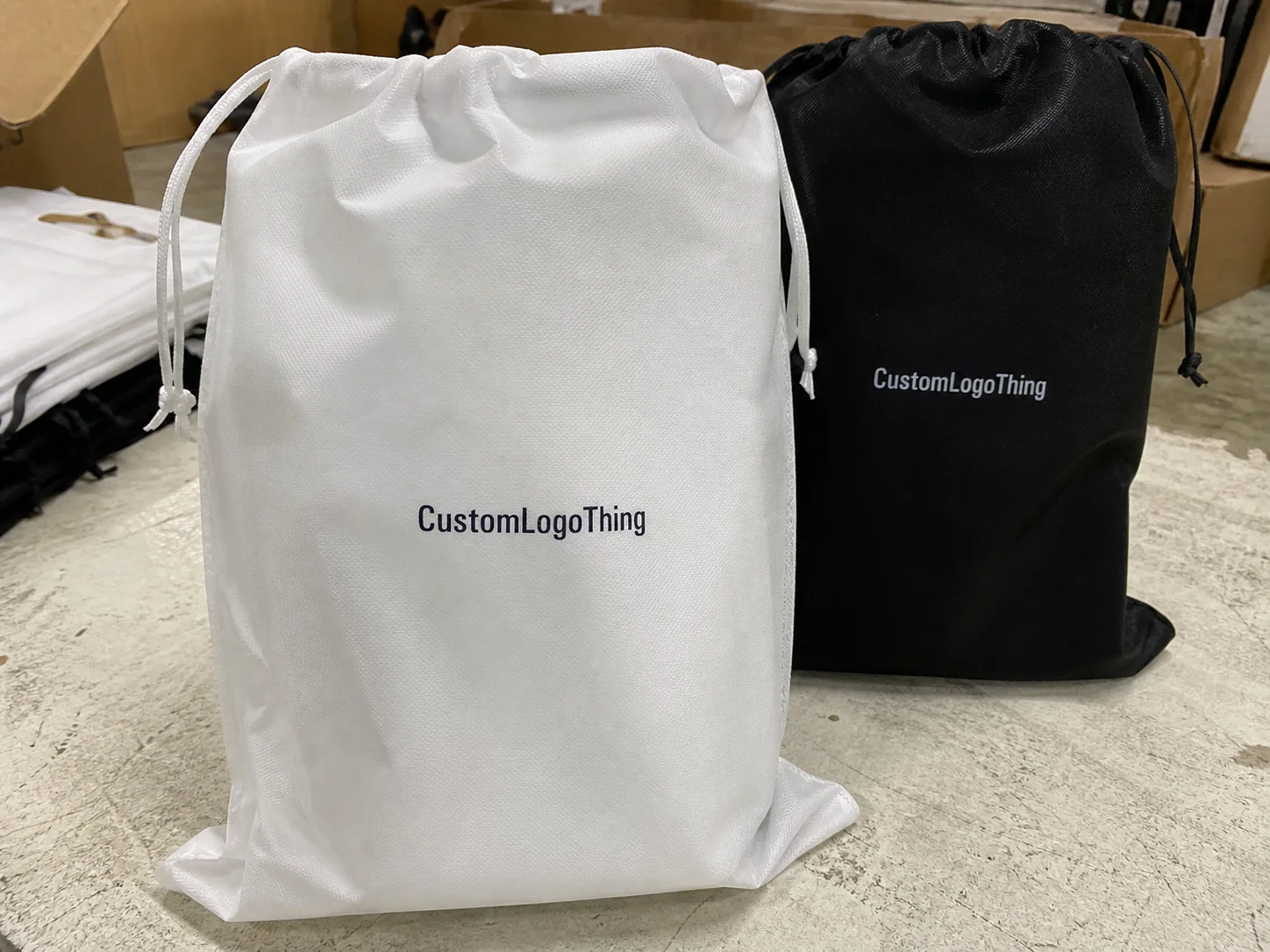
A shoe bag is one of the few packaging pieces the customer may keep using after the purchase. That matters. The logo does not vanish when the unboxing ends. It moves into travel, storage, gym use, and suitcase organization. For brands that want repeated exposure without paying for repeated media, that is a practical advantage.
It also changes the way the product feels at first contact. A shoe set presented in a clean pouch reads as more organized and more considered than the same pair tossed into plain wrapping. Even a budget bag can improve the perception of the product if the material and closure are chosen well. The point is not to imitate luxury for the sake of it. The point is to make the experience look deliberate.
There is a useful rule here: shoe bags do best when they are slightly understated. A giant logo on a thin bag usually looks cheap. A balanced layout on decent fabric looks intentional. The customer does not need to think about why it works. They just register that it does.
A shoe bag is a small piece of packaging, but small pieces get inspected closely. Fabric, stitch quality, and print clarity show up immediately because people hold them in their hands.
That close handling is why weak execution stands out. A wrinkled logo, loose drawstring, crooked hem, or rough seam can drag down the perception of the shoes inside. It is not a dramatic failure. It is worse than that. It is a slow quality leak.
How branded shoe bags are made and finished
Most branded shoe bags follow a simple production chain: choose the fabric, cut the panels, sew the body, add the closure, then apply decoration. Simple on paper. Less simple in practice. The final result depends on whether each step is controlled tightly enough to keep the bag looking clean after it is filled and handled.
Construction usually falls into a few common formats. Drawstring pouches are the most common because they are light, compact, and easy to pack. Zipper bags feel more structured and can offer better protection if the bag is going to be reused often. Nonwoven bags are usually chosen for budget control. Cotton twill, canvas, and brushed cotton tend to feel more premium because they have more texture and better drape.
Decoration method changes both cost and appearance. Screen printing is usually the most practical choice for one-color or limited-color artwork at moderate to high volume. Heat transfer works when the logo needs more detail or more color variation. Woven labels and embroidery increase perceived value, but they also raise the cost floor and can affect the hand feel. None of these are automatically better. The right answer depends on how the bag will be used and how much value the brand needs it to carry.
Small production details matter more than most buyers expect. Stitch density affects seam strength. Cord quality affects how well the closure holds up after repeated use. Edge finishing affects whether the bag feels tidy or rough. If the logo is centered but the hem is uneven, the whole thing still looks off. That is why sample quality matters so much. A good proof does not just show the artwork. It shows the way the bag will actually be built.
There is also a documentation side if you are making material claims. If you are specifying recycled content, FSC-certified paper components, or other environmental claims, ask for proof instead of trusting a line in a quote. If the bags are part of a broader shipping program, transit testing logic from groups like ISTA is worth reviewing. It is not glamorous work. It prevents preventable damage.
Material, size, and branding factors that change performance
The spec decisions that matter most are not the dramatic ones. They are the quiet ones. Fabric weight. Bag dimensions. Closure style. Logo size. Color contrast. If those are locked early, the project moves faster and the quote is easier to trust.
Material choice changes the bag immediately. Cotton usually reads as more premium because it feels softer and folds naturally around the shoe. Nonwoven polypropylene is the budget workhorse. It is light, serviceable, and easy to price at scale. Polyester and nylon sit in the middle for many programs because they offer smoother surfaces and better moisture resistance. For travel or athletic use, that can matter more than a softer hand feel.
Size is where plenty of programs go wrong. Too small, and the shoe stretches the bag open or distorts the seams. Too large, and the logo looks lost because the pouch has more empty fabric than it needs. A good fit should allow for laces, inserts, or a pair of shoes depending on the use case, but it should not feel baggy. Oversized packaging wastes material and makes the branding look smaller than it should.
Logo placement deserves real attention. A centered mark on a flat panel usually prints cleaner and reads better from a distance. A design that crosses seams, lands too close to a drawstring channel, or relies on fine detail may look fine in a mockup and weak on the finished bag. Bags are soft goods. They move. They wrinkle. They fold. Artwork that survives that movement is better artwork.
- Cotton or cotton blend: softer touch, stronger retail feel, usually higher cost than nonwoven.
- Nonwoven polypropylene: low-cost, light, and suitable for volume-driven packaging.
- Polyester or nylon: better moisture resistance and a smoother decoration surface in some builds.
- Embroidery or woven label: better perceived value, but more setup and a higher price floor.
If your footwear line already uses consistent package branding, the shoe bag should sit inside that same visual system. Matching color logic and logo scale across the box, tissue, inserts, and pouch makes the whole set feel planned. A shoe bag does not need to mimic a rigid carton. It does need to look like it belongs in the same program.
There is one more practical point. Buyers often focus on how the bag looks on a flat table. That is only half the job. Test it with the actual shoe. Check how the logo reads once the pouch is full. Check whether the drawstring still closes cleanly. A beautiful empty bag is not much help if the finished one feels awkward in use.
Cost, pricing, and MOQ drivers buyers should compare
Unit price is only one line in the real cost equation. Material grade, size, decoration method, color count, stitch complexity, and order volume all affect the final number. MOQ matters because low volumes carry a heavier share of setup and labor costs. Higher runs spread those costs out, but only make sense if the forecast is real.
For planning purposes, a simple nonwoven pouch with a one-color logo might land around $0.18 to $0.35 per unit at 5,000 pieces. A cotton drawstring bag with screen print often lands around $0.30 to $0.65. Heavier fabrics, embroidery, woven labels, or zipper constructions can push the number higher. At 1,000 pieces, the same build is usually more expensive per unit because the fixed costs have less volume to absorb them.
| Bag style | Typical feel | Common decoration | Indicative unit price at 1,000 | Indicative unit price at 5,000 |
|---|---|---|---|---|
| Nonwoven drawstring | Light, utilitarian | Screen print | $0.28-$0.55 | $0.18-$0.35 |
| Cotton drawstring | Soft, retail-friendly | Screen print or heat transfer | $0.45-$0.90 | $0.30-$0.65 |
| Polyester zipper pouch | Smoother, more structured | Heat transfer or woven label | $0.55-$1.10 | $0.38-$0.78 |
| Premium textile bag | Elevated, gift-ready | Embroidery or woven label | $0.90-$1.80 | $0.65-$1.30 |
Those numbers are useful, but they are not the full answer. Sampling may be charged. Freight can outweigh the unit cost on small orders. Rush production adds cost. Double-sided print, special cords, custom zipper pulls, or packaging inserts add more. If a quote looks unusually cheap, it usually leaves something out. Usually the things that matter.
Compare suppliers on the landed cost, not just the unit price. A cleaner bag with slightly higher pricing can still win if it reduces damage risk, sample revisions, or customer complaints. That is especially true for retail packaging, where visible quality gaps show up fast and are hard to hide later.
Production steps and lead time from artwork to delivery
The workflow is usually straightforward, but delays show up in the same places every time. The buyer sends specs and artwork. The supplier prepares a proof. A sample is made if needed. Production starts after approval, then inspection and shipping finish the job. The sewing line is rarely the slowest part. Revisions are.
Artwork issues create friction quickly. Low-resolution files, raster logos that should have been vector, missing color references, and vague placement instructions all slow down proofing. If the logo must match a Pantone reference, say so early. If the bag fabric is dyed to a custom tone, say that early too. A clean brief prevents a round of guesswork.
For a straightforward order, a practical lead time is often around 12 to 15 business days after proof approval. More complex builds take longer. Embroidery adds steps. Zippers add assembly time. Multiple decoration passes add checks. If a physical sample is part of the process, the schedule needs extra room for sample production, review, and any correction round. That is not a delay problem. That is normal production discipline.
You can shorten the timeline by sending a complete request the first time. Include exact dimensions, target quantity, preferred material, closure style, artwork files, color expectations, and delivery location. If you are ordering other branded packaging at the same time, combine the brief. Shoe bags, inserts, wraps, and similar pieces are often easier to quote together than as separate, scattered requests.
One thing that gets overlooked: the bag has to survive the trip, not just the mockup. If it is shipped inside a larger retail kit or parcel, ask how it holds shape under compression. A pouch that looks crisp before packing can arrive wrinkled if it was folded badly or packed too tightly. That kind of issue is easy to avoid if you test the packaging path, not just the product itself.
Common mistakes that make custom shoe bags look cheaper
Most quality problems are boring. That is why they keep happening. The size is wrong. The print is too small. The logo sits too close to a seam. The closure feels weak. None of those mistakes sounds dramatic in a quote review. All of them show up in the finished bag.
Size errors are the most visible. If the pouch is too small, the shoe stretches the fabric and the bag looks strained. If it is too large, the branding seems lost and the whole item feels under-designed. A useful size has to accommodate the shoe style, not just the abstract idea of “a shoe.” Men’s sneakers, women’s heels, and single training shoes are not the same spec.
Printing mistakes are just as common. Low-contrast artwork disappears into the fabric texture. Fine lines break up on soft material. A design that looks sharp on a screen can blur when it is applied to cotton or nonwoven fabric. If the logo is important, keep the layout simple. Simple usually survives production better than clever.
It is also easy to spend in the wrong place. Some buyers choose a premium fabric, then save money on seam finishing or print quality. Others add trim that does nothing for function. The smart spend is on the parts the customer touches every time: fabric, stitching, closure, and the logo itself. If the bag is going to be reused, durability should be the first priority. If it is meant for gift presentation, the finish and visual balance matter more.
Quality control misses are expensive because they arrive late. Skipping a pre-production sample is risky, especially if the supplier is new or the logo is being applied to a fabric you have not used before. Checking only the mockup is not enough. Review the finished sample under light, fill it with the actual shoe, and test the closure several times. That reveals more than any rendered image ever will.
- Keep the logo legible after the bag is filled.
- Avoid placing artwork across seams or cord channels.
- Ask for a sample if the fabric texture is unfamiliar.
- Test the largest shoe style first, not the easiest one.
Good packaging does not call attention to itself. It just works. That is the standard worth holding here.
Expert tips for a cleaner quote, faster approval, and better results
Start with the shoe. Not the bag. That sounds almost too obvious to say, but many briefs begin with a generic size target instead of the actual product shape. A leather sneaker, a heeled shoe, and a training shoe need different internal dimensions. The bag should follow the product, not the other way around.
Then send one complete quoting request. Not five emails with missing pieces. Target quantity, dimensions, artwork files, material preference, closure style, destination, and delivery deadline should all be in one brief. A supplier can quote faster and with fewer assumptions when the request is complete. If the answer is vague, ask questions before approval. Guessing is how projects drift.
Samples should be handled with a physical test, not just a visual one. Hold the fabric. Check the stitch line. Open and close the pouch multiple times. Look at the logo from a normal retail distance and from close up. The cheapest sample is not always the best commercial option, and the most polished one is not always the right cost fit. The right sample is the one that matches the brand position and the budget without creating hidden problems.
Here is the sequence I would use for custom shoe Bags with Logo:
- Define the shoe type and the actual use case.
- Choose the fabric based on brand position and reuse expectations.
- Lock the dimensions and closure style before finalizing artwork placement.
- Request a written quote that separates unit price, setup, sampling, and freight.
- Approve the proof only after checking the logo at real size.
- Move to production once the sample or digital approval is signed off.
If the bags are part of a wider packaging program, align them with the rest of the set. Consistent color, consistent typography, and a similar finish level make the whole system feel deliberate. That is especially true if the shoes already ship in Custom Printed Boxes or other branded packaging. The pouch should reinforce that system, not wander off on its own.
My practical view is simple. The best custom shoe Bags with Logo are easy to quote, easy to inspect, and easy for the customer to reuse. If the spec is clear, the material matches the job, and the decoration method suits the fabric, the result will do more than hold a pair of shoes. It will keep the brand in circulation for as long as the bag stays useful.
FAQ
What size should custom shoe bags with logo be for retail shoes?
Choose the size based on the actual shoe silhouette, not just the box. Leave room for laces, inserts, or paired shoes if the bag is meant for retail presentation. If the bag is for single-shoe storage or travel, you can size down, but test the largest common style first so the seams do not strain.
Which material works best for branded shoe bags?
Cotton and cotton blends usually feel more premium and work well for customer-facing programs. Nonwoven and synthetic options are often better for budget control and moisture resistance. The best choice depends on brand position, expected reuse, and how much durability you need during storage or transit.
How much do custom shoe bags with logo usually cost?
Price depends on fabric, size, print method, stitch complexity, and quantity. A simple nonwoven pouch can be very economical at volume, while cotton, embroidery, or zipper constructions raise the cost. Ask for a quote that separates unit price, setup fees, sample charges, and freight so you can compare suppliers fairly.
What is the typical turnaround time for custom shoe bags?
Turnaround depends on sample needs, decoration method, and order size. A straightforward build may be ready in about 12 to 15 business days after proof approval, but revisions can extend that. Final artwork and exact specs shorten the schedule more reliably than pushing for a rush slot.
Can custom shoe bags with logo be reused after purchase?
Yes. Reuse is one of the main reasons brands use them. They work for travel, storage, gym use, and keeping shoes separated in luggage. If reuse matters, prioritize durable seams, a reliable closure, and branding that still looks clean after repeated handling.


