Custom stickers for bakery boxes do more than hold a lid shut. They are often the first brand touchpoint a customer sees, and they can make a plain carton feel finished, giftable, and intentional without moving to a fully custom box program.
That matters because bakery packaging has to work in real conditions: fast packing, delivery handling, refrigeration, and repeated touch at the counter. A sticker has to look good on screen and still perform on the actual board, with the actual adhesive, under actual pressure.
For many bakeries, stickers are the most practical starting point. They support seasonal runs, rotating flavors, and smaller orders without forcing a large packaging commitment.
Why custom stickers for bakery boxes change the box experience
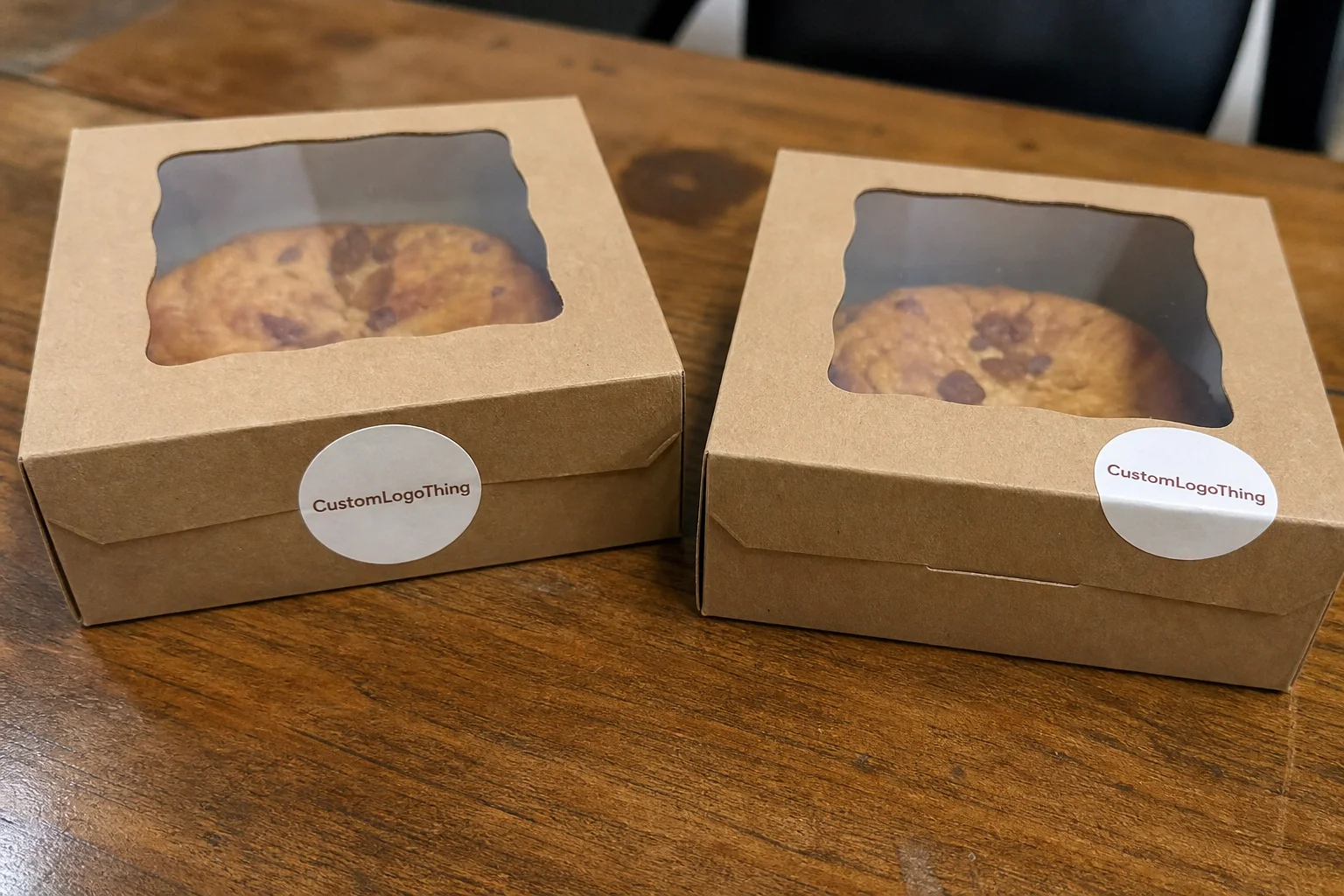
A plain bakery box does the job. A well-placed sticker makes the box feel branded and complete. It can seal a lid, identify the product, and give customers a clearer sense of value before the box is opened.
Bakery buyers usually care about presentation, freshness signal, and workflow. Stickers help with all three. A sealed box feels newly packed, a branded seal looks deliberate, and a content label helps staff sort multiple orders during busy periods.
The operational side matters too. Packaging is part of labor flow. If a label peels cleanly, places easily, and reads clearly, packing moves faster. If it curls, misaligns, or lifts at the corners, staff lose time fixing it.
There is also a pricing perception effect. A standard carton can look budget-oriented even when the product is not. A clean sticker shifts that impression quickly. The key is restraint: one clear message usually works better than a crowded design.
How the label structure, adhesive, and finish work together
A bakery sticker is a system made up of face stock, adhesive, liner, and print method. If one part is wrong, the label underperforms even if the design looks good in proof.
Face stock is the first decision. Paper labels are common because they print well and suit a natural, handmade look. They work best for dry counter service and everyday packaging. Film labels, usually polypropylene or BOPP, are better when moisture or condensation is part of the use case.
That difference matters more than many buyers expect. A buttercream cake taken from refrigeration can create condensation on the carton. Paper may soften or curl. Film gives more margin for error and is typically the safer choice for chilled or delivered products.
Finish changes the visual read. Matte feels softer and more artisanal. Gloss increases color pop and contrast. Textured stocks can feel premium, but fine type, small QR codes, and thin lines need careful review on textured surfaces.
Adhesive matters just as much. Permanent adhesive is usually the safer choice for coated or slick carton surfaces. Removable adhesive has a place in reusable packaging or short-term promotions, but it should be specified early if clean removal is required.
Technical references such as ASTM D3330 peel testing can help compare adhesive performance, but the practical test is still simple: apply the label to the actual box, let it sit, handle it, and see whether the edges lift. The real carton, not a desk sample, tells you whether the spec works.
For shipping-heavy operations, ISTA-style thinking helps when considering vibration, compression, and handling. For paper programs, FSC chain-of-custody expectations may matter if the bakery wants a more responsible fiber story. These details are not cosmetic. They affect whether the label behaves like packaging.
| Label Type | Best Use | Typical Thickness / Stock | Practical Notes |
|---|---|---|---|
| Matte paper label | Dry bakery boxes, everyday logo seals | 60-70 lb paper face stock | Soft look, easy to print, weaker against moisture |
| Gloss paper label | Bright branding, color-heavy designs | 60-70 lb paper face stock | Higher color pop, but glare can show under strong lighting |
| BOPP film label | Chilled display, delivery, condensation-prone packaging | 2-3 mil film | Better moisture resistance and edge stability |
| Textured premium label | Gift boxes, seasonal drops, boutique packaging | Varies by supplier | Strong tactile feel, but small type needs review |
Key factors that decide size, material, and artwork
Start with the box, not the art. Measure the closure area, top panel, and any fold lines the label will cross. A round sticker can look clean on a pastry box, but a rectangle may cover the seam better.
Shape should follow the job. Circular labels work well for logo seals. Rectangles are better for flavor names, dates, or multi-line copy. Custom Die Cuts can strengthen identity, but they add tooling complexity and cost. In most bakery programs, the best shape is the one that fits the box instead of forcing the box to adapt to the label.
Material should follow the environment. Paper works for dry goods and room-temperature retail. Film is better for chilled display, delivery, or any packaging exposed to condensation. If the product is rich with buttercream, mousse, or refrigeration, moisture resistance is not optional.
Artwork has to read fast. The bakery name should be visible at arm’s length. Flavor or seasonal copy should be secondary. If allergen notes or a QR code are included, they need contrast and quiet space so they remain legible and scannable.
Color count also affects cost and consistency. More colors can increase complexity and create more room for variation. A tighter palette usually prints cleaner, especially on kraft board or textured paper. Three strong colors often outperform six weak ones.
- Use larger type for the bakery name and primary logo mark.
- Keep flavor, seasonal, or ingredient text secondary.
- Leave enough margin so the seal does not look crowded.
- Match the finish to the counter lighting and display case conditions.
If you need related pieces, coordinate the sticker program with Custom Packaging Products and Custom Labels & Tags. That keeps the box seal, hang tag, and support labels aligned instead of looking like separate orders.
| Label Type | Best Use | Typical Thickness / Stock | Practical Notes |
|---|---|---|---|
| Matte paper label | Dry bakery boxes, logo seals, everyday retail packaging | 60-70 lb paper face stock | Good for a soft, artisanal look; less resistant to moisture |
| Gloss paper label | Bright branding, color-heavy designs, display packaging | 60-70 lb paper face stock | Higher color pop; reflections may show under strong lighting |
| BOPP film label | Chilled display, delivery boxes, condensation-prone applications | 2-3 mil film | Better moisture resistance and edge stability |
| Textured premium label | Gift boxes, seasonal drops, boutique packaging | Varies by supplier | Strong tactile feel, but finer artwork may need careful review |
Step-by-step ordering checklist for a clean first proof
The first proof is where avoidable mistakes show up. The cleanest orders start with measurements, then move into artwork, material, adhesive, and proof approval. That sequence matters because label failures usually come from missing physical details, not bad intent.
- Measure the box top, seal line, and any flat area where the label will sit without folding.
- Confirm the carton surface. Kraft, coated board, and laminated board do not behave the same way.
- Prepare artwork in the correct file format, with images at usable resolution and fonts outlined or packaged correctly.
- Decide on finish, adhesive, and cut shape before requesting proof revisions.
- Check spellings, contrast, bleed, barcode placement, and QR code quiet space if one is included.
It also helps to get one production-like sample if the order matters. Apply it to the exact box stock you plan to use, then handle it under realistic conditions. Cold storage, light condensation, and repeated touch will reveal issues that a tidy proof will not.
For custom stickers for bakery boxes, include the people who actually pack orders. The owner may care most about the brand look. The packing team will care about speed and whether the label behaves under pressure. Both perspectives matter.
Production process and turnaround times
Most sticker orders follow the same path: file review, proofing, production, finishing, packaging, and shipment. What changes is how much cleanup the job needs before production can start.
The fastest orders arrive with clean files and clear specs. The slowest ones are held up by missing dimensions, unclear dielines, or artwork that has to be rebuilt. For custom stickers for bakery boxes, standard turnaround is often about 12 to 15 business days after proof approval. Digital production can sometimes move faster.
Specialty finishes, Custom Die Cuts, metallic stock, and unusual adhesives usually slow things down. Rush service is possible in some cases, but it narrows the available material and finish options.
The biggest delay is usually artwork. A low-resolution logo, a missing font, or a file that does not match the requested size can stop production before it starts. Proof approval is the next bottleneck. If a buyer waits several days to review a simple proof, those days come directly out of the schedule.
Shipping can also affect timeline and cost. Flat labels, rolled labels, inserts, and cartons may ship differently. If the order needs to go to multiple stores, decide in advance who receives the labels, where they are stored, and who owns the reorder trigger.
Pricing, MOQ, and unit cost drivers
Sticker pricing depends on more variables than most first-time buyers expect. Size, material, print count, shape, adhesive type, and finish all influence cost. Quantity matters too. Larger runs usually lower unit price, but they raise the upfront spend and inventory burden.
MOQ, or minimum order quantity, is the point where setup cost and production efficiency meet. A small bakery may want a low MOQ so cash is not tied up in inventory. A multi-location operation may prefer a larger run if the unit cost drops enough to justify it.
| Option | Typical Use | Approx. Unit Cost at 5,000 pcs | Notes |
|---|---|---|---|
| Matte paper label | Dry bakery boxes, logo seals, everyday retail packaging | $0.04-$0.08 | Good for a soft, artisanal look; less resistant to moisture |
| Gloss paper label | Bright branding, color-heavy designs, display packaging | $0.05-$0.09 | Higher color pop; reflections may show under strong lighting |
| BOPP film label | Chilled display, delivery boxes, condensation-prone applications | $0.07-$0.12 | Better moisture resistance and edge stability |
| Textured premium label | Gift boxes, seasonal drops, boutique packaging | $0.08-$0.14 | Strong tactile feel, but finer artwork may need careful review |
Those numbers are directional, not fixed. A larger label, a special adhesive, a custom cut, or a multi-color print can move the price up. Freight and setup charges can distort the total as well, which is why landed cost matters more than the headline unit price.
Reprint cost is the hidden line item. If the adhesive is wrong or the artwork is off, the first run is not the real cost. The second run is. That is why a slightly higher spec can be the better buy when the labels need to perform consistently across stores and products.
Common mistakes and expert tips for better shelf performance
The most common mistake is choosing adhesive by appearance. A sample can look great and still fail on coated, dusty, or slightly textured board. The next mistake is packing too much into a small label. If the customer has to work to understand the message, the sticker is doing too much.
Poor hierarchy causes another problem. If the flavor, social handle, ingredient note, promotion, and logo all compete for space, nothing wins. Good package design usually means subtraction: one main message, one supporting detail, one purpose.
- Keep the bakery name or logo dominant and let secondary text stay secondary.
- Leave enough edge margin so the seal does not look cramped or accidental.
- Match the finish to the lighting in the display case or pickup counter.
- Test one real sample on the actual box before approving the full run.
- Check how the label behaves after refrigeration or light condensation.
A simple handling test catches more issues than most people expect. Put one sticker on the real carton, close the box, reopen it, and inspect the edges after a short wait. If the bakery uses cold storage, move the sample through that environment too.
From a branding standpoint, the best stickers are often the quiet ones. Clean type. Clear color. One obvious message. That is usually enough to make the box feel considered without turning the seal into a billboard.
Next steps for a faster, safer reorder
The fastest reorders come from documentation. Save the approved artwork, proof notes, exact size, finish, adhesive type, quantity, and box style in one spec sheet. That cuts down on back-and-forth the next time the order needs to be restocked.
Set a reorder trigger based on usage, not panic. Seasonal bakeries burn through packaging faster than expected. If the labels support a holiday menu, reorder before inventory gets thin.
If the sticker program is part of a larger packaging setup, keep it tied to your Custom Packaging Products and your Custom Labels & Tags order history so the next buy does not have to be rebuilt from zero.
The cleanest way to handle custom stickers for bakery boxes is to treat them like packaging, not decoration. Match the label to the box board, the product environment, and the speed of the bakery. If those pieces line up, the sticker supports the sale instead of complicating it.
Final takeaway: custom stickers for bakery boxes work best when they close cleanly, print clearly, survive handling, and fit the brand without fighting the carton. That is the difference between a label that just exists and one that earns its place on the box.
What size should custom stickers for bakery boxes be?
Measure the closure area first, then choose a size that covers the seam without folding over edges or crowding the panel. A cleaner result usually comes from matching the label to the box proportion instead of forcing one universal size across every package.
Which adhesive works best on coated bakery boxes?
A stronger permanent adhesive is usually the safer choice for slick or coated surfaces. Removable adhesive can work for short-term promotions or reusable boxes, but the label should still be tested on the actual carton because coating, dust, and temperature can change performance.
Are matte or gloss stickers better for bakery packaging?
Matte often reads as more artisanal and reduces glare under counter lighting. Gloss can sharpen color and contrast, but it may show fingerprints or reflections more easily. The better choice depends on the brand look and the lighting in the shop.
How long does production usually take for bakery box stickers?
Lead time depends on proof approval, print method, finish, and order volume. Standard production is often around 12 to 15 business days after proof approval. Rush orders may be possible, but they can reduce finish and material options.
How do I keep custom stickers for bakery boxes from feeling generic?
Use a specific logo treatment, a clear flavor or seasonal cue, and a restrained color palette that matches the bakery brand. A well-placed mark and a clean cut shape usually do more than packing the label with extra copy.


