Buyer Fit Snapshot
| Best fit | Custom Sustainable Mailer Boxes Quote projects where brand print, material claims, artwork control, MOQ, and repeat-order consistency need to be specified before quoting. |
|---|---|
| Quote inputs | Share finished size, material target, print colors, finish, packing count, annual reorder estimate, ship-to region, and any compliance wording. |
| Proofing check | Approve dieline scale, logo placement, barcode or warning zones, color tolerance, closure strength, and carton packing before bulk production. |
| Main risk | Vague material claims, crowded artwork, missing packing details, or unclear freight terms can make a low unit price expensive after revisions. |
Fast answer: Custom Sustainable Mailer Boxes Quote: Film, Print, MOQ, and Carton Packing should be specified like a repeatable production item. The safest quote records material, print method, finish, artwork proof, packing count, and reorder notes in one written spec.
Production checks before approval
Compare the actual filled-product size with the drawing, then confirm tolerance on folds, seals, hang holes, label areas, and retail display edges. Reserve space for logos, QR codes, warning copy, and material claims before decorative graphics fill the panel.
Quote comparison points
Review material grade, print process, finish, sampling route, tooling charges, carton quantity, and freight assumptions side by side. A quote is only useful when the supplier can repeat the same color, closure quality, and packing count on the next order.
Getting a custom sustainable mailer boxes quote is not just about chasing the lowest number. A decent quote tells you how the carton will perform, where the money is going, and which choices are actually driving cost. Board grade, print coverage, inserts, closure style, pallet count, and freight all show up in the final number one way or another. Two mailers can look almost identical on screen and still land in very different price bands once you account for transit strength, recycled content, and the product sitting inside them.
That matters if you buy packaging for a living, because a quote should help you decide something. A useful custom sustainable mailer boxes quote makes comparisons easy. It should show what you are paying for and where a lower price might mean thinner board, less print, or a simpler build. Brands trying to balance product protection, shipping performance, and visual impact need a quote that works like a decision tool. Anything else is basically a fancy guess in a blazer.
What a custom sustainable mailer boxes quote should include
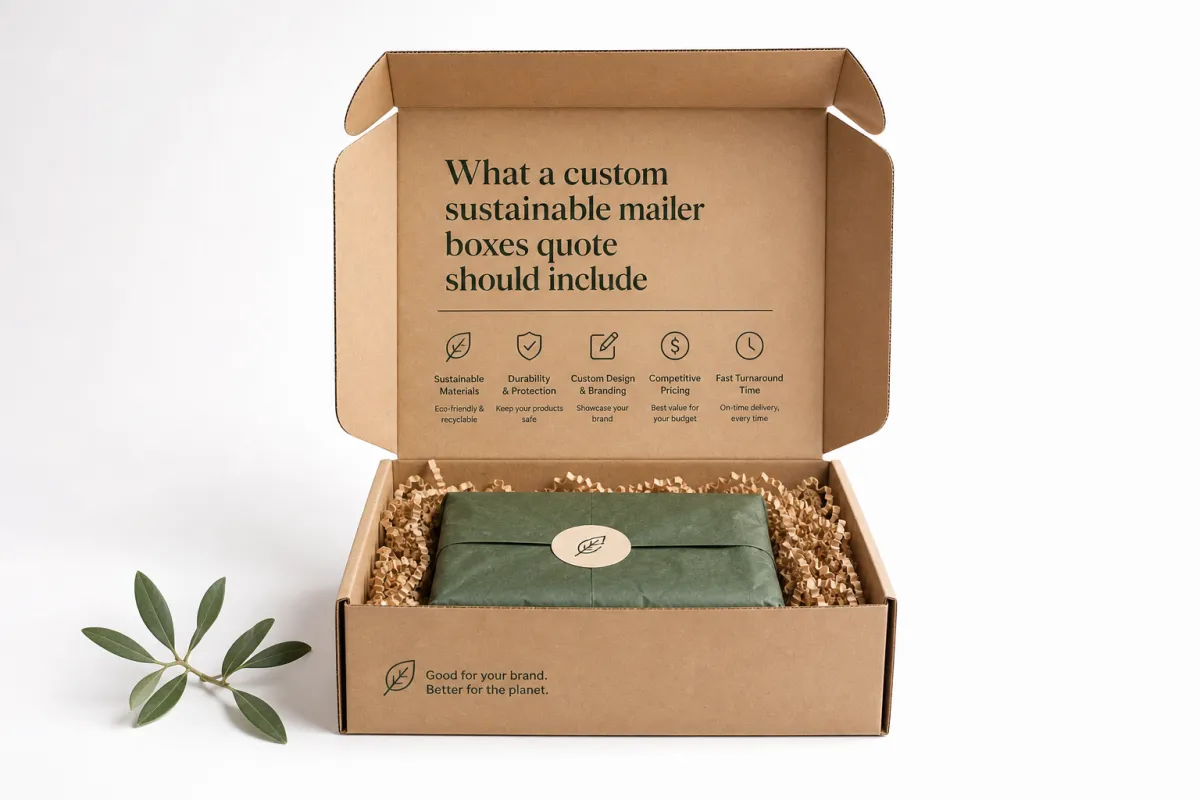
A proper custom sustainable mailer boxes quote should spell out the cost drivers in plain English. If a supplier hands over one lump sum and calls it done, you are stuck doing detective work later. Not ideal. A solid quote should separate unit pricing, setup or tooling, finishing, freight, and any extra handling tied to custom printed boxes.
Same outer size on paper does not mean same cost in production. One box may use a heavier recycled-content corrugated board. Another may need more ink coverage. A third may include a die-cut insert to keep the product from sliding around. Sustainable packaging only works if the structure fits the product. A recycled kraft liner, the right flute profile, and a sensible closure style can protect ecommerce shipments just fine, but only when the spec is built around the item instead of a vague green label.
If you want the quote to be genuinely useful, ask for these items in writing:
- Unit pricing at each quantity tier so you can see how volume changes the number.
- Setup or tooling charges for dies, plates, and print preparation.
- Board grade and construction details, not just a generic mailer box label.
- Print method and coverage level, including one-color, two-color, or full-wrap artwork.
- Freight or delivery assumptions, especially if the cartons ship flat in pallet loads.
- Lead time from proof approval to shipment.
"The best packaging quote tells you where the money is going before you approve it."
The common mistakes are boring, which is probably why they keep happening: vague dimensions, no target quantity, missing dieline files, and sustainability requirements that never make it onto the brief. Someone writes "eco-friendly mailers" and expects the supplier to fill in the blanks. That is not how this works. If you need recyclable coatings, FSC-certified paper, recycled content, or unbleached kraft, spell it out. If the goal is a lower carbon footprint with fewer materials, say that too. Those details shape the final custom sustainable mailer boxes quote more than most teams realize.
For buyers building a wider branded packaging program, it can also help to compare the mailer line against other formats like Custom Packaging Products or a lighter shipper option such as Custom Poly Mailers. Sometimes the corrugated mailer is the right call. Sometimes the lighter format wins, especially for soft goods and lower-fragility items. I have seen teams spend extra on a mailer structure they did not really need, and that kind of overspec hurts fast.
Custom sustainable mailer boxes quote: product details that change the build
The carton structure has a direct effect on price, strength, and pack-out. A custom sustainable mailer boxes quote for a roll-end tuck-front box will not match a self-locking mailer if the locking tabs, glue points, or closure geometry are different. For ecommerce fulfillment, roll-end tuck-front cartons are popular because they close neatly, stack well, and open cleanly for the customer. Self-locking closures can reduce assembly time. Flat-shipping designs help keep warehouse handling efficient.
Material choice is where the sustainability conversation really lives. Kraft corrugated board gives a natural look and usually supports a clean recyclable story. Recycled-content corrugated is a smart pick for brands that want a lower-impact material profile without changing the carton architecture. Paperboard mailers can work for lighter products, but they are not right for every shipment. If the packed item has edge pressure, more weight, or a rough distribution path, corrugated usually makes the safer box. A responsible custom sustainable mailer boxes quote should make those tradeoffs obvious instead of hiding them behind vague wording.
Sustainable features only matter if they fit the use case. Unbleached liners, soy or water-based inks, and recyclable coatings can all support an environmental claim, but the end-of-life outcome depends on the full construction. A high-gloss lamination may look polished, yet it can complicate recyclability claims depending on the finish and local collection rules. That is where honest packaging design earns its keep. If the box is meant to be curbside recyclable, say it clearly and build to match the claim.
Inserts and partitions deserve real attention. They get treated like an afterthought way too often. Bad move. A die-cut insert holds a fragile item in the center of the box, protects corners, and reduces movement, but it also uses more board and adds converting work. If you are comparing a custom sustainable mailer boxes quote with and without an insert, the difference can be meaningful. In some product packaging programs, the insert is the cheapest way to prevent damage. In others, it adds cost without enough value to justify it.
Print style matters just as much. A simple one-color logo on kraft stock often feels more restrained and more in step with a sustainability story than a heavy flood of ink. Full-wrap graphics can strengthen package branding, but they increase coverage and push costs up. For retail packaging that has to ship and still look good on arrival, the balance between visual punch and material efficiency becomes a real design decision, not decoration.
Specifications that shape your custom sustainable mailer boxes quote
Dimensions are not just dimensions. They affect fit, board allowance, shipping density, and the outside size of the carton, all of which can change a custom sustainable mailer boxes quote. A box that looks perfect on a spec sheet can still be too tight once wall thickness, product padding, or a retention insert gets involved. A good spec should list internal length, width, and depth, plus any tolerance range the converter can hold reliably.
Ask for the board details to be written down clearly. That means flute profile, caliper, liner type, and whether the stock is kraft, white, or a recycled-content blend. If the project needs extra crush resistance, the quote should say so. If the box has to survive long-distance ecommerce transit, stacking strength is not a side note. It is part of the buying decision. I like to see fill weight, product fragility, and distribution method in the brief before the custom sustainable mailer boxes quote gets locked in. Otherwise, everyone is guessing and pretending not to.
A useful spec sheet often includes:
- Length, width, depth in internal dimensions.
- Tolerances for each dimension so production expectations stay realistic.
- Tuck style and locking style, especially for mailers that close without tape.
- Board caliper and flute profile.
- Special scoring, cutouts, or retention features.
- Artwork files and print placement notes tied to the dieline.
Compliance and quality notes should be part of the brief from the start. If you need recyclable claims, recycled-content documentation, or FSC-certified material, put those requirements in the request. If your artwork depends on precise color matching, remember that kraft stock changes how color reads compared with coated whiteboard. That is not a defect. It is substrate behavior. Dark ink usually reads best on kraft, while soft tones can look muted. A detailed custom sustainable mailer boxes quote should call that out so no one acts surprised later.
The distribution method matters too. Boxes going direct to consumers in standard parcel networks take a different beating than cartons handled through light retail backroom traffic. Fragile glass, candles, supplements, and premium apparel all have different needs. A lighter mailer may be enough for folded garments, but a stronger corrugated build is usually the better choice for items that can crush, chip, or shift under load.
Testing standards help here. For transport testing, many teams reference ISTA methods to simulate vibration, drop, and compression performance. That does not mean every box needs the same level of testing. It does give you a shared language for risk. If a vendor can explain a carton design in terms of compression resistance, transit risk, and pack-out behavior, the custom sustainable mailer boxes quote becomes easier to trust.
Custom sustainable mailer boxes quote: pricing, MOQ, and freight factors
Pricing usually falls into four buckets: raw material, print and converting, setup or tooling, and freight or delivery. A custom sustainable mailer boxes quote that breaks out those buckets helps you see which decisions really move the total. The board itself is not always the biggest line item, especially when print complexity, inserts, or custom engineering are involved. On smaller runs, setup can dominate the unit cost because the prep work is spread across fewer boxes.
Minimum order quantity is one of the most misunderstood parts of the process. Smaller quantities are possible in many cases, but the unit price usually climbs because the production line still needs to be set, checked, and run. Standard dielines and simple print coverage keep MOQ more manageable. If you are trying to balance launch volume with budget, ask for a custom sustainable mailer boxes quote at two or three levels, such as a pilot run, a replenishment run, and a larger annual order. That gives you something real to compare instead of a single number that looks nice and hides the tradeoffs.
Here is a practical comparison that shows how different builds can affect price and usability:
| Option | Typical Use | Relative Unit Cost | Strength / Finish | Best For |
|---|---|---|---|---|
| Standard kraft corrugated mailer | Ship-ready ecommerce packaging | $0.42-$0.68 at 5,000 units | Good strength, natural look | Apparel, accessories, light consumer goods |
| Recycled-content mailer with simple one-color print | Branded packaging with sustainability focus | $0.48-$0.78 at 5,000 units | Good strength, cleaner eco message | Subscription kits, DTC brands, seasonal packs |
| Mailer with insert or partition | Protection and presentation | $0.62-$1.05 at 5,000 units | Better product retention, more converting work | Fragile items, multi-piece kits, premium unboxing |
| Full-wrap printed mailer with premium finish | Brand-led retail packaging feel | $0.75-$1.25 at 5,000 units | Strong visual impact, higher ink coverage | Launches, gift sets, higher-margin programs |
Those numbers are not universal, and they should not be treated like a promise. They are a practical range to help buyers ask sharper questions. The landed cost may shift based on sheet size, print method, carton efficiency, pallet count, and whether the order moves by truck, parcel, or mixed freight. Freight is usually the piece people underestimate. Large cartons shipped flat can look inexpensive per unit and then get expensive once delivery, palletization, and warehouse receiving are added. Any serious custom sustainable mailer boxes quote should make freight assumptions visible.
One smart cost-control move is to standardize dielines where possible. If your product line can share a common footprint, you cut tooling complexity and usually improve supply consistency. Another move is to simplify print coverage. A well-placed logo, a clean inside-panel message, and restrained exterior graphics can support brand perception and keep the budget from wandering off. That is one reason many packaging buyers prefer a design system that can flex across custom printed boxes without changing the structure every time.
Do not compare quotes on box price alone. Compare total cost per packed order. A slightly stronger mailer can cut damage, replacement shipments, and customer complaints. That matters more than saving a few cents on the carton if the lower-cost option creates crush failures, corner denting, or product movement in transit. On a direct-to-consumer program, the cheapest box is rarely the cheapest package once returns are counted.
Process and timeline for a custom sustainable mailer boxes quote
The best production runs start with a clean brief. The workflow is pretty simple: request intake, spec review, pricing, proofing, sample or prototype approval, production, and final shipping. A well-prepared custom sustainable mailer boxes quote usually comes back faster because there is less back-and-forth about dimensions, artwork, or material assumptions. When the information is thin, the process slows down fast.
Response time depends on how complete the brief is. If the buyer sends product dimensions, packed weight, quantity targets, artwork files, and sustainability requirements up front, the quote stage can move efficiently. If the request shows up with approximate dimensions and a handwritten note about eco packaging, expect follow-up questions. That is not red tape. That is the difference between an accurate proposal and a rough estimate that will shift later.
Proofing is where the details get confirmed. Dielines are checked, print placement is reviewed, and the board choice gets locked before the run is released. This step matters because a box can be dimensionally correct and still behave badly if the folds are too tight, the closure tension is off, or the graphics sit too close to the trim. A solid custom sustainable mailer boxes quote should include proof timing so nobody assumes the order is ready before artwork and structure are approved.
Sampling is worth the time any time fit matters. A flat digital mockup can show the design, but a physical carton tells you how the board scores, how the tuck feels, how the product sits, and whether the closure needs a firmer hand than expected. That is especially useful for premium retail packaging, gift sets, and subscription boxes where the opening experience is part of the value. If the product is fragile or presentation matters, a sample saves trouble later.
Typical timelines can vary, but a practical planning window often looks like this:
- Quote preparation: 1-3 business days if the brief is complete.
- Proof and artwork review: 2-5 business days depending on revisions.
- Sampling or prototype approval: 3-10 business days if a physical sample is needed.
- Production: often 10-18 business days after approval, depending on complexity.
- Freight transit: varies by destination and shipping method.
Those time ranges are realistic, not guaranteed. A late artwork change, a missing sustainability document, or an insert revision can add days. That is why I tell buyers to align sampling, approval, and delivery dates before they commit. If the packaging is tied to a launch, a retail reset, or a replenishment schedule, the timeline needs to be written down, not assumed.
For broader packaging design work, it can help to coordinate the mailer quote with other packaging assets so the brand voice stays consistent. That may include inserts, labels, sleeves, or a secondary shipper in a different format. If the mailer is only one piece of the program, ask how it fits into the larger packaging set. A well-managed custom sustainable mailer boxes quote should support the whole pack-out flow, not just the carton itself.
For buyers who want more context on material sourcing and certification, the Forest Stewardship Council provides a clear reference point at FSC. If you are specifying recycled content, certified fibers, or chain-of-custody documentation, define those terms before the order starts. Sorting that out after proof approval is a headache nobody needs.
Why choose us for custom sustainable mailer boxes
Good packaging work should feel practical, not theatrical. A strong custom sustainable mailer boxes quote reflects experience with board choice, box structure, and print decisions that matter in real fulfillment conditions. The value is not in hype. It is in helping you choose a carton that protects the product, supports the brand, and can be produced at the volume you actually plan to buy.
What buyers usually want is clarity. They want to know why one structure costs more, why one board grade performs better, and how the sustainability story changes with recycled content, coating choice, or ink coverage. A disciplined quoting process does that work for you. It separates the cost drivers, points out where the spec can be simplified, and shows where the extra spend is buying better protection or better presentation. That is the difference between a generic estimate and a useful custom sustainable mailer boxes quote.
Quality control matters just as much as pricing. A sustainable carton still has to fold correctly, close securely, and print consistently. If the score depth is wrong, the box can crack at the fold. If the artwork sits too close to the edge, the printed image can drift into the trim area. If the board is too light for the packed product, the box may survive the bench and fail in transit. Careful file review and inspection catch those issues before they turn into customer complaints.
Material sourcing and manufacturing flexibility matter too. Some projects need a specific board strength, some need a cleaner kraft appearance, and some need recycled-content material without changing the outer footprint. The job is to balance those requirements without making the build awkward. For many brands, the best result is a box that looks intentional, feels solid, and keeps the fulfillment team moving. If your project also needs a companion shipper or alternate format, we can compare that against Custom Packaging Products and decide whether the mailer is the right structural fit.
I also think transparency belongs in the process. If a certain box size is awkward for palletization, say it. If a premium finish pushes the quote beyond the budget, show it before approval. If a small change in depth can cut material usage without hurting performance, put it on the table. That kind of practical guidance turns a custom sustainable mailer boxes quote into a buying decision instead of a blind leap.
Still comparing format options? Review the product, the shipping method, and the brand goal together before you lock anything in. That is usually the fastest path to a box that does its job without drama. No one needs a carton that looks nice and behaves badly.
Next steps after your custom sustainable mailer boxes quote
Before you ask for revisions, gather the basics: product dimensions, packed weight, target quantity, artwork files, and any sustainability requirements. If you already know the box needs recycled content, FSC-certified paper, low-impact inks, or a curbside-recyclable build, include that from the start. A clear brief makes the next custom sustainable mailer boxes quote faster and usually more accurate.
It is usually smart to compare two or three build options instead of one. For example, you might review a standard mailer, a heavier-duty transit version, and a simplified print spec side by side. That way you can see how much cost buys you in strength, visual impact, and handling efficiency. From a packaging buyer's point of view, that comparison is far more useful than a single number with no context. It also helps align the carton choice with your product packaging budget and your shipping reality.
If the first proposal is close but not final, ask for a revised quote. Small changes in size, board grade, or print coverage can move the cost in a meaningful way. The same goes for adding an insert later. A good supplier should be able to show you how those changes affect the structure so you can make a clean tradeoff. That matters especially in branded packaging programs where the box is part of the customer experience and not just a transit shell.
Confirm the sample, approval, and delivery dates together. If the mailer is for a launch or replenishment cycle, the packaging schedule needs to match the business schedule. A delayed carton can slow fulfillment, and a rushed carton can force avoidable compromises. A realistic plan protects both margin and brand consistency. That is exactly why the custom sustainable mailer boxes quote should include timeline assumptions, not just pricing.
The main takeaway is simple: send complete specs the first time. Packed dimensions, target quantity, print coverage, board preference, inserts, and sustainability requirements belong in the same brief. That is the cleanest way to get a quote you can actually use. If you skip those details, the number you get back is just a placeholder wearing better shoes.
Frequently asked questions
What should I include in a custom sustainable mailer boxes quote request?
Give the supplier product dimensions, packed weight, target quantity, artwork files, and any insert or coating requirements. If the box has to be recyclable, made with recycled content, or printed with low-impact inks, say that clearly so the quote reflects the real spec. Shipping destination helps too, because freight can change landed cost and sometimes changes which box is actually practical.
How does recycled material affect custom sustainable mailer box pricing?
Recycled-content board can affect raw material cost, but the bigger pricing factor is often the board grade and thickness needed to keep the carton strong. If a recycled stock needs a heavier build to protect the product, unit price and freight can both rise. The better comparison is total performance per packed order, not recycled content alone.
What MOQ is typical for sustainable mailer boxes?
MOQ depends on the conversion method, board type, print complexity, and whether the box uses a standard dieline or a custom structure. Smaller runs are possible, but the unit cost usually rises because setup is spread across fewer cartons. Standard sizes and simple print coverage are usually the easiest way to keep MOQ practical.
How long does a custom sustainable mailer boxes quote and production order take?
Quote turnaround is fastest when dimensions, quantity, and artwork are already finalized. After approval, sampling, proofing, and production timing depend on material availability and the number of revisions. Extra time is usually needed if inserts, custom printing, or sustainability documentation have to be approved late in the process.
Can I request samples before placing a full order?
Yes, sampling is strongly recommended when product fit, closure feel, or presentation quality matters. A physical sample helps confirm board strength, folding behavior, and print expectations before the run is released. If time is tight, a prototype or flat sample can still catch spec issues early.

