Custom T Shirt Bags do a narrow job, and that is exactly why they work. They move product out of the store quickly, keep checkout from bogging down, and give the customer a branded surface that is still visible after the sale. A bag that leaves the counter cleanly is not a luxury item. It is packaging that earns its keep in seconds.
The appeal is practical. These bags are inexpensive relative to other retail packaging formats, they stack and dispense fast, and they make even a basic handoff look more deliberate. For apparel shops, convenience retail, food service carry-out, pop-ups, and event merchandising, that combination matters more than glossy presentation. The bag only has to do a few things well, but it has to do them every time.
There is also a branding advantage that people underestimate. Unlike a flyer or insert, the bag travels with the customer. It shows up in the parking lot, on the train, at home, and sometimes in the next store down the street. That is a long tail for a relatively small purchase.
What custom t shirt bags actually do for retail
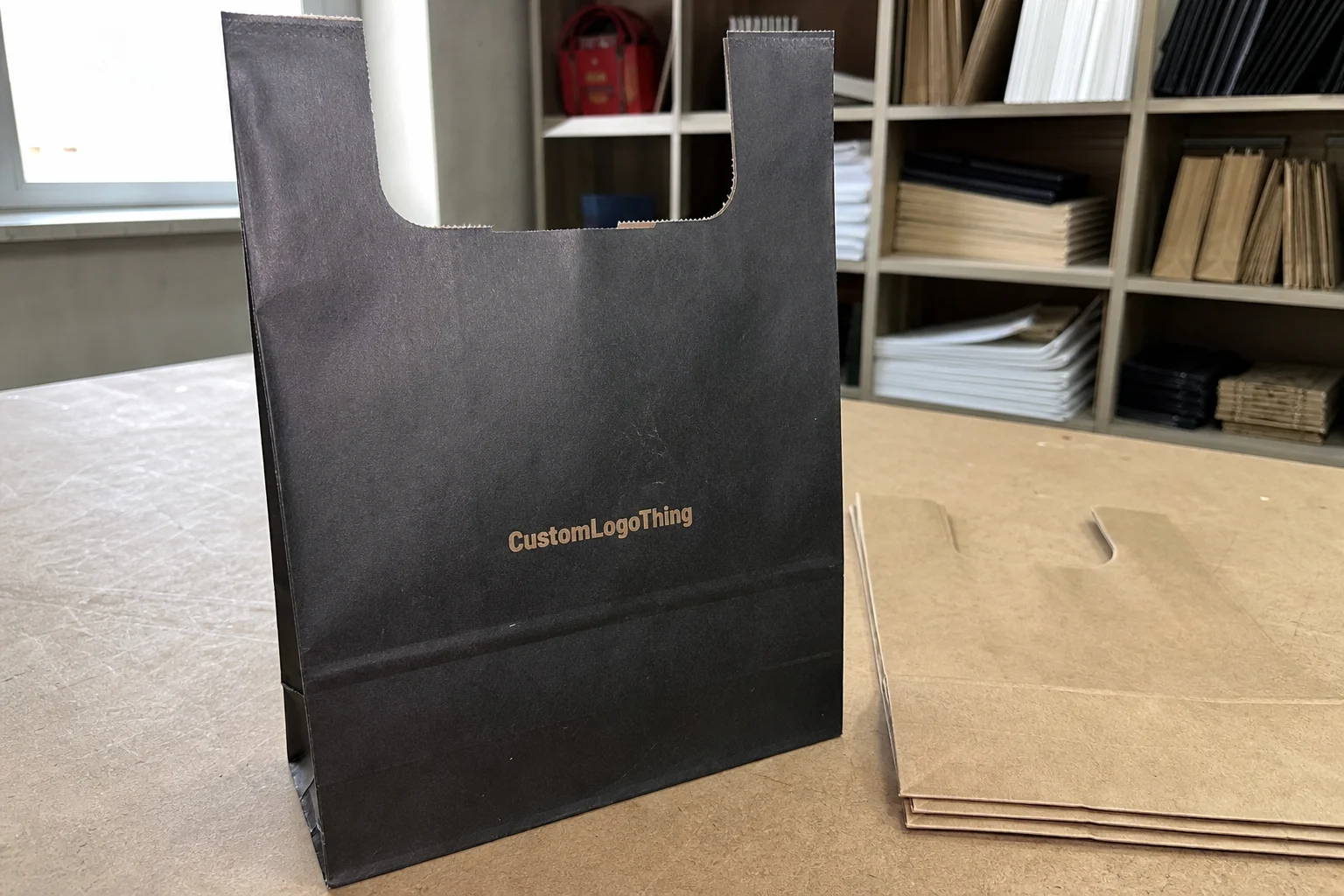
A t-shirt style bag is the workhorse of checkout. It usually has die-cut handles or looped handles, side gussets for volume, and a shape that is easy for staff to grab, open, and load. The format is simple on purpose. Simplicity is what keeps it fast in a high-volume environment.
Used well, the bag solves three problems at once. It carries the product safely, it keeps the register line moving, and it gives the store a visible brand mark without moving into expensive packaging territory. That is why you see this format everywhere from apparel counters to grab-and-go food service. The use cases differ, but the logic does not.
This is not the right format for everything. If the goal is a premium unboxing moment, rigid protection, or gift-like presentation, a paper shopping bag or custom printed box may fit better. T-shirt bags are strongest where speed, cost control, and volume matter more than structure.
The cheapest bag is the one that still reaches the customer’s home in one piece. If it tears in the parking lot, the printing did nothing except document the failure.
From a buyer’s perspective, the math is straightforward. A low-cost bag can improve presentation, reduce handling friction, and create repeat exposure at the same time. That is a rare combination in retail packaging. Most formats do one of those jobs well and compromise on the rest.
How the bag structure affects performance and print
Structure matters more than most first-time buyers expect. Film type, gusset depth, handle cut, seal strength, and print method all change how the bag performs once it leaves the counter. A thin high-density film can be efficient and easy to dispense, but it will feel crinklier and can show stress sooner. A thicker low-density film usually feels softer and more forgiving, which helps when the load is awkward or heavier than average.
Gusset depth is one of the first places orders go wrong. Too shallow, and the bag fights the product. Too deep, and the bag can waste material, stack poorly, or feel loose when folded. Handle design matters too. A clean die-cut handle is convenient, but the surrounding film needs enough support to keep the handle area from tearing under load.
Printing on flexible film behaves differently from printing on paper or board. Bold type, clear contrast, and simple artwork usually perform best. Thin lines can disappear, small type can become unreadable, and gradients can print less cleanly than expected if ink coverage is not tightly controlled. On this format, restraint often looks better than decoration.
Color and opacity influence the result as well. White or frosted film creates strong contrast for logos. Colored film can make the bag feel sharper at the counter, but it also changes how the artwork reads. Opaque bags hide contents more effectively and often feel more polished for retail packaging. Translucent film can still be appropriate when product visibility is part of the experience, especially in grocery or food service settings.
Durability is another tradeoff that deserves a direct answer. Lightweight bags keep costs down and dispense quickly, but they are a poor match for boxed goods, bottled drinks, or dense apparel bundles. In those situations, moving up a grade in thickness is usually cheaper than replacing bags, handling complaints, or watching a customer carry the bag like it might fail before the door.
Specs that change fit, durability, and branding
Start with the actual product pack-out, not the old bag size in storage. Measure the average width, depth, and height of the items that will go into the bag, then add enough room for easy loading. A bag that is barely large enough usually slows checkout and looks sloppy when it is overstuffed.
The main variables are straightforward: width, length, gusset depth, gauge or mil thickness, and material type. Each one changes how the bag feels in the hand and how it behaves under load. Once those are set, decide whether the application needs reinforcement or whether a simple spec will do the job. For apparel, a moderate spec is often enough. For dense or awkward products, heavier film makes more sense.
Branding choices matter just as much. A large logo placed high on the bag is easier to read from a few feet away than a tiny mark tucked near a seam. One-color print is usually the most cost-efficient option, but two colors can still be practical if the artwork stays bold and the quantity justifies the setup. Reuse value matters too. If the bag is clean and durable enough that customers use it again, the brand gets extra exposure at no extra cost.
| Spec style | Best for | Typical print style | Typical unit range at 5,000 pcs | Tradeoff |
|---|---|---|---|---|
| Lightweight HDPE, standard size | Apparel, small retail items, fast checkout | 1-color logo, bold type | $0.06-$0.11 | Lowest cost, least forgiving on heavy loads |
| Midweight HDPE or blended film | General retail, boxed accessories, mixed orders | 1-2 colors, larger logo area | $0.09-$0.16 | Better handfeel, moderate cost increase |
| Heavier film with larger gusset | Bottles, dense bundles, higher carry stress | Bold multi-color branding | $0.14-$0.26 | More durable, higher material and print cost |
Storage and handling should not be ignored. Larger bags take more room in the back stock area and can be awkward on a tight counter. A fast register workflow usually benefits from a simpler spec, not a more complicated one. Fancy dimensions do not help if staff cannot load the bag quickly or if the stack is always in the way.
For buyers comparing formats, the cleanest rule is this: match the bag to the actual handling condition. Not the idealized one. Not the one that sounds tidy in an email. The real one, with real product weight, real store traffic, and real hands moving under pressure.
Cost, MOQ, and unit pricing: what changes the quote
Price on Custom T Shirt bags usually comes down to five things: size, thickness, print colors, material choice, and order volume. Freight matters too, especially on larger runs, because a quote that looks strong on paper can lose its edge once shipping is included. If the order requires custom tooling or print plates, that adds another cost layer.
MOQ is where many buyers misread the economics. Smaller runs almost always carry a higher per-unit price because setup is spread across fewer bags. In practical terms, a 5,000-piece order may run 20 to 40 percent higher per unit than a 25,000-piece order with the same basic spec. That is not a pricing gimmick. It is the cost structure of the job.
There are also budget items that often get overlooked. Setup fees, proof revisions, extra artwork versions, split shipments, and storage charges can turn a clean estimate into a messy one. If the bags are tied to a launch calendar or distributed across multiple locations, those details should be checked before approval. A low bag price with expensive logistics is not actually low.
A practical buying sequence helps keep the project grounded: pay for the spec that protects the product first, then optimize decoration to stay inside budget. If the size is wrong or the film is too light, the print will not fix the underlying problem. The bag has to work before it gets credit for looking good.
- Lower cost path: one-color print, stock size, standard film.
- Middle path: custom size, stronger gusset, one or two inks.
- Higher-end path: heavier film, larger print area, tighter color control.
For broader packaging programs, compare the bag quote against other branded elements rather than treating it as an isolated purchase. If the store is also ordering labels, inserts, or Custom Packaging Products for a launch, the bag should fit the same visual system instead of feeling like an afterthought.
Production steps and turnaround: from proof to shipment
The production path is predictable when the artwork is clean and the spec is clear. First comes the quote. Then the size and print details are confirmed. After that comes artwork prep, proofing, production, inspection, packing, and shipment. Delays usually happen when one of those steps is vague or rushed.
- Quote and spec review: confirm size, thickness, handle style, print colors, and quantity tier.
- Artwork prep: convert files to the correct format, size, and color setup.
- Proof review: check dimensions, logo placement, text, and any required marks.
- Production: print, cut, seal, and form the bags.
- Inspection and packing: check consistency, then pack for shipment.
- Freight and delivery: move the order to a receiving point that can actually handle the cartons.
Turnaround varies by volume and complexity, but standard runs often land around 12 to 18 business days after proof approval. Larger orders, more print colors, or tighter color matching can push that to 20 business days or more. Rush schedules are sometimes possible, but they cost more and leave less room for correction if something looks off.
The proof stage is where most problems are either caught early or baked into the order. Check bag size, logo scale, copy, color references, and any regulatory text with real care. If something feels off, fix it there. Adjusting artwork after production starts is the fastest route to delay and waste.
If the bags are part of a broader shipping or distribution program, transit discipline matters too. Packages fail in ways that do not show up on a screen, which is why testing standards exist. Groups like ISTA are useful references for how packaging behaves in the real world. For a broader framing of packaging design and materials, packaging.org is also a useful resource.
Step-by-step ordering guide for first-time buyers
If this is the first time ordering Custom T Shirt bags, start with the use case instead of the artwork. What products go into the bag? How heavy are they? How many bags does the store use in a day or month? That tells you whether you need a lightweight retail bag or a heavier spec that can survive dense product and rough handling.
Then move through the order in a practical sequence.
- Measure the product pack-out. Use the average item size, not the most flattering example.
- Pick the size and thickness. Choose a bag that loads easily and carries without stress.
- Decide on the print approach. One color is usually the cleanest budget choice; two colors work if the artwork stays simple.
- Prepare the artwork file. Ask for the correct format before sending a screenshot from an old website header.
- Request tiered pricing. Compare a few quantity levels so MOQ does not distort the decision.
- Ask for a sample or digital proof. Verify fit, print placement, and finish before production.
- Plan receiving and storage. Make sure cartons have a home when they arrive.
That last step gets overlooked more than it should. A shipment with nowhere to go creates delay, clutter, and a lot of improvised decisions that make no one happier. Good packaging planning includes the receiving area, not just the print file.
If the bag is part of a larger launch, align it with labels, inserts, and any custom printed boxes or shipper materials already in use. Consistency makes the whole program feel deliberate. That is the point of package branding: the customer should feel that the pieces belong together, even when the order itself is simple.
Spec the item first. Decorate second. That rule prevents more bad bag orders than any sales pitch ever will.
Common mistakes, expert tips, and next steps
The most common mistakes are predictable. Buyers undersize the bag, choose a gauge that is too light, use low-contrast artwork, or forget that local packaging rules can affect what gets sold or distributed. None of those errors is hard to avoid. Each one gets expensive once the order is already moving.
- Mistake: choosing a bag by guesswork.
- Fix: measure the actual product and add working space.
- Mistake: using tiny artwork details.
- Fix: simplify the logo and keep the type bold.
- Mistake: buying only on unit price.
- Fix: compare the full landed cost and the failure risk.
The practical tips are not exotic. Keep the logo large enough to read from a few feet away. Test the bag with real product weight, not with empty optimism. Compare a sample against the actual checkout workflow, because a bag that looks fine in a mockup can be annoying at the counter if the handles, gusset, or film feel wrong in practice.
Sustainability questions also need a direct answer. If recycled content, compliance marks, or local recycling guidance matter, ask for them up front. Do not assume the default spec works in every market. Material claims, thickness rules, and recycling streams vary, and sloppy assumptions are a fast way to create a packaging problem nobody planned for.
The simplest path forward is usually the best one: collect the product dimensions, estimate monthly quantity, set the needed ship date, and request pricing across a few volume tiers. That gives you a real buying picture instead of a hopeful guess. Done properly, custom t shirt bags become a predictable retail tool rather than another line item with mystery math.
What size custom t shirt bags should I order for retail?
Base the size on the actual product pack-out, not the old bag size in storage. Measure the average width, depth, and height with a little slack for easy loading. If the items vary a lot, choose the most common use case and avoid overstuffing the bag.
How thick should custom t shirt bags be for heavier items?
Heavier groceries, bottles, or boxed goods usually need a thicker gauge than apparel-only bags. Match thickness to weight and handle stress instead of chasing the cheapest spec. If the load is awkward or dense, ask for a sample test before approving production.
Are printed custom t shirt bags much more expensive than plain ones?
Printing adds setup and decoration cost, but the per-bag increase is usually modest at volume. One-color artwork is typically the most efficient choice for budget control. The real cost jump usually comes from small runs, extra colors, or custom sizing.
What is the typical turnaround time for custom t shirt bags?
Turnaround depends on quantity, print complexity, and whether the artwork is approved cleanly the first time. Standard runs often take about 12 to 18 business days after proof approval, while more complex orders can run longer. Rush schedules are possible in some cases, but they cost more and leave less room for changes.
Can custom t shirt bags be made with recycled content or compliance marks?
Yes, depending on the supplier and the regulations in your market. Ask for recycled-content options, required labeling, and any local thickness or recycling rules before the order is locked. For custom t shirt bags, that is the difference between a bag that looks fine and a bag That Actually Fits the market.

