Custom t shirt Bags With Logo are simple by design, which is why they remain a practical packaging choice. They carry merchandise, protect it from scuffs and moisture, and give customers a branded takeaway that can extend beyond the sale.
For buyers, the format is attractive because it is relatively inexpensive to brand and widely used in convenience retail, boutiques, foodservice carryout, pharmacy counters, trade show handouts, and community events. The main decision points are still the same: size, film thickness, print layout, and order quantity.
Why custom logo t-shirt bags still punch above their weight
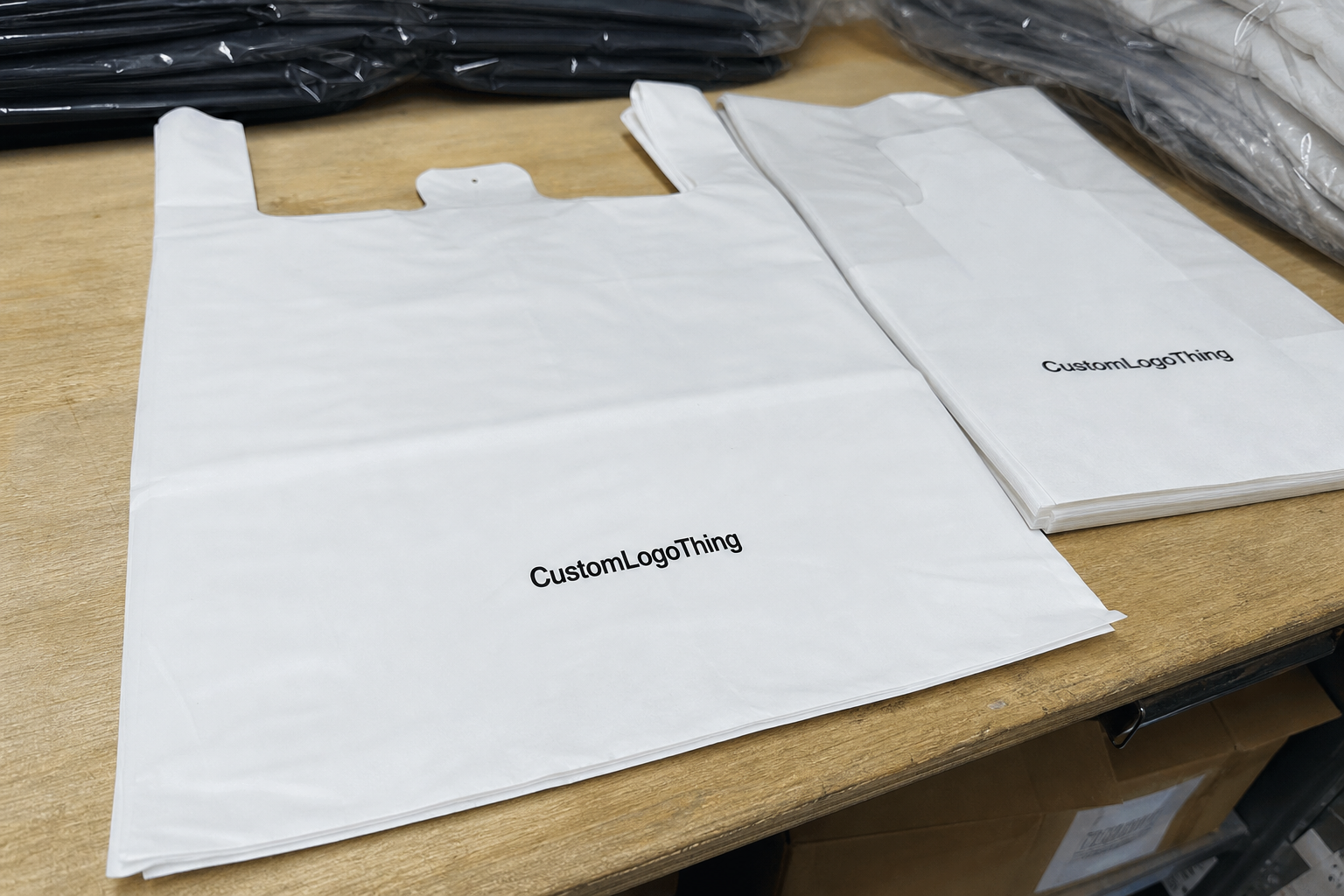
The “t-shirt” name comes from the die-cut handle shape and the draped look of the bag. Structurally, these bags typically use side gussets for expansion, a bottom seal for load support, and a handle cut that makes them fast to grab at checkout.
A good bag does not need to be complicated. It needs to fit the item, hold the weight, and print cleanly enough that the logo still looks intentional after handling. In retail, that is usually enough.
These bags are especially useful where speed matters and the contents are relatively light: convenience stores, bakeries, takeout counters, apparel shops, and event giveaways. They also make sense for businesses that want branded packaging without moving up to heavier shopping bags or more rigid cartons.
A useful bag is one that disappears into the process until the moment it is supposed to do its job.
Before ordering, buyers should set expectations around four things: print area, film thickness, minimum order quantity, and load capacity. Those four specs account for most of the problems people run into, and most of the extra cost too.
How the bag structure and printing process work
Most t-shirt-style bags are made from polyethylene film, usually LDPE or HDPE. LDPE feels softer and more flexible. HDPE feels crisper and can often be produced thinner while still delivering useful strength. The right choice depends on the product, the desired hand feel, and the print requirements.
The production sequence is straightforward. Film is prepared or extruded, gussets are formed, the bottom is sealed, and the handle openings are cut. If the bags are printed, the artwork is applied during the film or converting stage depending on the plant’s equipment and the bag style.
For larger runs, flexographic printing is the usual method. It handles one-color and two-color branding efficiently across thousands of bags. Setup is where the fixed cost lives. Once the plates are made and the press is running, the per-unit print cost generally becomes more attractive as quantity rises.
Detailed art is where reality pushes back. Tiny text, gradients, thin lines, and overly fussy logos are harder to hold on flexible film. Simple logos tend to reproduce better, especially when the bag is being formed, cut, and stacked at speed.
Artwork placement matters more than most buyers expect. The handle cut, side folds, and bottom seal reduce usable print space, so a design that looks fine on a flat proof may sit too close to an edge once the bag is converted. That is why printers ask for exact dimensions and vector files before quoting.
Material choice also changes how the bag behaves during use. LDPE generally gives a smoother hand and a bit more stretch, which can help with merchandise that has corners or uneven shapes. HDPE is often thinner for a given strength level, so it appeals to buyers trying to reduce material use without giving up function.
When the print is simple, the process is usually cleaner and more economical. One-color or two-color logos, a centered imprint, and a standard film choice tend to keep the job moving. Full-bleed graphics, specialty film requests, and highly detailed art add complexity fast.
For brands that want packaging to feel consistent across the shelf and the counter, it helps to compare this format with other branded packaging pieces, including Custom Packaging Products.
Key specs that affect durability, look, and everyday use
Thickness is one of the first specs to confirm. Suppliers may talk in gauge or microns. Either way, the point is the same: thicker film generally handles more weight and resists tearing better, while thinner film saves material and can work well for lightweight merchandise. If the bag is going to carry boxed goods, bottled items, or multiple products, thin film can become a problem around the handle zone.
Size matters just as much. A bag that fits a folded T-shirt may be too tight for boxed products or a bundle with inserts. A bag that is too large can look sloppy and use more material than necessary. The dimensions need to match the real item, not the idealized version of it in a mockup.
Color choice affects both visibility and perceived quality. White film usually gives the cleanest background for logo contrast. Natural or semi-clear film can reduce visual weight when a lighter look is wanted. Solid-color bags make a stronger brand statement, but they can affect ink contrast and may need more careful press setup to keep the logo readable.
Handle style and seal quality also affect daily performance. Die-cut handles are common because they are fast to use and easy to stack. But the bottom seal has to be consistent, especially if the bag will see repeated handling in a busy checkout lane. A weak seal ruins a bag faster than most logos can be fixed.
- Thickness: should match the load and expected handling
- Size: must fit the product with enough room for loading
- Color/opacity: changes contrast and how premium the bag feels
- Handle and seal strength: determine real-world durability
- Material goals: recycled content or lower-impact options may matter depending on your packaging standards
If sustainability is part of the buying brief, ask what recycled content is available and whether it changes print quality, clarity, or consistency. In some cases that means post-consumer recycled content. In others, it means using less material without weakening the bag.
For buyers who want a broader reference point, industry groups such as the Flexible Packaging Association and testing bodies like ISTA are useful when evaluating packaging performance and distribution handling.
Custom t shirt bags with logo: cost, pricing, and MOQ factors
Pricing usually comes down to five variables: bag size, film thickness, print colors, quantity, and whether the job needs plates or screens. A standard one-color run on stock sizing is a different purchase from a custom-size, multi-color program with special film requirements. More variables usually mean more setup work.
MOQ, or minimum order quantity, is the smallest run a plant will make efficiently. It exists because printing setup, plate prep, material loading, and converting all happen before the first sellable bag is packed. That fixed work has to be spread across the run, which is why small orders usually cost more per unit.
Here is a practical way to think about the cost picture:
| Option | Typical cost pressure | Best fit | Notes |
|---|---|---|---|
| Standard size, one-color print | Lower | Retail counters, events, basic branding | Usually the cleanest path for a first order |
| Standard size, two-color print | Moderate | Retail packaging with stronger logo emphasis | More setup than one-color, but still efficient |
| Custom size, one-color print | Moderate to higher | Products that need an exact fit | Size changes can affect tooling and film use |
| Custom size, multi-color print | Higher | Brand-heavy programs and premium packaging | More plates, more setup, more proofing |
As a rough budgeting reference, Printed Plastic Bags can vary a lot depending on spec. A buyer might see very different quotes for the same apparent bag if thickness, size, color, and print method are not identical. That is normal. A run of 5,000 pieces and a run of 20,000 pieces will rarely share the same unit economics.
Use landed cost, not just unit price, when comparing suppliers. Add shipping, storage, handling, and the rate at which the bags are actually consumed. A slightly higher unit cost can still be the better deal if it lowers freight per bag, reduces stockouts, or keeps inventory from sitting too long.
It also helps to compare the bag against the rest of the customer handoff. A well-printed bag can support retail packaging, reinforce the brand, and reduce the need for extra inserts or decorative wrap.
Process and turnaround: from artwork approval to shipment
The usual production flow starts with a quote request, then moves into spec confirmation, artwork review, proofing, production, packing, and shipment. If the buyer sends clear information at the start, the job usually moves faster. If the specs are vague, the back-and-forth eats time before production even begins.
Artwork approval is often the first bottleneck. Vector files are preferred because they stay sharp at scale and separate cleanly for flexographic print. Raster files can work if they are high resolution and large enough, but small text, thin lines, and tight registration tend to cause proof revisions.
Lead time depends on the production queue, stock availability, print complexity, and whether the requested film is already on hand. A standard run with common materials will usually move faster than a custom-size job or a bag that needs unusual color matching.
For seasonal promotions, store openings, trade show handouts, or packaging rollouts, buffer time matters. If the bags are part of a broader product presentation, they should arrive early enough to allow for proof changes, freight delays, or a second approval round.
Some buyers coordinate the bag order with inserts, labels, or Custom Packaging Products that need to match the same visual language.
If the bags will ship through a rough distribution channel, it can be worth asking whether any test standards apply. ISTA methods matter more for packaged goods than for the bag alone, but they help buyers think through how packaging behaves once it leaves the counter. For disposal and recycling questions, EPA recycling resources can help frame local expectations.
Common mistakes buyers make when ordering printed plastic bags
The first mistake is ordering size from the product’s front view only. Once items are folded, banded, boxed, or bundled with inserts, the thickness changes quickly. A bag that looks generous on paper can feel tight on the loading table if the gusset depth is off.
The second mistake is sending artwork that was never designed for flexible film. Low-resolution logos, tiny phone numbers, and hairline type may look fine on screen and still print weakly on the bag surface. Bold, clean artwork nearly always performs better.
Another common issue is under-ordering. If a store moves through bags faster than expected, emergency replenishment usually costs more and may force a compromise on size or print style. Reordering before the last carton is empty is boring. It is also cheaper.
Buyers also overlook local bag rules or the practical difference between carryout use and merchandise use. Some markets care about material reduction or recyclability messaging. Others care more about durability and checkout speed. Those goals do not always point in the same direction, so the use case needs to be clear before approval.
If the bag will touch food, apparel, or customer-facing merchandise, it should be reviewed like a working packaging component, not just a promotional item with handles.
Finally, do not assume all custom logo bags are equal because the proof looks similar. Film quality, seal consistency, and handle cut all affect the real customer experience. The logo is only one piece of the job.
Practical ordering steps for a cleaner, more cost-effective run
Start with the basics: bag dimensions, target thickness, film color, print count, estimated monthly usage, and the type of product the bag will carry. Those details give a supplier enough to recommend a format instead of guessing.
Ask for a sample or a spec sheet before final approval, especially if the bag has to balance branding with actual load-bearing performance. A sample tells you more than a catalog image ever will. You can feel the film, check handle comfort, and see whether the logo reads clearly from a few feet away.
Use vector artwork whenever possible, and confirm the exact imprint placement before production starts. Small shifts matter on a bag with gussets and handles, because the visible panel is not always as large as the flat mockup suggests. If there is any uncertainty, request a digital proof and a written spec summary.
For a cleaner buying process, this sequence usually works best:
- Compare two or three quotes using the same specifications.
- Verify print method, thickness, and bag dimensions line by line.
- Approve the proof only after checking logo placement and text legibility.
- Confirm lead time and shipping method before the order is released.
- Reorder while inventory is still healthy, not when cartons are nearly empty.
That routine prevents a lot of avoidable friction. It also keeps the buying decision grounded in the actual outcome: a practical retail packaging item that carries the product safely, reinforces the brand, and does not create extra problems on the floor.
What’s the difference between custom t shirt bags with logo and plain stock bags?
Custom bags add brand recognition, a more polished handoff, and a better customer takeaway experience. Plain stock bags are usually faster to source, but they do not reinforce your logo or messaging. The better choice depends on budget, order volume, and how important branding is at the point of sale.
How do I choose the right thickness for printed T-shirt bags?
Match thickness to what the bag will carry, because heavier items need stronger film and better seal durability. Thin bags can work for lightweight merchandise, but they are more prone to stretching and tearing. Ask for a spec recommendation based on product weight, handle comfort, and expected use.
Do custom printed t-shirt style bags require a large minimum order?
Often yes, because printing setup and converting equipment create fixed costs that are spread over the run. Larger quantities usually lower the per-bag price, while small runs tend to cost more per unit. Minimums vary by size, print colors, and material availability, so it helps to confirm early.
How long does the production timeline usually take for logo bags?
Timeline depends on artwork approval, material stock, print complexity, and the current production schedule. Simple jobs move faster than projects needing multiple revisions or special material sourcing. Build in buffer time so you are not waiting on bags right before a launch or busy season.
What artwork files work best for custom t shirt bags with logo?
Vector files are ideal because they stay crisp when scaled and print more cleanly on flexible film. High-resolution raster art can work if it is large enough and has clean edges. Confirm spot colors, logo placement, and any fine text before approving production.