Buyer Fit Snapshot
| Best fit | Custom Uv Printed Boxes Bulk projects where brand print, material claims, artwork control, MOQ, and repeat-order consistency need to be specified before quoting. |
|---|---|
| Quote inputs | Share finished size, material target, print colors, finish, packing count, annual reorder estimate, ship-to region, and any compliance wording. |
| Proofing check | Approve dieline scale, logo placement, barcode or warning zones, color tolerance, closure strength, and carton packing before bulk production. |
| Main risk | Vague material claims, crowded artwork, missing packing details, or unclear freight terms can make a low unit price expensive after revisions. |
Fast answer: Custom Uv Printed Boxes Bulk: Structure, Print Proof, Packing, and Reorder Risk should be specified like a repeatable production item. The safest quote records material, print method, finish, artwork proof, packing count, and reorder notes in one written spec.
Production checks before approval
Compare the actual filled-product size with the drawing, then confirm tolerance on folds, seals, hang holes, label areas, and retail display edges. Reserve space for logos, QR codes, warning copy, and material claims before decorative graphics fill the panel.
Quote comparison points
Review material grade, print process, finish, sampling route, tooling charges, carton quantity, and freight assumptions side by side. A quote is only useful when the supplier can repeat the same color, closure quality, and packing count on the next order.
Custom UV Printed Boxes Bulk is not a styling exercise, it is a retail psychology problem with a manufacturing budget attached. I used to underestimate this in my early projects, because it felt like “just coating,” but watching people in fulfillment hubs unpack samples taught me otherwise: a box either tells a controlled story or it looks like random stock. For Custom Logo Things, that distinction shows up in every use case—retail drops, ecommerce unboxing, promo kits, and gifts where the first touchpoint is often the only chance to set expectation. If you are comparing Custom UV Printed Boxes bulk quotes, the first question is not “Which one is cheapest?” The first question is “Will this box look intentionally designed when someone notices it in two seconds or less?”
That effect is easier to spot than people think. A sharper gloss edge, a cleaner logo edge, or a raised UV panel can lift perceived value faster than increasing box height, adding five extra stickers, or overprinting interior paper layers. Plain board with matte ink often reads as functional and forgettable. Custom UV printed boxes bulk gives you visual rhythm—light hits a point, pauses, then recognition appears. I’ve sat in enough photo shoots to see this repeatedly: the same product in a stronger finish package gets chosen by buyers who are still scanning the shelf.
A packaging job has one base order: protect, present, scale. If it does not protect, it fails. If it does not present, it disappears. If it does not scale, it gets shelved after one campaign. UV finishing is useful only when it supports those three jobs and doesn’t break workflow control. In practical terms, it is an amplifier, not a substitute.
Why Custom UV Printed Boxes Bulk Beat Plain Cartons
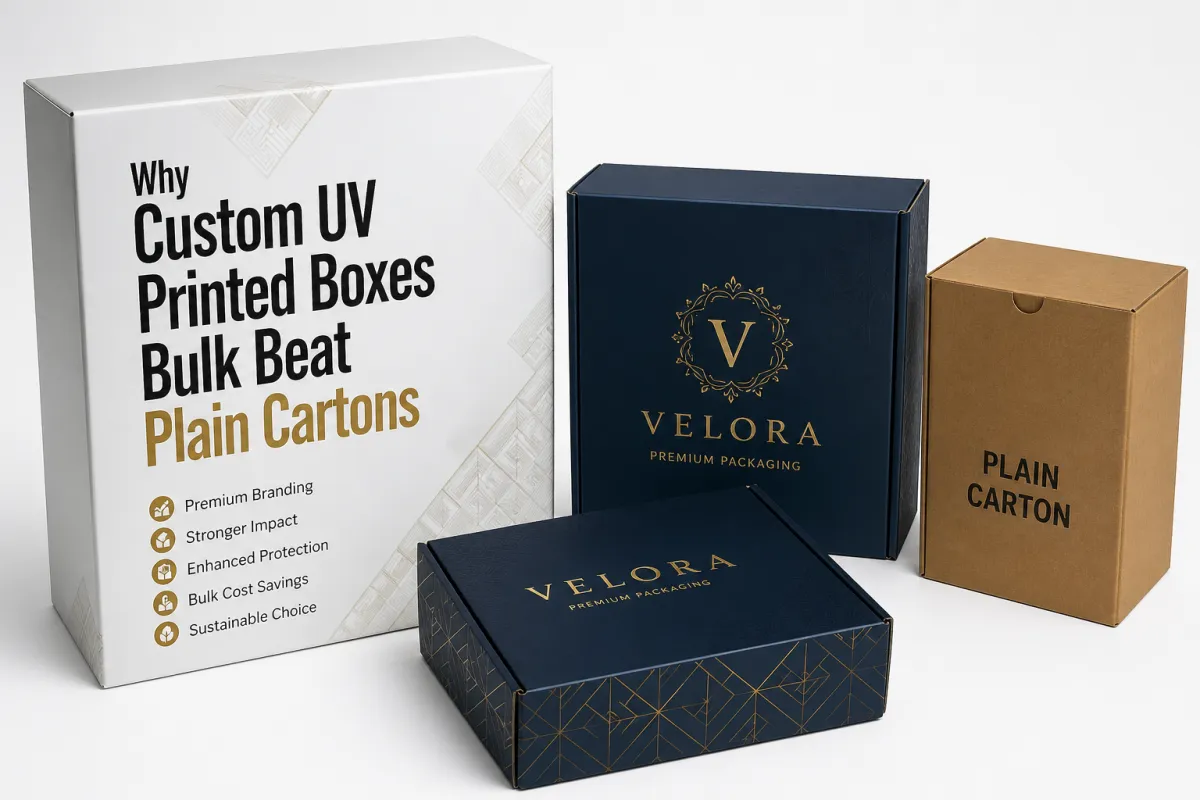
Plain cartons are fine when the package is mostly transport. Place them beside another plain carton and both are interchangeable until one detail catches the eye. Custom uv printed boxes bulk matters when a brand has to be recognized across platforms and distances. A matte board with a selective spot UV hit can feel more premium than a larger printed area that has no tactile hierarchy. The difference is physics and cognition: UV reflection gives your edges a cleaner edge, and clean edges feel intentional.
Look at where the pressure is highest. On retail displays, attention is fragmented and distance is short. In ecommerce, the package arrives as a promise after the order decision and either confirms or quietly weakens expectation. For subscription programs, repeat identification depends on memory, so packaging must remain recognizable without redesign every cycle. Promo kits and event mailers are judged in seconds by people already overloaded with messaging. That is exactly the environment where custom uv printed boxes bulk performs better than plain print.
A useful lesson from multiple brand launches: surface treatment often outperforms artwork density. Loud graphics can become visual noise when everything competes for attention. One focused UV accent on a symbol, one descriptor, or one pattern bridge usually carries the information more reliably. That is why teams use this process for launches, replenishment cycles, and premium retail programs where each repeat order has to feel familiar. The finish creates packaging hierarchy, and hierarchy is what moves attention into memory.
Long-run discipline matters more than novelty. The first run can tolerate surprises; the tenth run cannot. Once production shifts from prototypes to recurring batches, the brand benefit of custom uv printed boxes bulk is repeatability: same spec, same measured output, same visual behavior. When controls are stable, you remove variation and reduce disputes. I still see teams spend money on style iterations while the fold profile changes by 1mm between batches—that is where budgets burn, not in clever design notes. The requirement is process discipline, not decorative ambition.
Practical rule: when packaging is part of the buying experience, finish quality and fold discipline compete for priority. When it only protects a product, keep the structure lean and don’t over-engineer gloss.
Custom UV Printed Boxes Bulk: Product Details and Finish Options
Most teams do not need a packaging thesis; they need the format that matches their SKU profile without creating surprise costs. In custom uv printed boxes bulk, format and structure affect printability, assembly speed, unit cost, and shelf presentation all at once. Common structures are mailer boxes, Tuck End Boxes, rigid boxes, sleeve boxes, and folding cartons. Each shifts what the customer sees and how much operational complexity your team can absorb. In short: form is not an aesthetic afterthought, it is the cost function.
Substrate choice drives finish behavior. UV response changes across SBS board, C1S/C2S artboard, corrugated board with a white liner, and wrapped rigid chipboard. Smoother surfaces give cleaner varnish edges and more reliable transitions between matte and gloss. Rough kraft can be beautiful when used with discipline, but the grain reduces micro-level gloss uniformity—kinda like trying to keep wet paint smooth on canvas grain. That is not a flaw; it is a tradeoff that changes perceived sharpness and edge integrity under store lighting.
Most programs use three finish systems:
Full UV applies a uniform high-gloss or matte-contrast coating over the full surface, useful for strong branding statements. Spot UV targets only selected art zones and preserves control of contrast and hierarchy. Raised UV adds a physical micro-relief effect and tactile depth, turning certain details into touch points. Narrow zones tend to read as intentional. Broad zones can work too but they reduce subtlety, especially in lower light conditions.
From a pre-press perspective, spot UV is usually the safest production default. It lets you guide the eye toward logos and key messaging without coating the whole panel. Fine, thin type in high-gloss areas can collapse depending on line width, so text below a practical stroke threshold needs review before locking artwork. On press, tight registration tolerance is the difference between “premium” and “blurry,” so every micron matters more than people admit during first review.
Design should start with the UV map, then place base print around it. Darker color fields with high contrast carry UV accents better than crowded multicolor scenes. If visual weight is spread evenly across too many elements, the finish becomes decorative, not strategic. When the finish architecture is mapped during layout and not added later, the package feels like one coherent design decision, not a second pass patch.
At scale, custom uv printed boxes bulk usually sits inside a broader packaging framework, and the strongest teams connect carton, insert, and label logic from the start. Custom Packaging Products can be useful for coordinating this ecosystem, while Wholesale Programs help when quantities and cadence rise quickly. A campaign often needs at least four packaging elements anyway: shipper, insert, label, and face package. If those layers drift, the brand gets fragmented across touchpoints.
Transit stress is one invisible failure mode. If your boxes pass through high-compression handling, validate corner crush behavior, stacking strength, and test methodology against ISTA references. If sustainability matters, check source and chain-of-custody documentation tied to FSC. These are unspectacular checks, but they prevent expensive reorders, fulfillment delays, and avoidable complaint loops. You can spot a weak spec only after it fails at the dock.
- Mailer boxes: best for ecommerce, subscription kits, and direct-to-consumer fulfillment environments.
- Tuck end boxes: efficient for retail packaging and lightweight products requiring fast visual recognition.
- Rigid boxes: premium presentation with a higher cost profile and stronger unboxing perception.
- Sleeve boxes: strong for layered branding, wrap-heavy campaigns, and controlled presentation reveals.
- Folding cartons: compact and economical, frequently used for recurring bulk runs.
Specifications That Decide Whether the Box Prints Cleanly
Most packaging defects do not begin at the press; they begin at instruction ambiguity. Custom uv printed boxes bulk needs exact dimensions, structure logic, finish map, and color assumptions before costing can be trusted. If the brief says “approximate size” and “light gloss somewhere,” no production planner can create a stable build plan. Ambiguity creates proof cycles, late corrections, and timeline drift. Every extra loop adds cost, and cost is rarely transparent until the second review.
Your core spec package should include finished dimensions, style code, board thickness, print coverage, finish placement, insert configuration, and carton pack-out expectation. That list sounds procedural because execution is process-driven. The most expensive mistakes usually come from skipped details done in a rush: window openings, fold-in flaps, magnet closures, and reinforcement structures. These are easy to define, and painful to discover after sign-off. Custom uv printed boxes bulk does not reward fuzzy language.
Dielines are where most projects lose accuracy. A weak dieline allows score drift, weak fold tolerances, and cut displacement that becomes obvious once UV lands on the edge. Spot or raised UV amplifies that weakness because gloss amplifies transitions and reveals misalignment faster than flat print. A disciplined sequence is: finalize dieline, then lock color and art within approved constraints. That order protects your approval windows and reduces what I call the “looks fine in preview” trap.
Artwork quality is technical, not merely visual. Vector logos and clean anchors are easier to register than high-detail raster textures. Safe margins must account for trim, glue, fold, and die tolerance. Full bleed coverage across UV-treated edges prevents fringe visibility and improves continuity across wraps. Keep fine detail out of narrow glossy zones unless you are certain of minimum line width, especially on textured board. In production, a 0.5mm shift is often invisible on-screen and obvious in hand.
Proofs are where confidence is built or destroyed. Ask for tolerance maps, cutout positioning, fold directions, and finish simulation close to production conditions. For bulk work, proofing should confirm gloss zones, score alignment, and wrap continuity over all panels. If those are missing, stop and request them before approval; no one should assume they are implicit. This is not red tape—it is quality control insurance.
One real packaging rule: clear specs and practical proofs reduce waste more effectively than any design flourish, because they prevent compounding errors at scale.
A reliable test for teams is simple and repeatable: does the project return consistent outcomes per pallet or per shift? Precise specs produce stable production behavior, while vague specs produce acceptable-looking samples and inconsistent lots. Buyers who submit final dimensions, approved art, and explicit gloss maps usually get faster responses and fewer surprises. Buyers who rely on “it should be okay” often spend weeks answering email threads.
Custom UV Printed Boxes Bulk Pricing, MOQ, and Cost Drivers
Bulk economics are straightforward once you separate fixed from variable costs. Setup, prepress correction, die-cut validation, and finish calibration are usually order-level costs. If you run fewer units, those fixed costs hit each unit harder. As volume rises, the per-unit value of that fixed setup improves. The result is the usual curve: early runs look expensive, larger runs become cost-efficient.
For custom uv printed boxes bulk, most market windows land between 250 and 1,000 units depending on structure and finish complexity. Folding cartons often enter with lower barriers when structure is simple. Rigid formats and dense spot UV patterns usually push MOQ upward because they require more setup and stricter process control. A supplier promising “no minimum” is possible, but setup still lands somewhere in the math. When it does, the real buyer pays through hidden unit pricing and operational surprises.
Cost is cumulative, not mysterious. Box size changes paper usage and pallet efficiency. Board profile changes stiffness, print behavior, and defect risk. One-sided print reduces cost; double-sided and interior graphics add material, registration, and inspection time. Spot UV is usually lighter on cost than raised UV because raised effects add handling and curing sensitivity. Inserts, sleeves, and custom die lines also add labor and QC checkpoints.
| Box Style | Typical MOQ | Common Finish | Rough Unit Price Range | Best Fit |
|---|---|---|---|---|
| Folding carton | 500-1,000+ | Spot UV or full UV | $0.45-$1.10 | Retail packaging, lightweight products |
| Mailer box | 250-1,000+ | Spot UV, matte + gloss contrast | $1.15-$2.40 | Ecommerce, subscription, kits |
| Sleeve box | 500-1,500+ | Spot UV or raised UV | $0.30-$0.95 | Layered branding, wrap presentation |
| Rigid box | 500-1,000+ | High-contrast spot UV | $2.80-$7.50 | Premium gifting, luxury presentation |
These ranges are directional, not guarantees. They assume clean files, standard structure stability, and no unusual manual finishing. If a quote appears much lower than these bands, request a breakdown of board weight, UV intensity, and print count before you sign. Lower numbers can signal lighter substrate, reduced coating quality, or process compromises not visible in mockups. Custom uv printed boxes bulk should be evaluated through the whole value stack: appearance, durability, timing, and service response.
Most teams keep costs under control with three decisions: standardize the carton size where possible, simplify structure to the needed level, and reduce UV effects to those that improve communication. Extra decorative coats without clear message gain, then quickly plateau in return. If the logo reads with one accent, adding two more gloss islands usually helps less than it costs. That’s a clean way to keep design intentional and manufacturing sane.
There is a hidden cost trap that looks like savings: pushing too much speed to get lower per-unit pricing on fragile specs. Thin board can pass an initial sample and still fail on shelf, under courier stress, or after returns. Over-extended glossy coating raises transfer and scuff risk, especially in repeated handling cycles. A custom dieline that is aligned with a stock-size assumption creates expensive rework when packaging actually sits on production machines. Teams who compare custom uv printed boxes bulk quotes on complete production assumptions usually save money in the total landed cost, even when initial unit pricing is not the lowest.
Production Process and Timeline for Bulk UV Printed Boxes
Production stays predictable when input dependencies are locked in early and approvals follow a logical path. The usual flow is still: spec review, dieline setup, artwork proofing, sample approval, run production, finishing, packing, then freight booking. When inputs keep changing after quote approval, schedules drift fast and quality risk rises. Every late change costs not just money, but rework time and internal attention. If your team misses milestones, most delays compound rather than add up cleanly.
- Spec review: lock size, structure, board grade, print sides, finish map, and packaging context.
- Dieline setup: confirm structure, fold paths, trim lines, glue zones, and orientation assumptions.
- Artwork proof: check placement, bleed, finish zones, color management, and registration notes.
- Sample or digital approval: approve finish behavior before full production starts.
- Run production: print, finish, cut, fold, inspect, and reject out-of-tolerance panels.
- Packing and freight: define pack-out, pallet method, and dispatch sequence based on carrier and route.
For standard folding cartons and mailer boxes, many operations complete in roughly 12 to 18 business days after proof approval when all materials are approved. Rigid builds and complex custom uv printed boxes bulk designs often need 18 to 28 business days because control points increase in finishing and assembly. Internal inserts, special coatings, and niche interior graphics can push timelines further. That is normal behavior for demanding jobs and should be discussed before quote acceptance, not after a date is promised.
Delay patterns repeat in almost every program. Missing dielines delay setup. Late approvals interrupt machine sequencing. Finish revisions after first proof approval force expensive corrections in visually critical areas. The common reaction is “just adjust quickly,” which often creates two or three extra review rounds. Packaging flow is linear, so any disruption near print or die output moves through folding, finishing, inspection, and freight together.
Rush runs are possible when all upstream decisions are already stable. The tradeoffs are predictable: higher unit cost, reduced revision windows, and stricter approval deadlines. If launch timing is fixed, send final files early, confirm the milestone plan, and agree on revision limits before work starts. If boxes enter courier networks, map handling assumptions with ISTA expectations and route realities. Transit is the only true final inspector, and real handling is harsher than most pre-press previews.
Most multi-layer programs fail on coordination, not print. Outer box, inner insert, and protective wrap each has its own clock, and their dependencies need one shared timeline. If one element ships early and the rest stalls, inventory gets stranded and fulfillment gets fragmented. Aligning all components to the longest lead is usually safer than trying to “just-in-time” each piece separately. The result is a cleaner release date and fewer emergency freight moves.
Why Choose Us for Custom UV Printed Boxes Bulk Orders
Custom Logo Things is built for teams that prefer process clarity over marketing noise. Custom uv printed boxes bulk is not a decorative side project. It is a repeatable manufacturing program with direct brand impact, especially for products where first-touch trust matters. A misaligned gloss edge, a weak fold, or low board stiffness can damage perception across an entire product range in one reprint cycle. That can cost more than redesigning artwork ever could.
The strongest supplier behavior is to challenge assumptions early. Not to delay, but to catch contradictions before approval. We constantly check whether dimensions match dieline geometry, whether finish areas land correctly, and whether structure fits actual product dimensions. Mockups can look perfect, yet fail at the physical fold line when assembly logic is added. A supplier that flags this early is valuable; one that just moves files forward is hoping for lucky alignment.
Consistency at bulk volume is a quality system, not a slogan. Coating placement must match approved color values every batch. Fold geometry needs tolerance control across shifts. Color has to be measured and repeated across runs. Board rigidity should align with the shipping profile and customer handling behavior, including stacking depth and friction events. If any one rule breaks, complaints move from “isolated issue” to “pattern” very quickly.
Support is usually the hidden edge in real execution. Teams need more than a file upload portal: they need practical comments on dieline constraints, finish behavior, and whether gloss visibility will actually show in your primary distribution channels. Questions around print reliability and visible defects need direct answers, because every unresolved ambiguity is an approval delay waiting to happen. In my experience, this kind of support is what turns a good supplier into a reliable one.
For larger programs, packaging coherence matters as much as individual box quality. Custom uv printed boxes bulk performs best as part of a broader wholesale and product packaging strategy where cartons, inserts, labels, and displays share direction. Separate visual systems create fragmented brand memory. Aligned systems make it easier for buyers to recognize your offer in channels as varied as subscription replenishment, retail, and gifting.
Good packaging partner rule: if a supplier asks you to relax spec discipline to save time, that usually means higher risk later. Discipline at the start protects your schedule, your budget, and your brand integrity.
Business realities shift almost immediately—forecasts jump, orders arrive late, and launch windows move. The teams that adapt without chaos are the ones with disciplined checkpoints and clear fallback logic. That is why custom uv printed boxes bulk projects stay viable under pressure. We build with enough flexibility to respond, but not so much looseness that control disappears.
What to Prepare Before You Request a Quote
A complete quote starts with complete data. Share exact external dimensions, target quantity range, preferred style, material, finish type, print-side preference, and all interior constraints such as inserts, windows, magnets, or closures. Delivery location and packaging destination should be included immediately, because freight assumptions can change total landed cost dramatically. Without that, even a precise quote can mislead.
Artwork should arrive with final brand colors, approved logos, and visual references. If you need a specific gloss intensity, define it clearly and include a benchmark sample or visual target. If your custom uv printed boxes bulk should feel soft premium instead of glossy premium, say that in writing and explain where the finish should calm down. When your packaging portfolio has a visual language already established, include those references. Production teams can match what is documented; they cannot infer intent from mood.
Ask for a synchronized response with three parts: quote, dieline, and timeline. A quote without structure is not a quote, and a spec without schedule cannot support planning. A timeline without proof checkpoints creates false optimism and unrealistic operational assumptions. A complete first response should always include constraints, assumptions, and decision points. That alone reduces revision cycles and protects your internal launch calendar.
Comparing only unit price is a trap that repeats in almost every procurement cycle. Low pricing can reflect thinner board, lighter UV, shorter handling windows, or reduced quality controls. A slightly higher unit price with stronger structure and better process discipline often reduces total cost once returns, damage, and reorders are included. This is especially true in campaigns with repeated replenishments where hidden defects can compound.
Before submitting a request, run your own pre-submit audit: exact dimensions, quantity breakpoints, UV type (full, spot, or raised), print side count, and documented interior requirements. If any item is undefined, clarify it first. Unknowns are where timeline risk hides, and timeline risk is where budgets quietly disappear. Filling these gaps improves response quality and reduces churn later.
When your files are clean, proceed in order: submit specs, validate proof protocol, and lock board and finish placement before confirming volume. That sequence gives you custom uv printed boxes bulk that is likely to look intentional on launch day and remain stable in the hand-off environment where real customers meet it.
What Should You Know Before Ordering Custom UV Printed Boxes Bulk?
Start with the basics you can measure: exact dimensions, target quantity, board grade, and a detailed finish map. Custom uv printed boxes bulk works best when logo, gloss zones, and folding logic are fixed before quote conversations begin. If those are still fluid, expect delayed approvals and revision overhead. A stable base spec gives you speed and reduces avoidable revisions.
Second, choose your finish identity early. Spot UV gives crisp emphasis through selective contrast, raised UV adds physical emphasis, and full UV gives broad surface consistency. The choice should follow your communication goal, not the cheapest default. A subtle finish works for restrained premium; high contrast supports impact under mixed light; dramatic coating suits short shelf cycles and gifting moments. Don’t let that decision be last-minute.
Ask for the same three artifacts in your initial comparison: dieline, proof, and timeline. That gives a common yardstick and avoids subjective quoting. For custom uv printed boxes bulk, the most reliable proposal explains board type, finish placement, and production timing clearly. If those sections are missing or vague, ask for expansion before you proceed. You’re not being difficult; you are preserving your release plan.
Finally, verify practical details that are easy to miss: expected transit handling, pallet density, and how defects are handled if they appear after start of production. Good suppliers discuss these conditions up front. No supplier should promise flawless output without defining control process, and no brand should sign a scope that excludes inspection terms. That transparency is not bureaucracy; it is trust engineering. Trust, in production-heavy packaging, is often worth more than a flashy finish.
What is the minimum order for custom UV printed boxes bulk?
Most custom bulk programs begin around 250 to 1,000 units, depending on structure, board profile, and finish complexity. Simpler cartons can dip lower under specific material and design conditions, yet lower volumes usually increase per-unit costs significantly. If you are running a pilot, request a limited sample batch first and scale only after you confirm appearance and assembly in real handling. That approach usually lowers total risk before full production lock.
How much do custom UV printed boxes bulk usually cost per unit?
Per-unit pricing changes with dimension, board type, ink build, print coverage, and finish method. Spot UV, raised UV, and full UV each add different setup demands and quality-control checks. Cost usually drops as order size rises because fixed workflow costs spread across the volume. Ask for at least two quantity-based quotes so you can see where the economics bend and where the quality commitments change.
Is UV coating the same as spot UV on bulk boxes?
They are related but not the same. UV coating is broader in application, while spot UV is localized and designed for emphasis. Spot UV often needs stricter registration control and more precise process management, which can affect cost and proof requirements. Use spot UV when contrast and hierarchy matter most, and avoid it when your design relies on broad visual uniformity.
How long does production take for custom UV printed boxes bulk?
Standard runs are often fastest when approval flows are clean and specs are complete, while rigid and highly custom builds can need longer timelines. Most delays come from late artwork edits, dieline revisions, and finish rework cycles. To protect date certainty, submit final files early and confirm timeline assumptions before quote approval, especially when launch deadlines are fixed. If timing is fixed, keep revision windows explicit and capped.
Can custom UV printed boxes bulk be printed on both sides?
Yes, most structures can be printed on multiple sides, and additional coverage generally increases both setup and control requirements. Double-sided treatment is useful for subscription campaigns, premium gifting, and unboxing sequences where interior visibility matters. For tighter budgets, prioritize strong front-face communication and add interior graphics only where they improve clarity or experience. In practice, this sequencing is often more effective than trying to cover every panel at once.

