A custom weekender bag is judged like compact luggage, not like a casual tote with a zipper. That distinction matters. If the handle pulls awkwardly, the zipper fights back, or the shape balloons past a usable carry-on size, the logo cannot save the experience. The best programs treat the bag as a travel tool first and a branding surface second. That order changes the spec from the start.
For branded gifting, retail assortments, or employee travel kits, the buyer is not only buying a soft-sided bag. The real question is whether the product supports the trip, the brand story, and the budget at the same time. If the bag sits inside a wider packaging program, it should also work with the carton, inserts, and presentation layer. That is where Custom Packaging Products come into the picture. The bag does not live alone.
What a custom weekender bag is and why buyers specify it
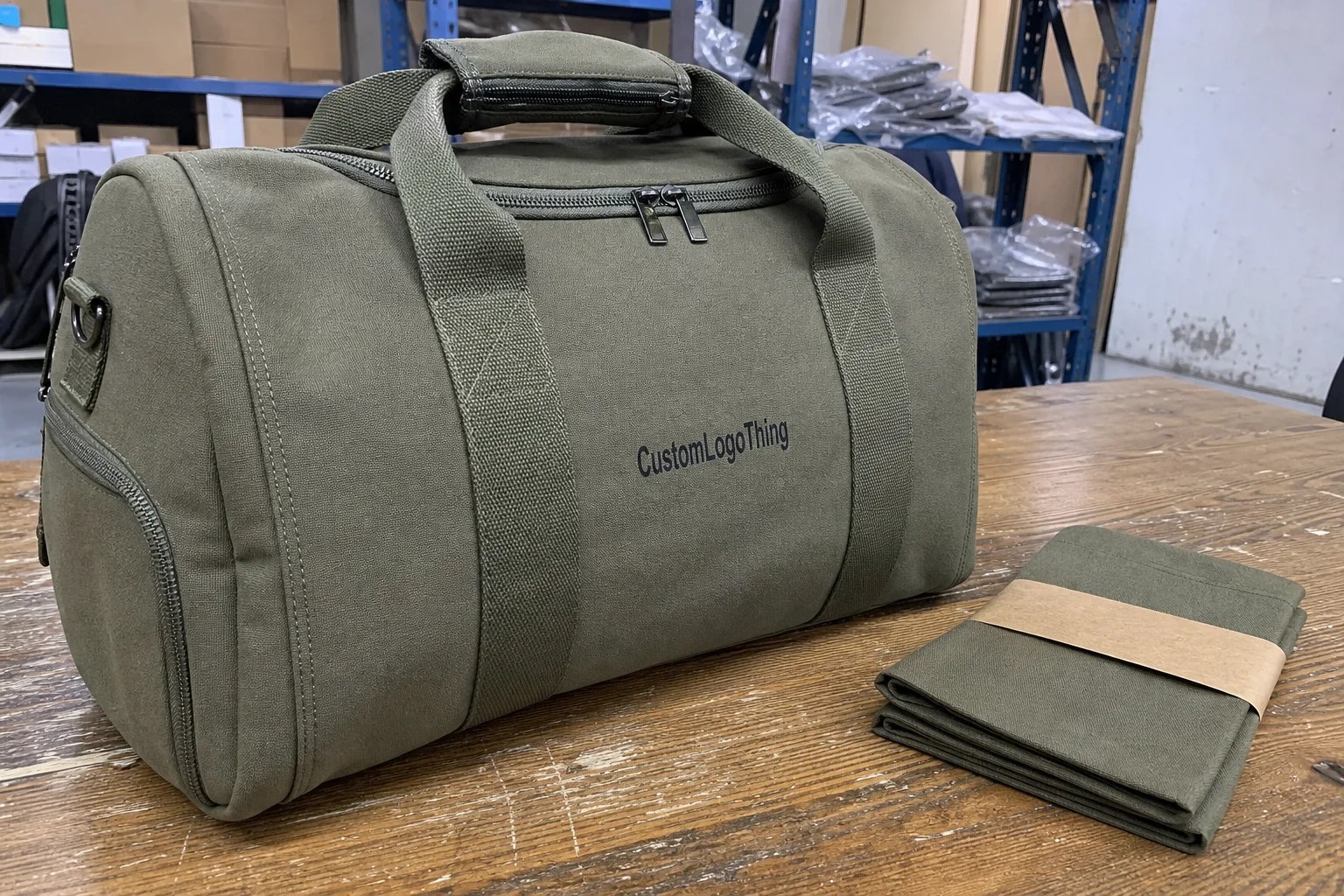
A weekender bag is a soft-sided travel bag built for one to three nights away. It usually sits between a tote and a duffel. That middle ground is the whole point. A tote opens wide and is easy to grab, but it can collapse under heavier items. A duffel holds more, but it can get bulky fast. A weekender aims for balance: enough room for clothing, shoes, toiletries, and a charger, while still looking presentable in a lobby, airport, or retail display.
Wholesale buyers choose a custom weekender bag when the program needs more perceived value than a standard promo item. Typical uses include hospitality welcome kits, premium retail assortments, corporate travel gifts, resort merchandising, and employee onboarding packages. The bag has to do two jobs at once. It needs to be useful on the road and credible on the shelf. That is why the build matters so much. The silhouette, the hardware, the stitch lines, and the lining all behave like product packaging decisions, not just style choices.
Most buyers start with six levers: size, material, structure, lining, hardware, and logo method. A seventh usually gets overlooked: packing format. A well-made bag can still disappoint if it arrives crushed, overfolded, or stuffed into a carton that makes the first impression feel careless. The product is the bag, but the pack-out shapes how people judge it.
How the bag is built: materials, structure, and decoration
Think of the bag as a stack of decisions. The outer shell controls the look, the lining controls the inside feel, the zipper system controls daily use, and the base determines whether the bag stands up or slumps. Handles matter more than many buyers expect. So do strap anchors, seam reinforcement, and corner finishing. Those details are not decoration. They are the difference between a bag that feels premium and one that feels rushed.
Material choice drives the rest of the build. Canvas gives a classic, casual look and takes embroidery well. Polyester and nylon usually cost less at scale, weigh less, and can improve water resistance. Faux leather or PU pushes the bag toward a more polished, giftable style, though it often adds cost and can feel heavier. Coated fabrics sit in the middle and work well when the buyer wants a cleaner surface with easier wipe-down cleaning. One practical rule applies across the board: the more complex the surface finish, the more carefully the logo and stitching need to be handled.
Decoration method matters just as much. Embroidery reads premium, but fine detail can distort. Screen printing works well for flatter graphics and cleaner brand marks. Woven labels and patches add texture without taking over the bag. Heat transfer supports multicolor art, but Buyers Should Ask how it holds up on high-flex areas. Debossing and foil treatment suit faux leather or coated surfaces, but they are not right for every brand. On a travel bag, the logo has to survive handling, not just photography.
| Material | Typical feel | Best use case | Cost impact | Buyer caution |
|---|---|---|---|---|
| Canvas, 12-16 oz | Casual, tactile, familiar | Retail, gifting, lifestyle brands | Low to medium | Can stain more easily unless finished |
| 600D polyester | Light, practical, less structured | Promotions, employee kits, high-volume programs | Low | Needs good stitching to avoid a thin look |
| Nylon, 210D-420D | Smooth, lighter, travel-friendly | Corporate travel, sportier programs | Low to medium | Logo contrast can disappear on dark colors |
| PU or faux leather | Polished, giftable, premium | Hospitality, executive gifting, retail tie-ins | Medium to high | Heat and abrasion testing matter |
| Coated fabric | Clean, modern, easy to wipe | Resort merch, commuter travel, modern branding | Medium | Coating quality changes the hand feel a lot |
From a sourcing angle, the brief should also mention the packaging around the bag. If the item arrives with a hang tag, tissue, dust cover, or retail carton, that becomes part of the perceived quality. Buyers who already think about Custom Printed Boxes usually understand this instinctively: every surface, fold, and finish contributes to package branding. If sustainability matters, check whether paper components can be sourced from FSC-certified supply chains at FSC and whether recycled-content claims line up with current guidance from EPA.
Key factors that change comfort, durability, and brand fit
Size sounds simple until you compare it with how people actually pack. A bag that is too small feels cramped after two shirts, a pair of shoes, and a toiletry kit. One that is too large becomes awkward in transit and more expensive to ship. For many buyers, a useful starting point is roughly 18 to 22 inches long, 9 to 12 inches deep, and 10 to 13 inches high. That is not a rule. It is a range that fits most overnight use without turning the bag into oversized luggage.
Comfort is where a lot of samples win or lose. Handle drop affects whether the bag hits the hip or digs into the hand. A padded shoulder strap matters more than many artwork reviews suggest. Balanced weight distribution matters too, especially if the bag includes metal hardware or a reinforced base. If a traveler has to wrestle the bag into a car seat or overhead bin, the logo becomes an afterthought. The product has already failed.
A bag can look premium in a render and still feel wrong after one real trip if the handles, zipper pull, and base are underbuilt.
Durability signals are usually visible if you know where to look. Check stitch density on load-bearing seams. Check whether the handle anchors are boxed or bartacked. Check zipper quality, especially on long opening runs. Check lining weight and whether the bag has a base board or foam support. Buyers often ask for one broad promise like “better quality,” but that is too vague to be useful. Better to specify the exact stress points that matter.
Brand fit deserves a hard look too. A minimalist premium brand usually needs cleaner seams, restrained hardware, and a tighter color palette. A high-volume promotional campaign may care more about easy logo visibility and lighter cost. A rugged outdoor-inspired program may want contrast stitching, water resistance, and reinforced corners. That is why a good custom weekender bag brief should define the brand mood in practical terms, not just adjectives. “Modern,” “luxury,” and “premium” do not say enough on their own.
For travel programs that will be packed and shipped repeatedly, ask whether the carton or packed unit should be tested against transit protocols such as ISTA methods. The bag itself is not a box, but the shipping logic is similar: vibration, compression, drop, and scuffing are the real enemies. If the outer pack-out is sloppy, the retail bag often inherits the damage before anyone touches it.
Step-by-step guide to ordering a custom travel bag
The cleanest orders start with a specific use case. Not “we want a bag.” Something sharper: overnight business travel, retail gifting, resort merchandise, employee welcome kits, or an event premium. Each one changes the spec. A resort bag may prioritize lighter weight and easier cleaning. A corporate travel bag may need a laptop sleeve. A resale bag may need stronger structure and a more polished finish.
Once the use case is set, build a simple spec sheet. Keep it practical and complete.
- Target dimensions and approximate capacity.
- Material family, color, and any coating or finish.
- Logo method, size, and placement.
- Hardware color, zipper style, and strap setup.
- Lining preference, pockets, and internal organization.
- Packaging requirements, including hang tag, tissue, dust bag, or outer carton.
Then request a sample or digital mockup before approving production. A mockup only proves the artwork fits. A sample proves whether the bag works in hand. That difference is huge. A zipper can snag. A strap can sit too high. A logo can look balanced on screen and awkward once the bag is folded or stuffed. Buyers who skip the sample stage usually pay for it later in revisions, freight delays, or markdowns.
If the bag is part of a larger gift system, compare the bag brief with the wider Custom Packaging Products plan at the same time. The bag, the box, and any inserts should feel like one program, not three disconnected purchases. That is where package branding gets stronger and less expensive to manage.
Approve final production only after the spec sheet, quantity, delivery address, carton count, and packing method are locked. A lot of friction disappears when everyone is looking at the same document instead of a string of email comments.
Common mistakes that create weak bags and avoidable delays
The first mistake is choosing style before use. That sounds harmless, but it usually leads to the wrong size, the wrong handle drop, or too much structure for the intended audience. A bag meant for hotel gifting does not need the same build as a retail travel bag. A rugged shape can look strong in a mockup and still be annoying to carry. Function should narrow the style, not follow it.
The second mistake is treating logo approval as the finish line. It is not. Low-resolution artwork, poor placement, or the wrong decoration method can make the bag feel cheaper than the sample price suggests. A large logo on a heavily curved panel can distort. Fine detail can disappear on textured canvas. Dark-on-dark printing can vanish under indoor light. If the brand mark cannot be read from a few steps away, the decoration probably needs revision.
The third mistake is ignoring stress points. Handles, strap anchors, and zipper ends fail first because they take the load. If a buyer only checks the front panel, the finished product can still disappoint after a few weeks of use. This is where practical packaging thinking helps. Good product packaging anticipates handling, friction, and repeated opening. Travel goods are no different.
The fourth mistake is underestimating shipping and packing. Folded dimensions, carton quantity, palletization, and freight mode all change landed cost. A bag that ships in a compact carton can be far cheaper to move than one that arrives partially stuffed to preserve shape. That tradeoff matters even more on international orders, where every cubic inch carries a cost.
Finally, avoid vague language like “make it premium.” That phrase does not tell a factory what to build. Better to say: 12 oz canvas, one-color embroidery, metal zipper pull, lined interior, reinforced base, and a dust bag. That kind of brief reduces back-and-forth and improves the odds of a usable quote.
Expert tips for a better-looking and better-selling bag
Choose a base color that can handle real use. Black, navy, olive, charcoal, and deep tan often hide scuffs better than pale colors, especially for travel programs. That does not mean every brand should pick dark tones. It means the color should survive baggage handling, car seats, and hotel floors without looking tired after one trip.
Place the logo where it will be seen while the bag is carried, not only while it is sitting flat. Side panels, upper front panels, and strap-facing views can matter more than a perfectly centered mockup. Buyers often think in terms of a hero shot. Users think in terms of motion. Those are not the same thing.
One premium detail is usually enough. Metal hardware, a lined interior, contrast stitching, a structured base, or a brushed zipper pull can carry the design farther than six small features fighting each other. Overdesign often makes a bag feel busy rather than premium. Simplicity, done carefully, usually wins.
Ask for detailed sample photos before approving mass production. Focus on seam finish, zipper tape, strap anchoring, lining edges, and base reinforcement. Those are the places where quality shows up. A flat front view tells you almost nothing. Side angles and close-ups tell you a lot.
If the bag is intended for resale, test it with real contents. Put packing cubes, shoes, and toiletries inside. Then check how the shape behaves at different fill levels. A retail buyer wants a bag that looks like it can hold a weekend, not one that only photographs well when empty. Perceived capacity affects conversion more than most teams admit.
Production process and timeline: from sample to shipment
The cleanest production path is usually brief, quote, sample or prototype, revisions, final approval, production, quality check, and shipment. Simple enough. The bottlenecks are usually not mysterious. Missing artwork, incomplete dimensions, unconfirmed hardware colors, and late packaging changes create most of the drag. A factory cannot build around a moving target without slowing down.
Lead time depends on complexity as much as quantity. A simple canvas bag with one decoration method may move through sampling faster than a padded faux-leather version with multiple pockets and custom hardware. Many programs see samples in roughly 7 to 15 business days, then production in about 15 to 30 business days after approval. That range is real, but it shifts with material sourcing, seasonality, and how fast the buyer answers questions.
One useful habit shortens schedules: consolidate feedback. One email with all revisions is better than five emails spread across a week. Scattered notes force repeated proofing and create avoidable mistakes. If you want a faster launch, keep the decision chain short.
Quality control should happen before shipment, not after arrival. Check measurements, decoration placement, seam integrity, strap attachment, zipper function, and carton count. If the order is going into retail or a gifting rollout, verify the packing method too. The difference between a neat packed unit and a loose one can change how the whole program is received.
Cost, pricing, and next steps: what drives the quote
Pricing mostly comes down to material, size, structure, logo method, hardware, packaging, and quantity. That is the short version. The longer version is that every choice affects labor and yield. A bag with more panels takes longer to cut and sew. A zipper pocket adds assembly steps. A multicolor logo can add setup and registration time. A premium lining changes both material cost and sewing complexity.
MOQ matters because setup cost gets spread across the run. Smaller orders usually pay more per piece. At lower quantities, a simple canvas bag with basic embroidery might land in the mid-teens per unit or higher, while faux leather with heavier hardware can move well above that. Larger runs usually improve the unit cost, but only if the spec stays stable. If the brief keeps changing, the savings disappear quickly.
Sample fees, tooling, freight, and rush handling can all affect the final budget. Buyers sometimes focus only on the bag price and forget the rest. That creates false comparisons. One quote may look cheaper because it excludes packaging, or because it assumes a different decoration method. Request apples-to-apples proposals using the same spec sheet. If the numbers are not built from the same assumptions, the comparison is not useful.
If the bag is part of a broader gift program, align the brief with the packaging partner early. That keeps the bag, the box, and any inserts moving as one system rather than three separate purchases. It also makes it easier to compare the bag against other product packaging decisions in the same campaign instead of treating it as a standalone item.
To get a reliable quote for a custom weekender bag, send dimensions, material preference, logo method, quantity, target budget, and packing requirements in one brief. The more complete the input, the less guesswork in the quote. That is how you protect margin and avoid revisions later.
How big should a custom weekender bag be for overnight trips?
A practical size usually fits one to three nights of clothing, toiletries, and a laptop or shoes without becoming too bulky to carry. The best dimensions depend on whether the bag is meant for business travel, retail gifting, or casual weekend use.
Which materials work best for a custom weekender bag?
Canvas, nylon, polyester, and faux leather are common choices because they balance cost, durability, and appearance in different ways. The right material depends on whether the buyer wants a casual look, a premium feel, water resistance, or easier cleaning.
How long does a custom weekender bag order usually take?
Timing depends on sample approval, material sourcing, decoration complexity, and order quantity. A clean spec sheet and fast feedback usually shorten the process more than any single production shortcut.
What MOQ is typical for a custom weekender bag?
MOQ varies by factory, construction complexity, and decoration method, but smaller runs generally cost more per unit. Ask for MOQ by material and logo method so you can compare options without hiding setup costs.
How can I lower the unit cost without making the bag look cheap?
Simplify the construction, reduce color changes in the logo, and avoid unnecessary hardware or special packaging. Keep one premium detail visible so the custom weekender bag still feels intentional instead of stripped down.


