Buyer Fit Snapshot
| Best fit | Dual Adhesive Poly Mailers for Shipping projects where brand print, material claims, artwork control, MOQ, and repeat-order consistency need to be specified before quoting. |
|---|---|
| Quote inputs | Share finished size, material target, print colors, finish, packing count, annual reorder estimate, ship-to region, and any compliance wording. |
| Proofing check | Approve dieline scale, logo placement, barcode or warning zones, color tolerance, closure strength, and carton packing before bulk production. |
| Main risk | Vague material claims, crowded artwork, missing packing details, or unclear freight terms can make a low unit price expensive after revisions. |
Fast answer: Dual Adhesive Poly Mailers for Shipping: Film, Print, MOQ, and Carton Packing should be specified like a repeatable production item. The safest quote records material, print method, finish, artwork proof, packing count, and reorder notes in one written spec.
Production checks before approval
Compare the actual filled-product size with the drawing, then confirm tolerance on folds, seals, hang holes, label areas, and retail display edges. Reserve space for logos, QR codes, warning copy, and material claims before decorative graphics fill the panel.
Quote comparison points
Review material grade, print process, finish, sampling route, tooling charges, carton quantity, and freight assumptions side by side. A quote is only useful when the supplier can repeat the same color, closure quality, and packing count on the next order.
For apparel brands, soft goods sellers, and anyone shipping items that might come back, the dual adhesive poly mailers guide usually starts with a very practical question: can one mailer protect the order on the way out and still give the customer a clean path for a return or exchange? Dual adhesive poly mailers answer that directly, because the package carries both the outbound seal and the reseal path instead of asking the packing team to add a second bag, extra tape, or a separate return pouch later. That simple detail changes more than people expect.
It matters for two reasons that show up in daily operations. One is speed and orderliness at the pack station, since fewer loose parts mean fewer interruptions and fewer chances for a small mistake to slow the line. The other is the customer experience after delivery, where a tidy unboxing and an easy return process can shape how the brand feels long after the first shipment lands. A strong dual adhesive poly mailers guide has to explain the format clearly, then show where it fits and where it does not, because not every product line or shipping lane benefits from the same setup.
Custom Logo Things works with buyers who want packaging that does more than contain a product. In that setting, a dual adhesive poly mailers guide is less about novelty and more about the practical fit between shipping, returns, and brand presentation.
Dual Adhesive Poly Mailers Guide: What They Are and Why They Matter
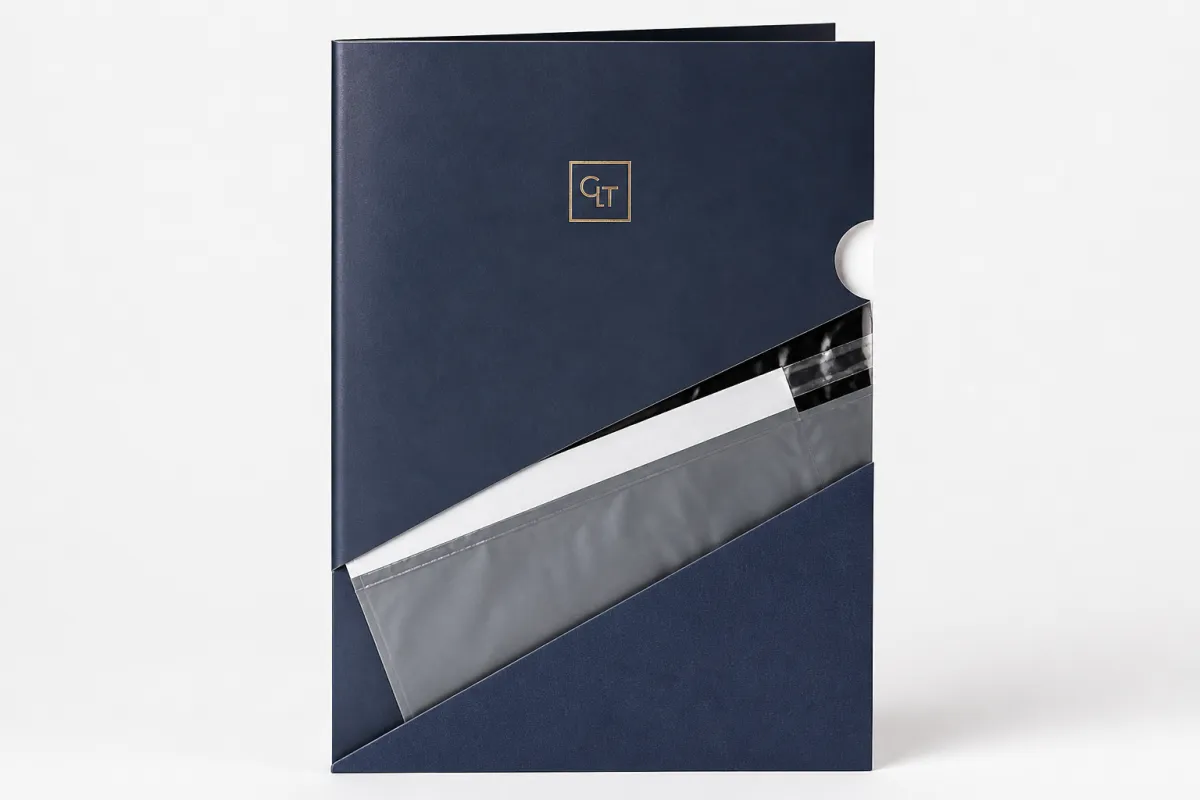
At the basic level, a dual adhesive poly mailer is a flexible shipping sleeve made from polyethylene film with two adhesive strips instead of one. The first strip closes the mailer for outbound shipping, and the second strip stays protected until the package is opened and needs to be sealed again. That second closure is the reason a dual adhesive poly mailers guide is useful for brands that want one mailer to serve both the outbound trip and the return trip without adding another packaging component.
This format shows up most often with apparel, athleisure, accessories, subscription shipments, soft home goods, and other lightweight products that do not need corrugated protection but still benefit from a clean seal. Flexible items that are not especially fragile, yet still likely to be exchanged or returned, are a natural fit. That is the core logic behind a dual adhesive poly mailers guide: one package, two closure cycles, and less friction for operations and customers.
The operational side is just as real. A standard poly mailer gets one use and then turns into a return problem unless the brand supplies extra tape or a second bag. A dual-strip version gives the packout team a built-in return path, which can cut down on waste in the packing area and make customer instructions much simpler. Instead of saying, "Use this bag, and keep this other thing in case you return it," the packaging quietly supports both steps. That is the kind of small improvement that saves time over and over again.
These mailers do not replace every other shipping structure. A dual adhesive poly mailers guide should be plain about that limit. Heavy products, sharp items, and rigid shapes still need stronger packaging, and corners can puncture thin film if the gauge is wrong. For the right assortment, though, dual adhesive poly mailers sit in a practical middle ground between basic shipping bags and more expensive return packaging systems.
From a buyer's point of view, the appeal is easy to understand. The format respects how shipping actually works. The outbound package leaves the dock once, while the post-purchase path can stretch across days or weeks. A single mailer that handles both phases can make the process feel more deliberate without adding much complexity. It is kinda the whole point, really.
A return-ready mailer only works when the packing team understands it and the customer can spot the second seal without guessing.
That is why a dual adhesive poly mailers guide is not just about material choice. It is about the full path from packout to delivery to reseal, and that wider view is where the value sits.
How Dual Adhesive Poly Mailers Work
The seal system makes more sense once you see it layer by layer. The first adhesive strip sits on the main closure flap and is used exactly once when the order leaves the warehouse. The second adhesive strip is usually protected by a release liner or tucked under a flap, so it stays clean until the package is opened. A good dual adhesive poly mailers guide should walk through that structure step by step, because the format depends on both seals doing their jobs at the right moment.
When the customer opens the mailer, the outer strip is gone, but the second strip remains available for a return, exchange, or internal reuse flow. That lets the person handling the package reclose it without tape, staples, or a separate return envelope. The value is not only convenience. It is consistency. A dual adhesive poly mailers guide should make clear that the mailer is built for a second closure path, not just a second chance to stick something together in a rough way.
The behavior of the film matters just as much as the adhesives. A 2.5 mil bag may work well for a soft tee, while a 3 mil or 4 mil structure can be a better fit for heavier knits, boxed accessories, or products with hardware that presses against the inner wall. Co-extruded film usually resists tearing better than very basic mono-layer stock, and a matte finish can hide scuffs better than a glossy surface when shipments slide through totes or across conveyors. Those details sound small, but they show up fast once the bags start moving.
Placement of the strips changes the experience more than many buyers expect. If the second seal sits too close to the edge, lining it up after opening gets awkward. If it sits too deep in the flap, the customer may not notice it at all. The cleanest setups make the second closure obvious without crowding the bag with extra visual noise. That detail is one of the things that separates a thoughtful dual adhesive poly mailers guide from a generic product page.
The package still needs a clean opening. A ragged tear can make the reseal path feel less intuitive, so flap size, seal width, and peel behavior all need to work together. If the customer has to wrestle the bag, the reseal feature stops feeling like a benefit and starts feeling like packaging theater.
I usually think about dual adhesive mailers as a simple system with three jobs. They need to ship cleanly, open cleanly, and reseal cleanly. When those three pieces line up, the format earns its place. That is the real lesson inside a dual adhesive poly mailers guide.
Key Factors to Compare Before You Order
Start with film construction before you place a run. Gauge, opacity, puncture resistance, and seal consistency all shape how the mailer behaves in the real world. A dual adhesive poly mailers guide should not treat material as a one-line spec, because a bag that looks fine on paper can still fail if the film is too thin for the product profile or if the seal area is too narrow for the handling conditions.
For many apparel brands, the sweet spot sits somewhere in the 2.5 mil to 3 mil range, though heavier or more angular contents can justify more thickness. If the contents have hard tags, metal hardware, zippers, or sharp edges, the risk of abrasion rises quickly. I have seen buyers save a few cents on the front end only to spend more replacing torn bags and reshipping orders. That is exactly the kind of problem a careful dual adhesive poly mailers guide should help prevent.
Adhesive performance deserves the same level of attention. The bag needs to hold in hot docks, cold storage, humidity swings, and the friction of conveyor movement. Hot-melt styles and pressure-sensitive formulations can both work, but the right choice depends on the supplier's construction and your lane conditions. If you ship through multiple climates, ask for samples that have sat in warm and cool environments before you test the seal. A dual adhesive poly mailers guide only helps buyers if it teaches them which stress questions to ask.
Fit is another place where small mistakes become expensive. A mailer that is too small can force the flap to sit under tension, which is bad for the first seal and awkward for the second. A mailer that is too large can let the product shift, crease, or bounce around inside the bag. The best size protects the contents without looking stuffed or wasteful. I usually tell buyers to spec with a little breathing room, not a lot.
Branding and print method belong in the same conversation. Some teams want a simple one-color logo and a strong return message. Others need full-coverage art, a matte surface, tamper language, barcodes, or recycling text. The more coverage you add, the more you need to think about registration, ink laydown, and how much of the adhesive zone must stay clear. A dual adhesive poly mailers guide that ignores print placement misses a major buying decision.
For buyers who want to test rather than guess, recognized methods help more than instinct alone. ISTA offers widely used transit test frameworks, and the broader packaging conversation around material performance often lines up with film testing concepts like tensile and impact behavior. For recycling expectations, EPA recycling guidance is a useful reminder that plastic film handling varies by local program and is not something to assume from a label alone.
One more practical filter belongs on the buyer's desk: think about the workflow on your own floor. If the packing line can use the bag quickly, and the customer can understand the reseal without a printed essay, you are probably close to a good fit. If the process feels fussy, the design probably needs another pass. That operational lens sits at the center of any dual adhesive poly mailers guide worth reading.
- Film gauge: Match thickness to weight and edge profile, not just to the lowest available quote.
- Seal width: Wider seals usually give better closure confidence, especially on return-ready bags.
- Print layout: Keep the adhesive zones clear so graphics do not interfere with function.
- Bag size: Allow enough room for fold-over closure without leaving excess slack.
- Use case: Favor dual-seal mailers where returns, exchanges, or reuse are part of the customer journey.
Production Steps, Timeline, and Lead Time
Production usually starts with artwork and spec review, and that step matters more than many buyers expect. The supplier needs exact dimensions, print colors, seal position, film gauge, and total quantity before the run can be set up correctly. A dual adhesive poly mailers guide should make that point early because most delays do not happen on the press; they happen before the press starts, while people are still correcting specs and proof notes.
Once the design is approved, materials are sourced and the film is prepared for printing. Depending on the setup, the bag may be printed in rolls or sheets, then slit and converted into finished mailers. The dual adhesive strips are added during conversion, and their placement has to stay consistent from one unit to the next. If the seal lands too high, too low, or off-center, the user experience suffers. That is why a careful dual adhesive poly mailers guide spends time on process, not just product features.
After the conversion stage, quality control becomes the next gate. Teams should inspect print alignment, adhesive tack, bag dimensions, and seal registration. If the order is large enough, random sampling should also check carton counts and pack consistency. A single off-spec bag will not usually ruin a program, but repeated variation can create packing confusion. That is one reason buyers who use a dual adhesive poly mailers guide seriously tend to ask for samples before approving a full run.
Lead time depends on how many moving parts are in the order. Simple stock-style mailers with light customization can move faster than fully custom dimensions with heavy ink coverage and specialty film. For a practical planning window, simple runs often land in the 10 to 15 business day range after proof approval, while larger or more custom orders can take longer. Freight adds its own clock on top of that, and international shipment or cross-country ground transit can shift the arrival date by several days.
Changes after proof approval are the biggest schedule risk. A revised logo file, a changed size, or a new seal placement can reset part of the production flow, especially if plates, cylinders, or print setup work has already started. Buyers often ask for speed, but speed is usually the reward for clarity, not a replacement for it. A dual adhesive poly mailers guide that treats proofing as a formality is setting people up for avoidable frustration.
From a buyer's perspective, the cleanest rollout usually starts with a sample pack, then a small test order, then a larger production order once the packing team has confirmed the bag behavior. That sequence costs a little more time up front, but it usually saves more time later by preventing overcorrection after full production begins.
Dual Adhesive Poly Mailers Guide: Cost, Pricing, MOQ, and Quote Details
Pricing trips up a lot of buyers because a dual adhesive mailer can look simple while still carrying several cost layers underneath it. Film thickness, bag size, print coverage, adhesive complexity, total quantity, and packaging configuration all influence the final number. A useful dual adhesive poly mailers guide should frame pricing as a mix of material and process, not just a single unit number pulled from a quote sheet.
Minimum order quantity, or MOQ, has a direct effect on unit price. Lower runs usually cost more per bag because the setup effort gets spread across fewer pieces. Larger runs normally improve the per-unit number, though freight and storage need to be factored in as well. If a supplier offers a test run, that can be a sensible way to validate the design, but the buyer should understand that the smaller order is not always the cheapest path on a unit basis. Any dual adhesive poly mailers guide worth trusting should say that plainly.
Here is a practical way to compare quotes: match the exact size, film gauge, print method, strip configuration, bag color, and carton packing before looking at the bottom-line price. If one quote is for a 2.5 mil bag and another is for 3 mil, those are not the same product. If one includes four-color print and the other is a one-color imprint, that is not the same product either. A clean dual adhesive poly mailers guide protects you from comparing apples to oranges and calling it a savings analysis.
Hidden costs deserve their own check. Setup fees, proofing, freight, custom packaging, plate charges, and revision charges can change the landed cost quite a bit. I also advise buyers to ask whether the quote includes overrun tolerance, because a small percentage of extra bags can be normal in conversion work. That should be discussed early, not discovered when the pallets land. A dual adhesive poly mailers guide that leaves out these details is incomplete.
There is also a business case worth keeping in view. A slightly higher unit price can still make sense if the mailer reduces return friction, lowers the need for replacement packaging, or helps the customer send items back more cleanly. In some programs, the packaging saves time in customer service and returns processing, which is worth real money even if it is not obvious on the first invoice. That is the kind of thinking a practical dual adhesive poly mailers guide should encourage.
| Option | Typical MOQ | Common Unit Range | Best Fit | Notes |
|---|---|---|---|---|
| Stock-style dual adhesive mailer with simple imprint | 1,000-3,000 | $0.12-$0.22 | Test programs and smaller launches | Fast to approve, fewer customization options |
| Custom printed dual adhesive mailer | 5,000-10,000 | $0.18-$0.34 | Branded apparel and return-heavy e-commerce | Good balance of price, print, and function |
| Fully custom size, film, and print | 10,000+ | $0.24-$0.45 | Higher-volume programs with tighter specs | More proofing, more control, more setup work |
Those ranges are ballpark figures, not a promise. A tight print area, plain white film, and standard sizing will usually come in differently than a full-coverage branded bag with a special matte finish and a larger return message. The right dual adhesive poly mailers guide tells you to compare like with like and to ask for a landed-cost view whenever freight is material to the order.
One final quote tip: ask for the adhesive configuration in writing. "Dual adhesive" can mean different things from one supplier to another, and you want the proof to show exactly where each strip sits, how it is protected, and how the reseal is activated. Clear specs are the fastest way to keep a dual adhesive poly mailers guide from turning into a guessing game.
Common Mistakes When Choosing Dual Adhesive Poly Mailers
The first mistake is picking a film that is too thin for the product. Lightweight tees can behave very differently from hoodies, bundled sets, or items with hard edges. If corners press into the seam, the bag can stretch or tear during transit. A good dual adhesive poly mailers guide keeps reminding buyers that the mailer is only as strong as the product profile allows.
The second mistake is getting the size wrong. Too small, and the flap closes under tension. Too large, and the product shifts around, which can make the package look sloppy and can wear on the film. I have seen good brands lose customer confidence because the bag simply looked improvised. That is why sizing gets so much attention in a serious dual adhesive poly mailers guide.
The third mistake is ignoring the return workflow. The second adhesive strip only helps if the packing team and customer both know it exists. If the packout process does not tell people how the mailer works, or if the customer cannot find the reseal path easily, the feature gets wasted. This is where operational training matters. A dual adhesive poly mailers guide should always connect the bag design to the instructions that go with it.
The fourth mistake is testing only in ideal conditions. A sample that feels perfect in an air-conditioned office might behave differently after sitting in a hot truck, a cold dock, or a humid storage room. Adhesive behavior can shift with temperature, and film feel can change with handling. Real testing should include packing, shipping, opening, resealing, and a quick visual check of the closure strength. If a dual adhesive poly mailers guide does not push for that kind of test, it is leaving out the part that matters most.
The fifth mistake is comparing quotes without matching specs. Two suppliers can give very different numbers for what sounds like the same mailer, but if one includes higher film gauge, a wider seal, stronger print coverage, or a lower MOQ, the differences are meaningful. Cheap is only cheap if the spec is actually the same. That point belongs in every dual adhesive poly mailers guide because it saves buyers from false comparisons.
A simple way around most of these problems is to sample, test, revise, then place the larger order. That sequence is slower than rushing, but it is much cheaper than correcting a bad spec after pallets are already in the building.
- Test product fit: Check whether the item sits flat without stressing the flap.
- Check seal behavior: Open and reseal at least a few samples by hand.
- Inspect print areas: Make sure logos and messaging do not interfere with closure zones.
- Review handling conditions: Include heat, cold, and conveyor friction in your sample review.
Expert Tips and Next Steps for a Smarter Rollout
If you want a cleaner result, start with a small sample order and treat it like a working test, not a display piece. Pack a few real products, ship them through the normal carrier lane, open the bags, reseal them, and inspect what happens to the film and adhesive after handling. That approach turns a dual adhesive poly mailers guide into a practical decision tool instead of a theory exercise.
A simple packing SOP helps more than people expect. The team should know which product sizes belong in which bag, how the closure should look, and how the second adhesive strip is supposed to be used when a return happens. Even a basic one-page instruction sheet can reduce confusion. A dual adhesive poly mailers guide is useful, but the process on the floor is what turns that guidance into consistent results.
Feedback should come from more than one department. Fulfillment can tell you how the bag behaves on the line. Customer service can tell you whether the return experience is clear. Returns processing can tell you whether the reseal actually supports the workflow or whether people still need extra tape. That cross-functional view often catches issues that a single tester would miss. For that reason, a dual adhesive poly mailers guide should encourage broader testing.
Before you request quotes, build a checklist with the basics: exact dimensions, film gauge, print count, adhesive configuration, MOQ, lead time, freight terms, packaging format, and sample options. If you are also building out branded packaging more broadly, our Custom Packaging Products page and Custom Poly Mailers category are good places to compare formats and see how the mailer fits into the larger packout system. That kind of prep makes the next dual adhesive poly mailers guide-driven quote conversation much cleaner.
Do not skip the customer-facing details. A short printed note that explains the reseal can help if your audience returns a lot of orders. Clear communication lowers support tickets and makes the packaging feel deliberate instead of mysterious. In practical terms, that means the product page, the insert card, and the bag artwork should all point in the same direction.
My honest advice is simple: do not overcomplicate the first run, but do not under-test it either. The best rollout starts with a tight spec, a realistic sample test, and a clear view of the return path. That is how a dual adhesive poly mailers guide becomes a usable buying decision instead of just another packaging read.
Once those pieces are in place, dual adhesive mailers can do exactly what they are supposed to do: protect the shipment, simplify the return, and keep the brand looking organized from the first seal to the second. If you are sorting through options, the most useful takeaway is simple: choose the bag by product weight, edge profile, and return volume first, then match print and price after that. That order of decision-making usually keeps the rollout steady and the package working the way it should.
Frequently Asked Questions
What are dual adhesive poly mailers used for?
They are used for shipping items that may need a second seal later, especially apparel, soft goods, and orders with a higher return rate. The dual adhesive design lets the same mailer support both outbound shipping and a cleaner return or exchange workflow.
How do dual adhesive poly mailers work for returns?
The first adhesive strip seals the package for shipment, and the protected second strip can be used when the customer needs to reseal the mailer. That helps returns move through a simpler process because the packaging already includes a built-in reseal path.
What affects the cost of dual adhesive poly mailers?
Price usually depends on material thickness, size, print coverage, adhesive setup, and total order quantity. MOQ, freight, and customization level can also move the price up or down, so quotes should be compared on identical specs.
How long is the lead time for custom dual adhesive poly mailers?
Lead time depends on proof approval, material availability, print complexity, and how many mailers you are ordering. Simple stock-style orders can move faster, while fully custom printed runs with special sizing usually take longer.
What should I ask for in a quote for dual adhesive poly mailers?
Ask for exact dimensions, film gauge, print method, adhesive configuration, MOQ, freight terms, and sample options. Make sure every quote lists the same specifications so you can compare true unit cost instead of guessing.


