Buyer Fit Snapshot
| Best fit | Eco Friendly Tray Boxes Wholesale projects where brand print, material claims, artwork control, MOQ, and repeat-order consistency need to be specified before quoting. |
|---|---|
| Quote inputs | Share finished size, material target, print colors, finish, packing count, annual reorder estimate, ship-to region, and any compliance wording. |
| Proofing check | Approve dieline scale, logo placement, barcode or warning zones, color tolerance, closure strength, and carton packing before bulk production. |
| Main risk | Vague material claims, crowded artwork, missing packing details, or unclear freight terms can make a low unit price expensive after revisions. |
Fast answer: Eco Friendly Tray Boxes Wholesale: Pricing & Specs should be specified like a repeatable production item. The safest quote records material, print method, finish, artwork proof, packing count, and reorder notes in one written spec.
Production checks before approval
Compare the actual filled-product size with the drawing, then confirm tolerance on folds, seals, hang holes, label areas, and retail display edges. Reserve space for logos, QR codes, warning copy, and material claims before decorative graphics fill the panel.
Quote comparison points
Review material grade, print process, finish, sampling route, tooling charges, carton quantity, and freight assumptions side by side. A quote is only useful when the supplier can repeat the same color, closure quality, and packing count on the next order.
Comparing eco friendly tray boxes wholesale options starts to make sense once the conversation moves beyond unit price alone. A tray that speeds packing, reduces filler, and still presents cleanly on shelf can save real money in places buyers do not always measure at first glance. That is why eco friendly tray boxes wholesale should be treated as a packaging system decision, not just a carton purchase.
The right tray format changes the economics of a product line in a very real way. A bakery sampler, a candle trio, a cosmetics kit, or a retail gift set often looks more polished in a tray than in a loose carton with extra void fill floating around inside. When the structure fits the product, eco friendly tray boxes wholesale can reduce repacking labor, lower the risk of transit damage, and improve the first impression all at once. That is where the value shows up fast.
From a packaging buyer's point of view, one question does most of the work: does the tray remove another component, another handling step, or another source of damage? If the answer is yes, the numbers usually improve. If the answer is no, a simpler build may still be the better choice. I have seen teams chase a greener-looking pack that actually costs more because it adds complexity without solving anything. That is the lens used throughout this buyer guide.
Eco Friendly Tray Boxes Wholesale: Where the Value Shows Up Fast
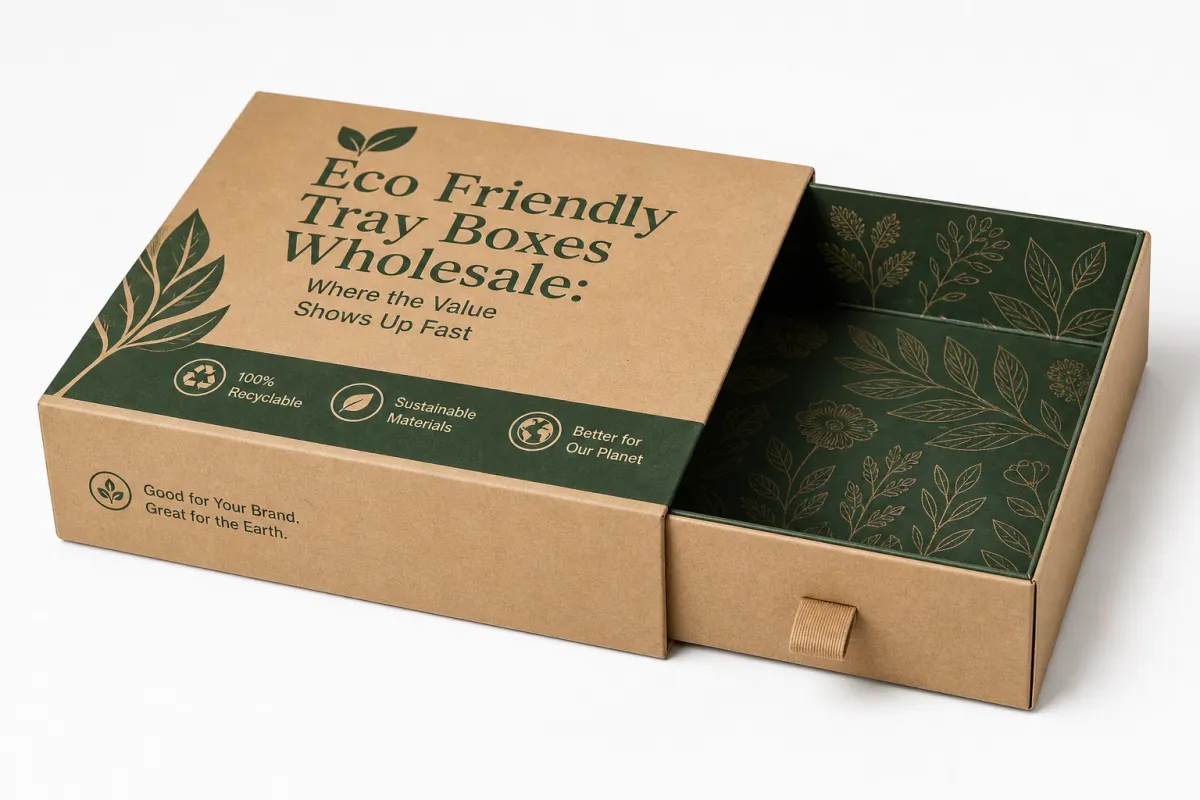
eco friendly tray boxes wholesale orders tend to pay back quickly in product categories that need both structure and visibility. Bakeries use them for assortments that should sit neatly instead of sliding around. Cosmetics brands rely on them for bundled items where color, spacing, and presentation matter as much as protection. Candles, wellness kits, gift sets, and retail sampler packs also benefit because a tray gives each item a defined place without asking for a complicated build.
The math is pretty straightforward. If a tray keeps the contents aligned, a packer spends less time adjusting inserts, wrapping items, or hunting for the right void fill. If the tray also works with a sleeve or lid, the product can move through packing and merchandising with fewer separate parts. That is why eco friendly tray boxes wholesale is often a procurement conversation first and a print conversation second. The savings live in labor, touchpoints, and fewer damaged units, not just in board cost.
Many buyers undercount presentation value. A tray that lands squarely on the shelf, with product faces visible and spacing under control, makes a bundle feel deliberate even before the branding gets its turn. That matters in retail programs, and it matters in e-commerce gift sets too. When the contents look orderly and stay put, the package feels more trustworthy, and trust sells. Simple as that.
Tray packaging saves money only when it removes another step or another component. If it only adds decoration, the math gets worse fast.
Wholesale matters because the unit price tells only part of the story. A quote that looks attractive on paper can turn expensive if the tray is too flimsy, if it needs a second inner carton, or if the dimensions push freight into a higher bracket. eco friendly tray boxes wholesale should be compared on total landed cost per saleable unit. That means looking at packing speed, damage rate, cartoning efficiency, and how the package displays on a shelf or inside a shipping mailer.
The categories that usually benefit most are easy to spot:
- Bakeries: tray boxes help hold pastries, bars, cookie assortments, and bakery gift packs in place.
- Cosmetics: a tray keeps tubes, jars, and compacts organized inside a presentation set.
- Candles: spacing matters, especially for fragile glass or wax surfaces.
- Wellness kits: sample packs, supplements, and self-care bundles need tidy separation.
- Gift sets: structured trays reduce the need for added crinkle fill or foam.
- Retail sampler packs: visibility and fast stocking usually outrank decorative complexity.
There is also a point where a tray box is not the right answer. Heavy products, rough parcel routes, or long-distance fulfillment may call for corrugated protection or a different internal fit. A buyer should not force eco friendly tray boxes wholesale into a use case that needs serious shipping armor. Packaging works best when the structure matches the handling environment, not when it tries to solve every problem at once.
Product Details: Materials, Styles, and Print Options
eco friendly tray boxes wholesale buyers usually start with the material because material drives the feel, the finish, the strength, and a good share of the price. Kraft board gives a natural, restrained look that often supports an eco message without extra decoration. Recycled paperboard offers a cleaner printing surface for retail graphics. Corrugated board enters the picture when protection matters more than elegance. FSC-certified stocks are useful when a buyer needs chain-of-custody documentation for a sustainability claim. The most widely recognized certification route for fiber sourcing is the FSC system, and many purchasing teams like that because it turns a broad sustainability claim into a traceable paper trail.
The common tray structures are easy to compare once the use case is clear. Open trays work well for display and easy access. Tray-and-sleeve sets give the buyer a presentation layer without moving all the way into a rigid box. Folding trays are efficient for storage and shipping before assembly. Compartmented trays separate multiple items inside one presentation unit. Display trays make sense when the package may move from case pack to shelf with little extra handling. If a product needs both structure and a strong visual front, eco friendly tray boxes wholesale in tray-and-sleeve form often land in the sweet spot.
Print options should match the job the package has to do. A one-color kraft tray can look clean and premium if the typography is disciplined. Full-color printing works better when branding, photography, or product cues need to carry the shelf story. Food-safe inks may matter for bakery and snack programs. Coatings such as matte, gloss, aqueous, or soft-touch change perception quickly, but they also affect cost and lead time. A little restraint often goes further than a busy surface. Buyers ordering eco friendly tray boxes wholesale usually get stronger results when the structure does the heavy lifting and the graphics support it.
Finishing choices should be made with intent, not habit. Embossing adds tactile definition. Foil can be a fit for gift sets, though it can clash with a low-material sustainability message if used without restraint. Spot UV can create contrast on a clean printed panel, yet it is not always the best match for a natural brand story. The better question is not “What finish can we add?” It is “What finish supports the sales job without masking the package’s actual function?” That is how serious buyers approach eco friendly tray boxes wholesale.
On the specification sheet, a useful product page should let a buyer answer three questions quickly: will it fit, will it hold up, and will it present the product the right way? If the page cannot answer those questions in a few seconds, it is slowing down procurement instead of helping it. That is where a well-built eco friendly tray boxes wholesale listing earns its keep.
Specifications That Matter: Size, Strength, and Fit
The first spec to get right is size. For eco friendly tray boxes wholesale, dimensions should be based on product footprint, stack height, and the amount of clearance needed for an insert, sleeve, or lid. A tray that is too tight creates scuffing and slows packing. A tray that is too loose lets the product drift in transit and looks careless on shelf. In most programs, the box should feel custom because the product should sit with only a small amount of movement allowance, not because the buyer paid for unnecessary board.
Board thickness matters more than many first-time buyers expect. Paperboard in the 14pt to 24pt range is common for presentation trays, while heavier recycled board or corrugated builds can move into stronger territory when the product is bulky or the route is rough. GSM, or grams per square meter, helps compare board weight in a practical way. Higher GSM usually means more rigidity, but it also changes folding behavior and cost. For eco friendly tray boxes wholesale, the job is to match thickness to handling, not to chase the heaviest sheet available.
Weight and route conditions should guide the build. A lightweight retail display tray that will sit in a controlled store environment does not need the same spec as a tray that will travel through parcel networks, warehouse stacking, and repeated touchpoints. If the package must survive vibration, compression, or longer transit, buyers should ask about performance testing and, where useful, validation against ISTA methods. For many ship-ready programs, ISTA 3A or ASTM D4169-style thinking helps the team avoid spec mistakes before production starts.
There are also practical compliance issues that should be addressed early. If the tray touches food directly, confirm food-contact suitability for the board, coating, and inks. If the product contains oils or moisturizers, ask about grease resistance. If the tray may sit in a cooler or cold-chain setting, moisture behavior matters. If the product will travel through humid or variable climates, the package should not warp after the first temperature swing. These are not edge cases. They are the details that separate a good eco friendly tray boxes wholesale order from a disappointing one.
A buyer can use a simple comparison rule:
- Display-first products: lighter board, cleaner print, easier assembly.
- Transit-first products: stronger board, tighter fit, better compression resistance.
- Food programs: coating, ink, and contact details checked before approval.
- Gift sets: presentation and insert fit matter more than raw board weight.
In practice, a good spec sheet is not long just to fill space. It is precise enough to stop guesswork before it starts. That precision saves money, and it saves time. For eco friendly tray boxes wholesale, those two savings usually travel together.
Eco Friendly Tray Boxes Wholesale Pricing, MOQ, and Quote Structure
Pricing for eco friendly tray boxes wholesale is driven by a small set of variables that buyers can control. Material choice comes first. Board thickness comes next. Then print coverage, coating, structural complexity, and order quantity. If the tray needs a sleeve, insert, or unusual cutout, the cost rises because setup becomes more specialized. A simple kraft tray with restrained branding will usually price lower than a full-color tray with a specialty finish and nested components.
MOQ, or minimum order quantity, exists because setup time has to be spread across enough units to make production efficient. Lower runs usually cost more per piece because the press, die, and finishing work do not disappear just because the order is small. Larger runs often unlock better pricing tiers. For eco friendly tray boxes wholesale, that is why a buyer should ask for tiered pricing. The difference between 2,500 units and 5,000 units can be more useful than many teams expect, especially if the higher volume drops the unit cost enough to improve margin.
Buyers should expect quote components to be listed separately. A fair quote generally includes the unit price, setup or tooling if a custom die is needed, sample or prototype charges where relevant, freight, and any special protective packaging for shipment. Some suppliers wrap these into one number, but that can make comparison harder. A cleaner procurement process asks every vendor to quote the same specification. Comparing a kraft tray to a printed premium board tray is not a real comparison. It is two different products.
| Format | Typical Wholesale Range at 5,000 Units | Best For | Buyer Notes |
|---|---|---|---|
| Recycled kraft tray, one-color print | $0.18-$0.28 per unit | Simple retail displays, bakery packs, eco-led branding | Lowest visual complexity; strong value when presentation is restrained |
| FSC paperboard tray, full-color print | $0.24-$0.42 per unit | Cosmetics, wellness kits, gift sets | Better graphics, more shelf impact, usually slightly higher setup discipline |
| E-flute corrugated tray | $0.35-$0.65 per unit | Heavier contents, shipping-oriented packs | Stronger protection; usually chosen when transit performance matters |
| Tray and sleeve set | $0.42-$0.78 per unit | Premium presentation, bundled products | Higher component count, but often stronger perceived value |
That table is illustrative rather than fixed. Even so, it shows how quickly the numbers move when the specification changes. A buyer who wants the most economical eco friendly tray boxes wholesale option should keep the material simple, reduce print coverage where possible, and avoid decorative add-ons that do not improve saleability. A buyer who needs premium shelf presence may choose the higher-spec path because the package has to do more of the selling.
One purchasing rule keeps the comparison honest: ask for both price per unit and estimated landed cost. Freight can erase savings if the supplier is far away or if the pack is unusually bulky. The real number that affects margin is not the ex-works quote. It is the total cost to get finished, saleable packaging to the line and into the market. That is the number buyers should use when reviewing eco friendly tray boxes wholesale proposals.
Process and Timeline: From Artwork to Delivery
The workflow for eco friendly tray boxes wholesale is predictable when the buyer sends clear information. It usually starts with inquiry and specification confirmation. Then comes the quote. After that, the supplier builds or checks the dieline, reviews artwork, issues a proof, and prepares the sample or pre-production sample if one is needed. Once the sample is approved, production begins, and shipment follows. Straightforward work moves quickly because there is less back-and-forth.
Timing depends on how complete the order is when it enters the system. A clean project with print-ready vector artwork, confirmed dimensions, and a settled finish choice can move much faster than one that keeps changing. In many cases, quote response takes 1 to 2 business days, dieline review takes another 1 to 3 days, samples take 3 to 7 days, and production can run 10 to 18 business days after final approval. Freight then adds its own window, depending on lane and method. Buyers who plan eco friendly tray boxes wholesale launches around retail resets or seasonal windows should build that lead time into the calendar early.
There are a few repeat delays that show up over and over. Incomplete artwork is one. Late proof changes are another. Material substitutions also create friction, especially if a supplier has to recheck board availability or coating compatibility. The fastest projects are the ones where the buyer approves the dieline early, sends vector artwork, confirms claims before print, and decides on finishes before proofing begins. That is not glamorous, but it is how good procurement works.
Communication matters just as much as production. Someone should own spec confirmation, someone should approve proofs, and someone should update the buyer during manufacturing. If those roles are unclear, deadlines slip. For eco friendly tray boxes wholesale, buyers should ask who signs off on the dieline, who checks color expectations, and when status updates arrive. Clear ownership avoids the usual problem where everyone assumes someone else is tracking the order.
A realistic project calendar might look like this:
- Day 1-2: inquiry, dimensions, and quantity confirmed.
- Day 2-4: quote and dieline shared.
- Day 4-8: artwork adjustments and sample approval.
- Day 9-24: production, depending on finish and complexity.
- After production: packing and transit based on the shipping lane.
That rhythm is one reason buyers keep working with suppliers who understand packaging, not just printing. When the team knows how a tray should fold, hold, and ship, there are fewer surprises. That is a real advantage in eco friendly tray boxes wholesale programs where time and accuracy both matter.
Why Buyers Choose Us for Sustainable Packaging
Buyers do not keep coming back because a supplier talks about sustainability in broad terms. They come back because the material is consistent, the communication is steady, the proofs are accurate, and the boxes arrive ready to use. That is the standard for eco friendly tray boxes wholesale work that needs to support actual purchasing decisions. At Custom Logo Things, the focus is on measurable service: clear specs, practical material choices, and repeatable quality checks.
Sustainable packaging should be judged by what it reduces and what it replaces. Recycled content matters, and print efficiency matters too. Responsible sourcing matters, and so does designing the tray so it does not use more board than necessary. A strong program also avoids unnecessary components. If the tray can handle structure without an extra insert, that is a better material story and a better cost story. That is exactly why many buyers move toward eco friendly tray boxes wholesale instead of piecing packaging together from separate vendors.
There is a meaningful difference between a general printer and a packaging supplier. A printer may do excellent graphic work but still miss the practical details of carton strength, nesting behavior, shipping space, or assembly speed. A packaging-focused partner tends to ask better questions: Is the product heavy? Will it be chilled? Does the tray need to stack? Does the customer touch the package directly? Those questions lower error rates. They also reduce rework, which is one of the hidden costs in eco friendly tray boxes wholesale procurement.
Buyers also care about proofing and repeatability. A sample should match the order, not just the artwork. Reorders should hold the same dimensions and print expectations. That is especially important for brands scaling across multiple SKUs or seasonal runs. If a packaging partner can keep the spec stable, the buyer can manage inventory with less stress. For eco friendly tray boxes wholesale, stability is not a luxury. It is part of the value.
Sustainability claims should also stay honest. Recycled fiber, FSC sourcing, and lighter structures all help, but they do not make a package automatically better if the tray fails in use or forces extra waste somewhere else. Buyers are usually better served by a package that uses fewer components and ships efficiently than by one that sounds greener in a sales pitch and then creates avoidable rejects. That kind of candor builds trust, and trust is what keeps a program healthy.
If you are comparing broader packaging options, our Wholesale Programs page is a useful starting point. If you are still mapping the right structure for a bundle, tray, or display pack, the Custom Packaging Products catalog helps narrow the choice quickly. For many buyers, that shortens the path from concept to quote, which is exactly what a serious procurement process should do.
One more practical point: sustainable packaging is not always the lightest package and not always the cheapest package. Sometimes it is the one that uses the fewest components while still protecting the product and keeping the presentation clean. That is the standard used when we talk about eco friendly tray boxes wholesale. Less waste, fewer surprises, better fit.
Next Steps to Order Eco Friendly Tray Boxes Wholesale
Before requesting a quote, buyers should gather the basics. For eco friendly tray boxes wholesale, the supplier will usually need product dimensions, target quantity, material preference, print goals, finish preference, and delivery location. If the product has unusual edges, fragile components, or a strong shelf-display requirement, include that too. The better the input, the cleaner the quote.
A simple internal checklist helps teams decide what kind of tray they actually need. Is the package for retail display, shipping, food service, or gifting? Will it be handled once or many times? Does it need to survive moisture, grease, or vibration? Those answers change the board choice and the structural format. In many cases, the best eco friendly tray boxes wholesale option is the one that balances presentation and protection without forcing a compromise on both.
If the product dimensions are unusual or the contents are delicate, ask for a sample or dieline before final approval. That step is usually worth the time. It can reveal a fit problem, a stacking issue, or a visual imbalance before production locks in. For high-value gift sets and food items, that early check can prevent far more expensive mistakes later. With eco friendly tray boxes wholesale, a one-day review can save a week of corrections.
It also helps to request two quote scenarios. One should be the standard spec. The other should be an upgraded version with the finish, board weight, or print coverage you may want. Comparing both makes tradeoffs visible. Sometimes the jump from basic kraft to full-color printed board is small enough to justify. Sometimes it is not. Either way, the buyer gets a cleaner decision. That is better than guessing.
Here is the shortest path from interest to order:
- Send product dimensions and quantity.
- Confirm the use case and handling environment.
- Review the dieline and approve the sample.
- Lock the print and finish details.
- Place the order once timing and freight are confirmed.
That process is straightforward, and it should be. eco friendly tray boxes wholesale is not complicated when the buyer knows what the package has to do. The right supplier should make the path clear, not noisy.
When the quote, sample, and timeline line up, move forward. The best eco friendly tray boxes wholesale purchases are the ones that are specified clearly, approved quickly, and built to do one job well: protect the product, present it well, and keep total packaging cost under control. If the tray does those three things, it has earned its place.
What materials work best for eco friendly tray boxes wholesale orders?
Kraft and recycled paperboard are common choices when the buyer wants a clear sustainable story and good printability. Corrugated board is better for heavier contents or shipping protection, while lighter paperboard works well for retail display and presentation. The best material depends on product weight, moisture exposure, and whether the tray will be handled in transit or mainly on shelf. For many eco friendly tray boxes wholesale projects, the right answer is the simplest board that still does the job.
What is the usual MOQ for eco friendly tray boxes wholesale?
MOQ varies by supplier, material, and print complexity, but custom packaging usually has a minimum tied to setup and production efficiency. Simple kraft or unprinted trays may support lower minimums than fully printed or specialty-finished boxes. Ask for tiered pricing so you can compare the cost impact of ordering slightly above the minimum. That comparison is often the fastest way to see whether eco friendly tray boxes wholesale pricing improves enough to justify a larger run.
Can I customize eco friendly tray boxes wholesale with my branding?
Yes, most wholesale tray boxes can be customized with logos, full-color artwork, or restrained one-color branding. Finish choices like matte, gloss, embossing, or spot effects can improve presentation, but they also change unit cost and lead time. Always confirm bleed, safe area, and dieline requirements before sending final artwork. A clean artwork file usually shortens the eco friendly tray boxes wholesale process more than any other single step.
How long does production usually take for eco friendly tray boxes wholesale?
Timing depends on sample approval speed, material availability, print complexity, and shipment method. Straightforward orders move faster than projects that need custom dies, specialty coatings, or multiple proof rounds. A clear spec sheet and print-ready artwork usually shorten the timeline more than any other factor. For planning purposes, many eco friendly tray boxes wholesale projects move from approval to production in roughly two to three weeks, then add freight time after that.
Are eco friendly tray boxes wholesale suitable for food packaging?
They can be, as long as the structure and materials are appropriate for food contact and any grease or moisture exposure. Buyers should confirm coating, ink, and lining requirements before production if the tray will touch food directly. For bakery, snack, or prepared food use, ask for material guidance based on storage conditions and shelf life. In food programs, eco friendly tray boxes wholesale should be specified with the same care you would give any direct-contact packaging.


