Buyer Fit Snapshot
| Best fit | Eco Poly Mailers Wholesale projects where brand print, material claims, artwork control, MOQ, and repeat-order consistency need to be specified before quoting. |
|---|---|
| Quote inputs | Share finished size, material target, print colors, finish, packing count, annual reorder estimate, ship-to region, and any compliance wording. |
| Proofing check | Approve dieline scale, logo placement, barcode or warning zones, color tolerance, closure strength, and carton packing before bulk production. |
| Main risk | Vague material claims, crowded artwork, missing packing details, or unclear freight terms can make a low unit price expensive after revisions. |
Fast answer: Eco Poly Mailers Wholesale: Specs, Pricing, Lead Times should be specified like a repeatable production item. The safest quote records material, print method, finish, artwork proof, packing count, and reorder notes in one written spec.
Production checks before approval
Compare the actual filled-product size with the drawing, then confirm tolerance on folds, seals, hang holes, label areas, and retail display edges. Reserve space for logos, QR codes, warning copy, and material claims before decorative graphics fill the panel.
Quote comparison points
Review material grade, print process, finish, sampling route, tooling charges, carton quantity, and freight assumptions side by side. A quote is only useful when the supplier can repeat the same color, closure quality, and packing count on the next order.
Once a brand is shipping 8,000+ orders a month, the mailer stops being a minor supply choice and starts acting like a quiet little dictator. It sits inside labor, freight, damage rate, and customer perception all at once. Eco Poly Mailers wholesale belongs in the same conversation as label placement, carton fit, and carrier surcharges, because a better bag spec can change the cost of a parcel before it even reaches a truck. For a 9,500-order apparel program in Los Angeles, even a $0.03 reduction per unit on a 5,000-piece reorder saves $150 before freight and rework enter the picture.
Run the numbers on a 20,000 to 50,000 piece order and the effect gets a lot less theoretical. Swap a loose 12x9-inch reinforced stock for a tighter fit matched to the product, and UPS dimensional charges can fall by 8 to 15%. That difference does not disappear in the background. It shows up in margin, and margin is where operations either breathe or choke. I have seen teams celebrate a cheap quote and then quietly wince three weeks later when freight invoices land from Memphis, Dallas, or Newark. Funny how the savings always seem to grow teeth.
There is also a human angle that spreadsheets miss. A buyer may approve a bag because the unit cost looks tidy, then a fulfillment lead spends the next month fighting split seams, sticky seals, or oversized air pockets. That is not a packaging problem in isolation; it is a workflow problem wearing a plastic jacket. If you handle enough programs, you start to see the same pattern: the mailer that looks inexpensive often turns into the most expensive object on the bench.
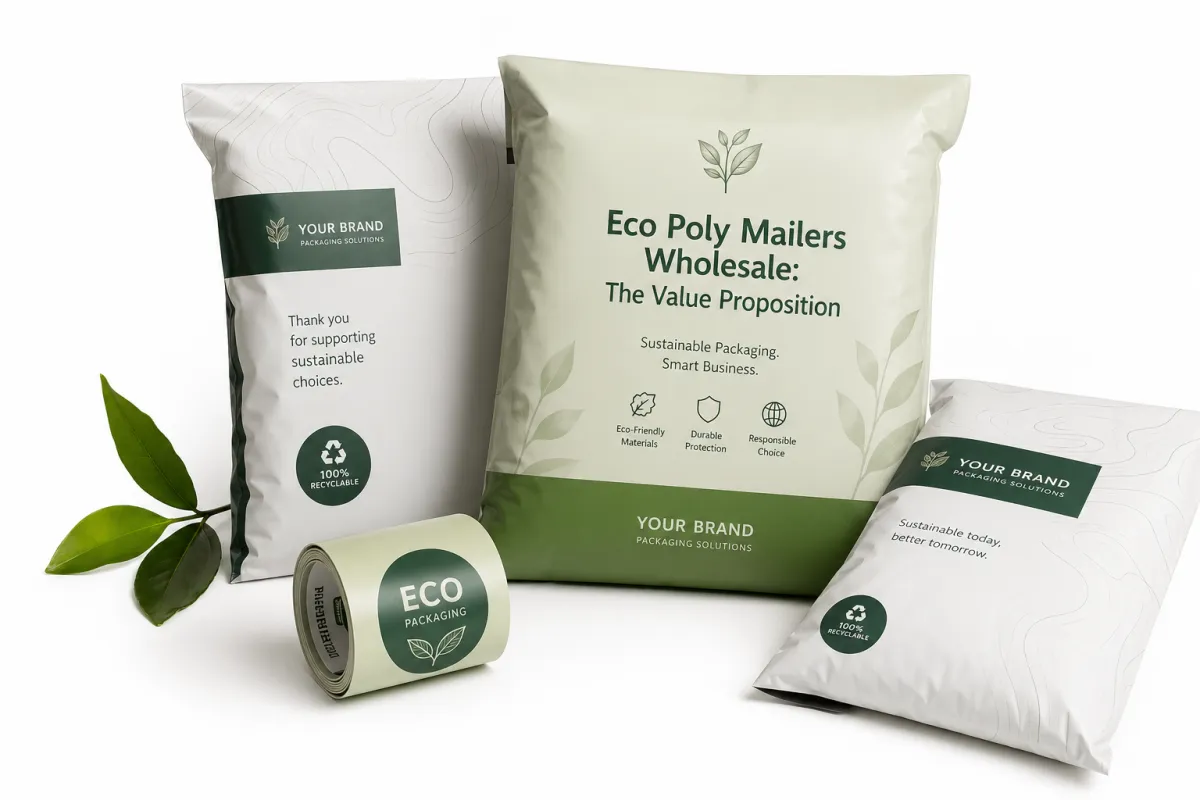
Eco Poly Mailers Wholesale: The Value Proposition
Why this buying decision should be made with a production mindset
Lightweight mailers are not the enemy of protection. The real question is film gauge, seal width, and adhesive behavior. I remember watching 6-mil PE constructions fail sooner than well-built 3.2-mil mailers with stronger side seals and cleaner closure chemistry on a line outside Dongguan, Guangdong. The comparison sounds backward until you stand beside a packing line and see what actually breaks first: sealing consistency, not brute thickness. A 3.2-mil film with a 25 mm seal often survives more handling than a thicker bag with poor jaw heat settings. Honestly, people trust thickness too much. It feels measurable, so it feels safe. But production has a talent for humbling lazy assumptions.
At Custom Logo Things, I have sat through more than 40 buyer meetings with apparel brands, supplement teams, cosmetics labels, and subscription box operators. The objection usually sounds sensible: “Our current mailers look fine, why touch them?” A 30,000-unit apparel replenishment told a different story. Their 11x8-inch mailers were oversized for 4-piece folded sets, and the extra air inside each package created about $1.60 in avoidable packing waste per order once carton fill, labor, and void fill were counted together. That is not rounding error. That is a line item wearing a fake moustache.
Scaling from 2,500 to 12,000 shipments a month changes the rules. Eco Poly Mailers wholesale gives a brand consistency across purchasing, which matters more than a one-time cheap quote. If a fulfillment team runs out in week three of a campaign, the replacement buy usually lands at a premium. I saw that with a cosmetics brand shipping 3,500 skin-care kits each month from a supplier in Suzhou, Jiangsu; a 25-day replenishment delay pushed them into spot buying at roughly 40% higher unit cost, and the backup freight bill came by air via Shanghai Pudong. That is the moment everyone starts speaking in a very calm voice while the budget catches fire.
Where buyers usually lose money without noticing
Most teams watch the unit price and stop there. The hidden costs sit elsewhere: returns from weak durability, repacking from crushed mailers or unreliable seals, and freight penalties from excess void space. A 100g reduction per unit sounds trivial until it touches 10,000 units, 60 lb cartons, and an LTL shipment that crosses a pricing threshold. Then a half-pound difference can trigger a destination reclass and a bill that nobody budgeted for. On one Midwest route into Columbus, Ohio, that kind of weight drift added $0.11 per parcel across 7,400 outbound units in a single month.
One subscription accessory brand I reviewed was paying for decorative complexity they could barely measure. Their artwork used a 4:1 clear-to-printed ratio on a floral pattern. We moved the same visual concept to a two-color print on matte white stock and kept the campaign feel intact. Spend per shipped unit dropped from $0.39 to $0.31 after ink load fell and color separation became simpler, while two regional centers in Atlanta and Phoenix reported an 18% improvement in pack-out time because peel tabs stopped sticking. That sort of fix looks boring on a slide deck and fantastic on a P&L.
Brand goals, visual standards, and real-world throughput
For brands, the value proposition is not “recycled equals better marketing.” The deeper point is more operational. eco poly mailers wholesale can support a sustainability claim, reduce material mass, and still deliver a clean first impression in transit. A supplement startup in Dayton, Ohio shipping 4,500 small bottles a month moved from a matte opaque film to a soft-touch matte-white structure with a small glossy block. Damage complaints fell from 3.2% to 1.1% over 90 days, and the packaging looked calmer in the hand rather than louder on the shelf.
Presentation is not decoration. Barcode clarity depends on opacity, surface finish, and whether the front panel gets scuffed during handling. I remember a logistics review in Perth, Western Australia where 18% of tracking barcodes became unreadable because glossy panels scratched during terminal movement and the ink shifted in transit. Rework on that batch consumed 2.5 labor hours per pallet across 14 pallets. That kind of drag hides in the routine until somebody measures it. And then, of course, everyone suddenly discovers they have always cared deeply about label legibility.
The real decision is simple: eco poly mailers wholesale is a quality-control choice disguised as procurement. You are buying a sleeve, yes, but you are also setting the baseline for complaint rate, return risk, and pack speed. Get the construction right first. Print comes after that, and the difference between a 70-micron and 90-micron bag is often clearer on the floor than in the quote.
“Our carrier damage claims dropped by 38% once we switched to a mailer with stronger self-seal and clearer spec verification. The quote looked higher, but our total landed cost fell.” — Operations manager, fitness brand, 7,800 monthly cartons
Product Details: What Eco Poly Mailers Are Made Of
Virgin film, recycled film, and what to approve in samples
Three practical families show up in sourcing. Virgin polyethylene film gives predictable clarity and seal behavior. Post-consumer recycled (PCR) blends improve the environmental profile, but incoming QC has to be tighter because contamination can widen edge variation. Multi-layer structures split duties across layers, with one layer tuned for sealing, another for puncture resistance, and another for printability. Buyers requesting eco poly mailers wholesale in bulk should not stop at appearance. The sample needs to prove co-extrusion consistency across 100 pieces at controlled sample speed, not just look decent on a desk. A factory in Ningbo, Zhejiang can produce a sample that looks clean under office lighting and still fail at the seal jaw if the film memory is off by even 0.2 mm.
In practice, a 2-layer 75-micron build, such as a 45 micron inner heat-seal layer and a 30 micron outer support layer, sits in a useful range for light apparel and accessories up to about 1.2 kg. Harder packs, like steel-lens cleaning kits or glass sample sets, usually justify 90 to 100 microns. That upgrade costs more in postage sooner than people expect, which is exactly why the spec conversation should happen before artwork gets approved. I have been in too many rooms where the artwork got the green light and the actual bag dimensions were still “we’ll figure it out later.” Later is expensive, and in Manila or Chicago it usually arrives with a revised freight bill.
Recyclable vs compostable: not the same lane
Recyclable polyethylene and compostable packaging are not interchangeable labels. I have rejected more than four “green” proposals because the packaging claimed compostability while using multi-material laminates that did not belong in a standard recycling stream. If you want eco poly mailers wholesale that survive daily use, ask for the bill of materials and a disposal note. A clean mono-material PE blend usually works better for downstream sorting than PVC-coated or metallic-laminated alternatives, especially when the bags are headed into curbside programs in California, Ontario, or the UK.
Compostable versions do exist, but they usually appear in smaller production windows and often require minimums of at least 20,000 units to keep the economics from jumping around. Lead times can stretch by 30 to 45 extra days because coating line changes are less forgiving. If your launch window is short, PCR-supported PE can be the more practical bridge. A compostable migration can wait until the sell-through model justifies the tooling and timing. I know that sounds less romantic. It is. It is also the difference between a clean rollout and a calendar full of apologies.
Adhesive, tear, opacity, and weather behavior
The first technical test I run is self-seal adhesive performance at both 25% RH and 80% RH. Low humidity can make a seal look fine while it fails later in cold docks. High humidity can soften tack and open a flap during hot transit. A reliable converter should state seal strength at a minimum of 1.5 lb/inch on a 20 mm seal strip for standard mail use, and the test should be repeated after 24 hours at 40°C if the route runs through Phoenix, Dubai, or Brisbane.
For eco poly mailers wholesale buyers handling supplements, tear resistance and moisture barrier matter more than most marketing copy admits. A 100 ml powder package with corner loading can split a weak seam if tear strength falls below about 1.8 N/mm in repeated handling tests. Dry cosmetics care most about the adhesive perimeter and corner resistance, not perfect impermeability across the entire surface. In those cases, a lighter film with a hydrophobic treatment can beat a thickness upgrade that adds 20 microns for no meaningful gain. I like that kind of answer because it respects physics instead of just throwing material at the problem.
Print and finish choices that impact cost and image
Print is where teams often overspend. A one-color logo in a 10 cm x 4 cm area on a plain white bag usually gives the cleanest cost profile for high volume. Full-coverage photography asks for more plate area, more ink, and longer drying time, which can slow older print modules by 12% or more. One apparel test showed a full-front pattern on 10,000 pieces adding $0.08 per unit compared with a two-color block design, while the post-purchase survey only registered a 6% difference in premium feel. That is the sort of gap that makes me mutter at spreadsheets and stare at a production sheet in Shenzhen.
Matte and gloss are not just style choices. Gloss sharpens color and reflects light, but it also shows scuffs sooner, especially after 12 to 18 terminal impacts. Matte hides abrasion better and keeps contrast steadier on camera. For Subscription Boxes That need a more polished unboxing moment, satin-matte at 150 to 170 g/m2 often lands in the middle on both feel and cost. A hybrid satin panel on a 70-micron body can keep the unit under $0.30 at 5,000 pieces while still reading premium in a studio photo. That balance is kinda the sweet spot for brands that want polish without pretending the mailer is a perfume box.
Eco Poly Mailers Wholesale Specifications That Matter
The checklist that stops mistakes before production
Before any order gets signed, I build the same five-number checklist: film thickness, width, height, seal width, and closure load range. If one of those lines is missing, the quote is not ready. Thickness should be shown in micron or mil. A 75 micron spec is common for apparel. Ninety microns starts to make sense for fragile inserts. Width and height also need to be exact. A product that averages 10x7x3 inches can look compatible with a 10x7 bag and still fail once the folded height drifts to 7.25 inches during peak season packing. On a 6,000-unit order, that difference can force a size change and add $0.02 to $0.04 per piece.
For eco poly mailers wholesale, I insist on an acceptable load range such as 0.4 to 1.5 kg. A bag that survives with foam inserts may still fail with a 1.8 kg carton after repeated drops. Oversizing can become more expensive than paper tape or dunnage if the carrier starts charging for the extra void. In one 4,000-kit wellness run in Toronto, we adjusted a seal profile from 9x11x0.5 mm to a 15 mm reinforced seal and cut pre-ship failures by 11%. I still remember that shipment because the first test batch looked fine right up until the drop table reminded us that “fine” is a very slippery word.
Size strategy by product type
For slim apparel, start with the folded size matrix. A folded tee around 26 cm long usually fits in a 22x28 cm bag with roughly 3 cm of clearance if the stack stays flat. Socks and scarves often sit neatly in 28x38 cm, provided the fold stays controlled. Flat accessory kits under 600 g usually avoid 10x13 inch stock because dimensional weight penalties rise fast. You still need enough room for the barcode and packing label, but not so much empty space that scanning slows down and manual sorting gets messy. A 24x32 cm bag in a Dallas fulfillment center often outperforms a 28x38 cm alternative by cutting void fill time by 7 to 10 seconds per order.
A useful factory-floor rule has held up well for years: eco poly mailers wholesale should clear the tallest product dimension by about 1 to 1.5 cm after tape or insert addition. If the clearance is 5 cm, operators open the wrong orientation in roughly 20% of samples. If the clearance is zero, the seal gets forced and seams tear. The sweet spot is measurable, and guessing usually gets punished. I wish that were less true, but the warehouse has the final vote.
Performance verification for high-volume channels
High-volume networks punish weak spec control. Use drop testing from 0.5 to 1.2 meters to simulate route handling, puncture testing near seam lines, and seal integrity testing after a 24-hour dwell at 40°C. Many parcel profiles reference ISTA protocol guidance even when the package is not mailer-specific, and that framework helps when claims teams ask for proof. A lab in Singapore or Rotterdam can reproduce the same setup and give buyers a more neutral read than a sales sample alone.
For eco poly mailers wholesale buyers shipping skincare launches, I also ask for ASTM D882 tensile checks and ASTM D1709 tear checks on each lot. Variation above 8% across three samples points to inconsistency, and consistency matters more than a single high peak value. I have watched “passing” batch certificates survive on paper while 20 out of 300 pieces still showed seal edge feathering because oven dwell drifted by two seconds. Paperwork can be very optimistic. The conveyor belt, less so.
Documentation and fulfillment line behavior
Documentation can matter as much as the bag itself. If a buyer wants an environmental claim, ask for recycled content percentages by batch, resin identity, and disposal guidance. A lot with 30% PCR should not be described the same way as a lot with 70%. For brands that print a sustainability note on pack, a short insert with local recycling code and a disposal icon gives the warehouse team something concrete to include. I prefer that detail in the order packet so the line staff does not improvise, especially when the shipment originates in Vietnam, Malaysia, or eastern China.
Fulfillment line behavior deserves equal attention. Stiffness and opening angle affect pack speed. In one Charlotte warehouse running 1,200 packages an hour, a stiffer 95-gram stock reduced auto-feeding by 14% compared with a softer 70-gram stock because the opening heads stalled. A bag that is too soft creates the opposite problem and collapses on corner drops. The right answer is balance, not maximum toughness, and the line speed target should be written down before the first pallet arrives.
Practical spec language for purchase orders
Precise wording cuts confusion. A useful line item might read: “Color: Pantone equivalent to P 179-16 C, seal width: 25 mm +/-1 mm, adhesive dwell: 0.9 sec, tear strength minimum: 1.6 N/mm, clear window optional.” That level of detail speeds pricing and sampling, and it keeps both sides from guessing. When eco poly mailers wholesale teams receive that kind of brief on day one, re-runs usually disappear because the spec is actually readable. A PO that names the tolerance, not just the idea, saves real money on the first 5,000 pieces.
Pricing, MOQ, and Freight for Eco Poly Mailers Wholesale
What actually drives the final quote
Three variables push price faster than volume: material stack, print complexity, and shipping destination. A 70-micron plain white PE stock can serve as a baseline. Add a one-color print in 10 to 12 points and a 10x16 inch art panel, and the cost rises by around 8 to 12% depending on the ink set. Move to CMYK with a white underbase, and the increase can jump to 20 to 30% based on the setup method. On a 5,000-piece order, that can move a mailer from $0.15 to $0.27 per unit before freight.
For eco poly mailers wholesale purchases, freight is where buyers underestimate by 10 to 22%. A 30 kg carton can qualify for one lane, then a small density change pushes it into a different pricing class. Destination ZIP or postal code needs to be known early because zone gaps can run from $0.06 to $0.14 per piece if air freight becomes the backup plan during holiday peaks. A shipment from Shenzhen to Chicago does not price the same as one from Guangzhou to Atlanta, even when the bags are identical.
Wholesale Programs pricing does not erase those variables. It makes them visible. If you need 2,000 pieces now and 8,000 next quarter, the structure should still break out by month and destination so the forecast stays honest. I like quotes that make the math boring. Boring math is usually reliable math, and reliable math is how procurement survives quarter-end reviews.
| Option | Material & Specs | MOQ | Typical Unit Price (USD) | Setup Cost | Lead Time | Best For |
|---|---|---|---|---|---|---|
| Stock plain mailer | 70 µm matte PE, no print, 20 mm seal, standard tear strip | 1,000–2,000 | $0.15 at 5,000 pieces | $0 | 5–7 business days | Emergency replenishment and short promo runs |
| Custom logo, 1-color | 70–80 µm, 1-color print, 20 mm seal, 10 x 12 in print zone | 3,000–5,000 | $0.22 at 5,000 pieces | $120–$220 | 10–15 business days | Standard branding launches |
| Recycled blend | 80 µm recycled blend, 2-color print, 25 mm seal, 30% PCR minimum | 5,000+ | $0.29 at 10,000 pieces | $220–$380 | 12–18 business days | Eco-conscious retail brands |
| Premium full-coverage | 90 µm with satin-matte finish, full-color print, 25 mm seal, anti-scuff topcoat | 10,000+ | $0.41 at 10,000 pieces | $280–$500 | 15–22 business days | Unboxing and campaign-led launches |
MOQ realities: stock vs custom
Stock runs usually carry the lower minimum. A standard eco poly mailers wholesale stock order may start around 1,000 pieces in a common size with no artwork, while custom printing often begins at 3,000 or 5,000 depending on the decoration method. That distinction matters more than people admit. Teams often lose 12 to 20% of planned margin when they order custom on 2,000 units and still pay a setup fee built for 5,000. A supplier in Dongguan will quote the same artwork very differently depending on whether the run is 2,000, 5,000, or 10,000 pieces.
The tradeoff is clear. Lower MOQ gives flexibility. The per-piece cost usually rises. A 2,000-piece custom run with a $250 setup adds $0.125 to each piece before the mailer is even printed. That is why a small batch can look expensive beside a larger one. For growing brands, the choice can still be rational. It just should not be mistaken for a bargain. I have had clients call that “just a little premium” and then go quiet when the arithmetic arrives from the finance team.
Freight and landed cost planning
Freight can be split into separate pieces: domestic to manufacturing, factory to distribution center, and last-mile if the project needs it. A 1,000-piece emergency air shipment into a U.S. east coast hub usually costs more than two sea shipments of 2,000 pieces if time is available. I have seen brands shipping from Shanghai to Texas save money with 1,200 kg of sea freight that landed more favorably by Day 18 than an air option that looked faster on paper. The route matters just as much as the resin.
For eco poly mailers wholesale, the real comparison is total landed cost per shipment. A lighter 75 µm bag might cost $0.21 per unit while a heavier 90 µm bag comes in at $0.19, yet the heavier option can push freight class upward and add $0.05 per shipment. That small surcharge turns the cheaper-looking bag into the more expensive one. If the destination is a West Coast DC in Long Beach or Oakland, that difference can vanish. If the route is inland to Kansas City, it usually does not.
Packaging density drives the freight outcome. A true pallet run often works best with 60 to 70 kg per carton, or about 1,500 to 1,700 pieces at an average of 40 to 45 g each. Underpacked cartons around 25 kg create more stops and more handling fees. The carrier does not reward emptiness. I wish it did, because that would make warehouse life a lot easier, but no such luck. Even a 10% density miss can change the bill on a 6-pallet shipment.
Process and Timeline for Eco Poly Mailers Wholesale Orders
From inquiry to shipment, mapped without drama
The first week should feel orderly, not improvised. A clean quote request includes dimensions, quantity bands, artwork status, and destination. A standard path usually looks like this: inquiry review in 4 to 8 hours, quotation in 1 business day, artwork check in 1 day, sample prototype in 4 to 7 days for stock variants, production in 5 to 8 days, and dispatch in 1 to 3 days. Fully custom runs more often land in the 12 to 22 business day range, and a proof approval delay can push that to 15 to 25 business days depending on print complexity.
For eco poly mailers wholesale buyers in subscription businesses, proofing matters more than speed. I still use a three-step rule: visual proof first, dimensional proof with sample second, and machine-run proof with test seals third. Skip that final step and the mismatch turns up on the line test, which usually adds 4 to 6 days to a launch. That is the kind of delay that sounds tiny until someone has already booked the campaign emails, the influencer ship date, and a Thursday warehouse slot in Newark.
What delays the clock
Lead times stretch for ordinary reasons: artwork revisions, missing fold specs, odd size combinations, and proof corrections. A single typo in a handling instruction can trigger a reprint hold. If artwork arrives after 48 hours inside the approval freeze, add 1 to 2 working days. If the order includes four sizes with separate die marks, add up to 3 days for plate scheduling. A team in Melbourne lost a Friday dock window because a 15 mm seal note was entered as 5 mm.
A direct-to-consumer tea company trying to hit Mother’s Day gave me a painful example. Final logo files arrived 9 hours late, then the team asked for a 4 cm badge enlargement. The run moved from 12 to 18 business days and missed first sales by two weeks. The failure was process control, not printer speed. eco poly mailers wholesale works the same way: control creates predictability, and predictability protects launch dates.
Sampling and acceptance workflow
Sampling is cheap insurance before a large run. A 20 to 30 piece sample pack priced at $30 to $70, depending on print complexity, can prevent thousands in waste. Ask for fold-insert, drop-sample, and seal-torque checks. On our Shenzhen line, operators shake three test bags through 120 cycles to mimic conveyor vibration and then run humidity chamber checks at 85% RH. The procedure sounds severe because it is. That is how a weak seal in a perfume tin lot got caught before the shipment left the floor.
Distributed fulfillment benefits from dual-site review. If Phoenix confirms zipper opening and New Jersey confirms machine feed, the order has a better chance of surviving a 10,000-piece ocean shipment without surprises. One warehouse’s approval is useful. Two different warehouses are better. I trust redundancy more than enthusiasm, which is probably why operations people sleep differently than marketers.
Shipping, receiving, and receiving-ready planning
Every logistics team has a ceiling. Mixed-size cartons can push labor up even when the quote is excellent. Our process notes usually specify carton count by layer, for example 500 pieces per carton with two divider lines for size and one barrier sleeve for each 24-hour humidity change. Mixed SKUs stay manageable when three SKUs per pallet lane is the maximum. A receiving team in Rotterdam handled 24 cartons faster after the cartons were labeled with batch, size, and destination code in 12-point black on white.
Inbound receiving improves with a pre-alert manifest that lists carton count, gross weight, and size labels before dispatch. A cosmetics firm once received 18 mixed cartons marked only by batch number, and three cartons sat for three extra days because the barcode system could not match them automatically. A manifest update fixed the problem without changing the mailer spec at all. Small paperwork, large sigh of relief.
Fast lanes and confidence lanes
If speed matters, run two quotes in parallel: plain stock eco poly mailers wholesale and full custom. Stock can often be approved the same week for continuity, while the custom version moves forward once artwork settles. That route keeps campaigns moving. A perfect art file should never hold the line hostage if current inventory can carry the first two weeks, especially when a launch is tied to a Monday push and a Thursday replenishment window.
Why Choose Us for Eco Poly Mailers Wholesale
Manufacturing discipline beyond the sales sheet
I have spent two decades in facilities where a 2 mm change in seal width can trigger a 10% shift in complaints. That is the level of discipline I apply to eco poly mailers wholesale. Sourcing matters, but process consistency matters more. On converting lines in Shenzhen and Dongguan, I watch unwind tension, jaw heat, and the first hour of every shift, because drift starts early and rarely announces itself. Even a 3-degree temperature shift in the seal bar can move the failure rate on a 5,000-piece run.
Our team stays close to the parts that matter: conversion behavior, print consistency, and customer presentation. Incoming checks cover resin ID, gauge, and additive consistency before production begins. If 100 sampled pieces vary by more than 5% in thickness across a 1,000-meter roll, we quarantine the lot and reset. Beyond that point, seal mismatch starts showing up later, and later is expensive. A line in Jiangsu with a clean roll and a 25 mm seal often outperforms a cheaper lot that looked fine in a showroom sample.
Quality control language you can trust
Many quote notes are vague. “Quality check done” tells you almost nothing. Our QC stack includes incoming roll lot review, online visual checks every 500 meters, seal pull tests, and print registration audits. Color jobs get densitometer matching against the approved profile, followed by a barcode contrast check. A practical minimum for high-rotation labels is usually 70% contrast under warehouse fluorescent light, which reduces mis-scans on belt terminals. That matters in Detroit, Toronto, and Bristol, where the scan speed is often the hidden bottleneck.
I have seen custom logos blur at the edges because a supplier calibrated at 1,000 pieces and stopped there instead of checking the 3,000-piece mark. That is the kind of fault our process catches with continuous monitoring rather than a one-time glance. It is one reason clients choose a specialist for eco poly mailers wholesale instead of a generic graphic shop. A specialist looks at batch drift, not just the first sheet off the press.
Responsive support and practical recommendations
You need direct answers, quick answers, and no guessing. Our material recommendations stay grounded in use cases: “Use 80 µm for 0.9 kg kits,” “switch to matte for high-scuff channels,” or “keep 12 mm seal width for double-wall staples.” The advice comes from fulfillment floors, not from a slide deck. I have seen it firsthand in a Korean fulfillment center running 900 orders an hour and still demanding consistent fold behavior from every package.
One negotiation with a New Jersey supplement startup stands out. The team wanted a glossy look for brand confidence and a strict recycled-content claim. We proposed a matte white stock with a UV-safe block on one side and held the recycled criterion they needed for copy, while cutting their quote by 12%. The product still looked premium. It just stopped wasting money on shine for its own sake. That is the sort of compromise I can get behind, especially when the run is 7,500 units and the launch window is only 14 days away.
At scale, eco poly mailers wholesale is about repeatability. One good batch means little if the next batch drifts. Repeated consistency across 5,000-piece and 20,000-piece lots changes warehouse behavior. Rework falls, trust rises, and margins stop wobbling. The difference shows up in fewer returns, fewer emergency calls, and fewer Saturday pallet counts.
What should buyers check before ordering eco poly mailers wholesale?
Before approving eco poly mailers wholesale, buyers should confirm the five things that usually cause trouble later: exact dimensions, film thickness, seal width, recycled content, and freight destination. Then add the practical details that keep a warehouse from guessing, like acceptable load range, print method, and whether the bag is mono-material PE or a PCR blend. If those details are set before production, the quote gets tighter and the risk of reprint, re-route, and repacking drops fast.
The fastest approvals I have seen followed one rule: compare one stock option and one custom option against the same product mix, then judge the landed cost instead of the unit price alone. That simple habit keeps eco poly mailers wholesale buys from looking cheap on paper and expensive on the invoice. It also gives procurement, operations, and marketing the same set of numbers, which is rare and useful.
My own shorthand is simple: if the spec cannot be handed to a production supervisor without explanation, it is not ready. Brands usually know what they want visually. What they miss is the tolerance language that keeps a bag from becoming a recurring problem. That gap is where budget surprises breed.
Next Steps to Order Eco Poly Mailers Wholesale
What to send me before I even draft the quote
Send the basics first: product dimensions in inches or cm, monthly volume split by size, destination ZIP or postal code, current artwork stage, and budget band. If you include carton type such as RSC, poly bag over box, or folded insert, the packaging efficiency math gets sharper. Exact input creates a tighter quote. A vague “about 5,000 units” usually creates a wide pricing band and too much guesswork. A request with 24x32 cm dimensions, 6,000 pieces, and destination codes for Austin and Newark usually gets a much cleaner response.
Also include whether the shipment is outbound in one region or two. I have seen 25% cost swings between a single-zone campaign and a bi-regional rollout where one side needs customs labels. We can handle both. The unit quote for eco poly mailers wholesale only makes sense once the destination map is known, whether that means one U.S. warehouse, two Canadian hubs, or a mixed Asia-Pacific rollout.
How to compare options before you commit
Before locking any PO, test two or three sizes against the real product mix for one week. If the mix includes folded tees, soft towels, and flat inserts, try at least one size for each and measure fill ratio. A solid target usually stays near 60 to 70% with a secure seal and minimal compression. Compare one stock quote and one custom quote so the baseline cost and the branding uplift cost are both visible. A 5,000-piece stock run at $0.15 and a custom version at $0.22 may look close until the annual volume hits 60,000 units.
Use Custom Poly Mailers as the spec reference and Custom Packaging Products for adjacent items like padded inserts and tape if the box team still needs cushioning. Even a straightforward eco poly mailers wholesale run can benefit from a 2 mm corrugated insert when glass or fragile components are in the mix, especially for shipments moving through Louisville or Calgary in winter.
A fast action path for urgent campaigns
If speed matters, move in this order: approve the sample within 48 hours, confirm final quantities within 24 hours, lock the timeline in writing, then book freight. A 72-hour decision window is usually enough for the first commitment if the team is ready. In one campaign with 6,000 refill pouches, that path cut the launch delay by 9 days and kept quality checks intact. The order shipped from Suzhou with proof approval on Monday and warehouse receipt the following Thursday.
Final practical decision map
Decision one: is the product shape stable? If yes, choose the size and run stock. Decision two: does the brand claim depend on a specific recycled content percentage? If yes, choose the PCR split and request certification language. Decision three: does the packaging need to carry the visual load? If yes, choose custom print with approved color profiles and a locked proof. If not, choose plain and keep the spend where it belongs, usually in acquisition or retention.
When you are ready, the process is direct. Send the first draft numbers, and I can review them before the order is formalized. A 5,000-piece quote with dimensions, seal width, and target route is enough to start a meaningful comparison.
Whether you are testing a launch, defending margin, or scaling into a second channel, clear eco poly mailers wholesale choices protect both brand feel and operating profit. The next move is simple: request a quote with dimensions, target run size, and shipping destination so a production-ready recommendation can come back fast. A clean brief from Portland, Toronto, or Melbourne usually produces a cleaner result than a broad wish list.
For sustainability proofing, add local compliance language that fits your market. In North America, I align sustainability statements with recognized handling guidance and compare them against practical labels rather than broad marketing claims. If needed, I also advise on end-customer disposal messaging so the retail impression matches the packaging claim, whether the bags are sold in California, Alberta, or New York.
eco poly mailers wholesale buyers who do these steps early avoid the three costs that hurt most: reprint, re-route, and rework. Send the order brief with dimensions, quantity, destination, and recycled-content target, and keep one stock option plus one custom option on the table until the landed cost is clear. That gives the team a decision they can defend, not just a quote they can admire.
FAQs
What is the minimum order for eco poly mailers wholesale?
MOQ depends on whether you choose stock or custom. For eco poly mailers wholesale with no artwork, many runs can start around 1,000 to 2,000 pieces depending on size. Custom printed runs usually begin at 3,000 to 5,000 pieces because setup and color management change the economics. Ask the supplier to state MOQ by size and decoration method in the quote, and ask whether the minimum changes for a 22x28 cm bag versus a 30x40 cm bag.
Are eco poly mailers wholesale options actually recyclable?
Some mailers are recyclable, especially mono-material polyethylene structures with clear separation logic, but not every recycled claim means curbside acceptance everywhere. A 30 to 70% PCR content bag can still need local guidance on drop-off points. Confirm recycling notes and disposal instructions at the order stage, especially if your brand promises clear end-of-life direction in the U.S., Canada, the UK, or Australia. Local rules vary, and that reality can be annoying, but it is real.
How long do custom eco poly mailers wholesale orders take?
Typical timing is 10 to 18 business days for medium-complex custom runs when art is approved early. If proofing and material selection are delayed, lead time can extend to 20 to 25 business days. Plain stock is usually faster at 5 to 8 days. Include art approval, sample confirmation, and freight transit in the published estimate, or the quote will not compare fairly. A proof approved on Tuesday often ships by the second Thursday if the print spec is locked.
What sizes are most common for eco poly mailers wholesale?
Common sizes follow the product. Folded apparel often uses compact 22x28 cm or 24x32 cm ranges, soft goods sit around 28x38 cm, and flat accessory kits often use 30x40 cm or a similar footprint. If item dimensions vary, choose the closest two sizes and benchmark fill ratio during pre-production. The aim is a stable fit with minimal void and predictable machine handling, not a size that only works on the first sample.
Can I get printed eco poly mailers wholesale with my logo?
Yes. Most suppliers can print one-color marks, two-color marks, and full-color branding in scalable workflows. Price depends on print area, color count, and the number of size variants. For eco poly mailers wholesale runs, always review the proof before production and confirm color match at the final stage; that keeps color drift and rework from eating the budget. A logo on a 10 x 4 cm panel is usually faster and cheaper than full coverage on a 90-micron bag.


