Buyer Fit Snapshot
| Best fit | Embossed Corrugated Mailers Supplier projects where brand print, material claims, artwork control, MOQ, and repeat-order consistency need to be specified before quoting. |
|---|---|
| Quote inputs | Share finished size, material target, print colors, finish, packing count, annual reorder estimate, ship-to region, and any compliance wording. |
| Proofing check | Approve dieline scale, logo placement, barcode or warning zones, color tolerance, closure strength, and carton packing before bulk production. |
| Main risk | Vague material claims, crowded artwork, missing packing details, or unclear freight terms can make a low unit price expensive after revisions. |
Fast answer: Embossed Corrugated Mailers Supplier: Film, Print, MOQ, and Carton Packing should be specified like a repeatable production item. The safest quote records material, print method, finish, artwork proof, packing count, and reorder notes in one written spec.
Production checks before approval
Compare the actual filled-product size with the drawing, then confirm tolerance on folds, seals, hang holes, label areas, and retail display edges. Reserve space for logos, QR codes, warning copy, and material claims before decorative graphics fill the panel.
Quote comparison points
Review material grade, print process, finish, sampling route, tooling charges, carton quantity, and freight assumptions side by side. A quote is only useful when the supplier can repeat the same color, closure quality, and packing count on the next order.
Choosing an embossed corrugated mailers supplier changes far more than a packaging spec sheet. It changes how a customer judges the brand before the product is even out of the box. It changes the damage rate, the packing line pace, and the margin math on every shipment. I have seen mailers arrive looking elegant in a mockup and then fold, buckle, or scuff in transit like they were built from wishful thinking instead of board. That gap is where a serious embossed corrugated mailers supplier earns trust.
Texture does something ink cannot. Raised pattern catches light, slows the hand, and makes a package feel deliberate rather than rushed. For ecommerce, subscription kits, samples, and gift packaging, that tactile cue matters because the outer mailer is often the first and last thing the customer touches. A strong embossed corrugated mailers supplier has to protect that experience without sacrificing strength, lead time, or landed-cost clarity. The best ones treat those as one system, not four separate problems.
How Do You Choose an Embossed Corrugated Mailers Supplier?
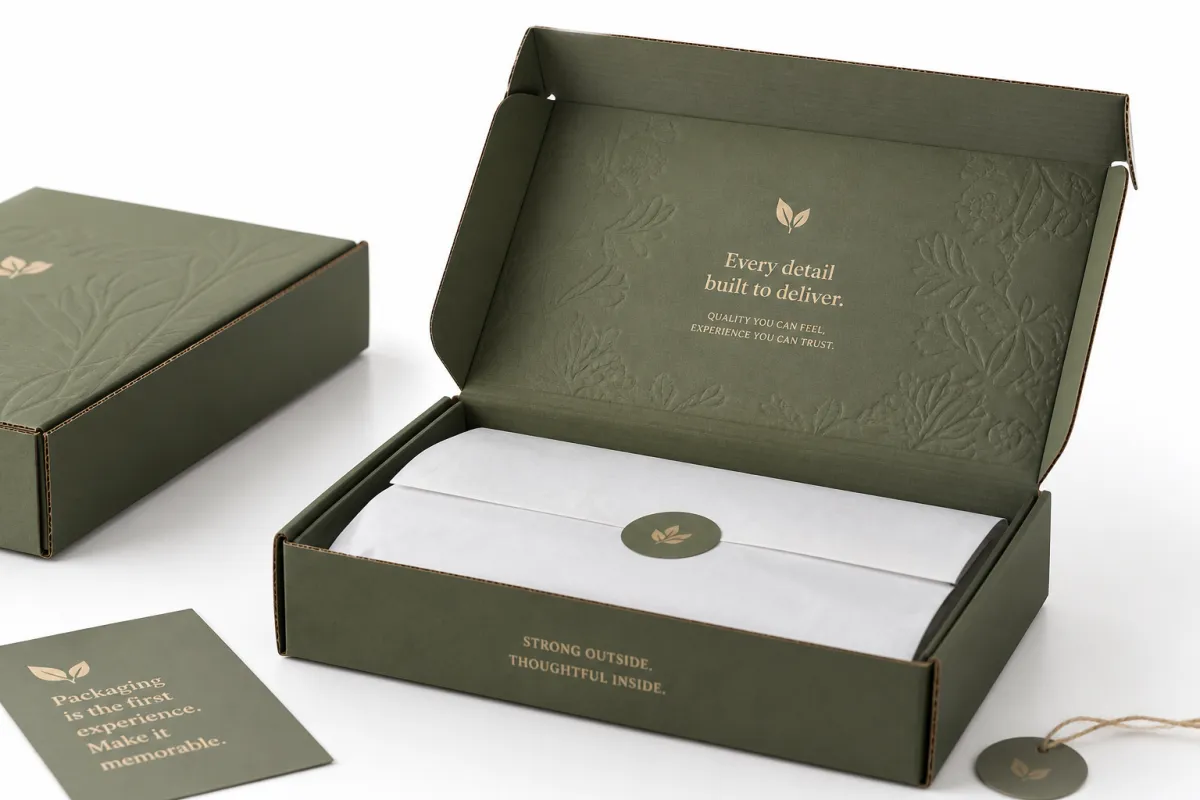
A plain mailer can do its job and still miss the moment. The box lands. The tape holds. The product survives. Yet the package feels forgettable, almost anonymous. A good embossed corrugated mailers supplier helps move the package out of that category. Raised texture gives the mailer a more deliberate hand-feel and a visual depth That Stands Out against the usual stack of kraft cartons, especially when every other parcel on the porch looks interchangeable.
Embossed corrugated mailers are corrugated mailers whose outer sheet has been pressed with a pattern, mark, or texture. The impression can be restrained, like a woven grain that only appears when light hits it at an angle, or more obvious, like a brand device that throws small shadows across the face of the mailer. A capable embossed corrugated mailers supplier thinks about board structure, print method, and finishing sequence together, because the strongest result is rarely the product of one isolated decision.
There is a practical truth behind the aesthetics. The mailer is both a brand signal and a shipping container. Those roles collide quickly. A package that looks expensive but crushes under stacking pressure is a failed package. A package that survives transit but feels cheap has failed in a different way. The better embossed corrugated mailers supplier designs for both realities at once.
A package can carry a luxury impression and still fail if it collapses under stacking, vibration, or sloppy pack-out. Texture should support the structure, not distract from a weak build.
Brands keep looking at embossed formats because sameness is a real problem in shipping. So many parcels are just variants of the same brown rectangle that a little surface intelligence goes a long way. A skilled embossed corrugated mailers supplier can create a tactile signature that stays memorable even when the color palette is narrow and the print budget is restrained. That matters for smaller brands that want a premium feel without moving into rigid boxes or elaborate inserts.
Comparisons help narrow the decision. Some teams begin with Custom Packaging Products and later refine the format once they see what the SKU actually needs. Others weigh embossed mailers against Custom Poly Mailers or Custom Shipping Boxes before they commit to a tactile upgrade. A seasoned embossed corrugated mailers supplier should be able to explain where embossing adds value and where a simpler structure is the smarter purchase.
That comparison also matters for brands trying to improve the unboxing experience without overspending. A lighter corrugated mailer with a strong embossed face can sometimes do more work than a heavier package with no texture at all. The right choice depends on product weight, shipping lane, and how much of the brand story needs to live on the outside of the mailer. I have watched a small apparel label spend less on board, more on surface treatment, and end up with a package customers remembered more clearly than a heavier competitor's shipper.
How Embossed Corrugated Mailers Work in Shipping
Corrugated mailers depend on three layers of performance: the face sheet, the flute, and the liner. The flute profile affects stiffness, crush resistance, and how clearly a textured impression reads on the surface. E-flute is common when the goal is a cleaner print face and tighter fold lines. B-flute gives a bit more cushion. F-flute is thin and refined, but it gives less forgiveness when packages are stacked hard. A good embossed corrugated mailers supplier will never pick emboss depth without also looking at flute type and board weight.
Embossing itself is a pressure process. A die or engraved tool changes the shape of the outer sheet by forcing it into a raised or recessed pattern. That impression can sit beside offset print, flexo print, digital print, die-cuts, coatings, or inserts. The sequence matters. Heavy ink coverage, fine registration, and a deep emboss can all compete for the same surface area. A reliable embossed corrugated mailers supplier will show where the design needs room to breathe and where the structure can carry more of the message.
Some categories get a stronger return from embossing than others. Beauty kits, apparel drops, premium samples, subscription boxes, holiday packaging, and high-touch ecommerce all benefit from a package that feels intentional before it is opened. A buyer may notice texture before color. That small physical cue can pull more weight than a busy printed design. An experienced embossed corrugated mailers supplier pays attention to that sequence of perception.
Texture is not automatically better than shine, color, or contrast. Spot UV adds gloss. Foil adds brightness and a sharper luxury cue. Standard print offers efficiency and broad color flexibility. Embossing brings depth and touch. Each of those solves a different problem. A practical embossed corrugated mailers supplier will reject embossing if the brand really needs a vivid metallic hit or a full photographic surface that depends on tight ink control. A quieter surface can feel more expensive than a loud one. The right answer depends on audience, product, and shipping conditions.
Shipping performance still rules the design. If the mailer has to survive parcel networks, the supplier should think about compression, tear propagation, opening force, and pack-out efficiency. The package may only be opened once, but it gets handled many times before that. Ask whether the sample was tested against a protocol from ISTA if the product is fragile or high value. That kind of testing tells you whether the embossing is decoration or part of a real shipping system.
Right-sizing is another place where the best suppliers separate themselves from the rest. A mailer that is too loose wastes dunnage and lets the product move around. A mailer that is too tight slows the packing line and can scuff the embossing during assembly. The sweet spot is usually a fit that leaves room for inserts, sleeves, or tissue without forcing stress onto the flaps. A strong embossed corrugated mailers supplier will look at the full pack-out, not just the flat dimensions.
Key Factors That Change Quality, Cost, and Performance
Board grade is the first thing to inspect. Lightweight board can look polished in a sample, then disappoint once the product has any real density or the shipping lane gets rough. Face-sheet quality matters too, because embossing only reads as sharply as the sheet it presses into. Inconsistent fiber distribution can make the pattern look uneven from one run to the next. A trustworthy embossed corrugated mailers supplier should be able to name the exact board spec instead of hiding behind phrases like "premium corrugated."
Flute profile comes next. It influences how much force the surface can absorb and how pronounced the emboss appears. Deeper texture usually looks cleaner on a smoother, denser liner. Softer liner may trim a bit of cost, but it can blur fine line work. Emboss depth matters just as much. Too shallow, and the mark disappears under normal lighting. Too deep, and the board can crack or distort near folds. A careful embossed corrugated mailers supplier talks in tolerances, not only in appearance.
Printing method changes the result, especially when artwork depends on fine text or precise edge alignment. Digital print helps with short runs and versioned artwork. Flexo is cost-efficient at scale. Offset can deliver sharper images on the right substrate. Coatings also matter. Soft-touch can make a mailer feel richer, yet it changes cost and may complicate recyclability expectations. Gloss or matte varnish changes how embossing reads under light. The best embossed corrugated mailers supplier is matching effect to function, not chasing finishes for their own sake.
Shipping profile matters just as much as material choice. A lightweight apparel order moving regionally is a different challenge from a glassware sample traveling through several hubs. Product weight, distance, climate, stacking, and palletization all shape the right spec. In a high-pressure lane, the emboss may need to be less aggressive so the mailer stays structurally sound. That is why a serious embossed corrugated mailers supplier asks about the contents, not only the dimensions.
Sustainability belongs in the conversation, but only if the language stays honest. Recycled content can be useful, though higher recycled percentages may affect brightness and surface consistency. Recyclability claims should be tied to actual material composition, not vague green language. If you want responsible material choices, ask for FSC-certified paper options and a plain explanation of what coatings do to end-of-life behavior. The EPA recycling guidance is useful when you want to understand how mixed materials affect disposal outcomes.
Consistency across production runs is where many buyers get surprised. A sample that feels perfect is only the starting point. Ask for a spec sheet, a repeatability statement, and photos from earlier production lots if the supplier can provide them. You want to know whether emboss depth, fold accuracy, and print alignment stay stable on the second run, the fifth run, and the tenth run. A dependable embossed corrugated mailers supplier does not just make a good first sample; they reproduce it.
It also helps to think about the mailer as part of corrugated packaging strategy, not as a decorative add-on. If the outer shell, insert system, and fulfillment workflow are all aligned, the package is easier to scale and easier to repeat. That is where a supplier with real production discipline becomes more useful than one that only sells attractive samples.
Embossed Corrugated Mailers Supplier Pricing: What Drives the Quote
Volume sets the baseline, but it does not define the whole price. A run of 1,000 units carries a heavier share of tooling and setup than the same project at 5,000 or 10,000 pieces. That is normal. A transparent embossed corrugated mailers supplier should separate one-time setup from recurring production cost so the buyer can see what changes as the order scales.
Custom tooling is often the first hidden variable. Emboss dies, cutting dies, and print plates may all be part of the job depending on the structure. The more precise the brand mark or the more intricate the surface pattern, the more likely there will be a tooling charge. Board usage matters as well. Larger mailers consume more material per unit, which pushes cost up even when the design looks simple. A thoughtful embossed corrugated mailers supplier explains the cost drivers instead of burying them in a single total.
A practical pricing frame helps buyers make sense of the quote, even though every spec moves the number. Short-run Custom Embossed Mailers usually sit in a higher per-unit band because setup is spread across fewer pieces. Mid-volume programs tend to become more efficient. Larger quantities can tighten the unit cost sharply if the artwork stays fixed and the supplier is not rebuilding tools for each reorder.
| Order Profile | Typical Unit Cost | Common Setup Costs | Best Fit |
|---|---|---|---|
| Short run, simple emboss | $0.85-$1.40 | $150-$450 tooling / proofing | Launches, limited drops, pilot tests |
| Mid-volume, branded emboss + print | $0.48-$0.92 | $250-$900 tooling / plates / setup | Growing ecommerce programs |
| Higher volume, optimized structure | $0.22-$0.55 | $400-$1,200 depending on complexity | Stable SKUs, repeat orders, seasonal replenishment |
Those numbers are not a quote. They are a way to see the shape of the pricing. A premium embossed corrugated mailers supplier is not automatically expensive if the order is planned properly. The quote only looks high when the buyer compares different board grades, different print coverage, or different emboss complexity without realizing those variables are not equivalent.
Freight can swing the picture fast. So can warehousing, split shipments, and packaging inserts. If the supplier is quoting ex-works only, you may still need to add pallet freight, insurance, or storage before the real landed cost is visible. Ask for the full landed picture whenever possible. A serious embossed corrugated mailers supplier will usually give you enough detail to compare quotes on equal ground.
Comparing headline price to headline price is a bad habit. If one supplier quotes lighter board, fewer colors, and no coating while another quotes a stronger board with emboss depth control and tighter registration, the cheaper number may not be the cheaper package. Use the same dimensions, the same board spec, the same finish, the same quantity, and the same delivery location. That is the only fair way to judge an embossed corrugated mailers supplier.
Tiered pricing is worth requesting. At 2,500 pieces, what does the unit cost look like? At 5,000? At 10,000? Those brackets show whether a larger run makes sense for the forecast. If a supplier cannot give a clean volume ladder, that is a signal to keep pressing for detail. A confident embossed corrugated mailers supplier knows where the breakpoints live.
Quotes should also spell out what is included. Sampling, proofing, insert assembly, color matching, and freight can all move the real number. The least useful quote is the one with the smallest unit cost and the largest number of surprises. Packaging buyers usually end up happier with the supplier that exposes total cost early than the one that hides it in a low number.
Step-by-Step Process and Timeline for Ordering
Good projects begin with dimensions. Length, width, depth, product weight, and any insert requirements should be decided before the design moves too far. A capable embossed corrugated mailers supplier will ask for those measurements first because structure drives the rest of the project. If the dimensions are off by even a few millimeters, the emboss placement and fold performance can suffer.
Artwork and structural intent come next. Is the emboss supposed to frame a logo, cover the full face, or create a subtle texture that reads more like paper than branding? Does the outside need print, or should the emboss carry most of the design with minimal ink? Cleaner briefs produce fewer revisions. A good embossed corrugated mailers supplier will usually want a clear dieline and layered artwork file before moving into proofing.
A realistic order sequence usually follows the same path:
- Discovery and fit review
- Artwork and dieline confirmation
- Tooling or emboss die creation
- Pre-production proof or sample
- Production run
- Finishing, packing, and shipment
Lead time depends on complexity. A simple embossed mailer may move from proof approval to shipment in about 12-20 business days, while more detailed jobs can run longer once tooling, coatings, or inserts enter the picture. A responsible embossed corrugated mailers supplier will not promise speed without checking the actual spec. That kind of honesty saves time, because the biggest delays usually come from late changes, not from the factory itself.
Proofing is where projects succeed or drift off course. Check emboss depth, print contrast, fold direction, and whether the mailer closes cleanly after pack-out. If the product creates pressure points inside the mailer, that is the time to catch them. A supplier that rushes approval is not helping you. A thoughtful embossed corrugated mailers supplier will push for one more review if the result looks even slightly off.
Late changes are expensive. A logo resize after the emboss die is built, a coating swap after print approval, or an insert adjustment after the sample has been signed off can add days or weeks. Exact alignment makes the risk worse. That is why procurement, design, and operations should approve the same specification at the same time. A disciplined embossed corrugated mailers supplier can keep the project moving, but only if the buyer side stays aligned.
Pack-out testing is easy to overlook and hard to regret. Put the product inside the mailer, close it, shake it gently, and stack a few units if you can. That simple check can reveal whether the mailer is too loose, too stiff, or awkward for warehouse teams to assemble. It is not glamorous work. It is also the kind of work that prevents expensive surprises. A good embossed corrugated mailers supplier welcomes it because fewer surprises mean fewer reworks.
If the mailer is part of a broader packaging refresh, compare the program with the rest of the pack line. Some brands coordinate embossed mailers with inserts, labels, and outer shippers so the full system feels coherent. Others begin with one SKU and expand later. Either approach can work. A clear brief gives the supplier a better target and gives the timeline a better chance of holding.
Common Mistakes When Choosing an Embossed Corrugated Mailers Supplier
The first mistake is judging the sample by appearance alone. A mailer can look polished on a desk and still fail under pressure. Fold quality, crush resistance, seam integrity, and repeated handling all matter. A strong embossed corrugated mailers supplier should be willing to talk about performance details, not just the visual finish.
The second mistake is sending vague artwork. Missing dielines, low-resolution logos, and unclear emboss placement create delays that never needed to happen. Embossing usually requires tighter alignment than ordinary print, so sloppy files cost time. If the supplier has to redraw the basic structure, the project slows down. A professional embossed corrugated mailers supplier can help clean things up, but they should not have to rebuild the whole file package from scratch.
The third mistake is underestimating lead time during heavy shipping periods. Seasonal demand, freight congestion, and revision cycles can stretch the schedule quickly. Buyers often assume the factory is the reason a project is late. In practice, the delay is just as likely to come from approval loops that keep bouncing the job back and forth. A dependable embossed corrugated mailers supplier will be blunt about schedule buffers and the points where a project is most vulnerable.
The fourth mistake is choosing the lowest quote without checking repeatability. A sample may be impressive. Can the supplier repeat the same emboss depth, color consistency, and cutting accuracy on the second order? That question matters more than people admit. For a brand that depends on consistent unboxing, a weak reorder is more damaging than a slightly higher first run. The right embossed corrugated mailers supplier should make repeat orders feel routine.
There is also a mismatch that shows up often: premium intent paired with low-margin products. Some teams add thick inserts, heavy coatings, and deep embossing to a mailer that ships inexpensive goods. The packaging spend starts eating the product margin. That does not mean embossing is wrong. It means the structure should fit the economics. A grounded embossed corrugated mailers supplier will help you make that call without dressing it up.
Assembly speed gets ignored too often. A beautiful mailer that takes too long to fold or pack can slow fulfillment teams and increase labor cost. If the design requires awkward tuck points, extra tape, or repeated adjustments, the full cost climbs. The right supplier should be willing to suggest structural tweaks that preserve the premium feel while reducing warehouse friction. That kind of suggestion is not a downgrade; it is a sign the supplier understands real operations, not just pretty samples.
Expert Tips for Vetting an Embossed Corrugated Mailers Supplier
Start with a scorecard. Weight structural performance, finishing quality, response speed, pricing transparency, and reorder reliability. That keeps the discussion grounded when two samples look equally strong on the surface. A solid embossed corrugated mailers supplier should score well across all five categories, not just one.
Ask for three proof points: a physical sample, a production-spec sheet, and a timeline with milestones. Those documents tell you more than a sales pitch. The sample shows how the emboss feels. The spec sheet tells you what the material actually is. The timeline shows whether the supplier can manage a real schedule. A serious embossed corrugated mailers supplier should provide all three without hesitation.
Variation handling matters too. What happens if board moisture changes? How are emboss tolerances monitored? What if color shifts slightly between lots? These are not edge cases. They are the small production realities that separate a stable operation from a shaky one. If the supplier answers in generalities, keep asking. If the supplier gives specific tolerances and control steps, that is a stronger sign. A careful embossed corrugated mailers supplier thinks in process, not only in design.
Customer service speed can be as important as machine capacity. Packaging projects rarely fail because one stage was perfect and another was flawed. They fail because someone waited too long for a file review, a change request, or a sample approval. Fast, accurate communication often saves days. A responsive embossed corrugated mailers supplier catches spec issues early enough to matter.
Ask about minimum order quantity, rerun policy, and storage options. Seasonal programs may need flexible replenishment. Teams that launch new SKUs often may need design consistency across multiple versions. If a supplier can handle those realities, they are more useful than the cheapest quote on the table. The right embossed corrugated mailers supplier should fit the rhythm of your business rather than forcing your business to fit theirs.
Comparing one premium supplier, one value-focused supplier, and one hybrid option can reveal more than any single quote. That three-way view often shows that the deepest emboss is not the real priority. Sometimes a slightly stronger board with better fold memory matters more. Sometimes cleaner print and lower waste beat a fancier finish. A practical embossed corrugated mailers supplier helps you see those tradeoffs clearly.
Run a pilot order before scaling. A small test batch can show whether the supplier keeps emboss detail sharp, holds deadlines, and packs cartons in a way your team can actually use. It also gives real feedback from warehouse staff and from the customer-facing side. That is the fastest way to decide whether the embossed corrugated mailers supplier is ready for a larger program. A pilot also reveals the boring but critical stuff, like whether the mailers stack neatly on a pallet or arrive with corners that need hand-fixing.
FAQ: Choosing an Embossed Corrugated Mailers Supplier
What should I ask an embossed corrugated mailers supplier before ordering?
Ask for the exact board grade, flute type, and emboss method used on the sample. Confirm minimum order quantity, proofing steps, and realistic production lead time. Then request landed-cost details so freight, setup, and tooling do not appear later as surprises. A good embossed corrugated mailers supplier should answer those questions directly, not dance around them.
How do I compare embossed corrugated mailers supplier quotes fairly?
Use the same dimensions, board spec, print coverage, and emboss complexity across every quote. Split one-time tooling charges from recurring per-unit costs. Check whether freight, packaging inserts, and sampling are included. If the numbers still look far apart, ask each embossed corrugated mailers supplier to restate the quote line by line so the differences are visible.
How long does an embossed corrugated mailers supplier usually need for a custom job?
Plan time for artwork review, proofing, tooling, production, and shipping. Simple projects can move quickly, but custom embossing often adds extra approval steps. Late design changes are the most common reason timelines slip. A realistic embossed corrugated mailers supplier will give you checkpoints, not a single optimistic date.
Can embossed corrugated mailers still be eco-friendly?
Yes, if the supplier uses recyclable corrugated board and avoids unnecessary coatings or mixed materials. Ask about recycled content and whether the design can be recycled in standard curbside streams. Keep the structure efficient so the premium finish does not waste material. A responsible embossed corrugated mailers supplier should be comfortable discussing those tradeoffs plainly.
What is the biggest mistake brands make with embossed mailers?
They focus on the look and ignore how the mailer performs in transit and on reorder. They approve samples without checking tolerance, stacking strength, or assembly speed. They also choose a supplier that cannot reproduce the same finish consistently at scale. The better path is to treat the embossed corrugated mailers supplier as a long-term packaging partner, not just a one-off vendor, because consistency is what turns a good sample into a reliable program.
The practical takeaway is simple: judge an embossed corrugated mailers supplier on structure, repeatability, and total cost, not on a pretty sample alone. If the board spec is clear, the emboss tolerances are documented, and the quoting separates tooling from unit price, you are dealing with a supplier that understands the difference between a nice-looking prototype and a package that can survive real shipping. That discipline is what keeps the finish premium and the program sane.