Buyer Fit Snapshot
| Best fit | Embossed Packaging Sleeves Wholesale projects where brand print, material claims, artwork control, MOQ, and repeat-order consistency need to be specified before quoting. |
|---|---|
| Quote inputs | Share finished size, material target, print colors, finish, packing count, annual reorder estimate, ship-to region, and any compliance wording. |
| Proofing check | Approve dieline scale, logo placement, barcode or warning zones, color tolerance, closure strength, and carton packing before bulk production. |
| Main risk | Vague material claims, crowded artwork, missing packing details, or unclear freight terms can make a low unit price expensive after revisions. |
Fast answer: Embossed Packaging Sleeves Wholesale: Pricing & MOQ should be specified like a repeatable production item. The safest quote records material, print method, finish, artwork proof, packing count, and reorder notes in one written spec.
Production checks before approval
Compare the actual filled-product size with the drawing, then confirm tolerance on folds, seals, hang holes, label areas, and retail display edges. Reserve space for logos, QR codes, warning copy, and material claims before decorative graphics fill the panel.
Quote comparison points
Review material grade, print process, finish, sampling route, tooling charges, carton quantity, and freight assumptions side by side. A quote is only useful when the supplier can repeat the same color, closure quality, and packing count on the next order.
Embossed Packaging Sleeves wholesale is not a decorative extra. It shapes how a product is judged before anyone opens the carton, and that matters when the base packaging already does the protective job but still needs more presence on shelf. A candle, skincare jar, or chocolate bar can look perfectly serviceable in a flat carton; add a raised logo, pattern, or seal and the pack starts to feel deliberate, considered, and easier to remember. That is the practical value of embossed packaging sleeves wholesale: more visual pull, better hand-feel, and a cleaner route to branded packaging without rebuilding the entire structure.
Buyers often compare embossed packaging sleeves wholesale with custom printed boxes, rigid cartons, or a more expensive outer wrap. That comparison is useful, though it can flatten the decision too much. A sleeve is usually the lower-cost upgrade because it changes the first impression without asking every part of the package to become more expensive. If your current carton already fits, protects, and shelves properly, a well-made sleeve can raise the perceived value quickly. If the dieline is weak, though, no amount of embossing will rescue it. Nice paper is not a strategy, no matter how pretty the mockup looks on a screen.
From a packaging buyer’s point of view, the real question is how much shelf value embossed packaging sleeves wholesale can add for a controlled spend. The answer depends on stock choice, emboss depth, print coverage, and order volume. Done well, the sleeve gives you a tactile cue, a cleaner way to separate SKUs, and a premium signal that flat ink cannot reproduce. Done poorly, it adds cost without improving the product story. So the useful approach is to keep the decision grounded in production reality, not wishful thinking.
Why embossed packaging sleeves wholesale works on crowded shelves
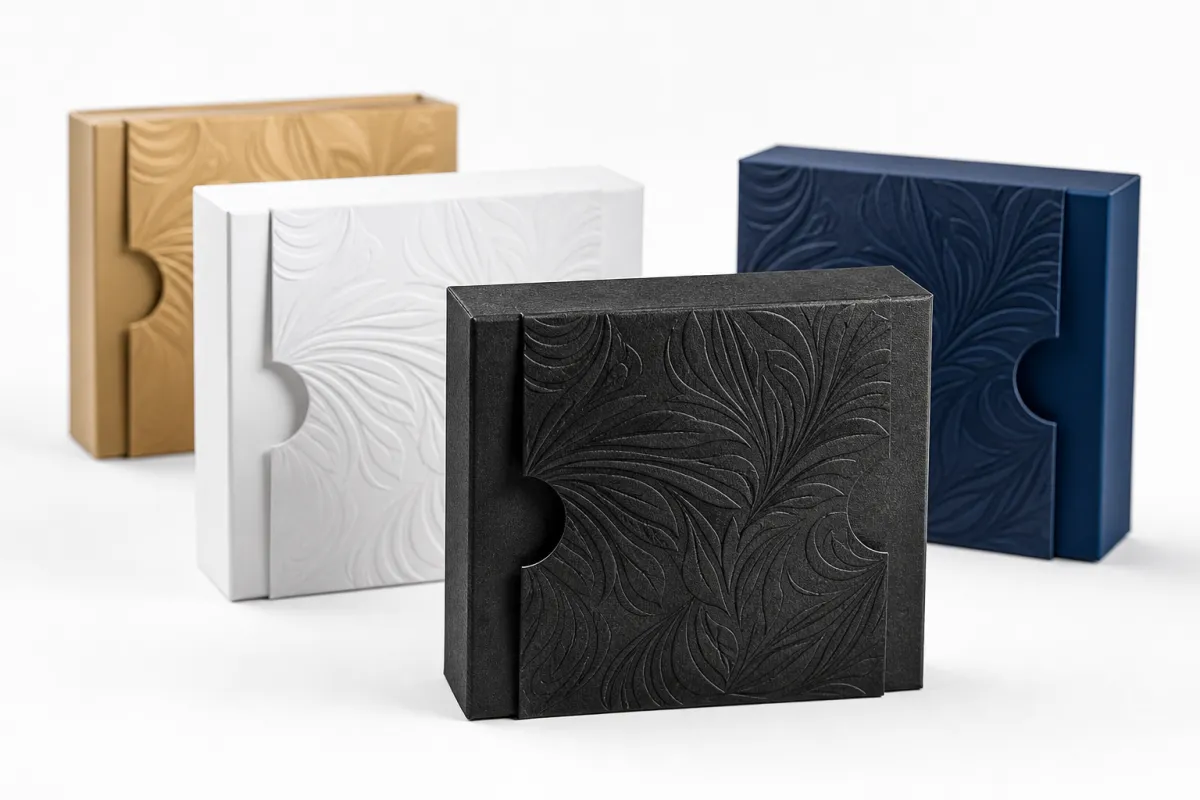
Shoppers do not study every label on a busy shelf. They scan shapes, color, contrast, and texture in a few seconds, then move on. Embossed packaging sleeves wholesale keeps showing up in categories where brands need a stronger signal without moving to a full premium structure. Raised detail catches light differently, and the hand-feel leaves a memory point that flat print rarely creates. A shopper may not remember a copy line, but they remember the product that felt sharper and more refined in hand.
Picture a candle brand sitting beside ten similar jars. The jar is acceptable. The label is acceptable. That is the problem; acceptable does not win much attention. Embossed packaging sleeves wholesale gives that candle a stronger retail packaging story by adding depth around the logo, scent family, or seasonal mark. The same logic works for skincare, tea, confectionery, supplements, and small gift sets. When the product is already good, the sleeve helps it look like it belongs in a higher price band.
One point buyers sometimes miss is that embossed packaging sleeves wholesale does more than decorate. It helps product segmentation. A brand can use one sleeve structure across a range and shift the emboss location, foil accent, or ink color by SKU. That makes it easier to separate lines without redesigning the whole carton system. For multi-SKU product packaging, that saves time, money, and a fair amount of frustration.
There is a cost reason too. A full Custom Rigid Box can become a heavy spend if the product does not justify it. A sleeve gives you a premium cue at a lower entry point, which is why embossed packaging sleeves wholesale appeals to emerging brands and to established brands testing a new line. You get the tactile upgrade without paying for a full structural rebuild. In plain terms, you are buying perceived value, not extra cardboard for the sake of it.
Practical truth: embossed packaging sleeves wholesale will not fix weak branding, poor color choices, or a sloppy dieline. It does make strong packaging design easier to notice, which is a very different thing.
The tactile element matters more than people usually admit. Flat print can look polished on screen and still feel forgettable in hand. Embossed packaging sleeves wholesale creates a physical cue that the brain reads as effort, detail, and quality. That is why premium beverage brands, boutique cosmetics, and gift packaging lines keep returning to it. If the product has to support a higher shelf price, a raised mark can carry part of that weight before the shopper even opens the box.
For brands balancing budget and appearance, embossed packaging sleeves wholesale often makes more sense than chasing every luxury finish at once. Use embossing where it will actually be seen: logos, pattern corners, crest marks, or a single band around the pack. Keep it clear of excessive ink coverage or visual clutter. The sleeve needs room to breathe. A raised detail needs space, or it turns into a technical footnote instead of a selling point.
One more point from the buyer side: embossed packaging sleeves wholesale performs best when the underlying packaging is already disciplined. If the box size is wrong, the closure is awkward, or the print looks off, the sleeve only exposes the issue faster. Good packaging design does the heavy lifting. The embossing simply gives it a louder voice.
Embossed packaging sleeves wholesale product details that matter
An embossed sleeve is usually a printed paperboard or specialty paper wrap with raised areas created through matched tooling. In practice, embossed packaging sleeves wholesale jobs usually fall into a few common build types: a wrap for a folding carton, a band around a jar or tin, a cross-sell sleeve for a promotional set, or an outer wrap for retail packaging that needs more presence. The structure looks simple. The tooling and fit are where the real work sits.
The most common embossing styles in embossed packaging sleeves wholesale are blind emboss, registered emboss, deep emboss, and emboss paired with foil. Blind emboss uses the raised shape alone, which stays clean and subtle. Registered emboss aligns the raised area with printed artwork, which gives tighter precision and a more controlled premium feel. Deep emboss makes the tactile effect more obvious, though it can stress thinner stocks if the layout is too aggressive. Foil plus emboss is the showier option, and yes, it costs more. Craft has a price tag attached.
For sleeves, the shape and fold logic matter just as much as the surface finish. Embossed packaging sleeves wholesale is not just a print exercise. Glue flap placement, fold direction, seam visibility, and the position of the raised design relative to a crease all affect the result. If the emboss lands too close to a fold line, detail can collapse. If it sits under a seam, the effect can disappear. Buyers who check those points early avoid awkward proofs and expensive rework. I have seen a 0.75 mm shift ruin an otherwise strong front panel, and that kind of thing is much easier to prevent than to repair.
Use cases are broad. Brands order embossed packaging sleeves wholesale for outer sleeves on custom printed boxes, band wraps on cosmetic jars, sleeves around chocolate bars, fragrance cartons, apparel packaging, and seasonal gift packs. The point is not that the sleeve does everything. The point is that it adds branding and tactile value without forcing the whole pack into a heavier structure. That is a sensible tradeoff when margin matters.
Design content should stay selective. A sleeve works best when it carries a logo, a pattern panel, a short claim, or a seal that can hold its shape in emboss. Too much text and too many fine lines crowd the raised area. For embossed packaging sleeves wholesale, I usually recommend giving the emboss one job: brand mark, signature pattern, or a hero frame. Let the flat print handle the rest. Crowding kills premium cues faster than a bad photo shoot.
Artwork also has to respect production realities. Fine-line type can close up, small icons can disappear, and dense dark backgrounds can make a raised feature harder to read. When a buyer is planning embossed packaging sleeves wholesale, I look closely at where the emboss sits relative to solid ink, varnish, and folds. The safest route is to keep the raised feature on a clean field or an area with enough negative space to show shape.
Compatibility issues show up early if nobody checks them. The sleeve must fit the carton or container closely. A loose sleeve looks cheap. A tight one can warp or scuff the edges. If the product is moving through a larger branded packaging system, the sleeve should still make sense with the carton, insert, and label layout. The sleeve is one part of the system, not a separate universe.
Specs for embossed packaging sleeves wholesale orders
If you want a quote that actually means something, you need real specs. Embossed packaging sleeves wholesale orders usually start with finished size, board thickness, print coverage, emboss depth, finish choice, and quantity. Leave those out and you get a vague number that looks useful until production starts asking questions. Then the budget shifts. Funny how that happens.
Material choice drives both look and price. SBS board is common because it prints cleanly and holds detail well. Kraft gives a natural look, which fits organic skincare, food gifting, and eco-oriented branded packaging, but it needs bolder artwork and more careful ink planning. Textured and specialty papers can look excellent for embossed packaging sleeves wholesale, yet they need a real check on how the emboss reads across the surface. Pretty paper that crushes the raised detail is not premium. It is just expensive paper with issues.
Recycled board is worth considering if your brand wants a more responsible story. Be clear about the grade and certification. If FSC chain-of-custody support is required, ask for the documents rather than a logo on the quote. For transport and shipping validation, ask whether the supplier works to ISTA test methods for packed goods, especially if the sleeves are shipped flat and inserted later into custom printed boxes or other finished product packaging. Standards do not replace good judgment, but they do reduce guesswork.
Finish choices affect both perception and cost. Matte is the safe middle ground. Soft-touch feels premium and pairs well with emboss, though it is not cheap. Gloss can make color pop, although it often competes with the tactile feature. Foil stamping adds contrast. Spot UV gives a hard shine that works better on some layouts than others. For embossed packaging sleeves wholesale, the best-looking spec is not always the most expensive one. It is the one that gives the embossed area enough contrast to show up in hand and under retail lighting.
Here is a practical way to think about the build:
- Board thickness: usually around 250gsm to 400gsm depending on the sleeve size and the amount of handling.
- Emboss depth: subtle on small marks, deeper on larger logos or pattern fields.
- Print colors: one to four spot or process colors is common for controlled costs.
- Coating: matte or soft-touch if you want the raised detail to stand out.
- Bleed and margins: enough space so the emboss does not run into the trim line or fold.
Those details sound small. They are not. A 1 mm change in fold allowance can affect fit. A 0.5 mm shift in the raised area can throw off registration. For embossed packaging sleeves wholesale, production tolerances matter more than most brand teams expect, especially when the sleeve must align with a logo panel on the carton or container underneath.
Artwork prep should be treated as a real production step, not a guess. Vector files help. Safe margins help. A proper dieline helps even more. Avoid tiny serif type inside the emboss zone unless you enjoy unnecessary risk. If the design includes fine-line patterning, ask for a sample or proof that shows the actual emboss result. Mockups can flatter bad choices. A physical sample tells the truth.
One more spec point: do not ignore the glue flap and seam. If the seam lands on the front face, it can interrupt the premium look. If it hides on the back or side, the sleeve usually feels cleaner. In embossed packaging sleeves wholesale, the seam placement is often the difference between a pack that feels intentional and one that feels assembled from leftovers.
| Spec Level | Typical MOQ | Approx. Unit Price | Best For | Main Tradeoff |
|---|---|---|---|---|
| Simple SBS sleeve with blind emboss | 500-1,000 pcs | $0.24-$0.48 | Launch tests, small retail packaging runs | Less margin for complex artwork |
| Printed sleeve with matte coating and registered emboss | 1,000-3,000 pcs | $0.30-$0.60 | Core SKUs, branded packaging programs | Setup still matters, so price shifts with size |
| Soft-touch sleeve with foil and deeper emboss | 3,000-5,000 pcs | $0.48-$0.95 | Premium lines, gift sets, holiday runs | Higher tooling and finish cost |
| Specialty paper sleeve with mixed finishes | 5,000+ pcs | $0.65-$1.30 | Luxury positioning, high-touch package branding | More proofing and tighter material control |
That table is not a quote. It is a buying frame. Real embossed Packaging Sleeves Wholesale Pricing shifts with size, paper choice, color count, and the amount of finish work in the layout. Still, it gives you a useful benchmark before anyone starts pretending a sleeve should cost pocket change.
Embossed packaging sleeves wholesale pricing and MOQ
Pricing for embossed packaging sleeves wholesale usually breaks into two buckets: setup and unit cost. Setup includes the die, emboss tooling, plate preparation, proofing, and press adjustment. Unit cost covers the paper, printing, finishing, folding, and packing. If the run is small, setup dominates. If the run is larger, the unit price starts to behave more politely. That is why embossed packaging sleeves wholesale can feel expensive on the first run and much more manageable on repeat orders.
The main price drivers are straightforward. Larger sleeves use more material. More print colors cost more. Deep embossing costs more than a light registered mark. Foil and soft-touch raise the number faster than many sales quotes admit in plain language. If you ask for a cleaner spec, the cost usually comes down. If you ask for a fancy one-piece solution with a lot of surface work, the price rises. There is no mystery here, just physics and labor.
MOQ varies by supplier and by finish level. A simple embossed sleeve can sometimes start around 500 to 1,000 pieces. A more detailed embossed packaging sleeves wholesale order with foil, spot UV, or heavier material often sits in the 1,000 to 3,000 range. Premium packs and larger SKUs can push higher. Suppliers are not being difficult when they set a higher MOQ for complex builds. They are trying to keep the press, die, and finishing line from turning into a cost sink.
Here is the trap buyers fall into: they compare quotes on unit price only. That is not enough. Two embossed packaging sleeves wholesale quotes can look close on paper and still be far apart in what they actually include. One may use a lighter stock, shallower emboss, or simpler fold structure. The other may include better board, tighter registration, and a more durable finish. If the quotes are not built from the same spec sheet, the cheaper one may be cheaper for a reason that shows up later.
For a clearer comparison, ask for three levels on the same layout:
- Prototype level: best for approval and fit checking, not ideal for final economics.
- Working level: the practical middle option with controlled cost and solid shelf presence.
- Premium level: deeper emboss, better finish, and a more luxurious hand-feel.
That three-step approach makes embossed packaging sleeves wholesale easier to buy because you can judge value instead of guessing. A lot of brands waste time arguing over a single number when the real decision is whether the sleeve should support a launch test, a core SKU, or a premium extension. Different job, different spend. Straightforward.
Hidden costs deserve a direct mention. Rushed timelines often carry rush charges. Artwork changes after the emboss die is made can trigger rework. Multiple proof rounds add time and sometimes money. Special inks and unusual stock colors can complicate the run. If the sleeve is part of a larger system, such as a carton, insert, and label package, ask how those elements will be coordinated. Embossed packaging sleeves wholesale is easiest to manage when the file is final before tooling starts.
Repeat orders can improve the economics a lot. If you know the design will be used again, ask about reserved tooling, tiered pricing, or bundle pricing across related SKUs. A supplier with a good wholesale program can sometimes hold the die or make the order structure friendlier for the next run. That matters for brands building a long-term product packaging line, not just a one-off launch.
There is also a material claim angle. If your brand wants recycled content or FSC support, price can shift depending on stock availability and certification requirements. That is not a reason to avoid the requirement. It is a reason to specify it early. Once a quote is based on the wrong board, the whole embossed packaging sleeves wholesale job turns into a cleanup exercise. Nobody wants that, least of all your finance team.
For buyers who want tighter commercial control, the safest route is to compare embossed packaging sleeves wholesale suppliers against the same data: dimensions, stock, finish, emboss style, quantity, and delivery window. Then compare total landed cost, not just piece price. Freight, cartons, and waste allowance matter. So does the cost of delay if the launch date slips. A cheap sleeve that misses shelf timing is not cheap.
Honestly, the best quotes usually come from clear briefs. If you can describe the packaging design in real terms, the supplier can give you a useful number. If you send a half-formed idea and hope the math will sort itself out, you will get a vague answer and likely a second quote later. That is how embossed packaging sleeves wholesale gets messy for no good reason.
Process and timeline for embossed packaging sleeves wholesale
The process for embossed packaging sleeves wholesale is more structured than a basic print job, and for good reason. The raised detail has to line up with the artwork, the die has to match the board, and the finishing step has to preserve the shape. A clean run usually moves through brief, quote, dieline confirmation, artwork setup, proofing, tooling, production, finishing, packing, and shipping. Skip one step and the whole project becomes a rescue operation.
Where do delays usually happen? Four places. First, incomplete dimensions. Second, late file changes. Third, emboss die approval. Fourth, color corrections after the first proof. In practice, the first two are client-side issues and the second two are shared issues. The easiest way to keep embossed packaging sleeves wholesale on schedule is to lock dimensions early and give the production team one clear contact who can approve changes fast.
Typical timing depends on complexity, but a useful planning window is 12 to 18 business days from proof approval for many standard embossed packaging sleeves wholesale runs, with more time for larger or more finished jobs. Sample work may be quicker or slower depending on tooling and whether the supplier needs to build a physical mockup. If the order includes foil, deeper embossing, or special paper, assume extra setup time. Real schedules are rarely improved by optimism.
Proof approval is the turning point. Before approval, the project is still fluid. After approval, the clock becomes much less forgiving. That is why the client side should review the dieline, artwork, emboss placement, finish notes, and quantity tier in one pass. One missed note can cost days. Multiple decision-makers can cost more. I have seen projects stall because four people wanted one “small” change. Small changes multiplied by committees are never small.
For launch planning, build in buffer time. Embossed packaging sleeves wholesale should not be planned to arrive the same week the product ships. You need time to inspect a sample run, check fit, and pack the sleeves with the rest of the retail packaging or shipping materials. If the sleeves are going into cartons or assembled product packaging, one dry run before mass approval is smart, not optional.
Transit testing can also matter. If the final pack will be exposed to heavier distribution, ask whether the supplier or your own team can reference FSC certification guidance where recycled fiber claims are involved, and use recognized shipping test standards such as ISTA where the packed goods need validation. The emboss itself is not load-bearing, but the sleeve still has to survive the same handling as the rest of the pack.
Some buyers want to move fast, and that is fair. Fast works if the project is well defined. In embossed packaging sleeves wholesale, speed comes from decision discipline, not wishful thinking. Final dimensions. Final artwork. Final finish call. One owner on the client side. That combination cuts friction more effectively than any promise of priority production. It also keeps the supplier from guessing, which is usually where expensive mistakes begin.
Packaging teams often ask whether they should sample first or go straight to bulk. My answer is yes, sample first if the sleeve is new, the fit is tight, or the emboss is a big part of the design. If you are repeating a proven structure with only minor artwork changes, you may be able to move faster. Either way, embossed packaging sleeves wholesale works best when the sample stage is treated as a real decision checkpoint, not a courtesy.
At the operational level, the supplier should check alignment, emboss clarity, edge trim, fold strength, and packing count before shipment. That is the basic quality control you want to see. If the supplier cannot explain those checkpoints, you are not buying a process. You are buying hope. Hope does not hold a sleeve together.
Why choose us for embossed packaging sleeves wholesale
A good supplier should make embossed packaging sleeves wholesale easier to buy, not harder. The value is not just in printing and embossing; it is in spec control, proof clarity, and predictable delivery. Buyers do not want marketing fluff. They want the die to match the artwork, the finish to match the quote, and the final pallet to match the approved sample. That is the job.
Strong support starts with a real review of the dieline. A useful packaging partner will flag weak emboss areas, too-tight folds, oversized type, or a finish choice that fights the artwork. That matters because embossed packaging sleeves wholesale is only as good as the prepress work behind it. If the supplier catches a problem before tooling, you save time and money. If they do not, the error gets pressed into every unit.
Quality control should be visible. Look for prepress checks, emboss alignment inspection, finish verification, and final packing standards. For a first-time buyer, that kind of discipline is worth more than a low quote with no backup. For an experienced brand, it protects repeatability across multiple SKUs. One run should look like the next. If it does not, your package branding starts drifting, and brand drift is expensive.
We also see a common need from growing brands: a test order before the full rollout. That is sensible. Embossed packaging sleeves wholesale can be produced in short runs for evaluation, then scaled once the fit and feel are approved. It is also useful for seasonal or promotional packaging where the design may change later. Not every project needs huge volume on day one. Some need a clean first run and a quick proof of market response.
For buyers comparing options across our broader catalog, it helps to review Custom Packaging Products alongside your sleeve specs. The sleeve may be part of a wider packaging design system, and seeing the full range often makes the structure choice easier. If you are planning repeat purchasing, our Wholesale Programs are set up to keep pricing and reorders more predictable across related jobs.
Flexibility matters, but not in the vague sense people like to throw around. I mean practical flexibility: multiple design versions under one sleeve size, repeat-order consistency, and a willingness to adjust quantity tiers without rebuilding the whole process. That is what helps a buyer manage product packaging across a line instead of treating every SKU like a fresh emergency.
There is a real difference between a supplier that sells boxes and one that understands how the sleeve sits inside the system. Embossed packaging sleeves wholesale should be judged on whether the supplier can think through carton fit, label placement, stock behavior, and production tolerance. If they can, the project gets calmer. If they cannot, you end up managing their mistakes for them. Nobody needs that hobby.
From a cost standpoint, a good partner also keeps the conversation honest. They should tell you when a deep emboss and soft-touch finish will push you beyond your target margin. They should also tell you when a simpler board and cleaner layout will deliver 80 percent of the visual effect for a better price. That kind of advice is what buyers actually pay for. It is not glamorous, but it is useful.
And yes, embossed packaging sleeves wholesale should still feel premium. That is the point. Premium does not mean wasteful, though. A focused design, decent stock, and careful tooling will usually beat a crowded, over-finished layout that looks rich on a screen and mediocre on a shelf. I would rather ship a clean sleeve than a complicated one that burns budget and energy for very little gain.
Next steps after you shortlist embossed packaging sleeves wholesale
Once you have shortlisted embossed packaging sleeves wholesale suppliers, the next move is not to ask for more sales talk. It is to gather the facts. Final dimensions. Stock preference. Emboss depth. Quantity tiers. Finish priority. Delivery window. If you send those details together, you will get a quote that helps you buy. If you send fragments, you will get fragments back.
Start with three scenarios: a prototype or sample version, a budget-conscious working version, and a premium version. Compare them side by side. That makes it easier to judge the actual value of embossed packaging sleeves wholesale instead of reacting to one number in isolation. A lot of buyers discover that the middle option gives the best balance of look, cost, and speed. That is not a failure. That is a good purchase.
Then send artwork files with notes on logo placement, non-negotiable brand standards, and any finish elements that must stay. Be clear about what matters most. If the embossed mark is the star, say so. If the sleeve has to coordinate with labels, inserts, or custom printed boxes, say that too. Production teams are not mind readers, and they should not have to be.
Delivery timing needs the same discipline. Confirm the shelf date before approving tooling. Confirm the freight plan before locking the order. Confirm the reorder path before you celebrate the sample. A quote that looks cheap but misses the launch date is not a good quote. It is a mistake with a nice font.
Here is the checklist I would use before approval:
- Fit: sleeve matches the carton or container with room for production tolerance.
- Finish: emboss, coating, foil, or UV choices are confirmed on the same proof.
- MOQ: volume tiers match the launch and reorder plan.
- Timeline: proof approval, tooling, and shipping are realistic.
- Consistency: repeat orders can stay stable across SKUs.
If you are still refining the packaging design, keep the embossed area simple and strong. If the brand story is natural, use kraft or recycled board. If the goal is premium shelf impact, use a cleaner board with a matte or soft-touch finish. If the product needs to look sharp under retail lighting, make sure the raised feature has contrast. The wrong combination can make embossed packaging sleeves wholesale feel underwhelming even when the artwork is good.
That is the actual buying logic. Not hype. Not guesswork. Just matching the sleeve to the product, the shelf, and the margin. Embossed packaging sleeves wholesale can do a lot for a brand that already has a decent carton and a clear offer. It can also burn money if you overcomplicate the spec. Keep the decision grounded, and the result usually is too.
The cleanest next step is to lock the dieline, choose one finish path, and request tiered pricing on the same spec sheet. Do that, and the conversation gets real fast. You will see where embossed packaging sleeves wholesale adds value, where it adds cost, and what the finished pack is actually gonna feel like once it lands in a customer’s hand.
FAQ
What is the usual MOQ for embossed packaging sleeves wholesale?
MOQ depends on sleeve size, board choice, and whether new emboss tooling is needed. Simple embossed packaging sleeves wholesale orders can start around 500 to 1,000 pieces, while more finished builds often begin closer to 1,000 to 3,000 pieces. If you want a clearer comparison, ask for tiered pricing at 500, 1,000, and 3,000 units so you can see how the unit cost changes before you commit.
Are embossed sleeves more expensive than standard printed sleeves wholesale?
Yes. Embossing adds tooling and setup cost, so the first embossed packaging sleeves wholesale run usually costs more than a standard flat-printed sleeve. The unit price improves as quantity rises because the setup spreads across more pieces. A cleaner design with fewer finishes is usually cheaper than a sleeve stacked with foil, spot UV, and a heavy emboss.
Which materials work best for embossed packaging sleeves wholesale orders?
SBS paperboard is often the cleanest choice because it prints sharply and holds emboss detail well. Kraft works nicely for natural, eco-forward product packaging, but fine details usually need bolder shapes and larger type. Specialty papers can look strong for embossed packaging sleeves wholesale, though they should be checked carefully for emboss clarity, ink coverage, and fold behavior before you approve bulk production.
How long does production take for embossed packaging sleeves wholesale?
Timing depends on proof approval, tooling, finish complexity, and order size. A standard embossed packaging sleeves wholesale run often takes about 12 to 18 business days after proof approval, with more time needed for deeper emboss, foil, or unusual stock. Fast client approvals save more time than shortcuts on the production side.
Can embossed packaging sleeves wholesale be customized for different SKUs?
Yes. The same sleeve structure can stay in place while graphics, names, and finish accents change by SKU. That is a common approach for branded packaging across a product line. Multi-design orders can reduce repeat tooling costs if the dimensions stay the same, and keeping the emboss location consistent across versions usually makes production cleaner and cheaper.
For buyers comparing sleeve options, the right move is to focus on fit, finish, MOQ, timeline, and reorder consistency. Do that, and embossed packaging sleeves wholesale becomes a commercial tool instead of a guessing game. When the spec is clear, the price is easier to judge, the proof is easier to approve, and the final pack has a better shot at doing its job on shelf. That is the point of embossed packaging sleeves wholesale, and it is usually the point where good product packaging starts to feel worth the spend.


