Buyer Fit Snapshot
| Best fit | Custom Rigid Box Manufacturer projects where brand print, material claims, artwork control, MOQ, and repeat-order consistency need to be specified before quoting. |
|---|---|
| Quote inputs | Share finished size, material target, print colors, finish, packing count, annual reorder estimate, ship-to region, and any compliance wording. |
| Proofing check | Approve dieline scale, logo placement, barcode or warning zones, color tolerance, closure strength, and carton packing before bulk production. |
| Main risk | Vague material claims, crowded artwork, missing packing details, or unclear freight terms can make a low unit price expensive after revisions. |
Fast answer: Custom Rigid Box Manufacturer: Board, Finish, Dieline, and Unit Cost should be specified like a repeatable production item. The safest quote records material, print method, finish, artwork proof, packing count, and reorder notes in one written spec.
Production checks before approval
Compare the actual filled-product size with the drawing, then confirm tolerance on folds, seals, hang holes, label areas, and retail display edges. Reserve space for logos, QR codes, warning copy, and material claims before decorative graphics fill the panel.
Quote comparison points
Review material grade, print process, finish, sampling route, tooling charges, carton quantity, and freight assumptions side by side. A quote is only useful when the supplier can repeat the same color, closure quality, and packing count on the next order.
Custom Rigid Box Manufacturer: A Practical Buying Guide
A custom rigid box manufacturer does a lot more than make cardboard thicker. The job starts with board, wrap, adhesive, magnets, and inserts, then turns those parts into structured packaging that protects the product and signals value before the lid even opens. Miss the fit by a few millimeters or leave the corners sloppy, and the box feels ordinary fast. Nice artwork does not rescue bad construction. Never has. Never will.
For brands comparing formats, the Custom Packaging Products page is a useful place to see how rigid packaging sits beside folding cartons and other retail packaging options, while About Custom Logo Things gives a clearer sense of how the team approaches branded packaging with a practical eye. A good custom rigid box manufacturer should be able to talk about structure, finish, and use case in one conversation, because those pieces are tied together from the start.
I see the same mistake over and over: people treat rigid packaging like a print job. It is not. A premium box is part engineering, part hand assembly, part quality control, and part brand theater. That is why the right custom rigid box manufacturer can save you from expensive surprises long before the first full run starts. You are not just buying a container. You are buying a controlled experience.
What a Custom Rigid Box Manufacturer Actually Does
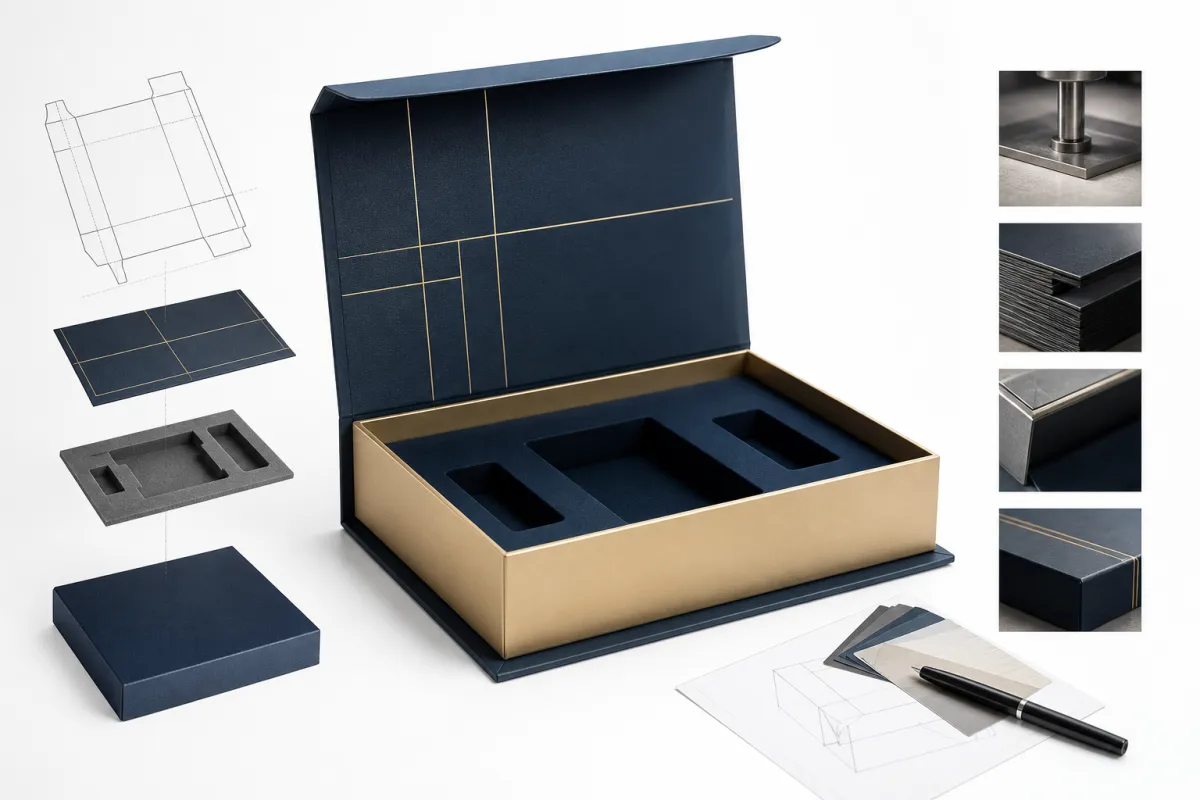
A rigid box is not just a heavier folding carton. It is a built structure, usually made from greyboard or chipboard in the 1.5 mm to 3 mm range, then wrapped with printed paper, specialty stock, or fabric-like material to create a premium shell. A custom rigid box manufacturer takes flat materials and turns them into packaging that feels permanent, holds its shape, and supports the product story in a way standard retail packaging usually cannot.
That difference matters because the box is doing more than guarding the item. It shapes the first physical impression. In luxury retail, gifts, electronics, cosmetics, subscription sets, and presentation packaging, that first impression carries real commercial weight. A customer may never measure board thickness, but they feel the difference immediately when the lid lifts with a clean reveal or the box closes with a crisp edge.
From a packaging buyer's point of view, a custom rigid box manufacturer is also a problem solver. The box has to account for product weight, shipping method, display environment, shelf handling, insert type, and the way the customer opens the package. A box that works for a light fragrance set will not automatically work for a glass bottle set or a multi-piece electronics kit. The structure has to match the use case, not just the artwork.
"A premium box that arrives scuffed, gapped, or hard to open is not premium packaging." That is the hard truth a lot of buyers learn after the first production run, and a strong custom rigid box manufacturer tries to catch those issues before they become expensive lessons.
The process pulls together more disciplines than many people expect. Structural packaging design, print production, hand finishing, assembly sequencing, and inspection all matter. If you are building custom printed boxes for a launch or a seasonal program, you are not buying one machine pass. You are buying a coordinated workflow. That is why the best conversations with a custom rigid box manufacturer usually start with the product, then move to the box, then to the finish details.
In real terms, the manufacturer needs a concrete brief: exact dimensions, product weight, closure style, shipping method, and any brand rules tied to color or texture. The more specific the brief, the more reliable the quote and the sample stage will be. When the brief is vague, a custom rigid box manufacturer has to guess at material thickness and insert fit, and guesses are where cost creep begins. Guesswork also eats time. Nobody needs that.
How a Custom Rigid Box Manufacturer Builds the Box
The basic construction starts with board, then moves outward. A custom rigid box manufacturer cuts greyboard or chipboard to form the walls and base, then applies a wrap layer over those panels to create the finished exterior. The wrap can be printed paper, coated stock, textured paper, or a specialty material chosen for feel as much as for graphics. Corners are folded and sealed to keep the edge lines clean, because on a rigid box the corners are one of the first places the eye lands.
That structure can be arranged in several ways. A two-piece setup box has a separate lid and base. A shoulder box creates a stepped reveal that makes the top sit a little higher than the walls beneath it. A book-style box opens like a hardcover and often uses magnets hidden in the flap. Drawer boxes slide out of a sleeve and give a slower, more deliberate unboxing moment. Collapsible rigid formats fold for freight efficiency, which helps if you are storing inventory or shipping long distances. A skilled custom rigid box manufacturer will recommend the style that fits the product and the channel, not just the one that looks attractive in a mockup.
Inserts matter just as much as the shell. Foam, paperboard, molded pulp, thermoformed trays, and custom die-cuts can all be used to keep the product centered. If the product is a glass bottle, the insert needs to cradle the neck and body without pinching the label. If it is a kit with several parts, the cavities need enough tolerance to allow fast packing without letting the pieces shift. A thoughtful custom rigid box manufacturer treats the insert like part of the package, not an afterthought.
- Two-piece rigid boxes work well for gift sets, cosmetics, and display-ready retail packaging.
- Book-style rigid boxes suit premium electronics, influencer kits, and launch presentations where the opening motion matters.
- Drawer-style rigid boxes add a tactile reveal and are useful for jewelry, samples, and smaller components.
- Collapsible rigid boxes help reduce shipping volume while keeping the premium structure intact.
Fit is where good packaging becomes great packaging. Even a polished exterior can feel cheap if the lid gaps are uneven, the magnets do not meet cleanly, or the insert lets the product rattle. A custom rigid box manufacturer should be checking those details during sampling, because a 1 mm drift at one edge can be very visible once the box is in hand. That matters even more for package branding programs where the box itself acts as a silent brand ambassador.
One more practical detail: rigid boxes do not forgive sloppy tolerances. A folding carton can hide a little more variation because the structure flexes. A rigid box cannot. That is why good manufacturers obsess over corner wrap, board squareness, and how the lid seats after assembly. It looks fussy on paper. In the hand, it just feels right.
Custom Rigid Box Manufacturer Pricing: What Really Changes Cost
Pricing looks mysterious until you break it into the pieces that actually drive the number. A custom rigid box manufacturer is usually balancing board cost, wrap material cost, print coverage, finishing steps, insert complexity, labor, and order quantity. Once you look at those inputs, the quote starts to make sense. A larger box needs more board and wrap. A magnetic closure adds hardware and assembly time. A full-coverage specialty paper wrap increases material spend. A custom insert adds both design and fabrication effort.
Quantity matters more than many buyers expect. Short runs often cost more per unit because the setup work does not scale down as easily as the materials do. If the die-cut, sample build, proofing, and hand assembly take nearly the same effort whether you order 300 pieces or 3,000 pieces, the per-box cost on the smaller run climbs quickly. A good custom rigid box manufacturer will show you tiered pricing so you can see where the break points are instead of guessing.
| Rigid Box Style | Typical Use | Approx. Unit Cost at 5,000 pcs | Cost Drivers |
|---|---|---|---|
| Two-piece setup box | Gift sets, cosmetics, presentation kits | $0.90-$1.80 | Simple structure, moderate wrap labor |
| Magnetic book-style box | Electronics, premium launches, branded packaging | $1.80-$3.75 | Magnet placement, precise wrap folding, extra assembly time |
| Drawer-style rigid box | Jewelry, samples, small accessory sets | $1.40-$3.10 | Rail fit, pull ribbon, sleeve alignment |
| Collapsible rigid box | E-commerce, stored inventory, mixed distribution | $1.30-$2.90 | Panel engineering, fold logic, shipping efficiency |
Those numbers are not fixed quotes, but they are useful planning ranges for a typical production run. If you move from 5,000 pieces to 1,000 pieces, the price per unit can rise by 20% to 60% or more, depending on print coverage and handwork. A custom rigid box manufacturer will usually see the biggest jumps when the box has large wrap coverage, multiple insert parts, or a highly manual closure system.
Finishes add up in small increments that still change the total. Soft-touch lamination can add a tactile luxury feel, but it also adds material and process cost. Foil stamping, embossing, debossing, and spot UV each carry setup time, and the price climbs with coverage area and registration complexity. A simple rule helps here: if the finish adds value once the box is in hand, it is probably worth considering; if it only looks impressive on a rendering, the cost may be hard to justify. A disciplined custom rigid box manufacturer will help you sort that out early.
A practical budgeting move is to ask for several quantity tiers at once, such as 500, 1,000, 2,500, and 5,000 units. That makes the economies of scale visible. It also helps you see whether a larger run is worth the inventory commitment. For product packaging programs with a long shelf life, the lower per-unit cost can be worth the extra stock. For seasonal launches or limited editions, a smaller run may protect cash flow better even if the per-box price is higher. Either way, the quote becomes much easier to read when the custom rigid box manufacturer breaks it down clearly.
Freight and storage belong in the real cost too. A rigid box ships bulkier than a folding carton, and if your carton is built assembled rather than flat, cubic volume can matter a lot. A buyer who only looks at unit cost may miss the storage and transit burden. A seasoned custom rigid box manufacturer should talk through that impact before you commit. Otherwise, the low quote becomes a very expensive surprise after delivery.
There is also a hidden line item many teams forget: rework. If a sample is wrong because the brief was vague, somebody pays for another round of prototypes, new approvals, and schedule slip. A clearer brief usually saves more money than shaving a few cents off paper stock. That is not glamorous. It is just true.
Materials, Inserts, and Finishes That Affect the Final Look
The finish system is where a box becomes memorable. A custom rigid box manufacturer can build the structure correctly and still miss the emotional effect if the wrap, insert, and finish do not match the brand. Coated paper gives sharp graphics and clean color blocks. Uncoated stock feels warmer and less reflective. Textured papers add depth that can make a box feel more tactile in retail packaging. Specialty wraps can mimic linen, leather, or soft-touch surfaces, which is why they show up so often in higher-end product packaging.
Inside the box, the insert choice changes both presentation and protection. Foam is strong at holding a fixed shape, though it is not always the best fit for sustainability goals. Paperboard inserts are often easier to print, score, and recycle. Molded pulp brings a more natural look and can work well for eco-minded branded packaging. Thermoformed trays create precise nests for electronics or multi-piece kits. A skilled custom rigid box manufacturer should know which insert behaves best for the item weight, shipping method, and final presentation.
Finish details also shift perception fast. Matte surfaces usually feel more restrained and premium than high gloss. Foil stamping can make logos and key marks stand out, but it works best when the artwork is designed with clean line weight and enough negative space. Embossing and debossing add physical depth, though a thin board or very busy art file can reduce the effect. Spot UV gives contrast, yet too much of it can feel busy rather than refined. A careful custom rigid box manufacturer will usually recommend fewer effects done well instead of stacking every possible effect into one box.
The inside of the box deserves attention too. A printed interior can create a strong reveal, especially for launch kits or gift sets where the opening sequence is part of the experience. Still, interior printing adds registration complexity and can make approval more demanding. If the box is mostly used for retail display, a plain interior might be cleaner and more economical. A practical custom rigid box manufacturer will ask how the box is handled in the real world, not just how it looks in the mockup stage.
There is also a simple material reality that buyers sometimes miss: some wraps are more forgiving than others. Soft-touch laminations can look beautiful, but they can show rub marks if boxes are packed tightly without protection. Dark matte papers can reveal fingerprints more easily than lighter textured wraps. High-coverage solids need excellent wrap alignment or every edge line becomes visible. That is why a good custom rigid box manufacturer always thinks about handling, stacking, and transit, not just the photography sample.
If sustainability is part of the brief, ask what fiber sources and certifications are available. The certification basics at FSC are useful when a brand wants documented forest stewardship for paper-based materials. That does not solve every sustainability question, but it does give packaging teams a more disciplined starting point. A custom rigid box manufacturer should be able to discuss certified board, paper wraps, and recycling compatibility without hand-waving.
At the technical level, the best finish choice is the one that supports the product story. A luxury scent line may benefit from a soft-touch wrap, foil logo, and paperboard insert with a precise bottle cavity. A tech accessory kit may need a tougher wrap, stronger corner build, and a tray that holds components securely during shipping. A gift assortment may need a warmer, textured feel. The point is not to add every premium effect; the point is to make the materials, inserts, and surfaces feel intentional, which is exactly where a strong custom rigid box manufacturer earns trust.
Step-by-Step Timeline With a Custom Rigid Box Manufacturer
A realistic timeline starts with the brief. Before a custom rigid box manufacturer can quote accurately, the team needs the product dimensions, weight, target quantity, closure style, artwork status, and any shipping constraints. If the product is fragile, oddly shaped, or sensitive to movement, those details shape the whole structure. Even a simple project goes better when the brief includes the end use: shelf display, gifting, subscription fulfillment, or e-commerce shipment.
- Brief and scoping: 1-2 business days if the information is complete.
- Dieline and structural review: 2-4 business days for most straightforward projects.
- Mockup or prototype: 3-7 business days, longer if specialty materials are involved.
- Revision and approval: varies, but one to two rounds is common for detailed branded packaging.
- Production: often 10-20 business days after approval, depending on finish complexity.
- Pack-out and transit: depends on destination, freight mode, and order volume.
That schedule is not extreme; it is just honest. A simple two-piece rigid box with standard print and no specialty insert can move from approved dieline to packed cartons in roughly 12-15 business days. Add magnetic closures, custom insert fabrication, soft-touch wrap, foil, embossing, or a more delicate assembly sequence, and the window can stretch toward 18-25 business days. A practical custom rigid box manufacturer will separate sampling, approval, production, and shipping so you can see where the time is actually going.
For programs that ship through parcel networks, the test method guidance at ISTA is worth reviewing before you freeze the spec. You do not need to become a testing expert, but you should understand that drop, vibration, compression, and temperature swings can all affect the way a rigid box performs in the field. A strong custom rigid box manufacturer will think about those forces while choosing board thickness, closure strength, and insert style.
The sequence inside the plant also matters. Board is cut first, then wraps are printed or prepared, then lamination or coating is applied if required, then the parts are die-cut and folded. After that, the box is hand assembled, corners are wrapped, magnets or closures are set, inserts are fabricated, and final inspection checks the reveal, squareness, and surface quality. If you are buying custom printed boxes for a launch, that stack of steps explains why a rigid box is much more labor-intensive than a folding carton.
One practical tip: ask for a schedule that shows the approval gates in plain language. You want to know when the dieline is due, when artwork must be final, when the sample ships, and what happens if the prototype needs revision. That kind of clarity keeps the project moving and helps the custom rigid box manufacturer stay accountable without constant chasing.
The same advice applies to sample review. Do not only examine the prototype on a desk. Open it under the lighting where it will actually be displayed, place the product inside, close it several times, and look at it while packed in a shipper if the box will ever leave a warehouse. A custom rigid box manufacturer can solve issues much more easily before mass assembly starts than after a full production run is already underway. Fixing a cut file is annoying. Fixing 10,000 bad boxes is a headache nobody wants.
Common Mistakes When Hiring a Custom Rigid Box Manufacturer
The first mistake is starting with aesthetics alone. A box can look excellent in a rendering and still fail in use if the product dimensions, handling path, and shipping method are not defined. A good custom rigid box manufacturer wants to know how the box will be packed, stacked, opened, and displayed. Without that, the design can drift toward style over function, and the final result may look polished but perform poorly.
The second mistake is under-specifying tolerances. On rigid packaging, a small gap is visible. If a lid reveal is supposed to be even and the actual build drifts by a couple of millimeters, the eye catches it immediately. Drawer boxes can bind if the rails are too tight. Magnetic closures can feel weak if the placement is inconsistent. Inserts can let the product move if the cavity is too generous. A careful custom rigid box manufacturer should help define the critical measurements instead of leaving them implied.
The third mistake is asking for too many effects at once without checking the budget impact. Foil, embossing, debossing, spot UV, specialty paper, soft-touch film, and complex inserts all sound attractive separately, but together they can push the program into a higher cost band very quickly. I have seen buyers approve a small run with every finish effect turned on, then wonder why the quote feels heavy. A practical custom rigid box manufacturer will usually suggest one or two high-value finishes that do the most work visually.
A box is not premium because it uses every premium effect. It is premium because the structure, surface, and opening experience all feel deliberate.
The fourth mistake is waiting too long to clean up artwork files. Missing bleed, unconverted fonts, low-resolution images, and unclear color targets create delays that affect the entire schedule. A rigid box usually wants a clean dieline, proper bleed, and artwork built to the printer's file rules. If a brand color must be exact, the team should decide early whether to use CMYK build, a spot color, or a controlled ink target. A reliable custom rigid box manufacturer should ask for this before production, not after the file is already in queue.
Another issue is buying the wrong quantity. Small runs can be smart, but sometimes the unit price climbs enough that a slightly larger run saves real money. Other times the larger run becomes dead stock. The answer depends on shelf life, sales velocity, and storage. A good custom rigid box manufacturer will not push quantity just for the sake of a bigger order; the better partners show the tier pricing and let the buyer decide with full information.
Finally, many teams forget to ask about packaging use after delivery. Will the boxes be filled by hand, by a pack-out line, or by a contract packer? Will they live in a humid warehouse? Do they need to survive direct-to-consumer shipping? Those details change the spec. A well-chosen custom rigid box manufacturer helps you plan for the real environment, not a perfect studio condition that never exists in the field. That is where the honest advice usually comes from.
Expert Tips and Next Steps With a Custom Rigid Box Manufacturer
If you want a smoother project, start by gathering the details that actually affect production. A custom rigid box manufacturer can work much faster when the brief includes exact product dimensions, product weight, target quantity, shipping method, desired closure, finish priorities, and any insert needs. It helps even more if you can share reference images of packaging you like and packaging you do not like, because those examples quickly reveal the level of gloss, texture, and structure you want.
- Send exact measurements: product height, width, depth, and weight.
- State the use case: retail packaging, gift packaging, subscription set, or e-commerce shipment.
- Define the must-haves: closure type, insert style, finish, and brand colors.
- Ask for tiered pricing: 500, 1,000, 2,500, and 5,000 units if that fits the project.
- Request a prototype: then inspect it in the same conditions the final box will face.
That last point matters more than most people think. A prototype can look perfect on a design table and still feel wrong in a shipping carton or on a retail shelf. If the product shifts, if the lid catches, or if the interior looks too plain for the brand story, fix it before mass production. A custom rigid box manufacturer should welcome that kind of review because it improves the final result and reduces expensive rework. If they act annoyed by revisions, that is a warning sign.
Compare manufacturers on more than unit price. Look at sample quality, response time, communication clarity, and how well they explain board grades, wrap options, and insert choices. Ask whether they can support FSC-sourced materials, whether they understand retail packaging and branded packaging programs, and whether they have clear proofing steps for custom printed boxes. For a broader view of available formats, the Custom Packaging Products page can help you compare styles before you settle on one path.
The best projects usually happen when the buyer gives the manufacturer a clean brief and a realistic budget window. That lets the team Choose the Right board thickness, the right wrap, the right closure, and the right insert without overbuilding the box. It also makes package branding feel sharper, because the box supports the product instead of fighting it. If you want a team that understands how those details work together, About Custom Logo Things is a good place to start before you request a quote.
My practical advice is simple: brief your custom rigid box manufacturer with clear priorities, review one real prototype, and insist on honest quantity pricing before you commit. That is how a packaging project moves from guesswork to a clean production plan, and it is how branded packaging ends up feeling as solid in the hand as it looks on the screen. In the end, the right custom rigid box manufacturer gives you more than a box; they give you control over product presentation, protection, and the customer experience from the first touch to the last fold. If you keep the brief tight and the standards clear, the whole process gets a lot less messy. Kind of refreshing, honestly.
What should I send a custom rigid box manufacturer for an accurate quote?
Start with exact product dimensions, weight, and a clear note on how the item will sit inside the box. A custom rigid box manufacturer also needs target quantity, preferred closure style, finish ideas, and whether you want a custom insert. If you already have artwork, send it; if you do not, do not wait for perfect graphics before opening the pricing conversation. The quote will be much more useful if the manufacturer can see the product and the use case, not just a rough idea of the box size.
How long does a custom rigid box manufacturer usually take to produce rigid boxes?
Simple projects can move fairly quickly, but prototype review, dieline approval, and finish selection usually set the pace. A custom rigid box manufacturer may need 10-15 business days for a straightforward run after approval, while boxes with magnets, specialty wraps, or custom inserts can take longer because they require more sampling and more manual assembly. The cleanest way to manage time is to ask for a schedule that separates sampling, approval, production, and shipping so delays are easy to spot early.
Why does a custom rigid box manufacturer charge more for small runs?
Setup work, sample creation, tooling, and hand assembly are spread across fewer units, so the per-box price rises. A custom rigid box manufacturer also has to absorb the same structural and print preparation whether you order a few hundred or several thousand pieces. Specialty finishes and custom inserts can cost almost the same to prepare on a small run as they do on a larger run, which is why tiered pricing matters. It shows you the point where a larger order begins to improve the unit economics in a real way.
What is the difference between a rigid box and a folding carton?
A rigid box uses thick board and arrives pre-formed, which gives it a sturdier feel and a more premium presentation. A folding carton ships flat, is usually lighter, and is easier to pack in volume. A custom rigid box manufacturer builds packaging for presentation, protection, and unboxing impact, while folding cartons are better suited to lighter retail packaging programs where speed and shipping efficiency matter more. The right choice depends on how much the package itself contributes to the product value.
Can a custom rigid box manufacturer add inserts and specialty finishes?
Yes, many can. A custom rigid box manufacturer can usually build inserts for bottles, electronics, cosmetics, gift sets, and multi-piece kits, and can also add foil, embossing, debossing, soft-touch lamination, spot UV, and specialty wraps. The strongest results come from matching the finish to the product story instead of stacking every effect into the same box. A restrained build often feels more expensive than a box crowded with features because the structure and surfaces have room to breathe.
How do I know if a rigid box design is actually worth the extra cost?
Look at what the box does after the lid comes off. If the rigid structure improves protection, fixes pack-out issues, supports the brand story, and creates a better customer experience, the extra cost is earning its keep. If the same product could ship in a simpler carton with no loss in presentation or safety, the premium box may just be decoration. A good custom rigid box manufacturer should help you separate those two cases without dressing up every option as necessary.

