Buyer Fit Snapshot
| Best fit | Fragile Glassware Shipping Cartons projects where brand print, material claims, artwork control, MOQ, and repeat-order consistency need to be specified before quoting. |
|---|---|
| Quote inputs | Share finished size, material target, print colors, finish, packing count, annual reorder estimate, ship-to region, and any compliance wording. |
| Proofing check | Approve dieline scale, logo placement, barcode or warning zones, color tolerance, closure strength, and carton packing before bulk production. |
| Main risk | Vague material claims, crowded artwork, missing packing details, or unclear freight terms can make a low unit price expensive after revisions. |
Fast answer: Fragile Glassware Shipping Cartons: Pack Without Breaks should be specified like a repeatable production item. The safest quote records material, print method, finish, artwork proof, packing count, and reorder notes in one written spec.
Production checks before approval
Compare the actual filled-product size with the drawing, then confirm tolerance on folds, seals, hang holes, label areas, and retail display edges. Reserve space for logos, QR codes, warning copy, and material claims before decorative graphics fill the panel.
Quote comparison points
Review material grade, print process, finish, sampling route, tooling charges, carton quantity, and freight assumptions side by side. A quote is only useful when the supplier can repeat the same color, closure quality, and packing count on the next order.
I still remember watching a carton fail after an insert slid less than a quarter inch on a corner drop, and 18 stemware pieces turned into a cleanup job nobody wanted, including the warehouse supervisor who had to file the incident report by 4:30 p.m. That gap between packaging that merely looks strong and fragile glassware shipping cartons that actually protect product is where breakage claims are born, and I have seen enough of those claims from facilities in Dongguan, Monterrey, and northern Ohio to know they are never as "small" as someone in procurement insists they are.
Most buyers assume the box tells the whole story. It does not. Fragile glassware shipping cartons are built as systems, and if the outer board, insert geometry, and closure strength do not work together, glass loses every time. I have seen that mistake in a Shenzhen plant making 20,000-piece runs, in a client meeting over a $0.09 insert upgrade, and during a supplier negotiation where everyone swore the sample was "good enough" right before the breakage rate climbed to 6.0% on a 750 ml bottle pack. Honestly, that is just packaging wearing a fake mustache and hoping nobody notices.
Practical matters more than packaging theater. The real story behind fragile glassware shipping cartons lives in materials, fit, closure strength, and lead time, not in marketing copy. I will walk through how they are built, what they cost, how long they take, and what usually cracks first when someone tries to save $0.05 in the wrong place. If your operation depends on order fulfillment, ecommerce shipping, and clean package protection, those small details carry real weight, even if they do not make for flashy spreadsheets.
What Are Fragile Glassware Shipping Cartons?
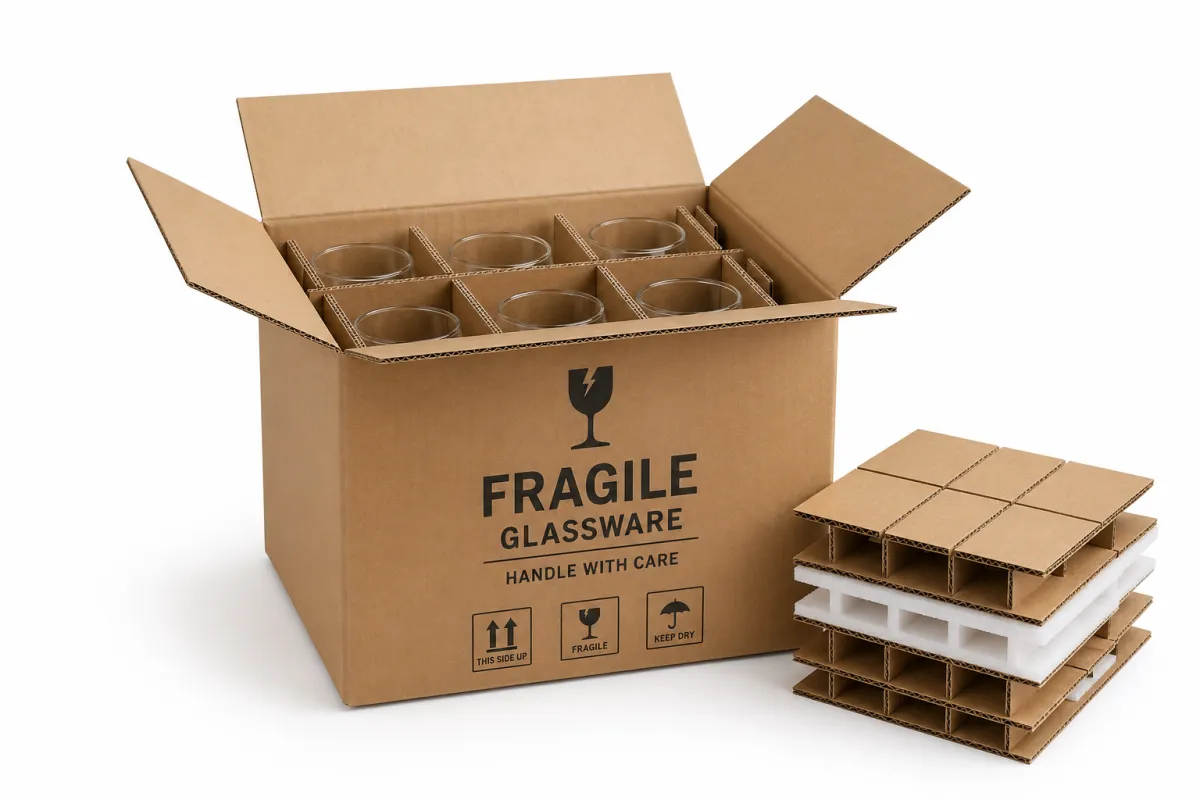
On one factory floor in Dongguan, I watched a carton that looked sturdy fail a corner drop because the insert shifted just under a quarter inch. The outside survived. The bottle base did not. That is why fragile glassware shipping cartons are not just "small boxes for glass." They are engineered transit packaging designed to control impact, vibration, compression, and the sloppy handling that happens between packing tables and delivery vans. A tidy print job on 350gsm C1S artboard for the retail sleeve does not change physics, which is rude but true.
Glassware is difficult to ship for three plain reasons. The shape is irregular, so a stem, shoulder, lip, or handle creates pressure points. The walls are thin, so a 2-inch drop can turn into a rim crack. Stack pressure builds fast in mixed freight and parcel networks, especially when a 12-pound master carton sits under another carton for 48 hours in a Nashville hub or a Frankfurt cross-dock. Good fragile glassware shipping cartons solve those problems with board grade, insert design, and void control, not hope. I wish hope worked here; it would save everyone a lot of time and a lot of broken stems.
In a client meeting with a wine importer in Napa, the buyer kept asking why a "nice looking carton" was not enough. I handed him a damaged sample and showed him the score line where the bottle had shifted 3 millimeters during a 36-inch edge drop. He got quiet after that. A carton can look handsome and still fail. fragile glassware shipping cartons need to hold every piece steady, especially during ecommerce shipping where parcel sortation punishes anything loose. My opinion? If the product can wiggle, it is gonna find a way to smack into the one hard edge you forgot about.
The promise is simple: practical buying advice with no gloss over the hard parts. Materials, costs, timelines, and testing all matter when you spec fragile glassware shipping cartons and want fewer surprises, fewer breakage claims, and fewer emergency reorders. I have spent enough time on dock floors in Shenzhen and in factory offices in New Jersey to know that one bad spec can turn an easy month into a mess of replacement orders and irritated emails.
How Fragile Glassware Shipping Cartons Work
The best fragile glassware shipping cartons behave like a small shock system. The outer corrugated shell takes the abuse first. The insert or partition walls keep each item in its own lane. Void control keeps the contents from rattling. The closure, whether it is a tuck flap, locking tab, or tape seal, keeps the load from opening under pressure. If one of those parts is weak, the whole structure begins to fail. Packaging people love to talk about "systems" until they are the ones paying for a broken shipment, then suddenly the system matters a lot.
Board choice matters more than most people expect. A 32 ECT single-wall B flute can handle lighter stemware, but heavier jars or multipacks often need 44 ECT, double-wall BC flute, or a tighter die-cut insert. I have also seen 275# test board fail in freight while a slightly heavier spec stayed clean, because the better board reduced flex at the corners in a 500-kilometer truck lane from Guangzhou to Chengdu. That is why fragile glassware shipping cartons should be spec'd by product weight, not by whatever the last supplier happened to stock or whatever was sitting on the shelf when someone got in a hurry.
Shock is only part of the picture. Vibration is the slow killer. A carton can survive one hand drop in the plant and still fail after 1,200 miles on a pallet because the contents kept walking inside the cavity. In one supplier review, I asked for an ISTA 3A-style sample run and the team acted like I was being dramatic. I was not. If you want a standard to compare against, start with ISTA and its published test methods, then back that up with your own drop and compression checks. I have learned the hard way that vibration will humble a design faster than almost anything else, especially on split shipments that pass through Chicago and Dallas in the same week.
The test language is straightforward. Edge crush strength helps you understand stacking resistance. Burst strength tells you how much puncture pressure the board can take. Drop testing shows what happens when a handler loses grip from 30 inches, 36 inches, or even a shoulder-height toss onto a dock. For fragile glassware shipping cartons, I care less about polished spec sheets and more about whether the carton survives the actual abuse path: pick, pack, sortation, transport, and final delivery. Fancy language is nice, but a crushed rim is still a crushed rim.
One more detail people miss: closure strength. A carton that opens a little at the seam can fail even if the board is fine. Tape width, glue area, and flap overlap all matter. In custom packaging, I usually ask for at least 2 inches of sealed overlap on heavier shipments and a closure that survives a 1-minute shake test without panel separation. That sounds basic because it is. The point of fragile glassware shipping cartons is not sophistication for its own sake. It is package protection that holds up under real handling, including the kind of rough treatment that happens when someone is moving too fast and pretending they are not.
Fragile Glassware Shipping Cartons: Cost and Pricing Factors
Pricing is where people usually get clever and then pay for it later. A cheap carton that saves $0.08 a unit can cost far more in returns, re-shipments, and customer service time. I have watched a brand spend $1.20 on a replacement bottle, $0.65 on freight, and another 12 minutes on a support call because the carton design was too loose. That is why fragile glassware shipping cartons should be judged by total landed cost, not just the quote line marked "unit price." I can almost hear the groan from finance, but the math still works the same way whether they like it or not.
The main cost drivers are predictable: carton size, board grade, insert complexity, print coverage, order quantity, and freight class. Smaller runs usually pay more because setup is spread over fewer pieces. Custom inserts can add pennies or a few tenths of a dollar, depending on whether you are using molded pulp, die-cut corrugated, or a partition system. A simple insert upgrade might add $0.07 to $0.18 per set at 5,000 pieces, while a molded pulp redesign in Qingdao or Suzhou can land closer to $0.22 when cavity depth and drying time increase. That is not nothing, but it can save a $40 case from a claim. I have seen people fight over that seven cents like it was a luxury tax, then act shocked when the returns ate the margin anyway.
The price reality I give clients after one too many budget meetings looks like this:
| Option | Typical Use | Approx. Unit Price at 5,000 | Lead Time | Main Tradeoff |
|---|---|---|---|---|
| Stock corrugated shipper | Fast replenishment, low-SKU programs | $0.46-$0.82 | 5-8 business days | Loose fit and more void fill |
| Semi-custom carton with standard insert | Mid-volume glassware and jars | $0.78-$1.12 | 10-15 business days | Moderate tooling and sample time |
| Fully custom carton + partition system | Stemware, premium bottle packs, mixed sets | $0.92-$1.48 | 12-20 business days | Higher setup cost, better fit |
Stock versus custom is not a moral decision. It is a math problem. If a stock carton gets you shipping materials in hand faster, that can be the right call for a short promotion or a one-time launch. Custom-fit fragile glassware shipping cartons often Reduce Dimensional Weight, cut void fill, and lower damage rates enough to pay back the extra setup. If you are also buying outer shippers, compare them with Custom Shipping Boxes so you can review the full structure instead of one line item in isolation. Otherwise you are comparing a tire to the whole car.
I once negotiated with a converter in Dongguan who wanted to charge $0.24 for a molded pulp insert on a 10,000-piece run. We got it down to $0.19 by changing the cavity depth by 2 millimeters and switching the board blank layout from a 3-up to a 4-up sheet. The savings looked tiny on paper. Then we tracked claims for three months and found the tighter design cut breakage by 2.7%. That is how fragile glassware shipping cartons save money: not by being the cheapest box, but by being the cheapest box that still keeps glass intact. In my experience, "cheap" often ends up being a very expensive adjective.
Fragile Glassware Shipping Cartons: Process and Timeline
The process starts with measurement, and I mean real measurement. Do not send a supplier a "rough size." Give them the exact outside dimensions, the heaviest filled weight, the closure style, and whether the carton will ship parcel, LTL, or palletized freight. For fragile glassware shipping cartons, a 1/8-inch error can create a pocket where the glass slides and strikes the wall on impact. One sloppy note on a spec sheet can undo an otherwise decent design, which is a little too much drama for a box, if you ask me.
My usual workflow is straightforward. First, gather dimensions and product weight. Second, choose an insert style: partition, molded pulp, die-cut corrugated, or a hybrid. Third, request samples and test them with the actual glassware. Fourth, revise the fit if the product can move more than 1-2 millimeters. That first sampling round often takes 5-7 business days, and revision samples can add another 2-4 days. If you need printed cartons or tooling, the clock stretches. That is not the supplier being difficult. That is the reality of custom transit packaging, which tends to move at the speed of actual manufacturing instead of wishful thinking.
Production timing depends on the setup. A simple re-run of existing fragile glassware shipping cartons might leave the plant in 10-12 business days after proof approval. A new die-cut structure or insert can take 12-15 business days, sometimes longer if the plant needs a fresh cutting rule or print plate in a facility near Shenzhen, Ningbo, or Ho Chi Minh City. Freight is its own line item. Domestic trucking may add 2-5 business days, while international ocean freight can add 20-35 days before the cartons land in your warehouse. I have watched a team schedule a launch around carton delivery and then sit around with product ready and packaging missing, which is a special kind of misery nobody puts on the project calendar.
"I do not care how pretty the mockup is," a buyer in Chicago told me after one too many breakage claims. "If the rim moves 3 millimeters, we are paying for it." He was right, and the sample that failed a 36-inch corner drop never made it into production.
You can avoid most timeline surprises by asking three direct questions before you approve artwork: Is tooling needed? What is the minimum order quantity? What is the quoted lead time from proof approval, not from the date of the first email? I have seen order fulfillment teams plan around a 7-day promise, then discover a 14-day insert build hiding in the fine print. That is how launches slip. Fragile glassware shipping cartons work better when the schedule includes sample review, revision, and freight transit from the start. I know that sounds boring, but boring is a wonderful feeling when you are trying to keep a launch from sliding off the calendar.
If you need a broader packaging program around the same SKU family, I usually start at Custom Packaging Products and work backward from the shipping method. A carton spec that fits the product but ignores dimensional weight can blow up your costs fast. A carton that saves 10 cubic inches might not sound dramatic, but in ecommerce shipping those inches become real dollars after enough parcels move through the network. That is why I always tie fragile glassware shipping cartons to the carrier math, not just the product mockup. My honest opinion: if you ignore carrier math, the carrier will happily remind you later, and they rarely do it gently.
Common Mistakes That Crack Glass and Raise Claims
The first mistake is sloppy sizing. If the internal cavity is too wide by even 1/4 inch, the glass can tilt and strike the wall on impact. If it is too tight, pressure lands on the rim or shoulder and creates hidden stress. I have seen both failures in the same week at a facility outside Atlanta, which is a sharp reminder that fragile glassware shipping cartons are unforgiving either way. There is no polite middle ground here; the carton either fits or it eventually confesses in the form of a cracked shipment.
The second mistake is using random void fill as a substitute for real structure. Kraft paper, loose chips, and air pillows can help in some shippers, but they do not replace a carton designed to hold each item in place. A bag of filler is not a spec. It is a guess. And guesses get expensive when the freight carrier shakes the carton for 300 miles between Indianapolis and Louisville. I have seen people stuff a box until it looked "safe," only to discover the contents were still dancing around like they had somewhere better to be.
The third mistake is ignoring storage conditions. Corrugated board loses performance if it sits in high humidity, on a wet floor, or near a loading dock where condensation builds overnight. I have been in plants where the outer stack looked clean but the bottom row had absorbed enough moisture to soften the panels. If your shipping materials spend 10 days in a damp warehouse in Houston or 14 days in a coastal port building in Busan, the best design in the world is already compromised. FSC-certified board can help with sourcing discipline, and you can verify chain-of-custody practices through FSC if responsible sourcing matters to your brand. Moisture is a sneaky little problem, and it ruins a lot more than people admit.
The fourth mistake is testing like a hobbyist. One hand drop on a carpeted floor is not a qualification plan. Fragile glassware shipping cartons need corner drops, edge drops, flat drops, shake testing, and compression checks that reflect the actual shipping path. I once watched a team approve a sample after one 24-inch drop, then lose 4.8% of the next production run because the carton failed under pallet stacking at 1,100 pounds of stacked load. That is not bad luck. That is bad testing. And yes, the meeting afterward was as cheerful as it sounds.
- Use the wrong internal dimensions, and a 3 millimeter shift becomes a break at the rim.
- Rely on loose void fill, and the carton passes a desk test but fails a 30-inch parcel drop.
- Store cartons in humidity above 65%, and the board edges start softening before you even pack them.
- Approve a sample without freight simulation, and claims show up after the first 100 orders, not the first 1.
One more issue shows up in mixed-SKU order fulfillment: people combine fragile items with accessories and assume the box can adapt. It cannot, at least not without a proper insert map. A divider that holds one jar and one stopper in the same cavity can save 0.3 ounces of void fill, but only if the insert actually locks both pieces. Otherwise you have a rattling box with a fancy label. That is not fragile glassware shipping cartons doing their job. That is just expensive optimism dressed up as packaging.
Expert Tips for Choosing the Right Carton
Ask the supplier for the boring specs first. I want ECT rating, burst strength, board caliper, flute type, and insert material before I look at print mockups. Pretty graphics do not stop cracked glass. Strong fragile glassware shipping cartons start with honest engineering, not a glossy render that hides a weak seam. If a vendor leads with artwork before they talk structure, I already know we may have a long afternoon ahead.
My favorite negotiation trick is to standardize where you can. If three SKUs can share one master carton with three insert layouts, you can buy larger quantities and reduce setup waste. I have seen a brand cut annual packaging spend by 11% just by moving from six odd-sized shippers to three standard formats in a facility outside Columbus, Ohio. That also reduces dimensional weight surprises, which matter a lot in ecommerce shipping because carriers bill on the bigger number: actual weight or volumetric size. Simple packaging logic often beats clever packaging logic, which is irritating for the clever people, but good for margins.
The conversation I usually have with buyers who want the lowest quote on day one is simple: compare the landed cost, not the box price. Add inserts, print plates, freight class, warehouse handling, and damage risk. Then ask whether a $0.06 upgrade in fragile glassware shipping cartons saves you $0.42 in claim exposure. More often than not, it does. That is why a cheap carton is rarely cheap. I know that sounds like a line from a grumpy consultant, but I have the claims reports to back it up.
- Request 3 samples from different vendors and test them with the exact 6-ounce, 12-ounce, or 750 ml product you ship.
- Run at least 5 corner drops and 5 flat drops from 30 inches, then inspect rims, shoulders, and base corners.
- Ask for a written spec sheet that lists 32 ECT, 44 ECT, or double-wall construction so the next reorder is repeatable.
- Review the full packing line, including tape width, seal pattern, and any accessory packaging, before you sign off.
I still remember a supplier negotiation where the plant manager in Suzhou offered to shave $0.03 off a carton by reducing the insert board by one ply. I said no. Not because I enjoy arguing over three cents. Because I had already seen the damage report from a similar design, and the replacement cost was $3.80 per break once freight and customer support were counted. That is the math behind fragile glassware shipping cartons: spend a little more on the right spec, or spend a lot more cleaning up the mess. I would much rather have the boring meeting about board grade than the frantic meeting about broken inventory.
If your workflow includes care cards, small accessories, or a second SKU that travels separately, Custom Poly Mailers can keep those pieces organized so they do not end up loose inside the carton. That is not a substitute for proper transit packaging. It is one more way to keep the shipment clean, especially when fulfillment teams are moving 500 orders a day and nobody has time to hunt for missing parts. I have seen a tiny accessory create a surprisingly big customer complaint, which feels ridiculous until you are the one answering the email.
Fragile Glassware Shipping Cartons: Next Steps
If you want the cleanest path forward, start with a measurement sheet. List the exact outside dimensions, product weight, closure method, and the carrier you actually use. Parcel, LTL, and palletized freight all change the answer. The best fragile glassware shipping cartons are designed around those specifics, not around a generic "small box" assumption. I know the generic route is tempting because it feels faster, but it usually comes back later wearing a damage claim.
Then ask for three sample builds and compare them side by side. One should prioritize fit, one should prioritize compression strength, and one should show the supplier's best value option. Test all three with the real glassware, not empty cartons, because empty board tells you almost nothing. If you see movement, rattling, or a rim touching the wall, revise before you place the big order. That small step can save a lot of money later. It can also save a lot of mild profanity in your inbox, which I consider a nice bonus.
Before you reorder, lock a spec sheet. Include carton dimensions, board grade, insert style, acceptable tolerances, print requirements, and the test standard you want used, whether that is a basic drop test or a fuller ISTA-style review. Good fragile glassware shipping cartons are repeatable. That is the point. Packaging should not become a fresh argument every time you restock, and yet, somehow, it often does unless somebody actually writes the spec down.
The short checklist I use with clients before we move from sample to production looks like this:
- Measure the product and note the filled weight to the nearest ounce.
- Confirm the shipping method, carrier class, and whether dimensional weight is a risk.
- Choose the insert type and board grade, then verify closure strength with a real sample.
- Approve the spec sheet only after a drop test, a shake test, and a compression check.
If you do those four things, fragile glassware shipping cartons stop being a guessing game. They become a controlled part of your package protection strategy, which is exactly how they should work. I have spent enough time on factory floors in Guangdong and in claim meetings in Dallas to know this part is boring only until the first broken bottle shows up. Then everybody suddenly cares about the spec, the tape, the insert, the board, and whatever else they had hoped to ignore five minutes earlier.
The takeaway is simple: choose the carton by fit, test it with the real product, and write the spec down before volume shipping starts. If the glass cannot move, the carton is doing its job; if it can, keep refining until it cannot.
What materials are used in fragile glassware shipping cartons?
Most fragile glassware shipping cartons use corrugated board with a flute chosen for compression and stacking strength, usually 32 ECT, 44 ECT, or double-wall when the load is heavier. Better designs add molded pulp, die-cut corrugated, or partition walls so the glass never touches its neighbor during parcel handling or pallet movement. In plain terms: the board does the heavy lifting, and the insert keeps everybody from bumping elbows. For printed outer sleeves or retail-ready wraps, 350gsm C1S artboard is common when a brand wants a cleaner shelf presentation without changing the transit carton underneath.
How much do fragile glassware shipping cartons usually cost?
Price depends on size, board grade, insert design, print coverage, and order quantity more than any single factor. For a 5,000-piece run, a stock shipper might land around $0.46-$0.82, while a custom-fit carton with inserts may run $0.78-$1.48. A molded pulp insert from a plant in Xiamen or Foshan can cost about $0.15 per unit for 5,000 pieces when the cavity is simple and tooling is already in place. Always compare landed cost, because freight and breakage can erase a bargain fast. I have seen a "cheap" carton cost more than the premium option once all the damage was counted up, which is a very annoying kind of cheap.
Do fragile glassware shipping cartons need inserts?
If the glass can move inside the carton, yes, you usually need inserts or partition walls. That is especially true for stemware, thin-walled drinkware, and mixed packs with different shapes or weights. A snug outer carton alone is not enough if the product can shift 1-2 millimeters during a drop or a vibration cycle. Honestly, I think inserts are the part people underestimate most, probably because they look boring right up until they save the shipment. A 6-cavity partition set in 32 ECT board can be the difference between a clean 2.5% damage rate and a very expensive 9% claim month.
How long does it take to make custom fragile glassware shipping cartons?
Simple stock-to-print jobs can move quickly, but custom sizes and inserts take longer because of sampling and approval. Plan for 5-7 business days for the first sample, another 2-4 business days for revisions, and 12-15 business days from proof approval for production on a straightforward run. If tooling is needed, add extra time so the project does not get rushed. The calendar is usually kinder if you respect it early, and many buyers in New Jersey, Texas, and Southern California build in a 3-day buffer just to avoid air freight panic.
How do I test fragile glassware shipping cartons before ordering in bulk?
Run drop tests with the actual glassware inside, not empty cartons, because real weight changes everything. Test corner, edge, and flat drops from at least 30 inches, then shake and compress the carton the way carriers will. If you find movement, cracked rims, or seam failure, revise the spec before you place the bulk order. And if a sample squeaks, rattles, or otherwise sounds unhappy, trust your ears; the carton is usually telling you something useful. A 36-inch corner drop, a 1-minute shake test, and a compression check at stacked load are a solid baseline for most fragile packs.

