Buyer Fit Snapshot
| Best fit | Custom Valentine's Day Packaging Boxes That Boost Sales projects where brand print, material claims, artwork control, MOQ, and repeat-order consistency need to be specified before quoting. |
|---|---|
| Quote inputs | Share finished size, material target, print colors, finish, packing count, annual reorder estimate, ship-to region, and any compliance wording. |
| Proofing check | Approve dieline scale, logo placement, barcode or warning zones, color tolerance, closure strength, and carton packing before bulk production. |
| Main risk | Vague material claims, crowded artwork, missing packing details, or unclear freight terms can make a low unit price expensive after revisions. |
Fast answer: Custom Valentine's Day Packaging Boxes That Boost Sales should be specified like a repeatable production item. The safest quote records material, print method, finish, artwork proof, packing count, and reorder notes in one written spec.
Production checks before approval
Compare the actual filled-product size with the drawing, then confirm tolerance on folds, seals, hang holes, label areas, and retail display edges. Reserve space for logos, QR codes, warning copy, and material claims before decorative graphics fill the panel.
Quote comparison points
Review material grade, print process, finish, sampling route, tooling charges, carton quantity, and freight assumptions side by side. A quote is only useful when the supplier can repeat the same color, closure quality, and packing count on the next order.
Custom Valentine's Day Packaging Boxes That Boost Sales
If I had to name the packaging detail brands still underestimate, it would be the first 3 to 5 seconds of unboxing. That is the moment a shopper decides whether a gift feels refined, rushed, or worth posting, and I have watched that judgment happen faster than most people can find a pair of scissors. That is exactly why custom Valentine's Day packaging boxes do more than carry a product. They set the emotional price point, shape the photo the customer shares, and influence whether the gift feels carefully made or tossed together at 11:30 p.m. the night before launch.
I have seen that play out on factory floors in Shenzhen, in client meetings in Los Angeles, and during late-night proof approvals when a sample finally lands on the table and the room gets quiet. A chocolate brand once told me the box was "just the wrapper," then changed its mind after seeing a sample built with 2.0 mm grayboard, soft-touch lamination, and a 25 mm satin ribbon pull. The owner looked skeptical first, then genuinely pleased, like someone who expected a small bill and got handed a very polished surprise. Sales teams notice the same thing, because custom Valentine's Day packaging boxes can lift perceived value without changing the candy, candle, jewelry, or skincare inside.
From a production standpoint, the category covers printed cartons, rigid gift boxes, mailer boxes, sleeves, inserts, and specialty structures built for seasonal gifting in February. From the brand side, it is about the whole package branding experience: Pantone 186 C foil, blush paper, message cards, and a clean reveal that feels personal enough for a partner yet polished enough for corporate gifting in New York, Chicago, or Toronto. If you are comparing structures, our Custom Packaging Products page is a useful starting point before you request samples from a factory in Dongguan or Ningbo.
How Do Custom Valentine's Day Packaging Boxes Boost Sales?
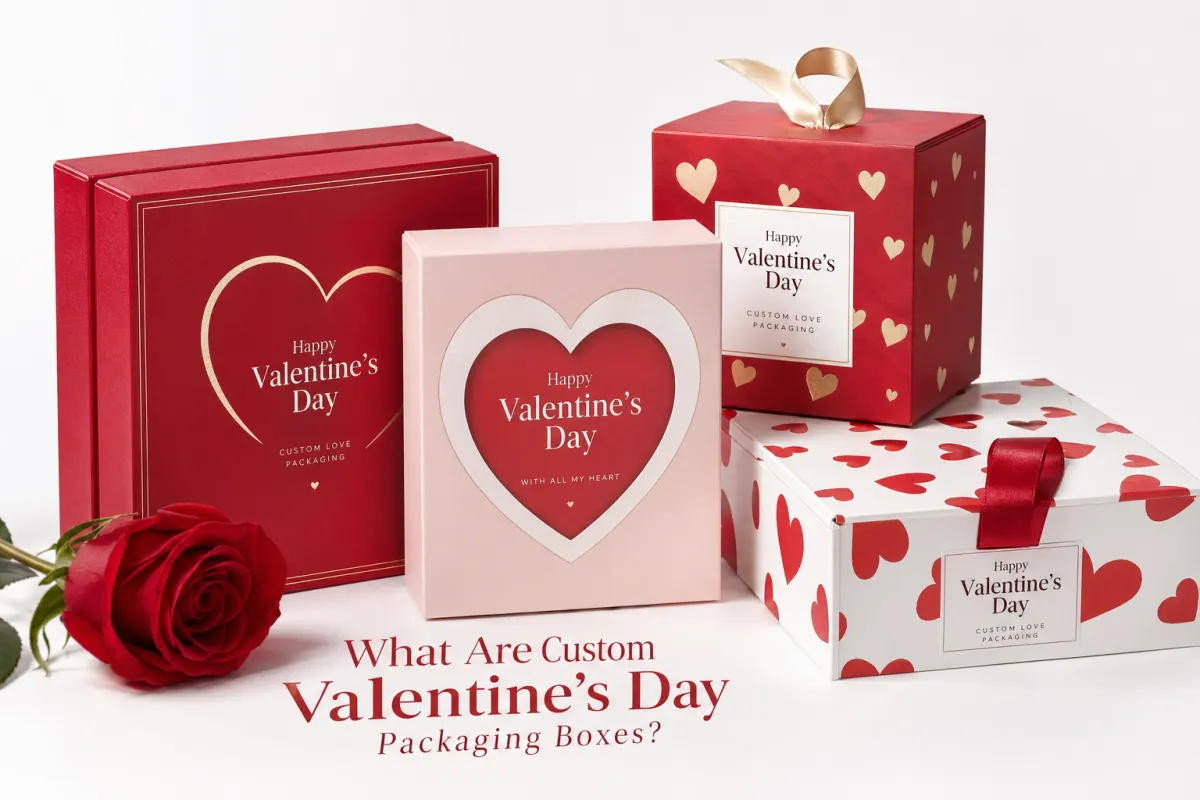
Custom Valentine's Day packaging boxes boost sales by making the gift feel more valuable before it is even opened. They raise perceived value, improve the first photo a customer shares, and make the product feel ready for gifting instead of requiring extra tissue, ribbon, or a last-minute apology wrap. For seasonal SKUs, that emotional lift can support a higher retail price, a better conversion rate, and more repeat orders the next February.
That effect is strongest when the structure, finish, and insert all work together. A rigid box with foil stamping and a fitted insert can feel like a keepsake; a lightweight carton with a clean print hierarchy can still look polished if the sizing is exact. The goal with custom Valentine's Day packaging boxes is not decoration for decoration's sake, but a package that sells the product the moment it lands in the customer's hand.
What Are Custom Valentine's Day Packaging Boxes?
Custom Valentine's Day packaging boxes are seasonal, brand-specific containers designed to turn an ordinary product into a giftable moment. In plain language, they include printed folding cartons, rigid keepsake boxes, corrugated mailers, sleeves, trays, inserts, and specialty formats built for February launches. The difference is not the shape alone; it is the way structure, artwork, and finishing work together to make the product feel deliberate. A 350gsm C1S artboard carton with a matte aqueous coating feels very different from a 2.0 mm rigid setup wrapped in 157gsm art paper, even before the ribbon is tied.
One detail people miss is that custom Valentine's Day packaging boxes often have to do two jobs at once. They need to protect the product during transit and create an emotional hit at the opening moment. That brief is very different from standard retail packaging, where shelf visibility may matter more than the reveal. For giftable SKUs, the box becomes part of the product story rather than a separate layer around it, and that story has to survive a 24-inch drop test and a 1,500-mile freight lane at the same time.
My rule with clients is simple: if the packaging feels generic, the gift feels generic. A red carton with a blunt die cut is not the same thing as a box with a matte finish, a foil heart, and a fitted insert that keeps the item from shifting by even 2 mm. Custom Valentine's Day packaging boxes let a candle brand, jewelry brand, confectionery line, or subscription business build branded packaging that looks intentional even before the ribbon is touched. I have said that in more polished ways in meetings, but the point stays the same.
That emotional side matters most when the buyer is purchasing for someone else. A partner, a friend, or a corporate recipient is not just buying a unit; they are buying a feeling, and that feeling is usually judged against a gift budget in the $18 to $85 range. That is where custom Valentine's Day packaging boxes earn their keep. A soft-touch coating, a message card tucked into a pocket, or a ribbon pull can make a box feel personal without changing the item inside, and that small upgrade can support a $2 to $6 price increase at retail.
If you want a quick material map, this is how the category usually breaks down in real production terms:
- Printed cartons for lightweight retail packaging, sleeves, and high-volume DTC items, often built on 300gsm to 350gsm SBS or C1S board.
- Mailer boxes for shipping-friendly custom Valentine's Day packaging boxes that still photograph well on arrival, usually made with E-flute corrugate.
- Rigid gift boxes for premium jewelry, chocolates, candles, and keepsake sets, often built with 1.5 mm to 2.0 mm grayboard.
- Inserts and trays for multi-item bundles, fragile pieces, or mixed gift sets, commonly cut from EVA foam, molded pulp, or paperboard.
- Sleeves and wraps for brands that want seasonal branding without changing the entire structure, especially for runs of 1,000 to 3,000 units.
I think many brands overcomplicate this category by starting with decoration instead of use case. Start with the product, the shipping channel, and the desired reveal, then build the custom Valentine's Day packaging boxes around those facts. That sequence saves money, and it usually produces better package branding. It also keeps everyone from arguing about foil shades before the box size is even settled, which is a surprisingly common way to burn a Thursday afternoon in a factory conference room.
For brands selling through both DTC and retail, the box has one more job: consistency. The same product may need to look luxurious in an unboxing video, fit neatly on a store shelf in Houston or Seattle, and survive a 24-inch drop test in transit from Shenzhen to the West Coast. That is why custom Valentine's Day packaging boxes often sit at the intersection of packaging design, product packaging, and retail packaging strategy, with the final quote depending on board type, closure style, and printing method.
How Custom Valentine's Day Packaging Boxes Move From Idea to Delivery
Custom Valentine's Day packaging boxes usually move through a tight sequence: brief, dimensions, structure, artwork, proofing, sampling, production, and freight. The order matters. If the size is off by even 2 to 3 mm, the rest of the chain gets shaky. I have watched a beautiful mailer fail because the product shifted inside and dented the corner board in transit from Dongguan to Dallas, and there was nothing romantic about that repair invoice.
I remember one morning in our Shenzhen facility when a rigid lid fit perfectly on paper but lifted by 1.5 mm in the physical sample. The cause was simple: the insert thickness changed after the tray was wrapped, and nobody adjusted the final depth. We caught it because the sample was on the table, not because a digital proof looked convincing. That is the kind of difference that separates nice-looking custom Valentine's Day packaging boxes from boxes that survive production at 5,000-piece scale.
"The sample looked right on the screen, but the real box felt off by 3 mm." I hear some version of that line in almost every holiday launch, and it usually saves the schedule before the mistake becomes a full carton order.
The first job is dimensions. A good packaging brief should list the product length, width, height, any insert depth, and the exact clearance you want. For custom Valentine's Day packaging boxes, I usually ask for measurements in millimeters because packaging lines do not forgive vague estimates. A 92 mm candle tin and a 95 mm candle tin may sound close, but they behave differently once foam, paper wrap, or a magnetic closure enters the picture, especially when the internal tolerance is only 1.0 to 1.5 mm.
After sizing, structure comes next. If the boxes ship directly to a customer in Austin or Atlanta, mailer construction matters because it handles compression better than a light folding carton. If the item is a luxury gift set, rigid board may justify the price because it gives the unboxing a heavier feel. If the item sits on retail shelves, a folding carton can be more efficient. The wrong structure can make custom Valentine's Day packaging boxes feel either overbuilt or underprotected, and both mistakes show up quickly in returns.
Artwork prep is where packaging design gets technical fast. I look for type that remains legible at 7 pt, safe zones around folds, Pantone targets for critical brand colors, and enough space for barcodes or compliance marks if the box will touch retail. A client once brought me a sleeve with six tiny heart icons inside the fold line; after the crease, three of them disappeared. That is not a creative problem. It is a production problem. And yes, there was a very long silence in the room after we spotted it, followed by a costly reproof in Guangzhou.
Proofing should happen in two layers. Digital proofs catch layout, spelling, and positioning errors. Physical samples reveal whether the board holds its shape, whether the closure clicks properly, and whether the printed color reads warm or muddy under store lighting. For custom Valentine's Day packaging boxes, I never treat a PDF as a final verdict, especially when the finish includes soft-touch film, foil stamping, or a window patch that changes how the color sits on the surface.
Logistics closes the loop. A 4,000-piece run with standard offset print can move quickly, but only if the factory slot is open and freight is booked in time. If you are planning a national campaign, build the schedule backward from the launch date and leave room for one round of sample revisions. Custom seasonal boxes do not forgive late decisions, and they definitely do not care that someone "thought the art would be done by Friday afternoon."
Key Design and Cost Factors for Custom Valentine's Day Packaging Boxes
The biggest price drivers for custom Valentine's Day packaging boxes are not mysterious. They are box style, material thickness, print coverage, finishing, inserts, and quantity. A 4-color printed folding carton on 350gsm C1S artboard is a very different animal from a 2.0 mm rigid box wrapped in 157gsm art paper with foil and embossing. The first may sell a low-ticket gift set efficiently at $0.19 to $0.34 per unit. The second may support a premium price that is 3x higher, or more, once the handfeel and reveal are factored in.
Material choice shifts the feel immediately. SBS paperboard works well for lightweight retail packaging and smaller SKUs. Corrugated mailers are stronger for shipping and reduce compression damage on routes from Nashville to Phoenix. Rigid board signals luxury because it has more structure and more visual weight. I have seen brands move from folding cartons to rigid shells and recover the extra cost simply because the unboxing supported a higher perceived value, especially when the final retail price sat above $65.
Decoration is where budgets can drift. Foil stamping adds shine, embossing adds texture, spot UV adds contrast, and soft-touch coating changes the handfeel. None of those effects are wrong. The problem is stacking four of them on a box that only needed one. With custom Valentine's Day packaging boxes, a single strong finish often beats three weaker ones. I am biased here, I admit it, because I have watched too many pretty-but-overworked boxes lose their charm under fluorescent lights in a warehouse aisle.
During one supplier negotiation, I was quoting a rose-gold foil stamp for a confectionery client. The plate charge jumped from $95 to $160 because the artwork had 11 separate islands and four tiny line weights that the foil house did not want to hold on a fast line. That conversation changed the design. We simplified the art, cut the plate complexity, and kept the premium look. This is why production-minded packaging design matters, especially when a holiday box has to launch before February 1.
Structural extras also change cost. Magnetic closures, window cutouts, pull tabs, custom inserts, and unusual angles usually increase tooling time and can push up MOQ. The same goes for oversized boxes, because shipping a box with 20% more volume can raise freight and storage costs before the product even reaches a customer. Custom Valentine's Day packaging boxes should feel generous, not wasteful. Nobody wants to pay extra just to ship air from Shenzhen to Chicago.
| Box Style | Best Use | Typical Build | Estimated Unit Cost at 5,000 Pieces | MOQ Reality |
|---|---|---|---|---|
| Folding carton | Light retail items, gift sleeves, low-weight sets | 350gsm C1S artboard, 4-color print, matte aqueous coating | $0.19 to $0.34 | Often 3,000 to 5,000 units |
| Mailer box | DTC shipping, subscription gifts, medium-weight bundles | E-flute corrugate, full-color print, one finish | $0.44 to $0.78 | Usually 1,000 to 3,000 units |
| Rigid gift box | Luxury chocolates, jewelry, keepsake sets | 2.0 mm grayboard, wrapped art paper, insert tray, foil detail | $1.25 to $2.40 | Often 500 to 2,000 units |
| Sleeve plus insert | Seasonal branding over existing retail packaging | 300gsm paperboard, die-cut sleeve, minimal print | $0.12 to $0.28 | Can support smaller test runs |
Those numbers are not universal, and I would never sell them as fixed quotes. Still, they help frame what I see in the market from factories in Dongguan, Foshan, and Xiamen. A low-complexity run of custom Valentine's Day packaging boxes can land near $0.29/unit for 5,000 folding cartons, while a premium rigid box with foil and a tray can move above $1.60/unit very quickly. The difference is not just art. It is labor, board, tooling, and finish time.
Hidden costs are the ones that hurt margins most. Design revisions can trigger extra prepress time. Sample freight can add $35 to $120 per shipment depending on lane and urgency. Warehousing seasonal boxes for six months can tie up cash and floor space in California or New Jersey. A large mailer may also trigger a higher dimensional weight charge, which means your packaging design can quietly increase shipping cost by 12% or more. That part makes me grumpy, frankly, because the invoice always shows up with a straight face.
For paper sourcing, I advise brands to ask for FSC documentation if sustainability claims matter on the box. The FSC chain-of-custody framework gives you a cleaner story when the customer asks where the fiber came from, whether the board originated in Zhejiang or another paper-producing region. For transit durability, I still lean on the ISTA test philosophy, because a romantic-looking box is useless if it arrives crushed after a 30-inch corner drop.
Custom Valentine's Day Packaging Boxes: Pricing, MOQ, and Timeline
Custom Valentine's Day packaging boxes price out in a way that feels simple at first and complicated after the first quote. The easy rule is this: unit price falls as quantity rises, but the savings only help if the order matches demand and storage capacity. I have seen brands save 18% on unit cost, then pay that back in warehouse fees because they ordered too many seasonal boxes for a 3-week sales window. It is a funny kind of math until you are the one staring at the pallet bill in March.
A practical way to think about pricing is by run size. Small test runs are ideal for checking the market response. Mid-volume runs fit most direct-to-consumer brands. Larger production runs make sense only when the SKU is proven and the design will hold for multiple seasons. With custom Valentine's Day packaging boxes, the sweet spot is usually the lowest quantity that still gives you a real margin advantage, and for many brands that means 2,000 to 5,000 units rather than 20,000 on the first order.
Here is a simple framework I give clients for planning seasonal orders:
- Test run: 300 to 1,000 units if you want to validate a new gift set or packaging concept in one city or one sales channel.
- Working run: 1,000 to 5,000 units for DTC brands with a forecast and a defined launch window.
- Scale run: 5,000 to 20,000 units if the packaging is tied to a reliable seasonal bestseller and an established replenishment plan.
MOQ is where many conversations get real. Digital printing can support lower minimums, especially for simple Custom Printed Boxes. Offset printing, foil, embossing, and specialty inserts usually ask for more volume because the setup work has to be spread across more units. That is why two suppliers can quote very different thresholds for what looks like the same custom Valentine's Day packaging boxes project, even when both factories are using similar Heidelberg presses or flatbed die-cutters.
Timing is even tighter than pricing. A realistic schedule often looks like this: 2 to 4 days for brief and dieline review, 5 to 10 days for sampling, 3 to 7 days for corrections, 12 to 15 business days for production after proof approval, and 7 to 30 days for freight depending on the lane. If the box uses special finishes or rigid construction, the window can stretch. If the campaign is close, expedited freight can save the launch but add serious cost, especially for air shipments out of Shenzhen or Hong Kong.
Here is the part I say bluntly in every seasonal planning call: late orders shrink your options. You may have to remove an insert, simplify the finish, or switch from a rigid gift box to a faster folding carton. Custom Valentine's Day packaging boxes can still look strong under pressure, but only if the supply plan starts early enough to preserve design choices and leave at least one round of sample corrections on the calendar.
One client meeting still stands out. A DTC skincare brand wanted 8,000 boxes, soft-touch lamination, foil hearts, and a magnetic closure, all with a three-week turnaround. The math did not work. We rebuilt the brief into a 2,000-piece test run using a printed mailer, a single foil accent, and a custom insert. The box still felt premium, the budget held, and the launch date survived. That is why packaging strategy matters as much as packaging design, especially when the retail price is set at $42.00 and every quarter counts.
For brands comparing suppliers, I usually recommend asking for the quote in three versions: bare structure, standard print, and premium finish. That reveals where the cost jumps. It also makes it easier to decide whether the extra $0.18/unit is buying visible value or just decoration. On seasonal custom Valentine's Day packaging boxes, visible value wins every time, because the customer sees the box before they see the product.
Step-by-Step Guide to Ordering the Right Box
Ordering custom Valentine's Day packaging boxes works best when the product brief is specific from the first email. Start with the real contents: one item, a bundle, or a subscription-style kit. A box built for a single candle is not automatically right for a three-piece gift set with tissue, a note card, and a protective insert. I still see teams guess at dimensions before the product is final, and that usually costs time, money, and at least one mildly irritated production call from the factory in Dongguan.
Here is the process I recommend, especially for brands moving toward custom printed boxes for the first time:
- Measure the product set. Use finished dimensions, not theoretical ones, and include insert depth, tissue folds, and any protective padding.
- Choose the structure. Pick mailer, rigid, folding carton, or sleeve based on shipping needs and unboxing goals.
- Define the finish. Decide whether the box needs foil, embossing, soft-touch, or a simple matte varnish.
- Build the artwork around production. Leave room for folds, barcodes, legal copy, and seasonal messaging.
- Request a sample. Check closure, print clarity, fit, and how the box photographs in daylight and store lighting.
- Approve only after testing. Confirm the sample against the shipping method, not just the desk.
That last point matters more than people think. A box can pass a desktop review and still fail in transit. I have seen a mailer with a gorgeous outside print but a tray that moved 4 mm after a 32-inch drop test. The outer look was fine; the product protection was not. For custom Valentine's Day packaging boxes, the structure has to earn the right to be beautiful, and that usually means testing at least three samples before you lock the order.
Choose the Box style based on the customer experience, not just the cost sheet. Mailer boxes make sense for DTC shipping because they protect and present in one piece. Rigid boxes work well for high-value gifts because they feel substantial in the hand. Folding cartons are efficient for retail packaging and can be cost-effective at scale. Sleeves are useful when you want seasonal branding without rebuilding the entire pack, especially if you are selling through 150 retail doors.
I also tell brands to think about the opening sequence in literal steps. What does the customer see first? What do they touch second? Where does the message card sit? Is the product visible immediately, or does it stay hidden until the final lift? Those details shape whether custom Valentine's Day packaging boxes feel like a gift or just a container, and the difference often shows up in the customer review score.
One confectionery client I worked with wanted a PET window so buyers could see truffles before opening the box. On the sample table, the window looked elegant. Under retail lights, fingerprints showed up in less than 20 minutes. We swapped to a peek-through sleeve and a foil-stamped top panel. The end result looked cleaner and reduced handling marks. Sometimes the best packaging move is the one that solves two problems at once, even if it means telling marketing that the original idea was not, in fact, untouchable.
If you need a place to start, browse Custom Packaging Products, then request two sample builds: one for the expected shipping route and one for the premium presentation route. That comparison often clarifies the whole decision tree for custom Valentine's Day packaging boxes, especially when the final choice comes down to a $0.22 difference per unit.
Common Mistakes Brands Make With Seasonal Packaging
The biggest mistake I see with custom Valentine's Day packaging boxes is overdesign. Four finishes, a window, a magnetic closure, and an embossed logo can sound exciting in a meeting, but the result can look busy and cost more than the margin allows. A stronger approach is usually one premium detail supported by clean structure and precise print. In packaging, restraint often reads as confidence, which is a nicer way of saying the box should not be yelling for attention from the first 6 feet.
The second mistake is ordering before the product dimensions are final. I have seen brands lock a 120 mm box around a product that later shrank to 112 mm. That 8 mm gap forced extra void fill, raised freight volume, and made the unboxing look unfinished. The fix was expensive because the packaging had already been printed. For custom Valentine's Day packaging boxes, premature approval is one of the easiest ways to waste money, especially if the box has a custom insert cut to a specific cavity size.
Timing errors hurt even more during seasonal launches. If artwork changes after the dieline is approved, the whole schedule can slip by a week. If the sample arrives late, the production slot can disappear. Once that happens, the brand may have to choose between simplified materials or urgent air freight. Neither option is ideal, and both can damage margin. That is why I keep saying that custom Valentine's Day packaging boxes are as much a planning exercise as a design exercise, with the calendar doing half the work.
Sustainability is another area where brands miss the point. A box can be giftable without being wasteful. Overpacked inserts, oversized mailers, and excessive laminations create a better photo but a worse customer impression once the packaging is opened. I have seen buyers comment that a beautiful box felt "too much" because it produced too much waste. In that moment, the package branding backfires. The EPA's waste hierarchy is useful here, even if the brand only applies the principle informally: reduce first, then reuse, then recycle.
The inventory trap is the final mistake. Teams sometimes overestimate Valentine's demand, then sit on unsold seasonal stock for months. I have seen pallets of red rigid boxes stored behind summer launches because nobody wanted to write off the excess. A safer move is to split the order into a small test run and a replenishment batch, especially for custom Valentine's Day packaging boxes tied to a new gift set, a new retailer, or a first-time seasonal campaign.
- Overdesigning: too many finishes, too many colors, too many moving parts.
- Bad sizing: final product dimensions not locked before print.
- Rushed timing: sample approval and freight treated as afterthoughts.
- Waste-heavy builds: extra board, extra inserts, extra laminate.
- Seasonal overbuying: too much stock for a 2-week sales window.
If I had to reduce the mistake list to one sentence, it would be this: custom Valentine's Day packaging boxes should support the sale, not become the story. Customers want to feel that the gift was thoughtfully made, not that the packaging budget swallowed the product budget, and that distinction becomes obvious the moment they compare the box to the actual item price.
Expert Tips and Next Steps for Your Next Launch
My first tip is simple: write a packaging brief that includes product dimensions, target unit cost, preferred finish, quantity, and launch date. That one page saves more time than a dozen loose emails. It also gives suppliers the information they need to quote custom Valentine's Day packaging boxes accurately on the first pass. If you want better answers, ask a sharper question, ideally one that includes the board grade, closure style, and ship date.
My second tip is to choose one premium feature and do it well. Foil stamping can be enough. A custom insert can be enough. Soft-touch lamination can be enough. The temptation to stack every effect usually weakens the final result. In my experience, the strongest custom Valentine's Day packaging boxes often look expensive because they are coherent, not because they are loud, and coherence is easier to sell at $24.99 than a pile of decoration ever will be.
Build your schedule backward from the ship date. I like to allow at least 5 working days for artwork edits, 7 to 10 days for sampling, 12 to 15 business days for production after proof approval, and a freight buffer of 7 to 21 days depending on the lane. For some projects, that means starting 8 to 10 weeks before the campaign goes live. That may sound conservative, but it keeps the launch from relying on luck, a last-minute overtime shift, or a cargo flight out of Hong Kong.
My third tip comes from a negotiation I had with a supplier in southern China. A buyer wanted a full magnetic rigid set, but the lead time and plate charges made the order clumsy. We switched the exterior to a structured mailer with a custom insert and a single foil hit. The packaging still felt premium, the unit cost dropped by $0.41 on a 5,000-piece run, and the customer still got the reveal they wanted. That is the kind of trade-off I trust with custom Valentine's Day packaging boxes.
Try to design for a second use if the box supports it. A rigid lid that can hold keepsakes, a drawer-style box that stores jewelry, or a mailer sturdy enough for re-gifting extends the brand presence beyond the holiday. Reuse is not just a sustainability talking point. It keeps your package branding on a desk, shelf, or dresser for weeks after purchase, which is hard to buy with ads and easy to earn with a well-built box.
If you are comparing options now, review Custom Packaging Products, ask for a sample based on the actual product fill, and compare one standard build against one premium build before you lock the order. That is the fastest way I know to balance cost, appearance, and lead time for custom Valentine's Day packaging boxes, especially when the factory quote changes by 8% between paper grades.
The brands that do this well are rarely the ones with the biggest packaging budget. They are the ones that lock the size early, choose one meaningful finish, and respect the calendar. That combination is what keeps custom Valentine's Day packaging boxes on schedule, on budget, and strong enough to carry the sale from the sample table in Shenzhen to the customer's doorstep in Minneapolis.
Frequently Asked Questions
What size should custom Valentine's Day packaging boxes be for gift sets?
Measure the full bundle, including inserts, tissue, and any protective padding, before choosing the outer box size. I usually recommend leaving just enough clearance for a clean fit, because too much empty space makes custom Valentine's Day packaging boxes feel less premium and can raise shipping cost by 10% or more on a crowded freight lane. If the gift includes several items, build the box around the largest piece first and then design the insert around the rest, using millimeter measurements instead of rough estimates.
How much do custom Valentine's Day packaging boxes usually cost?
Cost depends on material, size, print coverage, finishes, and order quantity, so two boxes that look similar can price very differently. A folding carton with simple print may sit near $0.19 to $0.34 per unit at 5,000 pieces, while a rigid gift box with foil and an insert can move above $1.25 per unit. The best estimate comes from the specification, not just the artwork concept, and a supplier quote from Shenzhen may differ from one in Dongguan by the cost of paper grade alone.
How long does it take to produce custom Valentine's Day packaging boxes?
Typical timing includes design review, sample approval, production, quality checks, and shipping, so the full process can stretch longer than many brands expect. Fast approvals help a lot, while artwork changes, structural revisions, or special finishes can add days. Seasonal demand also tightens factory calendars, so early ordering is the safest way to protect the launch date for custom Valentine's Day packaging boxes. A practical schedule is usually 12 to 15 business days from proof approval for production, plus transit time.
Which packaging style works best for Valentine's Day gifts?
Mailer boxes work well for shipping-friendly DTC orders because they combine protection and presentation. Rigid boxes feel more premium for luxury gifts or keepsake presentations. Folding cartons can be the most efficient option for retail shelves or lightweight products, especially when the budget is tight and the unit needs to scale. The best choice usually depends on whether the box must survive parcel delivery, sit in a boutique in Dallas, or support a $50 retail price.
How can I make custom Valentine's Day packaging boxes feel premium without overspending?
Choose one high-impact finish, such as foil stamping, embossing, or a soft-touch coating, instead of adding several at once. Use a well-fitted structure and a clean interior layout, because precise sizing often reads as more premium than heavy decoration. For custom Valentine's Day packaging boxes, the first thing customers notice is usually the fit and finish, not the number of effects, and a thoughtful $0.18 upgrade can do more than a crowded finish stack.