Buyer Fit Snapshot
| Best fit | To Poly Mailer Recycling Programs for Businesses projects where brand print, material claims, artwork control, MOQ, and repeat-order consistency need to be specified before quoting. |
|---|---|
| Quote inputs | Share finished size, material target, print colors, finish, packing count, annual reorder estimate, ship-to region, and any compliance wording. |
| Proofing check | Approve dieline scale, logo placement, barcode or warning zones, color tolerance, closure strength, and carton packing before bulk production. |
| Main risk | Vague material claims, crowded artwork, missing packing details, or unclear freight terms can make a low unit price expensive after revisions. |
Fast answer: To Poly Mailer Recycling Programs for Businesses: Film, Print, MOQ, and Carton Packing should be specified like a repeatable production item. The safest quote records material, print method, finish, artwork proof, packing count, and reorder notes in one written spec.
Production checks before approval
Compare the actual filled-product size with the drawing, then confirm tolerance on folds, seals, hang holes, label areas, and retail display edges. Reserve space for logos, QR codes, warning copy, and material claims before decorative graphics fill the panel.
Quote comparison points
Review material grade, print process, finish, sampling route, tooling charges, carton quantity, and freight assumptions side by side. A quote is only useful when the supplier can repeat the same color, closure quality, and packing count on the next order.
Guide to Poly Mailer Recycling Programs: the overlooked way to cut return costs
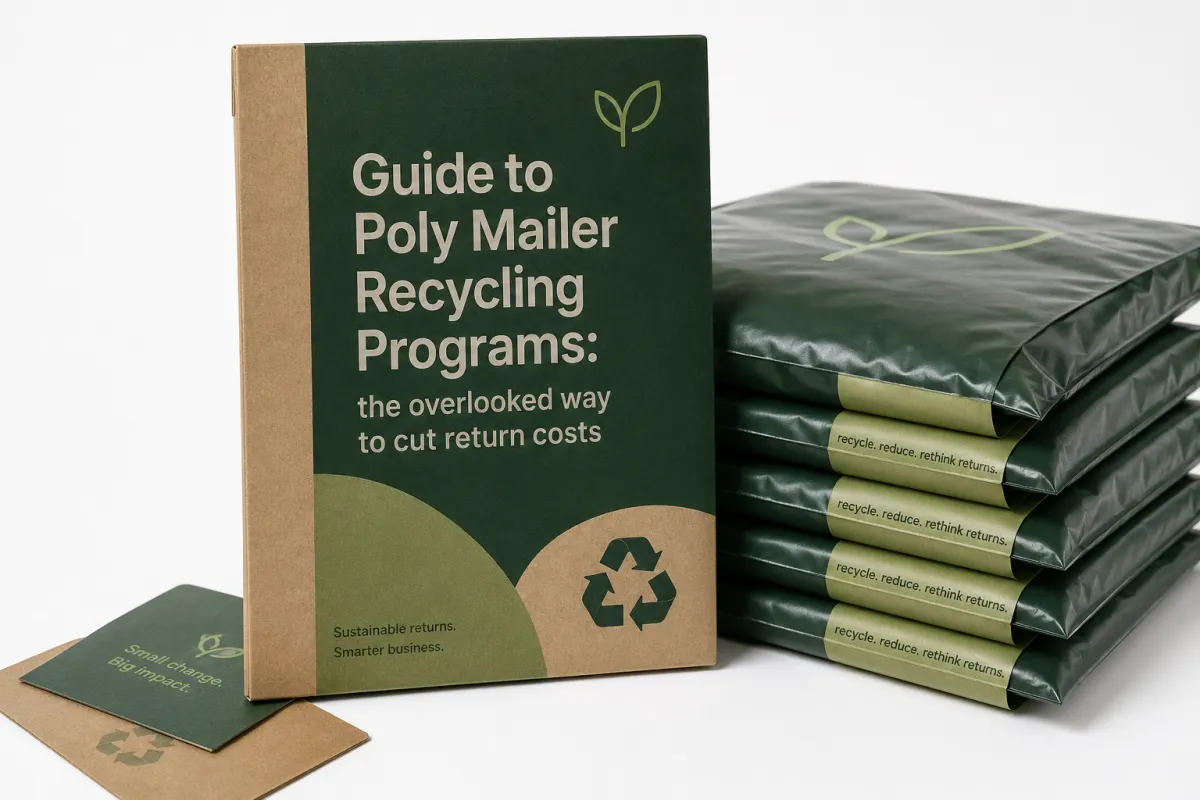
Busy fulfillment days can turn into a mountain of plastic film before lunch, and that is exactly why a guide to poly mailer recycling programs matters. This is not a trendy sustainability checkbox. It is a practical system for collecting used mailers, sorting them correctly, routing material to a recycler, and keeping plastic from piling up in mixed trash. If your shipping desk keeps buying pallets of new mailers, pays for storage, pays for movement, and still spends time arguing about what can actually be recycled, you already have a packaging cost problem. You just probably called it something else because “packaging cost problem” sounds less dramatic than it is.
From a packaging buyer’s perspective, the math is blunt. You buy the mailer, you store it, you handle it, and you eventually pay to remove the leftovers. A guide to poly mailer recycling programs gives your team a recovery loop instead of a dead-end bin. That matters for ecommerce sellers, subscription brands, direct-to-consumer teams, and agencies managing outbound logistics for multiple clients. It also matters for operators who want a process that survives real warehouse noise, not a polished deck that only works in a clean conference room. If you also move stretch wrap, void fill, or other plastic film, the same discipline applies. The material changes, but the mess behaves the same.
One practical fact: a brand shipping 20,000 orders a month can generate huge stacks of used poly mailers, liner wraps, and stretch film scraps. Recover 40% through a controlled collection flow, and the waste stream gets lighter, floor space clears up, and teams stop spending unplanned time fighting disposal chaos. That result is measurable, not magical. A strong guide to poly mailer recycling programs should help reduce avoidable return costs, tighten handling routines, and make shipping operations calmer without pretending compliance alone will save you.
Compliance matters, yes, but it is rarely the whole point. A real program also reduces container overflow, lowers training friction, and gives cleaner reporting for sustainability claims. That matters when you are aligning packaging with Custom Poly Mailers that are lighter, thinner, or made with recycled content. It matters even more if you are rethinking the whole outbound stack with Custom Packaging Products instead of treating each mailer as an isolated consumable. The cleaner the stream, the easier the buying decision next quarter.
Most brands underestimate how quickly small process leaks become major cost. A few missing labels, one mixed bin, and one missed pickup can erase half the progress from a whole week. A guide to poly mailer recycling programs only works when every team member knows where the line is, and what happens when that line is crossed. The bin is not a suggestion box. It is either controlled input or it is garbage with a nicer name.
What should a guide to poly mailer recycling programs cover?
A useful guide to poly mailer recycling programs should cover five things: material specs, collection rules, contamination control, pickup rhythm, and reporting. Miss one of those, and the whole thing gets wobbly. The goal is not just to “recycle more.” The goal is to create a repeatable system that handles LDPE, LLDPE, and other film formats without turning the warehouse into a sorting lab.
The starting point is material reality. Most poly mailers are polyethylene films, often low-density polyethylene (LDPE) or linear low-density polyethylene (LLDPE), and some are blends with behavior that changes everything at sorting and reprocessing. I still see teams skip this first step and discover too late that their “recyclable” pile has half the wrong materials in it. A recycler may accept clean film, then route it through a material recovery facility (MRF) where it becomes feedstock for new film or other recycled products. Or it may not. That depends on spec, contamination, and local equipment, which is why the rules need to be written down before the first pickup.
That is why recyclable is not a sticker. It is a boundary map. A plain one-way mailer often fits a film stream if it is clean and dry. Bubble-lined material can need a separate route. Heavily coated, glued, or laminated styles can be rejected on pickup. Reusable loops are a different bucket entirely. A practical guide to poly mailer recycling programs defines these categories before collection starts, not after the first rejection invoice arrives. Otherwise somebody in ops ends up explaining why the “recyclable” bin contains three kinds of plastic and a receipt, which is always a fun conversation.
There are two common setups. A closed-loop model keeps one material stream, usually one brand, one specification, and one recycler. That structure helps high-volume teams control quality and traceability. A mixed-stream model accepts more packaging types, and requires tighter sorting discipline plus sharper training. Smaller operators often launch with mixed-stream because it looks simpler, until labels and habits add just enough contamination to make the system unreliable. The guide to poly mailer recycling programs should predict this failure mode and prevent it before the first truck load.
Responsibility should be shared, but it is not equal by default. The brand owner sets rules. Fulfillment teams run bins, signage, pickup timing, and touchpoints. The recycler sets acceptance criteria and tolerance levels. Carriers and reverse-logistics providers may sit in between if return packaging travels through their network. One side pretending it owns the whole flow is how programs stall. Shared ownership with defined handoffs is what turns a pilot into a process.
Quality standards win over good intentions every time. Clear, dry, source-separated material beats “we collect everything plastic” by a very large margin. A contaminated load gets downgraded, penalized, or refused entirely. That is why a serious guide to poly mailer recycling programs puts contamination rules in writing, with visual examples, and re-trains when drift appears.
Quick checkpoint: if your team cannot state exactly what goes in the collection bin in one sentence, you are not ready to scale yet.
How Poly Mailer Recycling Programs Work in a Real Fulfillment Flow
Most teams imagine recycling as one pickup at the end of the week. That model breaks in practice. A guide to poly mailer recycling programs works as a chain of handoffs: packing station, returns desk, staging area, pre-sort check, container storage, pickup window, and recycler intake. Miss one link and contamination or overflow appears, sometimes in the same day.
In a normal fulfillment flow, used poly mailers land in a color-coded container near packing or reverse logistics. Teams move material into reusable totes or lockable carts if multiple departments share space. A pre-sort pass removes labels, paper inserts, non-film padding, and dirty waste. After sorting, material is compacted or staged, and pickup is triggered by actual volume. The recycler weighs and documents accepted weight, then the data feeds a reporting loop. That loop is what makes a guide to poly mailer recycling programs feel like an operational system instead of a promise. It also gives you a clean path to track plastic film recycling instead of guessing where the material disappears.
Documentation is tedious and boring in equal measure, which is also why it is powerful. Useful data points are straightforward: shipment volume by SKU family, waste weight by site, contamination incidents, pickup dates, rejection notes, fees and credits. Once tracked, patterns become obvious. If one facility has high rejection rates, the issue is almost always training, location, or ambiguous labels. If one shift struggles more, staffing consistency and supervision are usually the culprits. That is why a guide to poly mailer recycling programs must include a data trail that people actually use.
Disputes happen, and they usually happen at handoff points. Who loaded the tote? Who signed off on content quality? Who verified pickup details? If operations says the load was compliant and the recycler says it was not, the gap sits in the handoff chain. A good program assigns owners and timestamps to every checkpoint. It is not glamorous. It is what prevents weekly frustration.
Financial upside goes beyond disposal reduction. Recovery data can support better spec decisions and more aggressive packaging optimization. Teams can move to lighter custom films with cleaner structures when the system exposes where material gets rejected. Sustainability claims become more believable with better audit trails. For cross-checking recycling basics, the U.S. EPA page remains a solid reference: EPA recycling guidance. For transport and packaging consistency, ISTA standards provide a more practical framework than vibes. If your recycler publishes post-consumer recycled content specs, match those against your packaging roadmap before ordering the next production run.
Multiple facilities need one language. Bins, labels, and rejection criteria should not change by location. If one warehouse uses one set of rules and another uses a different set, your reporting becomes a set of disconnected stories. Uniform standards across 500-order and 5,000-order sites make benchmarking real. Otherwise you are comparing apples to oranges and calling it insight, which is kinda adorable until finance asks for the source data.
Process and Timeline: a 12-week guide to poly mailer recycling programs
A guide to poly mailer recycling programs does not begin at launch day and call it done. Skipping rollout sequencing creates expensive cleanup later. A twelve-week plan usually gives enough runway to measure baseline performance, train teams, test a pilot, and correct mistakes before full rollout. Shortcuts usually create more rework than they save. I have never seen “we’ll figure it out later” age gracefully. It usually ages like milk left in a hot van.
Weeks 1-2: baseline audit. Measure order volume, material usage, and actual after-use pathways. Break numbers by site, order type, and packaging spec where possible. Teams usually see this as a “data exercise,” but it is the one move that prevents decisions based on memory. If you cannot baseline volume and contamination before launch, you cannot prove improvement afterward. That includes any mix of poly bags, stretch wrap, or liner film that ends up in the same bin. A little audit pain now beats a lot of guessing later.
Weeks 3-4: supplier alignment and training prep. Confirm collection method, pickup windows, and recycler acceptance criteria. Build a short material policy sheet and include eligible versus non-eligible visuals. Train every touchpoint that sees used film: packers, returns handlers, receiving, and shift leads. A strong guide to poly mailer recycling programs never assumes someone can infer policy from a sign hidden behind a cart. If the sign needs a scavenger hunt, the system already failed.
Weeks 5-8: pilot launch. Start at one zone or one facility and run fast reviews weekly. Track contamination events, tote overflow, pickup consistency, and staff questions. One paper insert in the wrong bin means a placement or instruction issue. Food waste, sticky tape, or foil-heavy packaging signals either sorting confusion or an upstream design gap. Repeated rejection from the recycler is feedback, not drama. It is a design signal. It tells you the stream is not as clean as everyone hoped it was.
Weeks 9-10: data integration. Move reporting into a lightweight dashboard or structured spreadsheet you can update by pickup cycle. Fancy software is optional; repeatable structure is not. Capture tonnage, rejected weight, fees, and any credit or rebate terms. Compare week-over-week and month-over-month shifts, then share the same view with operations and finance. A guide to poly mailer recycling programs should make metrics readable without a translator. If the report needs a meeting to explain the report, that is not reporting. That is a second job.
Weeks 11-12: evaluation and scale decision. Review recovery rate stability, contamination levels, and pickup rhythm against actual volume. Expand one variable at a time only after the first site is stable: another shift, another facility, then another SKU family. If cleanup cost or contamination is still high, pause and tighten the system before it scales too far too fast. That is how a guide to poly mailer recycling programs protects the next phase. It also keeps waste audits honest, which is more useful than pretty graphs with shaky inputs.
Completion signals are simple and boring: stable recovery rate, contamination under accepted thresholds, reliable pickup cadence, and fully documented checklists. Ignore them and the program turns into a six-week campaign. Respect them and it becomes an operating routine.
Step-by-Step Guide: Launching Your Poly Mailer Recycling Program Without Chaos
Here is a guide to poly mailer recycling programs version that fits a working warehouse, not a conference room fantasy. The target is not flawlessness. The target is a system that keeps operating even when shifts are overloaded and someone is out unexpectedly. That is the difference between a program and a slide.
- Pick one metric you will defend. Choose kilograms recovered per 1,000 shipments or net cost per recovered shipment, and stick to it. A vague goal produces vague behavior.
- Write a material policy that staff can use quickly. Spell out eligible mailers, exclusions, and rejection reasons in plain language. Photos beat definitions every time.
- Train every touchpoint, not just one team. Packing, receiving, returns, and shipping supervisors must enforce the same rules. A guide to poly mailer recycling programs collapses when each department builds its own version.
- Match pickup frequency to real fill rate. Weekly pickup sounds neat only when totes stay under capacity. A three-day fill cycle plus weekly pickup guarantees overflow and contamination complaints.
- Review operationally each week. Spend five focused minutes on recovery rate, contamination, and exceptions. Log one corrective action and move on. Consistency beats long debate sessions.
- Set ownership in writing. Name one facility lead, one escalation contact per shift, and one monthly report owner. No owners equals no accountability.
- Scale only when signals are stable. Add one location or one SKU family at a time. Chaos always looks like “big picture” progress from afar.
Standardize bin language aggressively. “Clean film only” removes ambiguity. “Plastics” invites everything from snack wrappers to office film. Laminated one-page sorters at each station remain the most cost-effective fix I have seen, because they sit where decisions happen. If confusion persists, revise wording and graphics instead of faulting the people on the floor.
Packaging design is part of the recovery system, not a separate project. Heavy print, mixed films, and extra liners can make a recyclable-looking stream impossible to run. A solid guide to poly mailer recycling programs nudges teams toward cleaner film structures and lighter grammage where quality allows it. That is also where reverse logistics gets cleaner, cheaper, and easier to explain to finance. Less guesswork, fewer complaints, fewer late-night emails that begin with “quick question.”
Cost and Pricing: What a Poly Mailer Recycling Program Really Costs
Teams always ask for a clean price, as if recycling lived in a spreadsheet fantasy. A guide to poly mailer recycling programs needs a better split: fixed setup costs and variable operating costs. Setup usually includes bins, labels, basic tools, and training. Variable line items include handling time, pickup charges, pre-sort labor, and service fees from the recycler. Rebate offers can help, but they should be counted carefully instead of treated as guaranteed margin.
Common pricing structures typically fall into three buckets: per-pound processing, monthly minimums, or bundled collection-and-handling fees. Small pilots often carry higher per-pound costs because volume is too low to absorb fixed labor. Larger networks usually negotiate better rates but face tighter documentation requirements and service standards. A thoughtful guide to poly mailer recycling programs explains this tradeoff before a contract is signed. It also explains why a low headline rate can still be the expensive option if the provider misses pickups or rejects half the stream. Cheap on paper is still expensive when the truck never shows.
Hidden costs keep showing up in the real world. Sorting labor is one of the biggest, especially where turnover is high. Temporary storage space can also become expensive if materials pile up. Rejected loads can trigger return charges or contamination penalties and quietly destroy margins. Onboarding new staff repeatedly adds training cost and slows performance. This is not an environmental failure. It is a process design flaw, and a guide to poly mailer recycling programs should say that out loud.
Contract terms matter more than people admit. Ask for acceptance criteria in writing, not in an email thread that gets forwarded six times and still says nothing useful. Confirm whether the recycler measures incoming gross weight or net accepted weight. Confirm who pays for rejected material. Confirm whether service changes happen at the pallet, pickup, or site level. Those details decide whether the program saves money or just creates a different invoice.
| Program Type | Typical Setup Cost | Monthly Handling / Pickup | Best Fit | Notes |
|---|---|---|---|---|
| Low-volume pilot | $300-$1,000 for bins, labels, and basic training | $150-$450 plus per-pound processing | One warehouse, one shipping lane | Fastest path to prove whether the guide to poly mailer recycling programs works in your operation |
| Regional rollout | $1,000-$3,500 across multiple sites | $400-$1,200 with negotiated collection rates | Multi-site ecommerce or subscription brands | Requires tighter reporting and consistent bin standards |
| Enterprise network | $3,500-$10,000+ for standardization and dashboards | $1,200-$4,000 depending on tonnage and service level | High-volume fulfillment networks | Lower unit costs, higher coordination load, stronger audit trail |
Break-even is boring math, and that is good. Compare reduced repurchase of new mailers, avoided disposal expense, and transport savings against total program spending. A brand spending $0.22-$0.38 per mailer can turn that around quickly if recovery is consistent and contamination stays controlled. Low-volume programs with higher contamination may still be worth it, but usually for operational clarity and proof, not quick margin recovery. A credible guide to poly mailer recycling programs includes all three reasons, because real decisions rarely have just one.
Budget for reporting with equal seriousness. If your data comes in partial PDFs and verbal updates, your team will duplicate work just to verify outcomes. Reporting is a cost line. If a recycler can produce clean records, the monthly burden drops and the program becomes easier to defend. It also makes sustainability reporting less annoying, which is a bonus nobody puts on the slide deck because it does not sound visionary enough.
Common Mistakes That Break Poly Mailer Recycling Programs
Waste stream contamination is the oldest and most expensive mistake. Mixing poly mailers with non-recyclable film, food waste, paper scraps, or loose office trash guarantees rejection. Someone then points at the recycler. Nobody wins that argument. A guide to poly mailer recycling programs should protect the system by controlling what enters the bin in the first place.
Late corrective action is the second recurring failure. Teams wait for a rejection event and then scramble to rewrite labels and retrain people. That timing is always expensive. By the time a full pickup has gone bad, habits are already in place. Pre-launch verification of labels, placement, and handling instructions is cheaper than post-failure cleanup. A small audit before launch beats a loud apology after.
Training gaps become routine when turnover is constant. New staff members inherit habits without context, and those habits get reinforced at full speed if leadership does not keep teaching. A short shift refresh, visual sorter sheets, and a monthly reminder outperform one giant kickoff presentation every quarter. People forget. The program should not.
Regional acceptance limits are often ignored until it is too late. One recycler may accept specific films and reject others because of equipment, contamination rules, or local processing capability. Applying the same route to every facility can look efficient on paper and fail in daily execution. A mature guide to poly mailer recycling programs respects local recycler rules and adjusts flow before volume expands. That part is not glamorous, but neither is cleaning up a rejected pallet.
Ownership drift is expensive because it is subtle. Sustainability teams expect operations to execute. Operations expects the sustainability owner to solve issues. Finance often expects “good news only,” so no one owns the middle. That is where progress leaks out the door. Set one accountable owner per site and one escalation path per shift, then enforce it.
Some teams treat the program like a brand-messaging campaign. They take photos, post updates, and stop there. Without a review rhythm, the system drifts right back to disposal behavior. Data review, not marketing, is the only thing that keeps contamination low and pickup quality high. Pretty posts do not lower contamination. A clean tote does.
Expert Tips + Actionable Next Steps to Keep a Guide to Poly Mailer Recycling Programs Working
To keep a guide to poly mailer recycling programs alive beyond launch, start small and build deliberately. One SKU group, one location, one explicit sorter guide. Hold contamination and pickup quality steady, then add one variable at a time. That pace is not timid. It is how operational systems survive real-world load.
Laminated one-page visual standards remain one of the best investments in this process. Keep one at each station, showing what is in, what is out, and how to handle borderline pieces. Teams moving fast process visuals faster than paragraphs. If the sheet needs a paragraph, it is already too wordy.
Set monthly targets that force action. A recovery increase of 8% or a contamination reduction of 3 percentage points is specific enough to drive behavior. Fuzzy goals produce drifting behavior. Numeric goals create decisions. That is the point.
Bring leadership two numbers each month: recovered weight and recovery cost per order. Those indicators show whether the program is improving both outcomes and spend. Add rejected pickup count to separate material risk from logistics or training risk. That is the type of reporting a practical guide to poly mailer recycling programs should support.
Use a 60-day reset protocol for any site that misses service-level targets. Retrain staff, re-check the stream, reset pickup timing, and verify the source rules in the same cycle. If the same site misses twice, redesign the process instead of hoping for a better quarter.
Action plan: this month, lock baseline metrics. Next, write and post the collection SOP and sorter guide. By the end of next month, run a controlled pilot at one facility and capture true recovery output. If your guide to poly mailer recycling programs ends there, it is still a win because you gain proof. And proof beats intention, every time.
If you want cleaner packaging to reinforce recovery results, audit mailer specs, insert choices, and ship-ready materials now. Pairing design discipline with an active recovery stream reduces both material weight and operational frustration across the outbound team. It also makes the next sourcing conversation much less annoying.
FAQ
Can a small e-commerce brand start a poly mailer recycling program without huge volume commitments?
Yes. Start at one fulfillment center and one shipping lane, even at modest volume. A shared-bin pilot can work if eligibility rules are strict and your recycler accepts low-minimum or no-commitment pickup terms. The purpose of a guide to poly mailer recycling programs is to validate process early, then scale with fewer surprises. Small brands often get better results because they can adjust faster.
What is the typical price range for poly mailer recycling programs?
Expect both fixed setup costs and variable processing fees tied to accepted weight. Smaller pilots usually begin with a base fee plus per-pound charges, while larger networks tend to negotiate better unit pricing and service terms. The useful figure is always net spend: recovered mailer savings and disposal avoidance minus program costs. If a provider will not share the math, assume the math is not friendly.
How long does a poly mailer recycling program timeline usually take before results appear?
Most teams see visible stability in 4 to 8 weeks when staff adoption is consistent and rules are simple. Material handling improvements and steady reporting usually become clear by 10 to 12 weeks. A checkpoint rhythm at weeks 2, 6, and 12 keeps a guide to poly mailer recycling programs from drifting into inactivity. You do not need a miracle. You need repetition.
Do printed, coated, or reinforced poly mailers qualify in a poly mailer recycling program?
Some do and some do not. Qualification depends on polymer structure, coating type, and the recycler’s equipment. The safest path is pre-testing samples before adding a material nationwide. Rejected variants should be assigned a separate stream immediately so one bad batch does not sink the whole operation. That is the part people skip, then act surprised when the load gets refused.
Can multiple fulfillment locations run one poly mailer recycling program from one dashboard?
Yes, if labels, bins, rejection definitions, and reporting fields are standardized first. A single template with columns for location, incoming weight, rejected weight, pickup date, and cost lets teams compare performance without arguing over formats. A working guide to poly mailer recycling programs scales only when exception handling is identical everywhere. One dashboard is useful only when the inputs are trustworthy.


