Buyer Fit Snapshot
| Best fit | To Holographic Brand Packaging That Builds Shelf Demand projects where brand print, material claims, artwork control, MOQ, and repeat-order consistency need to be specified before quoting. |
|---|---|
| Quote inputs | Share finished size, material target, print colors, finish, packing count, annual reorder estimate, ship-to region, and any compliance wording. |
| Proofing check | Approve dieline scale, logo placement, barcode or warning zones, color tolerance, closure strength, and carton packing before bulk production. |
| Main risk | Vague material claims, crowded artwork, missing packing details, or unclear freight terms can make a low unit price expensive after revisions. |
Fast answer: To Holographic Brand Packaging That Builds Shelf Demand: Material, Print, Proofing, and Reorder Risk should be specified like a repeatable production item. The safest quote records material, print method, finish, artwork proof, packing count, and reorder notes in one written spec.
Production checks before approval
Compare the actual filled-product size with the drawing, then confirm tolerance on folds, seals, hang holes, label areas, and retail display edges. Reserve space for logos, QR codes, warning copy, and material claims before decorative graphics fill the panel.
Quote comparison points
Review material grade, print process, finish, sampling route, tooling charges, carton quantity, and freight assumptions side by side. A quote is only useful when the supplier can repeat the same color, closure quality, and packing count on the next order.
Picture a low-cost spice jar in a crowded grocery aisle: same formula, same size, same pressure on margin as the jars around it. I still remember one CPG roll-out where that exact setup was getting lost shelf-by-shelf. Then we added a thin, controlled holographic stripe, and it changed the first-second decision rhythm. Shoppers still had to judge value, but recognition got cleaner and accidental mis-picks dropped. That is the practical center of a guide to holographic brand packaging: not glitter theater, but measurable movement from shelf glance to purchase confidence.
Most teams start in the wrong place and treat the finish like decoration. A real guide to holographic brand packaging starts with optics, substrate behavior, legal constraints, and a supplier workflow that keeps the schedule realistic. If you miss one, you can have a killer mockup and still fail on retail handling, carton strength, or shipping abrasion. I’ve seen that happen enough times to know the preview image is the least expensive test in the chain, not the most meaningful one.
Another reset: true holographic packaging is not plain foil, metallic ink, or pearlescent varnish. Foil gives broad reflection, metallic ink gives a single sheen, and pearlescent often softens the movement effect. A guide to holographic brand packaging should separate those, because each choice changes expectation, print behavior, and cost. The same goes for holographic foil, foil stamping, and other specialty coatings—they are related, but not interchangeable.
Why does it work, exactly? Motion optics. Microprisms and diffraction structures bend and split light, and the eye reads movement even if the package stays still. That little flicker matters in the aisle, where there are dozens of competing messages at once. In categories like premium skincare, vitamins, spirits, tech accessories, and gift items, people often over-index on visual cues tied to quality—as long as the cue stays controlled and legible. A good guide to holographic brand packaging is a brake and a steering wheel, not just a throttle.
A good holographic package should not scream at every angle. It should make the right shopper pause for one extra second.
And yes, one extra second can matter a lot when a shopper has three looks and five product families to compare. You’re gonna get more upside from clarity than from pure flash.
What Is a Guide to Holographic Brand Packaging?
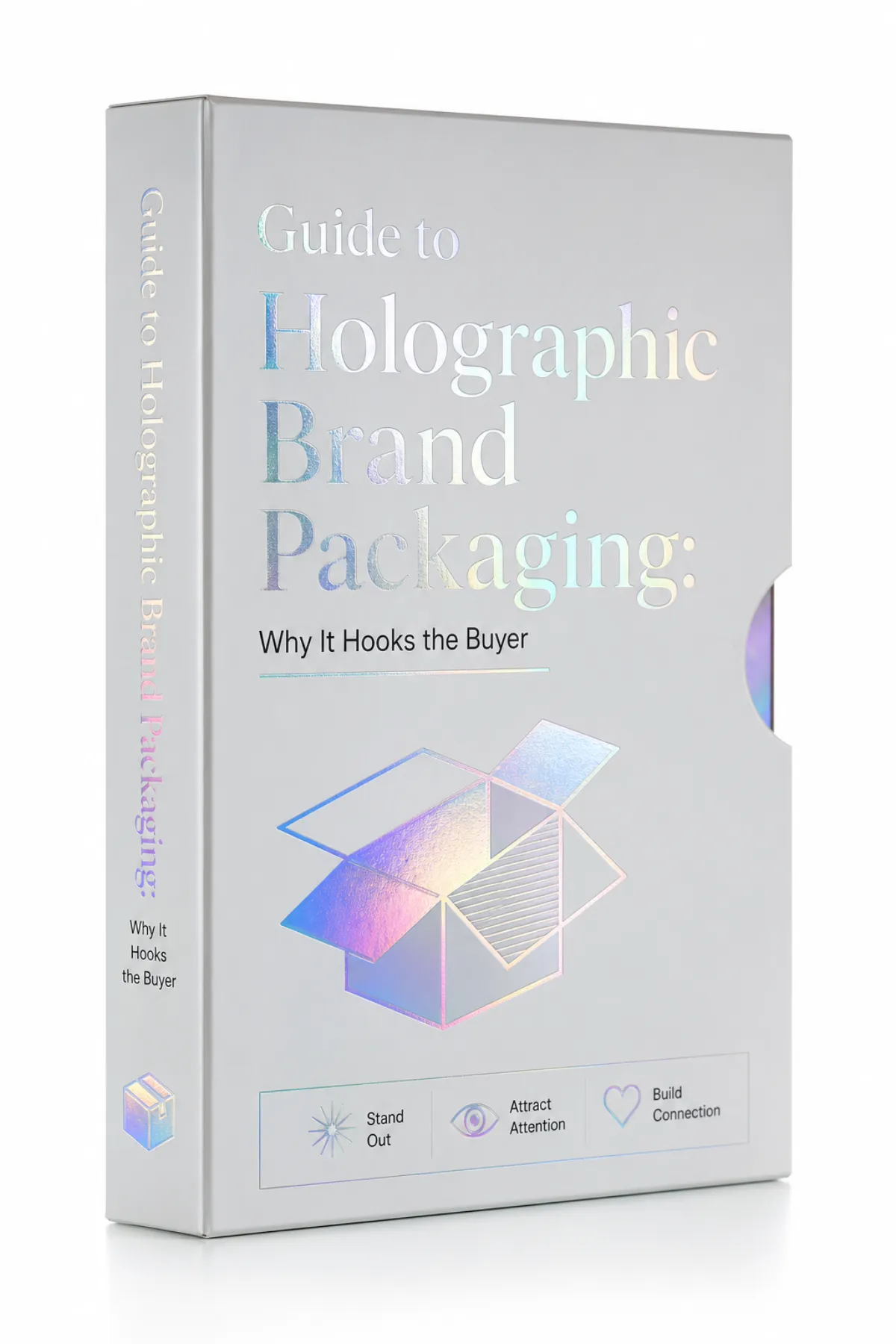
A guide to holographic brand packaging is a working framework for using reflective, angle-shifting design without blowing up readability, budget, or production reliability. It includes visual effect, substrate, adhesive and top-coat stack, and the manufacturing controls needed to move from concept to shelf-ready packaging that survives real handling. If the process stops at “make it shiny,” you don’t have a guide. You have a mood board on expensive paper.
The useful version connects business goals to hard decisions: where to place the reflective element, how much area to cover, which package format can carry it, and what tests must happen before launch. That is why a robust guide to holographic brand packaging usually includes shelf simulation, durability checks, and supplier sign-off milestones. The pretty part is easy. The usable part is engineering around chaos.
In practice, the first pass should ask two questions: what problem are we fixing, and which customer behavior should change? Maybe it is shelf confusion, counterfeit risk, shelf-life confidence, or perceived premium alignment. A framework that starts there usually survives pressure better than one that starts with “look fancy.”
Guide to Holographic Brand Packaging: Why It Hooks the Buyer
From a buyer perspective, value in a guide to holographic brand packaging starts with recognition speed. A package has seconds under mixed lighting and those seconds are always contested. A precise holographic accent can improve recognition without turning the box into a loud billboard. That matters most where shoppers are scanning and switching fast.
Honestly, packaging design is often less about inspiration and more about friction reduction. Better recognition lowers decision friction. Lower friction lowers hesitation. Lower hesitation lowers “I’ll just keep browsing” behavior. That is why the effect can help in crowded categories where attention is always in short supply.
The practical side of a guide to holographic brand packaging works in layers. First, visual behavior at shelf distance. Second, the substrate-film-adhesive-topcoat stack. Third, legal compliance for barcodes, ingredient lists, and claims. Fourth, supplier execution: proofs, sampling, approvals, and a clean handoff to production. Drop one layer and you’ve moved from strategy into expensive trial-and-error.
The real brand question is not, “Does holography look cool?” It is, “Which SKU needs which intensity, and why?” A flagship serum can support stronger cueing than its refill pouch. A premium spirits bottle can use a bold neck label while keeping the back panel restrained. A vitamin can use a thin band as a brand code or anti-counterfeit marker. A disciplined guide to holographic brand packaging matches finish intensity to product role.
For Custom Printed Boxes and flexible formats, visual hierarchy cannot disappear behind shimmer. Contrast plus restraint keeps both premium and legibility in one package. Overusing reflective effect on every panel breaks the packaging architecture and confuses attention. The strongest guide to holographic brand packaging gives a clear decision: full coverage, spot treatment, or no holography.
One project taught me this clearly: a skincare brand pushed full-surface foil-like holography on all panels because it tested “beautiful” on studio light, but customers couldn’t locate essential info quickly. The next batch kept only a top band and side accent, and shelf reads improved immediately. That’s not a style choice; that’s a decision framework in action.
How Holographic Brand Packaging Works Without Becoming Decorative Noise
A practical guide to holographic brand packaging starts with stack control because every layer changes final optics. In a common setup, you start with substrate, add holographic transfer, add adhesive, then protective topcoat or lamination. Change one layer and the color travel, scratch resistance, and tactile read all move. Base substrate drives stiffness and print quality. Transfer controls color shift and pattern geometry. Topcoat protects and shifts feel.
Misaligned stacking creates distortion, edge lift, and visual cheapness. I’ve seen teams spend twice because a “tiny alignment drift” was treated as a cosmetic issue instead of a structural one. It becomes expensive in short order if you skip stack-level signoff before art lock. A guide to holographic brand packaging should include this checkpoint, not as an optional good idea but as an operational rule.
Angle is a bigger lever than many teams expect. Near zero angle, the surface can look like soft metallic shimmer. Mid-angle, the pattern becomes vivid and directional. At steep angles, some effects fade or disappear. That behavior is normal physics. A thoughtful guide to holographic brand packaging predicts this and uses it to guide shopper movement, not fight it.
Substrate mismatch creates the most common production trap. Rigid cartons tolerate stress better than pouches, which can wrinkle around seals. Curved labels can lift if adhesion is weak. High porosity boards may flatten pattern or cause patchy pickup. A guide should require fold testing, die-cut behavior, peel-tab interaction, and perforation checks before final approval. No one wants to discover this once pallets are already in transit.
Matte or satin backgrounds usually pair better with reflective effects. They build a calm base so reflective elements remain readable. Glossy everything often creates glare collisions and kills contrast. Same goes for machine-readable elements. You can have a gorgeous sample that fails warehouse QR scans under low contrast. A serious guide to holographic brand packaging treats scan reliability as design quality, not a compliance afterthought.
Anti-forgery performance can be a useful bonus. Controlled pattern structures, serialized marks, and orientation cues can create a visual verification layer for distributors and consumers. It will not make packaging foolproof, but it can raise the bar for tampering and counterfeiting in categories with real pressure, like supplements and collectibles. A guide to holographic brand packaging usually touches fraud prevention once testing starts in distribution.
Trade-offs are not theoretical. Higher optical intensity often increases abrasion sensitivity and edge wear risk. A finish that looks incredible in a folder can look tired after repeated stocking and handling cycles. A reliable guide to holographic brand packaging balances visual impact with logistics reality so the package survives the shelf, shipping, and the first customer touch.
Brands scaling across SKUs should treat holography as part of a language system, not a one-off stunt. If the program includes Custom Packaging Products, this finish language should stay coherent with carton structure, tone, and tactile cues across formats. That keeps the experience deliberate instead of looky-loo. Inconsistent execution is how brand equity starts to leak, one package at a time.
How a Guide to Holographic Brand Packaging Fits Brand Strategy
The purpose of a guide to holographic brand packaging is to tie finish level to business intent. Launch SKUs can carry stronger cues than refill SKUs. Limited editions can justify sharper visuals because scarcity alters buyer expectation. Distributor-facing cartons usually need enough shimmer for quality signaling while still staying easy to photo and scan. That is why finish planning should sit in brand strategy, not as a late design afterthought.
Think in category tiers. Trust-led categories like vitamins and some personal care need credibility before spectacle. Impulse-driven categories like cosmetics and giftable treats can accept bolder cues. Collector-led lines such as games and prestige bundles can let the finish carry more narrative weight. A practical guide to holographic brand packaging respects category norms while carving a clear edge.
Channel behavior creates another real constraint. Packages live in thumbnails, social clips, retail photos, and unboxing videos, not just aisle-level daylight. Holography can look rich or noisy depending on lens and angle. A guide to holographic brand packaging tests shelf shots, mobile crops, and close-up renders before the press slot is committed. If your effect collapses in non-studio conditions, the finish is too fragile.
Measurement is part of strategy, period. Teams should track dwell time at first encounter, shelf-lift rates, complaint ratio tied to finish issues, and repeat order intent. These numbers are imperfect, but they beat “we all loved the mockup” reviews. A strong guide to holographic brand packaging asks one uncomfortable question: did the finish improve sell-through enough to justify the added complexity?
Stronger is not always smarter. A narrow band, seal, or badge can outperform full coverage for recognition and spend control. That is especially true when your brand already has color equity and typography identity. The finish should amplify what the brand already owns. Not replace it.
Across a broader portfolio, comparing outcomes with real Case Studies is useful because you get evidence, not opinions. Seeing what worked in production and where, in actual shopper contexts, beats a mood board every time. Trust me, the data does not lie, even when people do.
Step-by-Step Guide to Planning a Holographic Brand Packaging Rollout
A practical guide to holographic brand packaging starts with one hard answer: what are we optimizing for? Shelf attention, price-premium tolerance, or anti-counterfeit confidence? If you do not define that before design, the team argues about shine while the launch date moves.
Step 1 is objective setting. Step 2 locks base color family and finish family. I use a simple two-by-two: visibility need on one axis, brand maturity on the other. A new brand can absorb bolder signaling. An established brand usually needs narrower treatment to preserve recognition. A guide to holographic brand packaging makes that trade-off explicit, not whispered.
Artwork zoning usually breaks projects at the wrong point, so treat the dieline as a production map. Keep registration-safe margins near folds, die cuts, perforations, glue flaps, and peel tabs. Holography crossing stress points can crack, fade, or lift. A reliable guide to holographic brand packaging requires 3D pre-approval checks, not a flattened “looks okay” call.
Proofing needs both digital and physical checks. Digital proofs catch text hierarchy, legal placement, and color intent. Physical proofs reveal light behavior, tactile consistency, and subtle contrast shifts. Testing under warm and cool LED separately catches differences that on-screen previews never show. That should be standard in a serious guide to holographic brand packaging.
Distributor-scale validation is where design earns its paycheck. Pilot batches should run through a mini handling chain: packing, pallet movement, handoffs, and shelf-edge contact. If the chosen variant survives that loop, the process risk drops fast. A stronger guide to holographic brand packaging doesn’t end at print room.
Step 6 is acceptance criteria before press. Put targets for ΔE range, edge curl limits, minimum text contrast, and allowed pattern-shift behavior into the work order. Vague standards turn approvals into arguments. A clear guide to holographic brand packaging aligns procurement, quality, and marketing before execution begins.
Step 7 adds a supplier review loop and tracks scrap, on-time performance, correction speed, and complaint categories. Step 8 builds one master asset library for cartons, inserts, and campaign visuals so the reflected look is consistent across channels. A small mismatch between packaging and campaign art can weaken trust faster than a typo ever will.
Legal content and barcode validation should not wait until final art lock. Teams that push this late usually pay with rework, corrected proofs, and schedule pain. A disciplined guide to holographic brand packaging runs legal, production, and branding in parallel, so none of those disciplines become the bottleneck drama later.
Contingency is not pessimism; it is professionalism. Pre-approved alternate films, fallback one-color versions, and secondary supplier paths can save a launch when preferred stock is constrained. Any real guide to holographic brand packaging keeps this planning explicit, because supply instability is operational reality, not a rumor.
Process and Timeline: From Concept Lock to Production Shipping
Timeline planning for a guide to holographic brand packaging often takes longer than teams expect, because finish adds proof, testing, and approvals. The practical phase sequence is straightforward: discovery, design, prepress, sampling, pilot, approvals, then full production. Bottlenecks happen in every phase, and one miss usually pushes everything down the line.
A practical benchmark looks like this: concept-to-dieline usually 1–2 weeks, sampling 1–3 weeks, pilot and revisions 1–2 weeks, then launch production 2–6 weeks depending on quantity and substrate. Print method, film stack, and whether it is a Custom Printed Box or specialty label workflow will shift these windows. A guide to holographic brand packaging gives buyers realistic ranges, not fantasy estimates.
Delays usually come from proof approvals, substrate shortages, press schedule changes, and transport lead-time spikes. A practical guide to holographic brand packaging uses 10 to 20 percent schedule buffer on complex builds and avoids overconfident promises that collapse under pressure. Predictability beats heroics most of the time.
Approval architecture matters as much as speed. Marketing signs off on look and shelf impact. Quality signs off on material and durability. Legal clears claims and required copy. Procurement verifies cost and supplier terms. Skip any layer and you will still have hidden risk in launch. A strong guide to holographic brand packaging keeps the sequence explicit and documented.
Parallel work reduces bottlenecks. While art is tuned, operations should confirm barcodes, regulations text, and shipping specs. That makes approval a convergence point, not a late crisis meeting where everyone is rewriting under fire. This setup cuts rework and prevents endless “fix-by-Friday” cycles.
Logistics is often underestimated. For SKUs that take rough handling, standardized tests—including methods commonly referenced by organizations like ISTA—help validate compression, vibration, and drop behavior. A guide to holographic brand packaging without transport testing is only half a strategy.
If sustainability claims are part of the position, material documentation should be locked early. FSC-certified paperboard may work in one system, but the full stack still needs review for consistency and process impact. For a practical guide to holographic brand packaging, sustainability is not a marketing phrase. It is a systems requirement and an auditable path.
Detailed declarations should be tracked from design to final package specifications. If finish claims sound eco-conscious but the layer stack does not support that claim, trust evaporates first, sales later. A better guide to holographic brand packaging keeps story and evidence synchronized.
Cost and Pricing of Holographic Brand Packaging by Complexity
Cost is where every packaging plan gets honest quickly. A grounded guide to holographic brand packaging breaks pricing into substrate, film family, coating depth, area coverage, quantity, finishing speed, and artwork complexity. The “how shiny is this?” question is almost always less important than that stack.
Separate setup cost from unit cost in every estimate. Setup includes plates, dies, tooling, registration trials, and color calibration. Unit cost includes material, press time, finishing labor, inspection, packing, and scrap allowance. MOQ changes alter everything fast, often against margin expectations. A strong guide to holographic brand packaging explains this clearly so surprises do not become excuses.
At a practical level, the cost ladder often looks like this:
| Finish option | Typical setup profile | Indicative unit cost at mid-volume | Best use case |
|---|---|---|---|
| Spot holographic accent | Lower tooling load; limited area coverage | $0.08-$0.18 per unit | Premium cues, seals, badges, and line extensions |
| Partial-panel holography | Moderate setup and tighter registration | $0.14-$0.28 per unit | Hero SKUs and shelf-facing cartons |
| Full-surface holography | Higher scrap sensitivity and finish control | $0.22-$0.45 per unit | Limited editions, collector packs, and gift packaging |
These numbers are directional and change by geography, volume, substrate, and finish complexity. A reliable guide to holographic brand packaging uses ranges and scenario-based quotes to avoid margin shock. Hidden cost inflation comes from the stuff nobody wants to discuss: die tweaks, repeat registration testing, correction cycles, shipping insurance, and slower changeovers.
Don’t ignore whether the finish is paying for itself. Compare incremental unit cost against expected conversion lift. If a finish adds 12 percent cost for a 3 percent lift, you need strong pricing power, not just confidence. I’ve seen that math break in exactly that way when teams approved a look without a margin test.
Supplier evaluation should test much more than price. Ask for consistency from sample to full run, historical lead-time reliability, certifications for sustainability, and proven performance under normal retail handling. A supplier can deliver a gorgeous sample and still fail scale control. That does not help production or the customer.
When the packaging system includes cartons, sleeves, inserts, and labels, cost logic should scale with the same rules. Broader Custom Packaging Products architecture can amplify value only if finish standards stay consistent across formats. A strong guide to holographic brand packaging keeps that discipline intact.
Common Mistakes in Holographic Brand Packaging Projects
The first mistake appears repeatedly: teams select the brightest film before checking barcode readability and contrast. The package may win visually and lose operationally in dim logistics environments. A sound guide to holographic brand packaging treats scan reliability as mandatory from day one, not a release-week emergency.
Ignoring edge behavior is another costly error. Hot spots near seams, folds, and cut lines often pass renders and fail in motion. Too much decorative layering pushes delamination risk and increases scrap. More layers also usually mean more rework and less control. Not sexy, but brutally true.
Supplier feasibility checks made too late are another tax. If artwork “looks final” but production has not signed off, late edits become expensive and emotional. Another miss is skipping hand feel, moisture tolerance, and pressure pop-off testing. A premium-looking carton that peels or rubs off quickly is not premium in customer hands. A practical guide to holographic brand packaging keeps physical performance at center.
Here is the correction playbook I use in production:
- Trim coverage in low-contrast zones to restore readability and scan reliability.
- Strengthen tolerances around high-stress folds, seams, and seals.
- Use a two-stage sign-off flow for art and production proofing.
- Run durability testing before a full release, not after complaints.
- Evaluate the same design in warehouse light, store light, and direct sunlight.
Those steps are plain. That is exactly why they work. They cut expensive damage: reprints, delays, complaints, and waste. A real guide to holographic brand packaging is about execution discipline, not flashy effects.
Some teams forget environmental reporting while chasing visual impact. If a packaging claim includes sustainability language, document finish and adhesive choices so claims can be defended later. The U.S. Environmental Protection Agency provides practical context on waste and materials management at EPA, which can help when disposal or recycling language is being drafted. The disclaimer is simple: local recycling guidance and label systems vary, so confirm before publishing end-of-life claims.
Expert Tips and Actionable Next Steps for Your Guide
If you need a fast and safe entry, start with one flagship SKU. One SKU lets you isolate what changes in material behavior, press performance, and shelf response. Expanding across additional SKUs too early usually creates confusion in both budget and learning. Data-first growth beats broad-stroke guessing.
Build a supplier scorecard around first-article pass rate, color consistency, and lead-time performance under pressure. Those indicators reveal risk better than glossy presentations. A practical comparison method: run three batches on the same SKU—matte baseline, spot holographic, full-surface holographic. Shelf behavior usually becomes clear faster than internal debate.
Set a pre-launch rhythm early. Freeze legal text before art lock. Lock dielines before cosmetic fine-tuning. Stage approvals while teams can still respond in hours. The goal is predictability, not rigidity. A practical guide to holographic brand packaging keeps the finish in service of the package and the business.
Post-launch, run KPI checks for at least thirty days. Track reorder velocity and damage-related rework percentage. If reorder rises and defects stay flat, the finish is working. If reorder slows while defects rise, revisit coverage, substrate, or handling protection quickly. A guide to holographic brand packaging stays alive after shipping, not just through it.
The strategic lesson is simple: holography is a measured branding tool when it is managed, or a shiny detour when unmanaged. It can reinforce identity, improve unboxing clarity, and support trust, but only if the stack, tests, and approvals are treated seriously.
Document outcomes in plain language as you go: what improved, what broke, and which finish level worked for each packaging family. Those notes become the foundation for better custom printed boxes, stronger carton systems, and cleaner retail decisions later. A guide to holographic brand packaging earns its keep when it creates repeatable choices.
Final takeaway: choose a single flagship SKU, define your success metrics, prototype with controlled coverage, prove durability under real handling, and only then scale. If you do those four things, a guide to holographic brand packaging moves from style preference to a repeatable growth lever for the brand.
Frequently Asked Questions
How much does a guide to holographic brand packaging usually add to unit cost?
Most of the cost comes from film selection, coated area, and run length, not just color count. Smaller runs often carry higher setup overhead, so per-unit increases can look sharp at first. As quantity increases through initial MOQ bands, the unit cost usually improves. A common control move is switching from full-surface treatment to controlled accents while keeping the brand-defining cue intact.
What is a realistic timeline for a first guide to holographic brand packaging run?
For mid-scale campaigns, a realistic timeline is 6 to 12 weeks from initial brief to shipment. Sampling and approvals usually consume the most time because you are validating both appearance and durability. Lock visuals and technical data before press booking to reduce overruns. If your film stack might change, add extra buffer because replacement material usually changes both appearance and lead time.
Should I choose full-surface or spot holographic branding for best performance?
Full-surface treatment gives stronger immediate visual impact, but it raises cost and increases rejection risk near folds and abrasion zones. Spot branding usually performs better when readability, scanning, and channel compatibility matter. The most practical way is to pilot both on a small batch and compare scan success, returns, and shelf attention before scaling.
Can holographic brand packaging be made with recyclable or compostable materials?
Yes, with major caveats. Behavior depends on substrate and adhesive choice, and some high-barrier films are not yet fully compostable. Demand full material declarations and complete stack documentation before artwork lock-in. Recyclable systems usually require separable layers, compatible clear windows, and disposal guidance that matches how the packaging is actually distributed. Treat claims as verifiable commitments, not slogans.
What technical checks prevent delays in a holographic brand packaging job?
Run fold-line and barcode contrast checks with physical mockups, not PDF-only reviews. Add clear tolerances for gloss, curl, and edge lift in the purchase order. Confirm supplier escalation paths and correction windows before production starts so defects are addressed quickly. That control reduces launch risk and keeps the schedule out of emergency mode.