Buyer Fit Snapshot
| Best fit | To Premium Retail Box Branding projects where brand print, material claims, artwork control, MOQ, and repeat-order consistency need to be specified before quoting. |
|---|---|
| Quote inputs | Share finished size, material target, print colors, finish, packing count, annual reorder estimate, ship-to region, and any compliance wording. |
| Proofing check | Approve dieline scale, logo placement, barcode or warning zones, color tolerance, closure strength, and carton packing before bulk production. |
| Main risk | Vague material claims, crowded artwork, missing packing details, or unclear freight terms can make a low unit price expensive after revisions. |
Fast answer: To Premium Retail Box Branding: Material, Print, Proofing, and Reorder Risk should be specified like a repeatable production item. The safest quote records material, print method, finish, artwork proof, packing count, and reorder notes in one written spec.
Production checks before approval
Compare the actual filled-product size with the drawing, then confirm tolerance on folds, seals, hang holes, label areas, and retail display edges. Reserve space for logos, QR codes, warning copy, and material claims before decorative graphics fill the panel.
Quote comparison points
Review material grade, print process, finish, sampling route, tooling charges, carton quantity, and freight assumptions side by side. A quote is only useful when the supplier can repeat the same color, closure quality, and packing count on the next order.
I still remember a $2.40 carton that sold a product like it belonged in a $28 gift set. The trick was not some magical marketing flourish. It was the guide to premium retail box branding doing its job before the customer ever touched the product. The sample had a 350gsm SBS outer, a 1.2 mm chipboard tray, and a single matte gold foil mark. That was enough. The conversation changed on the spot, and I have not forgotten that table since.
That kind of result is why premium packaging gets treated so seriously on factory floors in Shenzhen, Dongguan, and beyond. Brands often ask for "just a nicer box," as if nicer were a minor tweak. Then the sample table proves otherwise. A 350gsm folding carton, a 1200gsm rigid shell, or a soft-touch wrap can change brand perception almost immediately. The guide to premium retail box branding is really a method for making the package feel worth the shelf price without pretending the product inside is something it is not.
People get this wrong all the time. They think premium means shiny. Sometimes it does. Often, it does not. A high-gloss finish on a $16 tea tin can look louder than luxurious, and loud is not the same as premium. The guide to premium retail box branding brings structure, print, finish, and unboxing experience into one system so the customer reads care, not clutter. If the product is close in quality to a cheaper competitor, the box has to earn the pickup, the giftability, and the repeat purchase. Otherwise, you have spent money to look busy. That is a special kind of expensive mistake.
"Expensive-looking" is not a strategy. It is a mood. A package has to protect the product, survive transit, and still make the brand look sharper after a 3-foot drop than it did in the mockup.
What Is the Guide to Premium Retail Box Branding?
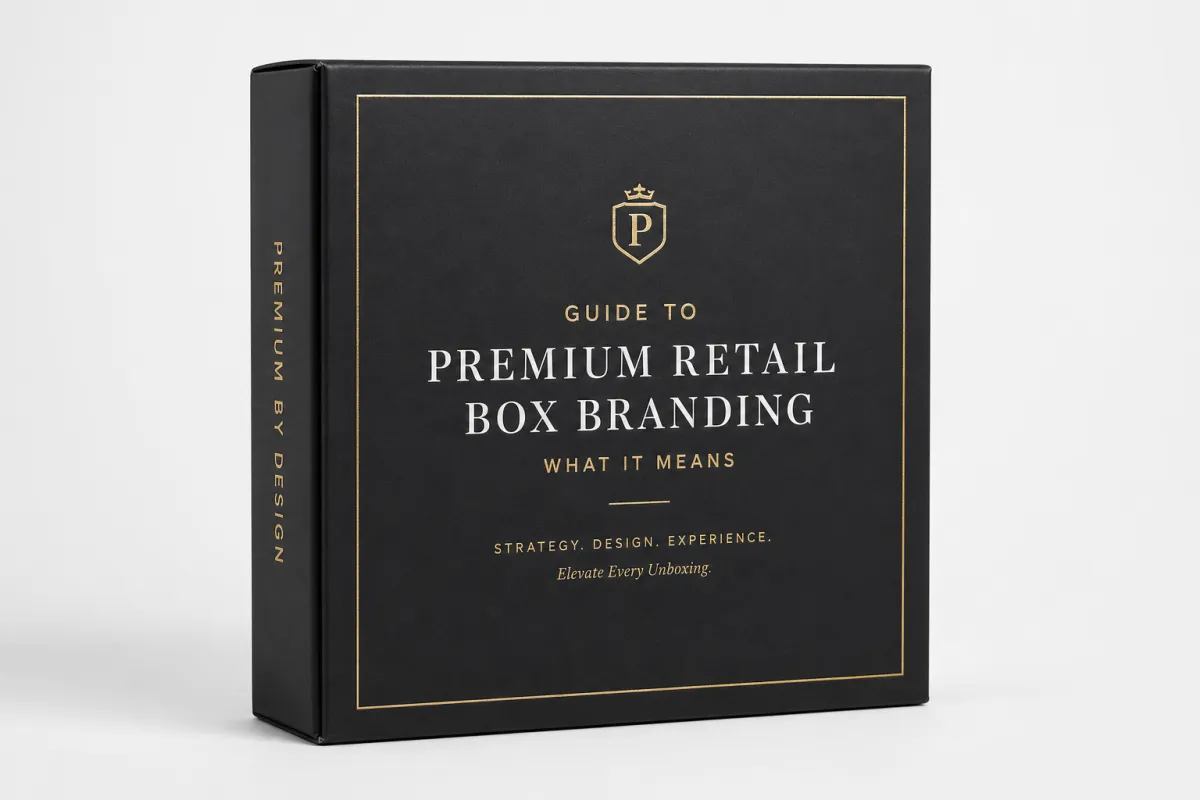
The guide to premium retail box branding starts with a simple idea: the package is part of the product story, not a wrapper thrown on at the end of the job. I have sat in client meetings where a $19 candle was treated like a commodity until we put it in a magnetic rigid box with a 157gsm art paper wrap and a blind-emboss logo. Same wax. Same fill weight. Different shelf reaction. Different brand recognition. A buyer in Los Angeles once picked up the box twice because it "felt more expensive," which is the sort of sentence that makes a packaging person quietly smile while everyone else is still talking.
Premium retail box branding brings structure, print, finish, and opening sequence into one system so the customer reads value in about 4 to 7 seconds. If the logo is buried, the type is tiny, and the lid flops open like a takeout carton, the package feels cheap no matter what the ink cost. The guide to premium retail box branding matters because buyers do not measure value with calipers. They react to instinct, store lighting, and whatever story the box tells them at arm's length, usually under 3000K LEDs that flatten weak color contrast and make weak decisions look even weaker.
I remember a beauty client who brought me a sample in a plain 300gsm folding carton. The product was good, but the package was doing absolutely nothing. We moved them to a 1200gsm rigid setup with a 0.5 mm foil line, a 1.5 mm foam insert, and a matte soft-touch lamination. Their wholesale buyer said the box looked like it belonged at $45, not $19. That is the gap the guide to premium retail box branding is trying to close. Not magic. Not hype. Just a better first impression, with better mechanics underneath.
There is another piece most people miss: a box can look expensive and still be a bad box. I have seen beautiful cartons fail a 1-meter drop test because the corners crushed, the insert shifted, and the lid scuffed in transit from Shenzhen to Chicago. The guide to premium retail box branding only works if the package is engineered to protect, present, and reinforce the brand at the same time. Pretty boxes that arrive dented are just expensive disappointment, and the complaints usually arrive before the reorders do.
If you want a clean example of how packaging supports visual branding and sales velocity, browse our Case Studies. You will see why I keep saying the guide to premium retail box branding is a business tool, not a decoration exercise. I am very biased on this, admittedly, because I have watched too many beautiful boxes fail at the retail shelf and in transit cartons.
"The box should sell the first impression, then disappear into the experience." That was the line a cosmetics buyer gave me after we changed the lid opening from a friction fit to a ribbon-pull tray.
Guide to Premium Retail Box Branding: How It Works
The guide to premium retail box branding works best when you treat it like a system with seven moving parts: brand strategy, dieline selection, material choice, artwork, prototyping, production, and final packing. Skip one, and the rest start to wobble. I have seen teams spend $1,200 on foil stamping and then discover the insert was 3 mm too tight, which turned a luxury launch into a tense round of rework emails. That is how a premium idea turns into a costly headache.
- Brand strategy sets the target. A $12 skincare cream and a $120 fragrance gift set do not need the same box language or the same board weight.
- Dieline selection locks structure. A sleeve, tuck end, rigid set-up box, or drawer style changes both feel and pack-out time by minutes per unit.
- Material choice gives the box weight. A 350gsm SBS carton feels different from a 1200gsm rigid board wrapped in specialty paper.
- Artwork controls hierarchy. Logo size, type size, and color contrast decide what the shopper sees first under 2,500 to 3,500 lux store lighting.
- Prototyping catches mistakes. A $150 sample is cheaper than scrapping 5,000 units printed in the wrong shade of navy.
- Production is where tolerances matter. A 0.3 mm shift is small on screen and annoying in print.
- Final packing finishes the job. If the insert, tissue, and outer carton do not align, the brand feels careless.
The box behaves like a silent salesperson. It guides attention with hierarchy, color, texture, and opening sequence. On one Shenzhen line, I watched a soft-touch sleeve add just 6 cents per unit and 11 seconds of handling time, but it changed the way buyers handled the sample. They lifted it. They turned it. They kept it on the table longer. That is not magic. That is the guide to premium retail box branding doing exactly what it is supposed to do, and the behavior shift showed up within minutes.
Structure matters more than people think. A magnetic closure says "gift" before the logo is read. A window says "show me the product" and is perfect for specialty food, cosmetics, or small electronics. A paper sleeve over a rigid drawer adds motion, and motion sells because the hand notices what the eye has not decided yet. The guide to premium retail box branding is not one fancy upgrade; it is the alignment of every touchpoint so the customer gets one clear message in 10 seconds or less. If the story is muddy, the package is muddy too.
That is also why I push brands to compare samples side by side. A rigid box with a 1.5 mm chipboard core, a simple tuck carton in 350gsm SBS, and a sleeve-and-tray combo can all look "premium" in a PDF. They do not feel the same in a store or at a kitchen table in Toronto, Dubai, or Manchester. If you want to see how those choices affect real sales and repeat orders, our Custom Labels & Tags page shows how small packaging details can keep the brand system consistent across SKUs. The guide to premium retail box branding gets a lot less abstract once you compare the physical pieces instead of arguing about renders.
Honestly, the guide to premium retail box branding gets easier when you stop thinking in terms of "one box" and start thinking in terms of a repeatable packaging system. Fixed logo placement, standardized color fields, and the same finish rules across 6 or 12 SKUs create brand consistency. That matters more than one dramatic finish treatment that looks great once and awkward everywhere else. I am firmly in the "repeatable over flashy" camp, even if that makes me sound boring at a sample table. It also makes the supply chain calmer, which is a rare luxury in Retail Packaging Design.
Key Factors That Shape Premium Retail Box Branding
The guide to premium retail box branding lives and dies on material choice. I have spent enough time on factory floors to know that the board feels different in your hand before you ever see the print. SBS, coated board, kraft, rigid board, and specialty paper wraps each carry a different story. A 350gsm C1S carton is a workhorse for retail. A 1200gsm rigid board wrapped in 157gsm art paper tells a different story. A natural kraft board can signal eco-minded simplicity, but only if the print and finish support that message in the first 2 seconds of pickup.
For luxury skincare, I usually want a smoother, cleaner face: SBS, coated paperboard, or rigid board with a soft-touch coating. For specialty food, a kraft look or a natural-feel carton can work better if the product wants an honest, earthy signal. For electronics, the guide to premium retail box branding often points to rigid structures, inserts, and a tighter closure because the customer expects protection and precision. Same budget, different story. Same product sometimes, too. The packaging is the accent mark, and the wrong accent can change the sentence.
Finishes are where the temptation gets dangerous. Foil stamping, embossing, debossing, spot UV, and soft-touch lamination all add value, but they also add setup time and money. A gold foil stamp might add $0.12 to $0.28 per unit on a 5,000-piece run. Soft-touch lamination can add another $0.07 to $0.18. Stack three finishes on a thin-margin item and suddenly your packaging cost is eating the profit you thought you had. The guide to premium retail box branding works best when one finish carries the whole mood. More is not always more; sometimes more is just more bills.
I had a food client try to use foil, embossing, and a heavy matte coating on a snack box that sold for $6.50. It looked like a luxury perfume package. It also looked like a mistake. We stripped it back to one spot UV accent, one deep green Pantone, and a textured paper wrap, and the shelf impact improved while the cost dropped by $0.23 per unit. The brand stopped looking like it was pretending to be something it wasn't. That is the guide to premium retail box branding in real life, where the product and the package have to agree on the same price point.
Sustainability belongs in the same conversation, not in a separate nice-to-have bucket. FSC-certified board, low-VOC inks, recyclable paper wraps, and clear disposal labeling affect trust and customer perception. I check for chain-of-custody paperwork when a brand says the package is FSC-based, because the claim should be traceable, not just printed in 8-point type. For material standards and responsible sourcing, the FSC site is a solid reference point, and it is far better than guessing. Guessing, in packaging, is how people end up with a very expensive conscience and a very confused compliance team.
Compliance matters too. If a package sits near food, personal care, or children's products, the inks, adhesives, and coatings cannot be chosen by vibes alone. I have seen brands save $0.04 a unit by switching suppliers, then lose two weeks explaining a packaging claim they could not back up in New York and Rotterdam. The guide to premium retail box branding should protect the brand's trust as much as its shelf appeal. I would argue that trust is the shelf appeal, just wearing a better jacket and a cleaner label claim.
Premium Retail Box Branding Cost and Pricing Breakdown
The guide to premium retail box branding gets real fast once money enters the room. And money always enters the room. The biggest cost drivers are box style, board thickness, print coverage, finish complexity, insert design, order quantity, and shipping weight. A simple 350gsm folding carton might land around $0.18 to $0.32 per unit at 5,000 pieces. A rigid gift box with a magnetic closure, foil, and a custom insert can land anywhere from $1.10 to $3.25 per unit depending on size and freight. I have had brands stare at those numbers like they were personally betrayed by physics.
Setup costs are separate, and a lot of brands forget that part. Die tooling can run $180 to $450. Printing plates can add $120 to $260 per color. Sample rounds often cost $75 to $250 each, and prepress checks may add another $50 to $150 if the artwork needs cleanup. The guide to premium retail box branding is not just a unit price conversation. It is a project-cost conversation, and those are not the same thing. A cheap unit price can become a surprisingly rude total once the tooling, samples, and freight are counted.
I once negotiated with a Guangzhou converter on a cosmetics run where the brand wanted four-color flood coverage, foil on the logo, embossed petals, and a magnetic closure on 8,000 units. Nice package. Beautiful, even. The quote came back at $2.14 per unit. We stripped one finish, changed the wrap paper to a smoother stock from Fedrigoni, and dropped the cost to $1.63 per unit without hurting the shelf look. That $0.51 saved on 8,000 boxes was $4,080 the brand could spend on marketing instead of overdecorating cardboard. The guide to premium retail box branding should be about smart allocation, not trophy finishes.
If your margin is thin, spend on one hero feature instead of layering every luxury effect at once. A soft-touch surface plus a clean foil logo can do more than embossing, debossing, spot UV, and a full flood coating fighting each other. The guide to premium retail box branding should improve the offer, not turn the package into a price trap. A package should feel intentional, not like it fell into the finish drawer and got everything taped on in one rush.
| Option | Typical Structure | Unit Price at 5,000 | Setup Cost | Best Use |
|---|---|---|---|---|
| Standard Folding Carton | 350gsm SBS, CMYK print, no special finish | $0.18-$0.32 | $180-$420 | Everyday retail, low-margin SKUs, fast launches |
| Premium Folding Carton | 350gsm board, soft-touch, foil or spot UV, basic insert | $0.42-$0.95 | $450-$1,250 | Beauty, specialty food, mid-price gifting |
| Rigid Gift Box | 1200gsm board, specialty wrap, custom insert, magnetic or drawer closure | $1.10-$3.25 | $650-$1,800 | Luxury sets, electronics, premium launches |
The guide to premium retail box branding also needs a shipping reality check. A rigid box can weigh 180 to 300 grams before the product goes in. Multiply that by 10,000 units and you can add 1.8 to 3 metric tons to the freight bill before pallets and outer cases even enter the math. I have watched a brand choose a heavier board, then discover the freight savings disappeared into carton weight on the route from Ningbo to Long Beach. Pretty package, ugly invoice. That moment always feels a little like finding out your elegant solution brought its own forklift.
For packaging education and broader industry context, the Packaging Association is worth a look. The guide to premium retail box branding gets stronger when you understand the whole supply chain, not just the print quote. The box does not exist in a vacuum, no matter how much the design deck pretends otherwise, and freight from Shenzhen, Ho Chi Minh City, or Warsaw will always remind you of that.
Premium Retail Box Branding Timeline: From Brief to Delivery
The guide to premium retail box branding is faster when the brief is clear on day one. A clean workflow usually runs like this: creative brief, structural concept, dieline confirmation, artwork prep, proofing, sample approval, production, and freight. For a straightforward folding carton, I like 12 to 15 business days from proof approval to dispatch. For a rigid box with inserts and specialty finishes, 18 to 25 business days is more realistic. Add freight, and the total can land anywhere from 3 to 7 days by air or 25 to 40 days by ocean depending on the route. If that sounds like a lot of calendar math, it is. Packaging has never respected wishful thinking.
Delays usually happen in the same places. Artwork is "almost final" but not actually final. The finish sample looked good in a photo but needs a second round in hand. The dieline changed after the design team had already placed the type. The guide to premium retail box branding is not slow because print shops are lazy. It is slow because revision cycles eat time, and every revision has a cost attached. The box is patient; the schedule is not, especially when three teams are waiting on a signature from one person.
I had one launch where a brand shaved 9 days off the schedule after the retailer moved the launch window. They paid for it, of course. We had to approve a sample in 48 hours, rerun a proof, and ship part of the order by air from Shenzhen to Dallas. The extra freight bill was $1,860. If they had locked the package two weeks earlier, the same run would have gone out by ocean at a fraction of that price. The guide to premium retail box branding rewards planning and punishes panic, and the invoice always arrives with the same blunt handwriting.
For transit-heavy projects, I ask for testing that reflects real handling, not fantasy handling. The guide to premium retail box branding should include carton integrity checks, corner crush review, and drop standards tied to the product route. For shipping guidance and package performance references, ISTA is a strong source. If the box has to survive warehouse stacking, pallet moves, and retail handling, the structure should be tested before 20,000 units are printed. I have seen enough crushed corners to know that "we will be careful" is not a testing protocol.
My simple rule is this: the more custom the structure or finish, the earlier it needs to enter the launch schedule. A plain folding carton can often move in 2 weeks if artwork is clean. A drawer box with a ribbon pull, foil logo, and custom tray needs more like 4 to 6 weeks, sometimes longer if the product dimensions are still shifting. The guide to premium retail box branding is never improved by a last-minute structural surprise. Surprise is great for birthdays, terrible for production on a Tuesday morning.
Common Mistakes in Premium Retail Box Branding
The guide to premium retail box branding fails the moment people start decorating before they start deciding. Overdesign is the classic mistake. A box can look expensive on a mood board and still be wrong for the product, the audience, or the price point. I once saw a $14 tea brand use matte black, heavy foil, and a velvet tray. It looked like a watch box. The customer wanted a calm, natural tea story, not a midnight tuxedo in cardboard form. I still laugh a little when I remember that presentation, because the box looked like it was trying to impress the wrong crowd in the wrong city.
Weak hierarchy is another easy way to waste money. If the product name is smaller than the tagline, if the logo is too close to the flap edge, or if the color contrast dies under store lighting, the shelf impact drops fast. The guide to premium retail box branding depends on readable typography, clear brand identity, and a layout that works at 3 feet, not just 300% zoom on a designer's monitor. A shopper should not need a magnifying glass and a strong opinion to understand the package, especially in fast-moving retail aisles in Los Angeles or Berlin.
Technical errors are worse because they are expensive. People approve artwork before the dieline is locked. They forget the insert leaves 1.5 mm of play. They miss the product height by 4 mm and force the line to rework every tray. I have watched a brand eat a $720 relabeling bill because the logo sat 5 mm too low on 1,200 units. That kind of mistake is why the guide to premium retail box branding must include both design and production discipline. You can absolutely make a lovely disaster if you skip the boring checks.
The budget mistake is the one that makes me sigh. Brands spend hard on finishes and skip proofing, which is how they burn cash and still get a mediocre result. No sample. No press check. No test fit. Then everyone is shocked that the box looks off. Not mysterious. Just avoidable. If the SKU names change often, use controlled secondary packaging and maintain the master print system with Custom Labels & Tags so the brand does not drift across runs. Consistency is unglamorous, but so is a reprint invoice with a four-figure total.
- Overdesign: too many finishes, too many colors, and no clear focal point.
- Unreadable copy: text that disappears at arm's length or under 3000K retail lighting.
- Wrong structure: a beautiful shell that crushes in shipping or wastes 18 seconds at pack-out.
- No proofing: saving $100 on samples, then losing $1,000 on bad units.
The guide to premium retail box branding is really a discipline exercise. The box should support the product, not fight it. If the package adds confusion, costs too much to ship, or lands outside the customer’s price expectations, it is not premium. It is just expensive cardboard with a self-esteem problem. Harsh? Maybe. Accurate? Absolutely, especially when the SKU is sitting beside a $9 competitor on a retail shelf.
Premium Retail Box Branding: Expert Tips and Next Steps
The guide to premium retail box branding gets much easier when you start with the unboxing moment. I mean the 5 seconds where a customer lifts the lid, slides the tray, or breaks the seal. That moment should feel deliberate. Choose one signature finish. Maybe it is a foil logo. Maybe it is a blind emboss. Maybe it is a soft-touch wrap with one sharp spot UV panel. Pick one and let it carry the emotion. I have a soft spot for restraint, which is not a sentence I expected to write about packaging in a warehouse north of Guangzhou.
Keep the rest of the design disciplined. I have seen brands spend $1.80 per unit on a rigid box and then ruin the effect with three fonts, four shade families, and a logo treatment that fights the product shot. The guide to premium retail box branding works better when every element has a job. White space is not wasted space. It is a tool for focus. If a layout feels crowded, it usually is, and the clutter shows up immediately when the box is opened on a kitchen counter or a boutique shelf.
Here is the rollout plan I use with clients who want results without drama: audit the current packaging, list the three most visible weaknesses, and fix the highest-impact one first. If the box scuffs, fix the finish. If the structure is weak, fix the board. If the brand looks scattered across SKUs, fix the system. That sequence keeps the budget honest. It also keeps the team from trying to solve a $0.14 problem with a $1.40 answer, which happens more often than anyone wants to admit when a launch date is only 10 days away.
I also tell brands to request samples early, compare board grades, and test the actual product fit before signing off. One client swore their perfume bottle was 52 mm wide. It was 53.8 mm. That 1.8 mm difference meant the insert had to be re-cut and the whole schedule slipped by 4 days. The guide to premium retail box branding is full of tiny tolerances like that. Tiny. Annoying. Expensive if ignored. Packaging has this irritating habit of punishing confidence that is not backed by measurement.
If you want a smarter starting point, build a one-page packaging brief with five numbers: target unit cost, order quantity, product dimensions, launch date, and the one finish you refuse to lose. That sheet is worth more than twelve rounds of vague design feedback. The guide to premium retail box branding should translate a brand idea into a manufacturable box by page one, not page eleven. Vague feelings do not die-cut well, and a 0.25 mm error in the brief can echo all the way into production.
My final advice is blunt: use the guide to premium retail box branding to make decisions before design gets fancy. Set the target landed cost, lock the timeline, and get the dieline approved before anyone starts chasing decorative extras. If the product margin is $4.50, I am not letting packaging wander to $1.80 without a very good reason. That is how you protect both the shelf impact and the profit. And yes, I have had to say that exact sentence out loud more than once, usually while holding a prototype with a misaligned flap.
That is the practical heart of the guide to premium retail box branding: a strong structure, a controlled finish, a clear unboxing sequence, and a budget that respects the math. Get those four things right and the box starts working as a salesperson, a protector, and a brand signal all at once. That is the rare kind of packaging that earns its keep, whether it ships from Dongguan, Toronto, or Barcelona.
FAQ
How much does premium retail box branding cost per unit?
The guide to premium retail box branding usually starts around $0.18 to $0.32 per unit for a simple 350gsm folding carton at 5,000 pieces, then climbs fast once you add rigid structure, inserts, foil, or soft-touch lamination. Rigid gift boxes with custom trays often land in the $1.10 to $3.25 range depending on size, finish count, and freight from places like Shenzhen, Ningbo, or Ho Chi Minh City. Ask for both a unit price and a full project quote so tooling, proofs, and shipping do not sneak up on you. I always tell clients to look at the landed cost, not the headline number, because that is where reality lives.
Which finishes are worth it in premium retail box branding?
The guide to premium retail box branding usually points to soft-touch, foil, embossing, debossing, and spot UV as the finishes that deliver the strongest lift in perceived value. I prefer one hero effect instead of stacking four. A clean foil logo on a matte box often beats a crowded mix of treatments, especially on a product that sells between $12 and $45. Match the finish to the category, because a skincare box and a tech accessory box do not need the same tactile story. And if you ever feel tempted to add "just one more" finish, take a breath and ask whether it actually helps the box sell.
How long does a premium retail box branding project take?
The guide to premium retail box branding can move in 12 to 15 business days for a simple carton after proof approval, but custom rigid packaging usually needs 18 to 25 business days before freight. Add 3 to 7 days by air or 25 to 40 days by ocean, depending on route and season. Delays usually come from artwork changes, extra proof rounds, or a dieline that was not final when design started. The fastest projects are the ones where someone is willing to say no early enough to save the calendar later.
What materials work best for premium retail box branding?
The guide to premium retail box branding usually relies on SBS, coated paperboard, kraft, rigid board, or specialty paper wraps. A 350gsm board works well for retail cartons, while a 1200gsm rigid board gives more weight and protection for gift sets or fragile products. Add the right coating or wrap so the box resists scuffs and still looks sharp after shipping, shelf handling, and one too many fingerprints from a curious shopper. I have never met a retail shelf that was gentle, so durability matters more than the mood board admits.
How do I keep premium retail box branding consistent across SKUs?
The guide to premium retail box branding stays consistent when you create a packaging system with fixed logo placement, color rules, typography rules, and finish limits. I also recommend a one-page spec sheet that every SKU follows, even if the accent colors change. Review dielines and press proofs the same way every time, and you will avoid the brand drift that turns a tidy product line into a chaotic shelf family. Consistency is not glamorous, but neither is explaining to a buyer why every box in the line looks like it came from a different plant.
The shortest path to better premium retail box branding is to lock three things before design gets decorative: the target landed cost, the structure, and the one finish that carries the mood. Do that first, and the rest of the box has a much better chance of earning its price.

