Buyer Fit Snapshot
| Best fit | To Layered Spot Uv Branding for Premium Packaging projects where brand print, material claims, artwork control, MOQ, and repeat-order consistency need to be specified before quoting. |
|---|---|
| Quote inputs | Share finished size, material target, print colors, finish, packing count, annual reorder estimate, ship-to region, and any compliance wording. |
| Proofing check | Approve dieline scale, logo placement, barcode or warning zones, color tolerance, closure strength, and carton packing before bulk production. |
| Main risk | Vague material claims, crowded artwork, missing packing details, or unclear freight terms can make a low unit price expensive after revisions. |
Fast answer: To Layered Spot Uv Branding for Premium Packaging: Material, Print, Proofing, and Reorder Risk should be specified like a repeatable production item. The safest quote records material, print method, finish, artwork proof, packing count, and reorder notes in one written spec.
Production checks before approval
Compare the actual filled-product size with the drawing, then confirm tolerance on folds, seals, hang holes, label areas, and retail display edges. Reserve space for logos, QR codes, warning copy, and material claims before decorative graphics fill the panel.
Quote comparison points
Review material grade, print process, finish, sampling route, tooling charges, carton quantity, and freight assumptions side by side. A quote is only useful when the supplier can repeat the same color, closure quality, and packing count on the next order.
Guide to layered spot uv branding for premium packaging starts with a simple truth I have seen repeat on press floors from Dongguan to Suzhou: people trust their hands before they trust a marketing deck. I remember standing in a review room with two sample boxes lined up, both printed on 400gsm SBS board, both carrying the same artwork. One had a normal spot UV accent. The other had guide to layered spot uv branding built up over two passes. Ten seconds later, everyone in the room kept touching the second one. Not because the brand message changed. Because the surface did. That tiny difference in touch memory is why this subject matters enough to justify the extra planning, the extra proof, and the extra $0.10 to $0.18 per unit it can add on a 5,000-piece run.
Factories see this pattern so often it becomes almost mechanical. Texture arrives first, copy arrives second, and the eye usually follows the thumb. A raised logo catches light under a 5000K inspection lamp; the edge lifts slightly under pressure; then the eye reads the mark as more expensive than it looked in a PDF proof. The guide to layered spot uv branding matters because the real shift is not just glossy ink. The shift is hierarchy, depth, and the way a package can stay in memory after it leaves the shelf in Singapore, Chicago, or Berlin.
“The first sample looked fine on screen. The second one, with layered gloss on the mark and a soft-touch wrap on the panel, felt like a different product line.”
I heard that exact line in a cosmetics review meeting in Dongguan in 2024, after the team had budgeted for a standard spot UV accent and then switched to layered spot UV branding once the samples were held under 5000K booth lighting. The original box was clean and technically acceptable on 350gsm C1S artboard with a matte laminate. It just did not support the retail price they wanted, which was $28 for a 50 ml serum. The revised version, same dieline and same print, changed the first impression completely. From arm’s length, it felt less like a package and more like a mini product object that belonged in a premium shelf bay in Hong Kong or Seoul.
This guide to layered spot uv branding lays out how the effect is built, where it works best, what it usually costs, and the production traps that quietly ruin a smart design. I have used it across rigid boxes, folding cartons, sleeves, mailers, and inserts, including 157gsm art paper wraps and 18pt premium board, and the rule holds: the finish should sharpen the design, not fight it. If it needs three extra visual tricks to make sense, it is probably doing too much. In a lot of programs, this approach is the practical answer because it improves shelf authority without turning the brief into an effects tournament.
How Does the Guide to Layered Spot UV Branding Hook Attention and Memory?
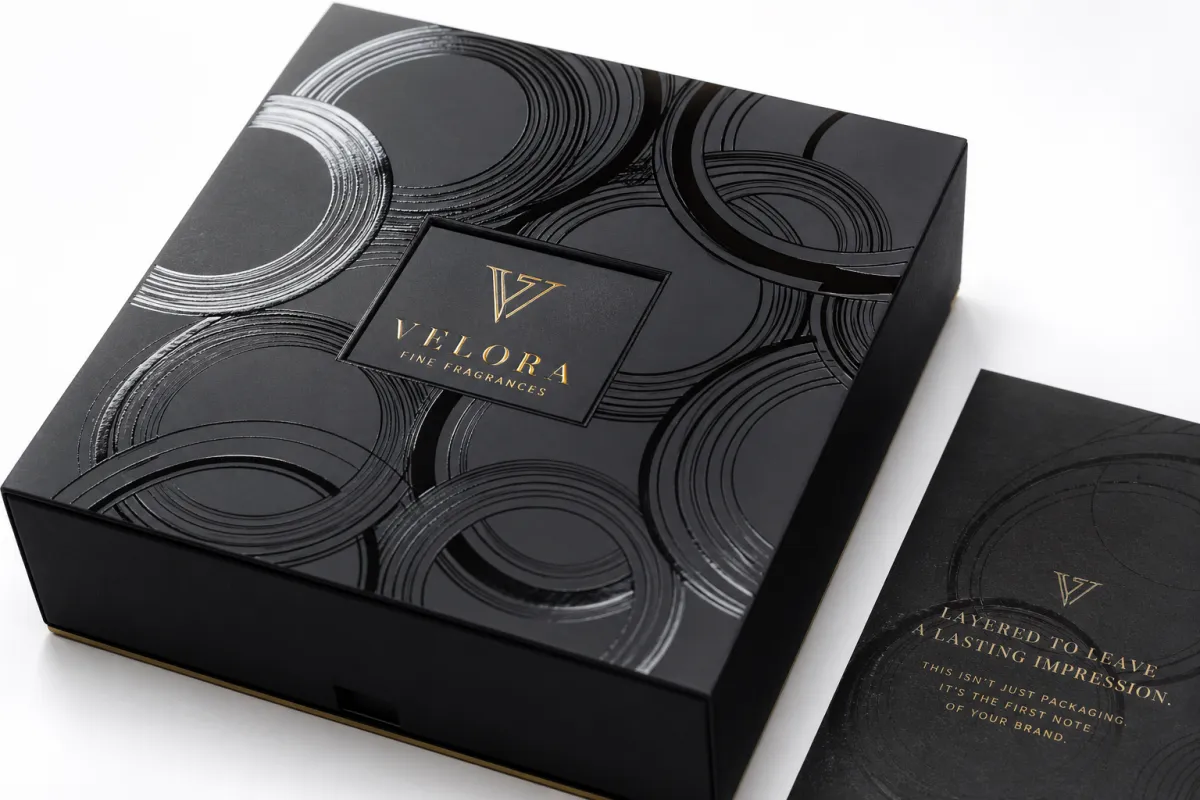
Most teams assume the logo gets seen first. In real retail tests, the hand often wins that race by a fraction of a second. The guide to layered spot uv branding starts there. Standard spot UV gives a selective glossy patch, usually on a logo, name, or pattern. Layered spot UV branding goes further by building depth through repeated varnish passes or a heavier coat build, so the treatment feels glossy and tactile at the same time. It is less decoration and more controlled physical emphasis, especially on cartons that leave factories in Shenzhen or Ningbo at volumes of 3,000 to 50,000 units. If the base print already has a clear story, this step in the guide to layered spot uv branding often delivers the biggest perceptual gain with no art redesign.
I remember seeing this happen on Rigid Setup Boxes with 157gsm wrap sheets and on folding cartons with matte laminate. A restrained package can look flat until the finish lands. Then it behaves like someone adjusted the contrast and added dimension at once. A lot of clients come to me saying they want a redesign; what they usually need is a finish language shift and a better material stack, like 350gsm C1S artboard with a soft-touch film instead of plain coated paper. The difference is often visible before the copy even registers. That is why the best designers treat guide to layered spot uv branding as part of the architecture, not as a decorative afterthought.
Compared with embossing, layered spot UV is more about visual lift than visible deformation of paper structure. Compared with foil, it sits in a less metallic lane and feels more architectural. Compared with single-pass spot UV, the shadow line and edge separation are stronger, especially on dark stock or soft-touch laminate. On a black carton sampled in Guangzhou, I saw the edge halo increase from barely visible to clearly legible under a 45-degree light angle once the coating build reached two passes. That edge is exactly the part that turns the guide to layered spot uv branding from a decorative option into a brand memory device. In practice, this is a question of selective varnish geometry and how you use contrast.
Rigid boxes, premium folding cartons, sleeves, and inserts that people touch all benefit from this process. I see this work especially well on sampler cards, warranty sleeves, and clean front-panel mailers, including 9 x 12 in. presentation folders and magnet-Closure Gift Boxes. I do not push it for every product. Heavy creases and badly handled cartons are poor candidates. A package can look stunning in sample form and collapse in tone after a week of transit abuse through regional distribution hubs in Kuala Lumpur or Dallas. For brands trying to justify a premium shelf price, this is often the difference between “nice packaging” and “I remember that box when I saw it at the shelf.”
One detail people still miss: guide to layered spot uv branding is not only shine. It is visual hierarchy. The eye reads matte field first, then glossy raised element, then contrast between the two. The result is a sequence that lifts the logo without changing the core artwork. I reviewed a beverage project on white board with a black flood in Shenzhen last quarter; the layered accent did exactly that, pulling the brand mark forward while the remaining art stayed quiet and minimal. In a store with fluorescent lighting and 14-second shopper decisions, that matters more than a clever tagline and even more than a heavier paper stock.
That same logic carries into brand consistency. If you define finish language well, the texture cue can move from outer carton to insert card to Custom Labels & Tags and still feel intentional. Then it is no longer a one-off trick and more a part of the brand language. I have seen that system hold together across a 12-SKU line launched in Toronto, where every item used the same gloss geometry on 4000-piece replenishment runs. In that case, guide to layered spot uv branding became a repeatable design system, not a sample-room gamble.
Guide to Layered Spot UV Branding: How the Layers Are Built
The production logic sounds simple at first. In a typical guide to layered spot uv branding workflow, the file prep starts clean, then a spot-mask layer marks every finish zone. The first coat is printed, cured, and in some cases a second pass is added to build stronger relief. Some printers call it a multiple varnish build. Others call it selective overprint. Others say raised varnish simulation. The naming changes. The invoice changes. The result changes. On a 5,000-piece job in Dongguan, that difference can mean a quoted $0.15 per unit versus $0.22 per unit, depending on pass count and inspection requirements.
On a supplier visit in Shenzhen, I asked three people for “layered spot UV.” I got three different definitions within five minutes. One person meant a single heavy pass. One meant two passes with drying between them. One meant a different press line entirely, with a UV curing tunnel and a slower conveyor speed of 18 meters per minute. The term sounds obvious until the quote arrives and no one can agree on what “layered” meant. I learned to include a process note or physical sample request in the brief from then on. If a design has thin linework or small type below 6 pt, that ambiguity can ruin the job fast.
Light does most of the talking. The coating builds height, the raised section reflects at a slightly different angle, and a shadow line appears. The effect can be subtle in a tight range but dramatic once the package is viewed at different angles, especially under retail lighting that sits between 3500K and 5000K. That is the beauty: dimensional cues without full die cutting across every panel, and without adding a structural tool cost that can run $180 to $500 depending on complexity. If the project is measured in conversion, this is where guide to layered spot uv branding proves its place as a premium finish decision, not a style preference.
Registration is the pressure point. Every extra pass increases the risk of drift. A 0.25 mm shift can make a logo edge look soft or float just enough to undermine the premium intent. I saw this on a cosmetics sleeve with an 18 mm mark produced in Ningbo. The first sample looked crisp. The second pass shifted so slightly the edge blurred in direct light. The guide to layered spot uv branding has a blunt rule: more layers demand cleaner masks and tighter press tolerance, especially on runs where the die cutter and coating line are in different factories.
Design strategy changes too. The goal is never “make everything shine.” It is to make one or two zones feel expensive and controlled. I see stronger outcomes when teams choose a hero element: crest, monogram, product name, border band, or a restrained repeating pattern. If every panel gets gloss, none of it feels premium. Too much contrast is its own form of visual noise, and on a 90 mm x 180 mm carton it can look crowded within seconds. This is why a guide to layered spot uv branding should begin with intent, not quantity of finish.
I push clients to think in zones. I often map front panel, side flap, and lid separately: hero on the front, optional pattern on the side, quiet inside lid. This gives the guide to layered spot uv branding rhythm rather than chaos, and it makes inspection easier. When the zone map is clear, the production team can verify consistency without decoding an overloaded art file, and the proof cycle often drops from five rounds to three. In my experience, this approach also reduces the risk of a late-stage surprise when a single varnish edge reads out of tolerance.
Key Factors That Change the Look, Feel, and Performance
Substrate choice is your first real lever. The same guide to layered spot uv branding can look razor-sharp on one board and muddy on another. Smooth coated stock usually gives sharp edges. Soft-touch lamination gives a velvet field that makes gloss appear louder. Rigid board naturally gives the clearest premium signal in hand. Uncoated stock can still work, but porosity can soften contrast and weaken raised impression. I have seen it happen too many times on 300gsm uncoated kraft, where the gloss sank instead of sitting proud. In those cases, the issue is often not creative quality but poor physical chemistry for a selective varnish finish.
Artwork density is the second lever. A large glossy field behaves very differently from a tight logo accent or text treatment. On a rigid box, a full-panel pattern can feel luxurious. On a slim folding carton, the same coverage starts crowded and heavy. My starting question before approving anything is usually: “What should someone notice in the first three seconds?” If the answer is not clear, reduce coverage. On most launches, one or two focal zones are enough, especially for products under $20 retail.
Contrast is the engine. Matte versus gloss is the obvious pairing, but contrast can also come from dark/light, dense/open, and active/quiet surfaces. For a clean-tech client in Amsterdam, we used a soft gray base with a clear layered mark plus a minimal metallic accent. It ended up calm, not flashy. For a beauty launch in Seoul, we tried black stock with a high-gloss emblem for a more theatrical pull. Same principle, very different emotional target, and the shelf response reflected that difference within the first week of sampling. This is one of the strongest examples of how guide to layered spot uv branding can be tuned by category, not copied blindly.
Technical variables shape the finish in ways people do not expect. Varnish thickness, curing speed, press capability, humidity, and even how long the coated stack waits before cutting all affect edge sharpness and build height. On a humid day in Shenzhen, a slower cure produced rich build but increased tack risk during stacking. That single tradeoff changed our timeline by two days and forced a stricter handling sequence, including interleaving and lower stack height after the press run. These are the moments where a process note in the guide to layered spot uv branding can save schedule and cost together.
The design goal should follow the brand goal. Luxury packaging often wants a slower reveal and stronger tactile contrast. Beauty packaging can need a clean silhouette with polished mark control. Beverage packaging can benefit from controlled pattern energy. Limited editions can tolerate a bolder expression because scarcity gives you room to be dramatic. The guide to layered spot uv branding fits these categories, but it does not fit the same recipe. A 1,000-piece holiday run in Milan can be much more theatrical than a 20,000-piece replenishment order in Texas.
If you want a guardrail on handling behavior, I cross-check with frameworks like ISTA and FSC material stewardship notes. Those references do not dictate where the varnish goes, but they force better logic around transport, substrate durability, and environmental claims. Brand teams often discover this only late, after they learn that a finish that looks perfect in Guangzhou can scuff badly after a 700 km truck route. The guide to layered spot uv branding should stay realistic about the distribution path, especially for cross-border stock movement.
Never judge the guide to layered spot uv branding from a flat screen alone. On-screen mockups cannot show edge height, reflectivity, or 45-degree reading behavior. Real board samples under daylight or 5000K booth light tell the truth. If the sample feels weak in hand, the final run likely will too, no matter how crisp the file preview looked. I have watched a $1,200 sample budget save a $48,000 launch more than once. That is why this process starts with physical verification, not PDF comfort.
| Finish Option | Typical Use | Setup Cost | Per-Unit Cost at 5,000 Units | What It Signals |
|---|---|---|---|---|
| Single-pass spot UV | Logo accent, small pattern | $120-$180 | $0.05-$0.08 | Clean, efficient, familiar |
| Layered spot UV branding | Raised logo, frame, or hero mark | $180-$320 | $0.10-$0.18 | More tactile, more premium |
| Spot UV + foil | Luxury labels, gift boxes | $260-$420 | $0.16-$0.28 | High contrast, more ornate |
| Embossing + spot UV | Hero panel, rigid box lid | $300-$500 | $0.20-$0.35 | Strong tactile depth |
Those numbers tell a useful story if you read them honestly. The guide to layered spot uv branding does not become expensive because of the technology itself. It becomes expensive when scope is vague and nobody defined where the effect belongs. A focused logo accent can be cost-efficient. A full-panel layered treatment on a 1,500-piece short run in Hong Kong rarely is. The decision is not just “do we have budget,” it is “how much premium signal does each zone need?” If the signal is weak, the answer is often to simplify the guide to layered spot uv branding before spending the first pass.
And yes, the math can be annoying in meetings. I have sat through too many price reviews where every stakeholder nods at the top line and then argues details for forty minutes. Ask for setup, per-unit, finishing, and proofing separately, and the confusion drops fast. A clear quote from a factory in Dongguan or Taichung usually beats a vague estimate every time. At that point, teams usually begin to separate “nice-to-have gloss” from “profitable finish language.”
Cost and Pricing: What Layered Spot UV Branding Really Adds to a Job
Pricing becomes manageable once you split it into buckets. In a guide to layered spot uv branding project, prepress setup, mask creation, coating passes, curing, finishing, inspection, and rework each sit in separate line items. If a vendor gives you only one total number, you are probably missing a chunk of the real story. I always ask for itemized quotes. It is less glamorous, but it avoids budget shock, especially when the production site is in Shenzhen and the proofing office is in another city.
Coverage area is the first cost lever. A 20 mm logo center patch is much cheaper than a full-panel treatment across edges and corners. In a recent 5,000-unit run on 350gsm C1S artboard, a simple accent finished around $0.10 to $0.14 per unit, while a fuller layered treatment moved into $0.16 to $0.18 per unit once proofing and inspection were included. It sounds small at first. It adds up when cartons hit 25,000 pieces across a multi-SKU launch. That is the economics of guide to layered spot uv branding in real volume terms.
Run length changes everything again. Short runs absorb setup pain harder because fixed prep costs are shared across fewer pieces. At 1,000 units, layered finish can feel pricey. At 10,000 units, unit cost smooths out because setup and prepress are spread over more volume. The guide to layered spot uv branding always needs run-size context, plus the city of manufacture, because a line in Dongguan may quote differently from one in Xiamen based on press capacity and labor mix.
Hidden costs hide in plain sight. Mislabeled spot layers can trigger rework. Extra proof requests can add shipping, time, and press scheduling pressure. Material substitutions can force reruns and additional testing if the stock changes midstream. I once watched a “simple” finish turn into two additional sample rounds because the client switched from 350gsm C1S to a soft-touch laminated board after art sign-off. That one change cost $640 in extra sampling and two days in the schedule. Good guide to layered spot uv branding practices catch those change risks in writing before they become production edits.
When I quote for teams, I use this structure: prepress line item, finish line item, proofing line item, packing and inspection line item. Then we map total cost against expected shelf performance. If the package must compete in crowded retail, that premium cue can justify higher prep because visual pull matters in fast decision moments at the shelf. A $0.12 increase per unit can be easier to defend on an $18 product than on a $4.50 one. The same guide to layered spot uv branding rule applies: price the effect against sales lift, not appearance-only desire.
Use return-on-value logic, not aesthetic appetite. If a product retails at $18, a +$0.12 per unit finish increase can be a valid investment. If the product retails at $3.50, that same increase may be too aggressive unless packaging is the main conversion driver. That is not a hard rule, but it is usually the first reality check, and it saves more than one finance meeting in Chicago or London.
If I had to give one quick budgeting rule, I would say: spend on the layer where the customer naturally pauses: front lid, shoulder panel, logo zone, top flap. Don’t spend on areas covered by retail tags, transit labels, or heavy shrink and corner stress. The guide to layered spot uv branding only pays off when the finish can be seen and touched in the final environment, not just admired in a studio mockup. In other words, if it cannot survive handling, it is not a profitable finish.
Some runs still perform better with foil or embossing alternatives, especially when the brand style demands stronger materiality. I have seen luxury skincare teams pair embossing for the crest and layered gloss for a secondary pattern to keep brand consistency across SKUs. The decision should support business goals, not simply satisfy creative ego. A £0.20 finishing choice that improves retention can beat a £0.35 flourish that confuses the shelf story.
Step-by-Step Process and Timeline for Layered Spot UV Branding
The cleanest jobs begin with a clear brief. The guide to layered spot uv branding should always start with one sentence for desired effect, one note for hero element, and one boundary for budget and timing. After that, the art team prepares files, separates spot masks, and creates a proof showing exact finish placement. If the dieline is off at this stage, the project will fight you all the way to press, and a 0.5 mm registration error can become visible at the corner fold.
From brief to approved proof, I normally budget 2 to 4 business days for a straightforward carton, longer if text and legal copy are still moving. The coating pass can be quick, but curing and inspection usually consume more time than people expect. A practical production window for a layered spot UV job is often 12 to 15 business days from proof approval, with longer cycles for complex structures or extra passes. Build in buffer time, especially when a launch date is tied to sales reviews, trade show freight, or Amazon warehouse intake.
Most timeline disruptions come from three places. First, registration checks on every layer. Second, substrate changes after proof approval. Third, late art revisions that require rebuilds of the spot mask. I once watched a simple 4,000-unit run in Shenzhen move four days late because the client changed two letters in the product name after the final sample had already been signed. Yes, I could have predicted it. No, nobody moved fast enough anyway. That is one reason I keep the guide to layered spot uv branding timeline visible for all stakeholders.
There are ways to move faster while staying sane. Send final dielines early. Name spot layers as explicit tags like “UV_logo” or “UV_pattern_A,” not “Layer 7 copy” or something no one can interpret at 9:00 p.m. on Friday. Lock copy before proofing. Keep one decision owner instead of six people giving tiny edits. Small process habits are boring and very effective, and they keep the guide to layered spot uv branding from turning into a fire drill. The right file hygiene is often worth more than adding an extra pass.
If you want a practical sequence, this is the process I use:
- Define finish target and confirm the hero element.
- Build dieline and spot mask with clear, descriptive layer names.
- Approve digital and physical proof under controlled lighting.
- Run first coating pass and inspect sheets before full production.
- Check registration, cure quality, and scuff resistance at the end of the press run.
- Pack, ship, and keep one retained sample with full notes for next time.
Rush production is possible. I have seen 72-hour turnarounds on small, clean jobs with simple geometry, including 800-piece influencer kits shipped from Guangzhou to Hong Kong by air. The tradeoff is reduced flexibility and weaker proof depth. If a launch includes die cutting plus foil and complex folding, a measured schedule is usually the smart move. The guide to layered spot uv branding performs best when teams protect time for sample review instead of trying to solve everything at full production speed.
For teams building a launch calendar, pair the packaging schedule with retailer intake dates. If cartons must arrive before warehouse receiving, finish approval must happen earlier than it would for a standard order. That single logistics detail has saved projects—and reputations—more than once, especially when ocean freight from Yantian to Los Angeles adds 18 to 24 days door to door. It is one reason I now include a finish-specific milestone in project plans.
Common Mistakes That Undercut Layered Spot UV Branding
The biggest mistake is overcrowding. When every icon, line, corner, and logo receives raised gloss, the eye has no anchor. The guide to layered spot uv branding is a lesson in restraint. I have seen excellent designs lose all authority because marketing wanted every possible premium effect on one lid, then wondered why nothing felt premium. A better result usually comes from one strong emblem and one secondary band, not six competing highlights.
Placement is the next culprit. A gloss detail on a crease often looks sharp in proof and tired after shipping, especially on folded mailers and stacked cartons. The guide to layered spot uv branding only works when placement respects die lines, fold behavior, and handling wear. A finish on a stable flat hero area usually survives much longer, especially on corrugated mailers that travel from Suzhou to Osaka.
File prep issues create expensive confusion. Merged layers, weak layer naming, missing dielines, raster masks with too-low resolution—these mistakes multiply through prepress. I reviewed a file where the mask was embedded in the main art without clear names. The printer had to rebuild the entire layer map before quoting accurately, which added two full days to what should have been a normal cycle. I still use this example in internal training because it is a perfect case of a small file error causing a large scheduling problem.
Mismatch is a quiet killer too. If the stock is porous, the ink too heavy, or the finish over-applied, the result can look patchy. Dark backgrounds expose imperfections quickly. A cleaner matte base with a focused gloss accent often beats heavy full-area gloss. Honestly, I think this is where many teams accidentally go overboard, because they trust the printer to “balance it,” but balance starts at the design level and the board spec level, not at the final approval stage. A guide to layered spot uv branding should include a technical specification section, not a hope-and-pray line.
Proofing mistakes are still one of my biggest frustrations. Laptop mockups lie. The screen cannot show depth, real reflectivity, or tactile response. A physical sample does. Better yet, two samples: one standard spot UV and one layered. When side by side, the difference becomes obvious in seconds. The guide to layered spot uv branding becomes trustworthy only when teams can physically compare under actual production lighting, ideally in the same city where the cartons will be printed.
“We thought the artwork was finished. The sample proved the finish was the real design decision.”
That sentence came from a beauty brand manager after we replaced a busy reflective layout with one raised logo and one patterned band on a 420gsm rigid board. The result looked cleaner, felt better to open, and actually cost less than the overdecorated version because we removed two unnecessary finish zones. Some days I am still amused that the “premium” move is often subtraction. It also hurts less. For once.
Putting the Guide to Layered Spot UV Branding Into Action
If you are requesting quotes, start with one hero element. Not five. The guide to layered spot uv branding works best when it directs attention to one decision point—logo, product name, border band, or pattern line. Decide where texture must carry meaning, then lock a budget ceiling before you start comparing vendor decks from Dongguan, Shenzhen, or Taichung. That stops the conversation from drifting into decorative excess.
My practical advice is to test small first, then scale. Ask for a logo accent, a narrow pattern band, or one top-panel sample before finishing every surface. A controlled pilot is cheaper than a full correction later. I have seen teams rescue major timelines by testing one panel on 157gsm wrap sheets and adjusting before they committed to full production. That is not glamorous, but it is exactly what keeps projects on schedule, especially when the target price is $0.15 per unit for 5,000 pieces and not much higher.
Send the three files vendors need most: final dieline, approved artwork, and clearly labeled spot masks. If the printer requires vector masks, confirm this before export. If they need minimum line widths, confirm that too. A 0.25 mm line that looks elegant on screen can disappear on press and trigger another proof round. That small detail can affect cost and deadlines, especially on a 12- to 15-business-day schedule from proof approval to shipment.
When samples return, compare side by side under identical light. Evaluate gloss intensity, edge clarity, and interaction with base stock. One sample can look more powerful from stronger contrast; another can feel richer due to softer build. The guide to layered spot uv branding is about exposing those tradeoffs early enough to correct them without burning budget. I usually compare samples under both daylight and a 5000K booth because each one reveals a different failure mode.
I also keep one retained sample with full notes: carton specs, ink mix, lamination type, and finish settings. This archive saves pain the next time the run is reprinted or the line expands. It also shortens future supplier conversations because your team can show what “premium” means in material terms, not vague adjectives. A note like “350gsm C1S artboard, soft-touch film, two-pass UV, cured in Shenzhen” is worth more than a page of brand fluff.
The practical payoff is real. Better finish control usually improves perception, shelf pull, and brand presence without adding major structural complexity. For some brands, the guide to layered spot uv branding is the easiest route to a premium cue because it builds on existing artwork. For others, it is the missing layer that connects embossing, foil, and die cutting into a consistent system instead of three disconnected effects. On a 10,000-piece run, that consistency can justify the entire finish budget.
Use the guide to layered spot uv branding as a filter: does this finish help people notice faster, feel it with more clarity, and read the brand consistently across the line? If yes, include it. If no, keep that budget for a stronger board, cleaner die, or better contrast in the base print. No one wants to pay for sparkle that does not help the story, especially when the press is running in Guangzhou and the warehouse deadline is fixed.
FAQ
How is layered spot UV branding different from regular spot UV?
Regular spot UV usually uses one selective gloss pass on a logo, pattern, or title area. Layered spot UV branding builds visible depth through repeated passes or a heavier varnish build, often on 350gsm C1S artboard or rigid 420gsm board. The layered version usually catches angled light more clearly and gives a stronger tactile cue, while also demanding tighter registration and stronger proofing discipline. I would choose the guide to layered spot uv branding approach when one focal point needs a premium signal and the whole package should still feel clean.
What files do I need for a layered spot UV branding job?
At minimum, send final artwork, a clean dieline, and separate spot layers or masks indicating exactly where the finish lands. Use clear names like “UV_logo” or “UV_pattern” so prepress does not waste time guessing. Before export, ask for preferred specs because some printers need vector masks, while others require strict spot-color naming and line-weight constraints. That preparation makes the guide to layered spot uv branding easier to quote, approve, and produce, especially on jobs running in Dongguan or Shenzhen.
How much does layered spot UV branding usually cost?
Cost depends on setup, coverage, run length, substrate choice, and number of coating passes. Short runs usually cost more per unit because setup is spread across fewer pieces. A small logo accent will usually stay closer to the lower end, while broad coverage pushes higher. On 5,000 pieces, a focused layered treatment can land around $0.15 per unit, while more extensive coverage can move toward $0.18 to $0.22 per unit. The most useful number is not the headline price; it is the itemized quote, because that is where the real economics of the guide to layered spot uv branding are visible.
How long does layered spot UV branding take from proof to delivery?
The timeline includes file review, proof approval, production, curing, inspection, and shipping. Most delays happen from artwork edits or slow approvals, not from the coating chemistry itself. If multiple layers, custom materials, or a tight launch date are involved, add buffer time. A well-planned guide to layered spot uv branding job can still move quickly, but only if the decision chain is short and files are locked before prepress. In practice, 12 to 15 business days from proof approval is a realistic window for a standard run.
Which packaging materials work best for layered spot UV branding?
Smooth coated stocks and rigid board usually deliver the clearest contrast and cleanest raised edge. Matte or soft-touch substrates can make gloss pop well, but porous stocks often soften the result. Test folds, edges, and high-contact zones before full production. In practical terms, the guide to layered spot uv branding works best on surfaces that stay flat, visible, and handled with intention, such as 350gsm C1S artboard, 400gsm SBS, or rigid chipboard wrapped with 157gsm art paper.
Takeaway: choose one hero area, prove it on real board under real light, and lock the file names before you ask for pricing. That sequence keeps the guide to layered spot uv branding useful instead of decorative, and it is the fastest way to get a finish that earns its keep on the shelf.


