Buyer Fit Snapshot
| Best fit | To Custom Compostable Labels for Sustainable Packaging projects where brand print, material claims, artwork control, MOQ, and repeat-order consistency need to be specified before quoting. |
|---|---|
| Quote inputs | Share finished size, material target, print colors, finish, packing count, annual reorder estimate, ship-to region, and any compliance wording. |
| Proofing check | Approve dieline scale, logo placement, barcode or warning zones, color tolerance, closure strength, and carton packing before bulk production. |
| Main risk | Vague material claims, crowded artwork, missing packing details, or unclear freight terms can make a low unit price expensive after revisions. |
Fast answer: To Custom Compostable Labels for Sustainable Packaging: Material, Adhesive, Artwork, and MOQ should be specified like a repeatable production item. The safest quote records material, print method, finish, artwork proof, packing count, and reorder notes in one written spec.
Production checks before approval
Compare the actual filled-product size with the drawing, then confirm tolerance on folds, seals, hang holes, label areas, and retail display edges. Reserve space for logos, QR codes, warning copy, and material claims before decorative graphics fill the panel.
Quote comparison points
Review material grade, print process, finish, sampling route, tooling charges, carton quantity, and freight assumptions side by side. A quote is only useful when the supplier can repeat the same color, closure quality, and packing count on the next order.
Guide to Custom Compostable Labels for Sustainable Packaging
Brands still come to me asking for a guide to Custom Compostable Labels when the brief sounds simple on paper: premium shelf appeal, then a cleaner disposal story after use. I remember a buyer at a chilled seafood plant in Rotterdam who assumed a label was compostable because the face stock was paper, then discovered the adhesive failed after 6 hours at 5 C and 85% relative humidity. That one mismatch delayed launch by 11 business days and forced a reprint of 18,000 units. A label is never just print on a roll; it is a stack of materials and interfaces - stock, adhesive, liner, ink, and finish - and the weakest link decides whether the claim holds up. Honestly, that is the part people underestimate most. They see a clean mockup and assume the rest will behave, which usually means it will not.
For teams building eco-friendly packaging, a guide to custom compostable labels is less about trend language and more about alignment: how the label behaves inside branding, how it passes compliance, and how it is explained to the shopper. I have watched teams assemble strong packaging systems with compostable pouches, recycled cartons, and premium mailers, then weaken the proposition with a mismatched label stack. If you are comparing constructions, our Custom Labels & Tags page is a practical way to scan options, while Custom Packaging Products helps connect label decisions to the larger packaging program. I like starting there because it pushes the conversation out of abstract sustainability language and into actual packaging parts, which is where the truth lives. On a recent project in Melbourne, that shift saved three rounds of artwork revisions and about $1,400 in proofing costs.
The short version is harsher than most sales decks admit: custom compostable labels must look convincing, survive production stress, and then break down in the exact disposal route promised. That is straightforward in a sentence and messy in a project plan. These labels face temperature swings from 2 C cold storage to 40 C dockside loading, plus moisture, friction, and handling shocks before anyone reads the sustainability copy printed on them. The real challenge is to keep all those demands alive without turning a premium package into a compliance landmine. If that sounds dramatic, packaging people earn their gray hair one adhesive failure at a time, and the invoice for a single missed test can easily reach $2,500 before rework.
What Does a Guide to Custom Compostable Labels Actually Cover?
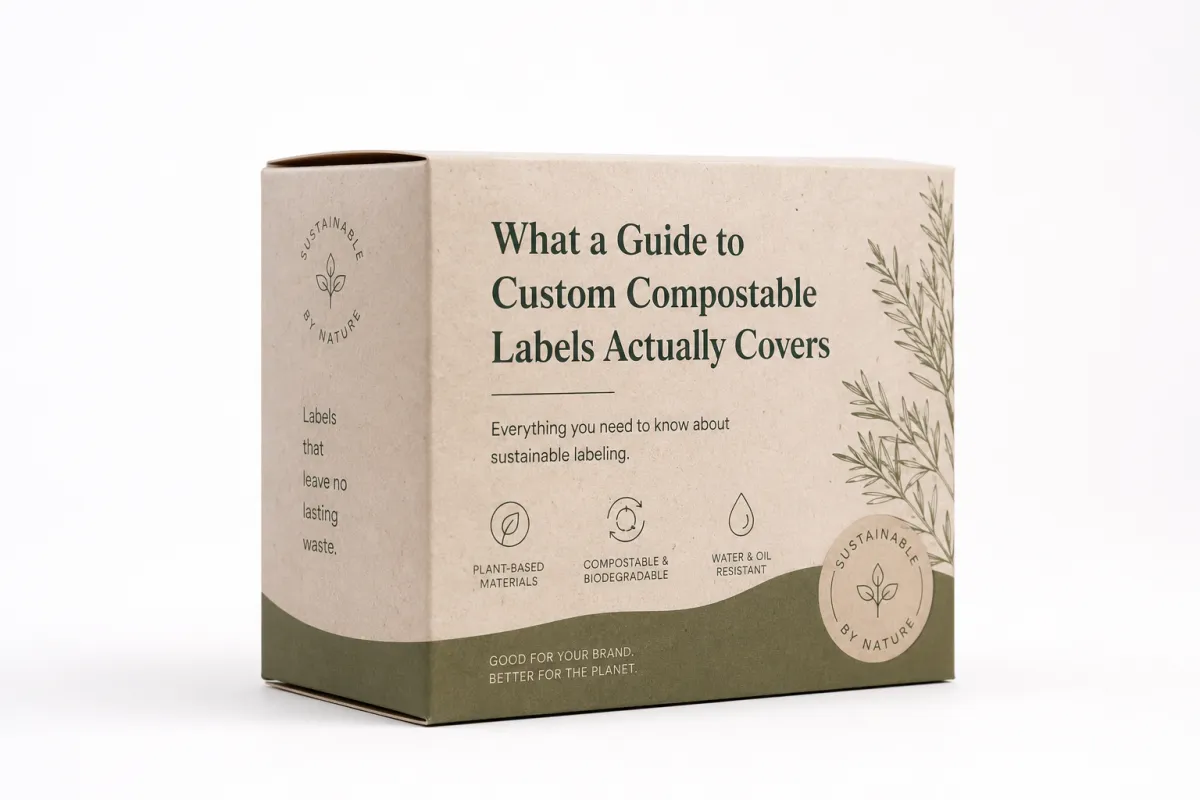
The first thing I tell clients is this: paper does not automatically mean compostable. I remember a meeting in Chicago where a brand manager brought a kraft sample and called it "basically compostable already." The lab report said otherwise. The face stock was acceptable, the adhesive and liner were not. A reliable guide to custom compostable labels has to describe the full construction, because the claim is only as strong as the weakest component, and I have seen weak points become expensive headlines. In one case, a single overlooked liner spec on a 100 mm x 150 mm pouch label created more back-and-forth than the entire carton redesign.
In plain language, custom compostable labels are built to break down in a specific composting route, most often industrial and sometimes home, depending on the material profile and the certification boundaries. Recyclable labels sit in a different system entirely, and standard paper labels can still be conventional beneath the surface. I have seen teams mix these categories in RFQs, then spend 2 full weeks revising artwork and legal language after suppliers flag non-compliance risk. The annoying part is that the confusion is predictable. The hopeful part is that it is fixable if the brief is written like a technical document instead of a marketing note scribbled between a 4 p.m. meeting and a train platform.
The practical side of a guide to custom compostable labels is where usage context changes everything. I see these labels across 250 ml jars, 500 g produce packs, compostable pouches, takeout cartons, and mailers. A cold-pressed juice producer may need a 50 mm x 80 mm label that holds up in condensation for 72 hours at 4 C, while a snack brand may need a compact design that stays stable on a textured pouch without edge lift after 1,000 handling cycles. The materials may be similar, yet each line has distinct failure points. That is why I always push for actual packaging samples, not just spec sheets and optimism. A 350gsm C1S artboard carton might tell you how the shelf looks, but it will not tell you how the label behaves when the line runs at 60 units a minute.
That promise sounds clean on a slide deck: help branding, pass the line, and support the disposal route the pack states. In execution, the bar is higher. If the pack is sold into industrial composting, the label stack has to cooperate with that process. If the route is landfill, the package language should not pretend the label solves that by itself. Consumers are quick to notice that mismatch, and trust has a long memory. I would argue trust behaves a lot like adhesive cure time - ignore it, and the failure shows up later, usually in public and usually with a photo attached.
How a Guide to Custom Compostable Labels Works in Production
A production-grade guide to custom compostable labels starts with four moving parts: face stock, adhesive, topcoat or varnish, and liner. The face stock is visible, yes, but the adhesive is what keeps the label where it belongs. The topcoat changes print depth and moisture resistance. The liner quietly governs whether the sheet can release cleanly at speed. One weak layer can carry a label out of production and into the legal review queue. I have watched that happen more than once, and it always starts with somebody saying, "We can probably get away with it." Probably is a dangerous word in packaging, especially when the order is 25,000 pieces and the art is already approved.
Industrial composting and home composting are not interchangeable environments. Industrial systems control heat, moisture, and aeration; home composting does not offer the same envelope. A label that passes an industrial protocol can still behave like an inert sticker in a home compost bin behind a terrace house in Bristol or a backyard in Oregon. Any guide to custom compostable labels I prepare treats the disposal route as the core operating parameter, because the path changes materials and claims in one move. If the end-of-life story is fuzzy, the packaging story is fuzzy too, and fuzzy claims are where brands get cornered by both customers and compliance teams.
Printing and finishing are never cosmetic-only decisions. Water-based inks, compostable coatings, die-cut geometry, and ink coverage influence both shelf perception and post-use behavior. A heavy finish can improve depth and color consistency, and I have seen premium jars benefit from that look, but too much coating can slow breakdown and complicate certification language. Soft-touch laminates can be beautiful, yet that visual effect may also narrow the margin and raise the rejection rate. That is why a guide to custom compostable labels has to tie design to production reality, not to a mood board. Mood boards are useful for direction; press checks in Dongguan are useful for truth.
On press, the label must track, register, and peel correctly. A sample can look perfect under fluorescent light and still fail at line speed. During one Shenzhen conversion project, a label that read beautifully in the office started lifting at the edge once the applicator ran at 85 labels a minute. The conversion crew was not debating sustainability theory; they needed stable die control, clean release, and no roller gum-up. That detail is where many otherwise polished sustainability efforts fall apart. I still remember the operator in that plant outside Guangzhou looking at the roll and saying nothing, which in factory language means the problem is already expensive.
Materials, Adhesives, and the Factors That Decide Performance
Material choice is where the guide to custom compostable labels stops sounding theoretical. Paper-based stocks are common, but they behave like different materials depending on porosity, coating level, and fiber profile. Some support short-distance retail use beautifully, while others are better for rigid formats with tighter print demands. Cellulose films can give curved surfaces a cleaner drape, and PLA-style alternatives can work in some industrial workflows, but neither is a universal cure. Container shape, handling speed, and storage profile often overpower brochure promises. I wish that were not true, but reality keeps refusing to be tidy, especially when a pallet sits for 36 hours in a warehouse at 28 C.
Adhesive choice is the variable most teams underestimate. A label designed for humidity, chilling, oil migration, or condensation can fail if the bond line is wrong. I was in a yogurt line near Lyon where the first-week look was flawless, then curl developed after 6 hours at 4 C. The design stayed unchanged; the adhesive did not. A strong guide to custom compostable labels collects temperature windows, wet grab strength, and dwell-time expectations before artwork moves past concept stage. That one step can save a lot of very expensive embarrassment. For some projects, the right adhesive is the difference between a clean launch and a return freight bill of $3,800.
The paperwork layer matters just as much as the chemistry. Certifications make the difference between an assumption and an auditable claim. For paper inputs, I still ask if the stock is FSC certified when the client's sustainability framework requires traceability. For distribution resilience, ISTA-style methods stay useful because a calm lab pass does not equal pallet-ready behavior. A practical guide to custom compostable labels treats these documents as required spec data, not optional attachments. If the paperwork is scattered across email threads, the project is already more fragile than it looks, and the missing document often turns up only after the first shipment arrives in Texas or Kent.
Fit can decide the result before chemistry does. A rough jar, a kraft mailer, and a matte pouch each pull a label in a different way. A small circular container may tolerate one radius and reject another. A 32 mm label that behaves on one product orientation can rotate and lift on another. MOQs can then force hard choices, so teams sometimes drop five SKUs to two to preserve setup efficiency and avoid cost spikes. An honest guide to custom compostable labels should capture texture, application method, and order pattern in the first draft, not after quotes arrive. The earlier the weirdness is named, the cheaper it is to manage, and the easier it is to keep unit cost near $0.15 for 5,000 pieces instead of drifting toward $0.24.
| Option | Typical Use | Strength | Trade-Off | Ballpark Cost Driver |
|---|---|---|---|---|
| Paper-based compostable label | Dry goods, jars, cartons | Strong print surface, familiar look | Can struggle with moisture unless adhesive is matched carefully | Lower to mid-range for a guide to custom compostable labels project, often around $0.10 to $0.16 per unit at 5,000 pieces |
| Cellulose film label | Pouches, curved containers | Flexible, cleaner wrap on irregular surfaces | Usually costs more and requires tighter sourcing control | Mid-range to higher, especially on smaller runs from 1,000 to 3,000 pieces |
| PLA-style compostable film | Industrial compost systems | Good clarity and premium appearance | Needs careful claim management and disposal alignment | Higher due to specialty material supply and certification review |
Custom Compostable Labels Process and Timeline
A practical guide to custom compostable labels follows a sequence: brief, material screen, artwork review, proofing, sample build, testing, sign-off, then full production. The fastest outcomes happen when container size, storage conditions, and claim language are already locked early. The slowest ones happen when marketing, product, and quality keep arguing over wording: "compostable," "industrially compostable," or "certified compostable." Ownership ambiguity can quietly add a week. Sometimes more, if everyone decides the label brief is suddenly the place to settle an unrelated brand debate between a Monday morning coffee and a 2 p.m. deadline.
Most timeline surprises come from tooling and compliance. A new die often adds 3 to 7 business days. Custom adhesive trials can push the clock by another week. ASTM D6400 and ASTM D6868 references can trigger extra documentation cycles. In a clear guide to custom compostable labels, a simple repeat run often lands in 7 to 10 business days after approved proof, while first-time launches tend toward 12 to 15 business days from proof approval, especially when they include on-product trials. I usually tell clients to plan for the longer end and celebrate if the job lands earlier, because the reverse is a terrible habit.
A supplier story I still remember involved a beverage launch deadline tied to a trade show in Singapore and a chiller test that had not been finalized. I told the team the label would be the easiest piece only once bottle dimensions and storage were stable. They did not take it seriously until the sample curled on the second run. Then every stakeholder understood why a guide to custom compostable labels starts with alignment, not enthusiasm. Marketing, procurement, manufacturing, and the converter should not each rewrite the brief halfway through approval. That is not collaboration; that is how a straightforward project acquires a migraine and a second round of freight charges.
To reduce delays, lock finish and die details early and test on final packaging under real conditions. Same refrigerant cycle, same carton stack order, same application direction, same transport vibration profile. I strongly recommend a controlled pilot in the 500 to 2,000-unit range before committing to full release volume. That small run usually pays for itself the first time it prevents a 15,000-piece reprint or a late-stage recall. I would rather spend a little more on a pilot than explain to a room full of angry people why a "minor" label issue turned into a warehouse problem in Oakland or Manchester.
Custom Compostable Labels Cost and Pricing Drivers
Many buyers ask why the guide to custom compostable labels spends so much time on cost. Sustainability only becomes real when it survives budgets, and budgets only respond to execution. A compostable label often costs more than a conventional label because materials are narrower-sourced and performance requirements are stricter. If a standard pressure-sensitive label sits near $0.06 to $0.09 in volume, a compostable alternative can move into $0.12 to $0.22 depending on material, finish, and run profile. I have quoted $0.15 per unit for 5,000 pieces on a straightforward paper-based construction, and I have also seen specialty film push the same size to $0.27. The spread is real, not theoretical. I have seen that exact spread shock a procurement team that thought "eco" should somehow also mean cheaper.
Material choice usually drives the biggest swing, often by 20% to 40%. Print method can move margins too, especially for short mixed-SKU runs where setup costs are harder to amortize. Finish decisions - matte, spot color, coatings - also move price quickly. Roll configuration, core size, labels per roll, and matrix waste all add pressure. Color count still matters: a four-color process job rarely lands at the same price point as a single-color design in a guide to custom compostable labels world. The math is stubborn, and it should be. A 10,000-piece run in Shenzhen with one PMS color is a very different quote from a 1,200-piece, six-SKU job in California.
Low sticker price can be a trap if the execution fails. A peeled label in transit, rework at the filling line, or weak claim language can erase any upfront savings through returns, labor, and reputation cost. I have sat in meetings where a team saved $600 in an initial quote and absorbed $8,000 in label failure fallout. That arithmetic repeats because the first line item is not the total package cost. The guide to custom compostable labels should always compare unit price against lifecycle cost. I repeat that point until people roll their eyes, then thank me later when the pilot saves them from a costly mess.
There are practical ways to control spend without gutting the concept. Keep finishes minimal unless they change shelf behavior. Consolidate SKUs and simplify sizes where brands can still keep distinct variants. Increase run volumes once performance is proven. Use one label family across related products if container geometry permits. Those moves can reduce spend materially while keeping the core sustainability message intact. A useful guide to custom compostable labels and the budget sheet should be reviewed together. Separately, they can sound reasonable. Together, they tell you whether the project is actually survivable.
| Cost Factor | What It Changes | Typical Impact | Cost Control Move |
|---|---|---|---|
| Material grade | Print feel, compostability path, moisture resistance | Often the largest swing in a guide to custom compostable labels quote, especially when switching from paper to cellulose film | Choose the simplest certified stock that fits the container |
| Run length | Setup amortization and waste percentage | Short runs carry a heavier per-unit premium | Combine orders or increase quantity if demand is stable |
| Finish complexity | Appearance, scuff resistance, and claim alignment | Spot varnish or specialty coatings can add 10% to 25% | Skip nonessential effects unless shelf impact depends on them |
| SKU count | Artwork management, changeovers, inventory | More SKUs usually mean more cost and more risk | Standardize label sizes where the packaging design allows it |
Common Mistakes to Avoid with Compostable Labels
The most damaging confusion starts with terminology. Compostable, biodegradable, and recyclable are often used as if they mean the same thing, but they do not. A guide to custom compostable labels should draw a hard line: recyclable is a recovery pathway, biodegradable is a biological behavior, and compostable is a defined claims framework. A vague front-panel copy line can weaken both consumer trust and legal defensibility. I have seen a team spend 3 days debating whether a phrase sounded "friendly" enough, only to learn later that it also sounded technically wrong. Friendly and wrong is not a winning combination.
A second recurring issue is tunnel vision on the printable face. Teams obsess over color and typography, then leave the liner and adhesive in silence. A compostable-looking face on a non-compostable adhesive still breaks the construction and the claim. Coatings and laminates can make a pack feel premium, but they can also sabotage the disposal route if they are not matched to the compost path. A disciplined guide to custom compostable labels keeps every layer visible. I usually say the invisible layers deserve more respect than the ones everyone photographs. On a 250 ml jar with a 35 mm neck, that invisible choice is often the difference between a neat shelf line and a curl at the corner.
Testing under unrealistic conditions is a third failure pattern. Samples conditioned in a dry room say little about a label that faces supermarket condensation, shopper handling, and humid distribution. A frozen entree carton that looked stable in a conference room failed for one client after only 48 hours in a real warehouse. Field testing with actual containers would have caught it earlier and cheaper. In an effective guide to custom compostable labels, that is not optional; it is the core check. Lab results are useful. Warehouse results are honest, especially when the pallet is sitting in Auckland or Atlanta in midsummer.
Paperwork gaps are often the last thing caught, and they are often the most expensive. If a supplier cannot provide a testing standard, certification references, or a clear material declaration, the project is already carrying a compliance debt. The strongest teams keep one folder that ties spec sheets, adhesive data, application notes, and disposal instructions into one source of truth. That habit keeps a label from becoming an after-launch audit headache. It also saves everyone from playing detective with six versions of the same PDF, which I would not wish on anyone. I have seen a missing test report stall a 30,000-piece shipment for 4 business days at a port in Hamburg.
Expert Tips and Next Steps for a Smarter Rollout
The fastest route to a meaningful result starts small: one SKU, one pilot run, one real-use validation. I keep seeing teams launch eight SKUs because the board deck looks complete, while they never tested the wettest package in the line-up. The real test should begin with the hardest container, then expand only when that one is stable. If the worst-case format survives, the easier ones usually behave with far less drama. A 1,500-unit pilot is a lot cheaper than learning on 50,000 units that the applicator prefers a different release speed.
Before chasing quotes, build a supplier checklist that includes certification level, temperature range, moisture tolerance, application method, minimum order quantity, roll-core details, and exact disposal language. Add the container specification precisely - 240 ml glass jar versus 750 ml pouch changes every recommendation. A smart guide to custom compostable labels also asks for sample lead time and changeover time, because launch timing depends on those variables as much as printing price. I have learned the hard way that a cheap quote with a 21-day sample schedule is not cheap at all; it is just sneaky.
Match label construction to disposal behavior before a marketing phrase locks the story. If customers mostly access industrial composting, write that clearly and keep instructions specific. If the reality is mostly home composting, the technical tolerance is tighter and the wording must reflect it. If landfill is the likely destination, the label should not imply a composting outcome. Honest labeling rarely hurts conversion; overpromising does. People can forgive a plain answer. They do not forgive being sold a story that collapses when they look for the bin. I have seen a retailer in Paris lose more goodwill over one misleading line than over a 2% price increase.
I usually finish by repeating the same sequence: gather specs, request samples, test on final packaging, review the quote, then scale. It sounds methodical because it is methodical. The upside is measurable: cleaner carbon claims, steadier line performance, fewer reworks, tighter budget control. A supplier once told me, "Can the label do all this and cost less than what we used before?" That is the right pressure point. A good guide to custom compostable labels helps teams identify where a compromise is acceptable and where it creates real risk. That, more than the buzzwords, is what keeps a project from drifting into expensive wishful thinking.
FAQ
What makes custom compostable labels actually compostable?
Every layer in the label stack must match the same end-of-life path, from face stock to adhesive, liner, ink, and coatings. The guide to custom compostable labels should ask which standard applies before artwork locks in, because industrial and home composting are not equivalent systems. Ask for certification evidence early, and do not approve the final art until the disposal claim is technically defensible. I would trust a test sheet long before I trust a vague promise from a sales deck, especially if the batch is being made in Dongguan or exported through Felixstowe.
How long do custom compostable labels usually take to produce?
Repeat production can move quickly, but first-use launches require extra time for sampling, testing, and approval. A repeat project often lands in 7 to 10 business days after proof approval, while a new launch commonly needs 12 to 15 business days from proof approval, sometimes longer if die changes, adhesive testing, or certification review are required. A guide to custom compostable labels works best when the schedule includes these buffers, because fewer surprises usually beat a compressed promise. I have never met a launch team that regretted having more time for testing.
Are custom compostable labels more expensive than standard labels?
In most cases, yes. The material system is narrower and often more specialized, and first-time runs rarely carry the same economies of scale. Costs can improve when finish complexity drops, SKU count is reduced, and order volume rises. I have watched teams lose more to rework than they save on initial unit price. A guide to custom compostable labels should be read from total packaging cost, not just print quote. Cheap on paper is not the same thing as cheap in reality, especially when the project starts at $0.15 per unit for 5,000 pieces and ends with a rushed reprint.
Can custom compostable labels handle cold, wet, or oily packaging?
They can, but only when adhesive, stock, and finish are selected for those exact conditions. A label that behaves on a dry carton can fail on chilled glass or an oily pouch. Testing on the real container in the actual use environment is the practical step, not just a validation checkbox. Ask for humidity, temperature, and adhesion tolerance guidance before committing to production, and run the guide to custom compostable labels as a live validation plan. If anyone tells you "it should be fine," ask them to stand next to the filler line when it is not.
How do I choose between industrial and home compostable labels?
Start from the disposal route your customers can actually access. Industrial compostable options are more common in commercial distribution systems and easier to source at scale. Home compostable claims require tighter material control and clearer customer-facing guidance. Keep the instructions direct so customers know what to do after use, and let the guide to custom compostable labels function as a practical project brief rather than a sustainability label of aspiration. Good intent is nice. Accurate intent is better, and it is easier to defend when the product ships from a plant in Shenzhen or Northern Italy.
The practical takeaway is simple: before you approve artwork, request the full label stack spec, confirm the disposal route, and test the final label on the actual package in the actual environment. If one piece of that chain is vague, the project is already kinda risky, and the cheapest fix is always the one found before production starts.

