Buyer Fit Snapshot
| Best fit | To Thermal Insulating Poly Mailers projects where brand print, material claims, artwork control, MOQ, and repeat-order consistency need to be specified before quoting. |
|---|---|
| Quote inputs | Share finished size, material target, print colors, finish, packing count, annual reorder estimate, ship-to region, and any compliance wording. |
| Proofing check | Approve dieline scale, logo placement, barcode or warning zones, color tolerance, closure strength, and carton packing before bulk production. |
| Main risk | Vague material claims, crowded artwork, missing packing details, or unclear freight terms can make a low unit price expensive after revisions. |
Fast answer: To Thermal Insulating Poly Mailers: Material, Print, Proofing, and Reorder Risk should be specified like a repeatable production item. The safest quote records material, print method, finish, artwork proof, packing count, and reorder notes in one written spec.
Production checks before approval
Compare the actual filled-product size with the drawing, then confirm tolerance on folds, seals, hang holes, label areas, and retail display edges. Reserve space for logos, QR codes, warning copy, and material claims before decorative graphics fill the panel.
Quote comparison points
Review material grade, print process, finish, sampling route, tooling charges, carton quantity, and freight assumptions side by side. A quote is only useful when the supplier can repeat the same color, closure quality, and packing count on the next order.
A carton can leave the packing bench in perfect condition, spend hours in a truck that feels like a kiln, and still land at the customer with a softened balm or a sample vial that loses its punch. I have seen this happen during one March launch, and the team thought the product was the problem before they looked at packaging. That is the real reason buyers ask for a guide to thermal insulating poly mailers: to keep products stable during the messy middle leg of shipping, not to create a medical-grade cold chain out of thin plastic.
At Custom Logo Things, we treat this as both a packaging and execution decision. A guide to thermal insulating poly mailers should help teams balance product safety, throughput, freight weight, and brand image without pretending one material solves every temperature issue. The strong option slows heat transfer enough to buy breathing room. The weak one adds cost, bulk, and a false sense of safety that usually shows up as a return label at the dock.
For teams building broader packaging systems, it helps to compare thermal options against Custom Packaging Products and purpose-fit Custom Poly Mailers. In practice, the smartest choice is rarely the thickest. It is the one that matches the product, shipping lane, and the level of risk your operations can actually absorb. That sounds basic. It is also what keeps this process from becoming a guessing game.
This distinction matters because insulated mailers are often judged by surface appearance. Two listings can look nearly identical and still behave differently when you add sealing pressure, pallet compression, or an extra day on a loading dock. A useful guide to thermal insulating poly mailers has to include the ugly middle of fulfillment: carton staging, line speed, lane temperature swings, and dwell times before pickup. Skip those details, and you optimize the wrong part of the system.
What the Guide to Thermal Insulating Poly Mailers Covers
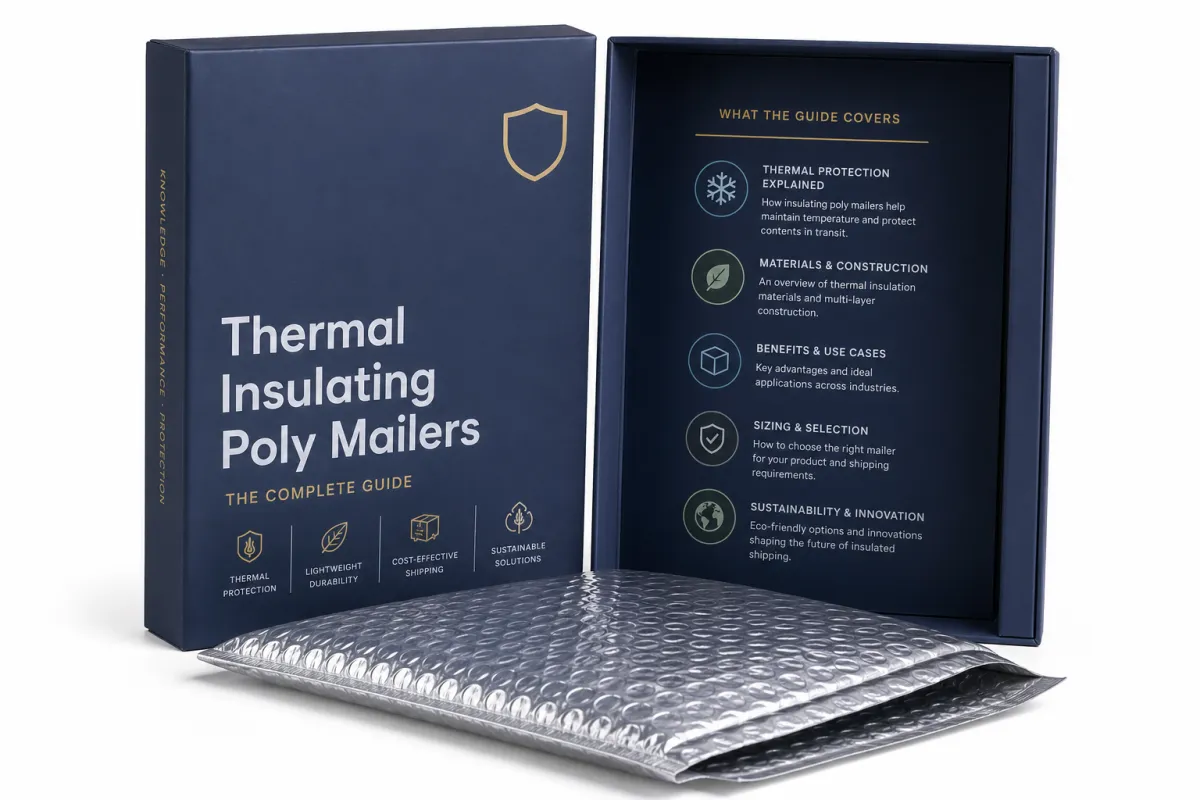
A practical guide to thermal insulating poly mailers starts with a familiar scene. A cosmetic serum, protein gel packet, or adhesive sample leaves looking fine, then spends hours in mixed conditions and arrives quietly changed. The item may still look undamaged. The impact is usually hidden: texture drift, shortened shelf life, weakened actives, a “not fresh-feeling” complaint from the end user.
Thermal insulating poly mailers sit between a normal poly mailer and a full thermal shipper. That sounds obvious, but it is the first technical boundary people miss. These mailers are flexible structures that slow heat gain or heat loss compared with standard packaging. They are not the same as bubble mailers, which are primarily cushioning. They are not cold-shipment boxes with gel packs either. A guide to thermal insulating poly mailers must draw that line early because confusion here gets expensive in a hurry.
In operation, they usually fit the “buffering” use case: goods that can handle a modest excursion but not prolonged exposure. Cosmetics, supplements, food-adjacent goods, diagnostic kits, temperature-sensitive adhesives, and small retail accessories are common candidates. You do not need a full cryogenic strategy for every use case. You need the right level of thermal delay for the route and tolerance window.
One practical upside is often overlooked: fit consistency. A custom-sized thermal mailer can make packing operations more repeatable. My team noticed this while testing a high-volume supplement run; when pack size matched product size tightly, seal errors dropped and so did complaint rates. A guide to thermal insulating poly mailers is therefore about the whole shipping system, not just material marketing.
Bottom line: when a product tolerates short excursions but not long ones, Insulated Poly Mailers can be a smart middle layer. If your item needs tighter control for longer transit windows, the mailer is part of a chain that also needs active thermal elements, lane-level controls, and sometimes reefer support.
How do thermal insulating poly mailers work?
The physical construction matters far more than the copy on a supplier page. A well-documented guide to thermal insulating poly mailers usually breaks it into outer film, insulation layer, optional reflective barrier, and a closure system. Each layer has a purpose, and each purpose can fail if assembled poorly.
The outer film protects against abrasion and moisture, but it is not the thermal hero. The insulation layer slows conductive heat transfer through the wall. Reflective surfaces reduce radiant heat, especially on parcels parked in sun-exposed environments. The closure and seal zone protects against convective exchange, because no thermal strategy survives a leaky air path for very long.
Heat transfer works through three mechanisms: conduction, convection, and radiation. Conduction happens across touching materials. Convection happens with moving air around the package. Radiation comes from nearby hot surfaces, sun load, and heated cargo environments. A guide to thermal insulating poly mailers is useful when it explains that insulation is about reducing all three, not just being “thicker.”
Material behavior is where real differences show up. Foam liners usually provide stronger buffering than you expect for short windows, especially with closed-cell profiles between 2 mm and 4 mm. Bubble structures offer trapped air layers at lower weight, but once a mailer is compressed and jostled, that air layer becomes less effective as a thermal path still opens and closes under load. Metallized films reflect radiant heat well, while layered laminates combine effects at the cost of stiffness and material complexity.
There is also a very important measurement reality: performance in a conditioned lab is not equal to performance in transit. I have seen packages pass a static 60-minute heat hold in controlled conditions and then fail after a two-hour waiting period under a sunny loading dock canopy. That is why an evidence-driven guide to thermal insulating poly mailers compares against actual route exposure and not just controlled room tests.
Packaging mechanics matter. If the product shifts inside the mailer, internal air channels can open and close in unpredictable ways and the thermal model collapses. A snug pack-out behaves more like a compact thermal zone. The gap between theory and reality can be measured in millimeters, and eventually paid for in fulfillment claims.
What the layers are doing
Think of the mailer as a small system, not a single “smart” sheet. A guide to thermal insulating poly mailers becomes more valuable when it maps each layer to a failure mode, the way a packaging engineer would in a test report.
- Outer film: resists scuffs, light moisture, and routine handling contact.
- Insulation layer: reduces heat flow rate into or out of the package.
- Reflective layer: reduces radiant heat input from sunlight or hot equipment surfaces.
- Seal area: minimizes air leakage and convection at the weak point of most failed assemblies.
Fit is the part most buyers underestimate. Oversized mailers create larger internal voids, and that extra space can become a thermal shortcut once shipment movement starts. A closer fit generally lowers internal air volume and improves sealing consistency. That is why a guide to thermal insulating poly mailers has to discuss spec dimensions and pack-out protocol, not just material grade.
Real-world route exposure still beats spec-sheet fantasy. A parcel on a porch in direct sun behaves differently than one inside a cooled van. A truck held overnight can exceed ambient by several degrees in sunlit parking lots. Railcars and docks can swing either side depending on weather. For teams running qualification cycles, it helps to use structured standards logic similar to ISTA style distribution testing for vibration, compression, and condition transitions, then layer in thermal measurements based on your actual lanes.
Key Factors That Change Performance and Protection
Not all insulated mailers perform equally, even when descriptions sound close. Guide to thermal insulating poly mailers should separate spec from behavior. Thickness helps but does not overrule other variables. A weak seal, loose fit, or highly sensitive product can erase the advantage of extra material.
Product sensitivity is still the first decision point. Some goods tolerate a short 10 to 15-degree swing. Others fail with even smaller excursions. If the tolerance is strict, this format is usually a helper, not the whole system. A guide to thermal insulating poly mailers has to be direct here: if temperature control is mission critical for hours, you likely need active cooling elements, phase-change packs, or dedicated cold-chain routes.
Moisture is the uninvited guest in thermal design. When external humidity rises or product surface temperature diverges from ambient, condensation can form and degrade performance. Puncture resistance also matters in ways people ignore. A thin liner can be destroyed by a blade nick at packing, or buckle under conveyor pressure before your team ever opens a complaint queue. Closure performance is one of those boring details that quietly decides whether a shipment survives.
Performance is a system, not a single spec
A good guide to thermal insulating poly mailers should treat performance as a stack of interacting decisions. No single metric predicts outcomes reliably:
- Insulation thickness: helps, but more material can hurt run-rate if it slows handling too much.
- Closure design: pressure-sensitive glue strips, peel seals, and tamper-evident styles behave very differently under heat and compression.
- Product fit: a tight package usually stabilizes thermal behavior and reduces internal convection.
- Humidity: some formulas and materials react to damp conditions even when temperature looks “okay.”
- Handling abuse: conveyor edges, stack loading, and corner compression create real losses before parcel handoff.
Sustainability should be assessed as a total system cost, not just material savings. A lighter mailer can reduce polymer load and lower immediate freight cost, but if it drives up returns, the environmental gain is not real. A guide to thermal insulating poly mailers should include rejection rate, replacement frequency, and product spoilage in the same math as grams of material.
For lifecycle perspective, many teams compare supplier guidance with external frameworks. ASTM-style distribution conditioning logic and lab humidity profiles can help, but the proof point is still your route data. For end-of-life context, EPA’s baseline guidance at EPA recycling guidance remains useful for framing material choices and customer communication. Laminates are often more complex than they look; that matters when buyers and customers ask about recycling claims.
Positioning-wise, thermal insulating poly mailers are often a middle-tier move. Plain poly is cheaper but offers little thermal buffering. Rigid coolers offer stronger thermal retention but increase weight, complexity, and Packaging Carbon Footprint. The insulated option exists in between: enough thermal resistance for certain windows without full cold-chain complexity. For many brands, that balance is the right entry point.
Guide to Thermal Insulating Poly Mailers Cost and Pricing
Cost discussions go wrong when teams stop at unit price. The total decision is unit price plus indirect loss, labor, transit failures, and returns. A lower number on a quote sheet can become the priciest route once you add failure cost and customer friction.
The biggest drivers are usually material construction, insulation profile, print level, dimensions, lead time, and minimums. Stock insulated mailers are often faster and cheaper at lower volume. Custom specs typically improve fit, lower internal waste, and reduce mis-pack risk, but can add setup cost and longer lead times. A guide to thermal insulating poly mailers should help teams compare both the quoted unit and the expected operational outcome.
On projects where I coach teams, we split pricing into direct and indirect. Direct is paper-exact: sticker cost and freight. Indirect is where the real margin sits: setup, labor, training, returns, support escalation, and repeat shipments. A guide to thermal insulating poly mailers is incomplete if it ignores that second category.
And this is the math most teams need to see. A brand shipping 12,000 sensitive units per quarter at a 3% damage rate spends the equivalent of 360 failures. If a stronger spec drops that to 1%, you avoid 240 incidents. The numbers can erase a per-unit difference quickly, especially with higher shipping costs and handling overhead. This is not abstract theory; it is operational arithmetic.
| Option | Typical Unit Range | Best For | Main Tradeoff |
|---|---|---|---|
| Stock insulated poly mailer | $0.18-$0.32 | Fast launches, lower volumes, simple pack-outs | Less precise fit, more internal air space |
| Custom printed insulated poly mailer | $0.24-$0.45 | Brand-forward shipments with better sizing | Higher setup cost, longer lead time |
| Foam-lined thermal mailer | $0.22-$0.40 | Short transit windows and moderate sensitivity | Can add bulk and may be less flexible |
| Bubble-style insulated mailer | $0.12-$0.26 | Light cushioning plus limited temperature buffering | Usually weaker thermal performance |
These ranges are planning estimates for moderate production volumes around 5,000 units and are not quotes. Real pricing can swing with paper weight, print coverage, material grade, coating chemistry, freight zone, and production scheduling. A guide to thermal insulating poly mailers should frame this clearly so teams do not chase an unrealistic target.
Ask for structured quotes: sample pricing, prototype testing costs, freight, and setup fees. If a supplier cannot clarify whether pricing assumes stock dimensions, custom inserts, or custom closures, the analysis is not complete. In custom branding programs, that gap shows up later as a rework expense.
Labor time should be treated as a real cost. Ten extra seconds per mailer for awkward opening or stubborn seals compounds fast at scale. At 20,000 units, that is over 55 hours of labor. A guide to thermal insulating poly mailers should include line-speed impact, because shipping costs are never just one line item on an invoice.
Step-by-Step Process and Timeline for Choosing the Right Mailer
A procurement team should treat selection like a controlled qualification, not a style vote. Start with a product profile: final packed dimensions, heat tolerance window, shelf-life sensitivity, fragility, and co-shipment items. If you select a mailer before you lock this profile, you are optimizing for guesswork.
The route profile comes next. A local two-stop lane in mild weather is a totally different animal than a long-haul route with overnight storage, dock dwell, and sun exposure. Warehouse dwell time, carrier transit profile, final-mile timing, and seasonality all affect the target spec. A guide to thermal insulating poly mailers should include a lane map before locking material choice.
Then test with live pack-outs. Unused sample pouches tell you almost nothing. You need to validate fit, closure behavior, seal consistency, and whether the product shifts during transit. For borderline SKUs, test multiple sizes, insert combinations, and shipping routes. This prevents the “works in the box” problem and forces evidence before commitment.
Seasonality planning is where many teams either win or fail. A spec that passes in spring can collapse in July and fail again in a cold snap. If tolerance is tight, test thermal stress in both high and low realistic scenarios before volume escalates. This does not require waiting for catastrophe; it requires planning the most likely stress points into pilot cycles.
A simple validation timeline
- Days 1-3: define product profile, lane profile, temperature risk, and packaging goals.
- Days 4-10: request samples, review laminate stack-up, closure options, and print requirements.
- Week 2: run packing-line simulations under real conditions, tracking fit, seal quality, and line throughput.
- Week 3: execute pilot shipments, compare arrival condition by lane, and capture failure modes.
- After pilot: finalize artwork, confirm reorder quantities, and lock the approved specification package.
That schedule is a framework, not a prison. Stock variants can move in days if approvals are quick. Custom specs usually need more time for artwork, tooling review, and fit tuning. Rushing the process usually just front-loads expensive corrections.
Documentation is the difference between one-off learning and repeatable execution. Keep a baseline file with product spec, pack-out steps, ambient assumptions, acceptable transit time and temperature range, and any known limitations. Teams with shift changes or seasonal volume spikes rely on this more than they know.
For logo-forward brands, the launch playbook should include a locked spec set, approved artwork files, explicit lead times, reorder points, and a one-page packer instruction sheet. It may sound administrative, but it prevents variation in the warehouse that kills performance consistency.
Common Mistakes to Avoid With Thermal Insulating Poly Mailers
Probably the most common mistake is the “one mailer fits all” assumption. Buffered shipping and refrigeration are different strategies. A guide to thermal insulating poly mailers should state this bluntly: if the SKU needs strict thermal stability, insulated mailers alone are unlikely to be enough.
Oversizing is the second recurring trap. Too much internal slack creates unstable airflow and inconsistent thermal behavior. It also feels cheap in hand for branded shipments and slows the operator because edges are harder to close consistently. A closer fit often improves protection and speed at the same time.
Weak edges and rushed closures create hidden leak points. A corner lift-off, poor sealing pressure, or mechanical pinch can all lower performance quickly. In one fulfillment test I reviewed, a team blamed material choice for repeat failures, but the issue was one worker angle on a heat-seal jaw. Tiny execution issues become major defects when volume is high.
Moisture deserves equal attention. If a colder item enters a warm route, condensation can form in the wall-to-air interface and stress labels, closures, and even product integrity. For hygroscopic materials, this can become a quality issue as serious as temperature drift. That is why you need to treat humidity and temperature together, not as separate checkboxes.
Price-driven decisions without return modeling are a silent killer. A guide to thermal insulating poly mailers focused only on unit cost misses total lifecycle cost. A small increase in damage rate often erodes margin faster than expected. I would rather spend more up front than run a month-long replacement cycle I can’t control.
Data-driven teams compare against actual service conditions, not generic claims. A route to a cooler region in winter is not a substitute for a summer coastal route. Record ambient temperature, pack-out temperature, and arrival condition for each pilot. Only then does the guide to thermal insulating poly mailers become a decision tool instead of a brochure.
Expert Tips and Next Steps for Thermal Insulating Poly Mailers
If you want a practical starting point, run a small matrix: two or three product variants against two or three lanes. Compare thermal behavior, seal integrity, and packing speed side by side. One successful sample is a signal, but a dozen across lanes gives evidence.
Push suppliers for practical data, not promotional summaries. Ask for sample lead times, minimum order quantities, recommended pack-out gaps, and operating constraints linked to closure and thickness. If they cannot explain when the mailer is a buffer and when it acts as control, that uncertainty is part of your supplier scorecard.
Use pilot records as institutional memory. I recommend logging: SKU, ambient condition, carrier lane, dwell duration, packaging method, measured defect, and final customer response. A guide to thermal insulating poly mailers becomes far more reliable when mistakes are categorized, not forgotten.
After a spec passes, document a standard operating process. Include storage location, mailer handling, recommended fit threshold, and what a bad pack-out looks like at the bench. Mailers kept near heat can shift seal behavior; one line change can alter adhesive reliability. Procedure reduces variance, especially when order volume jumps.
From there, the practical sequence is simple: audit historical shipments, shortlist 2–3 specifications, test prototypes, run pilot logistics, then choose the option that best balances protection, cost, and packing speed. No hype, no silver bullets. A guide to thermal insulating poly mailers is valid only when its recommendation survives the lane it was built for.
If I had to put it in one line, it is this: choose an insulated mailer only when it matches the product tolerance, route reality, and acceptable risk, then verify it with real shipments because nothing replaces field data. Without that, you are basically gonna run blind.
One honest reminder before you commit: no published specification can fully predict your local carrier, seasonal variance, and warehouse behavior. Use the spec as a starting model, then validate, adjust, and revalidate every quarter.
FAQ
What products are best for thermal insulating poly mailers?
They are best for products requiring short-term buffering instead of active temperature control. Cosmetics, supplements, samples, food-adjacent SKUs, and certain adhesives often fit this profile. If an item has a narrow thermal tolerance, a guide to thermal insulating poly mailers should still point teams toward additional protection such as phase-change packs or refrigerated lanes.
How do thermal insulating poly mailers compare to bubble mailers?
Bubble mailers excel at cushioning and light impact protection. Thermal mailers are engineered to slow heat transfer through the structure. If the risk is a dented corner, a bubble mailer may be enough. If heat or cold spikes are the threat, a guide to thermal insulating poly mailers points toward insulated construction with thermal layers and controlled sealing.
How do I choose the right size thermal insulating poly mailer?
Measure after the product is fully packed. That includes inserts, labels, cards, and any secondary wrapping. Include enough tolerance for a clean closure while avoiding dead space. Snugness is usually the key compromise: better thermal consistency plus faster packing without rummaging for extra adjustments. That is why sizing is a core part of any practical guide to thermal insulating poly mailers.
What affects the price of thermal insulating poly mailers most?
Material type, insulation thickness, custom dimensions, print coverage, and volume are the biggest drivers. Freight costs, setup fees, and minimum order requirements can alter total project economics more than unit price. The lowest unit quote is not always the best value if it increases replacement rates, handling time, or claims.
How long does it take to source and launch thermal insulating poly mailers?
Stock insulated mailers can move quickly once samples are approved, sometimes in days for modest quantities. Custom builds usually need more time for design review, fit testing, and production scheduling. Build validation into the launch timeline so your team can confirm thermal and handling performance before committing full volume, and revisit after peak seasons to account for lane changes.