Buyer Fit Snapshot
| Best fit | Blister Packaging Solutions projects where brand print, material claims, artwork control, MOQ, and repeat-order consistency need to be specified before quoting. |
|---|---|
| Quote inputs | Share finished size, material target, print colors, finish, packing count, annual reorder estimate, ship-to region, and any compliance wording. |
| Proofing check | Approve dieline scale, logo placement, barcode or warning zones, color tolerance, closure strength, and carton packing before bulk production. |
| Main risk | Vague material claims, crowded artwork, missing packing details, or unclear freight terms can make a low unit price expensive after revisions. |
Fast answer: Blister Packaging Solutions: Artwork Proof, Packing Count, and Landed Cost should be specified like a repeatable production item. The safest quote records material, print method, finish, artwork proof, packing count, and reorder notes in one written spec.
Production checks before approval
Compare the actual filled-product size with the drawing, then confirm tolerance on folds, seals, hang holes, label areas, and retail display edges. Reserve space for logos, QR codes, warning copy, and material claims before decorative graphics fill the panel.
Quote comparison points
Review material grade, print process, finish, sampling route, tooling charges, carton quantity, and freight assumptions side by side. A quote is only useful when the supplier can repeat the same color, closure quality, and packing count on the next order.
A clear cavity, printed card, and controlled seal line do a lot more than hold a product in place. In many programs, that structure is the practical core of what is blister packaging solutions: a packaging form that protects, displays, and survives real handling from production floor to checkout lane. For teams asking that question, the answer is usually a hybrid between shelf-ready packaging, anti-tamper control, and display behavior. In other words, this is often the shortest path to a package that shows, protects, and sells without asking for a lot of extra support from the shelf or the supply chain.
That helps explain why blister formats keep surfacing in categories that rarely talk to one another. A peg-tool blister for hardware is not the same system as a blister for a healthcare unit dose, yet both teams chase the same outcome: the product stays where the package intends it to be. The cavity locks position, the card keeps the story readable, and the shopper gets a clean first look before buying anything.
One practical memory from my own work: I reviewed two launches in the same week, one for a battery pack line and one for a small cosmetic tool. Both looked almost identical in the early renders. By first shipment, one had high returns from poor opening behavior and the other was still in stock with low damage rates. The difference came from the line items most teams skim: tolerance logic, seal behavior, and shelf handling assumptions for opening force. That is exactly where what is blister packaging solutions stops being a generic label and starts acting like a systems decision.
Language still trips teams up in early planning. “Blister pack,” “clamshell,” and “thermoformed tray” get used as if they are interchangeable, and they are not. Buyers who brief design, compliance, and production from the same vocabulary get faster quotes and fewer re-runs. What is blister packaging solutions can mean carded blisters, foil-sealed units, or specialized thermoformed arrangements, and each variant has different tooling logic and different sealing behavior.
If you compare blister packaging to plain cartons or loose-fill shipping for certain SKUs, the distinction is obvious quickly. Blistering gives visibility without opening friction and reduces internal movement that causes scuffs and impact damage. It also gives merchandising teams a structured face for hierarchy and hierarchy can be managed through panel layout, color blocks, and hierarchy cues. That is why what is blister packaging solutions is often discussed near Custom Printed Boxes even when the engineering problems are not exactly the same.
As a practical framing: when visibility, containment, and shelf behavior all matter at the same time, what is blister packaging solutions tends to be a design decision, not a back-office afterthought. The sections below break down mechanics, cost, timing, and the point where packaging structure starts to shape sales behavior as much as branding.
What Is Blister Packaging Solutions?
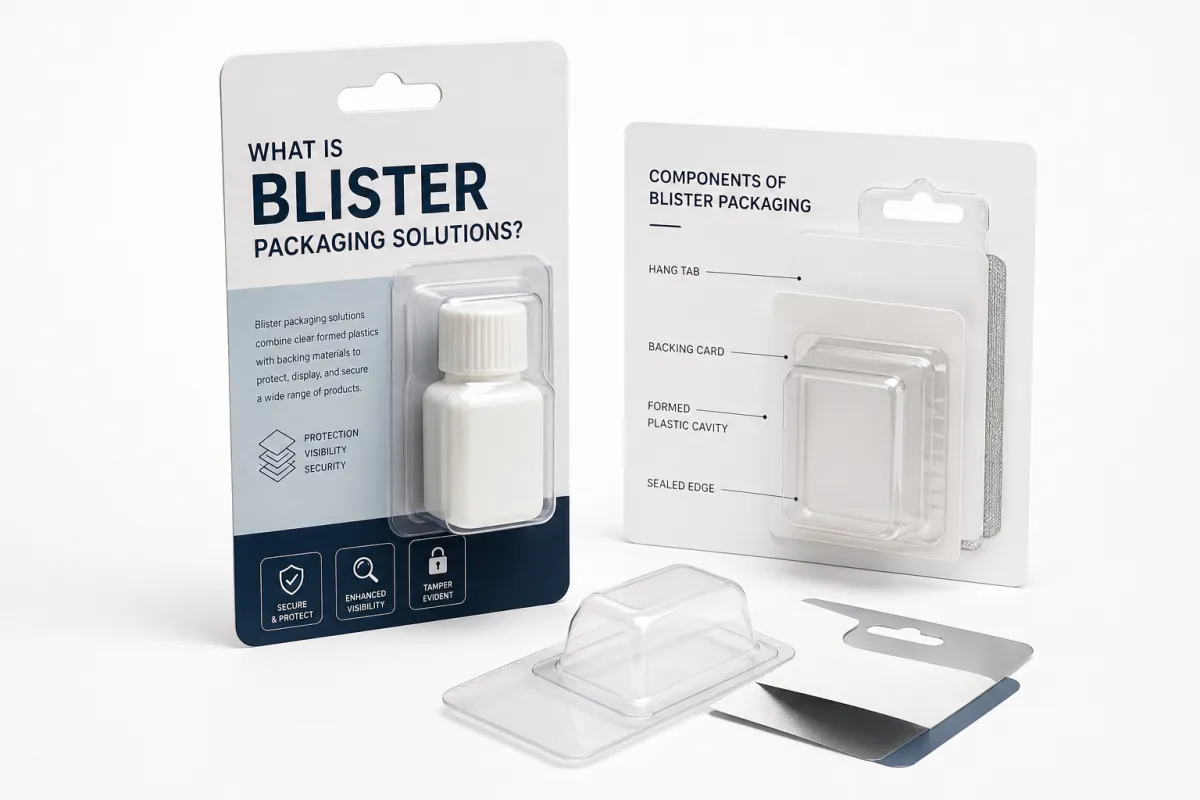
At its core, what is blister packaging solutions describes a formed plastic cavity that captures the product and is attached to a paperboard card, foil, or similar backing structure. The critical principle is that geometry follows the item, not the other way around. That simple order reduces motion during handling and makes warehouse flow, merchandising, and checkout behavior more predictable.
The look can be simple, but the performance is layered. A blister pack often handles several functions simultaneously: stabilizing the product, presenting it clearly, and helping a shopper identify what they are buying without opening it. Categories like small tools, batteries, storage devices, grooming accessories, and OTC-style consumables still reach for this format when immediate visual confirmation matters.
| Format | Typical Use | Strengths | Tradeoffs |
|---|---|---|---|
| Carded blister pack | Retail hang-sell items | Strong shelf visibility, compact footprint, good tamper evidence | Opening can be harder for shoppers if the seal is aggressive |
| Clamshell | Reclosable or fully enclosed display items | More physical enclosure, reusable in some cases | Often uses more plastic and can feel bulky |
| Thermoformed tray | Multi-component kits, inserts, shipping display | Good part separation, useful for organized kits | Usually not the same retail front-end presentation as a blister pack |
That table is not a decoration block. A lot of suppliers still blur the categories because all three look like “plastic around a product” at first glance. But the differences drive cost and execution. A clamshell wraps two hinged shells around the unit, while a thermoformed tray organizes multiple parts but often behaves like a transport-first container. A standard blister uses a pocket plus backing support, and that combination affects tooling, automation compatibility, and how the package reads on shelf.
From the buyer view, the decision is usually a single frame: visibility, containment, and scalable production logic. A blister approach can satisfy those three with fewer compromises than alternatives when volumes are meaningful, not theoretical. It becomes useful in the middle ground between basic carton packaging and heavier rigid systems, especially for merchandising environments that punish uncertainty.
The card backing matters more than many teams give it credit for. It is part of structural communication, not just support. Warnings, instructions, compliance blocks, and brand cues can be designed there while the cavity stays focused on physical logic. When cavity geometry and print layout are coordinated, what is blister packaging solutions feels like a purpose-built retail unit, not just a wrapper around a tiny object.
The real test is not whether blister packs are good in theory; it is whether the product genuinely needs fixed display, moderate protection, and straightforward handling in both transport and retail. If all three are true, the format is usually a defensible first-line option, rather than a default chosen because it is familiar.
How Blister Packaging Solutions Work
The operating model is straightforward but not simple. What is blister packaging solutions typically depends on three parts fitting together: cavity geometry, backing material, and a sealing method that survives shipping while still opening with normal shopper force. If one part drifts, the whole package appears inconsistent and costly.
Tooling normally starts the build sequence. A mold sets cavity width, depth, corner radius, and draft around the product profile. Thermoplastic sheet is heated and formed into a pocket, then trimmed, loaded, and sealed to a card, foil, or chosen substrate. In high-repeat production this baseline repeats, but seal method, loading profile, and quality checks still change by item shape and channel requirements.
Sealing architecture typically lands in three buckets. Heat sealing remains common for carded blisters because it supports stable bonds and high-speed consistency. Pressure-sensitive approaches are used for lower-volume programs or materials that do not tolerate heat well. Controlled medical or regulated environments may require foil or specific lidding systems with higher barrier logic. What is blister packaging solutions for pharmacy-style lines can therefore differ significantly from what works for battery and electrical accessories.
Throughput is decided as much in loading as in forming. Manual loading can work for prototypes, short runs, or fragile goods. Semi-automation improves speed without a full-capital line retool when geometry is stable. Fully automated lines become realistic when forecast confidence is high and dimensional consistency is proven. A five-hundred-unit request usually points to simpler handling, while one hundred thousand units usually forces a deeper process debate. In practice, this is often a logistics question posing as a design discussion.
Consumer interaction is also a behavioral equation. You get more than a clear front; you get faster confidence. People can see the item before opening, which lowers mistaken expectation returns and reduces hesitation where SKUs are clustered tightly. In high-density shelves, that can move the sales needle in ways that are not always obvious in the budget model.
Distribution testing is where showroom assumptions fail. Teams should run drop, vibration, and compression checks under recognized standards to validate cavity and seal behavior under stress. A package that looks good in hero photography can still fail at pallet corners, edge impacts, and parcel transit if seal lines flex or pockets relax under load. You can review the test structure at ISTA, and many programs also layer ASTM-style parcel logic depending on channel.
A blister pack can look fine, but opening friction can sink it at the shelf. Visual confidence buys attention; opening ease keeps trust.
So what is blister packaging solutions is not just a material decision. It is a complete system: design, tooling, loading, and inspection. If all parts stay coherent, the pack stays reliable. If one piece is weak, the issue often appears later at the shelf or dock, when changes are most expensive.
Key Factors That Shape Blister Packaging Solutions
Size and weight drive the first round of design logic. A two-ounce accessory behaves very differently from a heavier, sharp-edged tool in a transport profile. Tight cavities reduce movement and improve impact control, but they also increase stress concentration and may require careful edge handling. Oversized cavities can help fragile items but can bloat material use and look clumsy on shelf. Letting product geometry lead the pack is usually the first sign of engineering discipline.
Material selection is the next lever and also where technical shortcuts cause trouble. PET, PVC, RPET, and related thermoformed plastics each have different forming behavior, clarity, stiffness retention, and compatibility with heat and adhesives. I still see teams default to clarity as if one variable solves everything. Clear film can help display, but not if seal strength, moisture/oxygen requirements, and stiffness are wrong. If your channel includes long shelf life and migration sensitivity, material stack becomes a structured decision, not a visual afterthought.
Cost behavior follows the same logic as performance behavior. More complex tooling, thicker walls, broader print coverage, and rising volume commitments move spend upward. A thicker wall can improve rigidity but slows forming and raises material cost. Full-coverage graphics help shelf communication, while premium finishes improve feel at the expense of cycle time and unit cost. Features like foil stamping, soft-touch surfaces, and high-end cards should be costed as features, not aesthetics.
Channel rules can make a design either straightforward or painful. Retail hanging programs may require specific hang-hole geometry and peg tension behavior. Healthcare channels may require tamper evidence and chain-specific labeling expectations. Scan-and-go and fast-pick environments demand barcode placement and contrast that survives real viewing angles. This is exactly why supplier discovery documents are usually longer than the quote itself.
A disciplined prequote brief protects everyone. Include exact dimensions, tolerance limits, expected drop risk, channel type, and performance priorities before asking for pricing tied to what is blister packaging solutions. If you are still undecided, the Custom Packaging Products page is useful for benchmarking structure differences before lock-in. Better input produces better pricing and fewer late revisions.
There is always a boundary between marketing intent and unit economics. A premium-facing pack can lift perceived value if margin supports it and if channel context makes that spend recoverable. In high-velocity categories, expensive upgrades may hurt economics quickly. In display-led SKUs with stronger margin tolerance, the same upgrades can reduce confusion and increase pickup confidence. The right recommendation for what is blister packaging solutions balances structural logic and financial logic together.
Not every SKU belongs in blister. Loose aggregates, irregular shapes, and very delicate subassemblies often behave better in trays, insert systems, or custom foldable carton systems. The objective is not to force blister, but to match the format to containment, visibility, throughput, and fulfillment speed. That constraint-first test is the real engine of packaging choice.
What Is Blister Packaging Solutions Cost, Pricing, and Timeline?
Cost starts with assumptions, and wrong assumptions are expensive. For straightforward forms, tooling can begin around $500 to $2,500, while multi-cavity or tighter-tolerance structures usually climb above that range. Depth, trim complexity, and dual-side tooling remain the major multipliers that alter quote shape.
Unit economics typically follow scale curves. Lower-volume runs carry higher per-pack rates because setup gets spread across fewer pieces. As quantities increase, unit pricing falls, but planning discipline gets more demanding. A basic carded blister at several thousand units can sit in the $0.18 to $0.45 range depending on size and print scope, while clarity film upgrades, specialty barriers, and manual labor add quickly. Once semi-automated production with stable geometry is active, unit economics usually improve at a much steadier slope.
Timelines are a mix of design and decision-making speed. A simple project can move from approved concept to production quickly when cavity geometry is stable and approvals are clean. Multi-stage sampling, sealing qualification, and compliance signoff can push programs to four to eight weeks, or longer. Delays usually come from late dimension changes, artwork updates after tooling, or failed fit/drop verification. There are no shortcuts for moving before upstream data is stable.
Strong teams request at least three pricing scenarios rather than one number. They isolate tooling and per-unit cost and then validate low, mid, and high-volume tiers with sample lead time and production lead time assumptions. A one-millimeter dimension change can alter cavity geometry, seal area, and final finish, which can trigger a rework cycle if not controlled up front.
| Option | Typical Setup Cost | Typical Unit Cost | Best Fit |
|---|---|---|---|
| Manual carded blister | $500-$1,500 | $0.18-$0.55 | Short runs, samples, niche SKUs |
| Semi-automated blister | $1,000-$3,000 | $0.10-$0.32 | Mid-volume retail packaging |
| Fully automated line | $2,500+ depending on tooling | $0.06-$0.18 | High-volume programs with stable dimensions |
| Clamshell alternative | $1,000-$4,000 | $0.15-$0.40 | Products needing stronger physical enclosure |
These figures are directional, not guarantees, because material costs, regulation, labor, and supplier geography shift quickly. They still show the common pattern: cost improves with volume and consistency, while customization and special seals raise the base cost curve.
Timing is an often-missed part of pricing quality. A sample round that is delayed by two weeks can create a bigger launch risk than a tooling saving of a few hundred dollars when the category is seasonal or campaign-driven. For that reason, pre-production sample reviews, dimension verification, and fit checks should happen before full build commitments.
If structure and design are developed in parallel, treat it like you would any high-risk packaging run: lock dielines, define print safety, and map legal text to usable space. The lowest unit price may still lose out once sample failure, rework, and channel rejection are added. For dependable launch planning, evaluate what is blister packaging solutions by total landed cost and time-to-shelf, not headline quote lines.
Step-by-Step Blister Packaging Process
Start with a product audit before opening design software. Measure dimensions, corner profile, mass, and whether the item shifts under repeated handling. Decide if tamper evidence, child resistance, theft deterrence, or pure display clarity is actually required. Those decisions define what is blister packaging solutions before any dieline exists.
Move into structural planning. Cavity depth, draft angle, seal width, and hang hardware must match item form and shelf context. A deeper cavity can cushion irregular geometry, but too much depth can break planogram discipline. A tight cavity reduces movement, but insufficient tolerance can pinch fragile goods during removal. At this stage, the cavity is function, not decoration.
Prototype and sample testing should include stress fit, visual balance, and everyday user behavior. A pack can pass first-piece inspection and still fail during normal use when someone lifts it off a hook, stacks it, and opens it one-handed in aisle lighting. Those are exactly the scenarios that expose practical failures early. For retail-facing programs, evaluate samples at real viewer distance, not studio lighting only.
Artwork and compliance should evolve together. Warnings, barcodes, brand marks, and legal copy need protected placement in the true printable area. Regulated sectors are less forgiving, so correctness has to happen before approval, not after. The cleanest outcomes happen when design, print, and engineering treat seal edges, tabs, and openings as one integrated system.
Production and quality control is where intent survives or disappears. Heat, dwell, loading force tolerance, and packing method need stable windows and measurable inspection checkpoints. A capable supplier tracks lot-level variability, seal line consistency, cavity alignment, and trim quality before release. Slight drift in large programs compounds quickly, and by week three the cost of defects grows into serious waste. If this sounds strict, that is because it is.
- Audit the product and confirm channel goals.
- Lock cavity shape, backing construction, and sealing architecture.
- Prototype for fit, opening behavior, and transport resilience.
- Approve warnings, legal content, and barcode placement before final build.
- Run production with inspection checkpoints at loading, sealing, and finish stages.
Teams that hold this sequence reduce expensive surprises and avoid the false confidence often created by attractive early prototypes. They also become better judges of whether blistering is the best solution versus another format for shipping and cost outcomes. That judgment is where what is blister packaging solutions proves itself in real operations.
Common Mistakes To Avoid With Blister Packaging
The first mistake is overengineering by default. Bigger walls and oversized cavities can create the impression of strength while adding cost, weight, and material waste with limited performance gain. If an item is already stable, increasing rigidity may solve the wrong problem. In budget-sensitive programs, that mistake can quietly kill margin.
Poor fit is the next recurring issue. Too much clearance causes movement, scuffs, and noisy shelf faces. Too little clearance causes loading damage and user frustration during removal. Both outcomes hurt quality perception fast. The right decision is to optimize tolerance windows for intended handling, not to swing extremes.
Ignoring opening behavior until late is a classic late-stage trap. A secure-seeming package can become a commercial problem if shoppers fight the opening edge. That friction shows up in returns, complaints, and repurchase hesitation. Teams can prevent this by testing opening force, edge grip, and user sequence before final signoff, not after launch.
Another recurring issue is separating graphic decisions from structural constraints. Brilliant artwork cannot fix a weak cavity, and polished finishing cannot hide poor compliance placement. Barcode and warning fields still need compliance-safe geometry. A technically strong pack should begin with structure and then build visual work into the same coordinate system.
A pack can pass formal specs and still fail commercially. Retailers and buyers judge clarity, ease, and trust long before they evaluate material science.
Fourth, teams often add complexity too early. Fancy inserts, high-end finishes, and exotic geometry can look compelling on concept boards, but they can become expensive liabilities if demand is unproven. Early programs usually gain more from repeatable prototypes and timing discipline than they do from premium accents. That is a practical answer to what is blister packaging solutions for new SKUs.
Compliance assumptions are expensive when they are left implicit. Retailer and regional rules can differ on barcode locations, hole placement, tamper indicators, and legal block requirements. A pack approved by one chain may be rejected by another, which can turn momentum into a rework cycle. Clear channel requirements and compliance checks need to happen early, especially when local distribution conditions are complex.
Expert Tips and Next Steps
For pricing clarity, ask for three-tier proposals: low, mid, and peak volume. This usually identifies the real break-even point where blistering stays commercially strong. Some SKUs keep unit costs down even with modest complexity, while others shift into alternative structures as soon as demand levels become predictable.
Before supplier outreach, create a tight specification brief with exact dimensions, mass, fragility notes, intended channel, opening feel, and compliance flags. Include sustainability constraints if relevant, such as recycled content targets, FSC preferences, or recovery pathways you expect in-region. A complete brief lowers interpretation risk and improves quote quality. If you are comparing formats, the Custom Packaging Products page is still a useful way to cross-check where blister-like structures stand versus nearby families.
Sample review should happen in conditions that look messy and real. Vibration, stacking, hanging, and repeated opening reveal weak points that CAD and rendering do not. Add a shelf-read at shopper distance and include an average user opening the pack without special tools. For parcel-heavy programs, ASTM or ISTA-modeled durability tests add confidence beyond static inspection.
Sustainability deserves hard numbers, not slogans. Clear plastics are not automatically disfavored, and they are not automatically accepted. Recycled-content films, fiber-backed supports, and reduced wall profiles can support a stronger profile, but only when local recycling or reuse pathways actually exist. A practical review includes backing board, inks, coatings, and mass profile along with performance needs.
A simple decision rule usually works. When visibility, protection, and merchandising are all strategic priorities, what is blister packaging solutions belongs in the first comparison list. For bulky, irregular, or premium-feel products, another structure may outperform. For high-visibility retail SKUs where a clear front face drives purchase confidence, blister-based systems often reduce operational noise and improve consistency.
Before signing, lock three inputs: measured dimensions, forecast volume, and channel requirements. Approve prototypes, compare landed cost against alternatives, and then validate total-time-to-market impact. If those three stay honest, your decision for what is blister packaging solutions will be practical, defendable, and aligned with the actual launch context.
If you are already running parallel options, keep one rule in focus: don’t force every SKU into one pack type. Test blistering beside one or two other formats and pick the one that performs best where the product actually moves. That’s the line where engineering, merchandising, and margin start disagreeing less and working together more.
What is blister packaging solutions used for in retail?
Retail teams use blister formats when they need immediate visual access to the product plus controlled movement through transport and handling. Small hardware, consumer goods, grooming items, electronics, and selected medical SKUs commonly use this format because the cavity keeps the item stable, while the backing supports messaging, regulatory content, and tamper control. This is why what is blister packaging solutions stays common in mixed retail environments.
How do blister packaging solutions differ from clamshell packaging?
Blister packaging typically uses a formed cavity bonded to a card or foil backing, while clamshell packaging uses hinged shells wrapping around the item from two sides. Blister packs often use less plastic for display-driven SKUs and preserve quick shelf readability. Clamshells usually give stronger enclosure and can support re-closure in some use cases, so the choice should be made before design so channel behavior remains controlled.
What affects blister packaging cost the most?
Tooling complexity, material thickness, part size, print scope, and order volume are usually the top cost drivers. Manual loading and shorter runs increase unit cost; stable repetition and automation reduce it over time. If you are pricing what is blister packaging solutions for a new SKU, request separate tooling and unit rates early, because that split reveals where cost really sits.
How long does it take to produce custom blister packaging solutions?
Production time depends on design complexity and how quickly requirements are finalized. A stable cavity design and early artwork approval can move simple programs quickly. Multiple sample loops, compliance reviews, and design changes extend timelines and can push launches into longer windows, so upstream clarity usually matters more than raw machine speed.
What should I ask a supplier before ordering blister packaging?
Ask for clear tooling and unit cost breakdowns by volume, plus sample turnaround, sealing method options, material compatibility, and pre-production durability checks. Confirm whether they can validate fit, transport robustness, and retail compliance before mass release. The tighter your requirements, the easier it is to determine what is blister packaging solutions for your specific use case instead of accepting a generic proposal.


