Buyer Fit Snapshot
| Best fit | Holiday Packing Inserts for Shipping projects where brand print, material claims, artwork control, MOQ, and repeat-order consistency need to be specified before quoting. |
|---|---|
| Quote inputs | Share finished size, material target, print colors, finish, packing count, annual reorder estimate, ship-to region, and any compliance wording. |
| Proofing check | Approve dieline scale, logo placement, barcode or warning zones, color tolerance, closure strength, and carton packing before bulk production. |
| Main risk | Vague material claims, crowded artwork, missing packing details, or unclear freight terms can make a low unit price expensive after revisions. |
Fast answer: Holiday Packing Inserts for Shipping: Material, Print, Proofing, and Reorder Risk should be specified like a repeatable production item. The safest quote records material, print method, finish, artwork proof, packing count, and reorder notes in one written spec.
Production checks before approval
Compare the actual filled-product size with the drawing, then confirm tolerance on folds, seals, hang holes, label areas, and retail display edges. Reserve space for logos, QR codes, warning copy, and material claims before decorative graphics fill the panel.
Quote comparison points
Review material grade, print process, finish, sampling route, tooling charges, carton quantity, and freight assumptions side by side. A quote is only useful when the supplier can repeat the same color, closure quality, and packing count on the next order.
Holiday Packing Inserts for Shipping: What to Know
Holiday packing inserts for shipping are one of those packaging details that look tiny on a spec sheet and somehow end up deciding whether a December order arrives crisp or shows up cracked, scuffed, or rattling around like it had a bad night in transit. I remember standing in a Shenzhen facility years ago watching a cosmetics run where a 2 mm gap inside a paperboard nest turned into a 4.5% return rate after vibration testing, and I wrote the number down twice because the outer carton was not the weak point at all, the insert was. That moment made the point clearer than any sales deck ever could: the inside of the package is where transit packaging either earns its keep or quietly fails.
Put simply, holiday packing inserts for shipping are the custom or semi-custom components that hold products steady inside mailers, cartons, trays, and gift boxes. They can be made from corrugated board, paperboard, molded pulp, foam, or hybrid builds, and they do two jobs at once: protect the product and make fulfillment faster, more repeatable, and easier to train when a seasonal crew is moving 70 to 90 parcels an hour and somebody is hunting for the tape gun again. In practice, that means the insert is doing structural work while the line is trying to stay fast, accurate, and calm enough to survive the holiday rush.
That matters even more during peak season, because holiday assortments usually bring more SKU variation, more gift-ready packaging, tighter deadlines, and far less patience for rework. I have seen brands spend all their attention on a printed sleeve or ribbon detail and then lose money because the internal fit was loose by 1/8 inch, which is exactly where holiday packing inserts for shipping earn their keep. If the inside is stable, the outside can do its job, and if the inside is sloppy, the prettiest ribbon in the world will not save the box. The same logic applies whether you are building a single premium candle, a cosmetics trio, or a mixed gift kit with multiple touch points and no room for movement.
Holiday packing inserts for shipping: why they matter
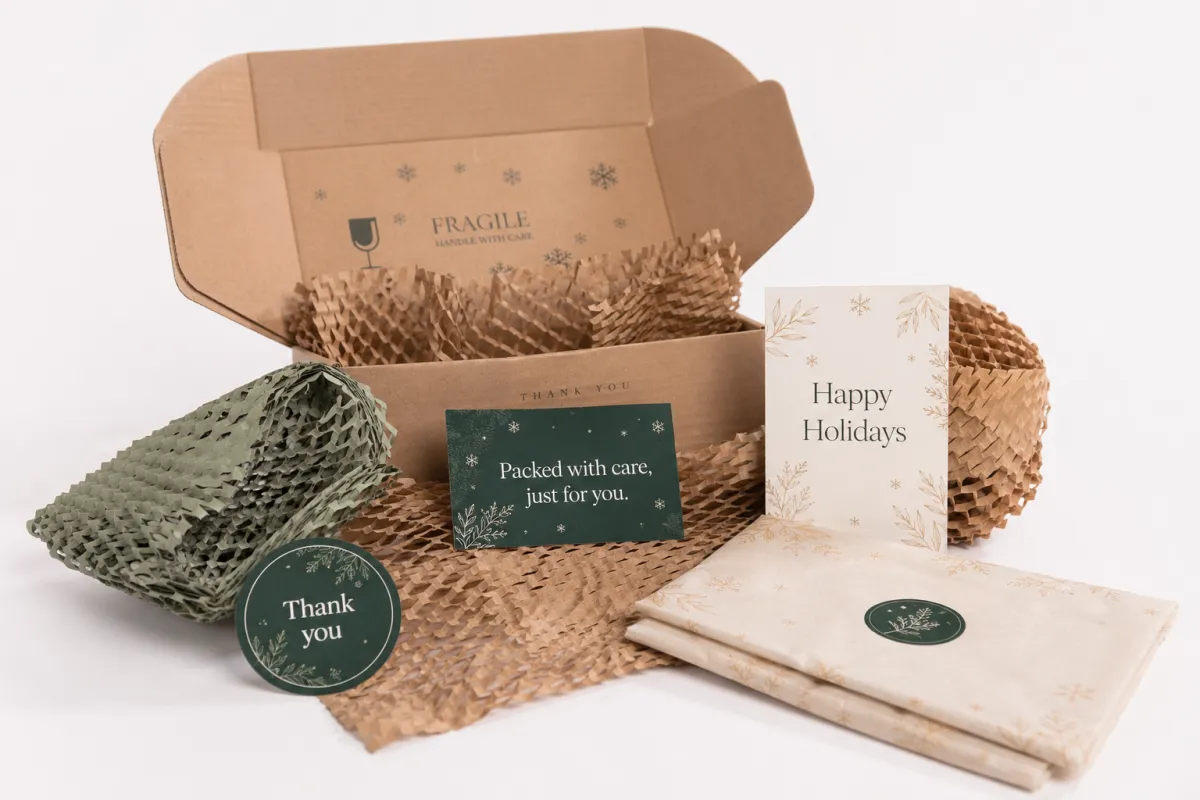
Holiday packing inserts for shipping matter because the most expensive holiday mistake is often not the crushed carton on the outside, but the small internal movement that turns a clean pack into damage halfway through the parcel network. I have seen a 12-ounce Candle Gift Set pass a quick drop test and still fail after three lane transfers because the jar shifted just 6 mm inside a loose insert and chipped the lid, which meant one return, one refund, and one retailer call that started with a very polite tone and ended with nobody feeling great. The carton looked fine from the outside, which is exactly why the failure was so frustrating.
That is why I always describe holiday packing inserts for shipping as the invisible working parts of package protection. They can create a fixed cavity for a single item, a divider system for a multi-item bundle, a nest for a fragile bottle, or a compression fit for a premium box that needs to stay centered. The insert is not decoration; it is transit packaging with a structural job, and on a busy line that difference shows up in seconds. Honestly, I think that distinction gets missed because inserts are quiet when they work and extremely loud when they fail. When the fit is right, no one notices. When it is wrong, everyone notices at once.
There is also a training benefit that people underestimate. A good set of holiday packing inserts for shipping reduces line variability, because packers are not guessing where each item belongs or stuffing loose void fill into a box at the last second. In one client meeting in Minneapolis, we timed two packing methods for a 4-piece gourmet set: the improvised filler version averaged 14.2 seconds per carton, while the die-cut insert dropped that to 9.1 seconds, which is the kind of gain you feel over a 15,000-unit holiday run and the kind that makes a warehouse manager stop pretending he is not impressed. That time savings becomes even more valuable when temporary staff are learning the line and every extra motion creates another chance for error.
"If the product can move, the season will expose it." That was a line a veteran line supervisor gave me while we were testing holiday packing inserts for shipping on a short-run gift program in Dongguan, Guangdong, and he was right down to the millimeter. A 1/16-inch slip is enough to turn a polished unboxing moment into a return that costs more than the insert ever would, which is a painful lesson but a useful one.
For brands building ecommerce shipping programs, holiday packing inserts for shipping also connect directly to customer perception. A well-fitted insert makes the reveal feel intentional, especially in gift sets where the first thing a customer sees after opening is the exact arrangement of the contents. If you are also planning broader packaging around that kit, our Custom Packaging Products page is a useful place to compare inserts with cartons, wraps, and other components before you lock the spec. I usually tell teams to think of the insert as the quiet stagehand doing the heavy lifting while the rest of the package gets to look good in public.
How do holiday packing inserts for shipping work?
At the pack bench, holiday packing inserts for shipping work by creating a fixed geometry that the product has to occupy, whether that geometry is a cavity, a divider, a sleeve, a cradle, or a compression-fit frame. The goal is not just to hold the item still for 12 inches of warehouse handling; it is to keep it stable through parcel sortation, truck vibration, and the 24 to 72 hours that most ecommerce shipping lanes spend moving a carton from one hub to another. That is the real test, because the product is not living in a display case, it is living inside a moving network of belts, drops, stacked cartons, and the occasional rough handoff that nobody planned for.
I like to explain the mechanics with one simple question: can the item shift when the carton is tilted, shaken lightly, or inverted for a second? If the answer is yes, holiday packing inserts for shipping probably need more restraint or a better footprint. A tight insert can absorb shock, resist vibration, and keep decorated surfaces from rubbing against board edges, which matters a lot for print-finished gift items, glass, ceramics, and high-gloss paperboard packs. I have seen a lacquered ornament get tiny scuff marks from what looked like harmless board contact, and those little marks turn into customer photos faster than anyone expects. A well-designed insert does not just stop breakage; it protects surface finish, presentation, and the first impression the customer makes when the box is opened.
Holiday packing inserts for shipping also support different pack styles, and that flexibility is useful during peak season. A subscription box with six small pieces needs a different insert than a single premium candle in a rigid mailer, and a multi-SKU holiday bundle usually needs divider logic so the parts do not collide. The best systems let the packer drop the insert into place in one motion, place the product in one or two motions, and close the outer shipper without wrestling the structure into shape. If the packer has to fight the carton, I can promise the carton is going to lose the patience battle by about 10 a.m. That is one reason Custom Corrugated Inserts often outperform clever but fussy concepts on a real line.
From a line-efficiency standpoint, holiday packing inserts for shipping should behave the same way on Monday morning and Friday evening. That means predictable fold lines, clean locking tabs, and enough tolerance to survive a tired seasonal worker who is moving at full speed after lunch. If the insert needs three corrections before the box closes, the design is fighting the line, and the line always wins. I have never met a holiday crew that got more forgiving as the shift wore on, especially during the first week of December. Predictability matters as much as protection, and in many facilities that is the difference between a stable packout and a pile of rework.
Another point that gets missed is dimensional weight. A strong insert paired with an oversized box can still raise freight cost, because the outer carton may be billed by cube instead of actual weight. I have watched buyers save $0.04 on an insert and lose $0.38 on shipping because the shipper footprint was 1.5 inches too wide, so holiday packing inserts for shipping should be designed with the outer carton, carrier rules, and the billable dimensions in the same conversation. That is the part that feels boring in the meeting and expensive on the invoice. The same applies to void fill, because extra paper or air pillows can mask a sizing issue without solving it.
If you are matching inserts to mailers or smaller ecommerce packs, it can help to compare the insert structure with the rest of the system, including Custom Poly Mailers for lightweight orders and Custom Shipping Boxes for heavier or more fragile bundles. The insert is strongest when the outer package and the inner restraint are designed together, not patched together after the fact. I say that from experience, and also because I have watched more than one team try to rescue a weak shipper with a heroic insert, which is a lot like putting better tires on a car with a bent axle.
Choosing materials, fit, and cost for holiday inserts
Material choice is where holiday packing inserts for shipping get real, because the right answer depends on product weight, fragility, surface finish, and how far the parcel has to travel. Corrugated board is usually the first place I look for strength and cost control, paperboard works well for lighter gifting applications, molded pulp adds a sustainable feel and decent cushioning, and foam still has a place for very delicate items that cannot tolerate edge pressure or abrasion. There is no magic material that wins every time, and anyone claiming otherwise is usually selling something with a very confident smile.
I had a supplier negotiation in Ohio where the conversation came down to 32 ECT versus 44 ECT corrugated and a difference of only $0.03 per unit at 8,000 pieces, but the heavier board saved enough on crushed corners to justify the change by the second re-order. That is why holiday packing inserts for shipping should never be judged on insert price alone; the real cost includes sampling, tool setup, assembly labor, void fill reduction, and the cost of a return that never should have happened. The cheapest line item has a nasty habit of becoming the most expensive program decision.
To make that tradeoff clearer, I like to compare options by both function and line behavior. A simple die-cut corrugated insert may cost less and pack faster, while a molded pulp tray may feel more premium and align better with FSC-minded sourcing. If your brand is working toward certified fiber choices, the FSC site is a useful reference for responsible sourcing language, especially when holiday packing inserts for shipping will be part of a broader sustainability story. I also think it helps to be honest about what the customer actually sees, because sometimes the most sustainable option is the one they can recycle without needing a degree in guesswork.
| Insert material | Best fit | Typical unit cost at 5,000 pcs | Typical lead time | Practical note |
|---|---|---|---|---|
| Corrugated die-cut insert | Medium-weight ecommerce shipping, bottles, mugs, candle sets | $0.14-$0.28 | 10-15 business days | Best blend of package protection and pack speed |
| Paperboard insert | Light gifting, cosmetics, small retail bundles | $0.10-$0.22 | 8-12 business days | Cleaner presentation, less crush resistance than corrugated |
| Molded pulp tray | Sustainable gifting, nested parts, moderate cushioning needs | $0.22-$0.40 | 15-25 business days | Good for eco messaging, but tool cost can be higher |
| Foam insert | High-fragility items, glass, electronics, premium finishes | $0.30-$0.65 | 12-20 business days | Strong protection, but recycling and customer perception need review |
That table is only a starting point, because holiday packing inserts for shipping usually look inexpensive in isolation and then become much more understandable once you factor in the full program. A $0.18 corrugated insert that cuts pack time by 4 seconds can outperform a $0.12 paperboard alternative if the paperboard version needs manual taping, extra void fill, or a second hand to keep the contents centered. In a 20,000-unit order fulfillment run, those seconds add up quickly, and I have seen teams underestimate them right up until the overtime bill arrives. That is also where packout labor, line balancing, and package protection start to overlap in a way that finance teams can actually feel.
One more practical note: holiday packing inserts for shipping should be built around standard calipers and repeatable fold logic whenever possible. A one-piece insert that uses a 350gsm C1S artboard face plus 1.5 mm corrugated support may cost a little more to prototype than a plain divider, but it can cut assembly labor by 15% if it reduces folding mistakes. That is the kind of tradeoff I recommend brands test with a short pilot before they buy 50,000 pieces, because no one wants to discover in November that the line only works if everyone has the patience of a saint.
For a concrete sourcing example, a 350gsm C1S artboard insert printed in Shenzhen and die-cut in Dongguan can land at roughly $0.15 per unit for 5,000 pieces, while the same structure with a matte aqueous coat may move closer to $0.19 per unit depending on ink coverage and knife wear. If you need molded pulp, factories around Xiamen and Ningbo often quote in the $0.24 to $0.33 range at 5,000 pieces, with a molded tool charge that can start near $1,800 and rise based on cavity count and wall thickness. Those numbers matter because holiday packing inserts for shipping should be priced as a system, not as a single line on a spreadsheet. Freight, labor, and damage risk belong in the same calculation.
Step-by-step timeline for holiday packing inserts for shipping
The cleanest holiday packing inserts for shipping programs start with measurements, not artwork. I ask clients for the product dimensions, the critical clearance points, the intended outer carton, and the holiday launch date, because the insert can only do its job if the inner and outer sizes are set together. If a glass bottle measures 3.2 by 3.2 by 9.1 inches, I want the tolerance stack, cap height, and closure method before anyone starts sketching a dieline. There is nothing charming about fixing a dimension after the print quote has already gone out.
The design phase is where the packaging team decides whether the holiday packing inserts for shipping should be a cavity tray, a divider set, a sleeve, or a folded structure that locks in place with tabs. This is also where the presentation brief matters, because a gift box for premium tea does not need the same visual language as a replacement part kit. A solid design balances protection, visual order, and packing speed in the same flat pattern, and it usually earns its keep by making a tired December line feel just a little less tired. A good design also reduces the need for extra void fill, which is a welcome side effect when the goal is faster and cleaner packout.
Prototype sampling is the point where theory meets reality. Holiday packing inserts for shipping should be tested with the actual product, the actual outer box, and the actual closure method, whether that means tape, tuck flaps, or a magnetic rigid box. I like to run at least three checks: a light shake test, a 24-inch drop test, and a pack-line fit test with the same gloves, cutters, and tape heads the crew will use in December. If the sample only works under perfect conditions with a calm engineer and fresh coffee, it is not ready yet. The most useful samples are the ones that expose the weak points early, before a holiday order turns those weak points into returns.
For validation, I lean on published methods where possible, including the same general discipline behind ISTA procedures and the common drop and compression logic used in transit packaging testing. The ISTA organization is a helpful reference point when you need to explain why one carton fails at the corner drop and another survives, and it gives buyers and suppliers a shared vocabulary before production starts. Holiday packing inserts for shipping should earn their place with test data, not with a pretty render alone. Pretty renderings are useful, but they do not stop glass from breaking.
Real lead times vary, but simple holiday packing inserts for shipping can move from proof approval to production in 12 to 15 business days, while custom die-cut or printed structures often need 15 to 25 business days when tooling, proofing, and freight are included. If there is molded pulp tooling involved, I would plan for another 5 to 7 business days because mold adjustments and moisture conditioning can add a real-world delay, especially in humid facilities near Guangzhou or coastal Vietnam. I have watched perfectly good timelines get mugged by weather and freight congestion, which is a very festive way to lose sleep.
One mistake I see every season is waiting to order holiday packing inserts for shipping until the shipping boxes are already in the building and seasonal staff have started training. That creates a bottleneck in freight booking, inbound staging, and line setup, because a late insert can delay the entire holiday launch by three or four days. A short calendar delay in October often becomes a hard revenue loss in November, and November is not the month you want to improvise structural packaging by committee.
If your schedule is tight, I usually recommend this sequence: finalize measurements in week 1, approve a white sample by week 2, sign off on print or finish by week 3, and lock production by week 4 so the factory can ship from South China or eastern China before the last-week freight crush. That kind of calendar discipline matters because holiday packing inserts for shipping do not just need design approval; they need enough buffer for carton sourcing, punch tooling, and carton erection tests before the first pallet leaves the dock.
Common mistakes with holiday packing inserts for shipping
The biggest mistake with holiday packing inserts for shipping is choosing a structure that looks elegant in a rendering but fails once real products, real packers, and real transport forces show up. I have seen a beautiful two-piece paperboard nest collapse under a 16-ounce glass ornament set because the designer never accounted for the stiffness loss after lamination, and that kind of miss costs more than the sample run ever did. The mockup looked gorgeous, which honestly made the failure more irritating than if it had looked ugly from the start.
Over-tight fits are just as bad, and sometimes worse, because they slow the line and make the carton hard to close. If a seasonal worker has to press with both hands to seat the item, the insert is already too aggressive, and holiday packing inserts for shipping should not be crushing corners or forcing labels to wrinkle. A 1/32-inch design change can be the difference between a smooth pack and a carton that needs rework every tenth unit, which is the kind of tiny number that causes very large sighs in a warehouse. That same issue can also create stress on seals, which matters when the packaging must survive both handling and transport.
The opposite mistake is the loose cavity. When there is too much room, the item rattles, rubs, and shifts, especially in parcel networks that subject cartons to repeated drops and sideways vibration. Holiday packing inserts for shipping need enough restraint to eliminate movement, and that usually means testing with the product loaded in the same orientation it will see on the pack line and in the truck, not just on a CAD screen. CAD is useful, but it cannot hear the tiny rattle that tells you a product is about to become a customer complaint. It also cannot tell you whether the product will tilt, twist, or sink after a few minutes in real handling.
Another problem is ignoring end-of-life and returns. If the insert is overbuilt, uses hard-to-separate mixed materials, or creates unnecessary waste, the holiday program can become expensive in more ways than one. That is where holiday packing inserts for shipping should be checked against the brand's recycling policy, the buyer's sustainability goals, and the practical recycling stream available in the customer's market, because not every material choice travels well after the box is opened. I have seen customers keep packaging for the unboxing moment and then quietly curse it later when the recycling bin refuses to cooperate. Good design should account for both the opening experience and the aftermath.
"We should have tested the actual holiday labor conditions first." That was a comment from a retail operations manager after a December pilot went sideways on a 600-piece gift set in Columbus, Ohio, and he was talking about holiday packing inserts for shipping that looked perfect in the design review but took 18 seconds too long to assemble on the floor. The lesson was blunt: test with tired hands, not just clean hands, because tired hands are the ones doing the work in December.
Finally, using one generic insert across too many SKUs usually creates hidden costs through filler, breakage, and inconsistent packout. I have watched teams try to force a single holiday packing inserts for shipping design to fit a family of 12 products, and by the third SKU they were adding tissue, kraft paper, and tape just to make the boxes close. That is not simplification; that is paying for the same error in three different ways, and usually giving everyone a headache in the process.
Another common oversight is forgetting about humidity and warehouse temperature. A paperboard insert that fits perfectly in a 68-degree sample room can expand slightly in a 78-degree facility in Atlanta or contract after a dry spell in Phoenix, and that small change can affect the tuck fit at scale. Holiday packing inserts for shipping should be checked against the actual warehouse climate, because a half-millimeter of fit change can matter more than a glossy design deck ever will. In other words, the sample bench is useful, but the warehouse tells the truth.
Expert tips for better holiday packing inserts for shipping
My first rule is simple: design around the product first, then the presentation, then the shipping lane, because a 4 oz candle and a 2.1 lb glass jar do not deserve the same restraint. If you are building holiday packing inserts for shipping for a premium set, I would start with the heaviest item, the most fragile edge, and the exact closure method, then map the cavity around that reality instead of around the prettiest version of the mockup. That approach tends to produce cleaner packouts and fewer surprises once the holiday rush begins.
- Use a white sample early, even if the final piece will be printed. A plain 350gsm C1S artboard or unprinted corrugated prototype in week 1 can reveal a bad fold line, a weak tab, or a too-tight cavity before you spend money on ink and finishing.
- Match the insert to the outer carton size within 1/8 inch whenever possible. If the outer box is 9.75 x 7.5 x 4.0 inches, a cavity insert for holiday packing inserts for shipping should be designed to fill that footprint intentionally so the contents do not slide during hub transfers.
- Ask the factory to quote at 5,000 pieces and 10,000 pieces. In Shenzhen or Dongguan, that comparison often shows whether your cost is labor-heavy or material-heavy, and it can reveal a useful break point such as $0.15 per unit at 5,000 pieces versus $0.11 at 10,000 pieces.
- Test assembly speed with the same people who will pack in December. A structure that takes 7 seconds in a design office may take 11 seconds on a 2 p.m. Friday shift, and holiday packing inserts for shipping should be judged by warehouse reality, not presentation room optimism.
My second rule is to keep the fold logic boring on purpose. A one-piece die-cut insert with clean score lines and a single locking motion usually performs better than a clever multi-part structure that needs three alignments and a prayer. For holiday packing inserts for shipping, boring often means repeatable, and repeatable is exactly what a seasonal line needs when the team is training new hires every Monday morning. Simpler structures also tend to reduce the chance of torn tabs, missed folds, and assembly confusion.
I also recommend specifying board strength in the RFQ instead of leaving it implied. If you want 32 ECT corrugated, say 32 ECT; if you need 44 ECT for a heavier candle set, write that down; if your finish needs a 350gsm C1S artboard face with aqueous varnish, make that explicit. A good supplier in Dongguan, Suzhou, or Xiamen will know what to do with precise specs, and precise specs make holiday packing inserts for shipping easier to quote, easier to approve, and easier to repeat in January when reorders start. Clear specs also help prevent a substitution that saves pennies but costs dollars in breakage.
Another practical tip is to ask for a packing video from the factory before production. A 30-second clip of the insert being assembled in a plant in Guangdong or printed in Zhejiang will tell you more than a polished PDF if the tabs are too stiff, the cavity is too shallow, or the fold sequence slows the line. Holiday packing inserts for shipping should not depend on the assumption that every hand is perfect, because December hands are usually moving fast and carrying a lot of other concerns. A quick video review can catch a problem before it becomes a pallet-level problem.
Finally, do not ignore the customer's unboxing moment, even when the main job is protection. A clean insert can frame the product neatly, prevent labels from rubbing, and make the contents look deliberate the moment the box opens, which matters whether the order is a holiday candle set, a cosmetic trio, or a six-piece tea assortment. Holiday packing inserts for shipping should protect the shipment and support the reveal, because those two goals are usually more compatible than teams think when they start the project. The best insert feels calm, structured, and intentional the second the lid comes off.
Holiday packing inserts for shipping: next steps
If you are planning holiday packing inserts for shipping now, the best next step is to gather three things: the product measurements, the outer carton size, and the target ship date. With those details in hand, a supplier can usually turn around a first quote in 24 to 48 hours, then a PDF proof in another 2 to 3 business days, and a physical sample shortly after that if the factory is already set up for die-cut or paperboard work. That kind of speed matters because every week lost in September becomes a shipping headache in November.
From there, ask for a sample that uses the real product weight and the real closure method, not a placeholder bottle or a generic mock item. If the final pack uses a 12-ounce glass jar, a printed sleeve, and a RSC shipper, the sample should include all three parts, because holiday packing inserts for shipping are only as good as the actual packout they support. I have seen teams approve a pretty insert and then discover later that the label placement blocked the tab, which is an avoidable mistake with a real sample in hand. The closer the prototype is to final production, the fewer surprises you will have in the warehouse.
It also helps to get pricing at different volumes before you commit to a holiday forecast. A quote at 3,000 pieces might come in at $0.21 per unit, while 5,000 pieces drops to $0.15 per unit and 10,000 pieces lands around $0.11, especially for a simple die-cut structure produced in South China. Those price steps tell you whether your insert is labor-driven, tool-driven, or material-driven, and that is valuable information before the holiday calendar tightens up. It also helps you see where a slightly better insert can actually lower the total program cost.
If you want a practical rule for deciding whether a design is ready, use this one: the insert should load fast, close cleanly, survive a drop from 24 inches, and still look acceptable after 50 to 100 manual pack cycles. Holiday packing inserts for shipping do not need to be glamorous to be effective, but they do need to be measured against the realities of the line, the carrier, and the customer who opens the box at home in five seconds and forms an opinion almost instantly. That is the standard worth designing to, because the customer never sees the prototype phase, only the result.
FAQs
What are holiday packing inserts for shipping made from? They are usually made from corrugated board, paperboard, molded pulp, or foam, and the right material depends on product weight, fragility, and the outer carton size. For example, a 350gsm C1S artboard insert can work well for cosmetics, while 32 ECT or 44 ECT corrugated is better for candle jars, glass bottles, and other heavier holiday bundles.
How much do holiday packing inserts for shipping cost? At 5,000 pieces, simple die-cut corrugated inserts often fall around $0.14 to $0.28 per unit, paperboard inserts around $0.10 to $0.22, molded pulp trays around $0.22 to $0.40, and foam inserts around $0.30 to $0.65. A specific quoted program in Dongguan or Shenzhen may land at $0.15 per unit for 5,000 pieces if the structure is straightforward and the artwork is limited.
How long do they take to produce? A simple insert can usually move from proof approval to production in 12 to 15 business days, while more complex printed or die-cut structures may take 15 to 25 business days. Molded pulp often needs an extra 5 to 7 business days if tooling or moisture conditioning is involved, so holiday planning should start before peak freight weeks hit Guangzhou, Ningbo, or your local port.
How do I know if the fit is right? The insert should stop movement without crushing the product, which means the item should not rattle when the carton is tilted or shaken lightly. I usually check fit by hand with the actual product, then run a 24-inch drop test and a short pack-line trial, because a structure that fits in a CAD file can still fail when a 16-ounce bottle or glass ornament is loaded for real.
Can one insert work for multiple SKUs? Sometimes, but only when the products share the same footprint, weight range, and closure method. If a brand tries to force one insert across 12 different items, it often ends up adding tissue, tape, or extra void fill, which defeats the point and raises labor cost; for holiday packing inserts for shipping, a small family of related SKUs is much easier to support than a one-size-fits-all approach.
What materials are best for sustainability goals? Molded pulp and paperboard are often the easiest to align with recycling goals, especially when brands want a cleaner fiber story and a straightforward customer disposal path. If your insert is part of a broader sourcing plan, a certified fiber option through FSC-aligned supply chains can be a good fit, but the final choice should still be based on product protection and the actual recycling stream in your customers' region.
Should I test holiday packing inserts for shipping before peak season? Yes, and the earlier the better. A sample tested in September can save you from a costly December correction, because once seasonal staff are trained and cartons are inbound, even a small insert change can disrupt packout speed, freight timing, and replenishment planning by several days.
What is the most practical takeaway for a holiday launch? Lock the measurements, sample the insert with the real product, and run one short line trial before you commit to production. If the piece does not load fast, stay quiet in transit, and survive a basic drop test, it is not ready for holiday packing inserts for shipping, even if it looks great on paper.

