Buyer Fit Snapshot
| Best fit | Order Branded Packing Tape Bulk projects where brand print, material claims, artwork control, MOQ, and repeat-order consistency need to be specified before quoting. |
|---|---|
| Quote inputs | Share finished size, material target, print colors, finish, packing count, annual reorder estimate, ship-to region, and any compliance wording. |
| Proofing check | Approve dieline scale, logo placement, barcode or warning zones, color tolerance, closure strength, and carton packing before bulk production. |
| Main risk | Vague material claims, crowded artwork, missing packing details, or unclear freight terms can make a low unit price expensive after revisions. |
Fast answer: Order Branded Packing Tape Bulk: Pricing, Specs, Lead Times should be specified like a repeatable production item. The safest quote records material, print method, finish, artwork proof, packing count, and reorder notes in one written spec.
Production checks before approval
Compare the actual filled-product size with the drawing, then confirm tolerance on folds, seals, hang holes, label areas, and retail display edges. Reserve space for logos, QR codes, warning copy, and material claims before decorative graphics fill the panel.
Quote comparison points
Review material grade, print process, finish, sampling route, tooling charges, carton quantity, and freight assumptions side by side. A quote is only useful when the supplier can repeat the same color, closure quality, and packing count on the next order.
Order branded packing tape bulk sounds simple until the dock is stacked, the trailer is backing in, and somebody is hunting for the right 2-inch dispenser while a stack of cartons waits beside the pallet jack. I have seen that scene more than once, and it is why I treat custom tape as an operations purchase with a print requirement, not as a little branding flourish. If you need to order branded packing tape bulk, the real question is whether the tape will hold up on the floor, stay legible in transit, and fit the equipment you already own.
I remember standing beside a corrugated line in Dayton, Ohio, where the outbound cartons were plain kraft, but the tape carried the company name, a repeated logo, and a yellow "inspection passed" message across every seam. The team had assumed the labels would carry the brand. Instead, the tape was what people noticed from 15 feet away under warehouse lighting, which was kinda the whole point once the pallets were wrapped and rolling. The operation had started with a 5,000-roll pilot run that came in around $0.16 per roll before freight, and that trial convinced them to order branded packing tape bulk before spending money on a full carton print change.
The business case is practical, and that is usually the best kind. Branded tape improves recognition at the dock, helps mixed-SKU pallets stand out, and gives direct-to-customer cartons a cleaner finish without changing the corrugate itself. It also reduces reorder noise when a facility is shipping 1,200 cartons a shift, two shifts a day, or sending work to a contract packer that can burn through 30 to 40 rolls before lunch. Here, I cover materials, print methods, pricing, minimums, and lead times so you can order branded packing tape bulk with fewer surprises and a better handle on landed cost.
"The pallets looked more organized the day we switched the tape than they did after a week of moving labels around."
Why do businesses order branded packing tape bulk?
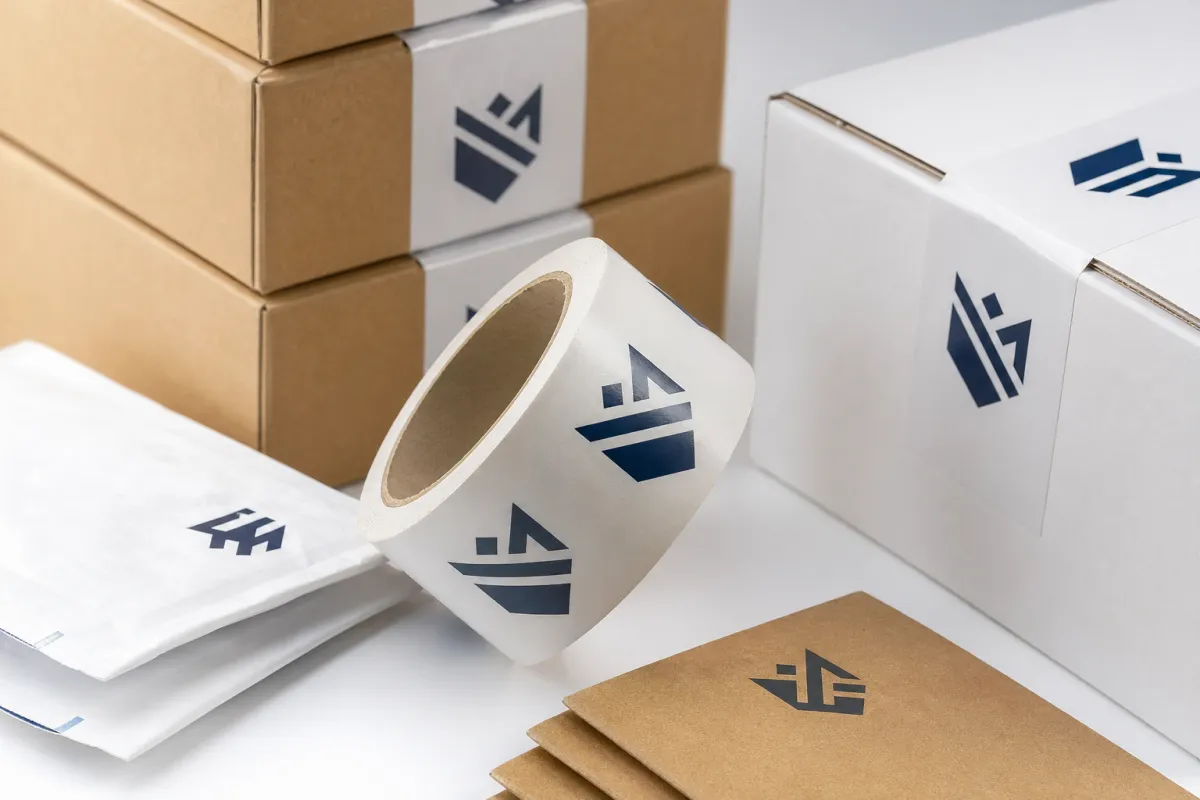
The first thing that surprises most people on a warehouse floor is visibility. Once cartons are stacked three high, stretch-wrapped, and staged under fluorescent lights, tape can become more noticeable than the label panel, especially on plain kraft cartons with a one-color brand mark. That is why teams that order branded packing tape bulk often get a brand lift without changing carton print. A 2-inch tape strip across the top seam can carry a company name, a web address, and a color band that stays legible from 10 to 15 feet away.
On a fulfillment line I visited outside Dallas, Texas, the supervisor said the outbound pallets looked "finished" after they moved to custom tape. Before that, the cartons were secure but generic. After they order branded packing tape bulk and started using a 48 mm polypropylene roll with a repeat logo every 14.5 inches, the pallets looked consistent even when three packing teams were working different shifts. That kind of visual order matters more than people think, especially when a receiving crew is scanning 200 cartons in one bay and sorting them by lane in less than 20 minutes.
I tend to frame the decision as an operations choice, not a design luxury. If you order branded packing tape bulk, you can reduce the number of separate SKUs your warehouse has to manage, standardize sealing across sites, and make life easier for contract packers who need a familiar tape spec with minimal training. The strongest programs fit a 2-inch handheld dispenser or a case sealer without forcing a line change. When the tape behaves the same way on every shift, the people on the floor stop fighting the tool and the supervisors stop improvising, which saves real time on a 90-second pack cycle.
There is also a cost logic that gets missed. A branded tape program gives you one more controlled brand touchpoint per carton, but the spend is usually far lower than full carton litho or a printed sleeve system. If a company ships 8,000 cartons a month, the cost to order branded packing tape bulk gets spread across thousands of impressions, and a 5,000-piece run at about $0.15 to $0.22 per roll can keep the total modest while still looking intentional. That is one reason procurement teams often prefer it to a higher-cost carton redesign when the budget is capped at a specific quarter number.
Most people focus only on logo appearance, and that is the wrong starting point. The better question is whether the tape supports the actual shipping environment. A branded roll for a climate-controlled cosmetics warehouse in New Jersey is not the same as a roll going through a humid dock in Houston, Texas, or a dusty industrial plant in Cincinnati, Ohio. If you order branded packing tape bulk with the right substrate and adhesive from the start, the tape feels like a small upgrade. If the spec is off, it becomes a daily annoyance, usually in the form of corner lift, curling, or adhesive haze after 48 hours on the pallet.
What goes into branded packing tape bulk orders
When buyers order branded packing tape bulk, the conversation usually starts with the substrate. Polypropylene is the common workhorse for general shipping, and a 25 to 28 micron BOPP film gives a strong balance of cost, print clarity, and availability. PVC tends to unwind more smoothly and quietly, which is why I have seen it preferred on packing benches where operator comfort matters or where the tape has to run cleanly through a hand dispenser for 6 to 8 hours a day. Paper tape, especially when the carton stream is designed for recycling, makes sense when sustainability claims and carton recovery are part of the packaging brief.
Adhesive choice matters just as much. Acrylic adhesive offers a long shelf life and stable performance for inventory that may sit in a storeroom or on a pallet for several weeks before use. Hot-melt adhesive grabs fast, which is useful on high-volume sealing lines where cartons are moving at 18 to 24 cartons per minute and you do not want the tape lifting at the edges. If you order branded packing tape bulk for cold rooms, humid docks, or cartons that will travel long-haul in a trailer, I always ask about the adhesive first because the wrong glue can ruin an otherwise good print spec. I learned that the annoying way: a beautiful roll can still behave like a grudge if the adhesive was chosen by someone who never spent a January morning near a loading dock in Milwaukee.
Roll dimensions are not trivia. A 2-inch wide tape on a 55-yard roll behaves very differently from a 2-inch by 110-yard roll when a line is running at speed. Longer rolls reduce changeovers, while shorter rolls are sometimes easier to handle for hand application. Core size matters too: 3-inch cores are common, but the wrong core can force a buyer to replace dispensers or case sealing hardware. If you order branded packing tape bulk, make sure the roll fits the equipment already on the floor before anyone approves the proof, because swapping one dispenser family for another can add $40 to $85 per station.
Print format is another major decision. Most customers start with one-color repeating logos because that format keeps setup simpler and usually gives the cleanest result at scale. Multi-color graphics can look excellent, but they raise setup complexity and often increase minimum order quantity. Message tape, such as "fragile," "packed by," or "sealed for shipment," is useful when the handling instruction matters more than a full logo lockup. When I compared tapes with a beverage client in Atlanta, we found that a repeating one-color logo on 48 mm tape was more legible from 10 feet away than a busy two-color version with a 22 mm icon. Simple sometimes wins, and I say that as someone who likes a strong visual system when it actually has a job to do.
Artwork requirements should be settled early. Good suppliers will ask for vector files, exact logo placement, repeat length, and whether the brand mark needs to stay clear from a splice or seam. If you order branded packing tape bulk without confirming repeat spacing, you can end up with a logo cut in half at every carton seam, and that looks sloppy no matter how sharp the print registration is. For a procurement team, the cleanest path is to lock the artwork before the production slot gets reserved, ideally with a PDF proof and one approved PMS reference, such as PMS 186 C or PMS 300 C.
The tape also has to fit the packout line. A carton sealing station with manual application, a semi-auto case sealer, and a full automated line all need slightly different tape behavior. The wrong combination of unwind, tack, and roll diameter can slow operators down by 3 to 5 seconds per carton, which becomes a real labor cost over 5,000 or 10,000 boxes. That is why bulk orders work best as tailored supply runs from converters in places like Dongguan, Guangdong; Suzhou, Jiangsu; or northern Ohio, not as commodity tape rolls pulled from a generic catalog.
Order branded packing tape bulk: specs to confirm before you buy
Before you order branded packing tape bulk, lock down the core specs in writing: width, length, substrate, adhesive type, print colors, core size, and the number of rolls per case. I have seen buyers skip one of those fields and then lose a week to re-quoting because the tape arrived in a length that did not match the dispenser, or a width that left too much exposed seam on a 32 ECT carton. The spec sheet should be boring, because boring prevents headaches and keeps the approval cycle under 48 hours instead of stretching across a full workweek.
Carton weight and storage conditions also belong in the brief. A 15-pound apparel carton stored in a climate-controlled room has very different tape needs from a 48-pound industrial parts box that sits on a humid dock for six hours before loading. If you order branded packing tape bulk for cold storage, long dwell times, or hot shipping lanes, ask whether the adhesive has been tested for those conditions. The best suppliers will speak plainly about adhesion, unwind, and edge lift instead of tossing around vague claims.
Print durability deserves its own line item. Does the logo need to survive light abrasion from carton-to-carton contact? Does it need to stay readable after a pallet has been restacked? Should it resist warehouse dust, label rubbing, or the scuffing that comes from a carton sliding over a conveyor guide? These are small details until they are not. When you order branded packing tape bulk, ask for samples or a proof when the brand color match or logo legibility matters to the business. A good proof catches problems before a pallet of tape does, and a corrected proof is much cheaper than reprinting 5,000 rolls.
For buyers with sustainability or compliance requirements, the tape spec should reflect that too. If your cartons are part of an FSC-controlled fiber program, if you need a water-based adhesive, or if you want a paper-based solution that does not complicate the recycling stream, say so at the quote stage. The standards published by ISTA are useful if your cartons are being tested for transit vibration, drop, or compression, because the tape should support the whole ship test, not just look good on a bench. If you order branded packing tape bulk without talking about the lane and the carton stream, you are guessing instead of buying.
Procurement teams also need to think about repeatability. If you have one artwork for outbound cartons and another for internal distribution, spell that out. If the same tape must work in two plants with different applicators, confirm the dispenser compatibility before the order is released. I have sat in supplier meetings where one missing note about core diameter forced a change from 3-inch manual dispensers to a more expensive replacement head, which added nearly $600 to a small pilot. That kind of surprise is avoidable when you order branded packing tape bulk with a complete technical checklist.
- Width: 2 inches is common for carton sealing, but 1.88 inches and 3 inches are also used on specific lines.
- Length: 55 yards works for handheld use; 110 yards can cut changeovers on busy stations.
- Adhesive: acrylic for shelf life, hot-melt for fast tack, solvent systems for demanding environments.
- Core: 3-inch cores are standard on many commercial dispensers.
- Artwork: vector logo, repeat length, color count, and safe margins around seams.
Pricing and MOQ when you order branded packing tape bulk
Pricing gets a lot easier to read once the cost drivers are out in the open. When you order branded packing tape bulk, the unit price is shaped by order volume, number of print colors, tape construction, artwork complexity, and whether the job runs on a standard schedule or needs a rush slot. A single-color polypropylene run with a simple repeat is usually the most economical place to start. Add a second or third color, special adhesive requirements, or multiple artwork versions, and the price moves up because setup, press time, and spoilage allowance move with it.
MOQ exists for a reason. Custom printing requires plates or cylinders, press setup, registration checks, and startup waste before the run is clean enough to ship. That is why a supplier may quote 5,000 rolls for one job and 10,000 for another, even if the tape width is the same. If you order branded packing tape bulk without asking about the setup assumptions, you may compare two quotes that are not built the same way. Always compare landed cost, not just the prettiest line item, because freight to Chicago or Atlanta can add $180 to $450 per pallet.
Here is a practical table I use when talking to buyers who want to order branded packing tape bulk. The figures below are illustrative, but they are close to the ranges I see on real packaging quotes for standard commercial runs, before freight and proofing charges.
| Material | Common spec | Typical MOQ | Sample unit price at 5,000 rolls | Typical lead time after proof | Best fit |
|---|---|---|---|---|---|
| Polypropylene | 2 in x 55 yd, 27 micron BOPP, acrylic, one-color repeat logo | 5,000 rolls | $0.15-$0.24 per roll | 12-15 business days | General shipping, stable budgets, high-volume carton sealing |
| PVC | 2 in x 55 yd, smooth unwind, one-color or two-color print | 5,000-7,500 rolls | $0.29-$0.48 per roll | 14-18 business days | Quiet application, premium feel, hand-pack stations |
| Paper tape | 2 in x 50 yd, recyclable carton program, water-based adhesive, simple print | 7,500-10,000 rolls | $0.41-$0.74 per roll | 15-25 business days | Recycling-focused programs, fiber-based packaging systems |
The table is not a promise, and I would never present it that way. Freight, plate charges, palletization, and artwork revisions can change the total. Still, it gives buyers a useful frame. If you order branded packing tape bulk for a site that consumes 400 rolls a week, the lower per-roll cost of polypropylene often wins. If the line is sensitive to noise or operator comfort, PVC can justify its higher price. If your brand story is tied to fiber recovery and carton recyclability, paper tape may be worth the extra spend, even if the landed cost rises by 10 to 18 percent.
One pricing lesson I learned during a supplier negotiation in the Midwest: the cheapest quote is not always the cheapest tape. We swapped a hot-melt formula for a lower-cost adhesive on a run of plain cartons, and the cartons held in the warehouse but failed once the pallet went through a warm trailer at 92 degrees Fahrenheit. The replacement cost was ugly. If you order branded packing tape bulk with only unit price in mind, you may save ten cents and lose a shipment. I would rather see a buyer spend a little more on the right construction than patch problems after the fact.
A useful rule of thumb is to ask for tiered pricing at three or four volume breaks, such as 5,000, 10,000, and 20,000 rolls. That way you can see whether moving up a tier makes sense based on annual usage and storage space. If you order branded packing tape bulk once a quarter, a higher volume break may reduce your unit cost enough to justify the inventory. If the tape is a seasonal item, a smaller buy with a slightly higher unit price may be the more disciplined choice, especially if you have only one 8-foot pallet position left in reserve.
Process and timeline for custom bulk tape orders
The cleanest ordering process is straightforward. You request a quote, the supplier reviews artwork, the spec is confirmed, a proof is issued, production is scheduled, quality checks are completed, and the finished rolls are packed for shipment. That sounds simple, but if you order branded packing tape bulk without a complete artwork file or a firm color reference, the proof step can drag. I have seen jobs stall for four days because a logo existed only as a low-resolution JPEG, which is a rough way to start a print run when the plant is in Dongguan or Suzhou and the slot is already booked.
Simple one-color orders usually move faster than multi-color jobs or special substrates. In many plants, a clean polypropylene run can ship in about 12 to 15 business days after proof approval, while a paper tape order with multiple colors or custom packaging may need 15 to 25 business days. If you order branded packing tape bulk for a product launch, seasonal promotion, or warehouse conversion, build the proof and approval window into the calendar first, then set the launch date. Too many teams schedule the carton rollout before the tape is even approved, and that can create a very expensive rush.
Delays usually come from the same three places: missing vector artwork, unclear color expectations, and late proof changes after the press slot is already reserved. I have watched a buyer insist on a Pantone tweak after proof signoff, and that tiny color change pushed the job into the next production window by five business days. If you order branded packing tape bulk, treat proof approval like a hard gate. Once the gate is passed, keep the change requests out of the queue unless they are truly necessary.
Shipping and receiving deserve attention too. A 5,000-roll order may arrive on multiple pallets, each with a defined carton count and shrink wrap pattern. If the tape is going to more than one site, ask whether the supplier can stage pallets by location or label them by distribution center. When we shipped a multi-site tape program for a food client, the receiving team saved nearly an hour because each pallet was clearly marked by lane and site code. That is the kind of small operational detail that makes it easier to order branded packing tape bulk again the next time.
I also recommend keeping a reorder buffer. If your weekly consumption is 250 rolls and the lead time is 15 business days, then a two- to three-week safety buffer is not excessive. It is practical. The worst time to discover you are low on branded tape is on a Friday afternoon with a pickup due at 6 p.m. Bulk tape should arrive before the last master carton leaves the dock, not after the new campaign has already shipped.
Why choose us for branded packing tape bulk supply
At Custom Logo Things, we approach tape like packaging people, not just print people. That matters because branded packing tape has to seal cartons, survive handling, and still look clean after it has traveled through a warehouse, a trailer, and a receiving dock. When you order branded packing tape bulk from a team that understands corrugators, line speeds, and dispenser compatibility, you get advice that protects your budget instead of just selling a roll. I have spent enough time around packing benches to know that a tape spec that saves two cents but breaks twice a shift is not a good spec.
Our guidance is rooted in real production details: print registration within +/-0.5 mm, adhesive consistency, unwind feel, and roll uniformity. If a customer tells us cartons are running on a semi-auto case sealer at 18 cartons per minute, that changes the recommendation. If they are hand applying tape at two separate warehouses in Phoenix and Nashville, that changes it again. That is why buyers who order branded packing tape bulk from us usually get a practical recommendation on substrate and adhesive before they see a formal quote. We try to remove waste before it starts.
We also support repeat programs that need stability across multiple locations. A lot of teams start with one site, then expand to three more when the tape proves itself on the floor. Our Case Studies page shows examples of that kind of rollout, from retail distribution centers to subscription-box packouts, including one 12,000-roll account that moved from a single 48 mm SKU to three lane-specific versions in less than 60 days. If you are building a standing supply relationship, our Wholesale Programs page is a good place to begin because it is designed for buyers who need predictable replenishment and clear volume pricing when they order branded packing tape bulk.
Quality control is not a slogan in this business; it is a checklist. We look at color consistency, edge alignment, roll tension, carton packing, and shipment inspection before freight leaves the facility. I have seen what happens when a roll is wound too loosely or a print plate is out of register by just a few millimeters. The tape still sells, but the brand impression drops. Our job is to avoid that problem so you can order branded packing tape bulk and trust that the pallet arriving on your dock matches the proof you approved.
For buyers who need help understanding fiber-based packaging or recycling claims, the FSC site is worth a look, especially if your cartons are part of a certified chain-of-custody program. If you are evaluating packaging recovery and waste handling, the EPA recycling guidance is another practical reference. Those standards do not replace a good tape spec, but they help shape a cleaner packaging decision when you order branded packing tape bulk for a sustainability-minded program with a 2024 or 2025 packaging scorecard.
One last point: we do not oversell. If a buyer needs a basic one-color run on polypropylene, we will say so. If the application really calls for PVC because of quieter unwind, we will say that too. Honest recommendations save everyone time. That is the kind of relationship I prefer, and it is the kind of relationship that keeps branded tape programs running without drama across 2,000 shipments or 20,000.
Next steps to place your bulk tape order
If you are ready to order branded packing tape bulk, gather five things before you request a quote: carton dimensions, monthly usage, preferred tape type, logo artwork, and the launch date. Those five details let a supplier narrow the spec quickly, whether you are filling 1,200 cartons a month or 12,000. The tighter the brief, the less back-and-forth you will need, and the faster you will see a meaningful price, especially if the production plan needs to move through a plant in Guangdong or the Midwest.
If you are unsure about material, ask for two options side by side. Compare polypropylene against PVC if line noise matters, or compare polypropylene against paper tape if recycled-fiber claims are part of the packaging story. That comparison is usually worth the extra hour. Buyers who order branded packing tape bulk with a simple A/B decision in front of them tend to Choose the Right spec faster than buyers who try to settle every packaging question in one call.
My recommendation is to start with the most common SKU first. If one carton size accounts for 70 percent of your outbound volume, make that the first tape version. Confirm the print quality, run the sample on the actual dispenser, and watch how it performs on the line. Once the application is validated, you can add secondary versions with confidence. That is the same approach I have seen work in contract pack rooms, fulfillment warehouses, and corrugated plants where time on the floor is too valuable for guesswork.
Ask for the proof and the delivery window together. Procurement needs the price, operations needs the ship date, and receiving needs the pallet count. If those three pieces are aligned, the rollout goes smoothly. If they are not, you end up with a carton of tape sitting in the wrong aisle while the launch shipment goes out in plain brown tape. That is why I keep pushing buyers to order branded packing tape bulk only after the whole handoff is mapped, including a 24-hour proof review and a confirmed freight date.
If you want the shorter path, send the spec, the artwork, and the target ship date, then let the supplier tell you whether the job fits a 12-day schedule or a longer production window. That is the cleanest way to order branded packing tape bulk without wasting time on assumptions. Do that, and the tape becomes what it should be: a reliable, branded seal on every carton leaving your dock.
Actionable takeaway: before you place a custom tape run, lock down substrate, adhesive, roll length, core size, dispenser compatibility, artwork repeat, and shipping conditions in one spec sheet. If those seven pieces are clear, you can order branded packing tape bulk with far less guesswork and a much better chance that the first pallet performs the same way as the proof.
How do I order branded packing tape bulk for a new product launch?
Start with carton size, monthly usage, and logo artwork so the supplier can recommend the right substrate and adhesive. If the launch depends on exact color or logo placement, request a proof before production. Build in time for setup, approval, and shipping so the tape arrives before the first launch cartons leave the dock, ideally 12 to 15 business days after proof approval for a simple one-color run.
What is the minimum order quantity for branded packing tape bulk runs?
MOQ depends on print colors, tape construction, and setup requirements rather than one universal number. Single-color runs usually have lower minimums than multi-color jobs or multiple artwork versions. Ask for tiered pricing so you can see the cost impact of moving up or down a volume break when you order branded packing tape bulk, such as 5,000, 10,000, and 20,000 rolls.
Which tape type is best when I order branded packing tape bulk?
Polypropylene is a common choice for general shipping and cost control, especially on high-volume carton sealing lines. PVC is often selected when quieter unwind or a smoother feel matters on the bench. Paper tape is a good fit for recycling-focused packaging programs when the carton stream supports it and the recovery claims are part of the brief, especially if the jobs are shipping from plants in Ohio, Tennessee, or Guangdong.
How long does it take to receive custom bulk tape after approval?
Timing depends on artwork readiness, print complexity, and the current production schedule. Simple orders move faster than jobs with multiple colors, special materials, or custom packaging requirements. Approve proofs quickly and confirm shipping details early to avoid avoidable delays if you need to order branded packing tape bulk on a tight launch schedule, because a missed proof window can add 5 to 7 business days.
Can I reorder the same branded packing tape bulk spec later?
Yes, repeat orders are easier when the original spec sheet, artwork file, and color references are stored clearly. Keeping the same tape construction and print layout usually shortens repeat quoting and production. Ask the supplier to save your job details so future purchases stay consistent across locations, shifts, and warehouse teams, whether the next run is 3,000 rolls or 15,000 rolls.

