Buyer Fit Snapshot
| Best fit | Holiday Shipping Cartons for Retailers projects where brand print, material claims, artwork control, MOQ, and repeat-order consistency need to be specified before quoting. |
|---|---|
| Quote inputs | Share finished size, material target, print colors, finish, packing count, annual reorder estimate, ship-to region, and any compliance wording. |
| Proofing check | Approve dieline scale, logo placement, barcode or warning zones, color tolerance, closure strength, and carton packing before bulk production. |
| Main risk | Vague material claims, crowded artwork, missing packing details, or unclear freight terms can make a low unit price expensive after revisions. |
Fast answer: Holiday Shipping Cartons for Retailers: Board, Finish, Dieline, and Unit Cost should be specified like a repeatable production item. The safest quote records material, print method, finish, artwork proof, packing count, and reorder notes in one written spec.
Production checks before approval
Compare the actual filled-product size with the drawing, then confirm tolerance on folds, seals, hang holes, label areas, and retail display edges. Reserve space for logos, QR codes, warning copy, and material claims before decorative graphics fill the panel.
Quote comparison points
Review material grade, print process, finish, sampling route, tooling charges, carton quantity, and freight assumptions side by side. A quote is only useful when the supplier can repeat the same color, closure quality, and packing count on the next order.
Holiday Shipping Cartons for Retailers: Smart Planning
Holiday shipping cartons for retailers are usually the last thing anyone applauds in a seasonal launch, which is exactly why they deserve careful attention. The merchandising team gets the pretty mockups, the buyers get the big forecast meeting, and the carton gets asked to do the messy work: survive forklift forks in a 28,000-square-foot DC, hold together in a Dallas cross-dock, and keep its shape after a trailer has been bounced across three states in weather that changes its mood by the hour. I still remember standing beside a corrugator line in Dongguan while a client's display-ready shippers came off the stack with split seams because somebody had trimmed the board from 44 ECT down to 32 ECT to save $0.04 a unit on a 5,000-piece run. The print was sharp, the sample looked convincing, and the carton still failed in the only place that mattered: under real freight, real handling, and real holiday impatience.
That is the job of holiday shipping cartons for retailers: protect product, keep labor moving, and hold up through peak-season abuse without turning the receiving dock into a repair bench. These cartons sit at the intersection of transit packaging, order fulfillment, and retail logistics, so they affect shelf readiness, freight cost, and the customer experience long before a shopper ever sees the merchandise. A carton moving from Suzhou to Chicago or from Monterrey to Phoenix has to tolerate temperature swings, mixed freight, damp docks, and a crew that is not in the mood for anything finicky at 5:30 a.m. If a carton collapses on a pallet or arrives with torn flaps, that is not a packaging hiccup. That is a supply-chain decision showing up late and loudly.
Retail teams that treat holiday shipping cartons for retailers as an operating tool instead of a line item usually save money in three places: fewer damages, faster handling, and better cube utilization. I keep nudging clients to think about lane, stack, and labor hour before they think about artwork. A carton can be beautiful and still slow a dock crew to a crawl, and that kind of beauty is expensive. I have watched people celebrate a strong-looking prototype from a factory in Foshan and then sigh when the warehouse asks, "Great, but can somebody actually close it in under 20 seconds?" That question tends to clear the fog pretty quickly.
Why Do Holiday Shipping Cartons for Retailers Matter?
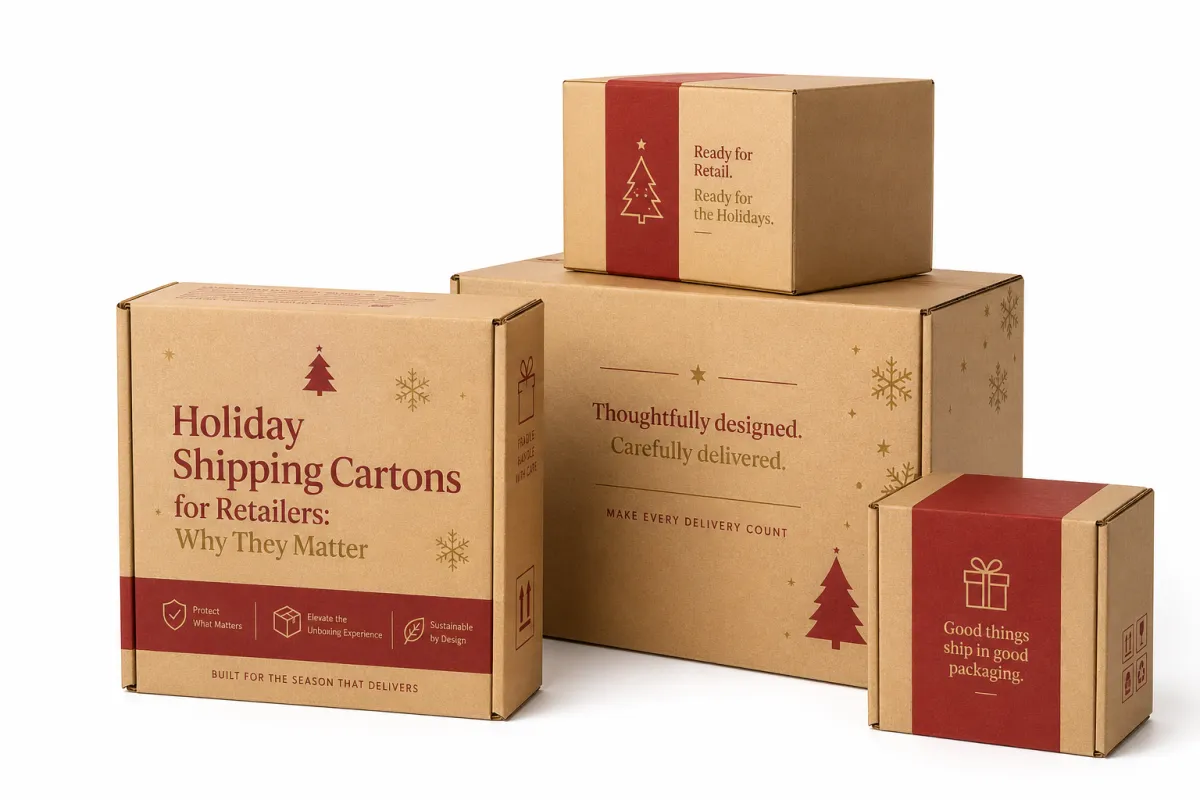
On a visit to a packaging plant outside Shenzhen, I watched a buyer approve a carton that looked stout enough on a sample table, but the board grade was really better suited to light e-commerce use. Once that spec moved into a rough domestic freight lane, the corners folded, the top flaps bowed, and the retailer ended up paying to repack units on the warehouse floor. The added cost worked out to about $0.18 per unit in labor and materials, and the repack queue added nearly six hours of dock time over a 9,000-unit shipment. Small numbers can behave badly. They are usually the most expensive ones in disguise.
Holiday shipping cartons for retailers matter because the holiday network is harsher than a normal month. Warehouses in New Jersey, Ontario, and Southern California get crowded, trailers are loaded faster, and receiving teams do not baby anything that is supposed to move now. A carton that survives gentle handling in September may fail after three more impacts, a 72-hour dwell time, and a colder dock at 38 degrees Fahrenheit. The spec has to match the season, not just the SKU. I have seen cartons that were perfectly fine in pilot runs fall apart once peak freight congestion, mixed pallets, and a little dock humidity joined the party. That part is not glamorous, but it is the truth.
Carton choice is often treated like a buying decision. That is the wrong frame. It is a supply-chain decision that changes package protection, freight class, replenishment timing, and store execution. Oversize the carton and you pay more in dimensional weight; on a 14 x 10 x 6 shipper, an extra inch can push billable weight up by 12 percent on certain parcel lanes. Underspec the board and you pay more in breakage. Pick an awkward opening style and every pack-out takes longer, which becomes very expensive once the volume climbs into the tens of thousands. It sounds dull until the first damage claim lands, and then it starts sounding like money.
"We saved less than two cents on the board and lost six times that in damages," a retail ops director told me after we reworked her seasonal carton program in Columbus, Ohio. She was not exaggerating. She was describing the dock, which is a harsher place than most conference rooms.
That is why holiday shipping cartons for retailers should be reviewed alongside routing guides, store calendars, and promotional plans. A carton that supports fast shelf restock in an Atlanta backroom is not the same carton that ships a bundled seasonal set direct to store in Minneapolis. Same broad category. Very different job. I have learned to ask one blunt question early: "What is this box actually supposed to do?" If the answer sounds fuzzy, the spec will be fuzzy too, and fuzzy specs usually become expensive cartons. Nobody needs that headache right before peak.
How Holiday Shipping Cartons for Retailers Move Through the Supply Chain
The carton path looks simple on a whiteboard and much messier in real life. A converter in Dongguan or Qingdao makes the corrugated box, the carton ships to a warehouse in Phoenix or Memphis, the team packs the SKU, the pallet moves through distribution, and then the retailer receives or stores the product for floor-ready placement. Every handoff adds risk. A miscount at the pack line. A label that does not scan in the Portland DC. A pallet pattern that shifts under load. That is the moment when holiday shipping cartons for retailers either prove their value or expose the weak link. I have seen a good program stumble because one label sat half an inch too low and the scanner missed it three times in a row. Tiny annoyance, huge headache.
In retail networks, the carton often has three jobs at once. It protects the product, groups SKUs for faster handling, and presents the item in a way that supports replenishment. A promotional set may need to open cleanly at store level with a tear strip cut on a 1.5 mm score line. A backroom replenishment carton may need to stack tighter and survive heavier handling on a mixed pallet. An ecommerce shipper may need to hold product in place without a mountain of void fill. A shelf-ready packaging format may need to look clean enough for direct merchandising while still surviving transit. The season stays the same, but the function changes from channel to channel, and that is where good planning earns its keep.
I once worked with an apparel client in Los Angeles that wanted one universal shipper for three very different channels. We tested it on a warehouse line in Rancho Cucamonga and then again with a store reset crew in San Diego. The box behaved well in one setting and annoyed everybody in the other two. The program eventually split into a backroom carton, a direct-to-store carton, and a smaller ecommerce shipping format. Labor improved, and the picking error rate dropped by about 11 percent over the next peak window. Not glamorous, not dramatic, just the kind of quiet improvement that lets people breathe in January.
That is the part many teams miss: holiday shipping cartons for retailers affect how many units move per labor hour. If a carton is easy to pack, easy to stack, and easy to scan, the operation gets faster without adding another shift that nobody budgeted for. If the shape forces awkward hand motions or creates unstable pallet layers, the labor loss shows up fast. Nobody needs a consultant to explain that after the dock is already full and somebody is muttering at a tape gun that jammed for the third time in 15 minutes. The box either helps or it slows everybody down; there usually is no middle ground.
For seasonal programs, I also separate cartons by lane severity. A direct truckload to a regional DC in Newark is one thing. A multi-stop route with mixed freight, cold docks, and store backrooms in Boston or Buffalo is another. In the second case, I want stronger corners, a better flap lock, and at least 10 to 15 percent more compression strength. That does not mean overbuilding every shipper. It means matching the carton to the route, which is the actual assignment. A box that makes it through a clean regional lane might face an entirely different personality once holiday congestion starts building, and freight has plenty of personality whether we want it or not.
Key Factors That Affect Performance and Cost
The first thing I look at is board grade. A light-duty carton may work for small accessories, but holiday sets usually need stronger corrugated board, especially if the product is dense or the route is rough. Common choices include 32 ECT single-wall for lighter loads, 44 ECT for more demanding lanes, and double-wall board for heavy or stack-sensitive items. There is no magic number here. Fit matters more than the label on the spec sheet. I have seen people get emotionally attached to a number because it "sounds stronger," which is not a very scientific way to buy packaging, especially when a 19-pound bundle is moving through a long-haul lane from Savannah to Denver.
Holiday shipping cartons for retailers also rise or fall on flute selection. B-flute offers decent crush resistance and a good print surface. C-flute is a dependable workhorse for general shipping. BC double-wall adds more protection and stack strength, but it also adds cost, weight, and a little more handling trouble if the line is tuned for a simpler structure. I have seen teams overbuild a carton just to feel safe, then complain about freight expense. That is not protection. That is a quiet surcharge wearing a hard hat.
Cost drivers are rarely just "box price." They include dimensions, print complexity, coating, minimum order quantity, storage footprint, and freight class. A 14 x 10 x 6 carton with simple one-color print may land at one price point; the same footprint with a 350gsm C1S paperboard sleeve, a coated finish, tighter tolerances, and custom inserts moves up quickly. On a 5,000-unit run, I have seen plain shippers around $0.58 to $0.74 each, while branded reinforced versions landed closer to $0.92 to $1.28 depending on volume and lane requirements. In one Guangdong program, a retailer got a unit price of $0.15 per piece for 5,000 units on a simple one-color carton shell, but the same item jumped once the spec added reinforced corners and a window patch. The difference can feel small on paper and very large once you multiply it by the whole season.
Here is the practical part. A carton that saves two cents can cost six cents in labor, nine cents in damage, and another five cents in freight because the dimensions are off by half an inch. That is why holiday shipping cartons for retailers need a total-cost view, not a unit-price obsession. I would rather explain a slightly higher carton price than answer for a pile of crushed product, a rework queue, and an angry call from the warehouse manager in Indianapolis who has already had enough for the day.
| Carton Option | Typical Use | Estimated Unit Cost | Pros | Tradeoffs |
|---|---|---|---|---|
| Standard RSC, 32 ECT | Light seasonal SKUs | $0.42-$0.68 | Low cost, fast to source | Less margin for heavy stacking |
| Reinforced RSC, 44 ECT | Mixed retail sets, moderate weight | $0.68-$0.98 | Better crush resistance, better lane fit | Slightly higher freight and material cost |
| Die-cut branded shipper | Promotional sets, shelf-ready packs | $0.88-$1.45 | Cleaner presentation, tighter fit | Higher setup cost, more approval steps |
| Double-wall shipper | Heavy or high-risk freight lanes | $1.10-$1.80 | Strong stack performance, better protection | More board, more cube, more cost |
Sustainability matters too, but I prefer it to be specific instead of decorative. Higher recycled content can reduce virgin fiber use, and a board spec with 30 to 40 percent post-consumer fiber is often a practical starting point for many retail cartons. Right-sizing can cut void fill. Better carton design can lower damage and re-ship rates, which is a real environmental gain, not a marketing line. If your board is FSC certified, that helps with sourcing credibility too; I would rather see that on the spec sheet than another vague eco-friendly claim. For certification details, I point teams to FSC certification guidance and for packaging performance context to ISTA test procedures.
The best holiday shipping cartons for retailers are the ones that look boring in a spreadsheet and excellent on a dock. They fit the pallet pattern, survive the lane, and do not force the warehouse to become a finishing department. That is a win I will take every time, even if it does not photograph particularly well.
Step-by-Step Process: From Spec Sheet to Store Delivery
The starting point is not artwork. It is measurement. I want the packed SKU dimensions, the weight of a fully loaded carton, the stack height, and the handling environment before I even talk about print. Measure the product as it will ship, not as it sits on a table. Include inserts, protective wrap, and any retail-ready components. Skip that step and holiday shipping cartons for retailers turn into guesswork, which is a costly way to run a season. I have watched teams chase a "close enough" spec for weeks, and the box always ends up reminding them that close enough is not a measurement system.
Next comes lane testing. A carton for a local DC in Charlotte does not need the same crush margin as a box going through multiple touches and a long regional route to Salt Lake City. I usually ask for a realistic test plan that covers drop, compression, and vibration. ASTM methods and ISTA protocols exist for a reason. Nobody enjoys paying for a carton redesign after a load shifts in transit, especially if the damage happens on a lane that could have been simulated. The good news is that testing is usually far cheaper than guessing, and guessing is weirdly popular for something so expensive.
Once the spec is set, I push for prototypes. One or two samples are fine for photos. Five or ten samples are better for real trials. We check hand-feel, tape closure, flap alignment, pallet pattern, and whether the carton stays square after packing. If a store associate or warehouse associate struggles with the opening, that is not a small irritation. That is a future bottleneck. Holiday shipping cartons for retailers need to respect the people who actually move the product, not just the people approving the deck. Good retail-ready packaging does not create a fight at the dock or on the sales floor.
I had a supplier meeting with a West Coast retailer in Irvine where the carton quote looked strong on paper, but the sample buckled under a modest 35-pound stack after 18 minutes in a hot receiving bay. The supplier wanted to jump straight to production and "see how it goes." I said no. We changed the board spec from 32 ECT to 44 ECT, spent an extra $0.07 per unit, and saved far more than that in claims. That is the difference between buying packaging and managing risk. I will always take the slightly more expensive box over the cheaper one that behaves like it has a personal grudge against the pallet.
Timeline matters just as much as structure. A realistic schedule often looks like this:
- Spec collection and quote request: 2-4 business days
- Prototype creation and review: 5-8 business days
- Artwork proofing and sign-off: 2-5 business days
- Production: 10-15 business days after approval
- Transit and inbound receiving: 3-10 business days depending on route
That is a healthy window, not a fantasy. If the calendar gets tight, simplify the structure first. Standardize sizes across similar SKUs. Reduce print complexity. Split production across approved vendors if you have to. I have done this with teams that needed both Custom Packaging Products and a separate family of Custom Shipping Boxes to keep the schedule alive. If the assortment leans toward apparel or accessories, Custom Poly Mailers can absorb some volume without forcing every item into the same carton format. The goal is not elegance for its own sake; the goal is keeping the season from wandering off the rails.
Holiday shipping cartons for retailers work best when the order window is treated like a real deadline, not a loose suggestion. Wait for one more approval round, one more forecast update, or one more stakeholder meeting, and the factory slot disappears while your options get thinner. I have seen that happen more than once in a Ningbo-to-West Coast program, and the bill is always larger than the first quote. That is one of those lessons nobody forgets after they have paid for it once.
Common Mistakes Retailers Make Before Peak Season
The classic mistake is ordering too late and assuming the supplier can absorb the entire holiday surge. That usually ends badly. Board mills run capacity. Converters book press time. Freight lanes fill up. A retailer that starts spec review in mid-October for a Black Friday launch is not being efficient. They are just late with better vocabulary, and the packaging industry has heard that story before, usually in a meeting in Shenzhen or Los Angeles with a very uncomfortable calendar.
Another common issue is size drift. A carton that is one size too large drives up dimensional weight and warehouse cube usage. A carton that is too small creates compression stress and increases damage risk. I watched one client shave half an inch off a mail-ready shipper to reduce board usage, then lose the savings in freight because the new size forced a worse pallet pattern. That was a very expensive half-inch. I still think about it whenever somebody tells me half an inch "won't matter much." It matters more than people like to admit.
Holiday shipping cartons for retailers also fail when teams ignore pallet patterns and dock conditions. A box can be strong enough on its own and still fail once it is layered on an unstable pallet or shoved across a rough dock plate in Newark, Atlanta, or Fresno. Stack strength matters. Corner integrity matters. So does whether the carton is being hand-carried, conveyor-fed, or loaded in mixed freight. The network decides the stress, not your idealized spec sheet, which is a sentence I wish more planning teams would write on the wall.
Skipping sample testing is another gift to future problems. I have seen teams approve a carton from a flat drawing, then discover too late that the flap tuck is too tight, the print scratches, or the glued seam opens under load. A simple drop test or line trial can catch that in a morning. It is cheaper to buy three prototypes than to rework three thousand units, and much less annoying than hearing "we probably should have tested that" after the fact, especially when the line is already running in a plant in Kunshan.
"We thought the box was fine because the dimensions matched," one buyer told me after a regional damage spike in Minneapolis. "What we missed was the stack pressure from the third-tier DC. The cartons were not wrong. Our assumptions were."
There is also the temptation to let every department customize something. Marketing wants full coverage print. Operations wants a plain box. Procurement wants the lowest quote. Store ops wants easy opening. Finance wants one SKU. If nobody owns the tradeoffs, holiday shipping cartons for retailers become a compromise that solves nothing. Someone has to make the call with actual numbers, not enthusiasm. Enthusiasm is lovely, but it does not stop a pallet from leaning at a 4-degree angle in a cold Chicago dock.
My advice is simple: define the carton by channel, not by ego. Backroom replenishment, shelf-ready promotion, and ecommerce shipping all deserve different specs if the volume justifies it. The retailer that forces one format to do everything usually ends up with a box that is mediocre at all of it. I have yet to meet a warehouse in Louisville or Sacramento that was thrilled by "good enough" packaging.
Expert Tips for Better Holiday Shipping Cartons for Retailers
Standardize where you can. A family of two or three carton sizes is easier to buy, store, and replenish than a dozen one-off specs. I have seen procurement teams save real money by standardizing dimensions across similar SKUs, then using inserts or dividers to handle product differences. That also makes reordering easier for the supplier, which helps when lead time gets tight. Fewer unique boxes also means fewer chances for somebody to order the wrong one at 4:45 p.m. on a Friday, which is a very specific kind of holiday headache.
Negotiate on the right levers. Do not focus only on unit price. Ask about board grade alternatives, print setup, freight consolidation, and production sequencing. One supplier may quote a carton at $0.84 and another at $0.79, but the first one might include better palletization or a 12-15 business day turnaround from proof approval, while the second needs 22 business days and a separate freight bill from Yantian. I have negotiated with regional converters in Ontario and large mills in Vietnam alike, and the cheapest quote has not always been the cheapest outcome. Funny how that keeps happening once freight, labor, and damage get a vote.
Prebook capacity early. If your holiday assortment is unstable, reserve extra room with the vendor and confirm backup stock. Holiday shipping cartons for retailers should not depend on a last-minute miracle. If the supplier can hold raw board or semi-finished inventory in Dongguan, Dallas, or Viet Tri, that gives you more room to absorb forecast swings. If they cannot, you need a second source or a simpler spec. Hope is not a supply plan, and I say that with affection for everyone who has ever tried to make hope work on a holiday timeline.
Use modular or nested carton sizes wherever possible. That reduces the number of unique boards, cuts tooling complexity, and makes reordering easier. It also helps if a retailer is balancing store delivery and order fulfillment from the same DC in Columbus, Toronto, or Nashville. Fewer unique carton specs usually mean fewer picking errors and less inventory confusion, which is worth more than most people think. I like packaging systems that behave politely under pressure; they are worth their weight in sanity.
I also recommend building a simple decision matrix for every seasonal carton program:
- Protection: Does the carton survive the actual lane, not just a demo?
- Speed: Can the pack line and store team use it without slowing down?
- Cost: Does the total landed cost make sense after freight and labor?
- Sustainability: Is the fiber source and material use defensible?
- Availability: Can the supplier deliver before the cutoff date?
That list looks simple because it is. The hard part is sticking to it under pressure. Holiday shipping cartons for retailers become much easier to manage once the team stops treating every carton like a custom art project and starts treating it like a retail utility. That may sound unromantic, but so is an expensive damage report from a December shipment in Philadelphia.
If you want the broader packaging system to match, use the carton program as part of a larger family that includes shipping formats, mailers, and display-ready packaging. That is where coordinated sourcing pays off, especially if the season forces multiple channels to share the same inventory pool. I like systems that talk to each other instead of competing in silence, especially when the materials are being produced in both Guangdong and central Mexico. A clean family of specs also keeps the vendor list from getting silly.
What to Do Before the Order Window Closes
Start with a carton audit. Pull the last season's damage claims, note which SKUs had the highest packing time, and mark any locations where receiving struggled with pallet integrity or carton collapse. Then rank the cartons by risk. The worst three usually tell you where the money leaks. That is far more useful than a giant spreadsheet that nobody opens twice, which is unfortunately a very popular file type in December and January.
Gather clean inputs before asking for quotes. I want SKU measurements, packed weight, artwork files, forecast quantities, ship dates, and any special handling notes. If you send vague numbers, you will get vague pricing. If you send real specs, you can compare apples to apples. Holiday shipping cartons for retailers are only as good as the data behind them, and bad data can make even a strong carton plan wobble. A spec that includes a 350gsm C1S paperboard insert for a retail-facing panel and 44 ECT corrugate for the shipping shell is much easier to price than a loose description like "premium box."
Build internal deadlines ahead of the vendor cutoff. Approval delays are the silent season killer. I have watched a buyer wait on one senior signature for six days, then miss production by a week and pay air freight to recover on a Toronto-bound replenishment run. That is the kind of decision that turns a packaging line item into a finance meeting. Set the internal deadline first. Then work backward. It is less exciting than procrastination, but a lot cheaper. Also, it keeps the whole thing from getting kinda ridiculous in the final stretch.
Before you close the season plan, make sure the carton spec, the forecast, and the delivery schedule all agree. If they do not, fix that now. Not later. The best holiday shipping cartons for retailers are ordered early, tested properly, and tied to a real warehouse plan instead of a hopeful spreadsheet. I have seen the difference in plants from Dongguan to Juarez, and the calm version is always the one with the better preparation.
If you are ready to tighten the program, start with the top SKUs and work outward. The fastest wins usually come from the products that ship the most units, damage the most often, or cost the most to move. That is where holiday shipping cartons for retailers pay back the fastest. It is not fancy work, but it is satisfying in the way good operations usually are, especially when a 12,000-unit order lands on time and the dock team barely notices because the cartons did their job.
What Should Retailers Ask Before Ordering Holiday Shipping Cartons?
How do I choose the right size for holiday shipping cartons for retailers?
Measure the packed product, not the bare product, and leave just enough room for protection without adding unnecessary void space. Match the carton to the pallet pattern and warehouse handling method so you do not create freight waste or unstable stacks. For holiday shipping cartons for retailers, a half-inch can matter more than a pretty print panel, which is a little rude but true, especially on a 48 x 40 pallet running through a Midwest DC.
How far in advance should retailers order holiday shipping cartons?
Start as soon as seasonal forecasts are reliable, because sampling, revisions, and production slots disappear fast. Build extra buffer for proof approval, freight transit, and any rework after the first prototype. I usually want the carton order locked before the shipping calendar gets crowded, because crowded calendars tend to ignore everyone equally, whether the cartons are shipping from Qingdao or from Guadalajara.
Are holiday shipping cartons for retailers more expensive than regular cartons?
They can be, especially if you need stronger board, custom print, or tighter size tolerances. The real comparison should include damage reduction, labor savings, and freight efficiency, not just the unit price. A few extra cents can be cheap insurance if the carton protects a higher-value SKU, like a $48 seasonal set or a fragile holiday bundle with mixed components.
What features help holiday shipping cartons survive rough handling?
Stronger board, smarter flute selection, and right-sized dimensions are the first line of defense. If the route is rough, test stack strength, drop resistance, and corner integrity before you commit to volume. Holiday shipping cartons for retailers should be built for the lane they will actually travel, not the lane everybody hopes they get, whether that lane runs through Memphis, Milwaukee, or a cold Canadian transfer hub.
Can holiday shipping cartons for retailers be branded without slowing production?
Yes, but keep the artwork process simple and approve proofs early so print setup does not delay the run. One- or two-color branding is often faster and cheaper than elaborate graphics, especially during peak season. If timing is tight, plain cartons with smart labeling are often the better call, and a clean one-color mark on a paperboard insert can still look sharp without adding a week to the schedule.
Holiday shipping cartons for retailers are not a small detail. They are the difference between controlled peak-season execution and a warehouse full of problems nobody budgeted for. Get the size right, test the lane, confirm the timeline, and do not let a two-cent savings create a two-dollar mess. I have seen the good runs and the ugly ones, from plants in Dongguan and Ningbo to distribution centers in Ohio and Arizona, and the winning pattern is always the same: clear specs, early approval, and cartons built for the job instead of just the quote.


