Buyer Fit Snapshot
| Best fit | Ai Packaging Design Ideas for Custom Boxes projects where brand print, material claims, artwork control, MOQ, and repeat-order consistency need to be specified before quoting. |
|---|---|
| Quote inputs | Share finished size, material target, print colors, finish, packing count, annual reorder estimate, ship-to region, and any compliance wording. |
| Proofing check | Approve dieline scale, logo placement, barcode or warning zones, color tolerance, closure strength, and carton packing before bulk production. |
| Main risk | Vague material claims, crowded artwork, missing packing details, or unclear freight terms can make a low unit price expensive after revisions. |
Fast answer: Ai Packaging Design Ideas for Custom Boxes: Board, Finish, Dieline, and Unit Cost should be specified like a repeatable production item. The safest quote records material, print method, finish, artwork proof, packing count, and reorder notes in one written spec.
Production checks before approval
Compare the actual filled-product size with the drawing, then confirm tolerance on folds, seals, hang holes, label areas, and retail display edges. Reserve space for logos, QR codes, warning copy, and material claims before decorative graphics fill the panel.
Quote comparison points
Review material grade, print process, finish, sampling route, tooling charges, carton quantity, and freight assumptions side by side. A quote is only useful when the supplier can repeat the same color, closure quality, and packing count on the next order.
The first time I watched AI Packaging Design Ideas rescue a launch, the buyer had already burned through six mockups, three late-night email chains, and one sample run that cost $420 before anyone agreed on the carton size. I remember staring at the screen in a meeting room in Shenzhen and thinking, "We are going to spend the entire budget arguing about beige." We generated three directions before lunch, the printer had not touched a dieline yet, and the team finally stopped fighting over shade names that meant almost nothing once the cartons reached press. That is the real value here: AI Packaging Design ideas can get you to a smarter starting point before you spend money on ink, board, foil, or a second round of custom printed boxes.
Most teams do not actually need more inspiration. They need faster sorting, a cleaner way to narrow the mess down to something usable, and a way to compare a matte mailer at $0.28 per unit with a rigid gift box at $1.75 per unit before anyone orders 3,000 pieces. Good AI Packaging Design Ideas can help a brand team compare package branding directions, test tone, and figure out whether a matte mailer feels premium or cheap in the first 10 minutes instead of after a week of back-and-forth. I have sat in meetings in Guangzhou where a marketing manager, a product lead, and a buyer could not agree on anything except that they were all tired and someone had brought stale coffee from a shop near Zhujiang New Town. A disciplined AI pass cuts through that noise and gives everyone something concrete to react to, like a 350gsm C1S artboard sleeve with a soft-touch coating instead of a vague "luxury" concept.
AI is not a packaging engineer, and it never pretends to understand the factory floor the way a human does. It does not know that a 2 mm greyboard luxury rigid box needs a different wrap allowance than a 350 gsm C1S artboard sleeve, or that an E-flute mailer in corrugated board behaves differently from a folded carton on a high-speed line in Dongguan. It does not know how glue behaves after 45 minutes of humidity in a warehouse near the Pearl River, or why a full-coverage dark flood on retail packaging can climb in cost once you account for ink load, drying time, and a 12-hour cure window. Honestly, I think that is fine. The best AI packaging design ideas are a launch point, not the finish line, and if you treat them like a finished spec, the factory will kindly punish you for it later.
For anyone building branded packaging for a product launch, subscription box, or retail refresh, the sharp move is to use AI packaging design ideas for visual direction, then hand the strongest route to a designer, packaging engineer, and supplier for a proper reality check. That is how you avoid pretty nonsense and get to packaging design that ships, stacks, protects, and sells, whether the run is 1,000 units for a startup in Austin or 20,000 units for a cosmetics line going through Ningbo. If you need a place to compare formats while you think, our Custom Packaging Products page is a useful starting point.
"I do not need 40 pretty options," one cosmetics buyer told me in a Shanghai meeting while she was tapping a stack of sample cartons from a 5,000-piece run. "I need two concepts that pass finance, survive the truck test, and do not make the warehouse hate me."
She was right. Smart AI packaging design ideas are not about flooding your team with images. They are about getting to a clear answer faster, with fewer dead-end revisions and fewer samples tossed aside after a rushed review on a Friday afternoon. A clean concept saves energy long before it saves money, which is usually where the real value shows up. And if you have ever watched a room full of people squint at a sample under fluorescent lights in a 12-foot conference room, you know exactly why that matters.
What AI Packaging Design Ideas Actually Mean
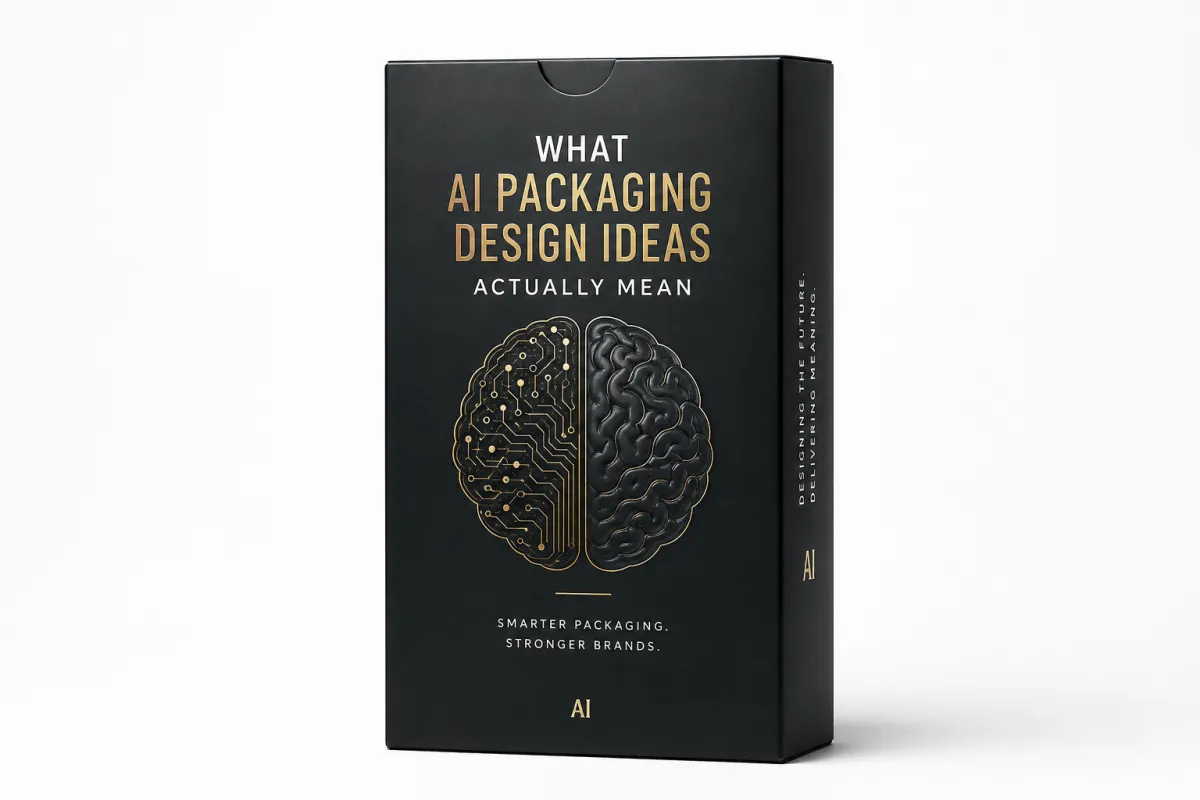
AI packaging design ideas are generated concepts, not finished artwork, and that difference matters on a press line in Suzhou or a hand-assembly station in Dongguan. That sounds obvious, yet people still mix the two together and then act surprised when a render that looked gorgeous on a laptop falls apart in production. AI can help create layout options, color directions, naming routes, and style variations for retail packaging or subscription mailers. It cannot replace structural thinking, print judgment, or the kind of supplier knowledge you only get after standing beside a folding carton line and watching where the problems begin, usually around the glue flap, the lock tab, or the ink-heavy corner.
When I visited a Shenzhen facility that was cranking out premium cosmetic cartons at 8,000 units a day, the client had been stuck in revision mode for 11 days. We ran one AI concept pass using the brand's exact palette, its audience profile, and the box dimensions, including a 78 mm x 78 mm x 112 mm bottle fit. The result was not final art, but it gave everyone the same visual target. That saved days of disagreement before a single proof was approved, and it kept us from ordering a second prototype at roughly $65 a sample. That is what AI packaging design ideas do well: they reduce fog and shorten the distance between opinion and decision.
There are a few things AI handles well, especially when you need three routes before 2 p.m. and a pitch deck is due the next morning:
- Generating quick visual directions for custom printed boxes, mailers, and sleeves in under 10 minutes per batch.
- Testing package branding styles for premium, eco, playful, or technical positioning with different color densities and logo scales.
- Showing how copy placement, icon weight, and color balance might feel on product packaging at shelf distance or in an unboxing video.
- Helping teams compare multiple concepts without paying for every sketch by hand, which can save $300 to $1,200 in early exploration.
Structural accuracy is where the glow fades. A render may show a magnetic rigid box that looks elegant, but if the wrap turn-in is wrong by 3 mm, or the insert depth is off by 1/8 inch, the box will not behave the way the render promised. A real packaging designer still has to verify dielines, bleed, board caliper, closure style, finishing, and whether the design can survive shipping and shelf handling. I have seen a gorgeous box become a very expensive paperweight because a tab was trimmed too short by a machine in Dongguan that was, frankly, in no mood to be forgiving after a night shift.
I usually tell clients to treat AI packaging design ideas like a well-trained intern with excellent taste and zero factory experience. Useful? Absolutely. Finished? Not even close. The human team still has to decide if the idea is production-safe, on-brand, and worth spending money on, especially when the target unit price is $0.15 for 5,000 pieces or $1.20 for 1,000 rigid boxes.
Packaging teams are under steady pressure to move faster. Sales wants a deck tomorrow, marketing wants three concepts now, and operations wants fewer surprises on a 6 a.m. loading dock in Ningbo. Good AI packaging design ideas help all three departments see something real earlier, but only if the process stays disciplined and nobody confuses a shiny image with a manufacturable box that can survive 12 to 15 business days from proof approval to production release.
How AI Packaging Design Ideas Work in Custom Packaging
The workflow is simple once you strip away the hype. The strongest AI packaging design ideas follow a clear sequence: prompt, generate, shortlist, refine, test, and hand off. Skip the middle steps and you end up with a pile of pretty images and no box. Follow the sequence and you get a concept that can move into custom packaging development with fewer surprises and fewer expensive corrections. I have watched teams try to shortcut this in a Monday morning review, and they usually end up paying for the missing steps anyway, often right before a launch in the last 72 hours.
Quality depends heavily on input. I have watched people type "luxury, modern, elegant" and then complain that the result looks generic. Of course it does. AI needs specifics: product dimensions, closure type, target customer, price point, finish goals, and a few visual references that actually mean something, like a 120 ml glass bottle, a tuck-end mailer, or a foil-stamped subscription sleeve. If you are making branded packaging for a skincare line, say whether you want a clean clinical look, a soft premium look, or a bold retail look. If the product ships flat, say that too. If the box needs to fit a 4 oz jar, a dropper bottle, and an insert, include all of it.
AI packaging design ideas improve quickly when you feed them constraints instead of only adjectives. A good prompt might include product size, material preference, retail shelf environment, unboxing style, print finish, sustainability goal, and competitor references. The model can then generate multiple routes that feel different without drifting into nonsense. If your target is a 350gsm C1S folding carton for a 60 g cream jar, say so; if your target is a 2 mm greyboard rigid box with a 157 gsm art paper wrap, say that too.
I once had a client selling supplement kits ask for "premium but approachable." That phrase meant very little until we translated it into something concrete: 18 pt SBS, soft-touch lamination, one foil accent, a restrained 2-color inside print, and a magnetic closure only on the top SKU. Suddenly the direction made sense, and the AI packaging design ideas matched the commercial reality. That is the difference between a cool-looking image and a usable packaging design process that can survive a quoted MOQ of 3,000 units and a 14-day sample window.
AI also shines when you need variants. One prompt can produce a series of looks for mailer boxes, rigid presentation boxes, inserts, sleeves, and labels. That matters for product packaging teams that need to compare styles side by side. Instead of paying someone to hand-draw 10 directions, you can get 10 plausible directions fast, then spend the real money on the two that deserve it. That part is hard to argue with, even if the graphics purist in the room crosses their arms and pretends not to be impressed while the procurement lead is already calculating unit cost at 5,000 pieces.
There are still lines AI should not cross without human review. Dielines, board thickness, coating behavior, ink coverage, barcodes, legal copy, recycling claims, and compliance rules all need a real check. If you are making Retail Packaging That touches regulated categories, the AI output is only a concept board until somebody with actual packaging experience signs off on it. I have seen one wrong claim force a reprint that cost a client $6,800 in Guangzhou, plus another $240 in freight to get replacement cartons to the warehouse. That kind of mistake stays in your memory, usually right next to the sound of everyone suddenly becoming very quiet.
Used well, AI packaging design ideas shorten the review cycle. Marketing approves faster, operations spots problems sooner, and production gets a cleaner brief that includes the correct board grade, artwork scale, and finish notes. That is the point. You are not replacing people. You are reducing the number of expensive dead ends, especially the ones that show up after sample approval and before the first pallet ships.
Key Factors That Make AI Packaging Design Ideas Useful
Not every good-looking concept is useful. That is where a lot of teams get burned. AI packaging design ideas only help when they support brand clarity, product fit, production reality, and customer behavior. If a concept fails on any one of those, it is decoration, not strategy. And decoration can be lovely, but it should not be allowed to sit in the middle of a supply chain pretending to be a plan while a freight booking in Ningbo waits for approval.
Brand clarity comes first. The box has to match the brand voice and price point. A $12 wellness item should not look like a $120 luxury serum unless that confusion is part of the plan. I have seen brands try to punch above their weight with metallic ink, heavy foil, and oversized logos, then wonder why the unboxing felt fake. Customers feel that. They may not explain it in production terms, but they sense the mismatch. The best AI packaging design ideas make the brand easier to understand in two seconds, not harder.
Product fit is the next filter. A beautiful concept that cannot protect the product is useless. The box should support the right insert, the right closure, and the right shipping method. If the item moves around in transit, you will hear about it from customer service, not from design. I learned that the hard way on a rigid mailer project where a small bottle set rattled inside because the insert looked elegant but measured 4 mm too loose, and the first 500 units shipped from Dongguan arrived with scuffed caps. The render was lovely. The returns were not. I was not amused, and neither was the client.
Print reality matters more than most people admit. Ink limits, dark coverage, flood varnish, aqueous coating, spot UV, foil stamping, and embossing all add cost and production risk. A concept that relies on eight finishing effects may look expensive online, but in the factory it can become a headache. I once sat with a supplier in Ningbo while they recalculated a carton that went from $0.18 per unit at 5,000 pieces to $0.31 because the client insisted on foil, spot UV, and a custom insert. The client later dropped two effects and saved more than $4,500 on the run. There was a little victory in that room, I will admit, mostly because nobody had to reprint a pallet of expensive glittery regret.
Audience behavior is the quiet variable. Luxury buyers, retail shoppers, and subscription customers do not read packaging the same way. Luxury buyers want restraint, material texture, and a calm layout. Retail shoppers want fast recognition and clear claims. Subscription buyers care about the unboxing sequence, the first reveal, and whether the package feels worth keeping after it arrives in a 14 x 10 x 4 inch shipper. AI packaging design ideas work better when you tell the model who the buyer is and what they are supposed to feel.
Sustainability should be part of the brief from day one. Recycled board, reduced ink coverage, lighter inserts, and smarter pack-out can save cost and reduce waste. If you are trying to reach FSC-aligned sourcing or lower transport impact, start early rather than trying to bolt it on later. For sourcing standards and responsible material choices, I often point clients to the FSC system at FSC and to testing resources at ISTA. That keeps the conversation grounded in real-world packaging, not just mood boards, especially when the order leaves a factory in Qingdao or passes through a warehouse in Suzhou.
The most useful AI packaging design ideas are the ones that survive a hard checklist. If the concept is on-brand, fits the product, can be made on your supplier's equipment, and does not blow the budget, then you have something worth developing. If not, it is just another pretty file sitting in a folder while someone in procurement asks for a unit cost at 10,000 pieces.
Step-by-Step: Turning AI Packaging Design Ideas Into a Real Box
There is a clean process for turning AI packaging design ideas into production-ready packaging. It is not glamorous. It is just practical. And practical is what keeps projects from turning into expensive theatre. I have spent enough time on the factory side in Dongguan and Zhongshan to know that the boring process is usually the one That Actually Works, especially if your target approval date is 12 business days away.
Step 1: define the brief. I want product size, shipping method, budget range, finish preferences, target market, and the exact packaging job. Is this box for retail packaging on a shelf, direct-to-consumer shipping, or a premium presentation kit? That answer changes everything. A sleeve for a candle is not the same brief as a rigid gift box for a cosmetic set, and a candle sleeve at $0.12 per unit is a very different conversation from a magnetic box at $2.10 per unit.
Step 2: build the prompt with constraints. Do not just write style words. Include dimensions, board type, closure method, color palette, and required copy. If the product needs to ship in a master carton of 24 units, include that. The more technical the prompt, the less cleanup later. AI packaging design ideas respond far better to specifics than to vague taste language, especially when the spec calls for 350gsm C1S artboard, a 1.5 mm insert, and a single-pass print schedule.
Step 3: generate a batch and score it. I use a simple scorecard: shelf impact, manufacturability, cost to make, and customer appeal. If a concept scores low on manufacturability, it is out. No emotional debate. No "but it looks premium." A pretty mistake is still a mistake, and I have seen more than one team fall in love with a mistake that was wearing a nice font and a gold foil headline.
Step 4: hand the strongest direction to a real packaging partner. This is where a supplier or designer sets the dieline, confirms measurements, and maps the print prep. A good partner will immediately flag risks like weak glue tabs, overdark coverage, or an insert that is too complicated for the planned budget. If your team is still choosing box styles, you can also use our Custom Packaging Products page to compare format options before moving deeper, whether you are sourcing in Shenzhen, Xiamen, or Yiwu.
Step 5: prototype, review, revise, and lock the schedule. AI can produce concepts in hours, but sample approval still takes real time. If you need a printed sample, expect proofing, color correction, and structural revisions. In my experience, a simple mailer box may move from concept to approved sample in 10 to 14 business days if everyone responds quickly. A rigid box with inserts, foil, and special paper can take 15 to 18 business days from proof approval. The timeline depends on how many people insist on "just one more change." There is almost always one more change, and it usually appears after the first quotation is already on file.
I remember a corrugated project in Dongguan where the AI render showed a sleek tuck flap that looked perfect on screen. On the line, the flap interfered with a glue station by less than 5 mm. Less than 5 mm. That tiny gap turned into a half-day delay because nobody had mapped the machine constraints before sign-off. That is why AI packaging design ideas must be converted by people who know the equipment, not just the aesthetic, especially when the run is 6,000 units and the truck arrives at 4:30 p.m.
The best process is boring in the best way. Brief, prompt, shortlist, supplier check, sample, approve, produce. Every shortcut usually costs more later, and the bill often shows up as rush freight, a second proof, or a reprint that nobody budgeted for in the first place.
Cost and Pricing for AI Packaging Design Ideas
Let us talk money, because everybody else is trying to dance around it. AI packaging design ideas can save money, but not in the lazy way people hope. They save money by reducing exploratory revisions, cutting wasted mockups, and helping teams align before they spend on tooling, prototypes, or print setup. They do not magically erase the real costs of packaging design. If anyone tells you otherwise, I would keep my wallet in my pocket and my eyebrows raised.
Here is how the cost picture usually breaks down. Early concepting can be cheap or expensive depending on how much human time is involved. If a brand team uses AI internally and then asks a designer to refine the top route, the early stage may only cost a few hundred dollars in labor. If the team hires an agency to do strategy, art direction, and iterations, that stage can run into the low thousands fast, especially in cities like Shanghai or Los Angeles where hourly rates can clear $125. The point is not that AI is free. The point is that AI packaging design ideas can reduce the number of paid hours spent on dead-end directions.
| Approach | Typical Early Cost | What You Get | Best Use Case |
|---|---|---|---|
| Pure manual concepting | $500-$2,500+ | Hand-crafted directions, slower iteration, fewer automated variants | High-control brand programs and complex package branding |
| AI-assisted concepting | $150-$900 | Fast visual routes, multiple mockups, quicker team alignment | Early-stage packaging design and presentation decks |
| Hybrid with packaging engineer review | $600-$3,500+ | Concepts plus structural checks, dieline validation, production notes | Custom printed boxes that must go straight into sampling |
Those ranges are not gospel. They depend on the market, the freelancer, the agency, and the complexity of the structure. A simple folding carton is cheaper than a rigid box with a PET window and foam insert. A one-color kraft mailer is cheaper than a metallic retail carton with embossing and spot UV. I have seen a project go from a $0.22 unit target to a $0.39 unit target because the buyer added foil, a soft-touch finish, and a custom molded tray after the concept was already approved. The render looked lovely. The budget did not.
The real cost traps are usually structural and production-related. Sample runs, die cutting, plate setup, shipping cartons, compliance checks, and reprint risk all sit outside the pretty AI image. If you are making product packaging for supplements, cosmetics, electronics, or food-adjacent items, the cost of getting a claim wrong can dwarf the design fee. That is why I push clients to think of AI packaging design ideas as a way to spend smarter, not just faster, whether the supplier is in Guangzhou, Dongguan, or a smaller plant outside Foshan.
There is also a hidden cost on the bad side: cleanup. A weak prompt can create more work than starting from scratch. If the AI output ignores the box style, the closure, or the material thickness, a designer spends extra time fixing impossible details. That is not saving money. That is just rearranging the invoice, usually into a second line item labeled "revision support" at $85 per hour.
My rule is simple. Use AI to reduce early exploration spend, then protect enough budget for structural development, proofing, and supplier validation. If you are trying to hit a unit cost target, tell the supplier early. I have negotiated enough runs to know that a two-minute pricing conversation in the beginning saves much more than a dramatic meeting at the end, especially when the first carton quote lands at $0.15 per unit for 5,000 pieces and the customer wants to know how to keep it under $0.20.
Expert Tips and Next Steps for AI Packaging Design Ideas
If you want better outcomes, build a small system around AI packaging design ideas. Do not wing it. The teams that win are the ones that organize the brief, keep their technical specs tidy, and talk to a supplier before the design gets emotionally attached to a bad idea. I say that with affection and a little exhaustion, because I have watched too many good projects drift into chaos for avoidable reasons, often after a beautiful concept review in a room with a $7 coffee and no ruler.
Use a three-file system. One file for brand goals, one for technical specs, and one for visual references. That keeps the prompt clean. I have watched teams stuff everything into one messy document and then wonder why the concept output was muddy. The machine is not a mind reader. It is only as sharp as your input, and it works better when the spec says "350gsm C1S artboard, 2-color print, matte aqueous" instead of "make it feel nice."
Use a scorecard with four checks. Brand fit. Manufacturability. Cost. Customer appeal. Score each concept from 1 to 5, then pick the top two. Not the top eight. Two. That is usually enough to move a project forward without creating analysis paralysis. If a concept looks gorgeous but fails on cost, it is probably not the one. I know that stings a little, but so does paying for a reprint and discovering the warehouse has already booked inbound space for the wrong carton size.
Talk to a real supplier early. I cannot say this enough. The fastest way to waste time is to wait until the design is "done" before asking about material limits, MOQ, finishing charges, and machine constraints. A good supplier can tell you whether your idea works on their line, whether the board thickness is right, and whether the design will stay within budget. When I negotiated with a carton vendor in Guangzhou, we saved $0.06 per unit simply by shifting the internal color and dropping one unnecessary coating. Small moves matter when you are ordering 8,000 units and trying to keep freight under $950.
Build the next step around the final use case. If the pack is for e-commerce shipping, ask for drop protection and pack-out efficiency. If it is for retail packaging, ask for shelf blocking, barcode placement, and front-panel clarity. If it is for branded packaging in a premium channel, ask how the finish will feel in hand. Custom packaging is not just a visual exercise. It is a logistics exercise with a marketing face on it, and the difference between a 4-oz serum carton and a 12-piece skincare set can change the entire board spec.
For teams building out new packaging design systems, I usually recommend this sequence: collect the dimensions, write the prompt, request two to three concept directions, and schedule a packaging review with production before anyone falls in love with the visuals. That keeps the process honest. It also keeps the budget from wandering off. And yes, someone will still fall in love with the wrong option for about 12 minutes in the room. That is just part of the job, along with the inevitable question about whether the insert can be 1 mm thinner.
One more thing. The best AI packaging design ideas do not pretend to replace hard work. They speed up the thinking. They help you compare faster. They make the first pass less painful. That is enough. Honest tools beat magical thinking every time, especially when the packaging has to survive a two-day transit from Shenzhen to Chicago and still look clean on arrival.
So if you are planning a launch, a refresh, or a new line of custom printed boxes, use AI packaging design ideas to compress the messy front end, then let real packaging experience handle the part where the box has to survive production, shipping, and the customer's hands. That is how you turn a concept into package Branding That Actually earns its keep, whether the run is 2,500 cartons for a boutique brand or 25,000 units for a national rollout.
My practical takeaway is simple: start with the exact product dimensions, the target unit cost, the closure style, and one supplier reality check before you generate a single image. If you do that, AI packaging design ideas stop being random inspiration and start acting like a useful pre-production tool, which is exactly what your launch needs.
How do AI packaging design ideas help you choose the right box?
AI packaging design ideas help you Choose the Right box by turning vague preferences into side-by-side options that are easier to compare on shelf impact, cost, and manufacturability. Instead of debating adjectives for a week, a team can review box mockups, compare a folding carton against a rigid box, and see whether the brand feels better in matte, gloss, kraft, or soft-touch finishes.
The real advantage is speed with structure. A good AI pass can show whether the packaging should be a mailer, sleeve, tuck-end carton, or presentation box before anyone pays for a full prototype. That gives your designer and supplier a cleaner starting point, which means fewer surprises when the dieline is built and the print-ready artwork is prepared. It also helps teams decide whether the packaging should focus on retail packaging, subscription unboxing, or e-commerce protection.
If you want the safest route, use the AI output as a visual shortlist, then confirm the final choice with measurements, board thickness, insert needs, and unit cost. That keeps AI packaging design ideas useful without letting them make structural decisions they are not built to make. In practice, that is how a good concept becomes a box that looks right, ships well, and stays on budget.
How do AI packaging design ideas help with custom box mockups?
They produce fast visual options so teams can compare styles before paying for multiple manual revisions. In practice, that means a buyer can review 3 directions in one meeting instead of waiting 5 to 7 days for another round of sketches from a studio in Shanghai or Brooklyn. They also help stakeholders agree earlier, which cuts down on endless email loops and avoids a second sample run that might cost $80 to $150. That said, they still need a real dieline and production check before anyone calls the design finished. I have seen one good-looking mockup save a week of arguing, which is a rare and beautiful thing.
How much do AI packaging design ideas cost compared with traditional design?
AI packaging design ideas can lower early concept costs by reducing the number of exploratory hours spent on rough ideas. A hybrid workflow may cost a few hundred dollars for concepting instead of several thousand for broad manual exploration, depending on who is doing the work and whether the job includes a packaging engineer in Dongguan or a freelance art director in London. They do not remove costs for structure, sampling, proofs, or production setup. The biggest savings usually come from fewer dead-end revisions, not from eliminating the full design process. That is where the money sneaks away if nobody is paying attention.
How long does it take to turn AI packaging design ideas into production?
Concept generation can happen in hours, but print-ready packaging still needs review, sampling, and approval. A simple project might move from concept to sample approval in 10 to 14 business days if the brief is clear and the stakeholder loop is tight. More complex structures with inserts, coatings, or specialty finishes take 15 to 18 business days from proof approval, especially if the supplier is in Ningbo or Xiamen and the paper has to be sourced in a separate batch. If the supplier is involved early, the process moves much faster. If not, well, you may end up refreshing your inbox more than you refresh your coffee.
What files do I need to make AI packaging design ideas usable for manufacturing?
You need exact product dimensions, box style, material preference, closure method, and print finish notes. A dieline template and brand asset files make the transition from concept to production much cleaner. I also want barcode requirements, legal copy, and any compliance notes in the same packet so nobody has to guess. Artwork still has to be checked for bleed, resolution, and print separations before release, and a supplier in Guangzhou will usually ask for a PDF with a 3 mm bleed and outlined fonts. A missing file here is how a tidy project turns into a detective story.
Can AI packaging design ideas follow brand and compliance rules?
Yes, if the prompt includes brand rules, required copy, and regulatory constraints from the start. No, if the team treats the output as final art and skips legal or packaging review. The safest approach is to let AI explore ideas, then have humans verify every regulated detail, from a recycled content claim to a lithium battery warning label on an electronics carton. That is how you keep package branding creative without turning it into a reprint problem. I have yet to meet a CFO in Shenzhen, Chicago, or Singapore who enjoys paying for avoidable mistakes.

